Behemoth

Variations: Shor Ha-bar (“Wild Ox”), Bahamut, Bahamoot

behemoth

Behemoth is the plural form of the Hebrew behemah, or “animal”; appropriately, the word is used to describe a creature of vast size and bulk.

The best-known reference to Behemoth is offered in the Biblical book of Job (40:15-24), where it is mentioned in God’s whirlwind tour of humbling natural wonders. The Behemoth eats grass like an ox, and its strength is in its muscular loins and tight-knit thigh sinews. Its tail stiffens like a cedar, its bones are like bronze, and its legs like iron bars. Despite its power, it is apparently passive and indolent, lying in marshes under lotus plants, and feeding in the mountains alongside the wild animals. Behemoth does not fear the river when it rushes into its mouth, and cannot be taken with hooks; only God can approach it.

Psalms 50:10 makes reference to “the behemoth on a thousand hills”, nowadays translated to “the cattle on a thousand hills”. The Midrash elaborates on that, making the Behemoth large enough to sit on the thousand mountains it feeds on, and making it drink six to twelve months’ worth of the Jordan River in one gulp.

The Talmud gives the Behemoth further cosmic significance. The behemoth were created male and female, but to prevent them destroying the Earth, God castrated the male and preserved the female in the World-to-Come for the righteous. This vision of the Behemoth has been interpreted as metaphoric, with the Behemoth representing materialism and the physical world.

If Behemoth is an animal known to us today, the primary candidates are the wild ox, the elephant, and the hippopotamus. The wild ox seems dubious, otherwise the Behemoth would not eat grass “like” an ox. The elephant’s trunk may have been the basis for the “tail”, but the description refers to stiffening, something which the hippo’s tail does. Another possibility is that the “tail” is in a fact a euphemism, and the description refers to the virility and vigor of the bull hippopotamus. Further details – living in water, feeding on land, a mouth big enough for the Jordan to rush into, terrifying power – all but prove that the hippopotamus is the subject of Job’s verses. Bochart agreed, heading his discussion of Behemoth with “non esse elephantum, ut volunt, sed hippopotamum“.

The Arabian Bahamut is a further magnification of the already-large Behemoth, turning it into a vast cosmic fish, one of the foundations on which the Earth stands. It is so big that all the seas and oceans of the Earth placed in its nostril would be like a mustard seed in a desert.

Behemoth is now a synonym for any large animal. Buel gives us behemoth as a possible originator of the word “mammoth”, alongside the Latin mamma and the Arabic mehemot.

The suggestion that Behemoth is a late-surviving dinosaur is best left unaddressed.

References

Bochart, S. (1675) Hierozoicon. Johannis Davidis Zunneri, Frankfurt.

Borges, J. L.; trans. Hurley, A. (2005) The Book of Imaginary Beings. Viking.

Buel, J. W. (1887) Sea and Land. Historical Publishing Company, Philadelphia.

Coogan, M. D.; Brettler, M. Z.; Newsom, C.; Perkins, P. (eds.) (2010) The New Oxford Annotated Bible. Oxford University Press, Oxford.

Slifkin, N. (2011) Sacred Monsters. Zoo Torah, Jerusalem.

Margot la Fée

Variations: Margot-la-Fée, Margot, La Bonne Femme Margot (The Good Woman Margot), Ma Commère Margot (My Godmother Margot), Fée Morgant
Margot

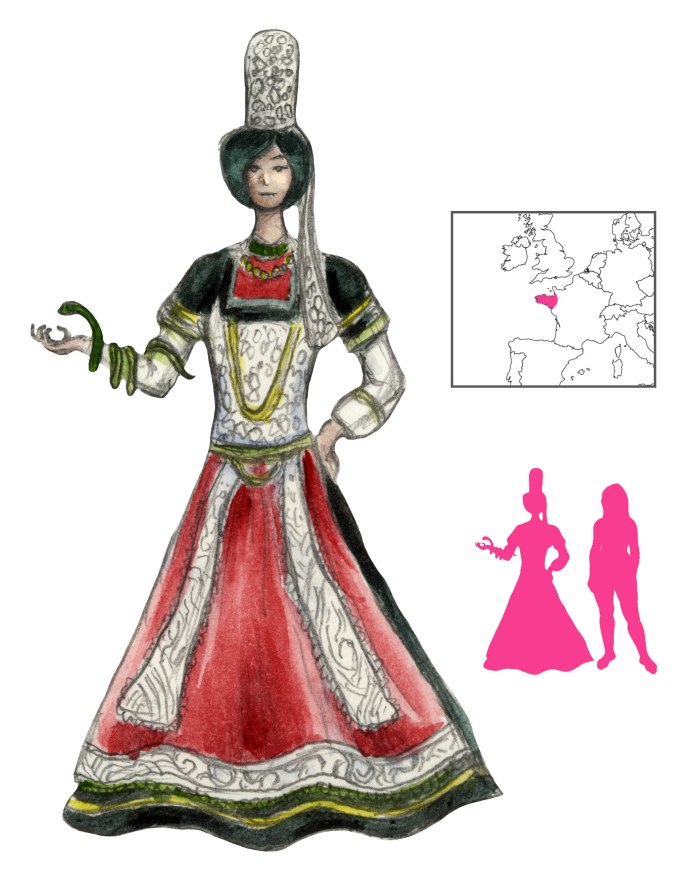
The Margot la Fée, “Margot the Fairy”, or more simply Margot, are fairies native to Brittany, particularly Collinée, Lamballe, Moncontour, and most of the Côtes-d’Armor. They are generally seen as benevolent and protective, but capable of deadly violence when provoked. The name of Margot – also used for magpies – is probably derived from Morgan or Morgana, as evidenced by the alternative name of Morgant; most local names are placatory terms of affection. Margot fairies are closely associated with megaliths, caves, treasures, and snakes, leaving the beaches to the Fées des Houles and the Groac’h.

Like most fairies, Margot fairies vary a lot in appearance, appearing as both young and old women as well as animals. They spend part of their time as snakes, both willingly and against their will, in which form they are most vulnerable. They possess considerable magical powers, dance in circles at night, haunt dolmens, swap babies with voracious changelings, and flee religious symbols.  Sometimes a Margot would take a fancy to a handsome young shepherd and choose to keep him in a cave for herself. In those cases time itself would seem to slow down, such were the pleasures that the fairy offered.

Margot fairies happily care for the livestock of their neighbors, even going so far as to feed them in the caverns while their owners were away. The Margot’s own livestock remained in the caves, emerging only to feed. On the other hand, hungry Margot fairies will tear a cow to pieces and devour it, only to restore it to life by the next morning, missing only any pieces that had been eaten by humans during the feast.

Margot fairies are often the guardians of fabulous riches. They will handsomely reward those who aid them, and punish any who take advantage of their generosity. If they tell you to take a certain amount of treasure and no more than that, you would be wise to follow their instructions to the letter. One man who took more gold from the Crokélien Hill fairies than he was instructed to had his son taken away from him, never to be seen again.

Other gifts of the Margot are more prosaic. They will offer piping hot loaves of bread to the hungry – loaves that never get smaller, no matter how many slices are cut from them. But if a piece is offered to someone else deemed unworthy by the fairies, the loaf will no longer regenerate.

Small acts of compassion are looked on with great favor. Two harvesters, resting after scything wheat, encountered a little grass snake eating the breadcrumbs they left behind. One tried to kill it, while the other stopped him, saying it would be wrong to kill a small, harmless animal. In the evening a Margot appeared to the second man and thanked him for protecting her daughter. She gave him two belts, one for him and one for his friend, telling him not to mix them up. His was of pure gold, while the other he tied to an oak tree, which wilted overnight.

Another man working near the hill of Crokélien encountered a Margot, who asked a favor of him. “Bring a large washtub with you”, she said, “and go to the Planchettes Bridge at sunrise. There you will find a grass snake. Put the washtub over it and sit on top. If anybody asks you why you’re there, tell them you’re waiting for the blacksmiths to fix the tub. At sundown, remove the tub, and you shall be richly rewarded for your help”. The man did as he was told, and sure enough, the snake was there at the bridge as the fairy had said. He covered it with the washtub and sat patiently there for the rest of the day, weathering the taunts and jeers of passers-by with aplomb. At sunset he removed the tub to find a beautiful maiden underneath. She was the Margot’s daughter, who transformed into a snake one day every year, and would have been killed had it not been for the man’s intervention. As promised, he never wanted for gold or silver for the rest of his life.

Human midwives will also be recruited by Margots to aid them in childbirth, gifting them with the power of second sight for the occasion. But woe to her if she let on that she could still see the fairies! A vindictive Margot would gouge her eye out, or spit in her face and blind her.

References

Dubois, P.; Sabatier, C.; and Sabatier, R. (1996) La Grande Encyclopédie des Fées. Hoëbeke, Paris.

Sébillot, P. (1887) Légendes Locales de la Haute-Bretagne: Les Margot la Fée. Maisonneuve et Ch. Leclerc, Paris.

Sébillot, P. (1904) Le Folk-Lore de France, Tome Premier: Le Ciel et la Terre. Librairie Orientale et Américaine, Paris.

Sébillot, P. (1905) Le Folk-Lore de France, Tome Deuxième: La Mer et les Eaux Douces. Librairie Orientale et Américaine, Paris.

Sébillot, P. (1906) Le Folk-lore de France, Tome Troisième: La Faune et la Flore. Librairie Orientale et Américaine, Paris.

Sébillot, P. (1968) Le folklore de la Bretagne. Éditions G. P. Maisonneuve et Larose, Paris.

Qiongqi

Variations: Thoroughly-Odd, Divine Dog

Qiongqi

Two versions of the Qiongqi, or “Thoroughly-Odd”, are described in the Guideways. The first variant of this Chinese creature is from Mount Gui, and resembles an ox with the quills of a hedgehog, and it howls like a dog. The second lives in the Land of the Demon People, and is a winged tiger. A third variety, referred to as a “divine dog”, is human with a dog’s head.

Qiongqi are carnivorous, and devour their prey head or feet first. They feed on people who wear their hair long, making them a particular threat to shamans and demons. They are evil creatures who devour the loyal and feed the rebellious, but they also eat insect poison.

Qiongqi has also appeared as the son of the thearch Lesser-Brilliance in Zuo’s Narratives, as the offspring of the Northern Desert Wind in Master of Huainan, and one of twelve divinities invoked in the Grand Exorcism.

References

Mathieu, R. (1983) Étude sur la mythologie et l’ethnologie de la Chine ancienne. Collège de France, Paris.

Strassberg, R. E. (2002) A Chinese Bestiary: Strange Creatures from the Guideways Through Mountains and Seas. University of California Press.

Ṣannāja

Variations: Ṣannājah, Ṣunnājah, Sannaja; Nubian Horse (erroneously)

Sannaja

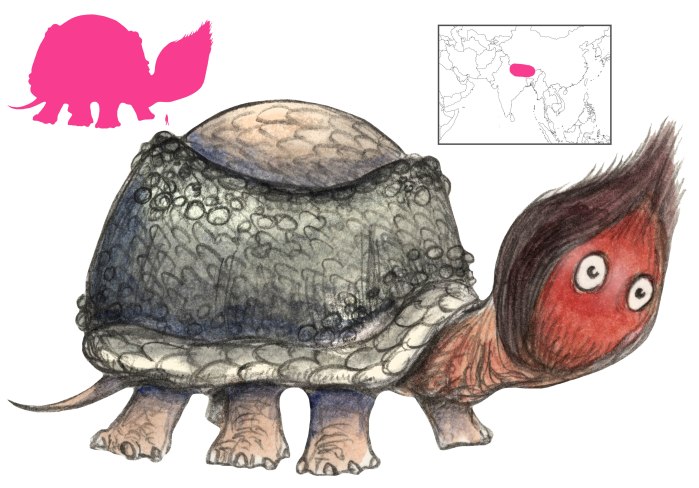
The Ṣannāja, “Cymbalist” (!), is a gigantic, deadly, yet pathetic creature originally described by al-Qazwini. It can be found in the land of Tibet, making it an abominable snowman of sorts, although it has more in common with the Gorgons of Greek myth.

According to al-Qazwini, the ṣannāja is indescribably vast, such that no animal can compare to it in size. This largest of all beasts makes dens one league wide.

Neither al-Qazwini nor al-Damiri describe its appearance, so artistic depictions of ṣannājas vary. As it is described in the same section along with insects and reptiles, the Wasit manuscript shows it with six stubby legs and a segmented, shelled turtle-like body. Its red, vaguely spiderish head is blank except for hair and two large, staring eyes. The artist of the C.1300 manuscript gives the ṣannāja a tusked, leonine head with massive, spotted folds of skin all over its body. A third is more cautious, assigning it the looks of a dragon. Finally, one Egyptian account is a ṣannāja in name only, placing it in African rivers and giving it four duck feet, a horse’s mane, water-buffalo skin, and a huge mouth. Described as the “Nubian Horse” living in water and ruining crops on land, this is the only case where the name has been applied to the hippopotamus.

The most distinctive quality of the ṣannāja is its deadly gaze, which nonetheless has a peculiar quality. Any animal that sees the ṣannāja dies instantly, but if the ṣannāja sees the animal first, it is the one to expire. Thus animals of Tibet come up to ṣannājas with their eyes closed, such that the monster will see them and drop dead, guaranteeing them a feast for weeks to come.

Accounts of mammoth fossils from Central Asia may have inspired the enormous ṣannāja. Traditional Tibetan art and kirttimukha faces may also have had a hand in its genesis.

References

Berlekamp, P. (2011) Wonder, Image, and Cosmos in Medieval Islam. Yale University Press, New Haven.

al-Damiri, K. (1891) Hayat al-hayawan al-kubra. Al-Matba’ah al-Khayriyah, Cairo.

Jayakar, A. S. G. (1908) Ad-Damiri’s Hayat al-Hayawan (A Zoological Lexicon), vol. II, part I. Luzac and Co., London.

Komaroff, L. and Carboni, S. (eds.) (2002) The Legacy of Genghis Khan. Yale University Press, New Haven.

Rapoport, Y. and Savage-Smith, E. (eds.) (2014) An Eleventh-Century Egyptian Guide to the Universe. Brill, Leiden.

al-Qazwini, Z. (1849) Zakariya ben Muhammed ben Mahmud el-Cazwini’s Kosmographie. Erster Theil: Die Wunder der Schöpfung. Ed. F. Wüstenfeld. Dieterichsche Buchhandlung, Göttingen.

Kamaitachi

Variations: Kama-itachi, Kamakaze (“Sickle wind”)

Kamaitachi

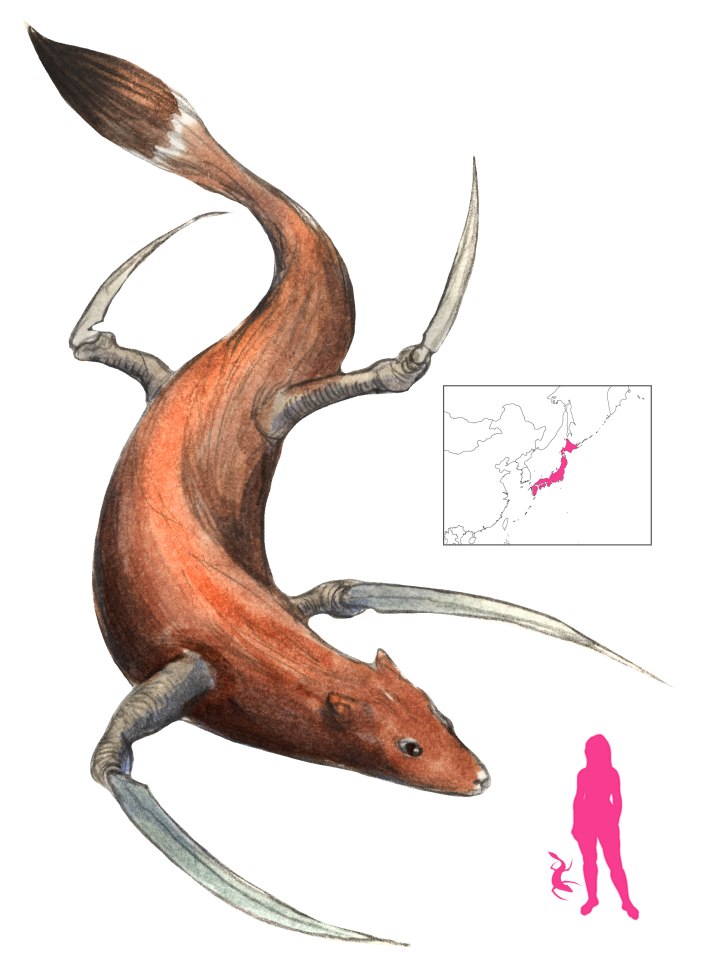
The Kamaitachi, or “sickle weasel”, is the Japanese yokai of unexplained cuts. It is most common in snowy Honshu. The name itself may be alternately derived from kamae-tachi, “poised sword”.

A kamaitachi looks something like a weasel with razor-sharp sickle claws. It travels in whirlwinds, but it is never seen. Instead, the presence of a kamaitachi is known by the cuts it leaves on its victims. It will also cause people to trip and fall, taking malign pleasure in causing injury.

Kamaitachi are useful scapegoats for inconvenient injuries. A woman in Niigata, after injuring herself during a nocturnal tryst, successfully deflected attention by blaming the kamaitachi for her wound.

The kamaitachi was rationalized in a number of ways, including pieces of sharp debris tossed around in whirlwinds. Y. Tanaka suggested that the “kamaitachi disease” was the result of temporary vacuums forming from stray air currents, slicing skin that came in contact with them. Such vacuums would be common in mountainous areas and thunderstorm conditions.

In Gifu the kamaitachi becomes three gods, the first pushing over the victim, with the second cutting with a knife and the third healing the injury.

References

Foster, M. D. (2015) The Book of Yokai. University of California Press, Berkeley.

Griffis, W. E. (1876) The Mikado’s Empire. Harper and Brothers, New York.

Y. Tanaka (1911) An Epitome of Current Medical Literature: Spontaneous Wounds. British Medical Journal, v. 2, p. 37.

Mantabungal

Mantabungal

The Mantabungal is known to the Tagbanua of Palawan, in the Philippines. It is found primarily in the forests of Mount Victoria in Baraki, and is the most feared of the mountain demons.

A mantabungal is like a cow in body and voice, but lacks horns. It has a long coat of shaggy hair that reaches the ground. Its monstrous mouth has two pairs of huge incisors – two above and two below – that it uses to tear its victims to shreds.

One man reported hearing bovine moos while gathering gum in the mountains. Spooked and disoriented in the darkness, he ran aimlessly into the forest as far as he could and spent the night shivering miserably under a tree. When he returned to camp, he found that the mantabungal had destroyed everything he had touched. His hut, gear, and even the firewood had been dismantled and chewed to bits.

References

Fox, R. B. (1982) Religion and Society among the Tagbanuwa of Palawan Island, Philippines. Monograph No. 9, National Museum, Manila.

Ramos, M. D. (1971) Creatures of Philippine Lower Mythology. University of the Philippines Press, Quezon.

Yamabiko

Variations: Yama-biko

Yamabiko

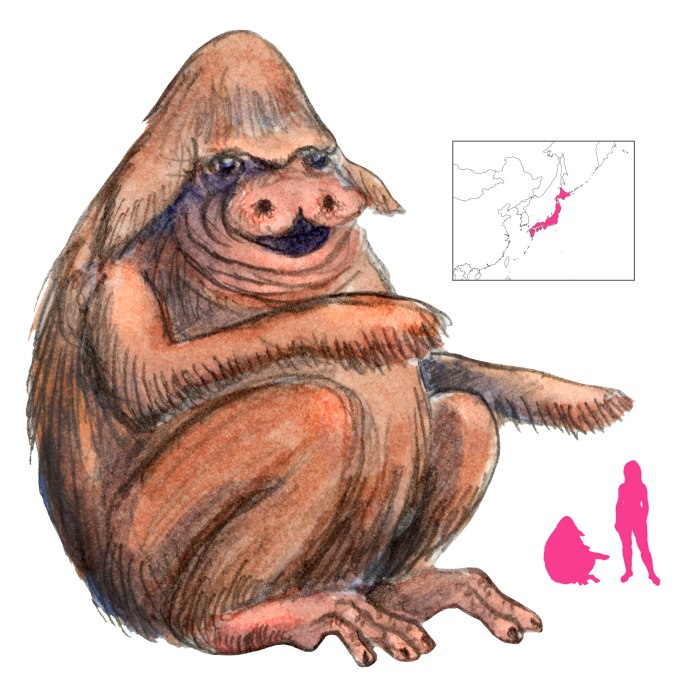
The Yamabiko, “mountain echo” or simply “echo” is heard rather than seen. It is found in the high mountains of Japan, and answers anyone shouting in the mountains with a mocking echo of their voice. While there is no definite version of its appearance, it was depicted by Toriyama Sekien as a rather simian creature.

Its name can also be interpreted as “spirit of valley reverberation”. It is not known if the yamabiko yokai was named for the echo, or if the echo was named for the yokai. The Yamabiko Shinkansen train, on the other hand, is named for the echo and not the yokai.

References

Foster, M. D. (2015) The Book of Yokai. University of California Press, Berkeley.

Jaculus

Variations: Iaculus, Jaculare; Sagitta (Latin); Acontia, Acontias, Saetta (Greek); Cafezati, Cafezasi, Altararat, Acoran, Altinanti (Arabic); Orchilanne (Turkish); Saettone (Calabria and Sicily); Ein Schosse Oder Angelsch Lang (German); Decurtati (Hungary)

Jaculus

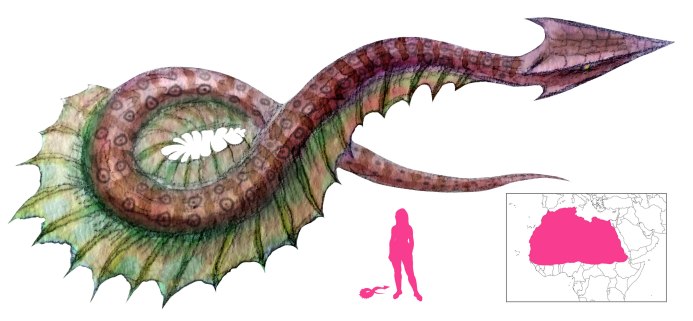
The Jaculus, “javelin” or “dart”, is one of the many snakes that attacked Lucan’s forces during their march through the Libyan desert. While catalogued as a Libyan desert snake, Topsell expanded its range to include Rhodes, Lemnos, Calabria, Sicily, Germany

It can be considered a flying snake, although the “flight” is long-distance leaping over ten to thirty feet. They get into trees and bushes, bunch themselves up in bow and hoop shapes, and fling themselves at high speed onto their prey. Traveling as fast as a thrown javelin, they can puncture clothing and flesh alike. Jaculi are cunning and cruel, and will lie in ambush for human prey, but their presence is given away by the noise they make while coiling in dry plants.

The appearance of the jaculus varies, but it usually has small black ocelli, no bigger than lentils, on its body. The jaculi of Rhodes are ash-colored with a white belly and two black lines running from its head to the tip of its tail; the cafezati or “jumpers” of the Middle East are red, and have been posited as the Biblical fiery serpents. The Hungarian jaculi or decurtati are thick and short-tailed, only two hands long.

A jaculus killed Paulus, one of Lucan’s men, by darting from a distance before it could be seen. It was not venom that felled its victim, but rather the gaping hole left behind after it passed through Paulus’ head at the temples. Topsell believed it was a jaculus that attacked the apostle Paul and bit his hand. Another such snake coiled around the arm of a Zurich peasant; even though it didn’t bite, the arm ended up putrefying and requiring yearly bleeding to drain the black blood inside.

Topsell attests that the same antidotes used for viper venom can be used for jaculus bites. He adds that jaculus gall with Scythian stone yields eye-salve.

References

Aelian, trans. Scholfield, A. F. (1959) On the Characteristics of Animals, vol. II. Harvard University Press, Cambridge, Massachusetts.

Aldrovandi, U. (1640) Serpentum, et Draconum Historiae. Antonij Bernie, Bologna.

Isidore of Seville, trans. Barney, S. A.; Lewis, W. J.; Beach, J. A.; and Berghof, O. (2006) The Etymologies of Isidore of Seville. Cambridge University Press, Cambridge.

Lucan, trans. Rowe, N. (1720) Pharsalia. T. Johnson, London.

Topsell, E. (1658) The History of Serpents. E. Cotes, London.

Usilosimapundu

Variations: Ugungqu-kubantwana, Ugunqu-kubantwana

Usilosimapundu

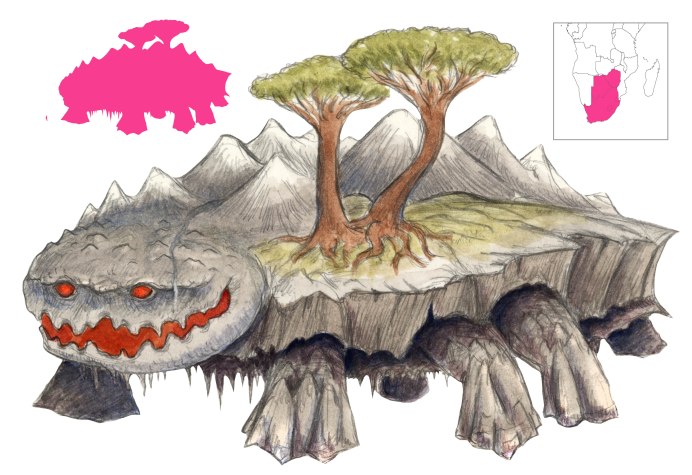
Usilosimapundu, “the rugose beast” or “the nodulated beast”, is a creature of superlatives. There are hills and mountains on his vast body, with rivers on one side, highlands on another, forests on the next, highlands and cliffs on other sides; he is so large that it is winter on one side of him and summer on the other. Two enormous trees, the Imidoni, serve as Usilosimapundu’s officers and servants. Usilosimapundu’s head is a huge rock, with eyes and a broad red mouth. He is a swallower, like many oversized African creatures, but also a force of nature, a personification of landslides and earthquakes.

The sorceress-princess Umkxakaza-wakogingqwayo (“Rattler of weapons of the place of the rolling of the slain”) was promised a great many cattle by her father the king, and the land was scoured for the finest livestock available. Unfortunately the very best cattle proved to be the property of Usilosimapundu. “Take them now”, he warned the soldiers, “but do not expect to get away with it”.

Umkxakaza was greatly pleased by her gift, and Usilosimapundu’s threat was forgotten as the years went by. That is, until the day the earth shook, and Usilosimapundu came to Umkxakaza’s doorstep. Two leaves detached from the Imidoni and took human form before heading for Umkxakaza and ordering her to do their bidding. They forced her to help prepare food for Usilosimapundu to eat – and eat he did, swallowing up everything in town. Finally Usilosimapundu had Umkxakaza climb onto his back, and he lumbered away with his trophy.

Of course, Umkxakaza’s father sent his armies to retrieve his daughter, but what good were the weapons of man against a living continent? Their spears landed in rocks, grass, ponds, trees – none of them had any effect on Usilosimapundu. Umkxakaza’s mother was the only one who continued to follow Usilosimapundu, and the beast obligingly gave her maize and sugarcane to eat while she hurried behind him, but eventually even the queen had to give up. She kissed Umkxakaza, weeping, bidding her to go in peace.

Usilosimapundu dropped Umkxakaza off in a fully furnished cave. “Your father spoiled me by taking my cattle”, he said, “so now I have spoiled him. He will never see you again”. With that Usilosimapundu left and was not seen again.

That was far from the end of Umkxakaza’s adventures, as she was abducted by the Amadhlungundhlebe half-men who fattened her up for eating. She escaped those new captors by summoning a storm, and made her way back to her father’s town, where she was greeted with joy and celebration.

Usilosimapundu has a female counterpart in Ugungqu-kubantwana, the mother of animals. Her name refers to the sound she makes when moving – gungqu, gungqu – rather like that made by a heavy wagon on a bumpy road.

References

Callaway, C. (1868) Nursery Tales, Traditions, and Histories of the Zulus. Trübner and Co., London.

Dwarf

Variations: Dvergr, Dvergar, Duergr, Duergar (Old Norse); Dvärgher (Old Swedish); Dweorg, Dweorh (Anglo-Saxon); Twerg (Old High German); Dökkalf, Dökkalfar, Svartalf, Swartalf, Svartalfar, Swartalfar (Dark Elf, Black Elf); Dverge (Norway); Bjergfolk, Troldfolk (Denmark); Dvärg (Sweden)

Dwarf

“Dwarf” is a broad term that has been used to describe any supernatural being of short stature, often stunted and ugly in form, and living under the earth. Here it is used to refer specifically to the Scandinavian dwarfs, the chthonic master craftsmen who emerged from Ymir’s corpse, the personifications of the earth’s might and riches. They are also known as Dark Elves or Black Elves, distinguishing them from the elves living on the surface.

When Odin and his brothers slew the frost giant Ymir, they used his body to make the world. From his blood they made the seas and rivers, from his flesh the land, from his bones the mountains, and from his teeth the stones. The vault of Ymir’s skull was the heavens, and fire from the land of Múspellheim became stars.

Living inside the ruin of Ymir’s body were maggots digging through his flesh. Odin gave them consciousness and human form, but, much like maggots, they continued their existence digging through earth and stone. Odin tasked four dwarfs – North, South, East, and West – with holding up Ymir’s enormous skull.

Dwarfs were twisted, hunchbacked, bearded, short-legged, pallid like corpses, shunning the sun – which turned them to stone. As there were no female dwarfs, they carved new dwarfs out of the rock. While small and ugly by the Aesir’s standards, they were also unequaled as artisans, smiths, and jewelers.

The greatest of the Aesir’s artifacts were made by dwarfs. After Loki cut Sif’s hair as a prank, the other gods forced him under penalty of death to restore her beauty. The trickster god went to the sons of Ívaldi, who not only fashioned perfect golden hair for the goddess, but also the ship Skídbladnir, and Odin’s spear Gungnir. Impressed with their work, Loki dared the dwarfs Brokkr and Sindri to do better, wagering his own head in the process. Despite Loki’s best efforts to stop them, which included turning into a fly and biting them at crucial moments, he was unable to prevent the creation of the golden boar Gullinbursti, the gold ring Draupnir, and Thor’s hammer Mjolnir. All those gifts were presented to the gods, who decided that the hammer was the greatest item made by the dwarfs. Brokkr made for Loki’s head, but was outwitted by the god. “I wagered my head only, and not my neck. You’re welcome to it – if you do so without touching my neck”. Frustrated, Brokkr settled for stitching the impertinent Loki’s lips together.

Dwarfs also made Gleipnir, the silken ribbon that was used to bind the Fenris-wolf. It was made from a cat’s footfall, a woman’s beard, a mountain’s sinews, a rock’s roots, a fish’s breath, and a bird’s spittle. The wolf was immediately suspicious of the fragile-looking thread, and the god Tyr had to put his hand in the wolf’s mouth to humor him. As expected, the dwarfs’ cord held fast and bound the Fenris-wolf, but at the cost of Tyr’s hand.

The dwarf Alvíss, the “all-knowing”, lusted after Thor’s daughter. The god consented to give him her hand in marriage, but only if he could answer the questions he asked. Thor then proceeded to ask Alvíss questions about the world and the universe, which the wise dwarf answered proudly. In fact, Alvíss was so engrossed in showing off his intelligence that he failed to notice the approach of dawn, and the unfortunate dwarf was turned to stone by the rising sun.

Known Eddic dwarf names include Ài, Àlfr, Althjófr, Alvíss, Andvari, Austri, Báfurr, Bifurr, Bömburr, Brokkr, Dáinn, Dólgthvari, Dóri, Draupnir, Dúfr, Durinn, Dvalinn, Eikinskjaldi, Falr, Fidr, Fili, Frosti, Fundinn, Gandálfr, Ginnarr, Glóinn, Hárr, Heptifili, Hledjólfr, Hörr, Hugstari, Ívaldi, Kili, Litr, Mjödvitnir, Módsognir, Náinn, Nár, Nidi, Nípingr, Nordri, Nóri, Nýi, Nýr, Nýrádr, Óinn, Ónarr, Óri, Rádsvidr, Rekkr, Sindri, Skáfidr, Skirfir, Sudri, Svíarr, Thekkr, Thorinn, Thróinn, Thrór, Váli, Vestri, Vídr, Vindálfr, Virfir, Vitr, and Yngvi.

References

Aldington, R. and Ames, D. trans.; Guirand, F. (1972) New Larousse Encyclopedia of Mythology. Paul Hamlyn, London.

Appenzeller, T. and the Editors of Time-Life Books. (1985) Dwarfs. Silver Burdett Company, Morristown.

Dubois, P.; Sabatier, C.; and Sabatier, R. (1992) La Grande Encyclopédie des Lutins. Hoëbeke, Paris.

Edwards, G. (1974) Hobgoblin and Sweet Puck. John Sherratt and Son, Altrincham.

Keightley, T. (1978) The World Guide to Gnomes, Fairies, Elves, and other Little People. Avenel Books, New York.

MacCulloch, J. A. (1964) The Mythology of All Races v. II: Eddic. Cooper Square Publishers, New York.

Sturluson, S. (1916) The Prose Edda. Humphrey Milford, Oxford University Press, London.