Barcädžy Calh

Variations: Wheel of Balsæg/Barsæg/Barsag/Balsag/Marsug/Father Ojnon, Thinking Wheel, Cutting Wheel

Wheel of Balsaeg

When Soslan or Sosryko, greatest of the Nart heroes, was born, his mother had him dipped in magical fire. The process rendered him immortal and invulnerable, but alas, the smith’s tongs had held him by the knees, which became his only weak spot.

After many adventures, Soslan was finally defeated by the jealous Syrdon. Aware of the hero’s weakness, Syrdon incited the devils to fire their arrows from below ground into his horse’s hooves. Like its master, the horse had only one weak spot, in this case the underside of its hooves.

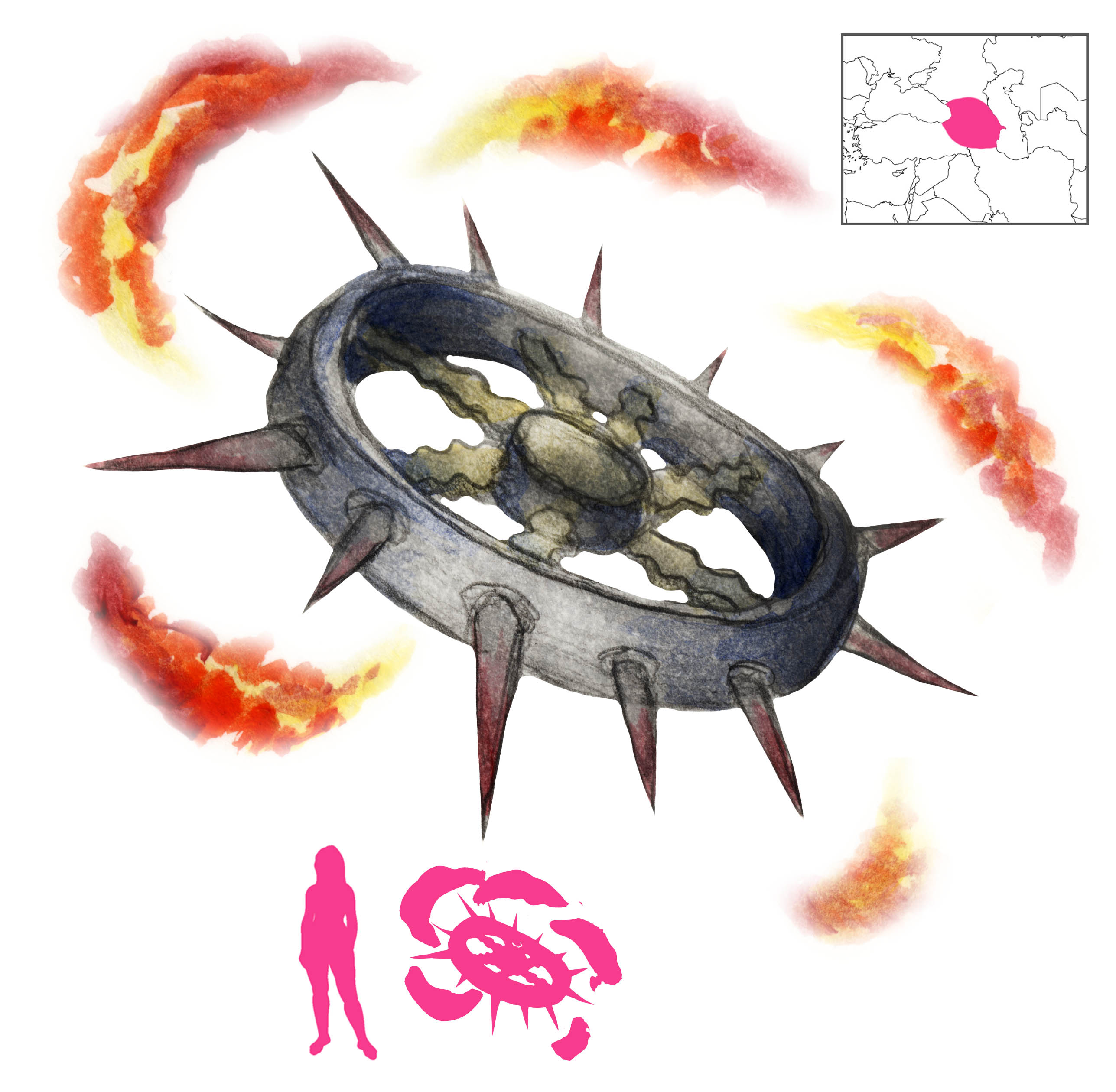
Once the horse fell, Syrdon called upon the enigmatic Barcädžy Calh, the Wheel of Balsæg or Cutting Wheel. The Wheel was a Thinking Machine, an intelligent and malevolent automaton that took the form of a razor-sharp metal wheel with steel teeth and flames bursting from it. It came rolling down from the heavens to the Earth, setting fire to plains and forests as it went on its headlong charge to the Black Sea. Only birch trees managed to avoid the flaming Wheel’s wrath. Soslan gave chase to it and captured it, but it escaped his grasp, flew at him, and sliced through his knees, leaving him for dead. The hero’s sons chased the Wheel back into the Black Sea, but it was already too late. The Narts buried him as he died; his last act from the grave was the impalement of Syrdon. Soslan’s nephew avenged him by breaking the Wheel in half.

Balsæg, also known as Barsæg, Marsug, and permutations thereof, remains unknown. Knowledge of his nature has been lost, save that he is the proprietor of the Wheel. In some accounts, the Daughter of the Sun sends the Wheel to kill Soslan; in others, it belongs to Father Ojnon – John the Baptist. It may have its origin as a solar symbol or accessory in solstice rituals. Finally, in some retellings the Wheel is reduced to a mere training discus, albeit a very sharp one. Soslan is tricked into bouncing it off his weak spot.

References

Cayla, F.; Quesnel, A.; Welply, M.; and Laverdet, M. (1997) Le guide illustré des mythes et légendes. Hachette, Paris.

Colarusso, J. (2002) Nart Sagas from the Caucasus. Princeton University Press.

Dumézil, G. (1978) Romans de Scythie et d’alentour. Bibliothèque Historique, Payot, Paris.

Littleton, C. S. (1979) The Holy Grail, the Cauldron of Annwn, and the Nartyamonga: A Further Note on the Sarmatian Connection. The Journal of American Folklore, vol. 92, no. 365, pp. 326-333.

Caladrius

Variations: Charadrius, Caradrius, Caladres, Kladrius, Icterus, Galgulus, Stone-curlew

Caladrius

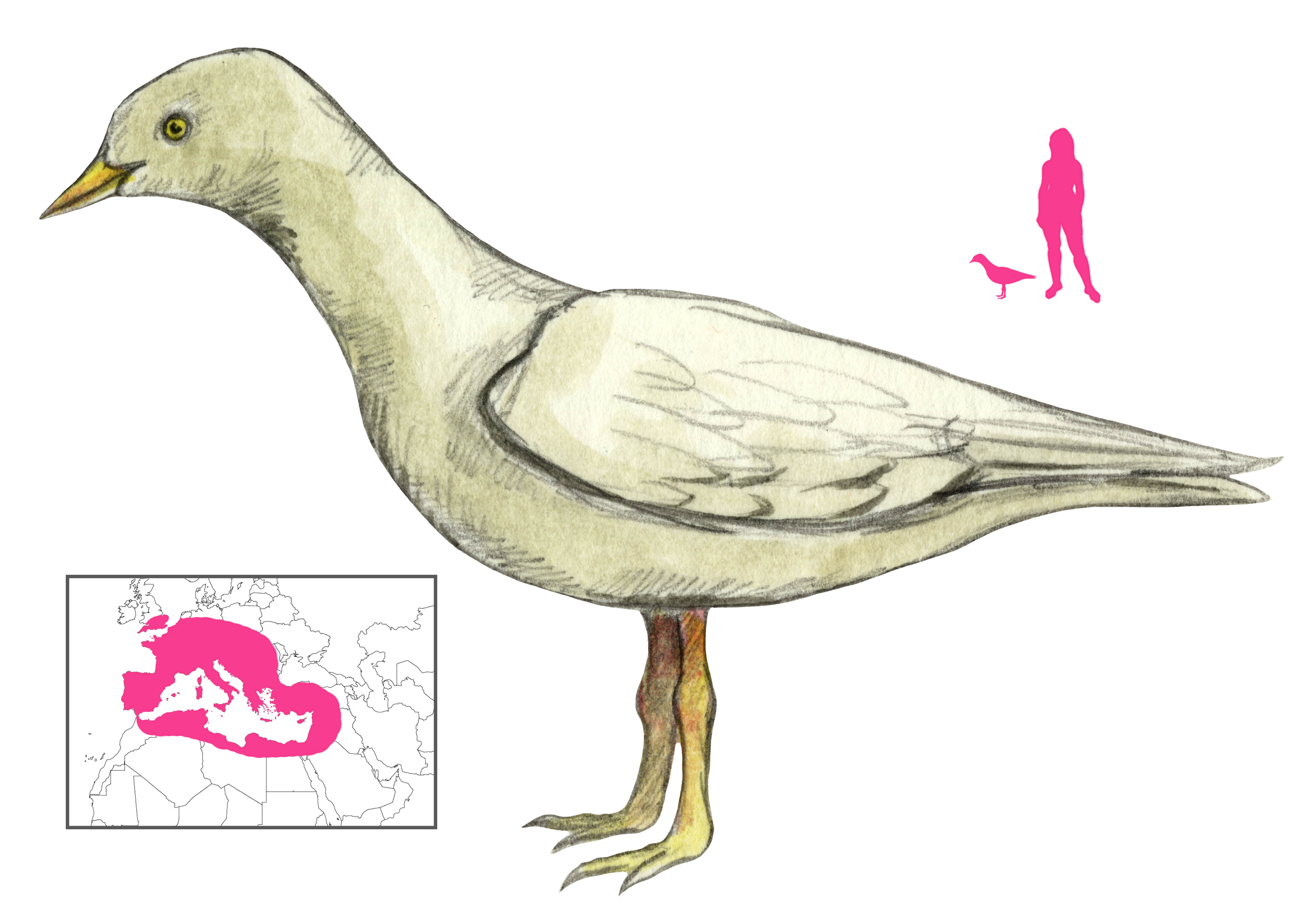
The Caladrius is a miraculous healing bird, believed to range from Europe to Jerusalem. It is generally believed to have originated from the stone-curlew, with other influences including seagulls, falcons, herons, ibises, owls, and any of a number of plovers (Charadriidae).

A caladrius is a waterbird the size of a hen or dove. It has immaculately white plumage, with a long neck, yellow eyes, beak, and legs, and rarely straight goat’s horns. Earlier accounts refer to it as being yellow, while others grant it reddish wings, spots, and a yellow-tinged dark color. It is an unclean bird and must not be eaten.

In its simplest form, the caladrius will cure jaundice by returning the stare of a patient who gazes intently at it. This connection to jaundice was inspired by the striking, staring yellow eyes of the stone-curlew. Its dung and the marrow of its thigh-bones will cure blindness.

A caladrius knows if a patient will live or die. It will look at someone who will be cured, and look away from someone doomed to die. Sometimes all it takes to be cured is touching the caladrius. The caladrius touches its beak to the patient’s mouth, taking disease and sickness into itself, and flies into the sky, where the sun burns the illness into oblivion.

This equates the pure and flawless caladrius with Christ, as it looks at and heals the faithful, granting them life, taking sins away in the process. The caladrius was iconographically represented in the role of a healer, sitting on the bedstead of a sick person and either looking to or away from the patient.

It was often kept in the court of kings for its curative powers. The sale of live caladrius was a potentially lucrative business, but merchants had to hide their specimens to avoid having people come in to see them and get cured for free.

References

Aelian, trans. Scholfield, A. F. (1959) On the Characteristics of Animals, vol. III. Harvard University Press, Cambridge, Massachusetts.

de Beauvais, P.; Baker, C. ed. (2010) Le Bestiaire. Honoré Champion, Paris.

Druce, G. C. (1912) The Caladrius and its Legend, Sculptured upon the Twelfth-Century Doorway of Alne Church, Yorkshire. Archaeological Journal, vol. 69, pp. 381-416.

del Hoyo, J.; Elliott, A.; Sargatal, J.; Christie, D.A.; & de Juana, E. (eds.) (2013) Handbook of the Birds of the World Alive. Lynx Edicions, Barcelona.

White, T. H. (1984) The Book of Beasts. Dover Publications, New York.

Wright, T. (1845) The Archaeological Album. Chapman and Hall, London.

Rukh

Variations: Rokh, Rukhkh, Roc, Ruc; Griffon, Griffin, Gryphon
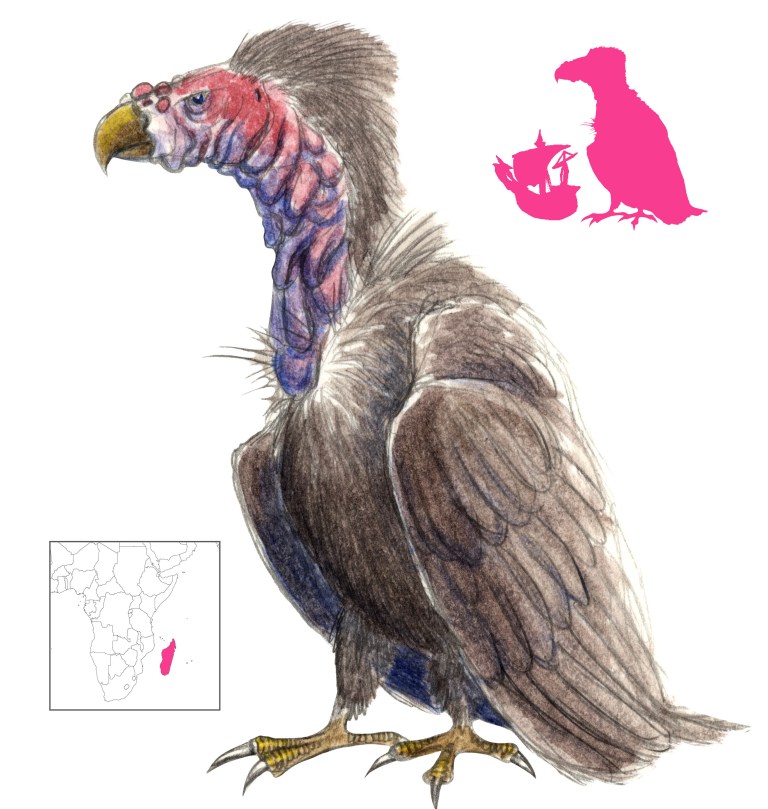
Rukh

The lineage of the Rukh (or, less correctly, Roc) is an ancient and venerable one, with tales of enormous birds stretching back into ancient Egypt. Generally believed to live in Madagascar (or possibly at the top of Mount Qaf), it is another iteration of the Arabian ‘Anqa, the Persian Simurgh, and the Indian Garuda and Cyena. The name rukh itself may have come about by a corruption of simurgh, which in turn came from cyena.

There is little defining the appearance of the rukh; it is a gigantic bird of prey, but what exactly that entails has varied from artist to artist. The only indisputable feature is that it is enormous. A rukh is as big as the storyteller needs it to be, leading to accounts of a hatchling rukh with wings a thousand fathoms (over 1800 meters) in length!

Rukhs are uncontested predators capable of feeding on the largest and most dangerous land animals. They have a particular fondness for giant serpents, elephants, and karkadanns or rhinoceroses. Sindbad observed that when a karkadann spears an elephant on its horn, the elephant’s fat runs into the rhino’s eyes and blinds it; a rukh will then swoop down and carry both combatants off to feed its chicks. Rukhs also appear to have some degree of intelligence, using boulders to smash prey.

The best-known interactions with rukhs were those of Sindbad the Sailor, who encountered them on his second and fifth voyages. The first time around, Sindbad found himself alone on a deserted island – not an uncommon occurrence in his life – and discovered a strange white dome, some fifty paces in circumference. As he pondered what the structure might be, the sky darkened as a huge rukh appeared. The dome was none other than its egg. Fortunately for Sindbad, it showed no interest in him as it sat on the egg and dozed off, and Sindbad tied himself to its leg with his turban, figuring that it might fly him to more civilized lands. In time the rukh awoke, screeched, and took off on the most terrifying ride of Sindbad’s life. When it finally landed he untied himself as fast as he could and ran for cover, while the rukh busied itself seizing a giant serpent in its talons and flying off with its prey.

Sindbad’s fifth voyage was even more catastrophic. This time, Sindbad’s crew went ashore without him and found the white dome of a rukh’s egg. Despite Sindbad’s warnings, they broke the egg and killed the chick inside. As they butchered the chick, the two parent rukhs appeared, their angry calls louder than thunder. When the sailors tried to flee in their ship, the birds returned with enormous boulders in their talons. The male’s rock narrowly missed the ship, but the female scored a direct hit, sinking the vessel. All sailors on board died with the exception of Sindbad, who drifted off towards further adventures.

In the tale of Aladdin, the evil necromancer attempts to convince Aladdin to demand a rukh egg to hang from the ceiling, a request which infuriates the genie. “You want me to hang our Liege Lady for your pleasure?” he roared, before informing them that such a wicked request could only have come from their enemy. In this case the author combined the rukh with the ineffably pure and holy simurgh.

Abd al-Rahman the Maghrebi, who had travelled far and wide across the world, obtained a rukh chick’s feather quill capable of holding a goatskin’s worth of water. He and his companions obtained it from a rukh chick that they cut out of an egg a hundred cubits long. The parent rukh flew after them and dropped a rock on their ship, but unlike Sindbad’s crew they successfully avoided it and went on their way. All those who had eaten the baby rukh’s flesh remained youthful and never grew old.

Ibn Battuta saw a rukh soaring over the China Seas. It was sufficiently far away to be mistaken for a flying mountain, and he and his companions were thankful that it did not notice them.

Marco Polo had the opportunity to observe rukhs on Madagascar; he believed them to be griffons, and specified that they were not half lion and half bird as he was led to believe, but simply enormous eagles. They had wings 30 paces long with feathers 12 paces long, and would pick up elephants and carry them into the air, dropping them onto the ground from great heights and feeding on the pulverized remains. A rukh feather was brought as a gift to the Great Khan, who was greatly pleased with it.

The rukh is not to be confused with al-Marwazi’s camel-like urine-spouting animal of the same name, described as zabraq by al-Mas’udi and as phalmant by Bochart. This grounded rukh may also be related to the rook chess piece, but both are far removed from the giant raptor.

The giant elephant bird Aepyornis of Madagascar, or its remains, was feasibly the origin of the rukh. It was, however, flightless, harmless, and non-elephantivorous. The rukh feathers that circulated as curiosities during the Middle Ages were fronds from the Madagascan Raphia vinifera palms.

References

Adler, M. N. (1907) The Itinerary of Benjamin of Tudela. Oxford University Press, London.

Bianconi, G. G. (1862) Degli scritti di Marco Polo e dell’uccello ruc da lui menzionato. Tipi Gamberini e Parmeggiani, Bologna.

Burton, R. F. (1885) The Book of the Thousand Nights and a Night, vol. V. Burton Club, London.

Burton, R. F. (1887) Supplemental Nights to the Book of the Thousand Nights and a Night, vol. III. Kamashastra Society, London.

Casartelli, L. C. (1891) Cyena-Simurgh-Roc: Un Chapitre d’Evolution Mythologique et Philologique. Compte Rendu du Congres Scientifique International des Catholiques, Alphonse Picard, Paris.

al-Damiri, K. (1891) Hayat al-hayawan al-kubra. Al-Matba’ah al-Khayriyah, Cairo.

Golénischeff, W. (1906) Le Papyrus No. 1115 de l’Ermitage Impérial. Recueil de Travaux Relatifs a la Philologie et a l’Archéologie Egyptiennes et Assyriennes, v. 12, pp. 73-112.

Kruk, R. (2001) Of Rukhs and Rooks, Camels and Castles. Oriens, vol. 36, pp. 288-298.

Payne, J. (1901) The Book of the Thousand Nights and One Night, vol. V. Herat, London.

Yule, C. B. (1875) The Book of Ser Marco Polo. John Murray, London.
Chonchón

Variations: Chonchon, Chonchoñ, Chon Chón, Chuncho, Chucho, Chuchu, Chaihue; Chonchones (pl.); Cocorote, Corocote (Venezuela); Cuscungo (Ecuador); Tecolote, Telocote (Mexico)

Chonchon

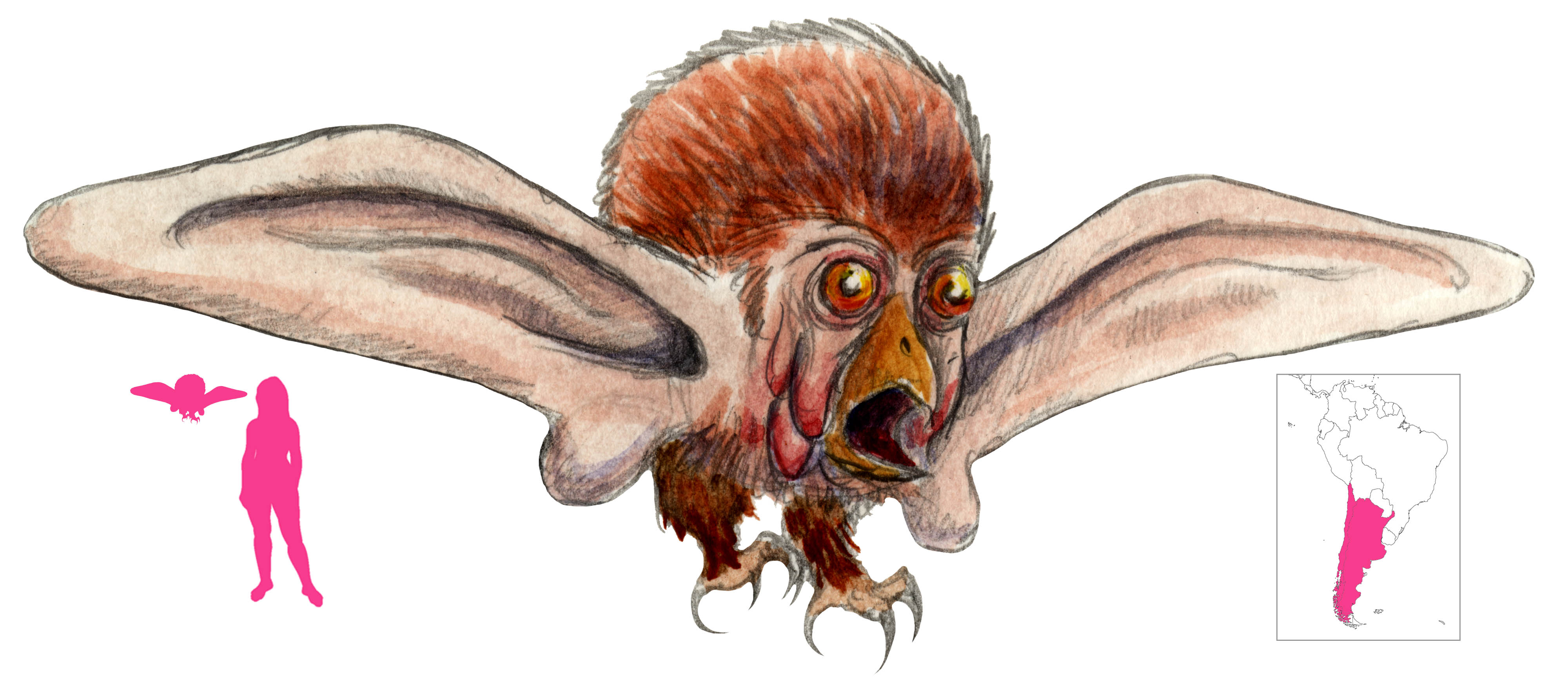
The Chonchón is a bird of ill omen from Chile and Argentina; it originally hails from Araucanian Mapuche folklore. Chonchón is also the name of a kind of kite.

In its simplest form it is a bird of the night, an owl (Strix rufipes) that flies on silent wings during the night to announce illness, death, or some other unwelcome event. When its croaking is heard it is advised to throw ash into the air and utter a few prayers in the hopes of turning away its evil.

The chonchón is also said to be a calcu or evil sorcerer in disguise. It resemble a human head, with oversized wing-like ears that allow it to fly. During the night, these sorcerers’ heads detach themselves from their bodies and fly around to cause mischief, invisible to most, their ominous tué, tué, tué call announcing misfortune. They have the same powers as sorcerers do, and have been known to suck the blood of sleepers.

In order to repel chonchones, several methods are recommended. These include drawing a Solomon’s seal on the ground, laying out a waistcoat in a specified manner, or reciting certain phrases or hymns such as the Magnificat, the Doce Palabras Redobladas, “Saint Cyprian goes up, Saint Cyprian goes down, Saint Cyprian goes to the mountain, Saint Cyprian goes to the valley”, or “Jesus goes ahead, follow him behind”. Doing any of these actions forces the chonchón to leave, or even fall to the ground where it can be destroyed. If the headless body of a chonchón sorcerer is found, turning it onto its stomach prevents the chonchón from returning to it. Finally, a more humane means of dealing with a chonchón is to yell “Come back tomorrow for some salt!” The next day, the chonchón in its human guise will show up and sheepishly request the promised salt. Except perhaps for the last method, most interference with the ways of chonchones will eventually incur the revenge of the chonchón or its friends.

One chonchón was reportedly grounded in Limache when someone made a Solomon’s seal, causing a large bird with red wattles to fall out of the sky. It was decapitated and its head fed to a dog, whose belly swelled up as though it had eaten a human head. Later the local gravedigger told that unknown persons had come to bury a headless body.

Not all chonchones are irredeemably evil, however. A Mapuche man in Galvarino once woke up early in the morning to find his wife’s body without her head. He immediately realized that she was a chonchón, and turned the body onto its stomach to prevent the head from reattaching. As expected, a chonchón soon flew heavily into the house, flapping and staggering as though blind. It then turned into a dog and whined pleadingly to be reunited with its body. The man took pity on it and allowed it to do so, and it became his wife once more. “Every night I leave, without you knowing, and visit distant lands”, she explained. She begged him not to tell anyone, and swore she would never harm him, and both kept their word; the story became known only after the wife died of natural causes.

Some authorities separate the chonchón from the chuncho, with the former being the sorcerous flying head and the latter the owl. Their calls are also different, with the chuncho hooting chun, chun, chun. They have further owl equivalents in the Venezuelan cocorote, the Ecuadorian cuscungos, and the Mexican tecolote. It is also compared to the myth of the voladora, a witch who flies while cackling loudly.

All this is quite unfair to the owls themselves, which benefit the farmers by eating mice, rats, and other vermin.

References

Aguirre, S. M. (2003) Mitos de Chile. Random House, Editorial Sudamericana Chilena.

Borges, J. L.; trans. di Giovanni, N. T. (1969) The Book of Imaginary Beings. Clarke, Irwin, & Co., Toronto.

Cifuentes, J. V. (1947) Mitos y supersticiones (3rd Ed.). Editorial Nascimento, Santiago, Chile.

Coluccio, F. and Coluccio, S. (2006) Diccionario Folklórico Argentino. Corregidor, Buenos Aires.

Rodríguez, Z. (1875) Diccionario de Chilenismos. El Independiente, Santiago.

Soustelle, G. and Soustelle, J. (1938) Folklore Chilien. Institut International de Coopération Intellectuelle, Paris.

Danghu

Variations: Danghu-bird

Danghu

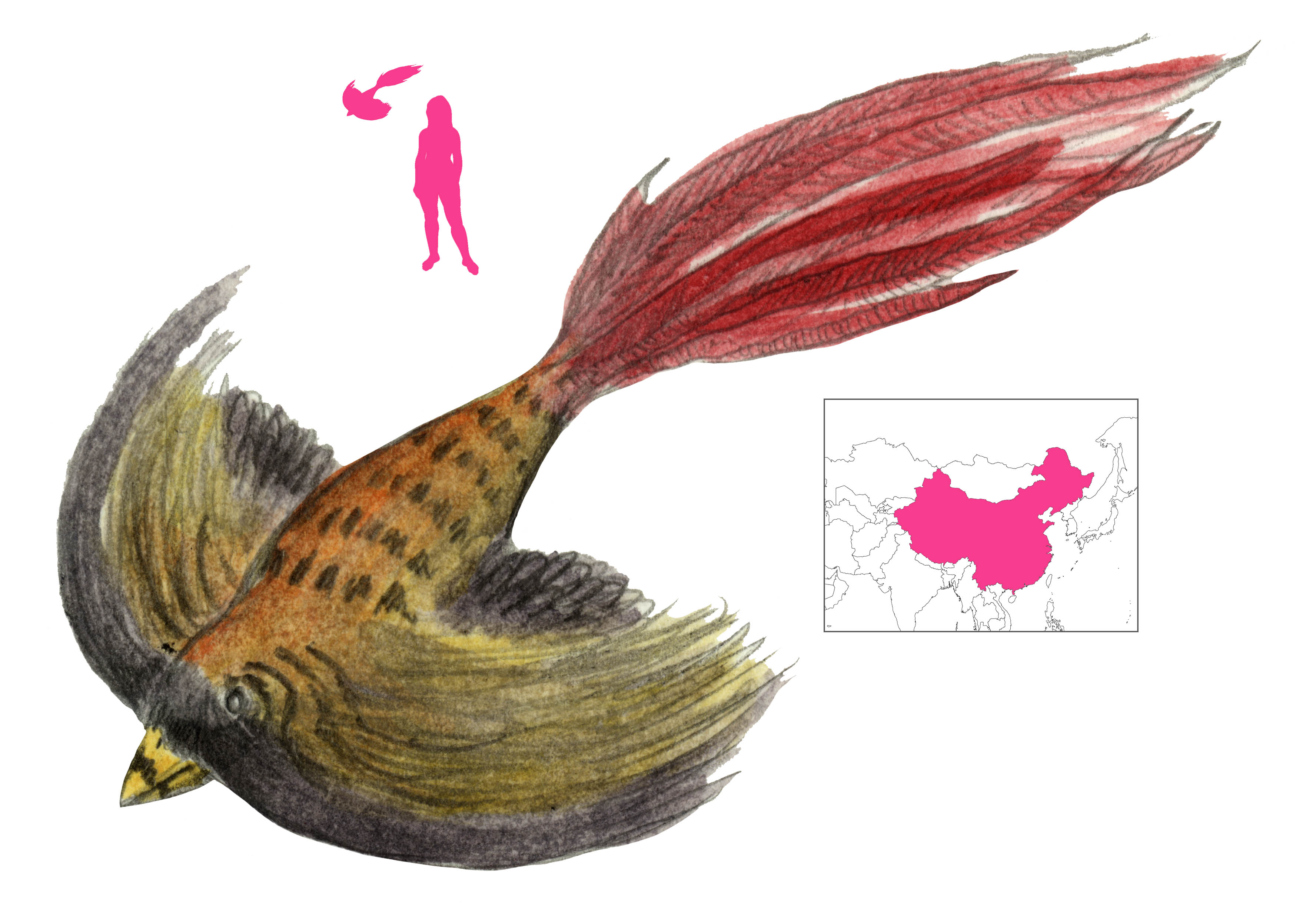
Upper-Shen Mountain or Shangshen is a rugged, rocky peak with no vegetation on it, but there are hazelnut groves at its base. There, Danghu birds can be seen flying from branch to branch. A danghu looks like a pheasant, but it flies using its hypertrophied whiskers and throat feathers. Consuming a danghu protects from and cures myopia. Guo Pu extolled the virtues of the danghu, using it as a metaphor for the economical mindset of Daoism as it makes do with what it has.

Mathieu suggests that this bird is the masked Japanese grosbeak (Eophona personata), which is nonetheless unwhiskered and unpheasantlike.

References

Mathieu, R. (1983) Étude sur la mythologie et l’ethnologie de la Chine ancienne. Collège de France, Paris.

Strassberg, R. E. (2002) A Chinese Bestiary: Strange Creatures from the Guideways Through Mountains and Seas. University of California Press.

Raiju

Variations: Raijū, Thunder-animal, Thunder-beast

Raiju

In Japan, it is said that lightning cannot pass through a mosquito-net – and neither can the Raiju. These creatures also hate the smell of incense.

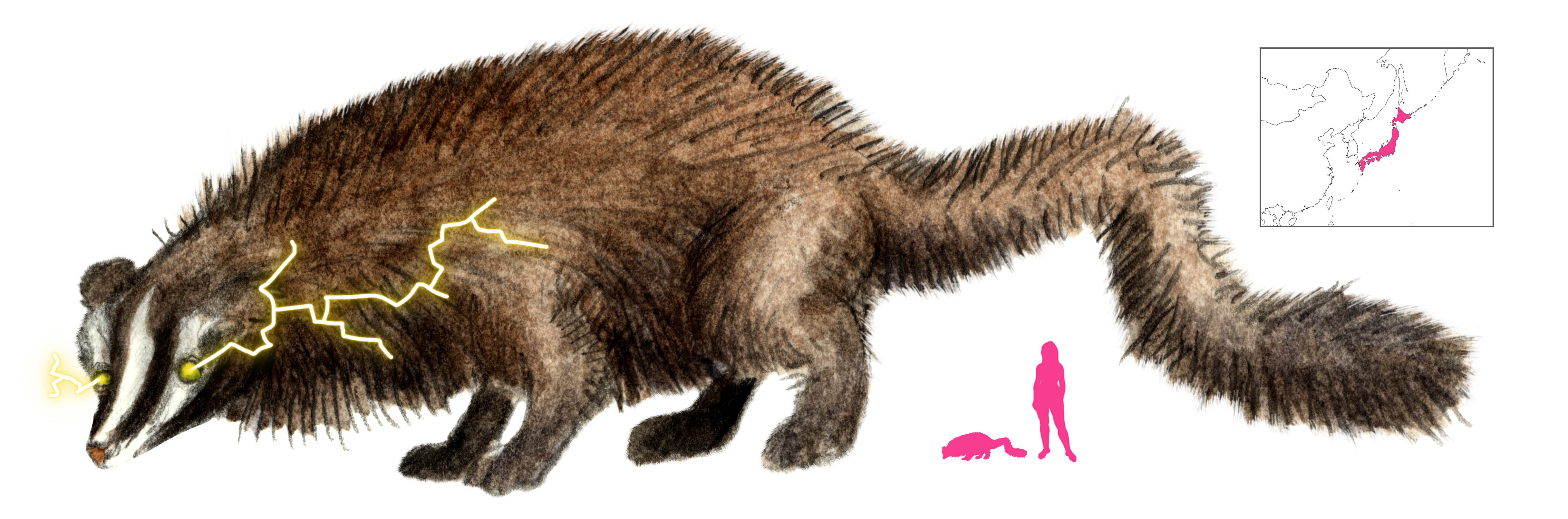
A raiju, or thunder-beast, ranges from dog to squirrel in general appearance, but usually resembles a badger. It falls from the sky with the lightning, and jumps from tree to tree. After the storm has passed, evidence of the raiju’s presence can be seen in the torn, deeply gouged treetrunks and woodwork where a raiju dug its claws in. Such raiju-damaged trees can be harvested for bark that cures toothache.

Raijus will pounce on anyone taking shelter beneath a tree, and will enter any house unprotected by mosquito netting or incense. They also love to eat human navels, and so it is vital to keep one’s navel protected during a thunderstorm, sleeping face-down if necessary.

Despite their elusive nature, raijus have been captured on multiple occasions. The Edo period in particular has many such cases across Japan, and it is believed the Chinese Bencao gangmu text was the inspiration for the raiju craze. One raiju got tangled in the ropes of a well and was taken alive. Another raiju was exhibited (for a fee) in a brass cage in the Temple of Tenjin in Matsue. It looked like a badger, and was said to sleep during fair weather, but during storms it would become active, with its eyes flashing.

The masked palm civet or hakubishin (Paguma larvata) is the most likely contender for the originator of the raiju. This badger-like animal was brought over to Japan from mainland Asia perhaps as early as the Edo period, its unfamiliar nature leading to tales of lightning beasts.

References

Foster, M. D. (2015) The Book of Yokai. University of California Press, Berkeley.

Hearn, L. (1910) Glimpses of Unfamiliar Japan (Second Series). Bernhard Tauchnitz, Leipzig.

Codrille

Variations: Cocadrille, Cocodrille, Coquadrille, Cocatris

Codrille

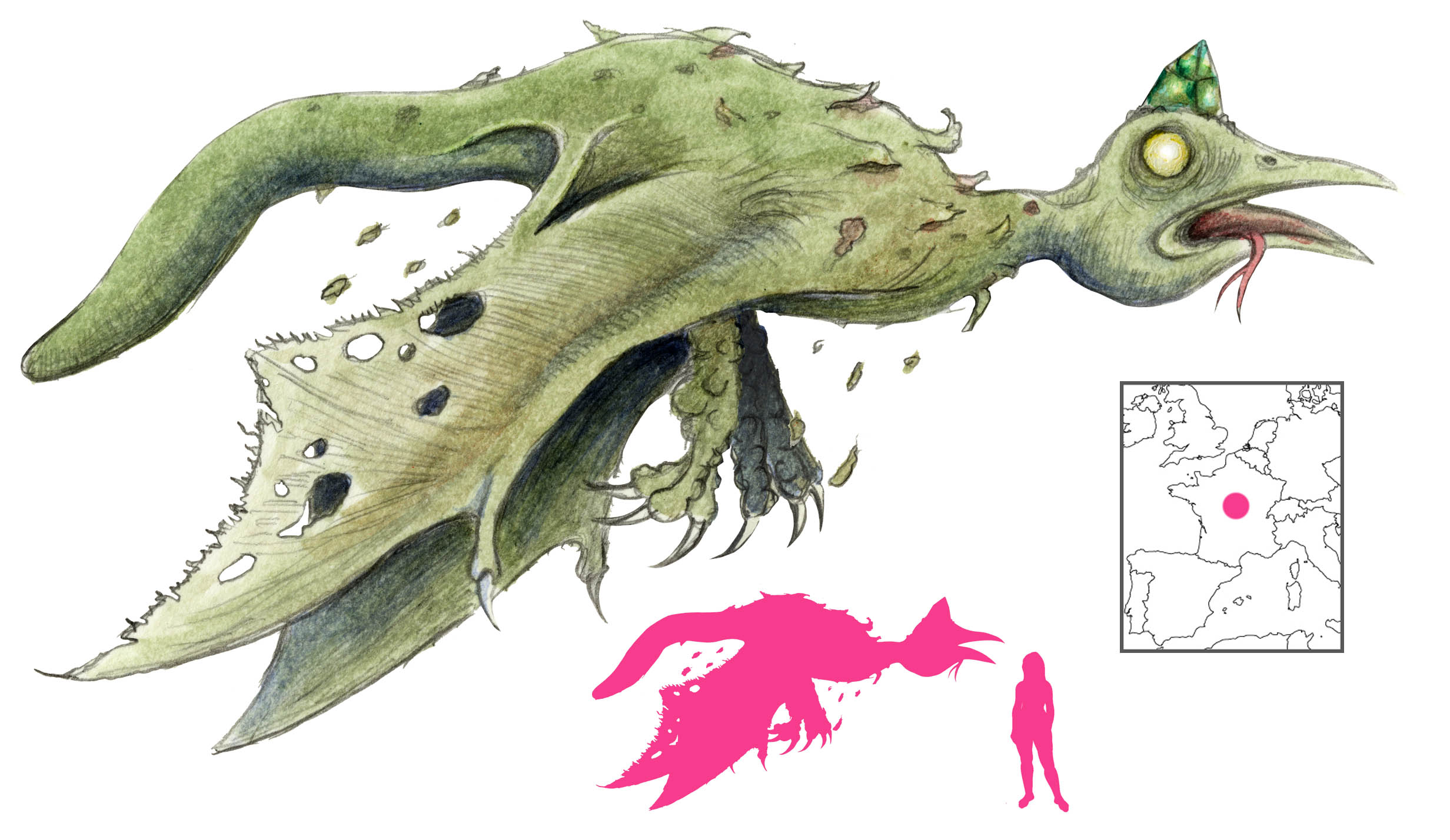
The Codrille, Cocadrille, or Codrille is a variety of basilisk or dragon native to central France, notably Berry, Maine, Poitou, Sologne, and Vendée. It combines features of basilisks and vouivres but without the redeeming aspects of either.

The name of the codrille was derived from the same etymological confusion that spawned the “cockatrice”. Starting with Crocodylus, the crocodile, practically a mythical creature in its own right, the name became progressively more garbled, becoming Cocodrillus, Cocodrille, Cocadrille, and Codrille. However, de la Salle derives it from coco and drille, meaning “rooster’s child”.

Unlike true basilisks, codrilles can grow to impressive size, becoming leathery-winged dragons at the last stage of their life cycle. The “crown” characteristic of basilisks manifests in the form of a brilliant gem on top of the codrille’s head. Codrilles can kill merely by looking at their victims, and emit an aura of disease and plague.

A codrille’s life is a complicated succession of metamorphoses. It hatches from a yolkless egg laid by a rooster, and incubated by the heat of the sun or of manure. To prevent those eggs from hatching, one must plant sprigs of ash in potential codrille breeding grounds. This should be done on the first day of May. Having other roosters around also helps, as they will devour the offspring of a codrille.

The codrille starts out its life as a very long, string-like snake. It is capable of killing right out of the egg – anyone who cracks a codrille egg and is seen by the newborn codrille dies instantly, but if they see the snake first, it dies instead. After a while, the juvenile codrille sprouts legs and becomes a salamander. During this stage of its life it will still die if seen first by humans, so it hides in deep wells, ruined tombs, and the masonry of houses, bringing bad luck to everyone living there and whistling ominously at night. It can debilitate a bull merely by crawling under it.

At the end of seven years the codrille reaches the adult stages. It grows spectacularly, sprouts wings, and metamorphoses into an enormous dragon. It spreads its wings and migrates towards the Tower of Babylon, breathing death and pestilence along its way. Its passage in the air dims the sun, and epidemics and plagues follow in its wake.

References

Sainéan, L. (1921) L’histoire naturelle et les branches connexes dans l’oeuvre de Rabelais. E. Champion, Paris.

de la Salle, L. (1875) Croyances et légendes du centre de la France, Tome Premier. Chaix et Cie., Paris.

Sébillot, P. (1906) Le Folk-lore de France, Tome Troisième: La Faune et la Flore. Librairie Orientale et Américaine, Paris.

Alicanto

Alicanto

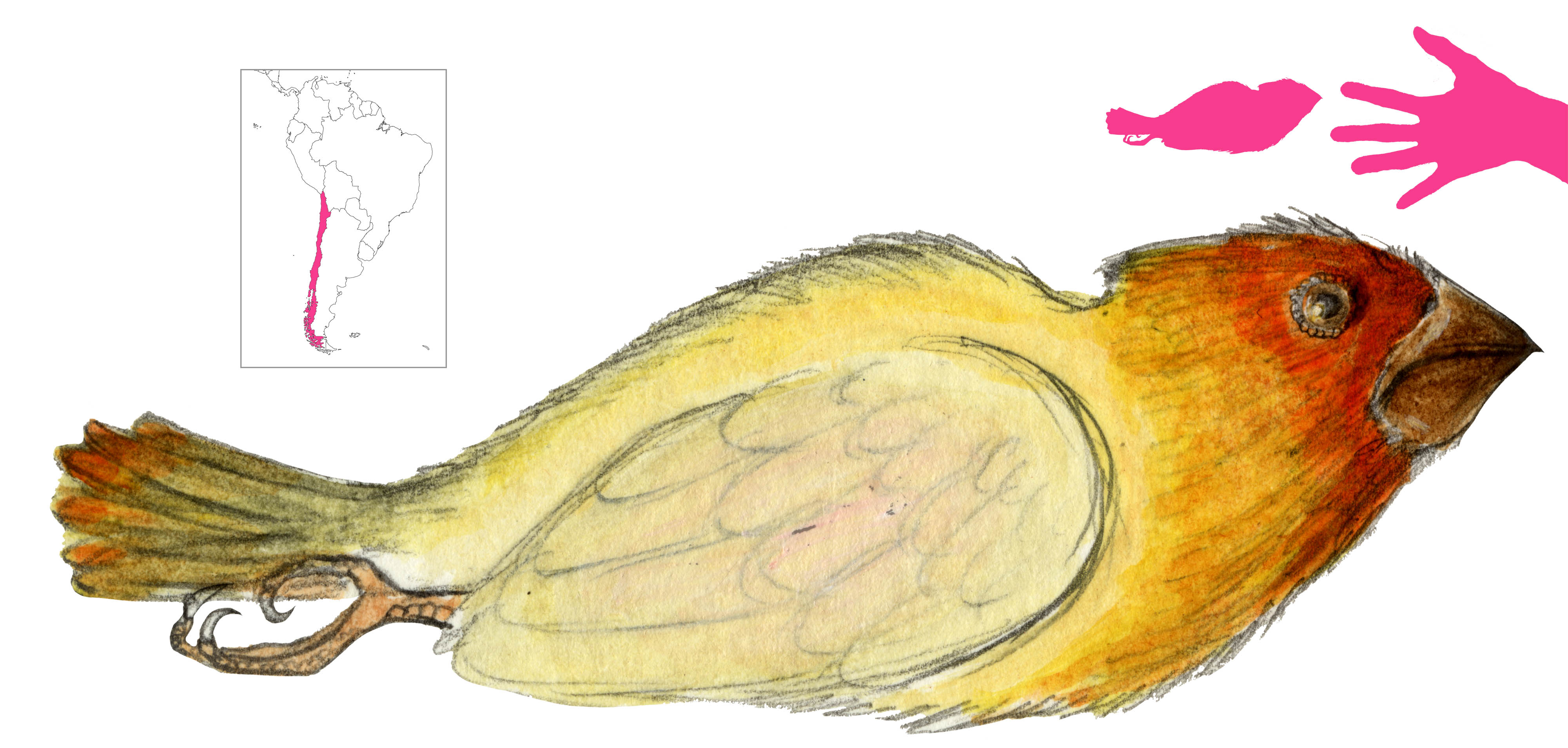
The Alicanto is a glowing nocturnal bird comparable to the Carbuncle, perhaps sharing the same folkloric origin. It is  known to inhabit Chile, and has been reported from Atacama, San Bernardo, Santiago, Talagante, and Tarapacá.

Alicantos feed exclusively on metal ores, and take on the color of the metal they ingest – a gold-eating alicanto emits a golden light, while the silver-eating variety glows a cold metallic gray. The rare copper-eating alicanto is greenish, with large wings, a hooked beak, long legs, and sharp claws. Due to its phosphorescence, an alicanto does not cast a shadow. The eyes are bright and gleam silver.

These birds are flightless, but their wings are perfectly functional. They will often gorge themselves on metal, filling their crop so much that they cannot fly. At best they run fast with their wings held open; a full alicanto can barely drag itself along the ground.

Alicantos live around mines and hidden treasure, and nest in small caves. The female always lays two eggs, the shells of which are made of the metal she eats.

As an alicanto indicates the presence of precious metal, finding one can be highly lucrative. For that reason they are sought out by prospectors, engineers, miners, and unscrupulous looters hoping that the birds will lead them to rich veins. However, an alicanto is highly protective of its food sources, and if it knows it’s being followed, it will stop glowing and disappear into the darkness – or worse, lead its pursuers to a cliff.

References

Aguirre, S. M. (2003) Mitos de Chile. Random House, Editorial Sudamericana Chilena.

Cifuentes, J. V. (1947) Mitos y supersticiones (3rd Ed.). Editorial Nascimento, Santiago, Chile.

Tsenahale

Variations: Tse’nahale, Tse’na’hale, Tsanahale

Tsenahale

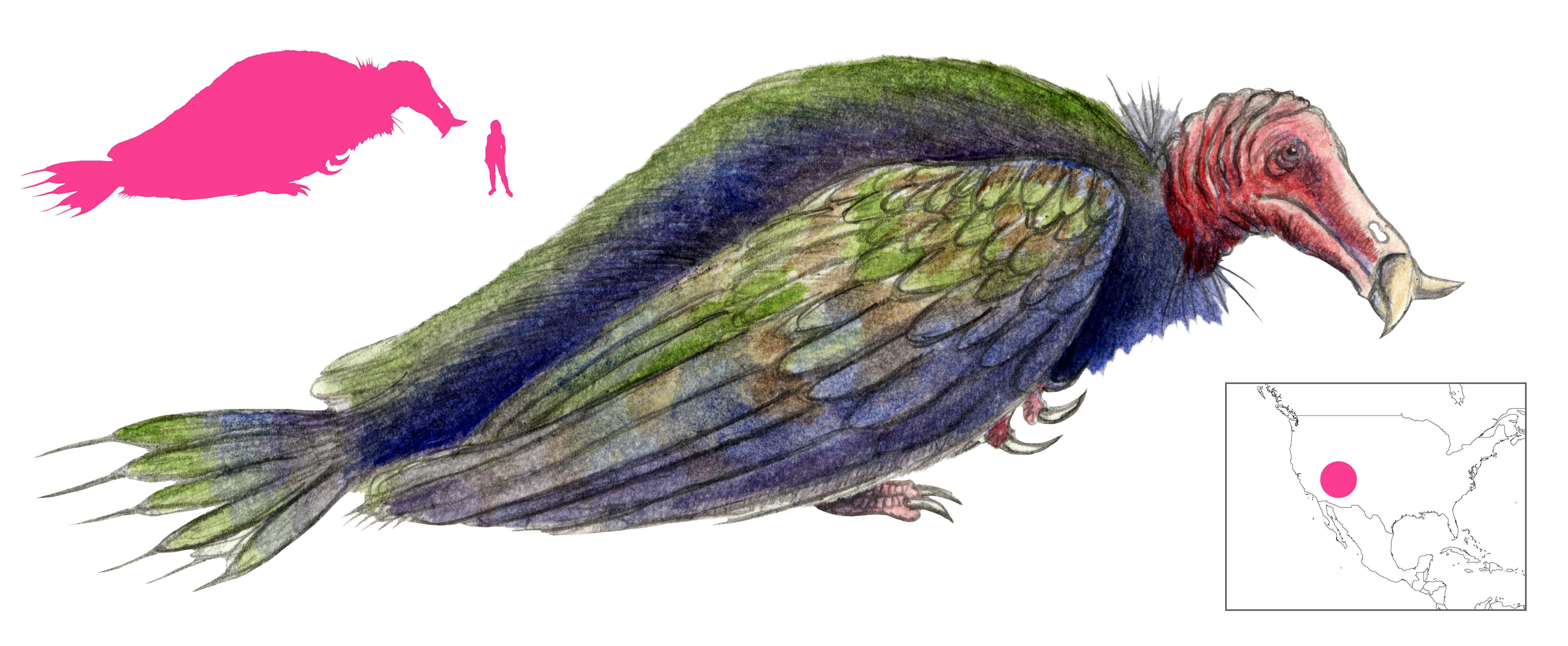
The Tsenahale were two of the Anaye, or “Alien Gods”, who plagued the land of the Navajo. They were born after men and women were separated, and the women resorted to unnatural practices as an outlet. In the case of the Tsenahale, the “father” was a pile of feathers; their mother must have been particularly desperate.

When the first Tsenahale was born, it was a misshapen creature with feathers on its back and shoulders. Its mother abandoned it in horror, but it survived and grew into a monstrous, bird-like creature likened to a huge eagle or a harpy. By the time Nayenezgani, the “Slayer of Alien Gods”, set out to rid the land of the Tsenahale, the Tsenahale were two in number, male and female. The male preyed solely on men, while the female hunted women. Raven was their spy.

Nayenezgani found the nest of the Tsenahale on Tse’bit’ai, the “Winged Rock”, or Shiprock as it is also known. As he approached, the male Tsenahale dive-bombed him, his huge wings whipping up a whirlwind as he swooped at him from four different directions. He seized him in his talons on the fourth attempt. The bird flew off with him and dropped him into the nest from a great height, but Nayenezgani was protected by his life-feather, and was unharmed. He cut open a bag of Teelget’s blood and let it spill, convincing the Tsenahale that he was safely dead.

As the two Tsenahale chicks approached him, Nayenezgani tried to silence them. “It’s not dead! It said ‘Sh!’ to us!” they screeched. “That’s air leaving the body. Just eat it”, snapped the father, before winging off.

Of course, Nayenezgani miraculously came back to life as soon as the Tsenahale was gone, and confronted the chicks. They were blue as a heron, with big eyes and sharp eagle beaks. “When will your father return?” asked Nayenezgani. “When we have a thunderstorm, he will be on that rock”, answered the chicks. “And your mother?” “When we have a rain shower, she will be on that crag”.

Soon a great storm formed, with thunder and lightning, and the male Tsenahale flew out of the clouds and perched on the rock as expected. Nayenezgani slew him with a single lightning arrow. Then the mother arrived in pouring rain, carrying with her a dead Pueblo woman in beautiful turquoise finery. Nayenezgani shot her in turn.

“What about us?” cried the chicks. “Are you going to kill us?” But Nayenezgani spared them. “You are not grown, and would grow into killers; but I will make something useful of you”. He picked the older chick up and told it “You will provide feathers for rites, and bones for whistles”. He swung it around four times and threw it into the air, turning it into a majestic eagle. Then he picked up the younger chick, telling it “Your voice will tell the future; sometimes you will lie, sometimes you will tell the truth”. He swung it as well, and it turned into an owl, which he threw into a crevice in the cliff.

As for the feathers of the Tsenahale, Nayenezgani took the largest from each wing as trophies. The others were plucked, and were metamorphosed into sparrows, warblers, chickadees, wrens, and all the little birds of the world.

References

Alexander, H. B. (1916) The Mythology of All Races v. X: North American. Marshall Jones Company, Boston.

Locke, R. F. (1990) Sweet Salt: Navajo folktales and mythology. Roundtable Publishing Company, Santa Monica.

Matthews, W. (1897) Navaho legends. Houghton Mifflin and Company, New York.

O’Bryan, A. (1956) The Diné: Origin Myths of the Navaho Indians. Bulletin 163 of the Smithsonian Institution, Washington, D. C.

Duphon

Duphon

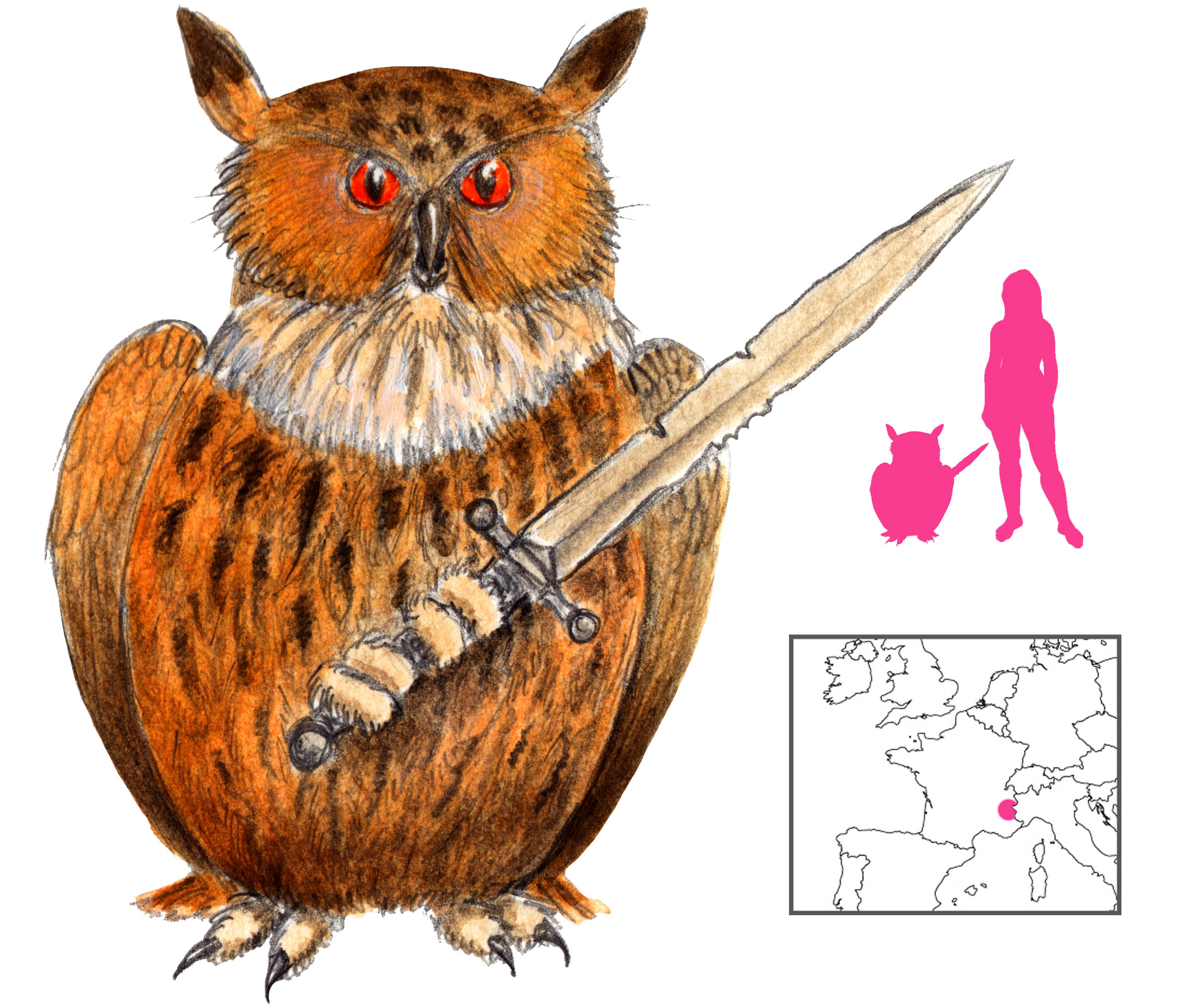
Eagle-owls are impressive animals. As the largest owls, they are top predators in their environments, even feeding on other birds of prey. Their size and eerie calls have ensured them a place in the folklore of many cultures.

It should then be unsurprising that the eagle-owl has been reinterpreted as a supernatural creature. The Duphon can be found in the Hautes-Alpes region of France, where it braids horse manes, pinches young women, and causes mischief and mayhem. The town of Serres preserves a duphon lair in the form of a stone door and ruined ramparts, known as the Trou du Duphon (“The Duphon’s Hole”).

References

van Gennep, A. (1948) Le folklore des Hautes-Alpes, Tome II. J. P. Maisonneuve et Cie, Paris.

del Hoyo, J.; Elliott, A.; Sargatal, J.; Christie, D.A.; & de Juana, E. (eds.) (2013) Handbook of the Birds of the World Alive. Lynx Edicions, Barcelona.

Ladoucette, J. C. F. (1848) Histoire, topographie, antiquités, usages, dialectes des Hautes-Alpes. Gide et Cie, Paris.