Làlomèna

Variations: Làlimèna

Lalomena

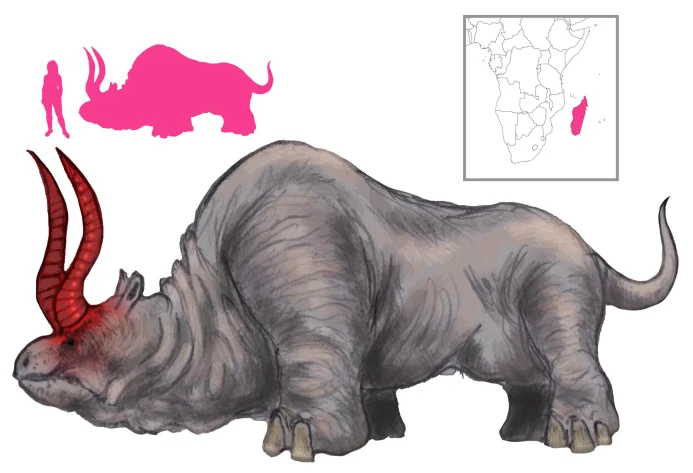
The Làlomèna is found in the waterways of Madagascar. It has two very red horns and looks like an ox. It is among the strongest of aquatic animals, but little more is known of its appearance and attributes.

Sub-fossil remains of Madagascan hippos have been referred to as làlomèna bones.

References

Sibree, J. (1896) Madagascar Before the Conquest. Macmillan, New York.

Chemosit

Chemosit

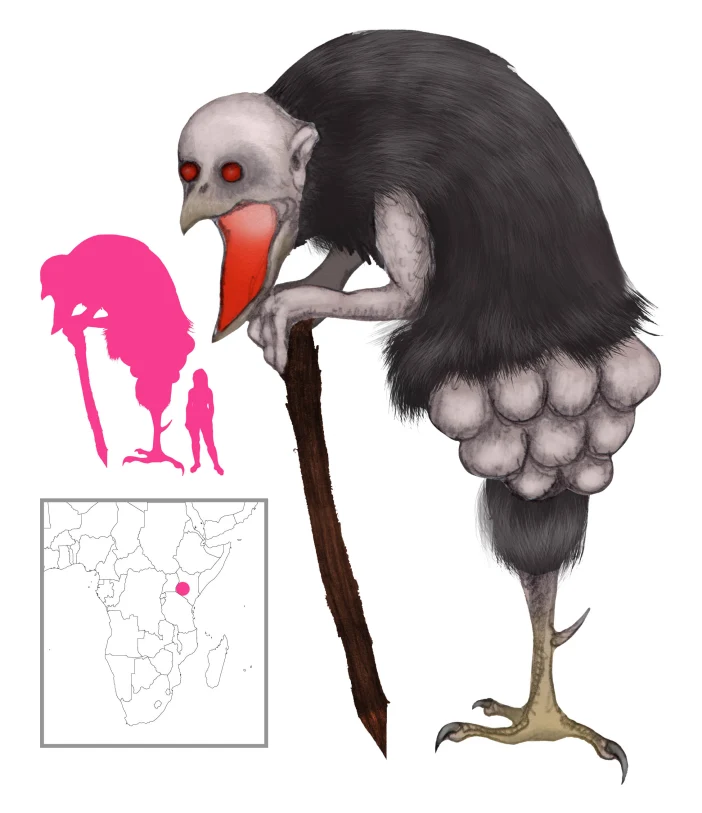
Chemosit is a demonic bogey that prowls the lands of the Nandi in Kenya. Half man, half bird, Chemosit stands on a single leg and has nine buttocks. Its mouth is red and shines brightly at night like a lamp. A spear-like stick serves as a means of propulsion and as a crutch.

People are Chemosit’s food, but it loves the flesh of children above all else. At night it sings a song near places where children live, its mouth glowing in the darkness. Unwary children seeing the light and hearing the song believe it to be a dance. They head out into the night to find the party and are never seen again.

References

Hollis, A. C. (1909) The Nandi, their Language and Folk-lore. Clarendon Press, Oxford.

Tsetahotsiltali

Variations: Tse’tahotsiltali, Tse’tahotsilta’li, Tse’dahidziqa’li, Tse’daxodzi’ltali, Kicker, Kicking Monster

Tsetahotsiltali

Tsetahotsiltali, “He [who] Kicks [people] Down the Cliff”, was among the many Anaye or “Alien Gods” slain by Nayenezgani. As with the rest of his brood, he was born from a human woman who, in the absence of men, had resorted to other means of stimulation.

Tsetahotsiltali was born at Tse’binahotyel, a high, wall-like cliff. He had no head, with only a long pointed end where the head should be. His mother, disgusted at the monster she had borne, put him in a hole in the cliff and sealed it with a stone. Tsetahotsiltali survived anyway.

As he grew, Tsetahotsiltali’s hair grew into the rock, anchoring him fast. He sat in place next to a well-beaten trail, his legs folded up, and anyone who passed by would be immediately kicked and sent tumbling down the cliff. Tsetahotsiltali’s children waited at the base of the cliff to dismember the offerings their father sent down. With three types of fruiting cactus growing nearby, a steady stream of victims was guaranteed. His spy was the turkey vulture.

That was where Nayenezgani found him. The hero followed the trail to the top of the high cliff, and beheld his enemy, much like a man in shape. Tsetahotsiltali was leaning back inoffensively, pulling at his whiskers, but Nayenezgani kept his eye closely on him as he walked past. Sure enough, Tsetahotsiltali kicked out suddenly, but Nayenezgani dodged the kick easily. “Why did you kick at me?” he asked the monster. “Oh, my grandchild”, said Tsetahotsiltali innocently, “I was tired and just wanted to stretch my legs”. Four times Nayenezgani passed by, and four times Tsetahotsiltali missed. Then the hero grabbed his stone knife and struck Tsetahotsiltali above the eyes, stabbing over and over until he was sure the monster was dead. But the body remained attached to the cliff, the thick cedar-root-like hairs holding it fast, so Nayenezgani had to chop through these as well before Tsetahotsiltali’s went tumbling down the same way his many victims had.

Immediately Nayenezgani heard a cacophony of squabbling voices. “I want the eyes!” “The liver’s mine!” “Give me an arm!” The sound of Tsetahotsiltali’s children fighting over their father’s body was a grim reminder of the fate Nayenezgani had escaped. The hero found another trail to the base of the cliff and beheld Tsetahotsiltali’s twelve hideous children, their father’s blood still streaming from their mouths. Only the bones and scalp of Tsetahotsiltali were left. Disgusted, Nayenezgani slew most of that vile brood. The survivors were spared, exiled, and, depending on the narrative, may have been transformed into Rocky Mountain sheep, owls, box turtles, or birds of prey.

Nayenezgani took Tsetahotsiltali’s scalp as a trophy and planted seeds in the surrounding area.

References

Locke, R. F. (1990) Sweet Salt: Navajo folktales and mythology. Roundtable Publishing Company, Santa Monica.

Matthews, W. (1897) Navaho legends. Houghton Mifflin and Company, New York.

O’Bryan, A. (1956) The Diné: Origin Myths of the Navaho Indians. Bulletin 163 of the Smithsonian Institution, Washington, D. C.

Reichard, G. A. (1950) Navaho Religion: A Study of Symbolism. Bollingen Foundation Inc., New York.
Issitôq

Issitoq

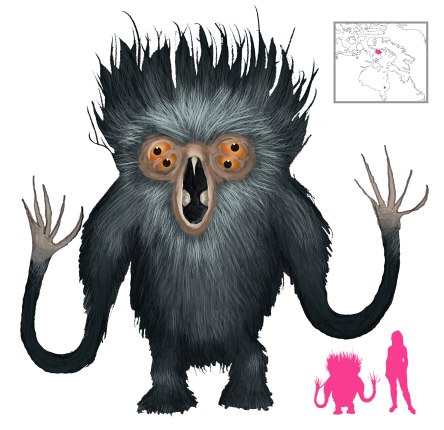
Issitôq, “giant eye”, is a gloomy helping spirit that appeared to the Iglulik Inuit mystic Anarqâq. As Anarqâq had just lost his parents, Issitôq consoled him. “You must not be afraid of me; I, too, struggle with sad thoughts, so I will go with you and be your helping spirit”.

Issitôq has short bristly hair that stands straight up. Each of its eyes is in two sections. Its mouth is vertical, with a single long tooth at the top and two shorter ones at the side. It specializes in finding taboo-breakers.

References

Rasmussen, K. (1929) Intellectual Culture of the Iglulik Eskimos. Glydendalske Boghandel, Nordisk Forlag, Copenhagen.

Guiamala

Variations: Ghiamala

Guiamala

The Guiamala is found in the African kingdoms of Gadoua and Giaca (or Gadda and Jaka), east of the kingdom of Bambuk. It is a huge animal, taller than an elephant but not as bulky, and capable of moving swiftly. It is a sort of camel, having a long neck, a camel-like head, and a dromedary’s hump or two on its back. Its legs are incredibly long to allow it to stand over 20 feet tall. For defense the guiamala is equipped with seven straight, pointed horns, each about two feet long. The horns are black, covered with tawny hair and a black point. The hair falls off after the horn has grown to a certain length. The hooves are cloven like an ox’s.

Guiamalas are not picky eaters, and will eat thorns and other low-quality browse. They also eat very little, allowing them to survive in arid areas. They are docile and harmless and could feasibly make good pack animals. Their flesh is edible and tender.

References

Delisle de Sales, J. C. (1769) Dictionnaire Theorique et Pratique de Chasse et de Pesche. J. B. G. Musier, Paris.

Labat, J. B. (1728) Nouvelle Relation de l’Afrique Occidentale, t. IV. Pierre-Francois Giffart, Paris.

Bifang

Variations: Bifang-bird

Bifang

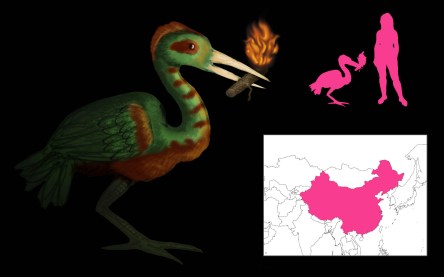
The Bifang can be found on barren Mount Zhang’e in China. It looks like a crane but has only one leg; it has a white beak and red markings on a green background. Its call sounds like its name.

A bifang is an omen of inexplicable fire starting in town. This is probably connected to its red color. It was not always an evil omen, however, as it appears as a benevolent attendant of the Yellow Thearch in the Master Hanfei, and is the divine essence of wood in the Master of Huainan.

Some sources have the bifang itself as the arsonist, using fire it carries in its beak. Mathieu equates it with the Chinese crane, whose habit of standing on one leg may have inspired the bifang’s appearance.

References

Mathieu, R. (1983) Étude sur la mythologie et l’ethnologie de la Chine ancienne. Collège de France, Paris.

Strassberg, R. E. (2002) A Chinese Bestiary: Strange Creatures from the Guideways Through Mountains and Seas. University of California Press.

Wingoc

Variations: Wing (obsolete), Wingocak (pl.), Wingwak (pl.)

Wingoc

The Wingwak are the Algonquian spirits of sleep. A wingoc appears as a somniferous fly or butterfly, with greater numbers appearing to bedevil people into sleep (they typically show up five per person). The term wingoc is also used for sleep; compare ingwac, to be sleepy, and ingwam, to sleep.

A man playing in the sky once fell through a hole to land on Earth. There he found people sleeping, and one man sleeping more than the others. The heavenly visitor fashioned himself a small bow and arrows and started shooting at the clouds of flies above the sleeper. With some of the wingwak killed and others set to flight, the sleeper awoke. The celestial man then imparted his wisdom to the Algonquians, warning them of the arrival of the bearded men who would be the end of their race.

Expressions include ni nisigok wingwak (“the wingwak kill me”, i.e. “I am overwhelmed with sleepiness”) and wingwak ondjita manek (“there are so many wingwak”, i.e. “everyone’s asleep”).

References

Chamberlain, A. F. (1900) Some Items of Algonkian Folk-Lore. The Journal of American Folklore, 13(51), pp. 271-277.

Cuoq, J. A. (1886) Lexique de la Langue Algonquine. J. Chapleau et Fils, Montreal.

Lemoine, G. (1909) Dictionnaire Francais-Algonquin. G. Delisle, Chicoutimi.

Pira-nu

pira-nu

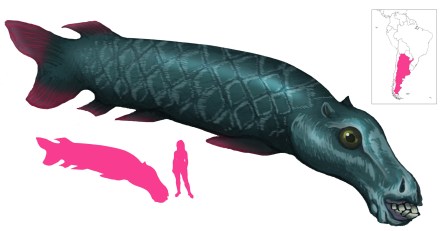
The Pira-nu, “black fish”, is born in old timber canoes lost in the rapids. This Argentinian fish is of great size, with a horse-like head and big eyes. It swims at the surface of the water to capsize canoes, and it quickly devours humans and livestock that have fallen into the water.

References

Ambrosetti, J. B. (1917) Supersticiones y Leyendas. La Cultura Argentina, Buenos Aires.