Tçaridyi

Variations: Tcaridyi, Tharidi

tcaridyi

Tçaridyi, “Hot” or “Burning” is one of the children of Ana, sired unnaturally by the King of the Loçolico as a spouse for Tçulo. As one of the Roma demons of disease, she torments humanity to this day.

Tçulo proved to be more troublesome than expected, persecuting even his own sister Lilyi. To distract him, Melalo told his father to conceive a wife for the little urchin. What the King used to induce Tçaridyi’s conception is unknown, but it probably involved worms of some kind.

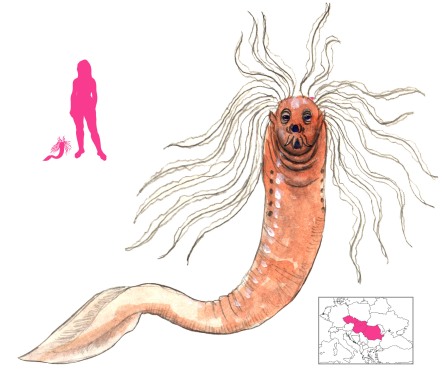
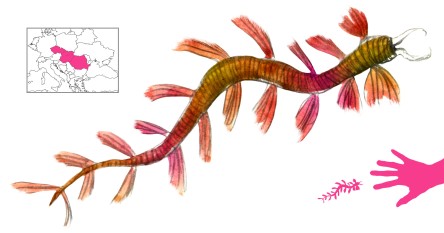
Tçaridyi herself takes the form of a little hairy worm or caterpillar. She only infests women, slithering through their arteries and veins. The long hairs on her body detach as she moves, causing fever and inflammation, especially puerperal fever. Her union with Tçulo produced women’s diseases; otherwise, Tçulo and Tçaridyi torture humans but rarely kill them.

References

Clébert, J. P. (1976) Les Tziganes. Tchou, Paris.

Clébert, J. P.; Duff, C. trans. (1963) The Gypsies. Vista Books, London.

Meyers Brothers Druggist (1910) Demons of Disease. Meyers Brothers Druggist, v. 31, p. 141.

Pavelčík, N. and Pavelčík, J. (2001) Myths of the Czech Gypsies. Asian Folklore Studies, v. 60, pp. 21-30.

Odontotyrannus

Variations: Arine Hayant Le Tirant, Arine Qui Het Le Tirant, Armez Hayant Le Tirant, Dentem Tyrannum, Dentirant, Dentityrannus, Dent Tyrans, Odentetiranno,  Odontatyrannum,  Odontatyrannus, Odontetiranno

odontotyrannus

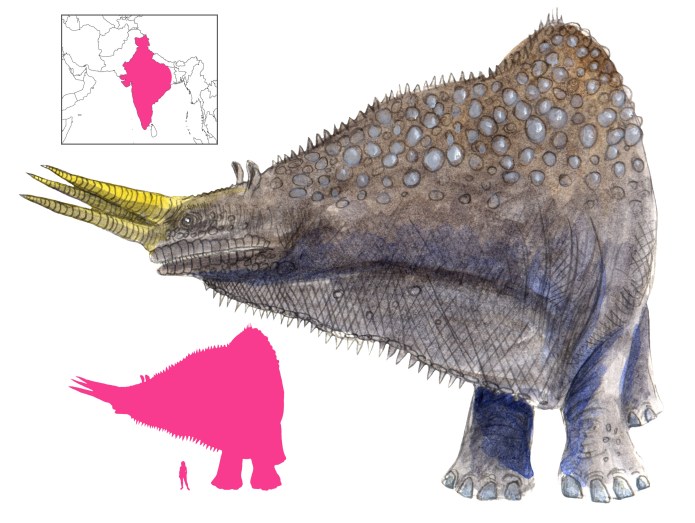
The Odontotyrannus is a massive beast found in the rivers of India, whose account has been told as one of Alexander the Great’s many exploits. Its name apparently means “tooth tyrant”, but medieval reading errors led to a variety of increasingly awkward alternate names and direct translations.

When Alexander and his men made camp by a river, they were found by an odontotyrannus coming to the water to drink. It was enormous, large enough to swallow an elephant whole, and black in color, or otherwise with a head black as pitch. It had three horns on its head. When it saw the Macedonians, it went on a rampage, killing 26 and injuring 52 of the soldiers before it was brought down by Emendus, Duke of Arcadia.

The rhinoceros is a certain candidate as the progenitor of the odontotyrannus, as is the crocodile. Confusion with Indus worms – Indian, armed with two terrible teeth, and capable of swallowing prey whole – may have led to the name, as nowhere in its description are teeth ever mentioned.

References

Wauquelin, J., Hériché, S. ed. (2000) Les Faicts et les Conquestes d’Alexandre le Grand. Librairie Droz, Geneva.

de Xivrey, J. B. (1836) Traditions Tératologiques. L’Imprimerie Royale, Paris.

Tçulo

Variations: Tculo, Thulo

tculo

Tçulo is the third child of Ana, Queen of the Keshalyi. As with his siblings before and after him, he is a vile demon of disease with no redeeming features, and originated from the machinations of the evil King of the Loçolico to impregnate his wife. Their stories are told in Roma folklore.

Eventually, the King realized that he could only make love to his wife while she was asleep, and Melalo was more than happy to oblige with soporific vapors. But Melalo himself was procreating with Lilyi, bringing more diseases and ailments into the world, and the King grew jealous of his son’s brood. On the other hand, Melalo found that he could not sire powerful demons, and hoped that his mother could produce a race of evil beings strong enough to destroy humanity. Following Melalo’s advice, the King ate a stag beetle and a crayfish before visiting Ana. Tçulo was the result.

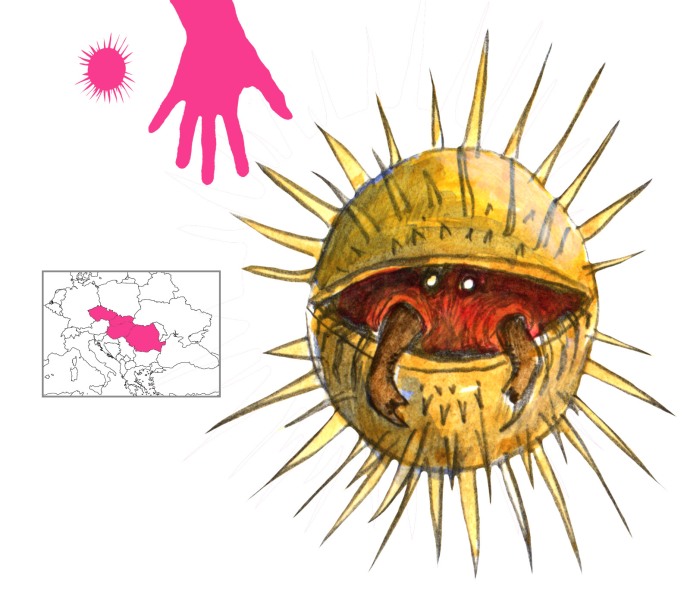
Tçulo, “Thick” or “Potbellied”, is little more than a small ball full of spikes. He enters human bodies and rolls around within the intestines, causing severe abdominal pains and colic. He particularly targets pregnant women, and even his big sister Lilyi was tormented by him. It was this behavior that led to the conception of Tçaridyi, Tçulo’s own sister-wife. Both of them caused pain but rarely death, and their offspring were all women’s diseases.

References

Clébert, J. P. (1976) Les Tziganes. Tchou, Paris.

Clébert, J. P.; Duff, C. trans. (1963) The Gypsies. Vista Books, London.

Meyers Brothers Druggist (1910) Demons of Disease. Meyers Brothers Druggist, v. 31, p. 141.

Pavelčík, N. and Pavelčík, J. (2001) Myths of the Czech Gypsies. Asian Folklore Studies, v. 60, pp. 21-30.

Last time on the Making of ABC, I discussed the importance of following a breadcrumb trail of references back to its source. This implies a significant amount of scholarly research. But I don’t want to discount another major source of creature discovery; namely, serendipity*.

Sometimes you don’t find the creature, but it is the creature that finds you. And for creatures to find you, you have to do a lot of reading of books both digital and physical, a lot of exploring in libraries and bookstores old and new. And I’m not talking about online bookstores, I’m talking about brick-and-mortar, real-deal, honest-to-goodness secondhand bookstores where the wonderful scent of books hits you as soon you go in, and where you can spend long, happy hours finding things you never knew you needed. I have made a number of discoveries merely by reading, whether in my home, in libraries, or in bookstores**. Caspilly surfaced in an old Larousse book on the sea. The Swan Valley Monster lurked in a corner of a used bookstore in Pennsylvania. The dreaded Wheel of Balsaeg, the unspeakable Boongurunguru, and the vast Trolual and Ziphius were found for the first time in a children’s book of mythology. The list goes on.

In summary, I guess what I’m trying to say is

reading

really

pays

off.

So next time you’re looking around in a bookstore full of books that nobody wants, you may yet find the next big thing. Who knows?

*No, not the pink dragon.
** I swear I would buy the book too.

Indus Worm

Variations: Odontotyrannus (allegedly)

indus-worm

Deep in the Indus River live worms that resemble those found in figs or rotten wood, only seven cubits (over 3 meters) in length on average, and thick enough that a ten-year-old boy could barely wrap his arms around one. They have two square teeth, one above and one below, each about 18 inches long. The skin is two fingers thick.

By day the worms remain underwater, wallowing in mud, but they emerge at night to prey on animals up to the size of a cow or camel. Victims are seized, dragged into the Indus, and devoured at leisure. The large teeth can crush their way through flesh, bone, and stone, and only the paunch is left uneaten. There have also been cases of hungry worms seizing drinking camels and oxen by the nose in broad daylight, and pulling them under.

Despite its predatory nature, it is prized by the Indians for its oil, which is highly flammable and capable of consuming wood and animals alike. Fires started by Indus worm oil can only be quenched by throwing large amounts of clay and rubbish on them. The oil is so rare that only the king of India may possess it. To obtain this oil, the worms are captured on hooks to which a lamb or kid has been chained, and slain with javelins, swords, and clubs. After landing and killing a worm, it is hung up for thirty days, with vessels underneath to catch the oil that drips from its carcass. 5 pints of oil are produced in this way. The worm is then disposed of, and the oil is sent to the king. Stored in clay vessels, it makes a formidable siege weapon.

The amphibious lifestyle, geographical location, and predatory habits of the Indus worm have led to comparisons with the Odontotyrannus, although the similarities end there.

References

Aelian, trans. Scholfield, A. F. (1959) On the Characteristics of Animals, vol. I. Harvard University Press, Cambridge, Massachusetts.

Ctesias, McCrindle, J. W. trans. (1882) Ancient India as described by Ktesias the Knidian. Thacker, Spink & Co., Calcutta; B. E. S. Press, Bombay; Trubner and Co., London.

de Xivrey, J. B. (1836) Traditions Tératologiques. L’Imprimerie Royale, Paris.

Lilyi

Variations: Lilye, Lili

lilyi

Lilyi is the second child of Ana, Queen of the Keshalyi. Like her siblings, she is responsible for an array of ailments that plague humanity, and she had her genesis in the abusive relationship between Ana and her repulsive husband, the King of the Loçolico.

After the birth of Melalo, Ana understandably refused to have another child. But this time it was Melalo himself, desirous of a wife, who told his father to cook a fish in donkey’s milk, and administer a few drops of the liquid in Ana before taking her by force. The product of this vile union was Lilyi.

Lilyi, “Viscous” or “Slimy”, is mermaid-like, part fish (some sources specify hagfish) with a human head. Nine sticky threads or barbs flow from either side of her head, and they can penetrate a human body, causing buildup of mucus. She is responsible for catarrh, coughing, dysentery, influenza, vomiting, and other diseases involving mucus and discharges.

Her union with her brother Melalo produced further demons of disease, but she was herself persecuted by her younger brother Tçulo – at least until Tçulo got a sister-wife of his own.

References

Clébert, J. P. (1976) Les Tziganes. Tchou, Paris.

Clébert, J. P.; Duff, C. trans. (1963) The Gypsies. Vista Books, London.

Meyers Brothers Druggist (1910) Demons of Disease. Meyers Brothers Druggist, v. 31, p. 141.

Pavelčík, N. and Pavelčík, J. (2001) Myths of the Czech Gypsies. Asian Folklore Studies, v. 60, pp. 21-30.

Yin Shu

Variations: Tien-schu, Tin-schu, Tyn-schu, Yn-schu

yin-shu

In Siberia, mammoth fossils were seen as the remains of giant mole-like creatures that lived and moved underground. These subterannean monsters tore up riverbanks as they tunneled, but died in broad daylight.

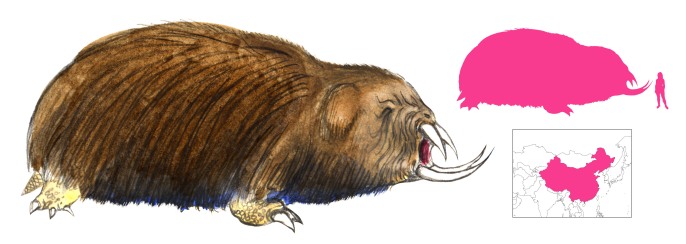
In China, numerous sources, including the treatise Ly-Ki, tell of the Yin Shu, the “Hidden Rodent” or “Hidden Mouse” that dwells in dark caves. The yin shu grows from the size of a buffalo to as big as an elephant in Manchurian manuscripts, but otherwise looks mouselike. It has a no tail (or a short tail), is dark in color, and has short legs, a short neck, and small eyes. Yin shu are dim-witted, slow, and extremely powerful, digging out caves in areas with the roots of the fu-kia plant. They have shown up when rivers flooded plains, and die instantly when exposed to sunlight.

Until recently, mammoth bones in drugstores were labeled as yin shu.

References

Buel, J. W. (1887) Sea and Land. Historical Publishing Company, Philadelphia.

Laufer, B. and Pelliot, P. (1913) Arabic and Chinese Trade in Walrus and Narwhal Ivory. T’Oung Pao, Second Series, v. 14, no. 3, pp. 315-370.

Pouchet, F. A. (1865) L’Univers. Librairie de L. Hachette et Cie, Paris.

Muirdris

Variations: Muirgris (erroneously); Sínach, Sinech; Píast Uiscide (“Water Beast”); Úath (“Horror”)

muirdris

Fergus mac Léti, the King of Ulster, was an inveterate swimmer. Captured while sleeping by water-spirits, the lúchorpáin or “small bodies” (actually the first appearance of leprechauns), he was awoken by the cold water they tried to carry him into. This allowed him to turn the tables on his would-be captors, and he seized three of the lúchorpáin. Fergus demanded that the sprites grant him three wishes: the ability to breathe underwater in seas, pools, and lakes.

The sprites granted him his wish, in the form of enchanted earplugs and a tunic to wear around his head. But like all wishes granted by the Fair Folk, it came with a caveat. Fergus was not to use his gifts at Loch Rudraige (Dundrum Bay) in his own land of Ulster.

Of course, Fergus arrogantly disregards the rule and swims underwater at Loch Rudraige anyway. There he encounters the Muirdris, the “Sea Bramble” or “Sea Briar”, a huge, mysterious, undefined horror that inflates and deflates, expands and contracts like a bellows. It has features of a thorn-bush, with branches and stings, and its appearance alone is deadly.

Fergus does not take well to his encounter with the muirdris, and he is horribly disfigured after seeing it, with his mouth moving to the back of his head. His courtiers are dismayed, as a man with a blemish cannot be king, but they somehow keep this defacement a secret from Fergus for seven years. They prevent him from accessing mirrors, and surround him only with people who will protect the king’s deformity. He finds out only after Dorn, a highborn slave, taunts him about it after he strikes her with a whip. She is bisected for her troubles, and Fergus goes to face his nemesis alone.

The battle between Fergus and the muirdris lasts a day and a night, during which the water of the loch bubbles like a giant cauldron. Finally Fergus slays the monster with his bare hands, and emerges from the loch holding its head in triumph – only to collapse and die from the ordeal.

A thirteenth-century retelling of Fergus’ tribulations renames the monster sínach or sinech. In this version, it is the king’s wife who reveals his secret after an argument.

The muirdris is a monster, but is it rooted in fact? Surely the expansion and contraction, the comparison to a thornbush, and the disfiguring stings strongly suggest a large jellyfish, perhaps the lion’s mane jellyfish.

References

Borsje, J. (1996) From Chaos to Enemy: Encounters with Monsters in Early Irish Texts. Brepols Publishers, Turnhout.

MacKillop, J. (2005) Myths and Legends of the Celts. Penguin Books, London.

61wcp0u2srl-_sx386_bo1204203200_

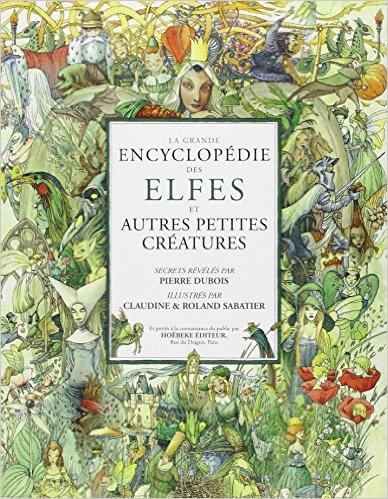
La Grande Encylopédie des Lutins/Fées/Elfes (The Great Encyclopedia of Faeries; The Complete Encyclopedia of Elves, Goblins, and other Little Creatures)

by Pierre Dubois, illustrations by Claudine and Roland Sabatier

The three encyclopedias written by Pierre Dubois and illustrated by Claudine and Roland Sabatier are a bit of a special case. As of writing this, there are 3 volumes, covering goblins, fairies, and elfs (respectively), but they are relatively little-known in the English-speaking world. Passable English translations are available, but the books have had an influence on French bestiaries in the same way Rose’s books have had in English – and that includes the mistakes too. I have a soft spot for these books – again, I read them cover to cover back in the day – but do they stand up to scrutiny today? Let’s find out.

Can be bought from Amazon in French here, here, and here, and in inferior English here and here.

Scope

The encyclopedias cover all sorts of magical beings but leave out the more “prosaic” creatures such as bonnacons and leucrotas. There is a marked tendency to favor humanoids above everything else, even when the creature in question isn’t humanoid (more on that below).

Otherwise, they cover a broad range of cultures across the world, with a strong focus on French creatures, giving them a niche that sets them apart.

Organization

Goblins, fairies, and elfs, but the distinction is vague and hazy at best. “Fairies”, for instance, includes basilisks and codrilles, valkyries and nagas. Chapters are by habitat: those of the Earth and caves, those of woods and forests, and so on.

The distinctions are arbitrary at best, but then that’s the author’s prerogative. Considering Dubois’ views on scholarship and classification, his categories come across as somewhat ironic.

Text

Florid, long-winded, pompous, purple, and fluffy. Dubois is a master at making mountains out of molehills, and creatures with summary descriptions are given extended biographies. For instance, the Duphon – literally the eagle owl, except it’s blamed for typical fairy behavior – is made into a sort of Knight Templar of the mountains by Dubois, with extended descriptions of its hunting habits and suicidal recklessness. None of this is corroborated in the primary literature.

Each creature gets a summary of vital statistics (size, habitat, food, activities, etc.) in the margins, which gives the book a further encyclopedic feel. These vital statistics are also often completely fabricated.

Dubois’ embellishment can take on rather uncomfortable tones. We really did not need to know what the pubic hair stylings are for the skogsra (thick) or the makralles (shaved). Nor is there an explanation for his alteration of some stories: the original tale of the girls and the pilous, for instance, ends with the girls shutting up and the pilous leaving, but Dubois makes the pilous stomp into the room, strip the girls naked, and force them to dance until exhaustion. There is no mention of the fact that vouivres get slain same as any other dragon. These modifications have no basis in the literature, which is cause for concern – not just for bad scholarship, but because they also say quite a bit about Dubois.

Images

There have been complaints that the drawings are “childish” and “comic-booky” and “not serious enough”. I on the other hand have no such problem. The ink and paint drawings by the Sabatiers are easily some of the best selling points of the books, often conveying a setting without even showing the creature front and center. There are interesting takes on some creatures (the Yara-ma-yha-who and the Gremlin come to mind).

Any inaccurate depictions are ultimately Dubois’ fault, and I would not blame the Sabatiers for them.

Research

This is where I reserve most of my criticism, although it overlaps a bit with the text complaints. The fact that most of what Dubois writes about is obscure gives him free rein to invent anything he wants, and a lot of his inventions have been parroted by later authors, making it even harder to separate myth from, er, modern man-made myth. Dubois has also made it clear that he has nothing but scorn for research, study, academia, books… And it shows.

Creatures that are non-human are changed to become humanoid, often losing their best features in the process. The beefy-armed water-horse Mourioche becomes a goblin in a jester’s hat. The shapeless pilous become anthropomorphic dormice (to be fair, I liked that look enough to keep it for my pilou. I am part of the problem). The tourmentine and parisette plants become a goblin and fairy respectively, complete with backstory. The Rabelaisian coquecigrue bird becomes a tiny snake-fairy. The Breton tan noz will-o’-wisps become goblins. The list goes on and on.

Other creatures are fabricated out of whole cloth. The H’awouahoua has found its way into less critical bestiaries, even though this purported Algerian bogey has meaningless gibberish for a name. The Processionary, the Fougre, the Danthienne… The list of dubious creatures goes on, made worse by the difficulty of finding primary sources.

Dubois has also used a pseudonym, Petrus Barbygere (“Peter the Bearded”, i.e. himself), which he uses as a source for a number of citations. Whether this is amusing or not depends on who you ask, but it only muddies the mixture further.

Summary

There is a lot to fault in the Dubois encyclopedias, foremost being an attitude to research similar to that espoused by Attila the Hun. Once again, however, I can’t bring myself to lower the grade too much, as those books have nice drawings, obscure creatures, and helped set me on the track to finding out more.

3

Skötumóðir

Variations: Skate Mother; Fluxuskrímsl (Flake Monster); Vatnsandi (Water Spirit); Vatnaskratti (Water Devil)

skotumodir

Skate in Iceland are mystical creatures. Saint Peter recognized them as the holiest fish in the sea, and they are intimately connected with the number nine. A skate has nine good qualities and nine bad. It will watch over a drowned man for nine nights, and spend the next nine nights eating him. A skate will carry its young within her for nine months, then lie upon them for nine weeks, during which a stone grows within them. This stone, the “skate-stone”, could make a man invisible for one hour, or relieve labor pangs. Empty mermaid’s purses, or “Peter’s purses” as they are known, have lost their skate-stones.

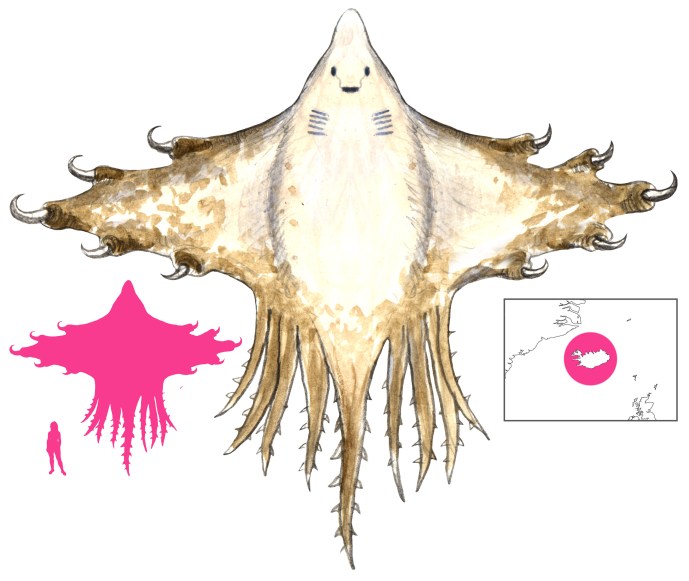
Most terrifying of all is the Skötumóðir, or “Skate Mother”. Like the other Icelandic “fish mothers”, they are not necessarily skate themselves; in fact, some accounts describe them as evil whales that resemble skates. They are enormous and toxic to eat, with backs like mud-covered islands, and sport nine tails. Unlike regular skate, they have been found inland, in freshwater, and even on dry land.

There is always a swarm of skate swimming around a skötumóðir. As they are caught by fishermen, the sea seems to get shallower as the skötumóðir rises to the surface. Finally, the vengeful skate mother hooks its wings onto the gunwales of the boat, and drags it below the waves.

To evade a skötumóðir, prompt action is required. When the huge ray latches its wings onto the boat, they must be immediately chopped off with whatever sharp implement is handy. This will effectively neutralize the threat.

An enormous skate, no doubt a skötumóðir, was one of three monsters terrorizing people around Lagarfljót, lying in wait at ferry crossings. It was transfixed to the bottom of the river by a powerful sorcerer, and unless it has escaped, it is there still.

References

Davidsson, O. (1900) The Folk-lore of Icelandic Fishes. The Scottish Review, October, pp. 312-332.

Hlidberg, J. B. and Aegisson, S.; McQueen, F. J. M. and Kjartansson, R., trans. (2011) Meeting with Monsters. JPV utgafa, Reykjavik.