Stökkull

Variations: Stokkull, Stöckull; Blödkuhvalur, Blökuhvalur, Blodkuhvalur (Flap-Whale); Bloejuhvalur (Veiled Whale); Springhvalur (Springing Whale); Stökkfiskar (Jumping Fish); Sprettfiskur (Sprinting Fish); Léttir (Agile One); Léttur (Light One); Dettir (Falling One); Hrosshvalur (Horse-Whale, probably erroneously)

Stokkull 2

The Stökkull is probably the most feared of the Icelandic illhveli, or “evil whales”. While not the largest or the most well-armed of whales, it is remarkably powerful for its size, and is easily capable of pile-driving ships into a watery grave. In fact, its name is used rather indiscriminately for a number of other monstrous whales with similar behavior; Jon Gudmundsson combined it with the hrosshvalur.

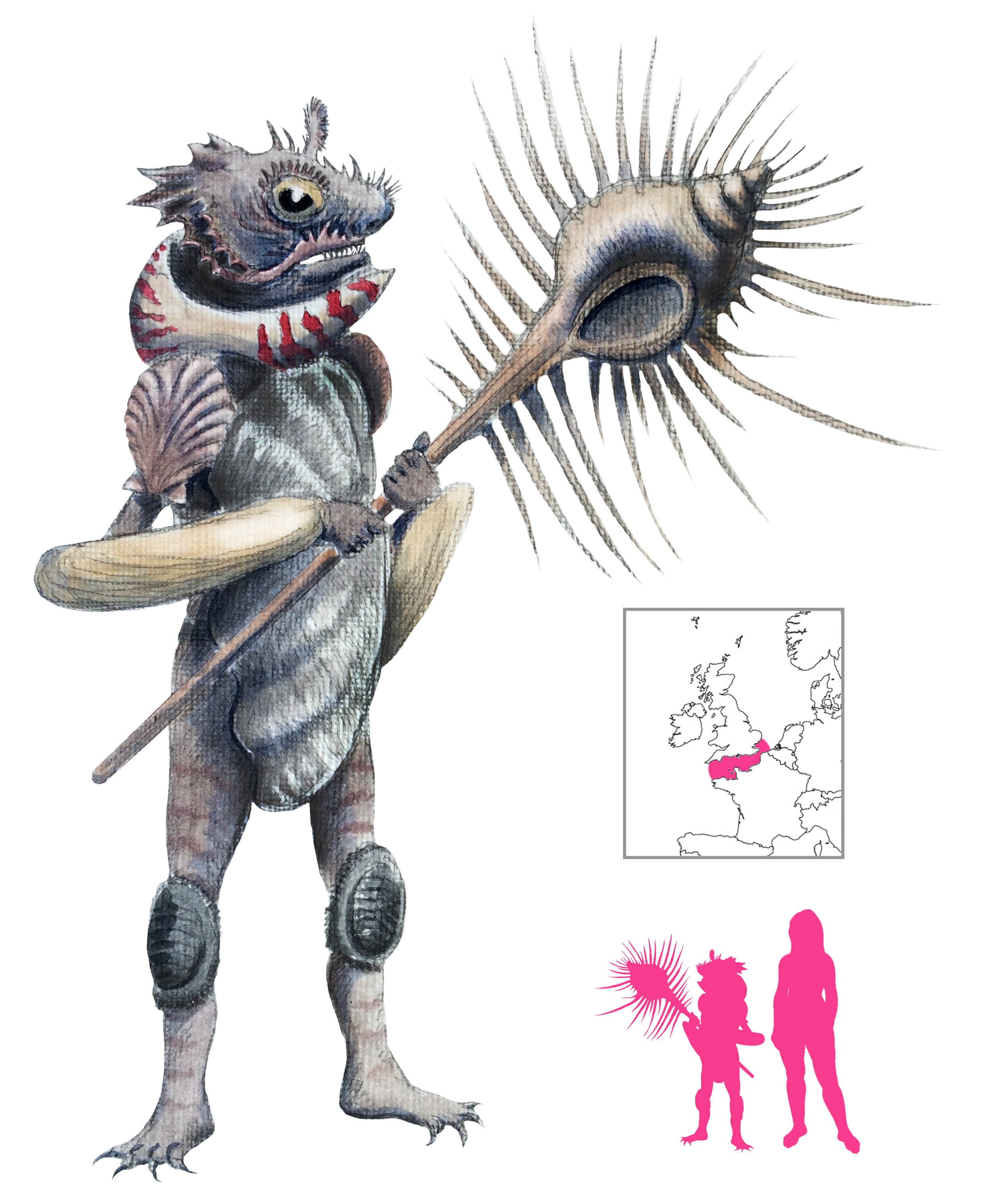
Stökkull means “jumper”, or “leaper”, and this is an apt description of this whale’s habits. A stökkull has a rounded body, black above and white below, and is about 8 to 20 meters long. It has a reinforced battering-ram snout and an underslung lower jaw full of sharp teeth. Most notably, it has blinder-like flaps of skin covering its eyes.

These fleshy flaps earn the stökkull its alternate name of blödkuhvalur (“flap whale”). They prevent the stökkull from seeing ahead of it, and so in order to see it has to leap out of the water and look underneath the flaps. Some accounts instead specify that the stökkull can see underwater and is blinded when it breaches, but this is less likely. It is said that the stökkull’s depredations were once even worse than they are today, until Saint Brendan implored the Lord to intervene. God responded by causing the flaps of skin to grow over the stökkull’s eyes, hindering its capacity to do evil.

Blinded or not, stökkulls are still formidable foes. They leap out of the water, breaching so high that the land and mountains can be seen below them, and cover a distance of four waves with every leap. When in pursuit of a ship, a stökkull can leap a mile in pursuit. It will sink anything it sees floating by jumping onto it nose-first, pulverizing boats and breaking the backs of large whales.

To avoid attracting the attention of a stökkull, it must not be referred to by name, otherwise it is likely to notice your presence. Any of a number of euphemisms must be used when talking about the jumper, and that is the reason for its profusion of names.

If a stökkull is sighted in the distance, it must be distracted before it smashes its way into the boat. The easiest way to do this is to throw a buoy or empty barrel overboard; the stökkull will exhaust itself trying to sink the object. Even a hat thrown overboard will distract a stökkull, as fishermen on Eyjafirth discovered. Another method is to make for the direction of the sun. If the stökkull tries to see where the boat is going, the sun’s glare will interfere. Finally, if all else fails, suitably strong firepower is advised. One stökkull was shot before it could leap, and that so startled it that it swam away at full speed, trailing blood behind it.

The legend of the stökkull probably dates back to tall tales of flying fishes. It may be inspired by sperm whales, Risso’s dolphins, and killer whales to various extents. Today stökkull is used in Iceland to refer to a number of harmless dolphins and porpoises.

References

Davidsson, O. (1900) The Folk-lore of Icelandic Fishes. The Scottish Review, October, pp. 312-332.

Hermansson, H. (1924) Jon Gudmundsson and his Natural History of Iceland. Islandica, Cornell University Library, Ithaca.

Hlidberg, J. B. and Aegisson, S.; McQueen, F. J. M. and Kjartansson, R., trans. (2011) Meeting with Monsters. JPV utgafa, Reykjavik.

Bosch

Bosch

Sometimes criminals face supernatural retribution for their crimes. In the Finistère region of Brittany, it is the victim that suffers instead. Crimes committed on board develop a life of their own and linger long after the guilty party has left the ship. Acts of greed summon evil spirits that populate the ship, bringing bad luck to the crew. In such cases humid straw must be burned to fumigate the ship. The demons can become small enough to hide in a thimble, so the smoke must reach every part of the ship. This must be performed before heading out to sea to avoid potential disaster.

In Audierne, committing a maritime theft actually guarantees good luck. The creature left behind is a Bosch, the physical manifestation of onboard theft. They have no clear appearance, and probably vary depending on the nature of the crime they embody. These wretched creatures come into existence after a theft occurs on a ship, and have a lifespan of a few months to a few years, at the end of which they weaken and disappear. During this time they hide in the bow of the ship and make life on board absolutely miserable. As long as a bosch is present, the nets will be empty, the wind will not blow, and bad luck will hound the crew.

Simply waiting for a bosch to die is therefore impractical. If a ship finds itself afflicted with a bosch, there are two ways to get rid of it. One is to steal an object from a “happy” ship, one whose crew is satisfied and whose catches are always plentiful. The ship should be moored near it, and during the following night the captain sneaks on board the other ship to steal some small object, usually a pair of oarlocks. The bosch will then go to other ship and become their problem.

If one does not wish to inflict the misery of a bosch on an innocent ship, the demon can be exorcised instead. The captain must steal a quantity of hay and hide it in the boat. At night he should set fire to the hay near the mizzenmast and yell “Devil on board!” The sailors, startled, will grab anything within reach and lash out randomly, beating every corner of the ship. Surrounded and beaten, faced with choking smoke and scorching flames, the terrified bosch dives into the sea.

References

van Hageland, A. (1973) La Mer Magique. Marabout, Paris.

Múshveli

Variations: Mushveli, Mousewhale; Hafmús, Hafmus (“Sea-mouse”)

Mushveli

The chimaera, ratfish, or rabbitfish (Chimaera monstrosa) is a small and completely harmless deep-sea fish. Evidently its legendary counterpart the Múshveli, or “mousewhale”, is enormous and highly dangerous. As one of the illhveli (“evil whales”) of Iceland, it is inedible and delights in causing death and destruction.

Múshvelis are mostly mouth, ear, and tail. The gaping, deeply split mouth is large enough to swallow a rowboat in a single gulp, and the large, prominent ears stick out like sails while the animal swims. A long whiplike tail without a fin allows the múshveli to swim at terrifying speeds, so fast that the sea churns ahead of it. Instead of fins, there are two stumpy hoofed legs. These animals are over ten meters long, and light gray or brownish-black in color.

Múshvelis sink ships by ramming them or rearing up, placing their feet on the gunwales, and pushing down until the ship capsizes. If a múshveli is sighted, the best course of action is usually to make for shore as fast as possible, and once there make for higher ground. Unlike most other evil whales, múshvelis can clamber onto the beach with their stubby legs, but they are out of their element and give up quickly. One múshveli ran a boat aground and followed the sailors as far as it could. It easily shrugged off three bullets, and eventually returned to the sea with the next high tide.

Large boats are usually impregnable to múshvelis. In one account, two Icelandic fishermen on a small boat were alerted to the presence of a múshveli by the roar of the foaming sea. It was making right for their boat, and terror made them freeze up. Fortunately, the crew of a French fishing schooner saw their plight, and steered their boat into the múshveli’s path. The sea-mouse rammed the ship so hard that it listed to one side, but remained afloat. The múshveli continued to take its rage out on the French schooner while the fishermen were taken aboard to safety, and eventually the monstrous whale gave up and disappeared.

References

Davidsson, O. (1900) The Folk-lore of Icelandic Fishes. The Scottish Review, October, pp. 312-332.

Hlidberg, J. B. and Aegisson, S.; McQueen, F. J. M. and Kjartansson, R., trans. (2011) Meeting with Monsters. JPV utgafa, Reykjavik.
Saratan

Variations: Zaratan (erroneously), Sarathan

Saratan

Saratan is Arabic for crab. It also means cancer, in the same way as cancer is Latin for crab. Hence, every use of the word saratan here can be replaced with “crab”.

Al-Jahiz knows what crabs are. He talks about how crabs have eight legs and two “teeth” which give the appearance of ten legs. They have eyes on their back. They live in water or burrows on the shore, where they lay their eggs, and feed out of greed instead of necessity.

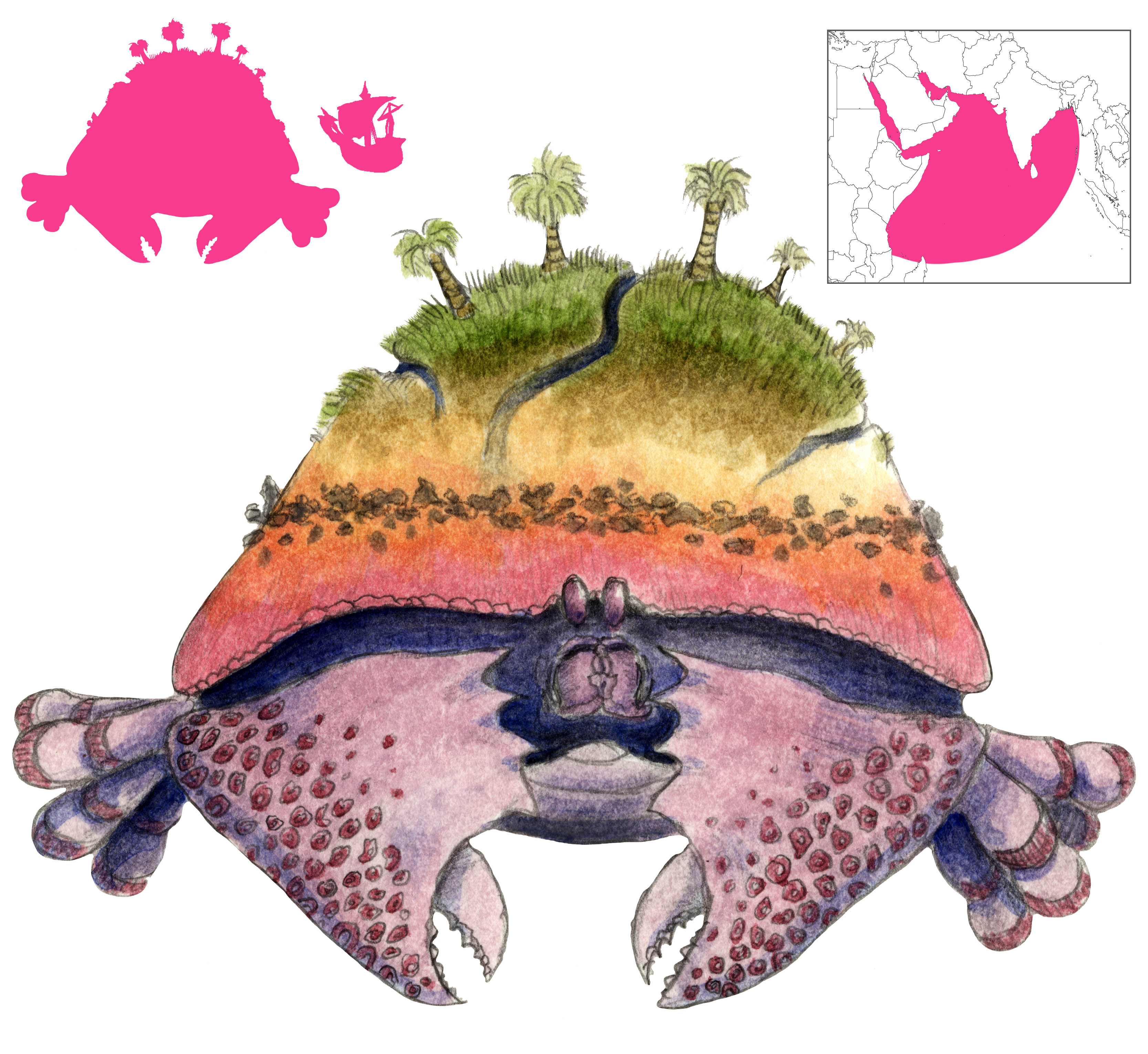
But the “crab” he describes at one point is enormous in size and lives in the open ocean. Vegetation grows on its back as it rests on the surface. Cracks and crevices in its shell look like gullies and rivers. It is this monster that sleeps in the middle of the ocean until sailors land on it, mistaking it for an island. Then it awakens and dives underwater, drowning anyone incapable of swimming back to ship.

Al-Jahiz does concede that he cannot find anyone who claims to have seen this monster.

“What is the most wondrous thing you have ever seen?” Al-Jahiz and a group of friends ponder this question. “The elephant”, comes one response. “The soul”. “Sleep and awakening”. “Forgetfulness and memory”. “Fire”. “The belly of the cosmos”. Another of the scholars present expresses his amazement with the elephant. Finally, Ma’bad bin ‘Omar states “The saratan and the ostrich are greater miracles than the elephant”.

Elsewhere Al-Jahiz goes on to add “The greatest of God’s creations are the snake and the saratan and the fish”, and “The greatest animals created are the fish and the saratan”.

It is strange that the saratan is popularly known as “zaratan”, and described as a whale or turtle. The blame for this lies with Borges, who describes the saratan’s activities but neglects to mention that it is a gigantic crab. He quotes a Spanish translation of Al-Jahiz by Palacios which converts saratan to “zaratan”. Oddly enough, the English translation of Palacios’ text uses the more reasonable transliteration of “sarathan”. In either case, Palacios does describe this monster as a “certain crustacean of the sea” (“cierto crustaceo maritimo”), a fact that Borges omits.

References

Borges, J. L.; trans. Hurley, A. (2005) The Book of Imaginary Beings. Viking.

Al-Jahiz, A. (1966) Kitab al-Hayawan. Mustafa al-Babi al-Halabi wa Awladihi, Egypt.

Palacios, M. A. (1919) La escatologia musulmana en la Divina Comedia. Estanislao Maestre, Madrid.

Palacios, M. A.; Sunderland, H. trans. (1926) Islam and the Divine Comedy. John Murray, London.

Trolual

Variations: Trolwal, Trolval, Teufelwal, Teuffelwal, Devil Whale

Trolual

The Trolual or “devil whale” is one of the more familiar sights on ancient ocean maps. These malevolent cetaceans are mostly found in the northern Atlantic around Scandinavia.

Troluals are depicted as enormous whales with prominent tusks, frills, paws, and large scales on their body. They are as big as mountains, and may have vegetation growing on their backs.

A sleeping trolual on the surface of the ocean looks deceptively like a small island. Sailors will land on it, walk around, even start a fire – and then the whale awakens and sinks below the waves, drowning anyone unfortunate enough to remain on it. Unlike most other island monsters, troluals will also take a more proactive approach by crushing and overturning ships, making them a significant navigational hazard.

Fortunately, troluals can be distracted from their murderous intentions. One strategy is the sounding of trumpets, which are loud enough to momentarily startle and confuse the trolual. Barrels thrown overboard will also divert the whale’s attention. As the trolual plays with its new toys, the ship can sail to safety.

Even the great troluals are not immune to exploitation by humans. Munster states that the inhabitants of Iceland build their houses out of the bones of these whales.

The only major literary appearance of a trolual is in the fabulous tale of Alector, where one surfaces off the coast of the Asian Tangut Empire and ravages harbors every full moon. It is defeated and slain with the help of a magical flying hippopotamus.

References

Aneau, B. (1560) Alector, Histoire Fabuleuse. Pierre Fradin, Lyon.

van Duzer, C. (2013) Sea Monsters on Medieval and Renaissance Maps. The British Library, London.

Gessner, C. (1560) Nomenclator aquatilium animantium. Christoph Froschoverus.

Munster, S. (1552) La Cosmographie Universelle. Henry Pierre.

Nigg, J. (2013) Sea Monsters: A Voyage around the World’s Most Beguiling Map. University of Chicago Press.

Davy Jones

Variations: David Jones

Davy Jones final

Where there is the sea, there will be Davy Jones. He is the demon of the ocean, the proprietor of Davy Jones’ Locker where all drowned sailors go. Originally from British tales, he has since been expanding his influence across the ocean; as long as sailors fear the deep, this “blackguard hell’s baby” will continue to exist.

There is no limit to the shapes Davy Jones can appear in. He is the whale, the shark, the whirlpool, the giant squid, the hurricane, all the fears of sailors. He has been described with huge saucer eyes, triple rows of teeth, a tail, and horns, with blue smoke pouring from his nostrils. When the sailors of the Cachalot landed an enormous, barnacle-crusted bull sperm whale with a twisted lower jaw, some of them declared they had killed Davy Jones himself.

Davy Jones rules over the lesser demons and spirits of the sea, and they do his bidding. He can be seen in various forms on the rigging of doomed ships, gleefully announcing their impending destruction. All who die at sea and sink to the bottom of the ocean – Davy Jones’ Locker – are his.

The first literary appearance of Davy Jones was in Defoe’s Four Years Voyages, as a passing remark. The origin of the name is unknown. One unlikely possibility is a corruption of Duffy Jonah, the ghost (Duppy) of the Biblical Jonah associated with storms at sea. Another possibility is that he was based on a real person. There was a sailor, mutineer, and eventual pirate by the name of David Jones in the early 1600s, and the Locker may have been expression he was fond of. Unfortunately there is no fully convincing explanation for the origin and etymology of Davy Jones.

References

Bullen, F. T. (1906) The Cruise of the Cachalot. MacMillan and Co., London.

Defoe, D. (1726) The Four Years Voyages of Capt. George Roberts. A. Bettesworth, London.

Smith, A. The Perils of the Sea: Fish, Flesh, and Fiend. In Davidson, H. E. and Chaudhri, A. (2001) Supernatural Enemies. Carolina Academic Press, Durham.

Smollett, T. (1882) The Adventures of Peregrine Pickle. George Routledge and Sons, London.

Jetin

Variations: J’tin, Crion

Jetin

Jetins (from jeter, “to throw”) are tiny lutins native to the seaside caves of Brittany. Their appearance is uncertain; Dubois suggests they are hirsute and rough-looking, with silver shoes. Despite their size – ranging from thumb-sized to 1.5 feet tall – they are incredibly strong, capable of lifting and tossing huge boulders with ease.

Always looking for a chance to show off their strength, jetins amuse themselves by throwing rocks around, sometimes over great distances. Standing stones, menhirs, all manner of megaliths; such stones are discarded playthings of the jetins.

Rock-throwing was not the only pastime the jetins enjoyed. They were also fond of tying knots in horse tails and releasing livestock, and, like any good fairy, they often exchanged human babies for one of their own. The ugly, wrinkled changelings they leave behind are never weaned and never grow. Jetins can be convinced to return stolen children by carrying the changeling to a jetin hole and threatening to kill it. The human baby will quickly be returned and swapped with the impostor.

The jetins shared their territory with the even tinier Fions and the secretive Fées des Houles (“Fairies of the Sea Caves”). Due to their size and their reclusive natures, none of these have been observed in great detail, although the Fées have been benevolent towards humans. The Crions, perhaps the same as jetins, were tiny dwarfs who carried the stones of Carnac on their shoulders.

Elsewhere, the discobolous function of the jetins is fulfilled by Gargantua and other giants, whose size is more proportionate to their strength, and the fairies known as Fileuses (“Weavers”).

References

Dubois, P.; Sabatier, C.; and Sabatier, R. (1992) La Grande Encyclopédie des Lutins. Hoëbeke, Paris.

Morvan, F. (1998) Vie et mœurs des lutins bretons. Actes Sud.

Sébillot, P. (1905) Le Folk-lore de France, Tome Deuxième: La Mer et les Eaux Douces. Librairie Orientale et Américaine, Paris.

Sébillot, P. (1907) Le Folk-lore de France, Tome Quatrième: Le Peuple et L’Histoire. Librairie Orientale et Américaine, Paris.

Ziphius

Variations: Ziph, Ziphio, Ziphij, Xiphia, Xiphias, Zyffwal

Ziphius

The Ziphius is a huge and horrifying sea monster, reportedly found in northern seas and near the Scandinavian coast. It resembles a whale in shape and size, but with a viciously sharp beak and terrifying bulging eyes. The beak and bristly hair around the head and neck combine to give it an owlish appearance. The ziphius also has a pointed dorsal fin, paw-like flippers, and horizontal stripes down its length. It is a carnivore, feeding on seals and sailors alike.

The Ortus Sanitatis gives it four fully-formed legs and tail, making it look more like a beaked lion or even a hedgehog. Olaus Magnus describes its hideous, beaked head, comparing it to an owl (or a toad in the French translation). It has a deep maw, horrid large eyes, and a knife-like dorsal fin used to tear holes in ships. Gessner compared it to the physeterus. Munster showed it swallowing a sea calf, and emphasizes the fact that it is horrible.

Today Ziphius refers to the harmless and rarely seen Cuvier’s beaked whale. Killer whales probably were a more significant contribution to the image of the ziphius, as were swordfishes – ziphius is derived from xiphias, or sword.

De Montfort interpreted the ziphius differently. As it had a hooked beak and blazing eyes, he believed that it must have been a distortion of the giant squid or kraken.

References

van Duzer, C. (2013) Sea Monsters on Medieval and Renaissance Maps. The British Library, London.

Gessner, C. (1560) Nomenclator aquatilium animantium. Christoph Froschoverus.

Magnus, O. (1555) Historia de gentibus septentrionalibus. Giovanni M. Viotto, Rome.

Magnus, O. (1561) Histoire des pays septentrionaus. Christophle Plantin, Antwerp.

de Montfort, P. D. (1801) Histoire Naturelle, Générale et Particuliere des Mollusques, Tome Second. F. Dufart, Paris.

Munster, S. (1552) La Cosmographie Universelle. Henry Pierre.

Unknown. (1538) Ortus Sanitatis. Joannes de Cereto de Tridino.

Arragouset

Variations: Arragousset, Sarregouset, Sarragouset

Arragouset 2

Jean Letocq, a shepherd on the west coast of Guernsey, woke up one morning to see hundreds of little people streaming out of the Creux des Fées (Fairies’ Hollow). They were armed to the teeth, carrying weapons made of sharpened shells. They told the man to bear their message: they wished to take human wives, and would be strongly displeased if women were not turned over to them. This ultimatum was refused, and so the fairies slaughtered every last man they encountered, dying the sea red with blood. The only survivors, a man and a boy of St. Andrew’s parish, hid in an abandoned oven for years.

They were the Arragousets, or Sarregousets as Hugo called them. We know that they were bellicose fairies of the sea, dwelling underwater and in seaside caves, ruling their own marine kingdom. One of their number once took a human woman for his wife, and her beauty and wit so enamored the other fairies that they had to follow suit.

With the men safely massacred, the Arragousets put down the sword and went native. They married the maidens and the newly-widowed, and lived peacefully on land. They made caring husbands and doting fathers, to the extent that the widows warmed to them, and the maidens were delighted with their fairy lovers.

Then, after years of peace, they disappeared as quickly as they had appeared. The circumstances remain mysterious. Sébillot suggests that they were recalled by their king, while MacCulloch states that their time on land was limited. Whatever the reason, all the Arragousets left the island and were never seen again.

Or rather, they went invisible, as their presence remained on Guernsey. They sired a new generation of boys and girls – intelligent, able sailors of small stature – and they returned regularly to watch over them. They did a hundred little favors in the hopes of finishing the work they had started. Arragousets are always ready to help their descendants, but they are pitiless in dealing with offenders.

Hugo said they can still be seen on stormy days, dancing in the clouds and longing to return to the land.

References

Dubois, P.; Sabatier, C.; and Sabatier, R. (1992) La Grande Encyclopédie des Lutins. Hoëbeke, Paris.

Hugo, V. (1866) Les Travailleurs de la Mer. Librairie Internationale, Paris.

MacCulloch, E. (1903) Guernsey Folk Lore. Elliot Stock, London.

Sébillot, P. (1905) Le Folk-lore de France, Tome Deuxième: La Mer et les Eaux Douces. Librairie Orientale et Américaine, Paris.

Caspilly

Variations: Caspilli, Neemora (Persian)

Caspilly

The Caspilly is a “marvelously large, and strong” fish from the Indian Ocean, described by Ambroise Paré on the basis of two separate accounts by André Thevet.

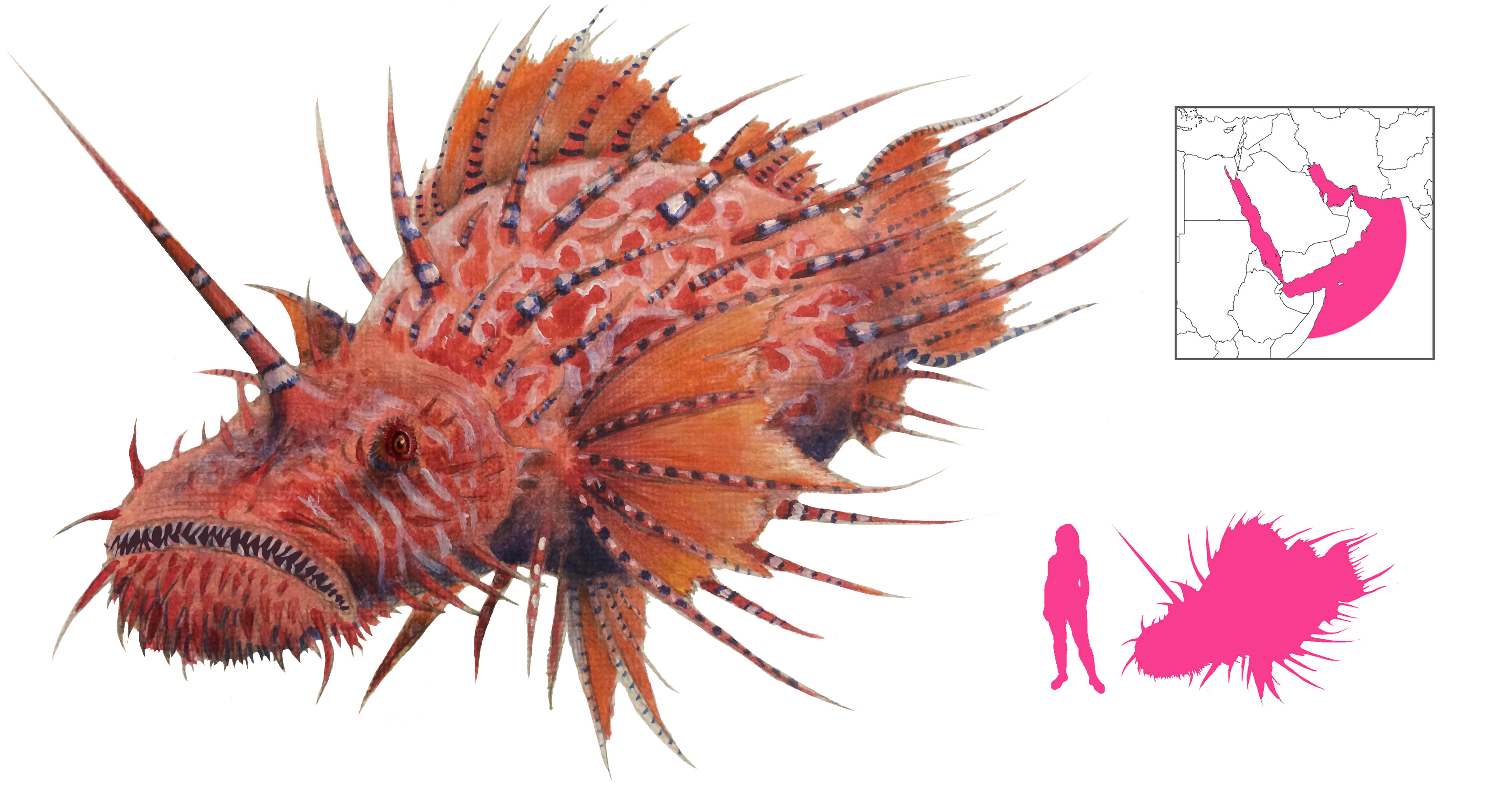
Thevet placed it in the Arabian Gulf, saying that it is known to the Arabs as caspilly, and to the Persians as neemora. The caspilly is almost as wide as it is long, but no more than two feet long. It has no scales, and its skin is spiky and barbed like that of a shark. On its forehead is a lancet-like spine, a foot and a half in length, that it keeps tucked along its nape. When it is hungry, it goes for the first fish it sees, stabbing it in the belly with its horn until its prey bleeds to death. Its teeth are venomous and bites are deadly. Applying a dead caspilly to a bite, on the other hand, will cure it. The horn is of great medicinal value, and caspilly are shot with arrows from a safe distance to retrieve such a prize.

Thevet also reports a nameless fish from the Peruvian sea, with a swordlike horn three feet long. This fish is a specialized whale killer. Upon seeing a whale, the fish will hide underneath before stabbing it in the navel with its horn, leaving the whale to writhe in its death throes and capsize nearby ships. Once the whale is dead, it can be eaten at leisure.

Paré economically combines both accounts, giving the caspilly a four-foot-long horn and making it the terror of the Arabian sea. He adds that the Arabs of the region hunt caspillys with giant hooks baited with camel meat. Any caspilly who greedily takes the bait will tire itself out on the line, eventually slowing down enough to be shot with arrows, brought onto ship, and bludgeoned to death. Caspilly flesh is edible, and caspilly alicorn is just as potent against venom as that of the unicorn.

In all likelihood the Caspilly was born from accounts of swordfish and killer whales, contaminated by lionfish and porcupinefish. The venomous bite may have been derived from the famed toxicity of pufferfish. Aldrovandi cautiously included it with his Herinaceus marinus, the porcupinefish, as Herinaceus arabus, the Arab hedgehog.

References

Aldrovandi, U. (1642) Monstrorum historia cum Paralipomenis historiae omnium animalium. Bononiae.

Paré, A. (1582) Discours d’Ambroise Paré – De la Licorne. Gabriel Buon, Paris.

Paré, A. (1614) Les Oeuvres d’Ambroise Paré. Nicolas Buon, Paris.

Thevet, A. (1575) La Cosmographie Universelle. Guillaume Chaudiere, Paris.