Lakúma

Variations: Lucooma

lakuma

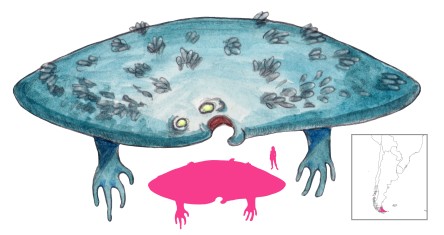
According to the Yamana, the Lakúma are the most dangerous sea creatures of Tierra del Fuego. These water spirits have been known to tip canoes over, pull their occupants out, and drag them under to consume, leaving their entrails to float to the surface. They can also create huge waves, summon whirlpools, and whip up storms to damage larger vessels.

Lakúma have been compared to whales, squids, and giant worms, making their exact appearance hard to pin down. What is known is that they like to flatten themselves out on the water’s surface, letting their back protrude like a small island. Their broad and flat backs are covered with encrustations of unusually large mussels.

Sometimes there are so many lakúma in one spot that they can be used as stepping-stones. A group of Yamana on a desert island saw countless wide, flat lakúma rise to the surface, forming a living bridge to a bountiful island. “If we run quickly, we’ll get to the other side!” said one man, running over the backs of the lakúma and reaching the other shore. But the others were too slow, and the lakúma dove, taking them to a watery grave. The one survivor recruited enough men to slay many lakúma in retaliation, and their bodies can still be seen today in the form of large, flat stones at the bottom of the sea.

Lakúma will also attack people breaking taboos. It is known that a menstruating girl or túrikipa should not eat berries, but one girl thought she could circumvent the rule by sucking out the juices and spitting the solid outer part. Alas, her canoe was attacked by a lakúma, and it refused the offerings tossed at it until it took the girl and devoured her. It then flattened itself out on the surface and rested. The túrikipa’s people went onto the lakúma’s back, took some of the mussels, and used their sharp shells to dismember the lakúma. But that was small comfort for the túrikipa, whose entrails served as a grisly reminder of her fate.

For all their malevolence, lakúma can be tamed by a powerful yékamuš or shaman, and can become obedient servants. One yékamuš was with his wife in their canoe while she scolded him. “I thought you were a powerful yékamuš, but you can’t even strand a whale, or fetch birds to eat!” In response the yékamuš slept and summoned two lakúma, who raised the canoe’s bow up in the air. “Wake up! Help me!” cried his wife, and the yékamuš stirred and spoke nonchalantly. “I thought you said I was powerless”, he taunted, before telling her to paint the lakúma with white paint. She did as she was told, and the lakúma did not resist. Then they dove and created a good breeze to send the canoe effortlessly to its destination. “I had always made fun of you”, admitted the wife, “but now I know you are truly a capable yékamuš!”

References

Gusinde, M.; Schütze, F. trans. (1961) The Yamana; the life and thought of the water nomads of Cape Horn. Human Relations Area Files, New Haven.

Gusinde, M.; Wilbert, J. ed. (1977) Folk Literature of the Yamana Indians. University of California Press, University of California, Los Angeles.
Lilyi

Variations: Lilye, Lili

lilyi

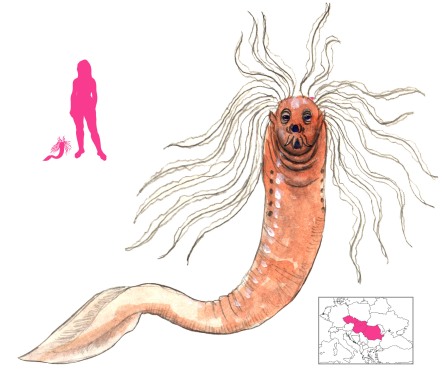
Lilyi is the second child of Ana, Queen of the Keshalyi. Like her siblings, she is responsible for an array of ailments that plague humanity, and she had her genesis in the abusive relationship between Ana and her repulsive husband, the King of the Loçolico.

After the birth of Melalo, Ana understandably refused to have another child. But this time it was Melalo himself, desirous of a wife, who told his father to cook a fish in donkey’s milk, and administer a few drops of the liquid in Ana before taking her by force. The product of this vile union was Lilyi.

Lilyi, “Viscous” or “Slimy”, is mermaid-like, part fish (some sources specify hagfish) with a human head. Nine sticky threads or barbs flow from either side of her head, and they can penetrate a human body, causing buildup of mucus. She is responsible for catarrh, coughing, dysentery, influenza, vomiting, and other diseases involving mucus and discharges.

Her union with her brother Melalo produced further demons of disease, but she was herself persecuted by her younger brother Tçulo – at least until Tçulo got a sister-wife of his own.

References

Clébert, J. P. (1976) Les Tziganes. Tchou, Paris.

Clébert, J. P.; Duff, C. trans. (1963) The Gypsies. Vista Books, London.

Meyers Brothers Druggist (1910) Demons of Disease. Meyers Brothers Druggist, v. 31, p. 141.

Pavelčík, N. and Pavelčík, J. (2001) Myths of the Czech Gypsies. Asian Folklore Studies, v. 60, pp. 21-30.

Skötumóðir

Variations: Skate Mother; Fluxuskrímsl (Flake Monster); Vatnsandi (Water Spirit); Vatnaskratti (Water Devil)

skotumodir

Skate in Iceland are mystical creatures. Saint Peter recognized them as the holiest fish in the sea, and they are intimately connected with the number nine. A skate has nine good qualities and nine bad. It will watch over a drowned man for nine nights, and spend the next nine nights eating him. A skate will carry its young within her for nine months, then lie upon them for nine weeks, during which a stone grows within them. This stone, the “skate-stone”, could make a man invisible for one hour, or relieve labor pangs. Empty mermaid’s purses, or “Peter’s purses” as they are known, have lost their skate-stones.

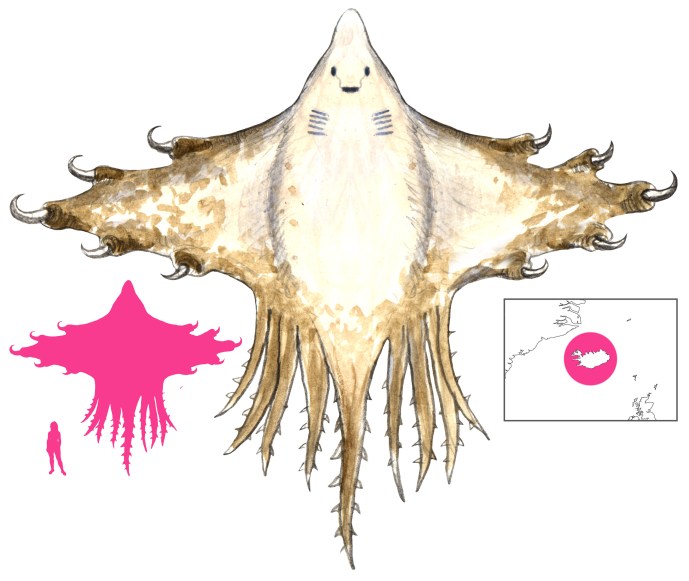
Most terrifying of all is the Skötumóðir, or “Skate Mother”. Like the other Icelandic “fish mothers”, they are not necessarily skate themselves; in fact, some accounts describe them as evil whales that resemble skates. They are enormous and toxic to eat, with backs like mud-covered islands, and sport nine tails. Unlike regular skate, they have been found inland, in freshwater, and even on dry land.

There is always a swarm of skate swimming around a skötumóðir. As they are caught by fishermen, the sea seems to get shallower as the skötumóðir rises to the surface. Finally, the vengeful skate mother hooks its wings onto the gunwales of the boat, and drags it below the waves.

To evade a skötumóðir, prompt action is required. When the huge ray latches its wings onto the boat, they must be immediately chopped off with whatever sharp implement is handy. This will effectively neutralize the threat.

An enormous skate, no doubt a skötumóðir, was one of three monsters terrorizing people around Lagarfljót, lying in wait at ferry crossings. It was transfixed to the bottom of the river by a powerful sorcerer, and unless it has escaped, it is there still.

References

Davidsson, O. (1900) The Folk-lore of Icelandic Fishes. The Scottish Review, October, pp. 312-332.

Hlidberg, J. B. and Aegisson, S.; McQueen, F. J. M. and Kjartansson, R., trans. (2011) Meeting with Monsters. JPV utgafa, Reykjavik.

Flyðrumóðir

Variations: Flyðrumóðirin (pl.), Halibut Mother; Laxamóðir (Salmon Mother), Laxamóðirin (pl.); Silungamóðir (Trout Mother), Silungamóðirin (pl.)

Flydrumodir

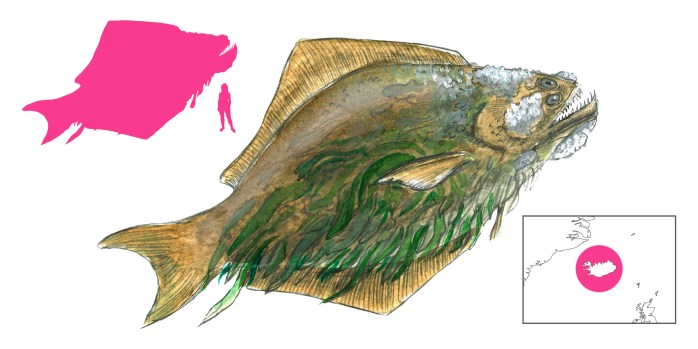
The Flyðrumóðir, or “Halibut Mother”, is fairly representative of the Icelandic móðirin, the “mothers” of certain species of fishes. These creatures look like huge, monstrous versions of their namesakes, and they protect their smaller kin fiercely.

A flyðrumóðir looks like the halibut it protects, but it is much larger, growing to the size of a fishing boat. Its body, which turns grey on both sides with age, is covered with shells, barnacles, and seaweed, making it look like a small island when it surfaces.

While the flyðrumóðir has been said to be the mother of all fishes in the sea, its true “children” are the halibut. It is followed by schools of halibut out at sea, and it protects them if they are persecuted. A schooner in Faxaflói attracted (and escaped) the attention of a flyðrumóðir after it hauled up 40 halibuts. Another fishing boat owned by Archdeacon Hannes Stephensen was less lucky; it caught a flyðrumóðir on a coffin-nail hook, but was capsized by the halibut mother with all hands lost.

Even catching a flyðrumóðir is not necessarily a good thing. After the halibut mother of Breiðafjörður was snagged on a golden hook and filleted, the waters of the area ceased to produce fish, and the angler who caught the giant halibut never again caught a fish in his life.

Similar fish mothers include the freshwater Laxamóðir, “Salmon Mother” and Silungamóðir, “Trout Mother”. Both of these resemble oversized salmon and trout, respectively. Salmon mothers will swim out of salmon-rich rivers, tearing through fishing nets along their way. The big-headed trout mothers are bad luck to catch, and should be released whenever possible.

References

Hlidberg, J. B. and Aegisson, S.; McQueen, F. J. M. and Kjartansson, R., trans. (2011) Meeting with Monsters. JPV utgafa, Reykjavik.

Swan Valley Monster

Swan Valley Monster

The Swan Valley Monster made its appearance on August 22, 1868, in the otherwise tranquil locale of Swan Valley, Idaho. Its presence was witnessed and reacted to by an unnamed old-timer crossing the river at Olds Ferry.

The first thing he saw of the monster was an elephant’s trunk rising from below the surface and spouting water. This was followed by a snake-like head the size of a washtub, with a single horn that kept moving up and down, and long black whiskers on both sides of the face. It had ten-inch-long fangs and a red forked tongue that spewed green poison. When it hauled its massive body onto the shore, the old-timer noted that it must have been twenty feet long, and it stank to high heaven. A pair of wing-like fins – or fin-like wings – came out of the sides of its neck. Its forward half was like a snake, the thickness of a calf, greenish-yellow with red and black spots; this in turn led into a fish-like section with hand-sized rainbow scales shining in the sun; finally, the tail was a drab, scaly gray like a crocodile or lizard tail. Shiny black barbed spines, like those of a porcupine, lined its back from head to tail. Finally, it had twelve stubby legs that were easily missed at first glance; the first pair under the fins had hoofs, followed by two pairs of legs with razor-sharp claws, then a pair of hoofed feet, a pair of clawed feet, and another pair of hoofed feet near the tail.

Of course, the old-timer’s first reaction to the abomination slithering up the bank was to fire a slug into its eye. The monster reared up, hissing, bellowing, and spurting poison over its surroundings, so it got shot a second time in its yellow belly, convulsed, and stopped moving. Everything its poison had touched, whether trees or grass or other living beings, withered and died.

As the monster was too large to be carried off by one man, the old-timer returned to town to fetch a wagon and six strapping lads to help him, as well as a tarp to protect them from the poison. They could smell the odoriferous creature a hundred yards away, and one of the men had to stay with the horses to keep them from bolting, while another got sick and refused to come any closer. But when they reached the bank where the monster had fallen, there was nothing but withered vegetation and a trail leading to the water.

Presumably the Swan Valley monster had crawled back into the river to die – or perhaps it didn’t die. Whatever its fate, the old-timer recommended keeping a close watch on the river, as “I’ve hunted an trapped an fished all over the state fer nigh ontuh seventy-five year… but I ain’t never seen nothin tuh compare with that speciment”.

References

Clough, B. C. (1947) The American Imagination at Work. Alfred A. Knopf, New York.

Fisher, V. ed. (1939) Idaho Lore. Federal Writers’ Project, The Caxton Printers, Caldwell.

Lewicki, J. and the editors of LIFE (1960) Folklore of America, part V. LIFE Magazine, Aug. 22, 1960.

Marool

Variations: Angler-fish, Carrachan, Devil-fish, Keddle-man, Kethrie, Kettach, Kilmaddy, Marmaid, Mareillen, Marsgum, Masgum, Meermaid, Merlin-fish, Molly Gowan, Monk-fish, Plucker, Shoemaker, Toad-fish, Weever, Wide-gab

Marool

The Marool of Shetland is a malevolent marine devil, appearing in the form of a fish. It has eyes all over its head, and a crest of flame. It can be seen in mareel, or phosphorescent sea-foam. During storms the marool can be heard singing wildly with joy when a ship capsizes.

Marool is only one of a number of names that have been applied to the anglerfish or monkfish.

References

Forbes, A. R. (1905) Gaelic Names of Beasts (Mammalia), Birds, Fishes, Insects, Reptiles, Etc. Oliver and Boyd, Edinburgh.

Saxby, J. M. E. (1932) Shetland Traditional Lore. Grant and Murray Limited, Edinburgh.

Mastopogon

Variations: Aegomastus, Egomastus; Houperou, Huperus (erroneously?)

Houperou

The first appearance of the Mastopogon (“breast beard”), also called the Aegomastus, is as a nameless “strange fish” observed by Thevet off the coast of South America. It has a beard resembling a goat’s udder under its chin, and the illustration provided includes a long dorsal spine and pointed fins.

Thevet also describes the Houperou as a large carnivorous fish that eats all other sea creatures, except for one small fish. The carp-like fish remains in the shadow of the houperou and enjoys the protection granted by its larger friend. The houperou has rough sandpapery skin like a dogfish, sharp teeth, and a long spine on its back. It attacks, drowns, and dismembers anyone it catches in the water, and the native people shoot it with arrows on sight. The similarity of this unlikely couple to a shark and pilot fish is clear; in fact, uperu is the local name for “shark”, appropriately converted to French pronunciation by Thevet.

Gesner takes up the descriptions of the houperou and the udder-bearded fish from Thevet, but pictures the houperou or huperus as a large pike. He also coins Mastopogon and Aegomastus for Thevet’s nameless fish.

With time the heraldic mastopogon and houperou blurred together to the point of inextricability, making it necessary to describe them together. Holme describes the mastopogon as a variety of houperou, looking like a salmon with large thorny fins, the dorsal fin reaching all the way to the tail. The houperou, on the other hand, now has the mammary wattle, along with two ear-like knobs on its head, a long-spined dorsal fin, rough scales, and a straight tail.

References

Gessner, C. (1560) Nomenclator aquatilium animantium. Christoph Froschoverus.

Holme, R. (1668) The academy of armory, or, A storehouse of armory and blazon containing the several variety of created beings, and how born in coats of arms, both foreign and domestick. Printed by the author at Chester.

de Souza, G. S. (1851) Tratado Descriptivo do Brazil. Typographia Universal de Laemmert, Rio de Janeiro.

Thevet, A. (1558) Les Singularitez de la France Antarctique. Maurice de la Porte, Paris.

Thevet, A. (1575) La Cosmographie Universelle. Guillaume Chaudiere, Paris.

Sverðhvalur

Variations: Sverdhvalur, Sword-whale, Swordwhale; Sverðfiskur, Sverðfiskar, Sverðfiskr (Sword-fish); Sverðurinn (Sworder); Brúnfiskur, Brún-fiskur (Brown-fish); Sveifarfiskur (Crank-fish); Slambakur (Slap-whale); Staurhvalur (Stump-whale); Einbægslingur (One-fin); Haskerðingur (High-Fin; potentially the basking shark or the swordwhale); Killer Whale, Orca, Swordfish

Sverdhvalur

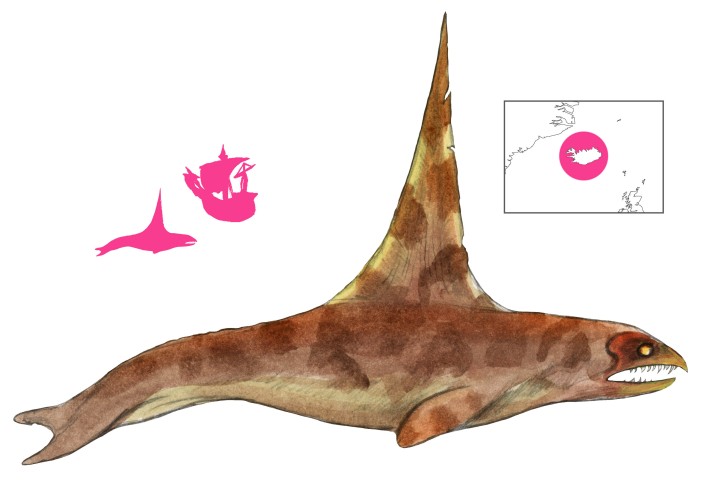
The Sverðhvalur (“Swordwhale”) or Sverðfiskur (“Swordfish”) is one of the illhveli, or “evil whales” that lurk off the coast of Iceland. Like the other evil whales, it is unfit for eating, and the steypireyður or blue whale is its mortal enemy.

The sverðhvalur’s most distinctive feature is the sharp bony fin growing out of its back. This fin is 3-12 cubits (1.5-6 meters) tall. The sverðhvalur is about the size of a sperm whale at the largest, and its spouting is short and heavy. Its face is owlish in appearance, with a pointed snout and a large mouth set with vicious teeth. If the brúnfiskur (“brown-fish”) is one of its many aliases, it can be assumed to be brown in color, but another account describes it as grey.

The sverðhvalur is a fast swimmer, and beats the water on either side of it with its fin when agitated. It is often accompanied by a smaller whale – perhaps its offspring – that swims under its pectoral fin and feeds on its scraps. The bladed dorsal fin is used as a weapon, and a sverðhvalur will swim underneath good whales to cut their bellies open with crisscross slashes. Whales will beach themselves rather than suffer a sverðhvalur’s attack. Sverðhvalurs are also wasteful eaters, choosing to eat only the tongue of cetacean prey and leaving the rest to rot. Boats are treated in the same way as whales are, with the dorsal fin punching holes through hulls or slicing cleanly through smaller boats and sailors alike.

Other encounters, especially with larger vessels, are more harmful for the whale. A trading ship sailing from eastern Iceland to Copenhagen came to a stop in the middle of a large pod of whales, and suddenly felt a strong tug coming from below. When the ship moored in Copenhagen, a large fish’s tusk was found sticking out of the hull.

Another sverðfiskur followed a boat off Eyjafjörður, and gave up the chase only after a gun was fired into its gaping mouth.

The term sverðfiskur or sverðfiskr (“sword-fish”) has been used to refer to the swordfish, the sawfish, and the killer whale. The basking shark and the killer whale have also been accused of slicing through ships and eviscerating whales with their fins, and it is the killer whale or “swordwhale” that appears to be the sverðhvalur’s ancestor.

References

Anderson, P. (1955) Bibliography of Scandinavian Philology XXIV. Acta Philologica Scandinavica, Ejnar Munksgaard, Copenhagen.

Árnason, J.; Powell, G. E. J. and Magnússon, E. trans. (1866) Icelandic Legends, Second Series. Longmans, Green, and Co., London.

Davidsson, O. (1900) The Folk-lore of Icelandic Fishes. The Scottish Review, October, pp. 312-332.

Hermansson, H. (1924) Jon Gudmundsson and his Natural History of Iceland. Islandica, Cornell University Library, Ithaca.

Hlidberg, J. B. and Aegisson, S.; McQueen, F. J. M. and Kjartansson, R., trans. (2011) Meeting with Monsters. JPV utgafa, Reykjavik.

Stella

Variations: Sea Star

Stella

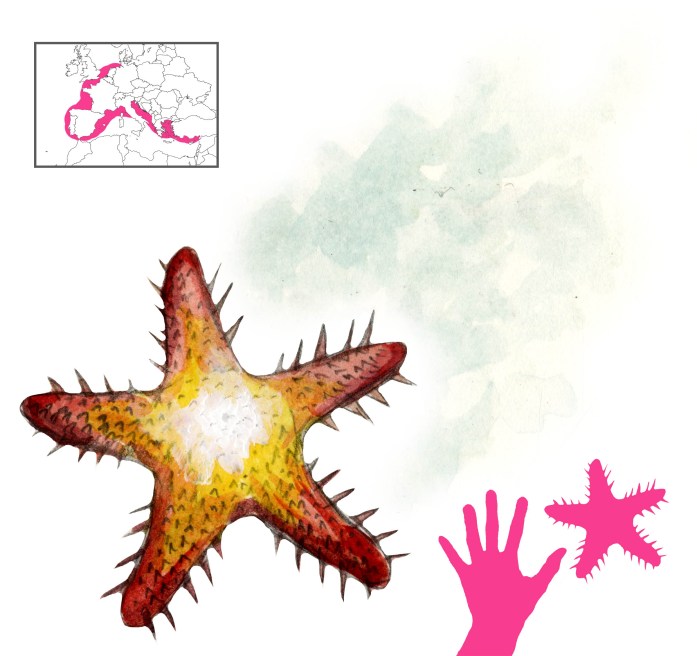
Stella, or the sea star, derives its name from its unusual appearance that resembles a painted star.

Much like its namesake, a stella is so hot that it burns, liquefies, and effectively cooks anything it comes in contact with. It will intentionally touch fish in order to kill them. Evidence for this incandescent nature was found in a large stella washed up on the shores of Maguelonne. Almost a foot in diameter, it was found to have five mollusk shells inside it, two of which were half-liquefied.

References

Boaistuau, P. (1564) Histoires Prodigieuses. Vincent Norment et Iehanne Bruneau, Paris.

Skeljúngur

Variations: Skieliungur; Svarfhvalur, Suarfhualur (Iron Whale); Skútuhvalur (Schooner Whale); Tigrishvalur (Tiger Whale); Hnúfubakur, Humpback Whale

Skeljungur

The Skeljúngur, or “shell whale” is one of the many illhveli, or “evil whales” of Iceland. Unlike its brethren, the skeljúngur is edible and safe to eat, making it the most dangerous of the edible whales. It has even helped humans on occasion; one young skeljúngur aided Hjalmper and Olvir in battle against a vicious hrosshvalur.

It is described as ranging from 20 to 45 meters long. It is very fat and short-flippered, lacks dorsal fins, and its entire body is covered with shells that rattle as it swims. The shells tend to make it itchy, and it will rub its head against rocks in deep coastal waters. Despite its portly appearance, it is a fast swimmer, earning it the nickname of “tiger whale”. It dives vertically, and sleeps vertically with its head sticking out of the sea. Whether it has teeth or baleen is unclear.

A shell-whale will position itself in the path of an oncoming ship, and will continue to obstruct the vessel’s course if the captain tries to avoid it. Skilled sailors should change their course fast enough to evade it, as sailing right onto it causes the whale to throw the ship and kill all on board. When destroying boats, it likes to strike them with its fins and tails. Skeljúngur armor makes them impervious to most attacks and quite fearless, and the whales will play dead to entice prey within range. The whaling ship Minerva off Grimsey thought they had killed a skeljúngur, but the seemingly dead whale immediately recovered and destroyed the boat sent to finish it off.

Skeljúngurs hate the sound of iron being ground and filed. If one of these whales hears that loathed sound, it will go frantic and beach itself to get away from it. The alternate name of svarfhvalur (“iron whale”) is derived from this aversion.

Skeljúngur is also another name of the humpback whale or hnúfubakur.

References

Davidsson, O. (1900) The Folk-lore of Icelandic Fishes. The Scottish Review, October, pp. 312-332.

Hermansson, H. (1924) Jon Gudmundsson and his Natural History of Iceland. Islandica, Cornell University Library, Ithaca.

Hlidberg, J. B. and Aegisson, S.; McQueen, F. J. M. and Kjartansson, R., trans. (2011) Meeting with Monsters. JPV utgafa, Reykjavik.

Larson, L. M. (1917) The King’s Mirror. Twayne Publishers Inc., New York.