Whowie

Variations: Whowhie

Whowie

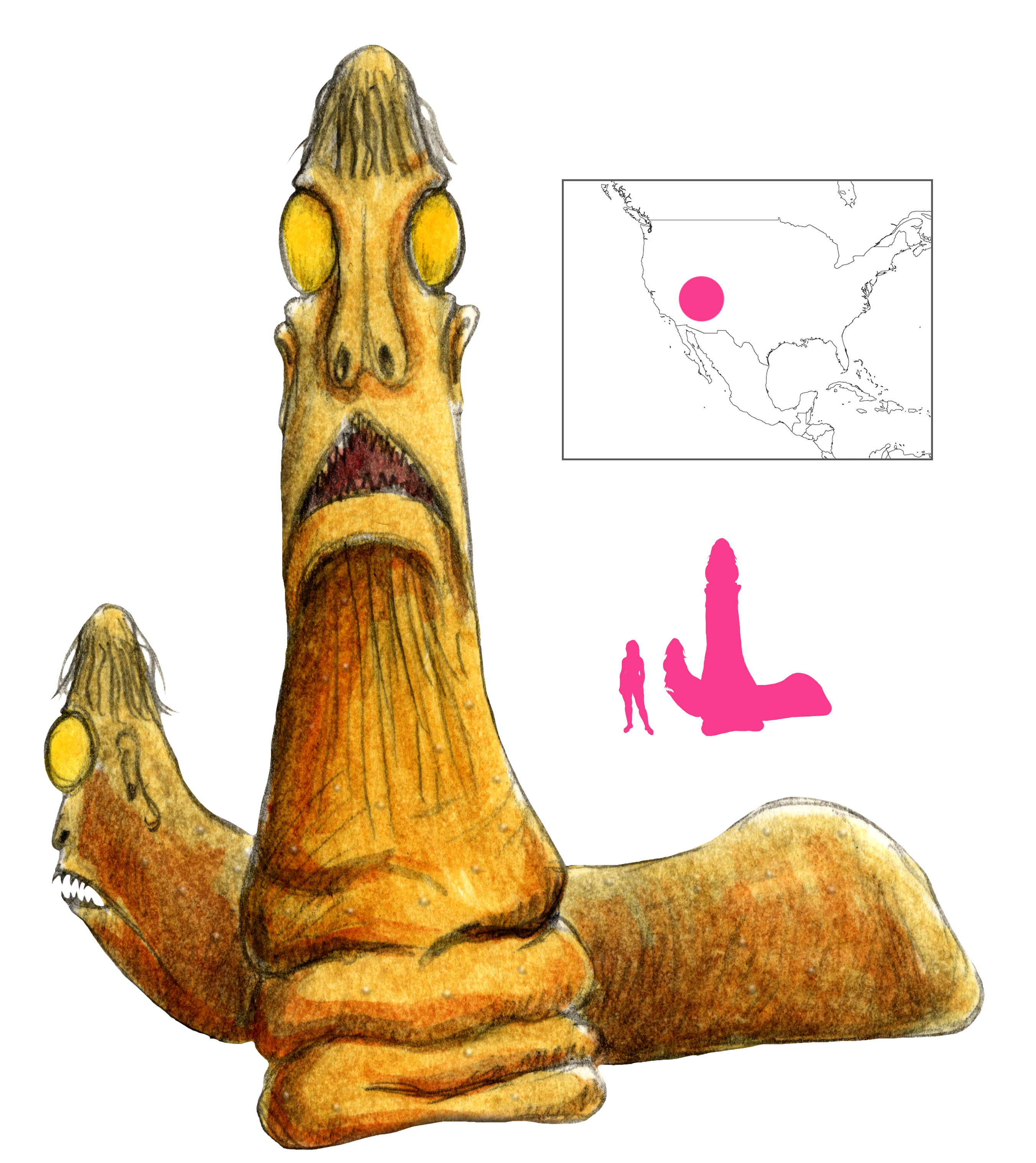
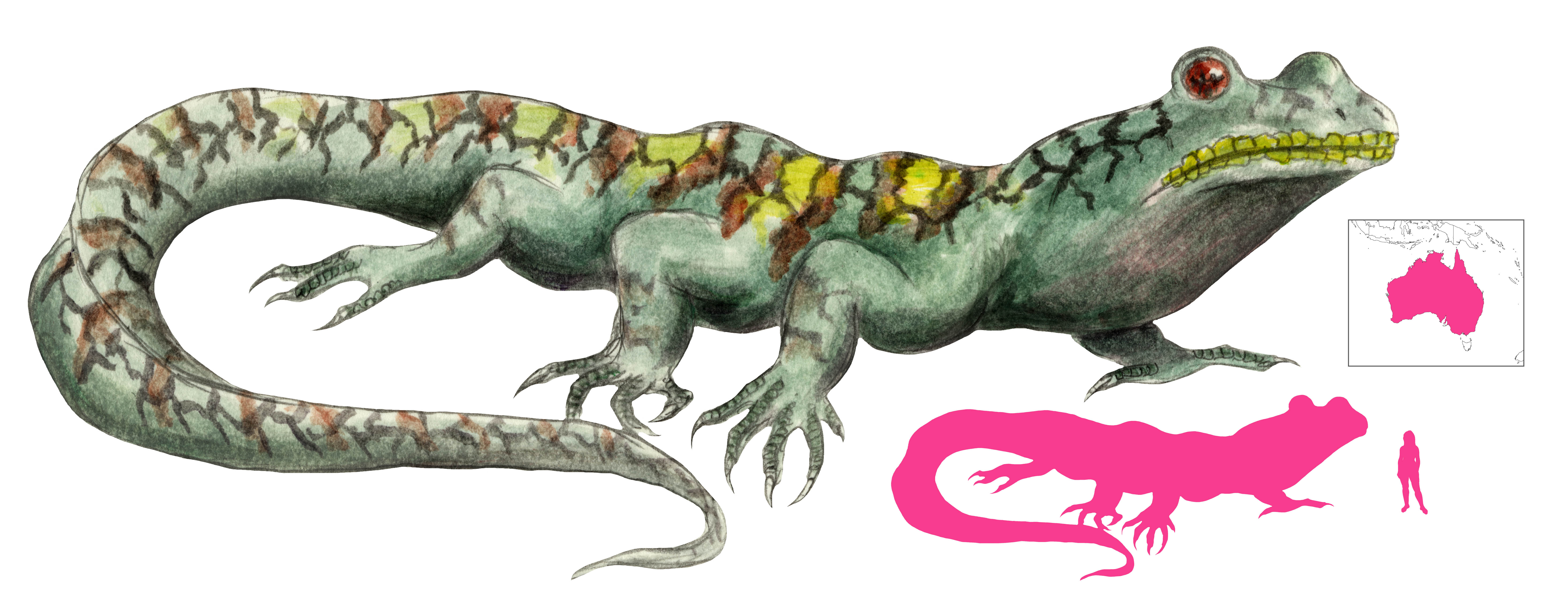
The Whowie was the terror of the Murray River in the Riverina district of Australia. He was like an enormous goanna, about twenty feet long, with six goanna legs and a huge frog-like head; he was perhaps somewhat like the huge monitor lizards that once roamed southern Australia. While very slow in his movement, he had no reason to be fast, as everyone fleed in terror from him. At night, the whowie would crawl into grounds where people were sleeping, and proceed to devour anyone who couldn’t get away. Thirty to sixty people could disappear down his cavernous mouth during one of those raids. During the day he would sleep in his cave on the Murray River, or bask along the riverbank; his movements created the sandhills of Riverina.

With the passage of time, the depredations of the whowie were starting to take their toll on the inhabitants. The water-rat tribe was first to convene, as they had suffered most from the whowie’s attention. The chief solemnly announced that they had no choice but to flee to a safer land or face certain annihilation. “I shall let you decide what we shall do”, he told his people. It was an elder who stood up and implored his people to stay. “We have lived here all our lives; we have always had plenty to eat, and much to do along the river. Now we dare not go there because of the whowie. Let us think of some other way by which we may be rid of this menace”.

A strict night guard was instated, and the aid of several other tribes was called for. The water-rats searched for the whowie, and found footprints leading into the cave’s one opening. As the whowie’s cave was many miles long, they knew it would take a week for him to return to the outside, and so they had all the time they needed.

Soon help had arrived from all over, from the kangaroo, platypus, eagle, magpie, cockatoo, lizard, snake, opossum and crow tribes, and many more besides. After holding a corroboree and spending a night in celebration, dancing, and storytelling, all of them busied themselves gathering sticks. The sticks were gathered into bundles and piled up halfway in the cave and at the entrance. Then, when they believed the whowie was soon to appear, they set the wood on fire.

Smoke and flames filled the cave, and the whowie roared and coughed angrily – but what good were his teeth and claws against smoke and fire? He struggled upwards through the cave for six days and appeared on the seventh burned, blinded, and gasping for breath. That was when the tribes descended upon him with spears, axes, and nulla-nullas, inflicting mortal wounds on their enemy. The giant lizard could only drag himself back into his cave, and was never seen again.

Now the whowie can still be heard sighing from deep inside the cave on the Murray River. He is dying, or perhaps his spirit has survived underground in some form. But either way he is harmless, and has become nothing more than a bogey with whom parents can threaten their children into good behavior.

References

Molnar, R. E. (2004) Dragons in the Dust. Indiana University Press, Bloomington.

Reed, A. W. (1965) Myths and Legends of Australia. A. H. and A. W. Reed, Sydney.

Smith, W. R. (2003) Myths and Legends of the Australian Aborigines. Dover Publications, Mineola.

Tiddalik

Variations: Tiddalick, Karaknitt

Tiddalik

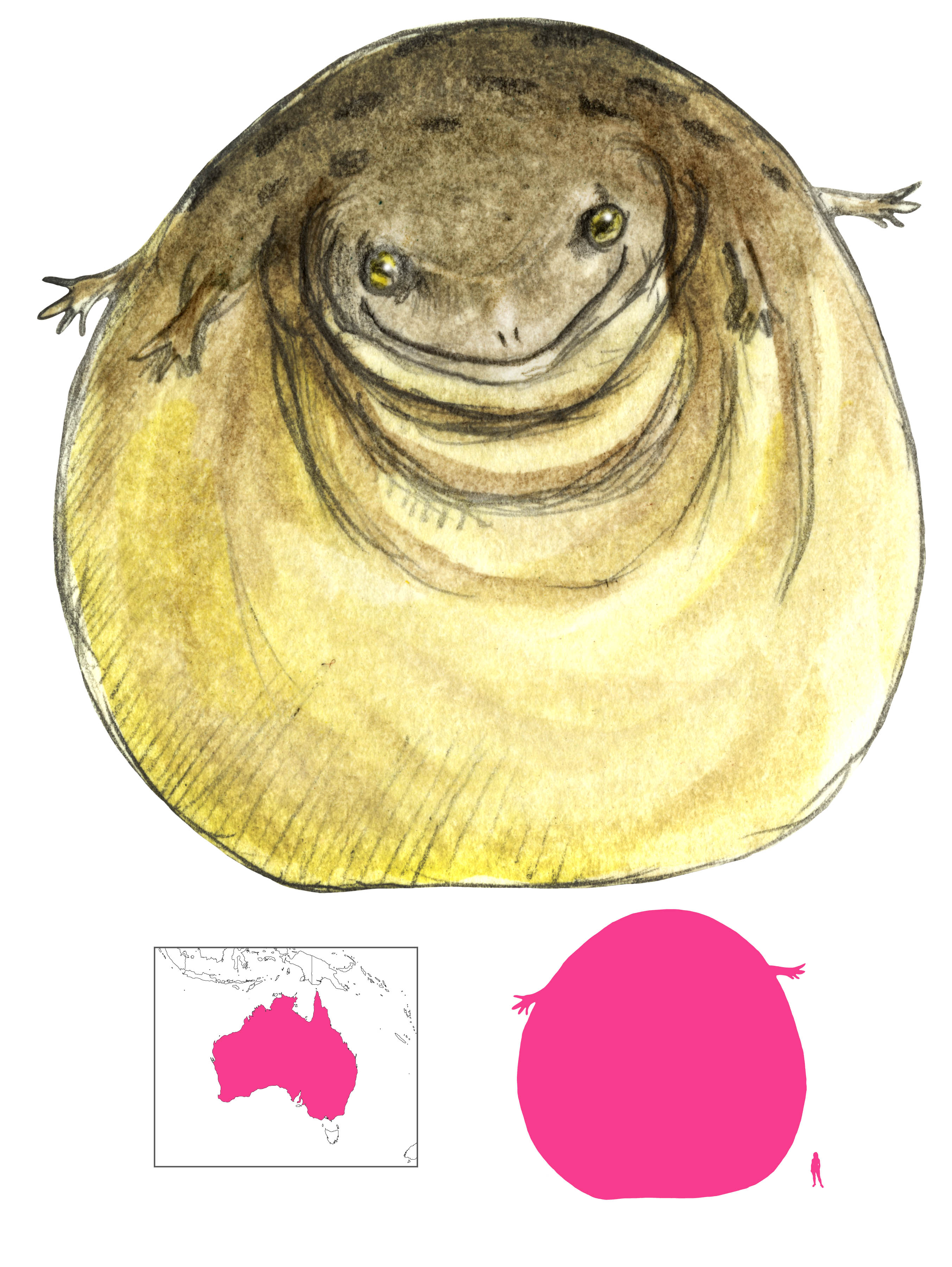
Tiddalik the frog was thirsty. He got up one day in the Australian bush and decided he needed more water. He began by drinking down all the water in his pond. After that, he crawled out of the hole left behind and drained the nearby waterholes. Then he swilled down the closest river, and followed its tributaries, drinking them down one by one. Billabongs and lakes were gobbled up, and Tiddalik grew bigger and bigger. Finally, once there was no water left in sight, Tiddalik stopped. He was now a bloated, mountainous creature filled with water and incapable of moving. He could only sit there and stare, content at last.

Soon, as the lack of water became painfully evident, the animals started to gather around Tiddalik. His size and thick skin made him impervious to anything they could do, and rain was nowhere in sight. It was Goorgourgahgah, the Kookaburra, who hit upon the solution. “We must make him laugh”, he said. “That way he’ll open his mouth and all the water will come out”.

As the champion laugher, Goorgourgahgah went first. He flew in front of Tiddalik’s face, laughing at the top of his lungs. He tumbled in the air, told jokes, and guffawed till he was hoarse. Tiddalik blinked impassively.

All the other animals tried their luck. Kangaroo turned somersaults. Koala made weird noises. Frilled Lizard ran around with his frill open. Wombat rolled around in the dirt. Brolga danced and squawked. But nothing they did seemed to get to Tiddalik, and the more they tried the thirstier they got. The monstrous frog merely continued to observe them with his globular eyes.

Then, as the other animals began to despair, Noyang the Eel stepped solemnly up. Everyone held their breath as Noyang straightened and balanced precariously on his tail. A ripple went through Tiddalik’s bloated body. Noyang began to twist and contort himself, forming hoops, spirals, springs, whirling around like a top… Tiddalik’s smile broadened, and he started to shake. Finally, Noyang tied himself in knots, and Tiddalik started to laugh hysterically – and all the water he held inside poured out, flooding the land before returning to its rightful place. Many died in the flood; Pelican took it upon himself to save as many as he could, but got aggressive when the human woman he wanted for a wife refused him. He painted his black feathers white to go to war, but was accidentally killed by another pelican who didn’t recognize him – pelicans today are both black and white in his honor.

When all had cleared, Tiddalik had shrunken back into a tiny frog once more. He had laughed so hard that he lost his voice, and could only croak hoarsely. Today, his descendants the water-holding frogs (Cyclorana platycephala) still practice every night in the hopes of regaining that voice, and still try to drink large quantities of water on a much smaller scale.

After losing all the water of the world, Tiddalik also came to resent anyone who tried to hoard water for themselves. When Echidna tried to keep a secret cache of water, it was Tiddalik who followed him and dove into the subterranean pond. “This water belongs to everyone!” he snapped. “You have no right to keep it to yourself!” The other animals punished Echidna by tossing him into a thornbush, and to this day he still has the thorns embedded in his back as a painful reminder of his greed.

References

Morton, J. (2006) Tiddalik’s Travels: The Making and Remaking of an Aboriginal Flood Myth. Advances in Ecological Research, vol. 39.

Ragache, C. C. and Laverdet, M. (1991) Les animaux fantastiques. Hachette.

Reed, A. W. (1965) Myths and Legends of Australia. A. H. and A. W. Reed, Sydney.

Reed, A. W. (1978) Aboriginal Legends: Animal Tales. A. H. and A. W. Reed, Sydney.

Binaye Ahani

Variations: Bina’ye Ayani, Nayie A’anyie, Bina’yeagha’ni, Eye Killers, Evil Eyes

Binaye Ahani

The Binaye Ahani, or “Eye Killers”, were among the many Anaye that were slain by Nayenezgani. As with the other original Anaye or “Alien Gods”, they were born from human women who had resorted to unnatural practices. Their “father” was a sour cactus.

The Binaye Ahani were twins born at Tse’ahalizi’ni, or “Rock With Black Hole”. They were round with a tapering end, no limbs, and depressions that looked like eyes. Their horrified mother abandoned them on the spot, but they survived to grow into monsters; as they were limbless, they remained where they were born. Instead of hunting prey actively, they could fire lightning from their eye sockets and fry anyone who approached them. In time eyes developed in the depressions on their head, and they could kill with their eyes as long as they kept them open. Magpie was their spy, and they had many children who took after them in the worst way.

Nayenezgani prepared for his fight with the Binaye Ahani by taking a bag of salt with him, and found the old twins in a hogan with their offspring. The monsters immediately stared at him, lightning shooting from their bulging eyes, but Nayenezgani’s armor deflected the beams. He responded by throwing salt into the fire, which spluttered and sparked into their eyes, blinding them. With the Binaye Ahani in disarray, Nayenezgani waded in and killed all but the two youngest. He took the eyes of the first Binaye Ahani as trophies.

“If you grew up here, you would only become things of evil”, he told the survivors, “but I shall make you useful to my people in years to come”. To the older one, he said “You will warn men of future events, and tell them of imminent danger”, and it became a screech owl. To the younger he said “You will make things beautiful, and the earth happy”, and it became a whippoorwill.

In other versions the surviving children become a screech owl and an elf owl, while the parents are turned into cacti.

References

Locke, R. F. (1990) Sweet Salt: Navajo folktales and mythology. Roundtable Publishing Company, Santa Monica.

Matthews, W. (1897) Navaho legends. Houghton Mifflin and Company, New York.

O’Bryan, A. (1956) The Diné: Origin Myths of the Navaho Indians. Bulletin 163 of the Smithsonian Institution, Washington, D. C.

Reichard, G. A. (1950) Navaho Religion: A Study of Symbolism. Bollingen Foundation Inc., New York.

Fayette

Fayette

The Fayettes (“little fairies”) live in the Forez region in France, today around the Loire basin. They are believed to be the descendants of the Greek nymphs, having escaped the advance of Christianity in the Mediterranean.

In France they are much tinier versions of their former selves, but their magical powers are undiminished. They guard the caves and forests, and can be seen dancing in the woods of Couroux, in the Beaujolais. Like any self-respecting fairy, they like to abduct children and leave insatiable changelings behind. Those fairy children are best brought to the mouth of a cave and threatened with violence, causing the fayette to return the stolen child. Te, vequio le tio, rends me le mio (“There, here’s yours, return mine”).

During the night, the fayettes do their laundry under the moon. Travellers in the woods are advised to sing at the top of their lungs to make sure they’re not mistaken for threats. At daybreak the fairies dissipate like fog, sometimes leaving behind solid gold washboards that would make anyone’s fortune.

During the day the fayettes take the form of moles, and take pleasure in ravaging gardens. This is why moles have pretty little pink hands.

References

Proth, M. (1868) Au Pays de l’Astrée. Librairie Internationale, Paris.

Sébillot, P. (1904) Le Folk-Lore de France, Tome Premier: Le Ciel et la Terre. Librairie Orientale et Américaine, Paris.

Basilisk

Variations: Cockatrice, Basilisco, Basiliscos, Basiliscus, Basili-coc, Basilicok, Regulus (Small Prince), Codrille, Cocodrille, Cocadrille, Coquatrix, Harmena, Sibilus (Hisser), King of Serpents, Crested Crowing Cobra (potentially)

Basilisk

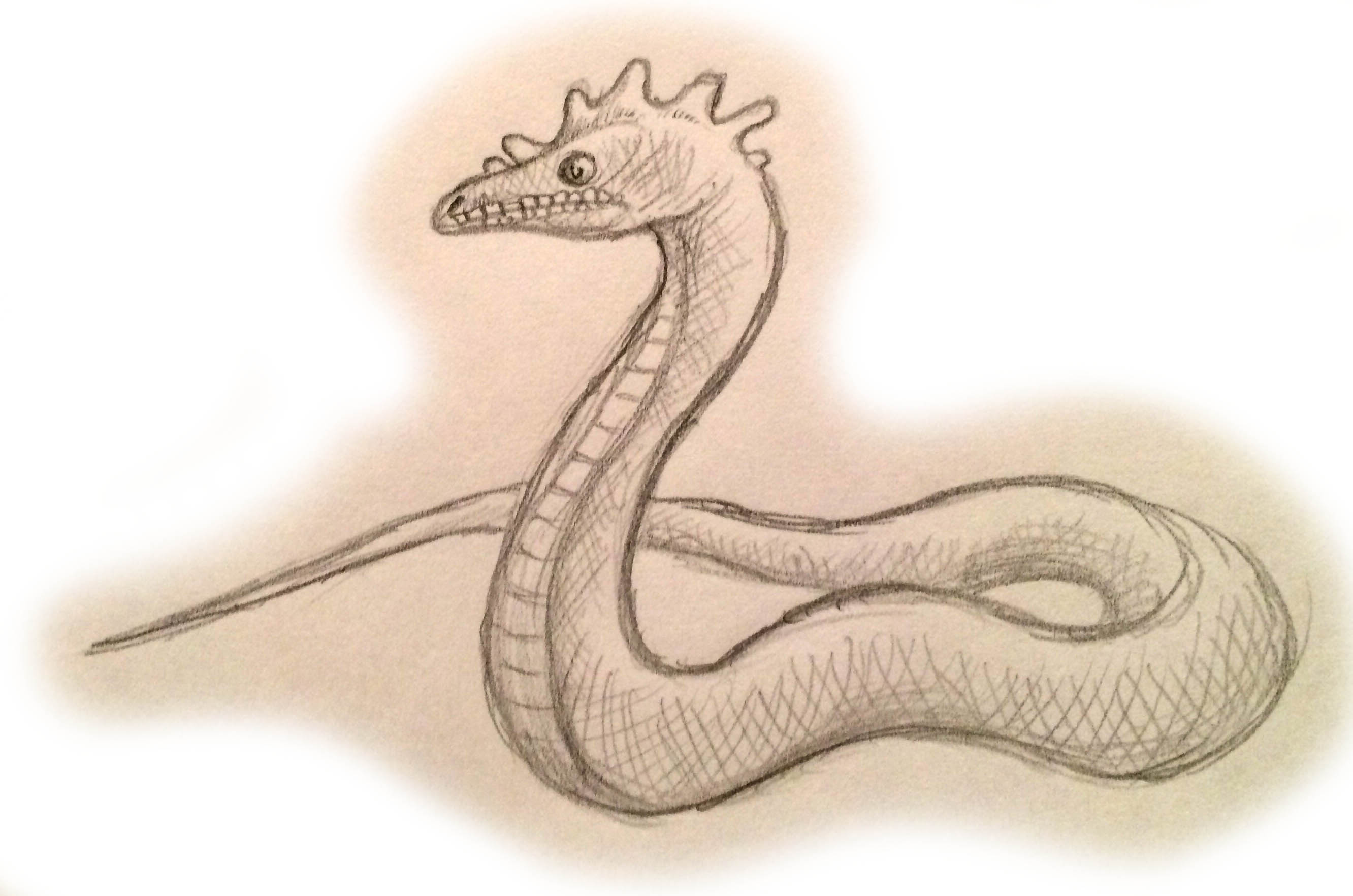
The Basilisk, the “little king” or “king of snakes”, is best known as a creature whose looks kill. Its primary claim to fame is a gaze that instantly kills anyone who sees it, or even anyone it looks at. The basilisk has appeared under a number of guises throughout the centuries, but there are at least a few constants. It is always deceptively small. It is a snake, or at least part snake, with or without rooster characteristics. It always has a crown – whether a white mark, a ring of hornlets, a rooster’s comb, or even a literal crown on its head. And finally, it is always extraordinarily virulent.
bas 1The basilisk is first and foremost a snake, born from the blood of Medusa as were all venomous snakes. It is found in the North African deserts – its very presence causes the desert, and it becomes frantic in the presence of water. At half a foot long, it is far from the biggest snake, but it is the king of snakes, traveling proudly with its head off the ground. It has a white spot or a crown on its head, and white markings down its back.

The exact nature of the basilisk’s deadliness is uncertain, as it is known to kill via venom, odor, and gaze. Murrus, one of Lucan’s soldiers, transfixed a basilisk with his spear, only to see the venom travel up his weapon and start corroding his hand. He survived by amputating his arm before the venom could reach his body. A basilisk can spit its venom skyward, frizzling up birds in flight. Its very gaze is deadly, as it can kill a man merely by looking at him with its gleaming red eyes. The regal nature of the basilisk and its propensity for projecting its venom suggest that cobras or spitting cobras were the origin of the legend.

Basilisks feared only three things: weasels, the crowing of roosters, and their own lethal gaze. The weasel was the only animal immune to the basilisk’s gaze and venom, making it the only natural predator of the king of snakes. Weasels were often sent into caves believed to harbor basilisks. This interaction also recalls that of the cobra and the mongoose. Basilisks also convulsed and died instantly upon hearing the crowing of a rooster. Travelers in the Libyan desert would be well advised to bring a rooster along with them. Topsell denied the possibility of basilisks perishing upon seeing each other, as “it is unpossible that any thing should hurt itself”; nonetheless, a basilisk in Vienna was killed by showing it a mirror.

With the passing of time the nature of the basilisk grew more and more confused. Various Biblical serpents were translated as basilisks. The basilisk gained more avian characteristics, including an origin in rooster eggs, and was confused with Cocodrillus (the crocodile); both of them were dangerous reptiles with small adversaries (the weasel for the basilisk, the hydrus for the crocodile). Further garbling of “cocodrillus” resulted in “cockatrice”. Wycliffe’s Bible had “cockatrice” as a translation of “basilisk”. Chaucer referred to the “basilicok”. With the accumulation of translation, grammar, and etymological errors, the basilisk (or cockatrice) became a hybrid of snake and rooster, with clawed wings, a rooster’s head, and a long serpentine tail (sometimes with an additional head at the end). This is the familiar cockatrice (or basilisk) of bestiaries, and an incarnation of the Devil himself. It further evolved into the alchemical cockatrice, holding its tail in its mouth, symbolizing the alchemical cycle and its mixed nature. The same nomenclatural confusion also gave rise to the Codrille, a basilisk from central France.

Despite efforts to separate the basilisk and the cockatrice – for example, making the basilisk a snake or lizard and the cockatrice a snake-rooster hybrid, or making them both snake-rooster hybrids, one with a snake head and the other with a rooster head – the fact remains that the names basilisk and cockatrice are interchangeable, and refer to the same animal. It is best to accept T. H. White’s statement that the cockatrice is “a medieval muddle” and leave it at that.
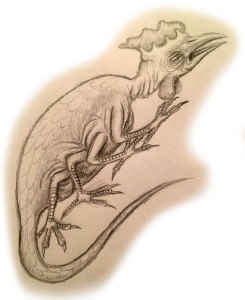
bas 2Cardano reported a basilisk found in the ruins of a demolished building in Milan. This particular specimen was wingless and featherless, with an egg-sized head that looked too large for its body. It had viper fangs, a bulky lizard-like body similar to that of the stellion, and only two stubby legs with catlike claws. The tail was as long as the body, with a swelling at its tip the size of the head. When standing up, it looked like a leathery, naked rooster.

Aldrovandi was apparently inspired by this animal for one of his images of the basilisk, helpfully giving it six more legs. Based on the description and appearance, it appears to have been inspired somewhat by scorpions. Ironically, while this eight-legged depiction has proven particularly enduring, Aldrovandi himself was apparently doubtful of its authenticity, placing this presumed African creature just before a couple rays preserved in the shape of basilisks. The true, snake-like basilisk is given a full-page spread. Aldrovandi also produces a couple of purported basilisk eggs.

Flaubert, taking considerable creative liberties, describes the basilisk as a huge violet snake with a three-lobed crest and two teeth, one on each jaw. It speaks to Saint Anthony, warning him that “I drink fire. I am fire – and I breathe it in from mists, pebbles, dead trees, animal fur, the surface of swamps. My temperature sustains volcanos; I bring out the gleam of gems and the color of metals.”

Finally, Hichens’ “crowing crested cobra” of sub-Saharan Africa appears to be some kind of basilisk. It resembles a cobra, but with a crest on its head and the call of a rooster.
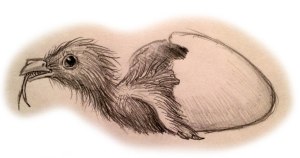
bas 3The life cycle of the basilisk is involved and complicated. The Egyptians believed it to be born from the egg of the ibis, while Neckham blames chickens. Basilisks are born from round shell-less eggs laid by old roosters in the summer (on a dungheap, in some accounts). Those eggs have to be incubated by a snake, a toad, or the rooster itself, eventually producing little terrors ready to kill at birth. As roosters may develop concretions that resemble eggs, and hens may look like roosters, any such fowl that seemed to be a male chicken laying an egg was immediately put to death. In 1474, one such heretical chicken was burned at the stake in Basle, in front of a large crowd.

The only plant immune to the withering gaze of the basilisk is rue, which is consumed by weasels to protect themselves from their enemies. Remedies for basilisk envenomation will always contain rue. A dead basilisk will ward away spiders, and one such basilisk carcass in Diana’s temple kept swallows at bay.

Borges quotes Quevedo as giving the paradox of the basilisk: its existence cannot be proven, as anyone who sees it and survives is a liar, and anyone who sees it and dies will not tell the tale.

The basilisk of biology, or Jesus Christ Lizard (Basiliscus) is a completely harmless South American lizard, known for walking on water. The lethal powers of the basilisk were also transposed by European settlers onto rattlesnakes, and the Mexican West Coast rattlesnake still bears the name of Crotalus basiliscus.

References

Aelian, trans. Scholfield, A. F. (1959) On the Characteristics of Animals, vol. I. Harvard University Press, Cambridge, Massachusetts.

Aldrovandi, U. (1640) Serpentum, et Draconum Historiae. Antonij Bernie, Bologna.

Barber, R. (1993) Bestiary. The Boydell Press, Woodbridge.

Borges, J. L.; trans. Hurley, A. (2005) The Book of Imaginary Beings. Viking.

Breiner, L. A. (1979) The Career of the Cockatrice. Isis, vol. 70, no. 1, pp. 30-47.

Breiner, L. A. (1979) Herbert’s Cockatrice. Modern Philology, vol. 77, no. 1, pp. 10-17.

Brown, T. (1658) Pseudodoxia Epidemica. Edward Dod, London.

Bulfinch, T. (1997) The Age of Fable. Macmillan, New York.

Cardano, G.; le Blanc, R. trans. (1556) Les Livres de Hierome Cardanus Médecin Milannois. Guillaume le Noir, Paris.

Evans, E. P. (1987) The Criminal Prosecution and Capital Punishment of Animals. Faber and Faber, London.

Flaubert, G. (1885) La Tentation de Saint Antoine. Quantin, Paris.

Hargreaves, J. (1983) The Dragon Hunter’s Handbook. Armada.

Hichens, W. (1937) African Mystery Beasts. Discovery (Dec): 369-373.

Isidore of Seville, trans. Barney, S. A.; Lewis, W. J.; Beach, J. A.; and Berghof, O. (2006) The Etymologies of Isidore of Seville. Cambridge University Press, Cambridge.

Lemnius, L. (1658) The Secret Miracles of Nature. Jo. Streater, London.

Liss, A. R. (1987) A Basilisk by Any Other Name… Teratology 35, pp. 277-279.

Lucan, trans. Rowe, N. (1720) Pharsalia. T. Johnson, London.

Pliny; Holland, P. trans. (1847) Pliny’s Natural History. George Barclay, Castle Street, Leicester Square.

de la Salle, L. (1875) Croyances et légendes du centre de la France, Tome Premier. Chaix et Cie., Paris.

Sax, B. (1994) The Basilisk and Rattlesnake, or a European Monster Comes to America. Society and Animals, vol. 2, no. 1.

Topsell, E. (1658) The History of Serpents. E. Cotes, London.

White, T. H. (1984) The Book of Beasts. Dover Publications, New York.
Haemorrhois

Variations: Haemorrhous, Haemorrhe, Blood-letter, Blood-flower, Affodius, Afudius, Alsordium, Halsordium, Sabrine (Topsell gives the last five as corrupted, barbarous versions)

Haemorrois

The Haemorrhois – “bleeder” or “blood-letter” – is one of the many Saharan snakes feared for its venom. True to its name, it produces a violent hemotoxin that forces its victims’ blood out of their bodies. Topsell seemed uncertain as to whether it was an asp or a viper, but its appearance and effect of its venom strongly imply a viper.

Descriptions of the haemorrhois consistently agree that it is one foot long and has horns of some sort. Aelian gave it bristling horns, but Aldrovandi sets the number to one. It is pitch black or fiery in color, with bright eyes; Topsell believed it to be sandy yellow with black spots. The head is broad, tapering to a short, pointed tail. The scales of a haemorrhois are rough and make a rustling sound as the snake moves, suggesting that it may have been inspired in part by the saw-scaled viper. They are slow and sluggish animals, and make winding nests in rocky areas.

Sexual dimorphism is known. Males tend to hold their head up when traveling, while females remain close to the ground. Aelian adds that the venom of female haemorrhois specifically targets the gums and fingernails.

Envenomation by a haemorrhois is particularly gruesome. As the venom spreads, blood begins to leave by every opening possible, draining out through the eyes, ears, nostrils, mouth, even the very pores. Scars reopen. Teeth and nails fall out. The entire body becomes one bleeding wound, and death comes through catastrophic blood loss. Lucan, in describing the fate of young Tullus, compared the dying Roman to a statue gushing water, weeping and sweating blood.

One of these snakes was encountered by Menelaus and his men in Egypt. Helen crushed it and extracted its poison for reasons unknown. Since then, all haemorrhois have been slow creepers.

Topsell recommends a number of substances as antidotes to haemorrhois bite. These cures include vine-leaves with honey; powdered haemorrhois head taken with water; garlic with fleur-de-lis oil as an emetic; and raisins. To staunch the bleeding, plasters made of vine leaves and honey or purslane and barley leaves should be applied, and the wound washed with cold water. Finally, he concedes that the same remedies used for other snakes may prove effective. Hard eggs with salted fish, or a potion of radish seeds, poppy juice, lily roots, daffodil, rue, trefoil, cinnamon, cassia, and sweet myrrh can help.

References

Aelian, trans. Scholfield, A. F. (1959) On the Characteristics of Animals, vol. III. Harvard University Press, Cambridge, Massachusetts.

Aldrovandi, U. (1640) Serpentum, et Draconum Historiae. Antonij Bernie, Bologna.

Batinski, E. (1992) Cato and the Battle with the Serpents. Syllecta Classica, Vol. 3, pp. 71-80.

Eldred, K. O. (2000) Poetry in Motion: the Snakes of Lucan. Helios 27.1, p. 63.

Isidore of Seville, trans. Barney, S. A.; Lewis, W. J.; Beach, J. A.; and Berghof, O. (2006) The Etymologies of Isidore of Seville. Cambridge University Press, Cambridge.

Lucan, trans. Rowe, N. (1720) Pharsalia. T. Johnson, London.

Topsell, E. (1658) The History of Serpents. E. Cotes, London.

Aksar

Aksar

Among the cavalcade of creatures Anthony faces in the Temptation is Aksar, described as “the python Aksar, sixty cubits long, who terrified Moses”. Thompson, drawing heavily from Flaubert, uses the basilisk of the Temptation for the appearance of Aksar, describing him as seventy cubits long, violet-colored, with a three-lobed crest and a single tooth in each jaw. He repeats Moses’ fear of Aksar, making him “the avatar of God’s red justice flaming far” and “the visible embodiment of all that is horrible, the incarnation of a desolation not merely physical, but of the soul.”

Flaubert derived Aksar from Bochart’s Hierozoicon. The original Aksar is far stranger than Flaubert leads us to believe.

Aksar is a monster of the apocalypse from Arabian legend. He is sixty cubits (almost 30 meters) long, and has the head of an ox, the eyes of a pig, the ears of an elephant, the antlers of a stag, the neck of an ostrich, the forequarters of a lion, the hindquarters of a cat, the tail of a ram, the legs of a camel, and the color of a leopard. There is no mention of any python characteristics.

God dragged Aksar out from his lair and brought him before Moses, who was greatly alarmed and requested the beast be removed from his sight. At the end of days, it is said Aksar will fly out with Moses’ staff, using it to mark people’s faces as “believers” or “unbelievers”.

There are some who say there is more than one of these creatures. Those people are hopefully mistaken.

References

Bochart, S. (1675) Hierozoicon. Johannis Davidis Zunneri, Frankfurt.

Flaubert, G. (1885) La Tentation de Saint Antoine. Quantin, Paris.

Seznec, J. (1943) Saint Antoine et les Monstres: Essai sur les Sources et la Signification du Fantastique de Flaubert. PMLA, Vol. 58, No. 1, pp. 195-222.

Thompson, J. W. (1921) The Lost Oracles: a Masque. W. M. Mill, Chicago.

Davalpa

Variations: Devalpa, Dawal-bay, Himantopus, Himantopode, Sciratae, Shaikh al-Bahr, Old Man of the Sea, Tasma-pair, Nasnas (erroneously)

Davalpa

“Would you be so kind as to carry me across the river?” The Davalpa, or “strap-leg”, looks up at you as he begs in a wheedling voice. It’s hard to deny the old man this one favor. He’s hunched, frail, and withered, dressed in rags which cover his entire body. It can’t hurt to help him, and you easily lift him up onto your shoulders. It is then that his legs appear – long, leathery straps that burst out of his clothes and wrap themselves around your neck. You find yourself barely able to breathe, staggering under your charge’s weight, all while the davalpa cackles and whips you, ordering you to move where he wishes. You’re his prisoner now, and will remain so until your death.

That is how davalpas catch their victims. Their legs, while 3 meters long and powerful, do not let them move around normally, and so they use unwilling humans as their mounts. Sometimes they have multiple long snakelike legs that erupt out of their belly, and a tail they use to whip their mounts. Sometimes they constrict their victims to death, a merciful fate compared to the slavery they impose.

Davalpas can be found in the Iranian deserts and on uncharted islands in the Indian Ocean, where they sit by the side of the road and wait for potential rides to show up. The most famous davalpa was the Old Man of the Sea, which Sindbad the Sailor met on his fifth voyage. The Old Man successfully enslaved Sindbad, forcing him to do his bidding, but Sindbad managed to escape the creature’s clutches by fermenting grape juice and offering it to him. After getting drunk, the Old Man’s grip loosened and he fell off; Sindbad smashed his head with a rock.

Sindbad’s adventure with the Old Man of the Sea is almost an exact copy of previous accounts. Al-Qazwini locates the davalpas on Saksar Island, which they share with the cynocephali. A sailor tells the story of how a strange person wrapped his legs around his neck and enslaved him, forcing him to pick fruits. He escaped by fermenting grapes and inebriating the davalpa; the experience left him with scars on his face.

Al-Jahiz refers to the creature as dawal-bay in Arabic. As with the Waq-waq, he believes it to be a cross between plants and animals.

Oddly enough, the davalpa is not of Persian origin. The earliest mention of davalpas is from Alexander’s Romance, where they are called the “savage Himantopodes” and share their land with Cynocephali, Blemmyes, Troglodytes, and other strange races. Himantopus means “strap foot”, and is currently in use today for the black-winged stilt, a shorebird with long slender legs. Pliny specifies that those strap-foots are incapable of walking, and get around by crawling; later he describes the snub-nosed, bandy-legged Sciratae, which seem to be one and the same.

One possibility is that the davalpa was inspired by apes, which can cling tightly and whose shorter legs might be less apparent at first glance. More intriguingly, Tornesello suggests that the various monstrous races of Hellenic myth arose from recollections of foreign soldiers during the Greco-Persian wars. The Sagartians in Xerxes’ army rode horses and used twisted leather lariats to entangle and kill enemies. The parallels with them and the davalpas include the leather-strap weapon, its use in strangling people, and the apparent incapability of walking (the Sagartians were always on horseback). Sagartioi can also be seen as the linguistic ancestor of Skiratoi.

Thus the davalpa concluded its journey. Inspired by Greek distortions of Persian warriors, it found its way back to Persia where it had lost all of its previous subtext and gained entirely new meaning. Today modern Iranian satirists and cartoonists have used the davalpa to represent greedy, parasitic institutions – especially helpful if those institutions disapprove of direct criticism.

References

Browne, E. G. (1893) A Year Amongst the Persians. Adam and Charles Black, London.

Christensen, A. (1941) Essai sur la Démonologie Iranienne. Ejnar Munksgaard, Copenhagen.

del Hoyo, J.; Elliott, A.; Sargatal, J.; Christie, D.A.; & de Juana, E. (eds.) (2013) Handbook of the Birds of the World Alive. Lynx Edicions, Barcelona.

Al-Jahiz, A. (1966) Kitab al-Hayawan. Mustafa al-Babi al-Halabi wa Awladihi, Egypt.

Marashi, M. (1994) Persian Studies in North America. Iranbooks, Bethesda.

Masse, H. (1954) Persian Beliefs and Customs. Behavior Science Translations, Human Relations Area Files, New Haven.

Al-Qazwini, Z. (1849) Zakariya ben Muhammed ben Mahmud el-Cazwini’s Kosmographie. Erster Theil: Die Wunder der Schöpfung. Ed. F. Wüstenfeld. Dieterichsche Buchhandlung, Göttingen.

Ricks, T. M. (1984) Critical Perspectives on Modern Persian Literature. Three Continents Press, Washington D. C.

Tornesello, N. L. (2002) From Reality to Legend: Historical Sources of Hellenistic and Islamic Teratology. Studia Iranica 31, p. 163-192.

Chimera

Variations: Chimaera, Chimaira

Chimera

The Chimera or Chimaera (“goat”) was the daughter of Typhon and Echidna. She was the terror of Lycia in southern Turkey, killing people and livestock and torching crops.

Homer describes her as being a lion in front, a serpent behind, and a goat in the middle, with the power of breathing fire. Hesiod specifies that she had three heads. The lion’s head was in its customary place, the snake’s head was on the end of the tail, and the goat’s head emerged tumorously from the middle. Hyginus gives all three heads the ability to breathe fire, while Apollodorus states that only the goat head could do so, functioning as some kind of shoulder-mounted flamethrower.

While Homer’s description might suggest a lion’s head, a goat’s body, and a snake’s tail, the Chimera has been consistently represented in Greek art with multiple heads. Usually she is mostly lion with a snake tail; the goat has proven tricky to depict convincingly, ranging from a head to the entire front half of a goat. Some Etruscan renditions add wings. The iconography behind the Chimera may go back farther, and may be of Asian origin. The term has also been used to describe various unrelated hybrid animals, with or without multiple heads.

She was finally slain by Bellerophon, who had been sent to Lycia to die. The wife of King Proitos had fallen madly in love with him; after he rejected her advances, she told her husband that Bellerophon had tried to seduce her. Enraged, the king dispatched Bellerophon to Iobates of Lycia, bearing a message requesting him to kill the messenger. Iobates sent him to battle the Chimera – surely an impossible task.

But Bellerophon had the favor of the gods, and the aid of the winged horse Pegasus. Mounted on Pegasus’ back, he easily flew out of range of the Chimera’s fiery breath, and shot her to death with arrows. Some accounts add that he rammed a lump of lead into her throat, where it melted and suffocated her.

Chimera bwChimera was a study in contradictions. Her three components did not make any sense together. Her name meant “goat”, but the goat was the least coherent part of her, reduced to a mere head in an anatomically dubious position. Evidently something so contradictory as the Chimera needed a rational explanation, even to the ancient Greeks. Plutarch believed she was inspired by a pirate captain, whose ship was decorated with the three component animals. Servius Honoratus said she was a loose interpretation of the Lycian landscape. Mount Chimera was a volcano, with snakes at its base, goats wandering around its heights, and a pride of lions at the top. Bellerophon, arriving on his ship Pegasus, set fire to the mountain and eradicated the dangerous animals.

The Etruscans dedicated the Chimera to the supreme god Tinia. The Etruscan Arezzo bronze of the Chimera remains the most enduring image produced of her. As a hybrid she was both celestial and chthonic, representing the year and the seasons. The lion, hot and strong, was summer; the snake, cold and ground-dwelling, was winter; and the transitory goat was spring and summer.

In The Temptation of Saint Anthony, the Chimera is a great, green-eyed, dragon-winged creature with a luxuriant mane; she is as capricious as desire and imagination. She reveals breathtaking new perspectives to humans, pours insanity, ambitions, hopes, and dreams into their minds, drives people to dangerous quests, and kills anyone content in wisdom. She is woefully incompatible with the rational, stoic Sphinx, and their attempts at copulation fail.

“Chimera” has entered our vocabulary in a number of ways, always in reference to incongruity. A chimera or something chimeric is fanciful, improbable, and imaginary. A chimera can also mean an organism with distinct cells from different zygotes. Finally, Chimaera is a genus of deep-sea fish, named after its bizarre appearance.

References

Bazopoulou-Kyrkanidou, E. (2001) Chimeric Creatures in Greek Mythology and Reflections in Science. American Journal of Medical Genetics 100:66-80.

Borges, J. L.; trans. Hurley, A. (2005) The Book of Imaginary Beings. Viking.

Flaubert, G. (1885) La Tentation de Saint Antoine. Quantin, Paris.

Hesiod; trans. Elton, C. A. (1832) The Theogony. In Hesiod. A. J. Valpy, London.

Homer, trans. Buckley, T. A. (1851) The Iliad of Homer. Henry G. Bohn, London.

Locatelli, D. and Rossi, F. (2010) Les Étrusques: Pouvoir – religion – vie quotidienne. Série Civilisations, Hazan.

Roes, A. (1934) The Representation of the Chimaera. The Journal of Hellenic Studies, Vol. 54, Part 1, pp. 21-25.

Schmitt, M. L. (1966) Bellerophon and the Chimaera in Archaic Greek Art. American Journal of Archaeology, Vol. 70, No. 4, pp. 341-347.

Smith, R. S. and Trzaskoma, S. M. (2007) Apollodorus’ Library and Hyginus’ Fabulae. Hackett Publishing Company, Indianapolis.

Till, B. (1980) Some Observations on Stone Winged Chimeras at Ancient Chinese Tomb Sites. Artibus Asiae, Vol. 42, No. 4, pp. 261-281.

Teelget

Variations: Teel get, Teelgeth, Delgeth

Teelget

As one of the Anaye, the “Alien Gods” of Navajo folklore, Teelget was born from a human woman who resorted to unnatural and evil practices. In this case, his “father” was an antler. The creature born was round, hairy, and headless, and was cast away in horror; it was this creature that grew into the monster known as Teelget.

The origin of Teelget’s name is not known with certainty, but the “tê” makes reference to his horns. He is like an enormous, headless elk or antelope, rounded in shape, hairy like a gopher, with antlers he uses as deadly weapons. Coyote was his spy, and between him and the other Anaye they laid waste to the land, slaughtering many.

It was Nayenezgani, “Slayer of Alien Gods”, who finally put an end to Teelget’s reign of terror. Armed with his lightning arrows, the hero tracked Teelget down, finding the monster resting in the middle of a wide open plain.

How was Nayenezgani to sneak up on Teelget without being noticed? The grass offered no cover, and Teelget was sure to detect him and retaliate. As he considered his options, he was greeted by Gopher. “Why are you here?” said Gopher. “Nobody comes here, for all are afraid of Teelget”. When Nayenezgani explained that he was here to destroy Teelget, Gopher was more than happy to help. He said that he could provide a way to reach Teelget, and all he asked for as payment was the monster’s hide.

Gopher then excavated a tunnel that led right under the sleeping Teelget’s heart, and dug four tunnels – north, south, east, and west – for Nayenezgani to hide in after Teelget woke up. He even gnawed off the hair near Teelget’s heart, under the pretext that he needed it to line his nest.

That was all Nayenezgani needed. He crawled to the end of the tunnel and fired a chain-lightning arrow into Teelget’s heart, then ducked into the east tunnel. Enraged and in agony, Teelget gouged the east tunnel open with his antlers, only to find that Nayenezgani had moved to the south tunnel. He destroyed that, then the west tunnel, but he only managed to put an antler into the north tunnel before succumbing to his injury.

Nayenezgani couldn’t tell if Teelget had died or not, so Ground Squirrel volunteered to inspect. “Teelget never pays attention to me”, he explained. “If he is dead, I will dance and sing on his antlers”. Sure enough, Ground Squirrel celebrated on top of the fallen monster, and painted his face with Teelget’s blood; ground squirrels still have streaks on their face after that day. In some retellings Chipmunk fills this role, painting stripes down his back.

A chunk of antler and a piece of liver were taken by Nayenezgani as trophies, but Gopher went to work at once skinning Teelget. “I will wear his skin, so that when humans increase once more, they will be reminded of Teelget’s appearance”. And to this day, rounded, hairy gophers still wear the skin that Teelget once wore.

References

Alexander, H. B. (1916) The Mythology of All Races v. X: North American. Marshall Jones Company, Boston.

Locke, R. F. (1990) Sweet Salt: Navajo folktales and mythology. Roundtable Publishing Company, Santa Monica.

Matthews, W. (1897) Navaho legends. Houghton Mifflin and Company, New York.

O’Bryan, A. (1956) The Diné: Origin Myths of the Navaho Indians. Bulletin 163 of the Smithsonian Institution, Washington, D. C.