Devil-jack Diamond-fish

Variations: Diamond fish, Devil fish, Jack fish, Garjack, Litholepe, Litholepe adamantin, Litholepis adamantinus

Devil-jack Diamond-fish

John James Audubon is remembered today as an artist and ornithologist of considerable import. His practical jokes are less well known, and began with the unexpected arrival of Constantine Samuel Rafinesque at Hendersonville, Kentucky.

Rafinesque was a brilliant, enthusiastic, “exceedingly remarkable”, and very eccentric young naturalist who tested Audubon’s hospitality. After they had retired to bed, Audubon was roused by a commotion coming from Rafinesque’s room. As he describes it, “I saw my guest running naked, holding the handle of my favorite violin, the body of which he had battered to pieces in attempting to kill the bats which had entered the open window!” Rafinesque was convinced the bats were new species. Audubon was not amused.

Perhaps to avenge his smashed violin, Audubon decided to take advantage of Rafinesque’s credulity and eagerness to describe new species. He solemnly supplied Rafinesque with 10 drawings of completely fictitious fish, which were duly named and described in detail. The likes of the bigmouth sturgeon and the flatnose doublefin caused headaches for ichthyologists and tarnished Rafinesque’s reputation beyond repair.

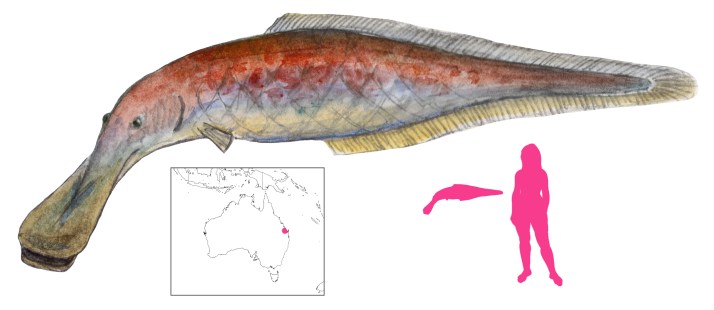
The Devil-jack Diamond-fish (Litholepis adamantinus) is surely the most remarkable of those faux fishes, as evidenced by Rafinesque’s breathless description. This “wonder of the Ohio” is found only as far up as the falls and probably in the Mississippi as well. Rafinesque claimed to have seen it from a distance, and seen some of its scales, but otherwise he “principally relied upon the description and figure given [him] by Mr. Audubon”.

We are fortunate enough to have a complete and detailed description of the devil-jack. It is classified among the garfish but is quite unique. The body is blackish and fusiform, 4 to 10 feet long and up to 400 pounds in weight. The head takes up a fourth of the total length. The snout alone is large (as long as the head), convex above, and obtuse. The eyes are small and black, with the nostrils in front of them. The mouth is transverse and has large angular teeth. Dorsal and anal fins are of equal length, the tail is obtusely bilobed, and there is no lateral line. The body is covered in oblique rows of conical pentagonal brown scales, half an inch to one inch in diameter; they become the color of turtle shell when dried.

The scales are the devil-jack’s main claim to fame, as they are hard as flint, completely bulletproof, and repel hooks. They produce sparks when struck against steel. Only nets or the strongest hooks can take a devil-jack. It is inedible and a voracious hunter, usually seen lying motionless at the surface like a log. The scales are a miracle of nature, for “they strike fire with steel! and are ball proof!” [sic]

References

Jordan, D. S. (1886) Rafinesque. The Popular Science Monthly, June 1886.

Rafinesque, C. S. (1820) Ichthyologia Ohiensis. W. G. Hunt, Lexington, Kentucky.

Fei

Variations: Fei-beast

Fei

The Fei or Fei-beast can be found on Great Mountain, the eighth and last of China’s Eastern Mountains. It is shaped liked an ox, with a white head and a single eye. Its tail is that of a snake.

When a fei moves over grass, the plants below it wither and die. When it crosses a stream, the water evaporates at its touch. Its appearance is an omen of worldwide plague and wars.

References

Mathieu, R. (1983) Étude sur la mythologie et l’ethnologie de la Chine ancienne. Collège de France, Paris.

Strassberg, R. E. (2002) A Chinese Bestiary: Strange Creatures from the Guideways Through Mountains and Seas. University of California Press.

Qinyuan

Variations: Qinyuan-bird, Yuanyuan, Zhiyuan

Qinyuan

Mount Kunlun is the Pillar of Heaven, a place of great energy and endowed of a fiery brilliant aura. Four rivers – Black, Red, Yellow, and Oceanic – flow from Mount Kunlun, and the mountain is administered by the god Luwu, or the Queen Mother of the West Xi-Wangmu in later texts.

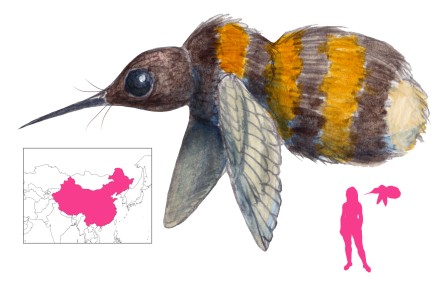
Many wonderful birds and beasts dwell on Mount Kunlun, including the Qinyuan or Qinyuan-bird. It looks like a bee, but is the size of a mandarin duck. Its sting is venomous enough to kill other animals and to wither trees.

Despite the classification as a “bird”, Mathieu believes it to be simply a large stinging insect.

References

Mathieu, R. (1983) Étude sur la mythologie et l’ethnologie de la Chine ancienne. Collège de France, Paris.

Strassberg, R. E. (2002) A Chinese Bestiary: Strange Creatures from the Guideways Through Mountains and Seas. University of California Press.

Roperite

Variations: Rhynchoropus flagelliformis (Cox), Pseudoequus nasiretinaculi (Tryon)

Roperite

The Roperite is one of the few Fearsome Critters found outside the northern lumberwoods. Its home is in the foothills of the Sierra Nevada where the digger pine grows, and it tends to live in herds. An active and gregarious animal, it has not been seen in a while, and there is concern that it may already be extinct.

Roperite biology is a mystery. We know that it is the size of a small pony, and that it has a a remarkable rope-like beak which it uses to lasso its prey. Its skin is leathery and impervious to the thorn and rock of its chaparral habitat. Its legs are well-developed and flipper-like. A. B. Patterson of Hot Springs, CA,  reported a tail with a large set of rattles. It is unknown whether roperites are bipedal or quadrupedal, whether they are fish, fowl, or beast, and whether they lay eggs, give birth to live young, or emerge fully-formed from mountain caves. Local legend has it that they are the reincarnated ghosts of Spanish ranchers.

Roperites run at blistering speed. Their legs give them a gait halfway between bounding and flying. Nothing can outrun them, and no obstacle can slow them down. Even roadrunners are trampled or kicked aside. Roperites are predators that chase down their prey and lasso them with incredible dexterity, then proceed to drag their through thornbushes until they die. The rattles on the tail are used to impressive effect during the chase, intimidating quarry with a whirring din worthy of a giant rattlesnake. Jackrabbits and the occasional lumberjack are taken.

References

Brown, C. E. (1935) Paul Bunyan Natural History. Madison, Wisconsin.

Cox, W. T. (1910) Fearsome Creatures of the Lumberwoods with a Few Desert and Mountain Beasts. Judd and Detweiler, Washington D. C.

Tryon, H. H. (1939) Fearsome Critters. The Idlewild Press, Cornwall, NY.

Ambisiangulo

Variations: Ambize Angulo, Negulla Omasa; Pezze-Mouller, Piexe Molhar (Portuguese), Meermin (Dutch), Sirene (French), Hog-fish, Ambize (erroneously), Angulo (erroneously)

Ambisiangulo

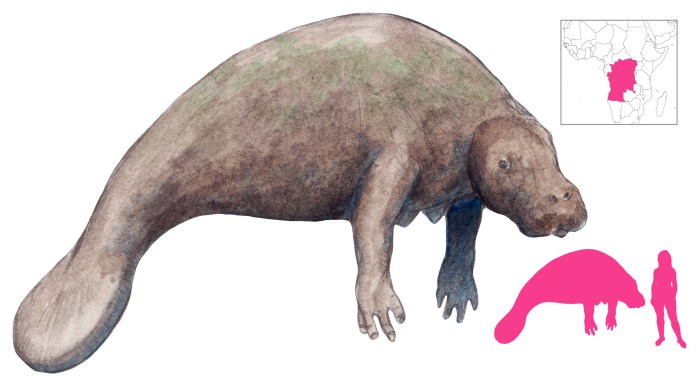
The travelers’ accounts of Purchas and Dapper include the unlikely Ambize Angulo or Ambisiangulo. This creature can be found in several bodies of water, including the Quansa and Zaire Rivers and a number of lakes in the Congo and Angola. Its name is derived from the Kikongo mbisi (“fish”) and ngulu (“pig”); here, preference has been given to Dapper’s name, as it is closer to the original words. It is also known as Pesiengoni, Pezze-Mouller, Meermin, and Sirene in various languages, several translating to “mermaid”.

Mermaid or not, an ambisiangulo is a homely creature. Tipping the scales at 500 pounds, it measures eight feet long and four feet wide, and is a uniform dull grey-brown. The females have a pair of teats and the males have a horse’s member, but they are otherwise indistinguishable. The forehead is high, the head and eyes oval, the mouh large but chinless, the ears reduced to thin, flat skin. The ambisiangulo’s two arms are short, and end in fingers that are long, and triple-jointed like those of humans – but they cannot be flexed. The tail is rounded and shaped like a target.

Ambisiangulos feed on grass growing on the sides of rivers, and never leave the water. Purchas claimed that an ambisiangulo hunt was perilous, but Dapper describes a far more leisurely approach. The ambisiangulos are easily captured and slain with barbed harpoons, despite the lugubrious, eerily human cries of pain they emit. An injured ambisiangulo is allowed to escape, as its slow flight can be followed in a canoe. The flesh is fatty and tastes of pork, earning it its common name. The ear bones cure malaria, and the powdered skull of male ambisiangulos is a remedy against kidney stones. The ribs on the animal’s left side can be prepared into blood-staunching bracelets and protective amulets.

References

Dapper, O. (1676) Naukeurige Beschrijvinge der Afrikaensche Gewesten. Jacob van Meurs, Amsterdam.

Dapper, O. (1686) Description de l’Afrique. Wolfgang, Waesberge, Boom, & van Someren, Amsterdam.

Etambala, M. Z. La faune du Royaume de Congo et de l’Angola dans les récits de voyage et les journaux missionnaires de la fin du XVIe et du XVIIe siècle. In Stols, E.; Werner, T.; and Verberckmoes, J. (2006) Naturalia, Mirabilia & Monstrosa en los Imperios Ibéricos (Siglos XV-XIX). Leuven University Press, Leuven.

Marsy, F. M. (1764) Histoire moderne des chinois, des japonnois, des indiens, des persans, des turcs, des russiens etc. Tome douzieme: histoire des africains occidentaux. Desaint & Saillant, Paris.

Purchas, S. (1626) Purchas His Pilgrimage: or Relations of the World and the Religions observed in all Ages and Places discovered, from the Creation unto this Present. William Stansby, London.

Swan, J. (1643) Speculum Mundi. Roger Daniel, Cambridge.

The Unprecedented Discovery of the Dragon Islands (or TUDDI for short) by John Kelly and Kate Scarborough is a book which I remember very fondly. I first saw it as a child in a bookstore that no longer exists, and my memories of it got so fuzzy that I eventually became convinced I had dreamt it up. Searching for “realistic dragon book”, “living trap monster”, and similar terms led nowhere. Eventually, by some quirk of fate I searched Amazon for “dragon island” and checked the results for the 90s… and there it was. I hadn’t imagined it after all. And since it’s mostly pictures, I’m covering it under Obscure Modern Monsters rather than ABC Reviews (needless to say I give it 5 gigelorums).

You needn’t search for it as you can buy it here and here.

IMG_7013

TUDDI is a big, colorful coffee-table book for children of all ages. It presents itself as the illustrated diary of young Lord Nathaniel Parker as he and his ship get lost at sea, and end up finding a fabulous archipelago where dragons and sea serpents exist. Lord Parker writes to Belinda, his main squeeze, and a lot of TUDDI’s humor comes from his stuffy aristocratisms. The book ends all too quickly and suddenly – sequel hook? It certainly feels like the authors could fill several more “episodes”, but sadly I don’t think they have (if you’re the authors and you’re reading this, take note).

The main reason you would want to read TUDDI as fans of ABC, mythical creatures, speculative biology, speculative evolution, and all-around great art, is the creatures. Some are new takes on old classics, while others are completely new organisms with no equivalents. Even speculative insects and plants are painted in loving detail.

Above you can see TUDDI’s take on the sea serpent. An enormous, sea-going reptile convergent on the whale, complete with baleen. Lord Parker and his friends find a dead one on the beach with ominous sucker markings on its body…

IMG_7016

I’ll just give a small sample of what’s inside. There are unicorns. There are griffons, which hunt in packs, feed on the unicorns, and make a go at our heroes. There are giant ratites with faces that look like the old duck-rabbit illusion. There are carnivorous plants. There are Cambrian relict arthropods. There are aquatic-adapted shrew-things.

IMG_7018

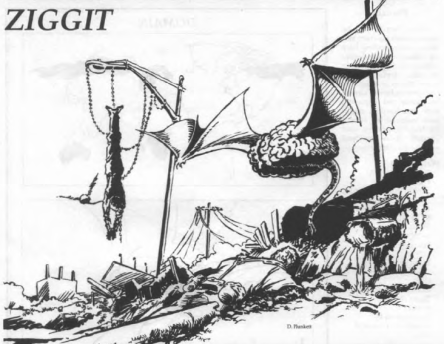
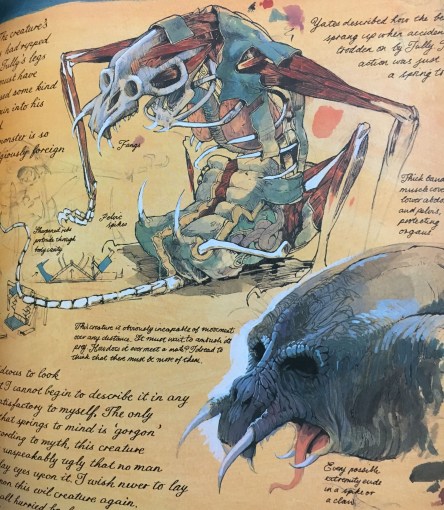
The gorgon is an all-original creation and one of the things I remember most from the book. It’s literally a living bear-trap, one that lies camouflaged amid tree roots and snaps shut on whatever steps on it. It’s a nasty piece of work, and I like that a lot of it is left to the imagination. We’re not even sure what it evolved from, but I’m guessing some kind of primate?

IMG_7019

Of course, it wouldn’t be the Dragon Islands without dragons, would it? The dragons themselves are marvelous organic balloons, big pink bloated floating translucent fire-breathing plankton-straining gilled soarers. They’re exactly as awesome as they sound.

Rolling-calf

Variations: Rolling Calf

Rolling Calf

A duppy is a type of ghost or spirit native to Jamaica. While described as the souls of dead people, duppies have much in common with Old World shapeshifters and roadside tricksters. They may be found in bamboo thickets and cottonwood groves, and feed on bamboo, “duppy pumpkin”, and strangler figs. Duppies appear from seven in the evening till five in the morning, and sometimes at noon. Duppy activities range from simple mischief to arson, beating, burning, poisoning, and stoning, but they are powerless against twins and those born with a caul. A left-handed crack with a tarred whip and the burning of certain herbs keep them away.

Some of the more dangerous duppies include Three-foot Horse, whose breath is poison and which can outrun anything, but which cannot attack those in the shadow of trees. Then there is Whooping-Boy who rides Three-foot Horse while whooping loudly. Long-bubby Susan has pendulous breasts that reach the ground, and which she throws over her shoulders. Old Hige, the witch, is fond of abducting children, but can be confounded by rice thrown on the doorstep – the duppy cannot count above three, but is compelled to count the grains anyway.

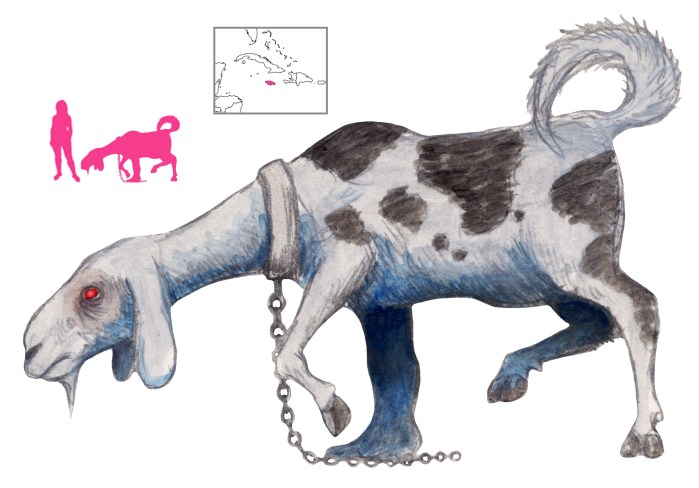
Then there is Rolling-calf, one of the worst and most feared duppies. “Rolling” in this context means “roaming”, as in “rolling through town”. It is a shapeshifter that can appear in a number of guises. The best known is that of a hornless goat, black or white or spotted, with a corresponding caprine stench. One of its front legs is human, the other is that of a horse, and the two hind legs are those of a goat. Its tail curls over its back. Its eyes are red and glow like blazing fires. Flames come from its nostrils. There is a collar on its neck, with a chain that drags on the ground and rattles ominously. The rolling-calf can also appear as a cat, dog, pig, goat, bull, or horse, with the brindled-cat form being particularly dangerous. It can be as small as a cat, or as big as a bull.

A rolling-calf is the soul of a particularly wicked person. Butchers and murderers return as rolling-calves, as do Obeah men; the latter can also set rolling-calves on people. Rolling-calves are found in bamboo and cottonwood as well as caves and abandoned houses, coming out on moonless nights in search of sugar (they are fond of molasses) and breaking into cattle pens.

Rolling-calves can wreak all sorts of evil and blow “bad breath” on their victims, but they can be warded off in a number of ways. Flogging them with a tarred whip always helps, as does sticking an open knife into the ground. Even more useful is the fact that rolling-calves are terrified of the moon to a comical extent.

But whatever method is used to escape a rolling-calf’s clutches, you would be well-advised to leave the premises at once. The rolling-calf will return with a vengeance.

References

Beckwith, M. W. (1924) Jamaica Anansi Stories. G. E. Stechert and Co., New York.

Beckwith, M. W. (1929) Black Roadways: A Study of Jamaican Folk Life. The University of North Carolina Press, Chapel Hill.

Falajitax

Variations: Leile, Leile, Liwo

Falajitax

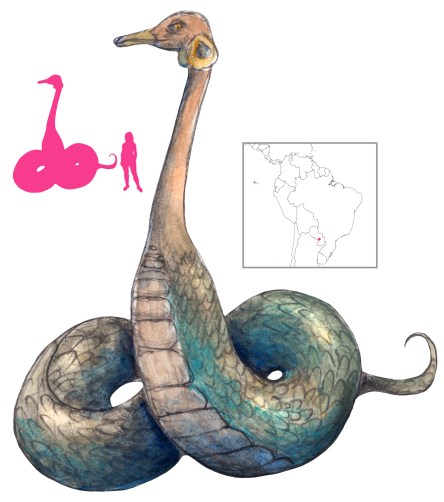
The Falajitax snakes are both violent ogres and benevolent rain-bringers. The Makka of Paraguay believe that they come from humid areas and bring the water with them wherever they go. Most falajitax live in the Chaco forests.

A falajitax has a head like that of a rhea. When it rears up with its body out of sight, it looks exactly like a rhea, and fools many hunters into coming too close. It wears earrings. Its massive serpent body is beautifully colored with eye-catching stripes. But a falajitax need not stick to one form, as it can assume any appearance it wishes, including human and equine guises. A falajitax disguised as a horse can tempt people into riding it, galloping with them into a lake where they drown.

At best, the falajitax are intelligent creatures that can be reasoned with by shamans. Falajitax often protect sources of honey in the forest, and the shaman can placate them by singing and soothing them with a sort of balm. A group of Makka and their shaman were permitted to harvest honey, and the falajitax next guided them to their secret stores of honey. The snakes finally appeared in the shaman’s dreams, telling him that they would live in peace with the Makka.

The falajitax that chased a rhea-hunter was much less friendly. With its head raised, it would beckon him to approach, then lie down and roll up as he came closer. When he discovered the deception, he rode off at full speed, with the falajitax following close behind, jumping from branch to branch like a monkey. When the hunter reached a burned field, the falajitax stopped moving, for such places are unpleasant to the snake. The man returned with other villagers and killed the helpless falajitax, taking its beautiful skin, but after they hung it out to dry it started to rain. The torrential downpour stopped only after they had thrown the skin away.

At worst, the falajitax are little more than anthropophagous monsters. They often swallow people alive, but victims can escape by cutting out the serpent’s heart from within – a difficult proposition, considering that a falajitax has multiple decoy hearts around its neck, with the real heart located in its tail. It took two days for one hunter to find the falajitax’s heart and slay it; by then, his hair and clothes had been dissolved and his skin was decomposing. Fortunately for him, his wife’s magic comb restored him to health. But if the falajitax decides to kill first, then there is no escape. The snake constricts its prey to death and then introduces its tail in its victim’s anus, making it walk like a macabre puppet.

References

Arenas, P.; Braunstein, J. A.; Dell’Arciprete, A. C.; Larraya, F. P.; Wilbert, J. and Simoneau, K. eds. (1991) Folk Literature of the Makka Indians. UCLA Latin American Center Publications, University of California, Los Angeles.

Apshait

Variations: Apsai, Apshai

Apshait

The XXXVIth chapter of the Egyptian Book of the Dead refers to the corpse-gnawing beetle Apshait. In typical apotropaic gestures, the soul of the deceased threatens the apshait with a knife, and runs it through with a spear.

The apshait may have originated in carrion beetles found in the bandages and bodies of poorly-prepared mummies. Later texts confuse the apshait with the tortoise, which dies as Ra lives.

References

Budge, E. A. W. (2015) The Gods of the Egyptians, vol. II. Dover Publications Inc., New York.

Budge, E. A. W. (2016) The Egyptian Book of the Dead. Dover Publications Inc., New York.

Yohualtepoztli

Variations: Yooaltepuztli, Youaltepoztli, Hacha Nocturna, Night Axe, Night Hatchet; Tooaltepuztli (Sahagun, typo)

Youaltepoztli

Thud. Thud. Thud. The Yohualtepoztli reveals its presence in the mountains of Mexico with a loud, intermittent sound, much like that of an axe being driven into wood. This is what earns it its name, from yohualli, “night”, and tepoztli, “axe” or “hatchet”. It is a spirit or phantasm associated with Tezcatlipoca, and it exists to torment nocturnal travelers.

Thud. Thud. Thud. The dull blows continue, and the traveler breaks out into a cold sweat. Fleeing seems like a good idea, but paradoxically they would be best advised to follow the noise to the yohualtepoztli itself. It manifests as a humanoid creature resembling a headless man. Instead of a head, the yohualtepoztli has a stump, like that of a felled tree. The chest cavity is open and hollow, the heart visible inside, and framed on both sides by what look like small hinged doors. The doors flap loosely as the yohualtepoztli moves, and their impact against each other causes the dull thuds.

Priests, warriors, and other fearless people should immediately grab the yohualtepoztli’s heart and hold it tight, threatening to tear it out. Then the creature can be asked for fame, glory, riches, strength, and other gifts. It will offer an agave thorn in return for its freedom, but it should not be released until three or four thorns have been gifted. In turn, those agave thorns guarantee the capture of as many prisoners of war – and therefore, of as much fame, glory, riches, and strength.

Holding onto a yohualtepoztli’s heart is a harrowing experience. Less brave people may immediately pull out the heart without bargaining and run home. If this happens, the heart should be wrapped up in cloth and left overnight. By morning, if the heart has transformed into agave thorns, bird down, or cotton, then it is a good omen. If coal or rags are left instead, then bad luck is sure to follow.

But for those cowards who fear the yohualtepoztli and dare not approach it, there are no rewards. They will flee in terror at the sound of the night hatchet, and misfortune will befall them.

References

Nuttall, Z. (1895) A Note on Ancient Mexican Folk-lore. The Journal of American Folklore, v. 8, no. 29, pp. 117-129.

Robelo, C. A. (1908) Diccionario de Mitologia Nahoa. Anales del Museo Nacional de México, t. V, Mexico.

Sahagun, B. (1829) Historia General de las Cosas de Nueva España, v. II. Alejandro Valdés, Calle de Santo Domingo, Esquina de Tacuba, Mexico.