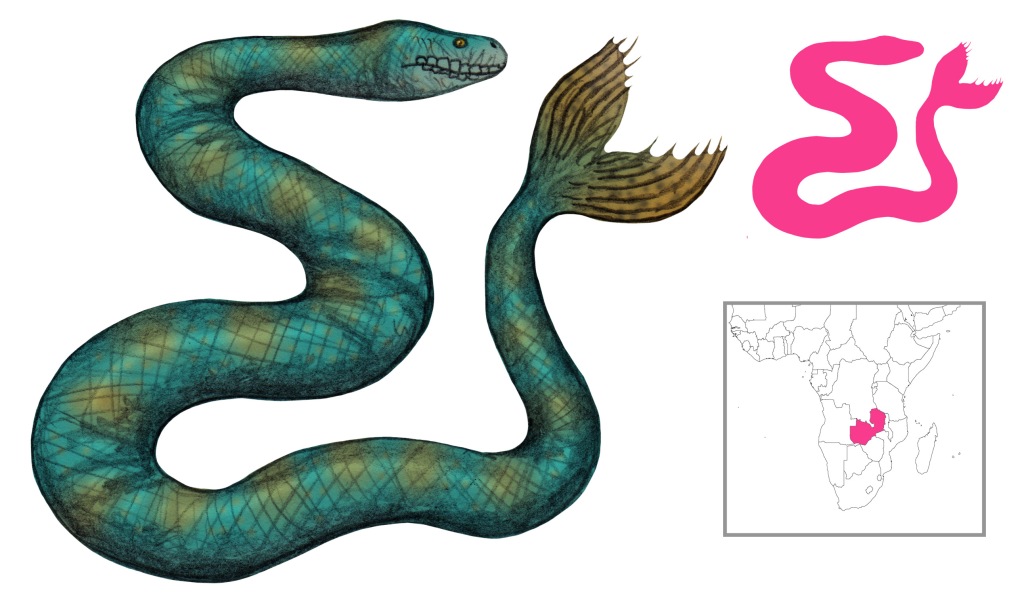
The Funkwe is a colossal snake from the folklore of the Lambas of Zambia. It is approximately eighty miles in length and has a tail like that of a fish. These serpents live at the sources of the Kafulafuta and Itabwa rivers, coiled up in holes deep beneath the surface.
When a funkwe wants fish to be abundant, it starts swimming downstream, followed by schools of fish. Eventually its head reaches the great Kafue river while its tail is still at the source of the Kafulafuta – a span of eighty miles. It returns from the big river and brings the big fish with it.
References
Doke, C. M. (1931) The Lambas of Northern Rhodesia. George G. Harrap and Company Ltd., London.
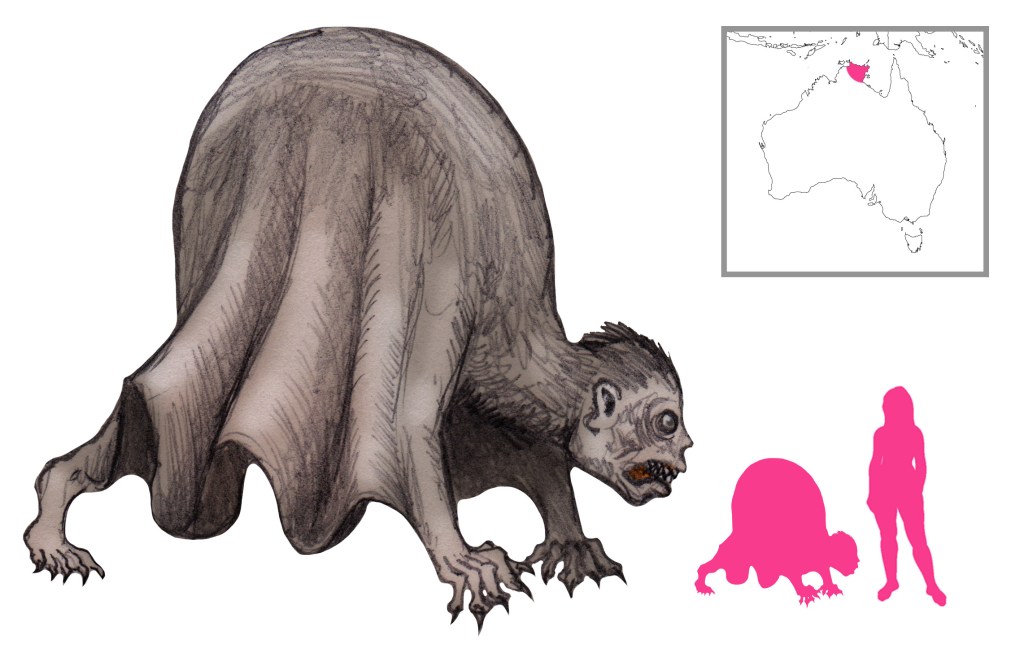
Garkain is a spirit found living alone in the tropical forests of Arnhem Land near the Liverpool River’s mouth. Human in appearance, he possesses great flaps of skin on his arms and legs, like wings or fins, that allow him to fly.
During the day Garkain sleeps under a pile of leaves. By night he attacks any intruders into his domain by flying up and falling onto them, enveloping them in a flurry of arms and legs, the folds of his skin suffocating them. They are eaten red raw – Garkain never learned how to make fire, use tools, and cook food.
References
Allan, T.; Fleming, F.; and Kerrigan, M. (1999) Journeys through Dreamtime. Time-Life Books BV, Amsterdam.
Butor, M.; Spencer, M. trans. (1981) Letters from the Antipodes. Ohio University Press.
Roberts, A. R. and Mountford, C. P. (1971) The First Sunrise. Rigby Limited, Adelaide.
Quetzalcoatl, the “Feathered Serpent” or “Plumed Serpent” is one of the most iconic deities of the Mesoamerican pantheon. Sahagun also records a far more mundane creature by the same name.
The quetzalcoatl is found in the province of Totonacapan (Guatemala) and is the size of a medium water-snake. It is covered with feathers just like those of the quetzal bird. There are tzinitzcan, small light green feathers, on its neck, red feathers on its breast, and blue feathers on the tail and rings (coils?).
This snake is rarely seen, and when it does it flies and bites the person seeing it. Its bite is deadly and kills instantly, killing both it and its victim, for it exhales its venom and its life in one go.
References
Nuttall, Z. (1895) A Note on Ancient Mexican Folk-lore. The Journal of American Folklore, v. 8, no. 29, pp. 117-129.
Sahagun, B.; Jourdanet, D. and Siméon, R. trans. (1880) Histoire Générale des Choses de la Nouvelle-Espagne. G. Masson, Paris.
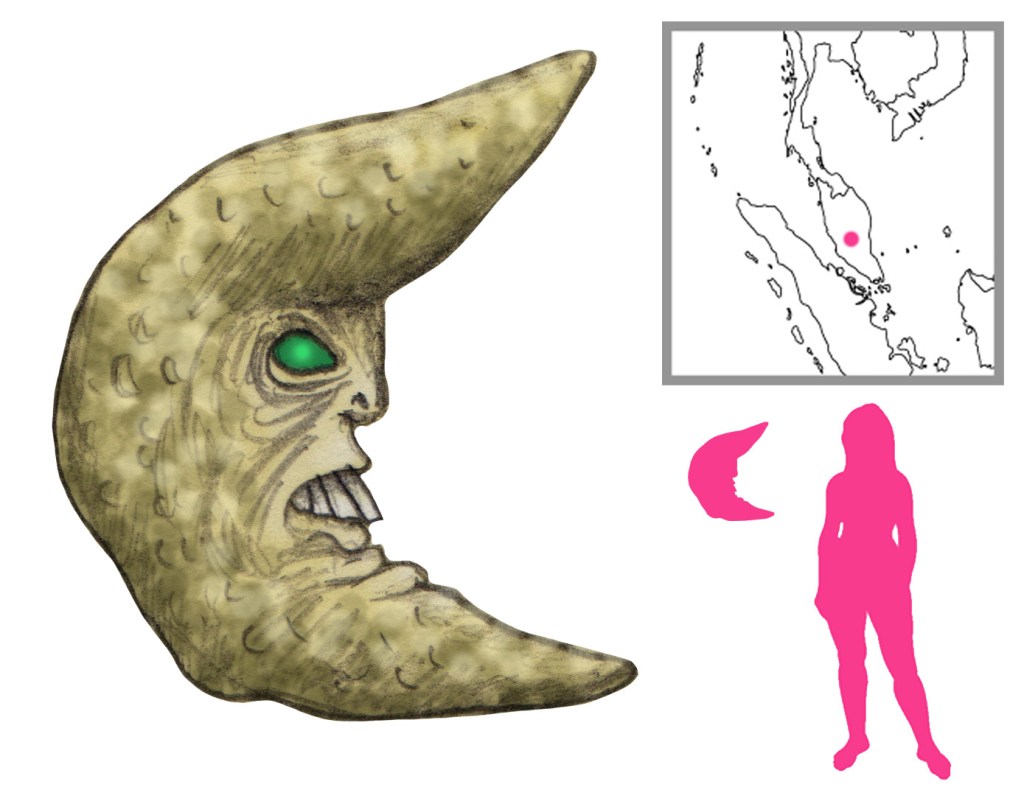
Bès Bulan, the Moon Spirit, lives with the moon; during the fruit season, it also lives on top of a small hill. When it calls – oi… oi… – it is trying to get people to eat, and anyone who hears it should avoid going deep into the jungle lest they be killed and devoured.
At night the moon spirit descends to where the moonlight falls. If a sleeping child awakes and sees the moon shining through the roof, the spirit will cause the child to cry non-stop.
References
Werner, R. (1975) Jah-hět of Malaysia, Art and Culture. Penerbit Universiti Malaya, Kuala Lumpur.
Off the shores of Andros Island in the Bahamas are the blue holes. These are deep submarine caves that appear as dark “holes” in the sea. Local lore claims that they are bottomless, and while it may be safe to sail over them, diving is perilous. The Lusca embodies the terror of these dark places and personifies their dangerous currents. The blue holes are littered with the skeletons of its victims and the wreckage of boats and outboard motors.
A lusca is a gigantic octopus or cuttlefish, sometimes said to be half octopus and half dragon. It is also known as a “giant scuttle”, where “scuttle” is the Bahamian term for octopus, and “Him of the Hands”, although it is unclear whether those are actual hands or merely a reference to cephalopod arms. Those arms can reach up to 75 feet (roughly 23 meters) long. They are dangerous because they can grab a boat or a fisherman from one end and anchor themselves to the bottom on the other; if they cannot make fast to the seafloor, they cannot pull their prey down.
The lusca shoots its “hands” out of the water to snatch anyone or anything that comes too close to a blue hole. A lusca can stop a two-master dead in the water, coiling its tentacles around the rudder while its “hands” reach up and feel around the deck. The moment the tentacles contact a human, they immediately pull the unfortunate sailor into the water.
George J. Benjamin and Jacques-Yves Cousteau were both warned of the dangers of the lusca, but failed to find any trace of the giant octopus. In fact, Benjamin succeeded in retrieving an outboard motor supposedly lost to a lusca, much to the bemusement of the motor’s proprietor.
Wood and Gennaro identify the St. Augustine blob, found on a Florida beach, as being the same animal as the lusca. As the blob was found to be a mass of connective tissue from a large vertebrate, probably a whale, this is unlikely.
References
Benjamin, G. J. (1970) Diving into the Blue Holes of the Bahamas. National Geographic, 138(3), pp. 347-363.
Cousteau, J. and Diolé, P. (1973) Trois Aventures de la Calypso. Flammarion.
Fodor, E. (1981) Fodor’s Caribbean and the Bahamas. Hodder and Stoughton, London.
Naish, D. (2016) Hunting Monsters: Cryptozoology and the Reality Behind the Myths. Arcturus, London.
Wood, F. G. and Gennaro, J. F. (1971) An Octopus Trilogy. Natural History, LXXX(3), pp. 15-24 and 84-87.
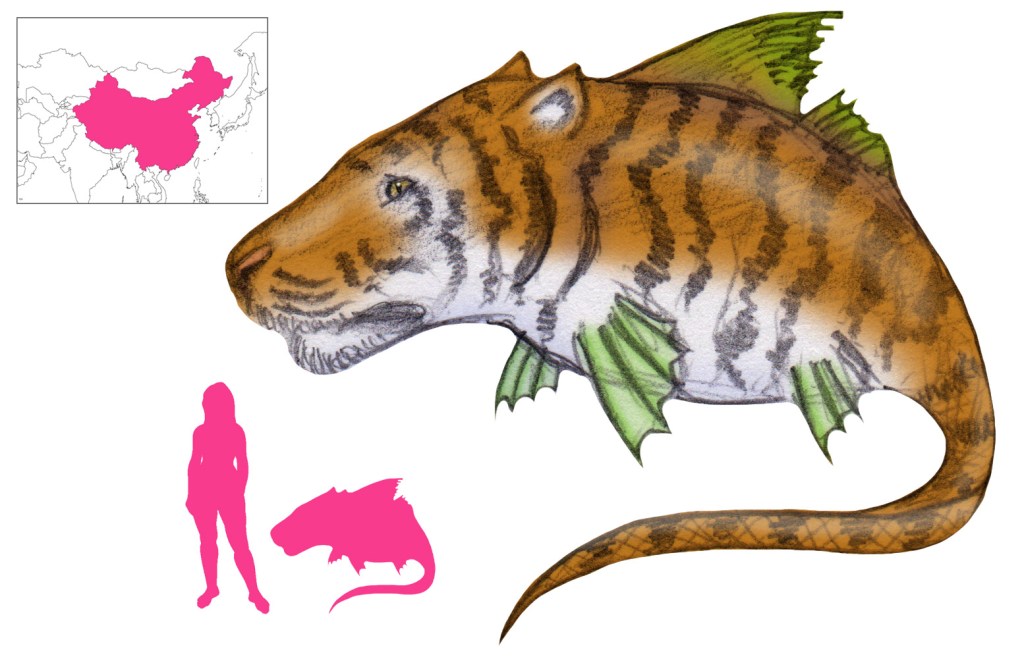
The Yin River and the Yangtze are home to large numbers of Hujiao, or tiger-dragons. A hujiao has the body of a fish with the tail of a snake, and makes a sound like a mandarin duck. It is probably the same as the cuo-fish, whose young hide in their mother’s womb, and the tiger-cuo, which has black and yellow patterns, the ears, eyes, and teeth of a tiger, and is capable of turning into a tiger. All of those are probably sharks.
Eating hujiao flesh prevents hemorrhoids.
References
Mathieu, R. (1983) Étude sur la mythologie et l’ethnologie de la Chine ancienne. Collège de France, Paris.
Strassberg, R. E. (2002) A Chinese Bestiary: Strange Creatures from the Guideways Through Mountains and Seas. University of California Press.
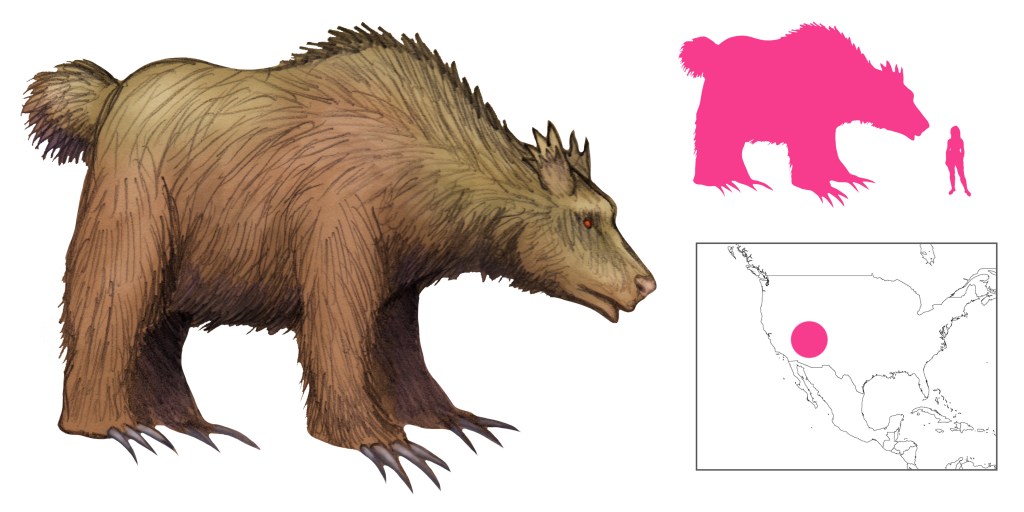
Variations: Cac na’alka hi, Bear that Pursues, Tracking Bear
The fearsome Sasnalkáhi, the Bear that Pursues, was a monstrous bear that terrorized the Navajo people. As one of the Anaye, Sasnalkáhi was born from unnatural sexual practices; in this case, his “fathers” were a smooth stone and a leg sinew. He lived in a cross-shaped mountain cave at Tse’bahástsit, the “Rock that Frightens”. Once Sasnalkáhi set on a hunt, his prey had no hope of escape.
When Nayenezgani set out to slay Sasnalkáhi, he carried yucca fruit in his left hand and hard oak twigs in his right hand. Those medicinal plants warded off Sasnalkáhi’s attentions.
Eventually Nayenezgani found the bear’s head emerging from a hole. He inspected the east, south, and west entrances; when he got to the north, Sasnalkáhi’s head immediately withdrew, and the bear headed for the south entrance. This time Nayenezgani was waiting for him, and when Sasnalkáhi stuck his head out, Nayenezgani decapitated him.
“You were a bad thing in life”, proclaimed Nayenezgani to the head. “You caused nothing but mischief. But now I will make you useful to the people; you will feed them, clean them, and clothe them in the future”. Sasnalkáhi’s head was chopped into three pieces. One piece was thrown east, where it became tsási (Yucca baccata). One piece was thrown west, becoming tsásitsoz (Yucca angustifolia). The last piece was thrown south, to become nóta (mescal). The nipples became pinyon nuts, while two pieces of fat cut from around the tail became a bear and a porcupine. The left forepaw, gall, and windpipe were taken as trophies.
References
Locke, R. F. (1990) Sweet Salt: Navajo folktales and mythology. Roundtable Publishing Company, Santa Monica.
Matthews, W. (1897) Navaho legends. Houghton Mifflin and Company, New York.
Reichard, G. A. (1950) Navaho Religion: A Study of Symbolism. Bollingen Foundation Inc., New York.
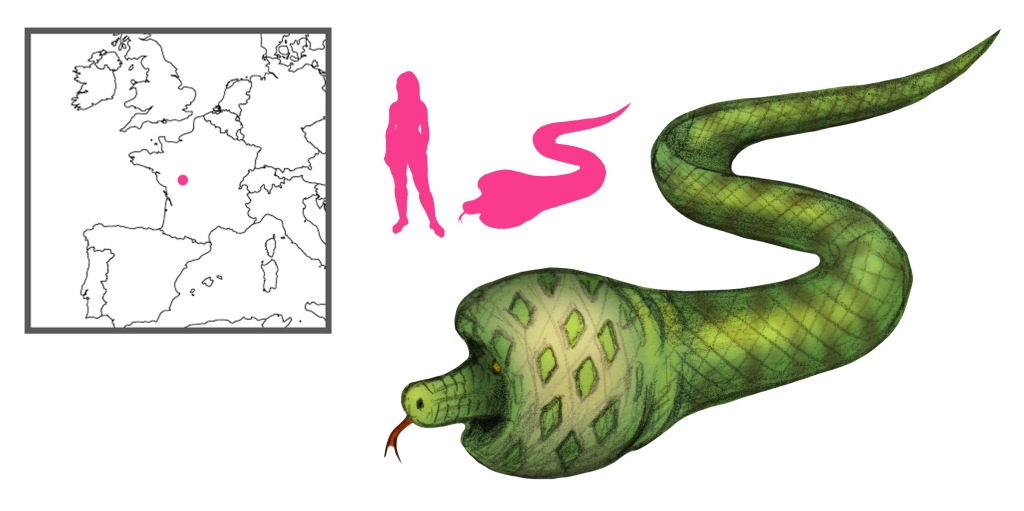
The small neighborhood of Cueille-Aigue, in the Montbernage area of Poitiers, was once witness to a reptile of extraordinary resilience. An event of this magnitude, of course, led to wildly divergent and contradictory accounts. The one reproduced here is the most implausible – and, therefore, the most correct.
One fine morning, an inhabitant of the Cueille-Aigue discovered an enormous serpent in his cellar. He called the neighbors to aid him, and, armed with spades, picks, and other gardening utensils, they attacked the monster. The snake responded by retracting its head into its body, like a turtle into its shell.
As everyone knows, a snake cut in two will regenerate unless the head is destroyed. The serpent was chopped in half, into quarters, into increasingly fine pieces until it was nothing but mincemeat. Alas, they never could find the head.
References
Ellenberger, H. (1949) Le Monde Fantastique dans le Folklore de la Vienne. Nouvelle Revue des Traditions Populaires, 1(5), pp. 407-435.
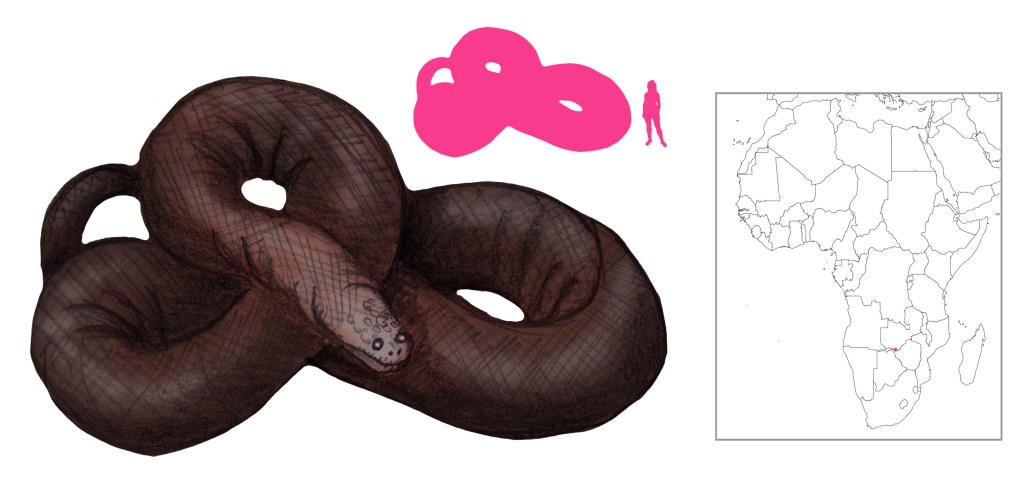
A serpent lives at the foot of Victoria Falls – at least, that’s what Dr. Livingstone presumed. Barotse folklore holds that this monster, the Chipique, came from the ocean, traveling over a thousand miles to rest at the falls.
The chipique rules the river by night, and it is unsafe to approach Victoria Falls during that time. Thirty feet in length, the chipique can easily grab a canoe and immobilize it. Its head is small and slate-grey, while its serpentine, heavy body winds in black coils.
Eyewitnesses include Mr. V. Pare, who saw the chipique in 1925. It reared and disappeared into a cave.
References
Green, L. G. (1956) There’s a Secret Hid Away. Howard Timmins, Cape Town.


 A Book of Creatures