Amphisbaena

Variations: Amphisbaina, Alchismus, Amphisilene, Amphistere, Amphiptere, Ankesime, Auksimem, Double-head, Double-marcheur (French); Doble Andadora; Blind Snake

amphisbaena

The Amphisbaena, “goes both ways”, is one of the many snakes encountered by Lucan and his army in the deserts of Libya. It has also been reported from Lemnus, but it is unknown to the Germans. Unlike its biological namesake, the benign, legless burrowing lizards known as amphisbaenas, the Libyan amphisbaena is venomous and deadly, producing double the amount of venom a regular snake would. Sand boas are another candidate for the amphisbaena’s identity, but they too are harmless.

Two heads are an amphisbaena’s distinguishing feature, with one head in the normal place and one at the end of the tail. How these heads affect locomotion is unclear. An amphisbaena may move like a regular snake, one head trailing behind, but changing directions instantly and going forward or backwards with equal ease. Alternatively, both heads could lead, leaving the body following behind in a loop. An amphisbaena’s sight is poor, but its eyes glow. Physically it resembles an earthworm, with an indistinguishable head and tail. It is blackish earth-colored, with a rough, spotted skin. It is very muscular and tough-scaled, and is an excellent digger.

In addition to the amphisbaena described above, Pammenes tells of two-headed snakes with two feet near the tail in Egypt. Borges reports a creature from the Antilles called the doble andadora (“goes both ways”), also known as the two-headed snake and the mother of ants. It feeds on ants and can reattach itself if chopped in half. The association with ants is the same as that of the legless lizards that share the amphisbaena’s name, and probably refers to the same animal. As with every other snake, the amphisbaena of medieval bestiaries was burdened with legs and wings, and the use of the term became even more confused. Any creature in medieval art with an extra head on the end of its tail can be safely labeled an amphisbaena, although at this point the Greek two-headed snake is long forgotten. The heraldic amphisbaena eventually was corrupted into amphistere, amphiptere, and amphisian basilisk, from where it was assumed to have a pair of wings as well as an extra head!

Amphisbaenas are very cold-resistant, and are the first snakes to come out after winter, ahead of the first cuckoo song. Their temperament is correspondingly hotter than that of other snakes. They feed on earthworms, beetles, and especially ants, digging into their nests, its tough skin protecting it from their bites and stings. Solinus believed amphisbaenas gave birth through the tail-end mouth. They take good care of their eggs, guarding them until they hatch and showing love to their offspring.

Amphisbaena venom is unremarkable and causes the same symptoms as viper bites – inflammation and slow, painful death. Besides drinking coriander, the antidotes for amphisbaena bite are the same as those used for vipers. Amphisbaenas themselves are hard to kill, except with a vine-branch. One amphisbaena woke Dionysus from his rest, and in retaliation he crushed it with a vine-branch.

Several remedies have been derived from amphisbaenas. A walking-stick covered with amphisbaena skin keeps away venomous animals, and an olive branch wrapped in amphisbaena skin cures cold shiverings. An amphisbaena attached to a tree will ensure that the logger will not get cold and the tree will fall easily. If a pregnant woman steps over a dead amphisbaena, she will abort instantly, as the vapor arising from the dead snake is so toxic as to suffocate the fetus. However, if a pregnant woman carries a live amphisbaena in a box with her, the effect is nullified.

The two heads of the amphisbaena understandably led to a healthy amount of criticism. Thomas Browne denied that amphisbaenas could exist, stating that an animal with two anteriors was impossible. Al-Jahiz recounts an interview with a man who swore that he saw an amphisbaena, and, unconvinced, chalked it up to fear-induced exaggeration. “From which end does it move?” he asked the man. “Where does it eat from, and where does it bite from?” The man replied “It doesn’t move forward, but it gets around by rolling, like boys roll on sand. As for eating, it eats lunch with one head and dinner with the other. And as for biting, it bites with both heads at the same time!”

References

Aelian, trans. Scholfield, A. F. (1959) On the Characteristics of Animals, vol. II. Harvard University Press, Cambridge, Massachusetts.

Aelian, trans. Scholfield, A. F. (1959) On the Characteristics of Animals, vol. III. Harvard University Press, Cambridge, Massachusetts.

Aldrovandi, U. (1640) Serpentum, et Draconum Historiae. Antonij Bernie, Bologna.

Borges, J. L.; trans. Hurley, A. (2005) The Book of Imaginary Beings. Viking.

Cuba, J. (1539) Le iardin de santé. Philippe le Noir, Paris.

Druce, G. C. (1910) The Amphisbaena and its Connexions in Ecclesiastical Art and Architecture. Archaeological Journal, v. 67, pp. 285-317.

Isidore of Seville, trans. Barney, S. A.; Lewis, W. J.; Beach, J. A.; and Berghof, O. (2006) The Etymologies of Isidore of Seville. Cambridge University Press, Cambridge.

Al-Jahiz, A. (1966) Kitab al-Hayawan. Mustafa al-Babi al-Halabi wa Awladihi, Egypt.

Kitchell, K. F. (2014) Animals in the Ancient World from A to Z. Routledge, Milton Park, Abingdon, Oxon.

Lucan, trans. Rowe, N. (1720) Pharsalia. T. Johnson, London.

Macloc, J. (1820) A Natural History of all the Most Remarkable Quadrupeds, Birds, Fishes, Serpents, Reptiles, and Insects in the Known World. Dean and Munday, London.

Palliot, P. (1660) La Vraye et Parfaite Science des Armoiries. Pierre Palliot, Dijon.

Parker, J. (1894) A Glossary of Terms Used in Heraldry. James Parker and Co., Oxford.

Pliny; Bostock, J. and Riley, H. T. trans. (1857) The Natural History of Pliny, v. III. Henry G. Bohn, London.

Topsell, E. (1658) The History of Serpents. E. Cotes, London.
 

Qasoǵonaǵa

Variations: Gasogonaga, Kasogonagá, Kasogongá, QasoGonaGa; Lightning; Owner of Storms/Lightning

qasogonaga

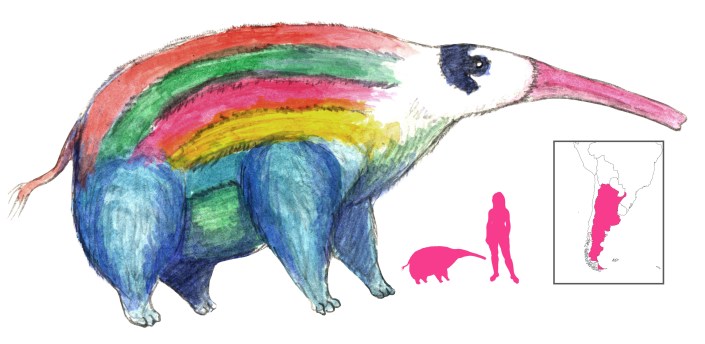
For the Toba of Argentina, lighning takes the form of a small, hairy creature called Qasoǵonaǵa, the Owner of Storms. It is an anteater, or perhaps an elephant, with a long snout, long rainbow-colored hair, and four tiny feet. Qasoǵonaǵa can also appear in human form, retaining a small head and shaggy body. As Qasoǵonaǵa has been referred to by both male and female pronouns, there are probably more than one of these beings.

Qasoǵonaǵa, as the Owner of Storms, lives in the skies and is responsible for storms and other meteorological conditions. Lightning comes out of its mouth, while its angry roars become thunder. It is responsible for rain, or lack thereof.

While Qasoǵonaǵa may be a mighty force of nature, it can be quite friendly and grateful for help granted it by the Toba. Often a Qasoǵonaǵa falls to the earth, and has to be returned there by human intervention, as it is too small to return there on its own. In such cases a bonfire must be built, and Qasoǵonaǵa placed on top before it is ignited. The rising smoke will carry Qasoǵonaǵa back into the sky, and the happy anteater will reward its benefactor with powerful shamanic powers. Qasoǵonaǵa will also cause or stop torrential rain if its helper requests it.

References

Cordeux, E. J.; Karsten, R.; Lehmann-Nitsche, R.; Mětraux, A.; Newbery, S. J.; Palavecino, E.; and Terán, B. R. D.; Wilbert, J. and Simoneau, K. eds. (1982) Folk Literature of the Toba Indians. UCLA Latin American Center Publications, University of California, Los Angeles.

Wright, P. G. A semantic analysis of the symbolism of Toba mythical animals. In Willis, R. (Ed.) (1990) Signifying Animals: Human Meaning in the Natural World. Unwin Hyman, London.

Wright, P. G. Dream, Shamanism, and Power among the Toba of Formosa Province. In Langdon, E. J. M. and Baer, G. (Eds.) (1992) Portals of Power. University of New Mexico Press.

Wright, P. G. (2008) Ser-en-el-sueño. Editorial Biblos, Buenos Aires.

extranimals-logo

The last time we discussed a short-lived car toyline with a biotechnological post-apocalyptic plotline, it was in the mid-90s. This time our story takes us to the late 80s, when French toy car manufacturer was in a bit of bind.

As mentioned in the Carnivores entry, superhero toys – I mean, action figures were all the rage, and more traditional toy companies such as die-cast car makers were losing the battle. Majorette, founded in 1961, was in decline, shutting down branches and cutting corners by replacing die-cast chassis with plastic and hinged doors with fixed ones. The company went out of business in 2000 and was bought by Smoby, but not before it tried to reinvent its brand and appeal to the modern demographic.

The Extranimals were one of those ephemeral experimental lines, designed to alleviate Majorette’s problems in every way. These car/animal hybrids were both cheaply made and had a (flimsy) plot set in a post-apocalyptic wasteland, meant to attract action-oriented children while being easy to manufacture. They even got two commercials on TV, and an audio cassette (little more than a dramatic retelling of the first commercial). The American release was called Wild Wheels, but I’ve never seen those. Unfortunately the Extranimals suffered from low advertising, lack of backstory, and no cartoon, which is why they lasted for two years before vanishing into obscurity. Today they can be found in the dystopian hellscape of Ebay, where they command monstrous prices.

Image below taken from this excellent French site.

sam_1324-600x492

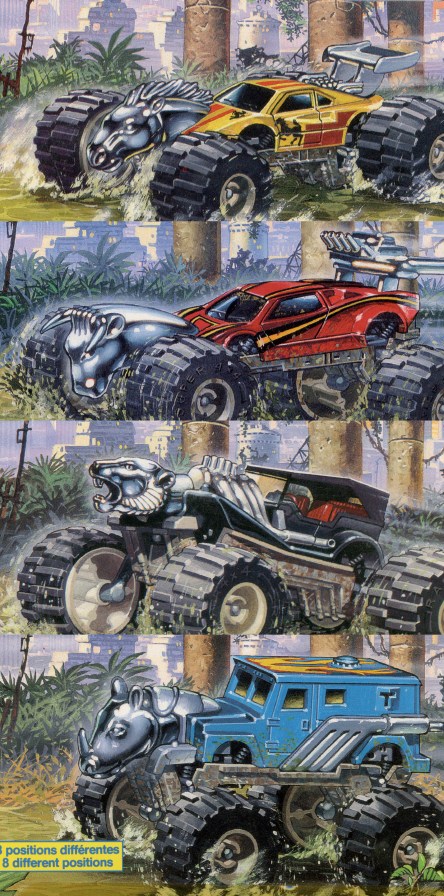
The brilliant idea behind the Extranimals was that they required very little work on Majorette’s part. The car bits were taken directly from models already in production, allowing them to repurpose surplus die-cast stock. The chassis, monster truck wheels, and animal parts were plastic, with the animal parts vacuum-metallized in chrome or gold.

The main gimmick of the line was that the wheels could be adjusted into different positions, allowing the vehicle to tackle different forms of terrain. As far as toy gimmicks go, this was a very lukewarm one, especially considering the competition in the form of, say, car that transform into robots. Do note also that the cardback below, for the Mustang, also makes sure to advertise the Elephant, the biggest and most expensive toy in the line. The makers took no chances.

cardback

The plot cast our vehicular animals in a not-so-distant future where humanity has gone extinct and the world has become a jungle of concrete, twisted rebar, and encroaching vines. In this world animals have melded with vehicles – or is it vehicles that have evolved animal features? – and wage endless battles for survival in the wasteland. There is no characterization besides the commercials suggesting that the Mustang and Elephant are the good guys.

basics

The original line (1988) consisted of 4 “basic” Extranimals and the “jumbo” Elephant. The basics were 4 variations on a theme, coming in several colors at the same size and with the same adjustable-wheels gimmick. The Mustang was made out of a Ferrari and Taurus was a Lamborghini (and if you have no idea why, look up the Ferrari and Lamborghini logos. Go on, I’ll wait). The Rhino was evidently an armored truck, and the Panther for some reason was an Excalibur (maybe it was meant to be a Panther de Ville?).

elephant

The Elephant, on a truck chassis (only the red cab is die-cast), was the largest and doubled as a car carrier for the smaller vehicles. In addition to the wheels, it also had a spring-loaded head that could knock over anything in its path, allowing for plenty of play value and hours of fun smashing things. With the second color variation in blue and red, the Optimus Prime parallels are even more striking.

naja

By the second wave of Extranimals of 1989, Majorette had apparently figured that they couldn’t sell the same sort of toy four times even with different animal heads attached, so the “medium” newcomers were a diverse lot with unique gimmicks. The Naja (cobra) above, for instance, was chromed in green and had a movable tongue and doors in addition to 6 configurable wheels. Its base was Majorette’s stretch limousine.

shark

For the Shark, Majorette used their submarine truck as a base, kept the submarine, and added deployable floats. I always wondered why the submarine itself wasn’t shark-themed, and that was because it was unchanged from its original release. No idea why – I always thought it was some sort of symbiotic sentient organism dependent on its larger host for survival. Or something. I used to make stuff up as a kid.

scorpio

The Scorpion had plenty of play features, with a ball-jointed stinger tail, a scoop that can be raised or lowered, and swiveling pincers. This one evolved from a loader.

eagle

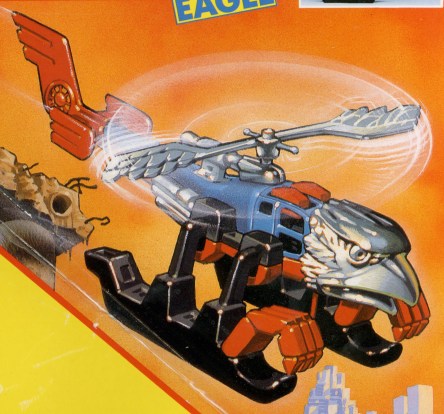
Finally, the Eagle is the odd one out of the group, swapping its trademarked wheels for spinning feathered helicopter blades and grasping talons. Its ancestor was a Gazelle helicopter.

I still have memories of seeing those in toy stores, and I always wondered if I hadn’t fabricated the memories out of a deep-seated desire for post-apocalyptic vehicular beasts. It took a while to find them. I still think they could have been an interesting series had Majorette invested more into plot, characters, and production quality, but the series is long gone now.

Extranimals are © Majorette.

Kori

kori

The Cuiva of Colombia and Venezuela tell of the Kori, a destructive aquatic monster. It has the appearance of a giant anteater, except far larger, and it lives underwater in the rivers. It uses its large claws to dig under riverbanks, causing their collapse, and that is why this is such a common occurrence in the rainforest. A kori can also cause strong gales to destroy constructions, and can turn soil into water to drown people.

A kori once collapsed a riverbank near a Cuiva village, killing most of the inhabitants. Only one man managed to escape by transforming himself into a howler monkey and climbing to the top of a tree, where he sat trembling and watching the kori. Even that wasn’t enough, as the kori eventually knocked down the tree and killed the monkey hiding there.

Word of the massacre reached the Cuiva, and after mourning the dead they set out to avenge them. The father of the howler-monkey man led the hunt, armed with a harpoon, while the others followed with poisoned arrows. Once found, the kori was riddled with harpoons and arrows while it was too weakened to fight back. It tried transmuting the ground to water, but it was only shallow water, and the warriors continued firing poisoned arrows until the enormous anteater died. The leader of the hunt chopped off the kori’s claws and made them into a necklace as payment for his son. The rest of the anteater’s body was left for the vultures.

References

Arcand, B.; Coppens, W.; Kerr, I.; and Gómez, F. O.; Wilbert, J. and Simoneau, K. eds. (1991) Folk Literature of the Cuiva Indians. UCLA Latin American Center Publications, University of California, Los Angeles.

Tçaridyi

Variations: Tcaridyi, Tharidi

tcaridyi

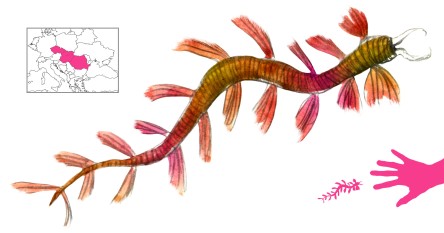
Tçaridyi, “Hot” or “Burning” is one of the children of Ana, sired unnaturally by the King of the Loçolico as a spouse for Tçulo. As one of the Roma demons of disease, she torments humanity to this day.

Tçulo proved to be more troublesome than expected, persecuting even his own sister Lilyi. To distract him, Melalo told his father to conceive a wife for the little urchin. What the King used to induce Tçaridyi’s conception is unknown, but it probably involved worms of some kind.

Tçaridyi herself takes the form of a little hairy worm or caterpillar. She only infests women, slithering through their arteries and veins. The long hairs on her body detach as she moves, causing fever and inflammation, especially puerperal fever. Her union with Tçulo produced women’s diseases; otherwise, Tçulo and Tçaridyi torture humans but rarely kill them.

References

Clébert, J. P. (1976) Les Tziganes. Tchou, Paris.

Clébert, J. P.; Duff, C. trans. (1963) The Gypsies. Vista Books, London.

Meyers Brothers Druggist (1910) Demons of Disease. Meyers Brothers Druggist, v. 31, p. 141.

Pavelčík, N. and Pavelčík, J. (2001) Myths of the Czech Gypsies. Asian Folklore Studies, v. 60, pp. 21-30.

Odontotyrannus

Variations: Arine Hayant Le Tirant, Arine Qui Het Le Tirant, Armez Hayant Le Tirant, Dentem Tyrannum, Dentirant, Dentityrannus, Dent Tyrans, Odentetiranno,  Odontatyrannum,  Odontatyrannus, Odontetiranno

odontotyrannus

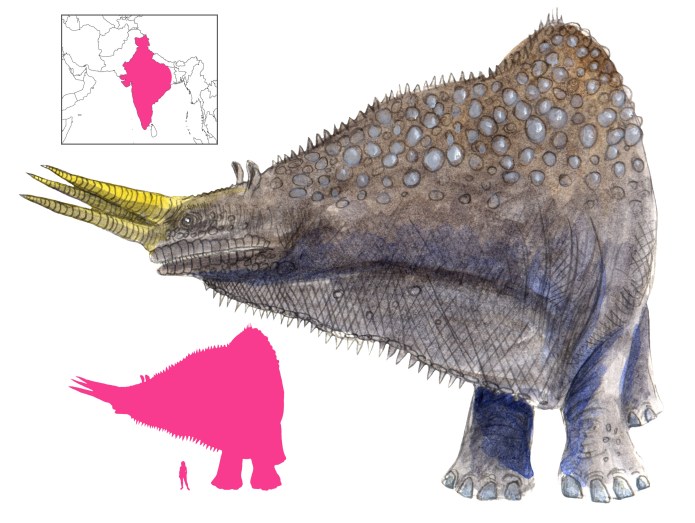
The Odontotyrannus is a massive beast found in the rivers of India, whose account has been told as one of Alexander the Great’s many exploits. Its name apparently means “tooth tyrant”, but medieval reading errors led to a variety of increasingly awkward alternate names and direct translations.

When Alexander and his men made camp by a river, they were found by an odontotyrannus coming to the water to drink. It was enormous, large enough to swallow an elephant whole, and black in color, or otherwise with a head black as pitch. It had three horns on its head. When it saw the Macedonians, it went on a rampage, killing 26 and injuring 52 of the soldiers before it was brought down by Emendus, Duke of Arcadia.

The rhinoceros is a certain candidate as the progenitor of the odontotyrannus, as is the crocodile. Confusion with Indus worms – Indian, armed with two terrible teeth, and capable of swallowing prey whole – may have led to the name, as nowhere in its description are teeth ever mentioned.

References

Wauquelin, J., Hériché, S. ed. (2000) Les Faicts et les Conquestes d’Alexandre le Grand. Librairie Droz, Geneva.

de Xivrey, J. B. (1836) Traditions Tératologiques. L’Imprimerie Royale, Paris.

Tçulo

Variations: Tculo, Thulo

tculo

Tçulo is the third child of Ana, Queen of the Keshalyi. As with his siblings before and after him, he is a vile demon of disease with no redeeming features, and originated from the machinations of the evil King of the Loçolico to impregnate his wife. Their stories are told in Roma folklore.

Eventually, the King realized that he could only make love to his wife while she was asleep, and Melalo was more than happy to oblige with soporific vapors. But Melalo himself was procreating with Lilyi, bringing more diseases and ailments into the world, and the King grew jealous of his son’s brood. On the other hand, Melalo found that he could not sire powerful demons, and hoped that his mother could produce a race of evil beings strong enough to destroy humanity. Following Melalo’s advice, the King ate a stag beetle and a crayfish before visiting Ana. Tçulo was the result.

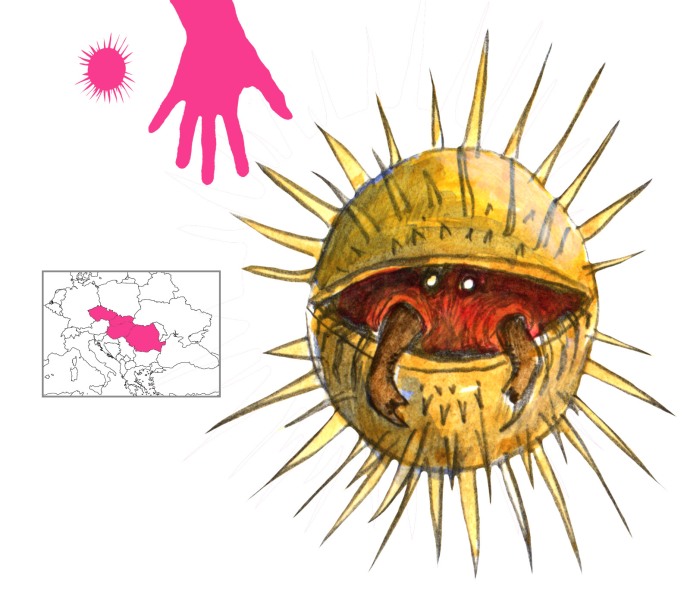
Tçulo, “Thick” or “Potbellied”, is little more than a small ball full of spikes. He enters human bodies and rolls around within the intestines, causing severe abdominal pains and colic. He particularly targets pregnant women, and even his big sister Lilyi was tormented by him. It was this behavior that led to the conception of Tçaridyi, Tçulo’s own sister-wife. Both of them caused pain but rarely death, and their offspring were all women’s diseases.

References

Clébert, J. P. (1976) Les Tziganes. Tchou, Paris.

Clébert, J. P.; Duff, C. trans. (1963) The Gypsies. Vista Books, London.

Meyers Brothers Druggist (1910) Demons of Disease. Meyers Brothers Druggist, v. 31, p. 141.

Pavelčík, N. and Pavelčík, J. (2001) Myths of the Czech Gypsies. Asian Folklore Studies, v. 60, pp. 21-30.

Last time on the Making of ABC, I discussed the importance of following a breadcrumb trail of references back to its source. This implies a significant amount of scholarly research. But I don’t want to discount another major source of creature discovery; namely, serendipity*.

Sometimes you don’t find the creature, but it is the creature that finds you. And for creatures to find you, you have to do a lot of reading of books both digital and physical, a lot of exploring in libraries and bookstores old and new. And I’m not talking about online bookstores, I’m talking about brick-and-mortar, real-deal, honest-to-goodness secondhand bookstores where the wonderful scent of books hits you as soon you go in, and where you can spend long, happy hours finding things you never knew you needed. I have made a number of discoveries merely by reading, whether in my home, in libraries, or in bookstores**. Caspilly surfaced in an old Larousse book on the sea. The Swan Valley Monster lurked in a corner of a used bookstore in Pennsylvania. The dreaded Wheel of Balsaeg, the unspeakable Boongurunguru, and the vast Trolual and Ziphius were found for the first time in a children’s book of mythology. The list goes on.

In summary, I guess what I’m trying to say is

reading

really

pays

off.

So next time you’re looking around in a bookstore full of books that nobody wants, you may yet find the next big thing. Who knows?

*No, not the pink dragon.
** I swear I would buy the book too.

Indus Worm

Variations: Odontotyrannus (allegedly)

indus-worm

Deep in the Indus River live worms that resemble those found in figs or rotten wood, only seven cubits (over 3 meters) in length on average, and thick enough that a ten-year-old boy could barely wrap his arms around one. They have two square teeth, one above and one below, each about 18 inches long. The skin is two fingers thick.

By day the worms remain underwater, wallowing in mud, but they emerge at night to prey on animals up to the size of a cow or camel. Victims are seized, dragged into the Indus, and devoured at leisure. The large teeth can crush their way through flesh, bone, and stone, and only the paunch is left uneaten. There have also been cases of hungry worms seizing drinking camels and oxen by the nose in broad daylight, and pulling them under.

Despite its predatory nature, it is prized by the Indians for its oil, which is highly flammable and capable of consuming wood and animals alike. Fires started by Indus worm oil can only be quenched by throwing large amounts of clay and rubbish on them. The oil is so rare that only the king of India may possess it. To obtain this oil, the worms are captured on hooks to which a lamb or kid has been chained, and slain with javelins, swords, and clubs. After landing and killing a worm, it is hung up for thirty days, with vessels underneath to catch the oil that drips from its carcass. 5 pints of oil are produced in this way. The worm is then disposed of, and the oil is sent to the king. Stored in clay vessels, it makes a formidable siege weapon.

The amphibious lifestyle, geographical location, and predatory habits of the Indus worm have led to comparisons with the Odontotyrannus, although the similarities end there.

References

Aelian, trans. Scholfield, A. F. (1959) On the Characteristics of Animals, vol. I. Harvard University Press, Cambridge, Massachusetts.

Ctesias, McCrindle, J. W. trans. (1882) Ancient India as described by Ktesias the Knidian. Thacker, Spink & Co., Calcutta; B. E. S. Press, Bombay; Trubner and Co., London.

de Xivrey, J. B. (1836) Traditions Tératologiques. L’Imprimerie Royale, Paris.

Lilyi

Variations: Lilye, Lili

lilyi

Lilyi is the second child of Ana, Queen of the Keshalyi. Like her siblings, she is responsible for an array of ailments that plague humanity, and she had her genesis in the abusive relationship between Ana and her repulsive husband, the King of the Loçolico.

After the birth of Melalo, Ana understandably refused to have another child. But this time it was Melalo himself, desirous of a wife, who told his father to cook a fish in donkey’s milk, and administer a few drops of the liquid in Ana before taking her by force. The product of this vile union was Lilyi.

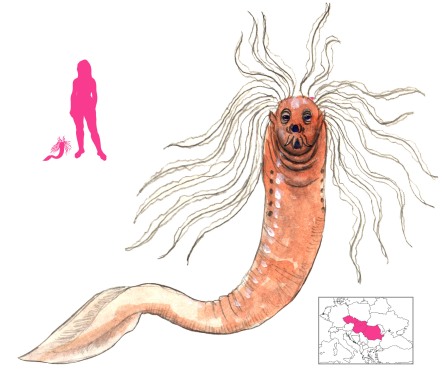
Lilyi, “Viscous” or “Slimy”, is mermaid-like, part fish (some sources specify hagfish) with a human head. Nine sticky threads or barbs flow from either side of her head, and they can penetrate a human body, causing buildup of mucus. She is responsible for catarrh, coughing, dysentery, influenza, vomiting, and other diseases involving mucus and discharges.

Her union with her brother Melalo produced further demons of disease, but she was herself persecuted by her younger brother Tçulo – at least until Tçulo got a sister-wife of his own.

References

Clébert, J. P. (1976) Les Tziganes. Tchou, Paris.

Clébert, J. P.; Duff, C. trans. (1963) The Gypsies. Vista Books, London.

Meyers Brothers Druggist (1910) Demons of Disease. Meyers Brothers Druggist, v. 31, p. 141.

Pavelčík, N. and Pavelčík, J. (2001) Myths of the Czech Gypsies. Asian Folklore Studies, v. 60, pp. 21-30.