Eloko

Variations: Biloko (plural)
eloko

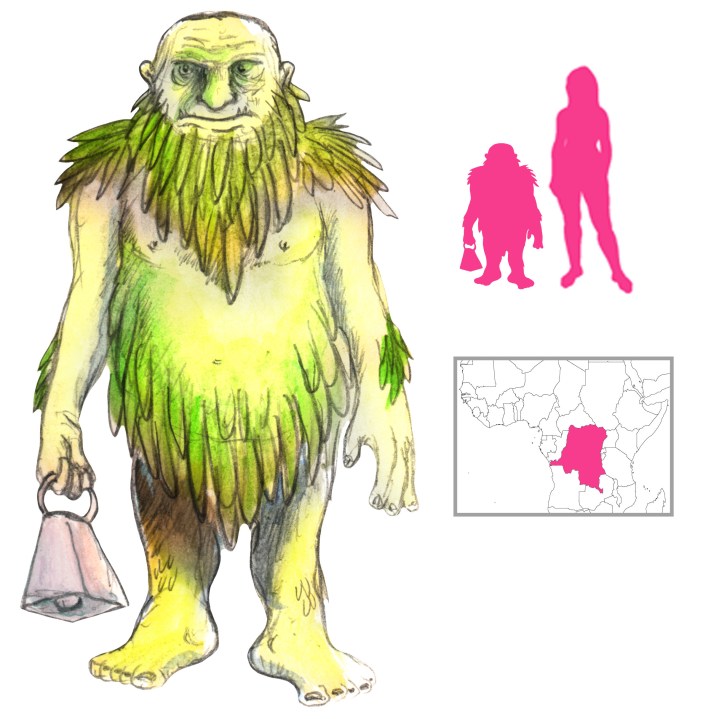
The Biloko of the Congo are vile, cannibalistic dwarfs or trolls of Nkundo folklore. They make their homes inside hollow trees, and they smell of the Congo’s rainforest. An Eloko has grass for a beard, clothes made of  leaves, and usually carries a bell, which is used to attract and bewitch unsuspecting humans. Despite their size, biloko are far stronger than the average human, and only heroes and sorcerers can defeat them.

Biloko represent the dangers of the forest, of going out alone, and of toying with danger. They are invoked to dissuade people from straying both physically and mentally, and warn husbands of the dangers of abandoning their wives. They may also represent various gangrenous diseases, as they slowly eat their victim away, eventually killing them by ending with the liver, where the spirit resides.

A Nkundo man once built a fenced-in hut in the forest to find game. Whenever the husband left for the village, he would warn his wife. “Remember, if you hear the sound of a little bell, don’t answer or you will die!” Yet as the monotonous hours went by, the wife found herself entranced by the ringing of a bell deep in the forest, coming closer and closer. Finally she ran outside calling to the eloko. “I’m here! Come to me!” she cried, and the eloko duly appeared. “Here I am, I have come to you”, he announced. The wife was overjoyed and prepared a meal for her guest, but the eloko refused the fried bananas and fish. “I only eat human meat, and I am so hungry…” he wheedled. “You are a delicious woman. Give me a piece of flesh”. The woman willingly proffered her arm, and the eloko took a portion of meat, which he roasted and devoured. Then he left, leaving the woman to bandage her wound in silence.

When her husband returned, he saw his wife bedridden and in pain. “I have sores”, she said. “Then take the bandage off, and have some medicine for it”. She refused, and would not explain further. But the next day the same gruesome episode repeated itself – the husband left, the wife entertained the eloko, and the eloko left the wife with another deep injury.

This time the husband did not believe his wife’s excuses, and decided to lie in wait instead of returning to the village. When the eloko returned that day, he pulled out a knife told the woman that this time he desired her liver. The husband immediately fired an arrow into the dwarf, then ran him through with his spear and decapitated him. But the eloko had already stabbed the wife in the liver, and she died. Those who love danger will die in it; or, those who play with fire will get burnt.

Other encounters with biloko treat them more as an enemy tribe than as forest bogeys. Likinda, Itonde, and Lianja, the grandsons of the spirit of Death Ilelangonda, went to war with the biloko, and tricked them into an ambush by scattering mbole-fruits on the path. They slaughtered all the biloko this way save for the wizard Inkankanga and his wife. Likinda caught up with them by turning himself into a baby, causing Inkankanga’s wife to pick him up and care for him. Then he climbed up a tree to throw fruits down to his adopted parents, but instead he transformed himself into a fruit and allowed Inkankanga to swallow him. The terrified eloko sorcerer killed his wife for being the cause of his impending doom, and then spent the rest of the day imploring Likinda not to kill him. Finally he fell into depressed acceptance, and the bored Likinda cut him up from the inside out. He returned to the village, where his story was celebrated with peals of laughter.

References

Knappert, J. (1971) Myths and Legends of the Congo. Heinemann Educational Books, London.

Knappert, J. (1977) Bantu myths and other tales. E. J. Brill, Leiden.

Bitoso

bitoso

Bitoso, “The Faster” or “Fasting One” (although some accounts mistakenly refer to “The Fastening One”) is one of the children of Ana, a Keshali fairy of Roma folklore who was coerced into bearing the offspring of the King of the Loçolico. As with his siblings, he is the cause of a number of diseases and ailments, although Bitoso has the dubious distinction of being the mildest and least harmful of the lot.

When Schilalyi moved on to molesting her own siblings, Melalo recommended that the King eat garlic on which he had urinated. After the King visited Ana, she give birth to Bitoso, who became Schilalyi’s husband.

Bitoso is a little worm with multiple heads (some accounts specifically refer to four heads) who causes headaches, stomachaches, and lack of appetite; his gnawing causes earache and toothache. He and Schilalyi’s children cause colic, cramps, tinnitus, and toothache. Bitoso himself is mercifully innocuous compared to his siblings.

Bitoso’s pedigree is one that goes back centuries. The folk knowledge that worms cause toothache dates back at least to the Babylonian civilization, in the tale of the worm’s creation. After Anu created the heavens, the heavens in turn created the Earth, the Earth created the rivers, the rivers created the canals, the canals created the marsh, and the marsh created the worm, the worm came before Shamash and Ea, demanding the food allotted to it. It refused figs and pomegranates, instead choosing to live between the teeth and the jawbone, destroying the blood vessels, seizing the roots, and ruining the strength of the teeth.

References

Clébert, J. P. (1976) Les Tziganes. Tchou, Paris.

Clébert, J. P.; Duff, C. trans. (1963) The Gypsies. Vista Books, London.

Kanner, L. (1931) Teeth of Gods, Saints, and Kings. Medical Life, 131, August 1931.

Meyers Brothers Druggist (1910) Demons of Disease. Meyers Brothers Druggist, v. 31, p. 141.

Pavelčík, N. and Pavelčík, J. (2001) Myths of the Czech Gypsies. Asian Folklore Studies, v. 60, pp. 21-30.

cover

I swear this is the last postapocalypic robot animals post I make in OMM, but I had to dedicate an entry to Metalzoic, an absurd and highly entertaining story told by Pat Mills and Kevin O’Neill, and published by DC Comics and 2000 AD. If tales of amoral robotic gorillas beating up tank-elephants are your bag, you can buy this stirring saga in stores, including here and here.

I will try not to give away too much plot, focusing only on the creatures, but if you were planning on reading this someday, spoilers are inevitable.

untitled-11

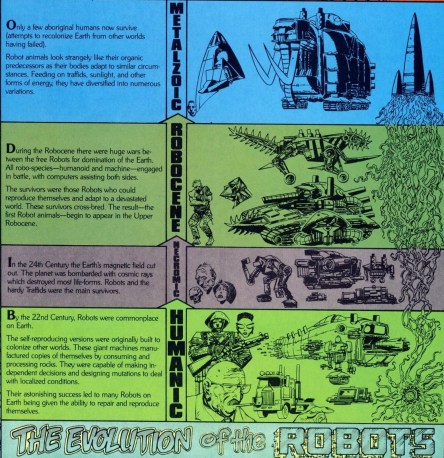
Metalzoic is set on Earth during the, well, Metalzoic period. The above timeline explains it far better than I ever could, but suffice to say the Earth belongs to metallic, naturally evolving robot and plants that evolved themselves from prior machinery. There are still pockets of humanity eking out a Mad Max-esque life, but it’s the robots that run this show.

untitled-9

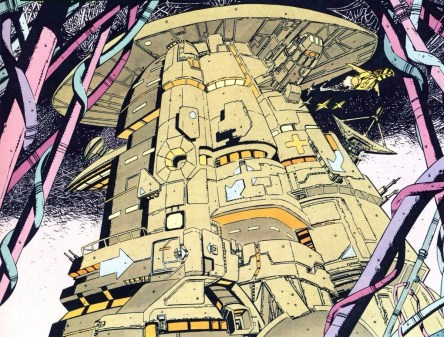
While the story focuses on Armageddon, Amok, and their respective tribes, it is arguably the Traffids that are the true dominant species. These are the mechanical equivalent of plants. Some grow to huge sizes and form dense forests through which other robots seek their food.

One interesting thing about Metalzoic is that it appears that all the robots are sapient and have names. Even the traffids. The specimen above, the equivalent of a pitcher plant, has successfully replicated a human building, down to the details of the interior, and uses this appearance to trick humans into coming in and dissolving in acid. Our heroes realize something is off when the pages of the books inside are blank.

untitled-5

The hero of the story is Armageddon, a robot gorilla and leader of the Mekaka*, a tribe of assorted robot primates. Armageddon, as the header image makes clear, operated on his own brain to remove such trivialities as emotion and compassion, making him ruthless, amoral, and highly respected by the other Mekaka. He even manages to pick up a squishy human and keep her alive somehow.

Armageddon’s special power, and a main plot point and deus ex machina, is to call on the power of Inti, the robot god, and start PUMPING IRON. It is as awesome as it sounds.

untitled-12

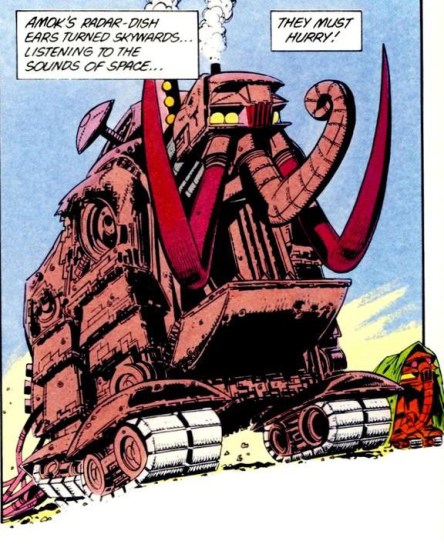
Opposing Armageddon is Amok the god-beast, the patriarch of a herd of wheeldebeasts – robo-elephants, the mightiest creatures of the Metalzoic. He’s pictured above with his calf, the little Buboc, next to him. The caterpillar treads and scoop mouth (just above them) strongly suggests ancestry in digging equipment.

Throughout the story Amok leads his herd of wheeldebeasts through various landscapes for a strange, unknown purpose. He is opposed in this by Attila, a younger male seeking to usurp him as leader of the wheeldebeast herd.

untitled-10

Amok is to the left here, Attila to the right. Why are they destroying the Mekaka village? Is this part of Amok’s mysterious goal? Read the book to find out!

untitled-1

Mekaka and wheeldebeasts are far from the only creatures shown, and a good deal of attention is granted to various predators that attack our heroes. Skimiteks are the lions of the Metalzoic, with saber teeth and chainsaw tongues, and they get around on skis, flying through the metal jungle at high speeds.

untitled-3

In this idyllic Metalzoic scene, a skimitek pride (bottom) is at an oilhole, with a girane and her calf (left) and  other assorted creatures of the open land.

untitled-2

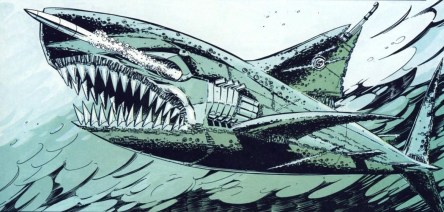
Polarisaurs are found underneath the frozen poles. Clearly the descendants of submarines, they use periscopes to sight prey on the ice before launching a torpedo at them. They then smash through the ice, grab their victim in their jagged teeth, and sink back into the depths. One of those claims the life of a wheeldebeast before Amok could intercede.

untitled-6

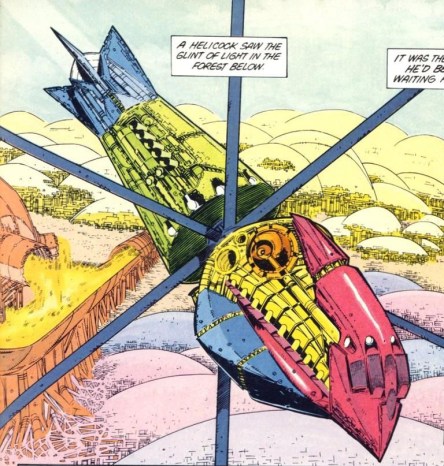
The mirrodillo above has an interesting hunting strategy. It works symbiotically with an airborne helicock, and they share the spoils. The mirrodillo attracts prey with its beautiful shining shell…

untitled-7

… prompting its helicock partner hovering above to fire a beam that reflects off the mirrodillo’s shell, causing indiscriminate damage to everything around it. The mirrodillo can then vacuum up its share while the helicock comes down to partake of the feast.

untitled-4

Mugger bugs are the descendants of car crushers, and have massive, crab-like bodies with powerful claws and huge mouths. The underbelly of a mugger bug is a powerful electromagnet that it uses to capture and disable prey before eating it and compressing it into a cube. Its back is covered with the remains of kills, effectively camouflaging it in plain sight. As you may have guessed, this is indeed something used in real life by assassin bugs, not to mention other insects as well. Technology imitates life. Or something.

untitled-8

Loco-constrictors, finally, are enormous snake-robots that evolved from trains, and still use the ruined rail system to get around. At least one of them, Nikku, was capable of generating paralyzing electrical shocks from the plates on her sides. She tries to eat Buboc, and gets chomped through by Amok for her trouble.

Metalzoic is © Pat Mills, Kevin O’Neill, DC Comics, 2000 AD, et al.

*Mekaka!

Schilalyi

Variations: Shilalyi, Shulalyi, Šilali

shilali

Schilalyi, “Cold” or “Cold One”, is the fifth of the children of Ana, and her third daughter. She and her siblings are the Roma demons of disease, and are the result of unnatural and undesired liaisons between the Keshali queen Ana and the King of the Loçolico.

After Ana’s fourth child, Melalo advised his father to serve her a cooked mouse which the King had spat on, along with soup. Ana fell ill, and as she drank water, Schilalyi crawled out of her mouth. This unnatural birth earned Schilalyi particular loathing from her mother. Schilalyi in turn tormented her brothers and sisters until her husband Bitoso was born.

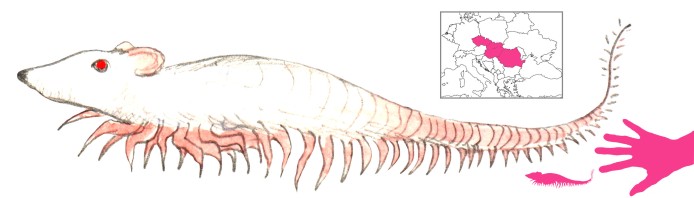
Schilalyi’s form is that of a white mouse with many little legs and possibly multiple tails, and she is the cause of chills and cold fevers. To counter her symptoms, patients are treated with dried mouse lungs and stomachs, steeped in alcohol.

White mice are regarded as agents and offspring of Schilalyi, leading to one alleged incident where a pharmacist’s lab mice were drowned in a well to ward off certain disaster.

References

Clébert, J. P. (1976) Les Tziganes. Tchou, Paris.

Clébert, J. P.; Duff, C. trans. (1963) The Gypsies. Vista Books, London.

Meyers Brothers Druggist (1910) Demons of Disease. Meyers Brothers Druggist, v. 31, p. 141.

Pavelčík, N. and Pavelčík, J. (2001) Myths of the Czech Gypsies. Asian Folklore Studies, v. 60, pp. 21-30.

Indombe

indombe

Indombe is fire, Indombe is life, Indombe is motherhood, Indombe is a slave to the power of death. She is an enormous copper snake over three feet wide, and several miles in length, and she makes her home in the trees of the Congo. Her cupreous body glows red with internal heat; she is immeasurably old, associated with the sun and the sunset in particular. Her tale is mysterious and metaphorical, and her ancestry is probably Semitic.

Itonde, hero and creator figure of the Congo, had been sent on a bizarre errand. His sister-in-law was pregnant, and she had developed a craving for snakes, so Itonde and his brother Lofale went into the forest to find them. There they saw Indombe coiled in a tree, shining bright as the sun. “Great Indombe”, said Itonde, “come down and let us talk together”. As Indombe refused to leave her perch, Itonde started chanting: “Indombe of the Bakongo, come down so I may carry you!” The giant snake was furious. “How dare you try to bewitch me?” she roared, causing her flames to flare and illuminate the entire forest. She then put her red-hot head on Itonde’s shoulder, severely burning him and leaving him for dead.

Fortunately for Itonde he was the owner of a magic bell, and he rang it, immediately recovering from his injuries. He did not want Indombe to gain the advantage of nightfall, so he captured the sun itself. Indombe next tried to constrict him, but Itonde kept ringing his bell, causing him to grow taller and stronger while the snake weakened.

It was in this state that Itonde triumphantly carried Indombe back to his village. He set her down outside the entrance of the village, and Indombe immediately coiled around the village and swallowed every last man, woman, and child. “You monster!” cried Itonde. “I’ll kill you, cut you up, and eat you!” Itonde produced his enchanted machete, and Indombe, seeing her death approaching, warned the hero. “If you kill me, eat me all today; you will not survive if you leave a single piece”. She was then promptly decapitated, cut into slices, and fried in oil. Itonde ate every piece, but left the inedible head, putting it under his bed.

Next morning, he awake to the horrifying discovery that Indombe was still there – but was now a ghost! “I told you eat all of me” she explained, “so now I return as a spirit, to aid you and show you a good place to live”. The spectral copper snake led Itonde to her village, a beautiful, disease-free location for future generations. Itonde then found out that Lofale was dead, killed by Indombe; but he could not avenge himself on a ghost, so he sought out a man in the forest. His quarry tried to hide by transforming into the first sugar-cane, but Itonde found and killed him as an expiatory sacrifice, discovering sugar-cane in the process.

“This village shall be yours because you are a strong fighter”, said Indombe. “Your name shall now be Ilelangonda. Farewell to you all”. With that the ghostly snake coiled up, jumped into the river, and disappeared.

References

Knappert, J. (1971) Myths and Legends of the Congo. Heinemann Educational Books, London.

Impundulu

Variations: Lightning-bird, Intakezulu; Chimungu; Ingqungqulu (Bateleur), Insingizi (Ground Hornbill), Inyoni Yezulu (Bird of Heaven), Isivolovolo (White-necked Fish Eagle), Izulu (Sky)

impundulu

The Lightning-bird, spirit of storms and clouds, takes a number of forms in southern Africa. Several familiar birds are associated with storms: the ground hornbill, the hamerkop, the bateleur, various birds of prey. The Amandebele refer to both the “bird of heaven” and the white-necked fish eagle as Isivolovolo, which flies at great altitude and whose droppings are potent magical ingredients. To the Baronga it is a hawk called Chimungu, which buries itself in the ground with every stroke of lightning. The Tumbuka lightning-bird is black with a curling tail like that of a rooster, scars people with its claws, and leaves little scarlet insects behind after a storm. In Buziba it is a whole flock of glittering red birds whose flashing feathers cause lightning and their wingbeats thunder.

The Impundulu or Intakezulu of the Xhosa is probably the best-known of the lightning-birds. It may appear as a human, but only women can see it in its true form, which is white with red wings, red legs, and a short red tail. Various remains have been identified as belonging to an impundulu, including a ground hornbill’s skull, a dead wandering albatross, a cattle egret, a peacock’s tail feather, and a strange avian skull with the penguinlike lower mandible protruding beyond the upper mandible. The last is not identified, but the description leaves little doubt that the African skimmer Rynchops flavirostris is to blame. Altocumulus clouds have also been identified as impundulu.

The beating of the impundulu’s wings causes thunder, although it only starts thundering after the appearance of the large mushrooms in the wet season. Lightning is caused by an impundulu rushing to the earth to lay a single large egg underground. These eggs must be found and destroyed by shamans before they hatch, lest more impundulus be brought into the world. Throwing assagais into the air also helps dissuade impundulus from landing.

Impundulus are vampiric, sucking human blood until their victims die. They will also carry off unprotected children. Milk is another substance impundulus are fond of, and poisoned milk can be used to exterminate them. Witches are believed to have impundulus who do their dirty work, sending them out to kill men; the fat of an impundulu can also be used in sorcery. Impundulus in human form will impregnate women, and their children will be birds. Tuberculosis is caused by an impundulu sucking away sufferers’ breath, and goes by the same name in West Pondoland.

A person with a nosebleed can be described: wanyiwa yimpundulu, “he has been sucked by impundulu”. Another proverb, “he/she has caught the chicken of impundulu”, refers to one having a stroke of good luck.

In more modern times impundulu has become the name of an electric tram-car.

References

Cook, P. A. W. (1931) Social Organisation and Ceremonial Institutions of the Bomvana. Juta and Co. Ltd., Cape Town and Johannesburg.

Godfrey, R. (1941) Bird-lore of the Eastern Cape Province. Bantu Studies, Monograph Series, No. 2, Witwatersrand University Press, Johannesburg.

del Hoyo, J., Elliott, A., Sargatal, J., Christie, D.A. & de Juana, E. (eds.). Handbook of the Birds of the World Alive. Lynx Edicions, Barcelona.

Werner, A. (1968) Myths and legends of the Bantu. Frank Cass and Co. Ltd., London.

Okpe

okpe

Okpe is a massive, quadrupedal ogre from Argentinian and Chilean Tehuelche folklore. He looks like a pig made of impregnable solid rock, without soft spots or weaknesses. Okpe preys on children, luring them with braised meat before carrying them off in a device on his back. Children captured by Okpe are taken into the jungle and devoured. Attempts to thwart his actions fail, as he is impervious to conventional weaponry.

Once Okpe abducted an older child, who had the presence of mind to hold onto an overhead branch and escape his captor. While Okpe sought his victim and screamed for him to return, the child ran back to his village. There a mare was butchered – as the Tehuelche do in emergencies – and its skin was stretched out on the ground. When Okpe trundled through in pursuit of the boy, he slipped on the stretched hide and fell so heavily that his stony armor rattled! Okpe started to cry in defeat, crying so hard that his tears caused a flood that went up as high as his teeth. He never bothered the Tehuelche again.

References

Borgatello, M.; Bórmida, M.; Casamiquela, R. M.; Baleta, M. E.; Escalada, F. A.; Harrington, T.; Hughes, W.; Lista, R.; Samitier, M. L.; and Siffredi, A.; Wilbert, J. and Simoneau, K. eds. (1984) Folk Literature of the Tehuelche Indians. UCLA Latin American Center Publications, University of California, Los Angeles.

Oókempán

ookempan

Oókempán is an ogre known to the Tehuelche of Argentina and Chile. He looks like a very large man, but has a shell on his back and moves around on all fours like a pig. Oókempán abducts children, enticing them with a bit of meat before slinging them into a box on his back and carrying them off. Any child playing on their own is at risk of being taken and presumably eaten. Attempts to stop Oókempán will fail, as his hard shell prevents any damage from reaching him; his weakness is in his heel, which is unprotected.

It was Oóuk’en, “truth”, the man incapable of lying, who put an end to Oókempán’s kidnappings. He interceded after a child escaped by grabbing hold of an overhead branch as Oókempán passed under it. Oóuk’en went to meet Oókempán at the top of a cliff. “What did you do with the children?” he asked the ogre. “I took them to increase my people”, replied Oókempán. “I only eat rhea, and I needed them to hunt for me”. After some more small talk, Oóuk’en pushed Oókempán off the cliff, shattering his shell and killing him.

The presence of fossil elephant bones in the region have been seen as evidence of Oókempán’s existence.

References

Borgatello, M.; Bórmida, M.; Casamiquela, R. M.; Baleta, M. E.; Escalada, F. A.; Harrington, T.; Hughes, W.; Lista, R.; Samitier, M. L.; and Siffredi, A.; Wilbert, J. and Simoneau, K. eds. (1984) Folk Literature of the Tehuelche Indians. UCLA Latin American Center Publications, University of California, Los Angeles.

Scytale

Variations: Scytalis (Latin), Scytall, Scicalis, Sciscetalis, Seyseculus, Picalis, Situla; Caecilia (erroneously)

scytale

The Scytale (Greek) or Scitalis (Latin), probably derived from scintilla (“spark” or “glimmer”), is one of the many venomous snakes born from the blood of Medusa in the Libyan desert. It was mentioned in the catalogue of snakes that plagued Lucan and his men, but does not get more than a cursory description.

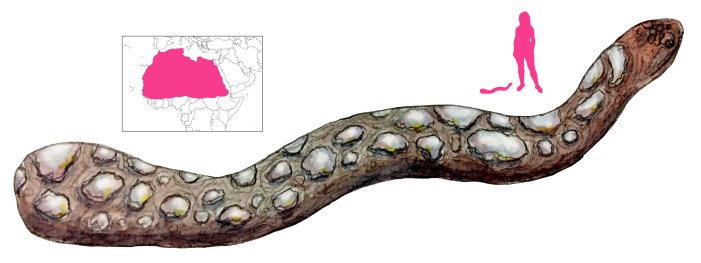
A scytale shares a lot of characteristics with amphisbaenas: earth-colored, heavy-bodied, blunt-headed and blunt-tailed. But while the amphisbaena has two heads, the scytale only looks like it has two heads. Its tail is rounded, flatter, and thicker than the rest of its body, but the scytale only slithers in one direction. More notably, a scytale has scales, markings, or spots on its back that shimmer and gleam in the colors of the rainbow. Its body generates a lot of heat.

Slow and sluggish, the scytale has no means of running down prey. Instead, it uses the gleaming, iridescent markings on its back to mesmerize onlookers, causing them to draw near and within striking range.

The intense inner heat of the scytale allows it to emerge in the winter to shed its skin, even with frost still on the ground. It shares this cold tolerance with the amphisbaena.

Scytale venom is indistinguishable from amphisbaena and viper venom, and remedies for it are the same.

References

Aldrovandi, U. (1640) Serpentum, et Draconum Historiae. Antonij Bernie, Bologna.

Cuba, J. (1539) Le iardin de santé. Philippe le Noir, Paris.

Isidore of Seville, trans. Barney, S. A.; Lewis, W. J.; Beach, J. A.; and Berghof, O. (2006) The Etymologies of Isidore of Seville. Cambridge University Press, Cambridge.

Lucan, trans. Rowe, N. (1720) Pharsalia. T. Johnson, London.

Topsell, E. (1658) The History of Serpents. E. Cotes, London.

mwm

Meeting with Monsters

by Jon Baldur Hlidberg and Sigurdur Ægisson

This time around the book I’m reviewing is less mainstream than the previous ones. While Rose’s and Dubois’s encyclopedias cover a wide range of material around the world, this exquisite little tome focuses entirely on non-humanoid folkloric creatures of Iceland. Is Meeting With Monsters any good for what it does? Let’s find out!

MWM is hard to find in general bookstores, even online. I got my copy from this specialty store, and there are probably other places it can be found too.

Scope

As mentioned above, only non-humanoid Icelandic creatures are covered, with the authors asserting that humanoids will be covered in a later volume. While this is a narrow field for someone looking for an Encyclopedia of All Creatures, it is no less than a godsend for research. It’s hard to find academic books focusing on creatures from a single, less-commonly discussed region, and yet this one does it – with pictures too!

I’ve reached the point where I can’t get myself to buy books like 100 Animal Facts or Uncle Greasebeam’s Big Book Of Scary Dragons. This specialty, academic-friendly approach is just what the doctor ordered.

Organization

They’re all Icelandic, so no divisions by country. Instead, the book is in two main halves, the first covering the land and the second covering the sea. All creatures get at least one full-color painting and a full text description. It’s clear and straightforward, nothing surprising here.

Text

The text has been translated from the original Icelandic (if you’re reading the English version), so I can’t verify whether it loses anything in translation (do I have any Icelandic followers?). It is, however, lucid, clear, and relatively jargon-free, with some amusing tongue-in-cheek comments here and there.

Besides the main text written by the author, text boxes with direct quotations are interspersed throughout the margins, giving you details straight from the horse-whale’s mouth. It’s a clever touch, and one I appreciated.

Images

Glorious. The images are color paintings on a white background (much like a certain blog devoted to cataloguing creatures), with additional black and white sketches and silhouette scale comparisons of each creature. (I swear I had started ABC long before I knew this book existed).

The illustrations are field-guide caliber, clear, detailed, and biologically sound. While not alluding to it, the authors have made sure that all the creatures look like they could plausibly have evolved from something. They do engage in some speculative biology, but read on…

Research

Complete fabrications are the bane of my existence, but MWM manages to dodge that bullet as well. The authors provide a good deal of biological speculation – the horsewhale and redcrest have serrated spines laced with bacteria, the skate-mother is actually a predator of skates that looks like an aquatic bat, and so on – but these embellishments are kept to marginal descriptions of the images, not in the actual text.

The authors have done a lot of research, and it shows. While the exact sources for each creature are not given, there is an extensive bibliography at the end for further reading (hope you know Icelandic). The creatures on display include well-known ones such as the horsewhale and obscure, hard-to-find ones like the shell-monster. All in all, the book is a treasure, a compilation of information on Icelandic creatures. In English, no less. And the references have led me on to other sources.

Summary

By now you’ve probably realized that I really like this book (my love of Icelandic creatures is probably also a giveaway). It has everything one could want from a bestiary: thorough research, marvelous art, and tasteful embellishment. The only thing keeping Meeting With Monsters from being on the shelf of every serious teratologist is its scarcity. But even with that, I have no reservations about awarding it a perfect score.

5