Jaculus

Variations: Iaculus, Jaculare; Sagitta (Latin); Acontia, Acontias, Saetta (Greek); Cafezati, Cafezasi, Altararat, Acoran, Altinanti (Arabic); Orchilanne (Turkish); Saettone (Calabria and Sicily); Ein Schosse Oder Angelsch Lang (German); Decurtati (Hungary)
Jaculus

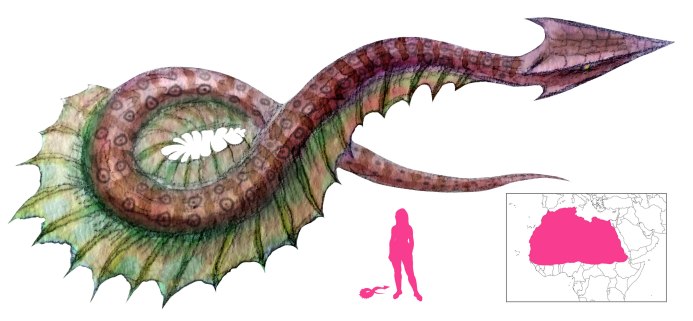
The Jaculus, “javelin” or “dart”, is one of the many snakes that attacked Lucan’s forces during their march through the Libyan desert. While catalogued as a Libyan desert snake, Topsell expanded its range to include Rhodes, Lemnos, Calabria, Sicily, Germany

It can be considered a flying snake, although the “flight” is long-distance leaping over ten to thirty feet. They get into trees and bushes, bunch themselves up in bow and hoop shapes, and fling themselves at high speed onto their prey. Traveling as fast as a thrown javelin, they can puncture clothing and flesh alike. Jaculi are cunning and cruel, and will lie in ambush for human prey, but their presence is given away by the noise they make while coiling in dry plants.

The appearance of the jaculus varies, but it usually has small black ocelli, no bigger than lentils, on its body. The jaculi of Rhodes are ash-colored with a white belly and two black lines running from its head to the tip of its tail; the cafezati or “jumpers” of the Middle East are red, and have been posited as the Biblical fiery serpents. The Hungarian jaculi or decurtati are thick and short-tailed, only two hands long.

A jaculus killed Paulus, one of Lucan’s men, by darting from a distance before it could be seen. It was not venom that felled its victim, but rather the gaping hole left behind after it passed through Paulus’ head at the temples. Topsell believed it was a jaculus that attacked the apostle Paul and bit his hand. Another such snake coiled around the arm of a Zurich peasant; even though it didn’t bite, the arm ended up putrefying and requiring yearly bleeding to drain the black blood inside.

Topsell attests that the same antidotes used for viper venom can be used for jaculus bites. He adds that jaculus gall with Scythian stone yields eye-salve.

References

Aelian, trans. Scholfield, A. F. (1959) On the Characteristics of Animals, vol. II. Harvard University Press, Cambridge, Massachusetts.

Aldrovandi, U. (1640) Serpentum, et Draconum Historiae. Antonij Bernie, Bologna.

Isidore of Seville, trans. Barney, S. A.; Lewis, W. J.; Beach, J. A.; and Berghof, O. (2006) The Etymologies of Isidore of Seville. Cambridge University Press, Cambridge.

Lucan, trans. Rowe, N. (1720) Pharsalia. T. Johnson, London.

Topsell, E. (1658) The History of Serpents. E. Cotes, London.

Colôrobètch

Variations: Colô Rodje Bètch, Colô Rotje Bètch, Clô Rotje Bètch, Colôrobètche, Colaurobètch, Colaurobètche, Colau-rodje-bètch, Corobètch, Routge Bètch

Colorobetch

Bogeys represent a variety of childhood fears – darkness, retribution, the murky depths of deep ponds… In Wallonia children are menaced by the personification of the bise or icy wind, in the form of a bird with a red beak.

He can be found around Andenne, Bastogne, Dinant, Huy, and Neufchâteau, and Warsage; in On, Oignies, and Stavelot he is simply the “red beak”. The Somme-Leuze redbeak is a monstrous sparrow, the Condroz and Hesbaye variety is a pigeon, while the Namur redbeak is Colôrobètch or Colô Rodje Bètch, the “Red-Beaked Rooster”.

As his name indicates, Colôrobètch has a beak stained red with blood; beyond that, it is unclear whether he is a bird, a human, or a grotesque combination of both. He preys on children unwary enough to walk in the cold without adequate clothing, nipping at their exposed faces and hands until they turn red, dry, cracked, and bleeding. Colôrobètch comes out in the winter to pinch noses and spread frostbite.

In Andenne Colôrobètch becomes a nocturnal water bogey who drags children into the Meuse.

References

Pignolet, M. (1985) La Symbolique du Coq. Le Guetteur Wallon, 61 (3), pp. 81-104.

Tijskens, J. (1965) Les Noms du Croquemitaine en Wallonie. Enquêtes du Musée de la Vie Wallonne, nos. 117-120, tome X, pp. 257-391.

Usilosimapundu

Variations: Ugungqu-kubantwana, Ugunqu-kubantwana

Usilosimapundu

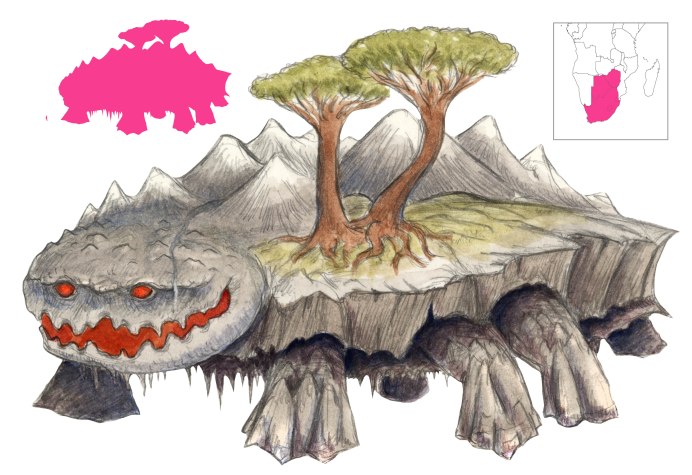
Usilosimapundu, “the rugose beast” or “the nodulated beast”, is a creature of superlatives. There are hills and mountains on his vast body, with rivers on one side, highlands on another, forests on the next, highlands and cliffs on other sides; he is so large that it is winter on one side of him and summer on the other. Two enormous trees, the Imidoni, serve as Usilosimapundu’s officers and servants. Usilosimapundu’s head is a huge rock, with eyes and a broad red mouth. He is a swallower, like many oversized African creatures, but also a force of nature, a personification of landslides and earthquakes.

The sorceress-princess Umkxakaza-wakogingqwayo (“Rattler of weapons of the place of the rolling of the slain”) was promised a great many cattle by her father the king, and the land was scoured for the finest livestock available. Unfortunately the very best cattle proved to be the property of Usilosimapundu. “Take them now”, he warned the soldiers, “but do not expect to get away with it”.

Umkxakaza was greatly pleased by her gift, and Usilosimapundu’s threat was forgotten as the years went by. That is, until the day the earth shook, and Usilosimapundu came to Umkxakaza’s doorstep. Two leaves detached from the Imidoni and took human form before heading for Umkxakaza and ordering her to do their bidding. They forced her to help prepare food for Usilosimapundu to eat – and eat he did, swallowing up everything in town. Finally Usilosimapundu had Umkxakaza climb onto his back, and he lumbered away with his trophy.

Of course, Umkxakaza’s father sent his armies to retrieve his daughter, but what good were the weapons of man against a living continent? Their spears landed in rocks, grass, ponds, trees – none of them had any effect on Usilosimapundu. Umkxakaza’s mother was the only one who continued to follow Usilosimapundu, and the beast obligingly gave her maize and sugarcane to eat while she hurried behind him, but eventually even the queen had to give up. She kissed Umkxakaza, weeping, bidding her to go in peace.

Usilosimapundu dropped Umkxakaza off in a fully furnished cave. “Your father spoiled me by taking my cattle”, he said, “so now I have spoiled him. He will never see you again”. With that Usilosimapundu left and was not seen again.

That was far from the end of Umkxakaza’s adventures, as she was abducted by the Amadhlungundhlebe half-men who fattened her up for eating. She escaped those new captors by summoning a storm, and made her way back to her father’s town, where she was greeted with joy and celebration.

Usilosimapundu has a female counterpart in Ugungqu-kubantwana, the mother of animals. Her name refers to the sound she makes when moving – gungqu, gungqu – rather like that made by a heavy wagon on a bumpy road.

References

Callaway, C. (1868) Nursery Tales, Traditions, and Histories of the Zulus. Trübner and Co., London.

Carcolh

Variations: Lou Carcolh (erroneously)

Carcolh

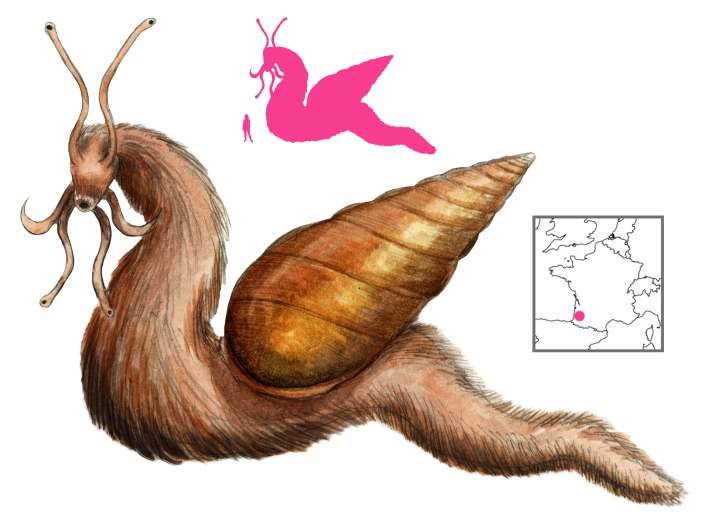
The French town of Hastingues, it is said, is built over an enormous cave honeycombed with entrance tunnels. Deep within that cave dwells the Carcolh (“snail”), also inaccurately known as “lou Carcolh” (“the snail”). The word is itself derived from the Spanish caracol, and does not have any special meaning, as evidenced by the béarnese riddle u houmiot qui s’emporte sa maysou darrè deu cot? Lou carcolh (“A little man who carries his house behind his back? The snail”).

Nobody knows how long the carcolh has lived there, or how old it is. It is a gigantic, slimy, shaggy serpent, with a shell as big as a house, and long prehensile tentacles.

The inhabitants of Hastingues hid their treasures underground before the Spanish invasion. Many have ventured into the cave in search of those treasures, and vanished without a trace. The carcolh does not move much, but its tentacles seize anyone who approaches it, dragging them into its shell to be consumed at leisure. At least one witness saw the carcolh drinking, and managed to escape before it saw him. He then blocked up the tunnel he had entered by, and swore never to return there again.

References

de Charencey, C. (1903) Etymologies Francaises et Provencales. Bulletin de la Société de Linguistique de Paris, v. 12, pp. lix-lxiv.

Foix, V. (1903) Glossaire de la Sorcellerie Landaise. Revue de Gascogne, v. 3, pp. 362-373.

Peyresblanques, J. (1977) Contes et Légendes des Landes. J. Pémartin, Dax.

Rolland, E. (1877) Devinettes ou Enigmes populaires de la France. F. Vieweg, Paris.

Pareas

Variations: Parea, Parias, Paruas, Pharias, Parous, Baron, Pagerina, Anguis Aesculapij, Aesculapian Snake

Pareas

The Pareas is briefly mentioned in the Pharsalia’s catalogue of Libyan serpents. It always travels on its tail, leaving a furrow behind it in the ground. Its bite is harmless and gentle, and so it was consecrated to Asclepius, god of healers. Topsell classifies it among the innocent serpents.

Aelian describes it as being red with sharp eyes and a wide mouth. Topsell, on the other hand, gave its length as four spans, and its color as yellow with two long streaks down its side. Aldrovandi describes the pareas as being yellowish below and black above, with possible variations of green and white along its length. He dismisses the claim that it has a crest.

The tendency of the pareas to travel while holding itself clear of the ground has led to its association with the Eden serpent, which did not creep along the ground prior to being cursed. This claim has been contested by Alexander Neckham and Petrus Comestor, as the pareas very clearly does not conform to that curse. Petrus concluded that the curse must only have affected the individual serpent of Eden, leaving other snakes – including the pareas – uncursed.

References

Aelian, trans. Scholfield, A. F. (1959) On the Characteristics of Animals, vol. II. Harvard University Press, Cambridge, Massachusetts.

Aldrovandi, U. (1640) Serpentum, et Draconum Historiae. Antonij Bernie, Bologna.

Isidore of Seville, trans. Barney, S. A.; Lewis, W. J.; Beach, J. A.; and Berghof, O. (2006) The Etymologies of Isidore of Seville. Cambridge University Press, Cambridge.

Kelly, H. A. (1971) The Metamorphoses of the Eden Serpent during the Middle Ages and Renaissance. Viator, 2, pp. 301-328.

Lucan, trans. Rowe, N. (1720) Pharsalia. T. Johnson, London.

Topsell, E. (1658) The History of Serpents. E. Cotes, London.
Marool

Variations: Angler-fish, Carrachan, Devil-fish, Keddle-man, Kethrie, Kettach, Kilmaddy, Marmaid, Mareillen, Marsgum, Masgum, Meermaid, Merlin-fish, Molly Gowan, Monk-fish, Plucker, Shoemaker, Toad-fish, Weever, Wide-gab

Marool

The Marool of Shetland is a malevolent marine devil, appearing in the form of a fish. It has eyes all over its head, and a crest of flame. It can be seen in mareel, or phosphorescent sea-foam. During storms the marool can be heard singing wildly with joy when a ship capsizes.

Marool is only one of a number of names that have been applied to the anglerfish or monkfish.

References

Forbes, A. R. (1905) Gaelic Names of Beasts (Mammalia), Birds, Fishes, Insects, Reptiles, Etc. Oliver and Boyd, Edinburgh.

Saxby, J. M. E. (1932) Shetland Traditional Lore. Grant and Murray Limited, Edinburgh.