Mastopogon

Variations: Aegomastus, Egomastus; Houperou, Huperus (erroneously?)

Houperou

The first appearance of the Mastopogon (“breast beard”), also called the Aegomastus, is as a nameless “strange fish” observed by Thevet off the coast of South America. It has a beard resembling a goat’s udder under its chin, and the illustration provided includes a long dorsal spine and pointed fins.

Thevet also describes the Houperou as a large carnivorous fish that eats all other sea creatures, except for one small fish. The carp-like fish remains in the shadow of the houperou and enjoys the protection granted by its larger friend. The houperou has rough sandpapery skin like a dogfish, sharp teeth, and a long spine on its back. It attacks, drowns, and dismembers anyone it catches in the water, and the native people shoot it with arrows on sight. The similarity of this unlikely couple to a shark and pilot fish is clear; in fact, uperu is the local name for “shark”, appropriately converted to French pronunciation by Thevet.

Gesner takes up the descriptions of the houperou and the udder-bearded fish from Thevet, but pictures the houperou or huperus as a large pike. He also coins Mastopogon and Aegomastus for Thevet’s nameless fish.

With time the heraldic mastopogon and houperou blurred together to the point of inextricability, making it necessary to describe them together. Holme describes the mastopogon as a variety of houperou, looking like a salmon with large thorny fins, the dorsal fin reaching all the way to the tail. The houperou, on the other hand, now has the mammary wattle, along with two ear-like knobs on its head, a long-spined dorsal fin, rough scales, and a straight tail.

References

Gessner, C. (1560) Nomenclator aquatilium animantium. Christoph Froschoverus.

Holme, R. (1668) The academy of armory, or, A storehouse of armory and blazon containing the several variety of created beings, and how born in coats of arms, both foreign and domestick. Printed by the author at Chester.

de Souza, G. S. (1851) Tratado Descriptivo do Brazil. Typographia Universal de Laemmert, Rio de Janeiro.

Thevet, A. (1558) Les Singularitez de la France Antarctique. Maurice de la Porte, Paris.

Thevet, A. (1575) La Cosmographie Universelle. Guillaume Chaudiere, Paris.
Romŝiwamnari’

Variations: Romŝiwamnare’

Romsiwamnari

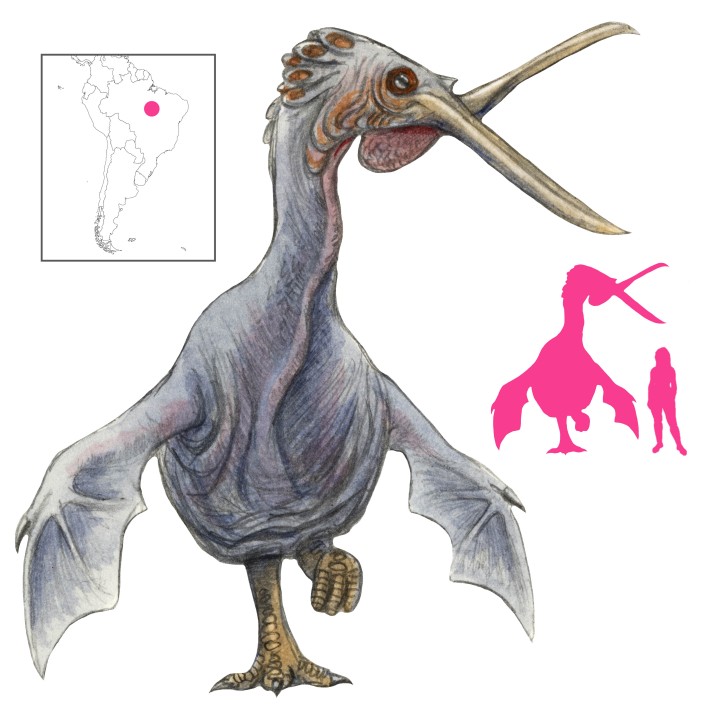
The Romŝiwamnari’ are forest and cave demons, known to the Šerente people of Tocantins, Brazil. They look like large birds with flabby, flightless bat’s wings, armed with beaks like scissors. Their call is an eerie whistle. Romŝiwamnari’ also appear as tapirs, or as stout humans with prominent teeth and a howler monkey’s tail. When in human guise, a romŝiwamnari’ resembles the Pope – a relic of missionary activity in Brazil.

Romŝiwamnari’ not only prey upon the living, but also ambush and consume the souls of the dead. A sufficiently powerful shaman can kill them while in the realm of death, but other souls are greedily devoured.

A man of the krara’ society and his pregnant wife once encoutered a pair of romŝiwamnari’ in a cave. The man held the monsters off as long as he could while his wife escaped, but he was outmatched and decapitated by the romŝiwamnari’. The woman brought the news to the rest of the village, and the other krara’ launched an assault on the romŝiwamnari’ cave. Three of the villagers were killed in the battle, but they slew the two romŝiwamnari’ – unaware that there were two more in hiding. However, the boy the woman gave birth to grew into a mighty hero in less than a year, and he avenged his father by burning the romŝiwamnari’ bones and killing the other two demons. The romŝiwamnari’ were not seen again in that area.

References

Crocker, W. H.; Giaccaria, B.; Heide, A.; Lea, V.; Melatti, J. C.; Nimuendajú, C.; Seeger, A.; Verswijver, G.; Vidal, L.; Wilbert, J. and Simoneau, K. (eds.) (1984) Folk Literature of the Gê Indians, v. 2. UCLA Latin American Center Publications, University of California, Los Angeles.

Nimuendajú, C.; Lowie, R. H. (trans.) (1942) The Šerente. The Southwest Museum, Los Angeles.

Cherruve

Variations: Cheruvoe, Cheurvoe, Cheurvue, Cherufe

Cherruve

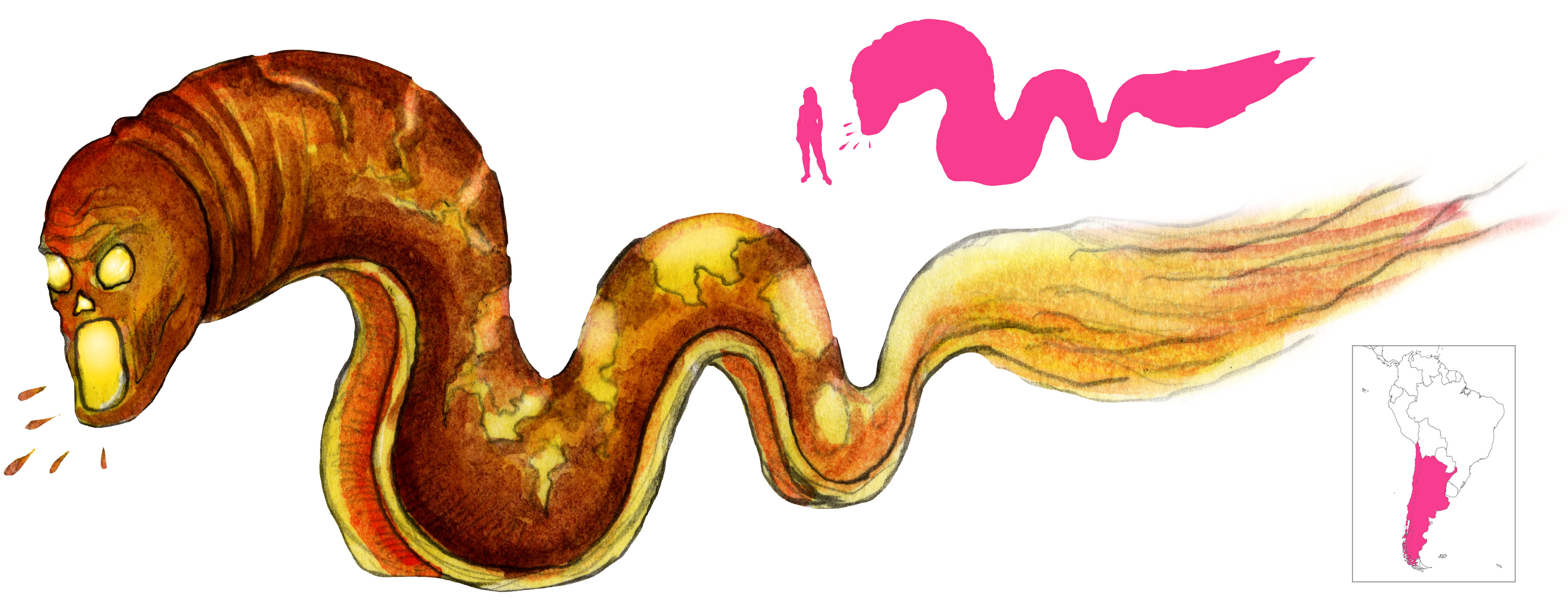
The Cherruve is the Chilean spirit of comets and asteroids. Originally no more than the Araucanian meteorite, the cherruve’s role has since expanded to include lava, volcanoes, fiery exhalations, will-o-the-wisps, whirlwinds, and animate stone axes.

Cherruve appearance varies from area to area, but it is usually described as a comet, or a great serpentine creature with a human head and lava dribbling from its mouth. Its appearance has been anthropomorphized to various degrees and conflated with aspects of European mythology; in the Andes it becomes a huge seven-headed dragon; elsewhere it is confused with dragons, devils, and giants, or bipedal goats with flaming eyes.

Cherruves live underground and in volcanoes, and streak across the sky by night. The appearance of a cherruve in the sky heralds the spread of an epidemic, the death of a great leader, or other misfortunes, while the cherruve’s vomit is lava and its movements underground cause earthquakes. They make thunder by tossing human heads. The more dragon-like cherruves may demand the sacrifice of Mapuche maidens, and will withhold the flow of rivers if their demands are not met.

Comets, asteroids, and meteors are all cherruves, as are meteorites and oddly-shaped volcanic rocks. Cherruve rocks are collected by sorcerers, who use them to carry out their evil purposes by sending them at their enemies. They are ordered to suck blood and inflict death and disease, and can operate on their own, returning diligently to their masters after performing their duties.

Cherruves are also capable of feeling more human emotions. One cherruve married a Cloud, and their beautiful daughter, ethereal and pale, was Snow. Despite the cherruve’s jealous attempts to keep his wife under lock and key, she was abducted by his mortal enemy Wind. Every now and then Wind would blow Cloud over the volcano, and her tears became rain, while the cherruve’s own despair turned into destructive eruptions. The cherruve redoubled his efforts to protect Snow, and kept her from leaving the mountain during the daylight hours. Snow’s curiosity about the world outside continued to grow, and one day she finally managed to escape her father and climb out into the light. She marveled at the sun, the songs of birds, the colors, all infinitely beautiful and unknown to her. The longer she stayed outside, the happier she was, and yet the weaker she felt. Her mother tried to protect her, but the spiteful Wind carried the Cloud away. When Snow sat down, exhausted, the love-stricken Sun came down to give her a kiss. When the cherruve finally caught up with his daughter, he found nothing but a puddle of crystalline water.

References

Faron, L. C. (1964) Hawks of the Sun. University of Pittsburgh Press, Pittsburgh.

Guevara, T. (1908) Psicolojia del pueblo araucano. Imprenta Cervantes, Santiago de Chile.

Latcham, R. E. (1924) La organización social y la creencias religiosas de los antiguos araucanos. Imprenta Cervantes, Santiago de Chile.

Lenz, R. (1897) Estudios Araucanos. Imprenta Cervantes, Santiago de Chile.

Pino-Saavedra, Y.; Gray, R. (trans.) (1967) Folktales of Chile. The University of Chicago Press, Chicago.

Soustelle, G. and Soustelle, J. (1938) Folklore Chilien. Institut International de Coopération Intellectuelle, Paris.

Araǵanaqlta’a

Variations: AraGanaqlta’a, AraGanaGalta’a; AraGanaqlate’e, AraGanaGalate’e; Owner of the Snakes, Father of the Snakes

Araganaqltaa

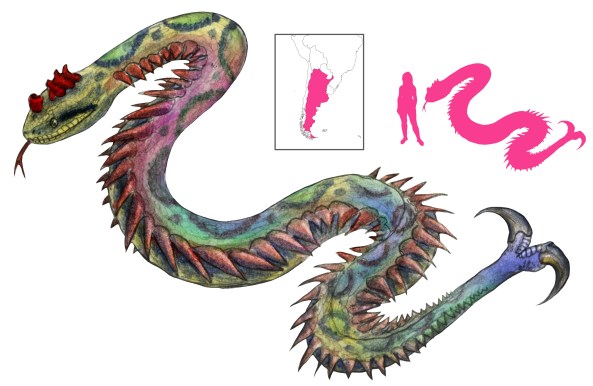
Araǵanaqlta’a is the father or owner of the snakes in Argentinian Toba folklore. It can be found in a range of habitats, but usually likes rivers and deep caves with access to water. In addition to snakes, which are all under its command, it is associated with water, rainbows, and storms.

The araǵanaqlta’a appears as a large, multicolored snake, 10 meters or more in length, resembling a bushmaster or fer-de-lance. It has a red crest, its “sign” (ndage), on top of its head, and a sawlike structure on either side of its body that allows it to move. An araǵanaqlta’a’s tail ends in two hooks which it uses to hold prey. The females are known as araganaqlate’e, the mother of the snakes.

Araǵanaqlta’a are shapeshifters, adjusting to fit their environment, and are also known in the form of four-legged snakes, as humans in elegant business attire, or as rheas with colorful necks. No matter what shape it takes, however, the araǵanaqlta’a always has its characteristic ndage, which identifies it as a powerful mythical creature.

Araǵanaqlta’a are intelligent and enjoy human conversation. These snakes will punish desecrators of nature and persecutors of snakes, but will reward those who they find worthy. After a hunter treated an araǵanaqlta’a with respect and obeisance, the snake promised him that he would have all he would ever need, and taught him how to heal the sick with his words.

References

Wilde, G. and Schamber, P. (2006) Simbolismo, Ritual, y Performance. Paradigma Indicial, Buenos Aires.

Wright, P. G. A semantic analysis of the symbolism of Toba mythical animals. In Willis, R. (Ed.) (1990) Signifying Animals: Human Meaning in the Natural World. Unwin Hyman, London.

Wright, P. G. (2008) Ser-en-el-sueño. Editorial Biblos, Buenos Aires.

Abúhukü

Variations: Abúhuwa (pl.)

Abuhuwa

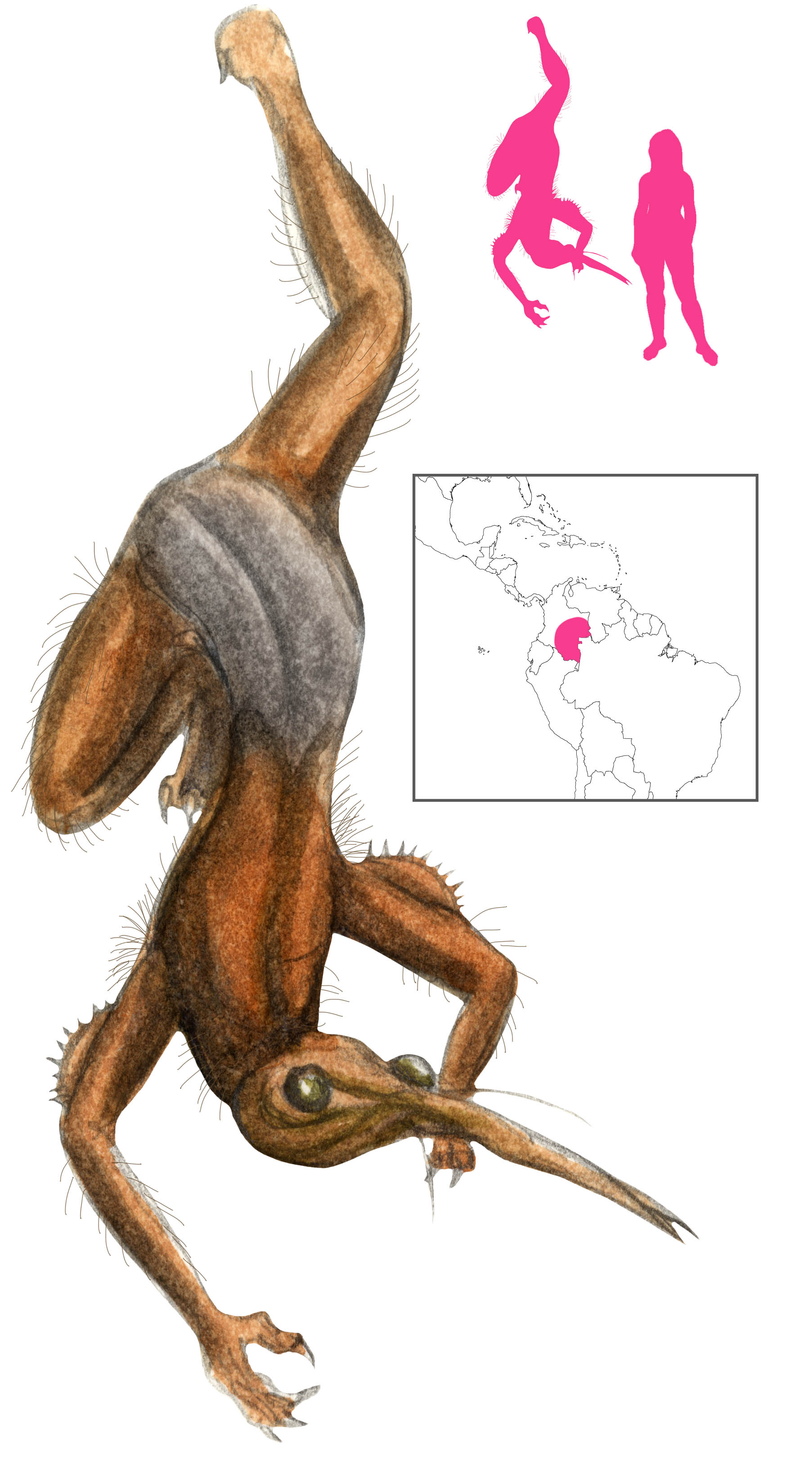
The victims of the Abúhuwa, the rainforest demons of the Cubeo people of the Colombian Amazon, are easily recognized. An abúhukü will cut a hole in the skull before sucking out the contents of the body. Sometimes prey is rolled in palm leaves and tenderized. Either way, they leave an empty skin hanging from a branch.

Abúhuwa are nocturnal creatures who embody disease, death, and all that is evil. They associate with the spirits of dead poisoners, murderers, and male adulterers, and are described as misty creatures from the realm of darkness. Their name is derived from “whiteness”, or the foaming of rapids. Like almost all other Amazonian ogres, the abúhuwa are hairy and foul-smelling, associating them with bestial sexuality and death respectively. In addition to that, they have an extra face in the back of their head, and sticky bodies that make escape from their embrace impossible. The females have long pendulous breasts and prefer to kill men, while the males attack women, often killing mothers and abducting their children to raise as their own. Such abúhuwa changelings become cannibals themselves.

The abúhuwa were once far more common, and were allied with a race of evil jaguars that worked with them to decimate human populations. Humanity got a respite after a series of floods and fires that reduced the numbers of both predators.

Abúhuwa are fortunately quite stupid, and can easily be outwitted by children. They are relegated to the status of nursery bogies, reflected in a sort of tag game where one child plays the part of the abúhukü. The grotesqueness of the abúhuwa makes them easier to confront and mock.

Armpit hair from an abúhukü makes a potent ingredient in poisons. To obtain it, an abúhukü must be caught during a lunar eclipse, and the hair from its left armpit must be cut with a corn husk, reduced to ash, mixed with water and turned into paste, and left to dry. It keeps well in a gourd sealed with beeswax.

Capsicum smoke is toxic to abúhuwa, and they can be easily driven away by burning peppers. When killed, they turn into sloths.

References

Goldman, I. (1979) The Cubeo Indians of the Northwest Amazon. University of Illinois Press, Urbana.

Goldman, I. (2004) Cubeo Hehénewa Religious Thought. Columbia University Press, New York.

Smith, N. J. H. (1996) The Enchanted Amazon Rain Forest. University Press of Florida, Gainesville.

Chonchón

Variations: Chonchon, Chonchoñ, Chon Chón, Chuncho, Chucho, Chuchu, Chaihue; Chonchones (pl.); Cocorote, Corocote (Venezuela); Cuscungo (Ecuador); Tecolote, Telocote (Mexico)

Chonchon

The Chonchón is a bird of ill omen from Chile and Argentina; it originally hails from Araucanian Mapuche folklore. Chonchón is also the name of a kind of kite.

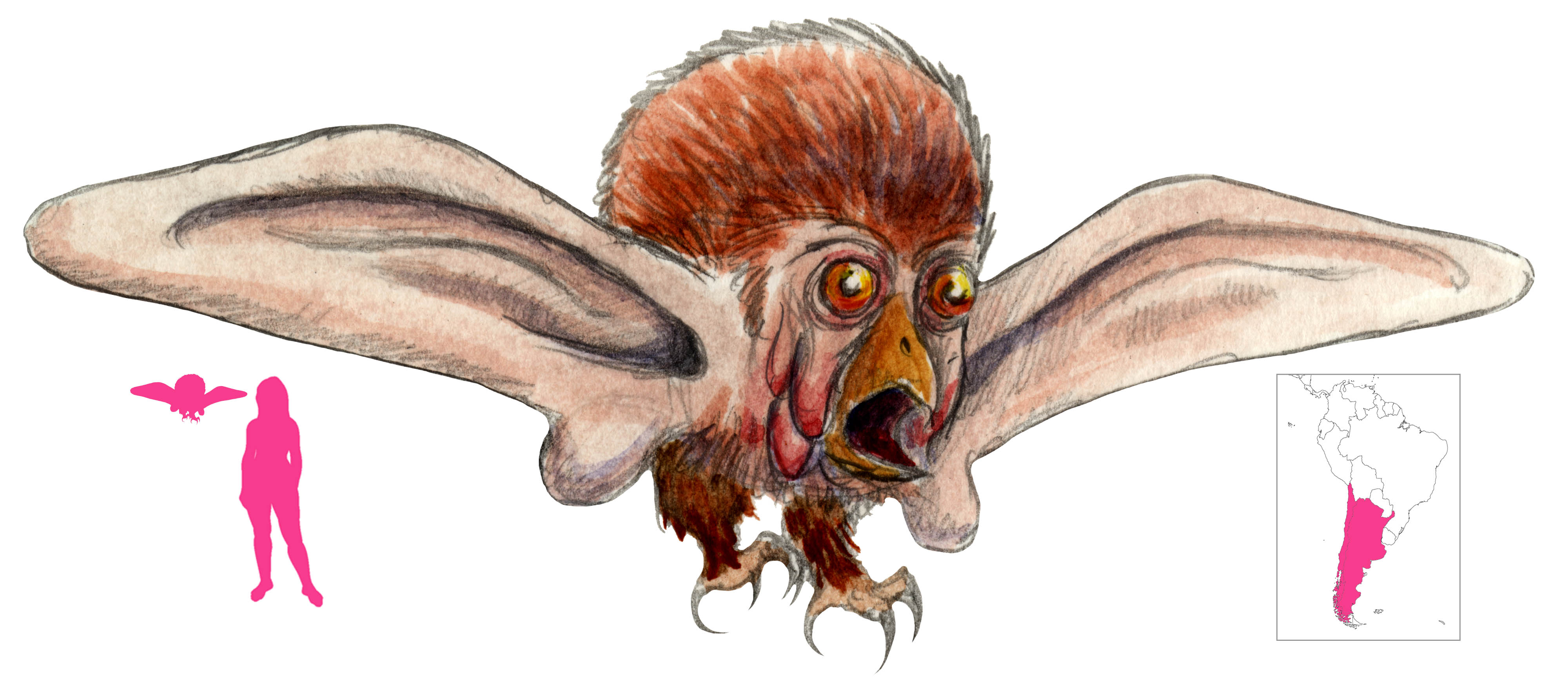
In its simplest form it is a bird of the night, an owl (Strix rufipes) that flies on silent wings during the night to announce illness, death, or some other unwelcome event. When its croaking is heard it is advised to throw ash into the air and utter a few prayers in the hopes of turning away its evil.

The chonchón is also said to be a calcu or evil sorcerer in disguise. It resemble a human head, with oversized wing-like ears that allow it to fly. During the night, these sorcerers’ heads detach themselves from their bodies and fly around to cause mischief, invisible to most, their ominous tué, tué, tué call announcing misfortune. They have the same powers as sorcerers do, and have been known to suck the blood of sleepers.

In order to repel chonchones, several methods are recommended. These include drawing a Solomon’s seal on the ground, laying out a waistcoat in a specified manner, or reciting certain phrases or hymns such as the Magnificat, the Doce Palabras Redobladas, “Saint Cyprian goes up, Saint Cyprian goes down, Saint Cyprian goes to the mountain, Saint Cyprian goes to the valley”, or “Jesus goes ahead, follow him behind”. Doing any of these actions forces the chonchón to leave, or even fall to the ground where it can be destroyed. If the headless body of a chonchón sorcerer is found, turning it onto its stomach prevents the chonchón from returning to it. Finally, a more humane means of dealing with a chonchón is to yell “Come back tomorrow for some salt!” The next day, the chonchón in its human guise will show up and sheepishly request the promised salt. Except perhaps for the last method, most interference with the ways of chonchones will eventually incur the revenge of the chonchón or its friends.

One chonchón was reportedly grounded in Limache when someone made a Solomon’s seal, causing a large bird with red wattles to fall out of the sky. It was decapitated and its head fed to a dog, whose belly swelled up as though it had eaten a human head. Later the local gravedigger told that unknown persons had come to bury a headless body.

Not all chonchones are irredeemably evil, however. A Mapuche man in Galvarino once woke up early in the morning to find his wife’s body without her head. He immediately realized that she was a chonchón, and turned the body onto its stomach to prevent the head from reattaching. As expected, a chonchón soon flew heavily into the house, flapping and staggering as though blind. It then turned into a dog and whined pleadingly to be reunited with its body. The man took pity on it and allowed it to do so, and it became his wife once more. “Every night I leave, without you knowing, and visit distant lands”, she explained. She begged him not to tell anyone, and swore she would never harm him, and both kept their word; the story became known only after the wife died of natural causes.

Some authorities separate the chonchón from the chuncho, with the former being the sorcerous flying head and the latter the owl. Their calls are also different, with the chuncho hooting chun, chun, chun. They have further owl equivalents in the Venezuelan cocorote, the Ecuadorian cuscungos, and the Mexican tecolote. It is also compared to the myth of the voladora, a witch who flies while cackling loudly.

All this is quite unfair to the owls themselves, which benefit the farmers by eating mice, rats, and other vermin.

References

Aguirre, S. M. (2003) Mitos de Chile. Random House, Editorial Sudamericana Chilena.

Borges, J. L.; trans. di Giovanni, N. T. (1969) The Book of Imaginary Beings. Clarke, Irwin, & Co., Toronto.

Cifuentes, J. V. (1947) Mitos y supersticiones (3rd Ed.). Editorial Nascimento, Santiago, Chile.

Coluccio, F. and Coluccio, S. (2006) Diccionario Folklórico Argentino. Corregidor, Buenos Aires.

Rodríguez, Z. (1875) Diccionario de Chilenismos. El Independiente, Santiago.

Soustelle, G. and Soustelle, J. (1938) Folklore Chilien. Institut International de Coopération Intellectuelle, Paris.

Auñ Pana

Variations: Pehiwetinome

Aun Pana

The Auñ Pana are evil man-eating fish from the folklore of the Yanomami of Brazil and Venezuela. They are large, have arms, and are covered with hair. Apparently they also have some degree of magical power. The auñ pana live in deep water and school with Pehiwetinome, which are equally large and anthropophagous.

A group of auñ pana and pehiwetinome once tore down a bridge that the Yanomami were crossing by biting through its wood. The bridge collapsed and became a raft, and the surviving Yanomami were turned into monkeys and pigs.

References

Albert, B.; Becher, H.; Borgman, D. M.; Cocco, L.; Colchester, M. E. M.; Finkers, J.; Knobloch, F.; Lizot, J.; and Wilbert, J.; Wilbert, J. and Simoneau, K. eds. (1990) Folk Literature of the Yanomami Indians. UCLA Latin American Center Publications, University of California, Los Angeles.

Aíǰe

Variations: Aíge, Spirit-Tadpole

Aige

The Aíǰe is associated with the Bororo of Brazil and Bolivia, and in particular the Páiwoe and Aróroe clans. It is a gigantic tadpole, somewhat like a hippopotamus.

Rubúgu of the Páiwoe first found the aíǰe while walking through a swamp. He liked the little animal and decided to keep it, taking it home in a vessel of water. Rubúgu had great plans for his little pet, and wanted it to become something great and amazing, so before covering its container with a fan he told it “Grow for me; thrive and become an extraordinary creature”.

And grow the aíǰe did. It became larger, and stronger, and it could sing a loud, buzzing song. Rubúgu had to keep switching it to increasingly large containers to support its bulk, and eventually he had nowhere left to put it. He tried doing a dance for the aíǰe, but the tadpole rejected Rubúgu’s mediocre talents. Instead, Chief Baitogógo of the Aróroe took the aíǰe, and honored it with a macaw-feather headdress and a marvelous dance, both of which pleased the tadpole greatly. Baitogógo told the aíǰe that it had to live in ponds, swamps, and lakes away from the Bororo, for it was so big and the magic of its song so powerful, it could pose a serious threat.

The aíǰe accepted, and before leaving it told Baitogógo that if the Bororo missed it, then they should fashion little tadpole sculptures in remembrance. Those figurines could be tied to a stick and swung in the air, making an amphibian buzzing much like aíǰe did. Thus the aíǰe went on to become one of the totems of the Bororo.

References

Albisetti, C.,; Colbacchini, A.; and Venturelli, A. J.; Wilbert, J. and Simoneau, K. eds. (1983) Folk Literature of the Bororo Indians. UCLA Latin American Center Publications, University of California, Los Angeles.

Tapirê-iauara

Variations: Tapir Nymph, Onça d’Água (Water Jaguar), Onça Pé de Boi (Cow-legged Jaguar), Paraná Pura Iuraretê (Turtle/Jaguar that Dwells in River Side Channels), Tai-açu-iara (potentially)

Tapire-iauara

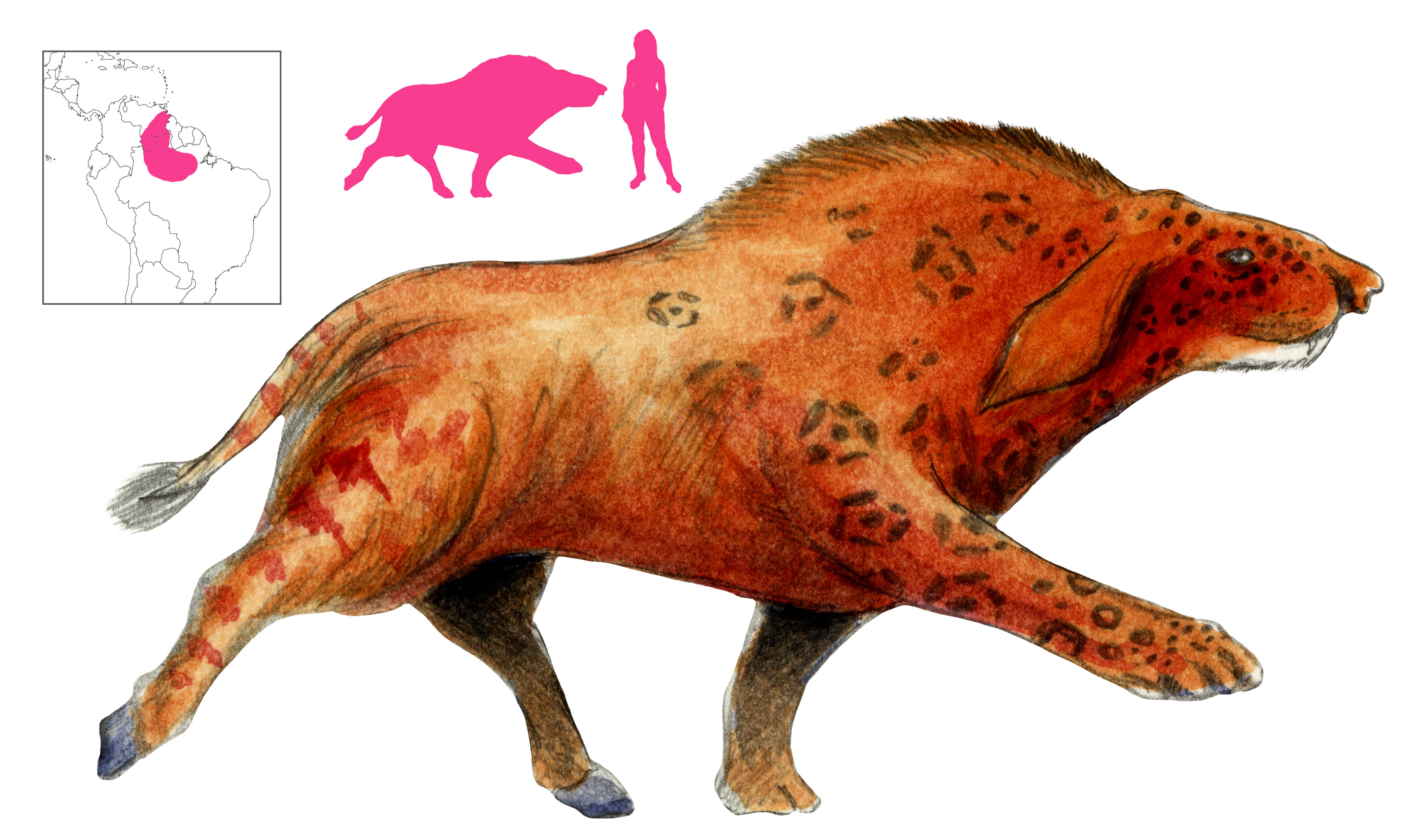
The Tapirê-iauara, or Tapir Nymph, enjoys a wide distribution in the Amazon, from the Orinoco in Venezuela to the Rio Negro, the Madeira, the Tapajós, and the Amazon down to Pará. Sightings have been reported from around Codajás, Fonte Boa, Itacoatiara, Nova Olinda, Oriximiná, Santarém, and Urucurituba. It lives in slower-moving waters, near groves of aninga or palm trees, and avoids human settlements.

The name tapirê-iauara is etymologically complex. Tapiré is Tupi for “tapir”, while y is “water” and ara is “lady” in língua geral; it also draws from the Tupi uara (“dweller”) or yguara (“dweller in water”). Hence, “tapir water-lady” or “tapir nymph” is a rough translation. This same derivation gives us the Amazonian nymphs Yara and Oyoára, the sea monster Hipupiara, and Paraná Pura Iuraretê, which was apparently a giant turtle creature that later was subsumed into the tapirê-iauara (iuraretê meaning either “turtle” or “jaguar”).

Reports of the tapirê-iauara appearance have varied somewhat. Most accounts agree that it resembles a cow-sized jaguar with a reddish waterproof coat, a thick mane, long droopy ears half a meter in length, and an overpowering stench (catinga). It may have jaguar legs, or the forelegs of a jaguar and hooved, donkey-like hindlegs. It may have horse legs with or without catlike paws, duck feet, or large otter paws. Variations in fur color include red, gold, and black with a cream patch in the chest. It notably does not look much like a tapir.

A tapirê-iauara is heard and smelled before it is seen. The large, finlike ears flap noisily against the water as it swims, while its putrid odor precedes it. From a safe distance, it’s merely nauseating; at close quarters the stench of a tapirê-iauara is enough to cause fainting and outright death. Tapirê-iauaras can also mesmerize prey into standing still before pouncing on them.

Tapirê-iauaras have a broad diet that includes large fish, capybaras, caimans, and humans. They are attracted to hauls of fish and the halitosis resulting from eating poorly-cooked fish. They often show up to inspect fishermens’ catches – or the fishermen themselves. When they do, they are fast, persistent, and resilient, relying on their odor to weaken prey before killing it with their sharp teeth and claws. One fisherman had to empty 12 slugs from a .22 rifle into a pursuing tapirê-iauara before the beast expired. Other fishermen have not been so lucky, having their catches stolen at best or being dragged into the river and devoured at worst.

Sometimes the stink of a tapirê-iauara is enough to cause a human’s shadow (and therefore soul) to depart. A person who has lost their shadow in this way is said to be assombrado. They can recover their soul by inhaling the fumes of a fire made with leaves, sticks, and the bones of undercooked piranhas.

Caraña resin (Protium heptaphyllum) is repulsive to tapirê-iauaras, and anyone concerned about tapirê-iauara attack should equip themselves with some before heading into the Amazon. Tapirê-iauaras also cannot climb, and so shelter should be sought in trees. As the tapirê-iauara’s odor will cause fainting and potentially falling out of the tree, secure branches must be found.

The Tai-açu-iara from around Parintins is similar and may be the same animal. It appears as a black piglike creature with jaguar paws.

References

Smith, N. J. H. (1981) Man, Fishes, and the Amazon. Columbia University Press, New York.

Smith, N. J. H. (1996) The Enchanted Amazon Rain Forest. University Press of Florida, Gainesville.

Eintykára

Variations: Tapezu’á, Honey Man

Eintykara multiple

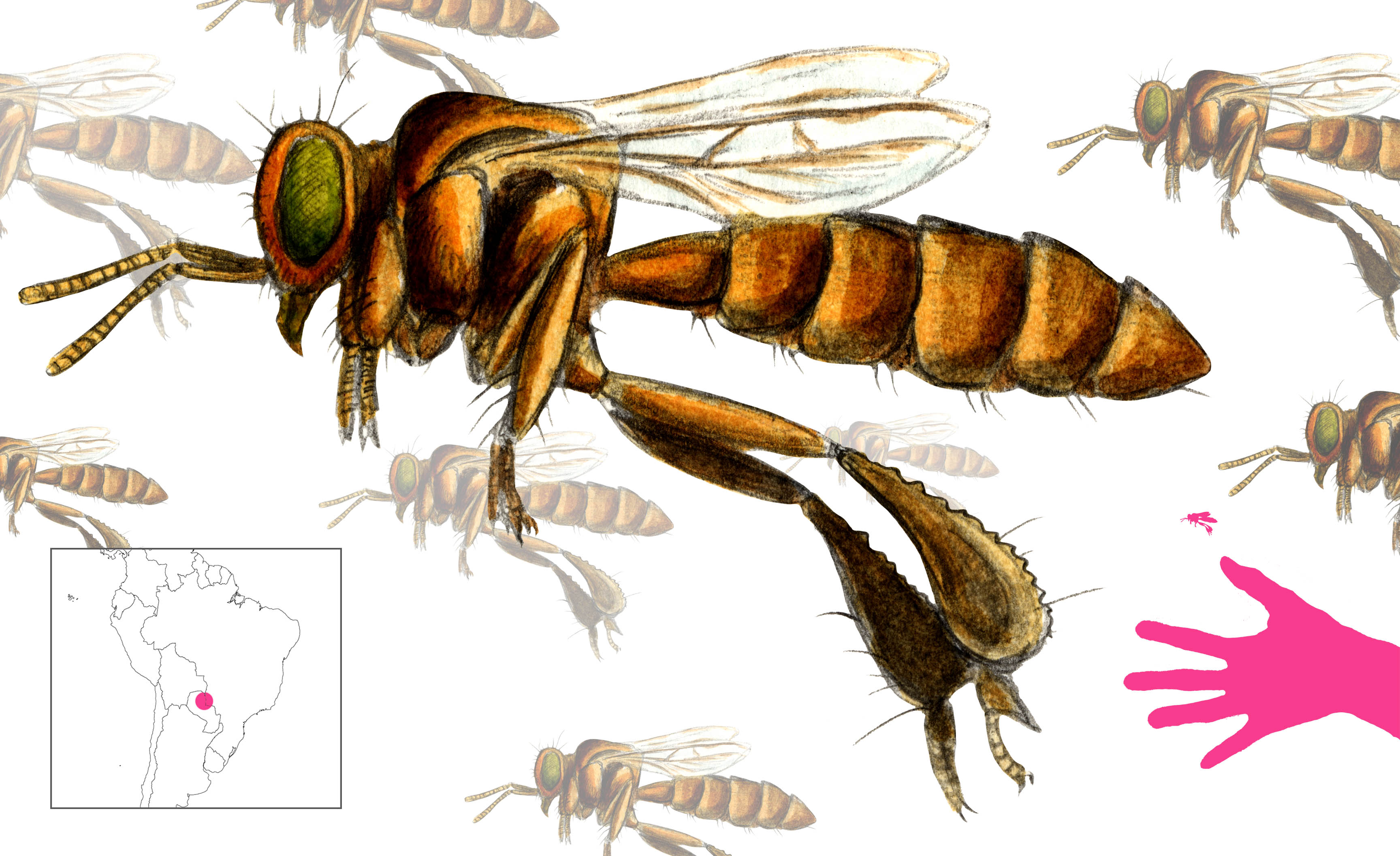
The Eintykára stingless bees, as told by the Chamacoco of Paraguay, are those that produce the golden honey. This honey can induce mild hallucinogenic effects, due to the presence of an ergot fungus on the plants the bees visit. But even more remarkable is their ability to swarm together and shapeshift into a man.

Eintykára hives have long, tubular wax entrances through which the bees enter and leave. An older single woman used to pass by such a hive every day, and its suggestive appearance made her mind wander. “Oh, what a beautiful eintykára hive!” she would say. “If only it were a handsome man who would make love to me…”

She continued to fantasize about the phallic hive, day in and day out. Eventually she started referring to it as her husband. “Ah, there is my husband again. He’s still there. If only he were a man, I would marry him on the spot”.

Finally, one night she was visited by a stranger. He was unlike any man she had seen – his skin was milky white, and his hair was as golden as honey. “Who are you?” she asked, stunned by his beauty. “I am Eintykára, the hive you desired and talked to for so long. I wish to take you as my wife, and support you and your people”.

And so it came to pass that the woman married Eintykára, and they had children together. He was unnaturally intelligent, and a diligent, tireless worker admired by the entire village. He never seemed to eat; instead, he would go into the forest, transform into a swarm of bees, and then reintegrate after collecting enough nectar. His “waste” was beeswax and eintykára honey, which he would distribute to all. That is why some of the Chamacoco are fair-skinned, for they are among his descendants.

Another eintykára was also known to have joined a Chamacoco village, but he and his adopted people were tragically killed in a raid by a neighboring tribe. They set fire to the houses, and though he tried to turn into an eintykára swarm and fly away, enough of his bees were incinerated to kill him.

References

Cañedo, J. A.; Belaieff, J.; Cordeu, E. J.; Frič, A. V.; Métraux, A.; and Pittini, R.; Wilbert, J. and Simoneau, K. eds. (1992) Folk Literature of the Chamacoco Indians. UCLA Latin American Center Publications, University of California, Los Angeles.