Fayette

Fayette

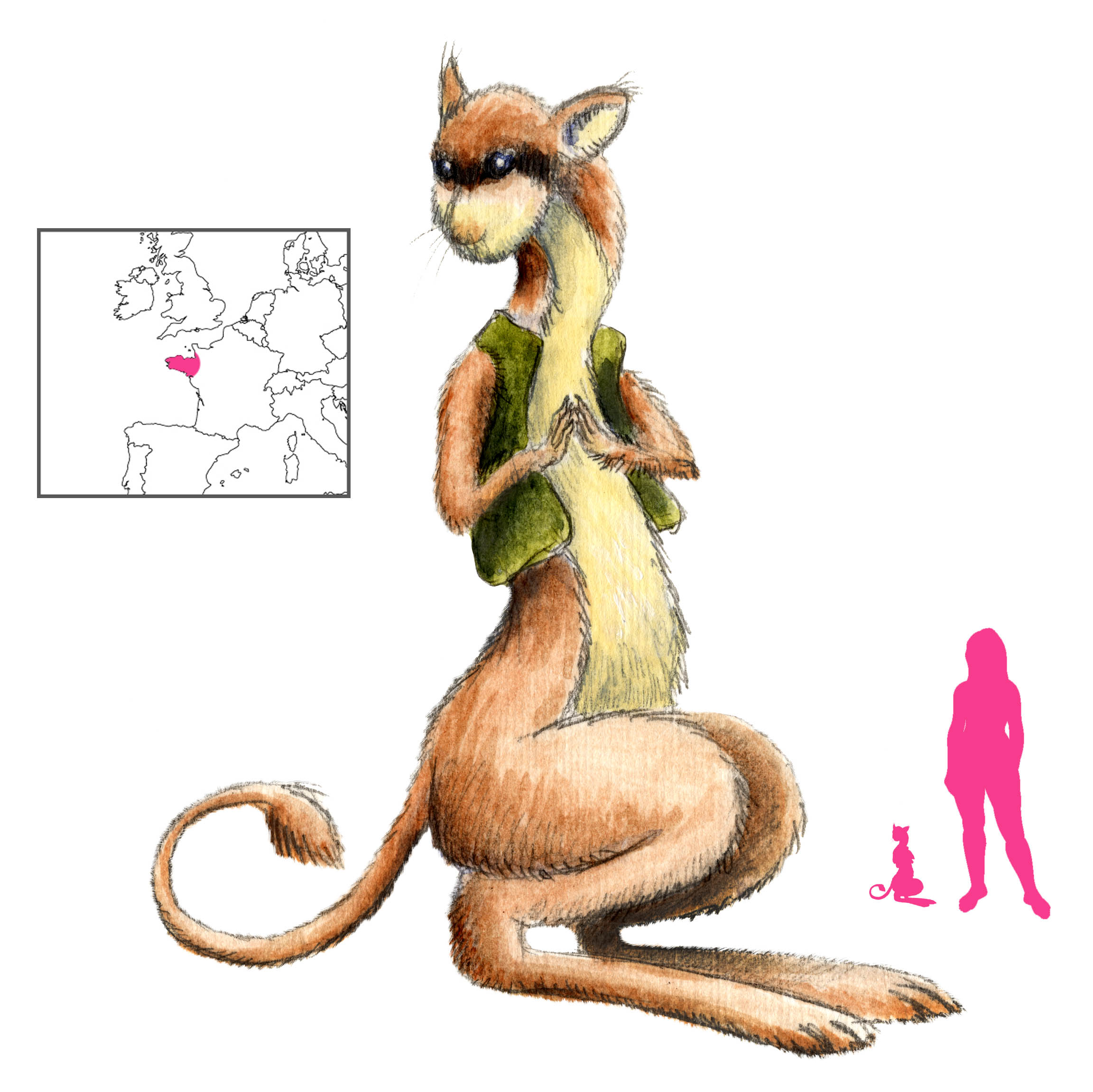
The Fayettes (“little fairies”) live in the Forez region in France, today around the Loire basin. They are believed to be the descendants of the Greek nymphs, having escaped the advance of Christianity in the Mediterranean.

In France they are much tinier versions of their former selves, but their magical powers are undiminished. They guard the caves and forests, and can be seen dancing in the woods of Couroux, in the Beaujolais. Like any self-respecting fairy, they like to abduct children and leave insatiable changelings behind. Those fairy children are best brought to the mouth of a cave and threatened with violence, causing the fayette to return the stolen child. Te, vequio le tio, rends me le mio (“There, here’s yours, return mine”).

During the night, the fayettes do their laundry under the moon. Travellers in the woods are advised to sing at the top of their lungs to make sure they’re not mistaken for threats. At daybreak the fairies dissipate like fog, sometimes leaving behind solid gold washboards that would make anyone’s fortune.

During the day the fayettes take the form of moles, and take pleasure in ravaging gardens. This is why moles have pretty little pink hands.

References

Proth, M. (1868) Au Pays de l’Astrée. Librairie Internationale, Paris.

Sébillot, P. (1904) Le Folk-Lore de France, Tome Premier: Le Ciel et la Terre. Librairie Orientale et Américaine, Paris.

Malebête

Variations: Malbête, Malebàete, Malebeste (archaic), Bête d’Angles (Beast of Angles), Troussepoil

Malebete

Visitors to the French town of Angles, in the Vendée, are drawn to the beautiful church of Notre-Dame-des-Anges (Our Lady of the Angels). There, at the top of the bell tower, stands a monstrous stone bear glaring down on the city. Those visitors would be well advised to steer clear of its line of sight.

Long ago, it is said that a terrible beast ravaged the countryside of Angles. It was in the form of a great black bear, with shaggy, matted fur, and it became known as the Malebête – the “Evilbeast” or “Illbeast”. This monster had a predilection for young maidens, glutting itself almost exclusively on women. After feeding it would then wash itself in the nearby river, causing its hair to clump and stick out and granting the river the name of Troussepoil (“Hair-Raiser”, more or less).

The depredations of this demonic creature led to increasing concern. The river was running red with blood, and the female population was dwindling. None dared approach it, as its strength was greater than any knight’s. As it was an incarnation of the Devil himself, it became clear that only a sufficiently holy man would be capable of defeating it. The abbots of Fontaines and Talmont both went to face the beast, only to scurry away in terror when it charged them. The Pope’s envoy fasted for two days before confronting the Malebête, but barely escaped with his life and swore never to return.

Was there any man holy enough to destroy the Malebête? The answer came in the form of Father Martin, an old monk from the Angles cloister who spent most of his time isolated in contemplation of God. Perhaps out of desperation, he was begged to do something about this.

Leaning on a walking stick, dressed only in his ecclesiastical robes, Father Martin walked out to where the Malebête awaited him. To everyone’s amazement, the beast lowered its gaze in front of the hermit. “Follow me”, he said simply, and the Malebête did – as did the entire population of Angles. They followed Father Martin all the way back to the church, where he told the Malebête to climb the bell tower. Once at the top, it froze in place, and turned to stone.

Despite the rejoicing over the Malebête’s defeat, there were still a few voices of dissent in the form of a few girls who taunted Father Martin. “Since when are you the Devil’s shepherd?” they sneered. Father Martin merely smiled and looked up at the Malebête. “Henceforth, you shall feed only on the beauty of the girls of Angles”, he stated. And instantly all the women present became ugly and ran home in shame.

Since then, the resourceful women of Angles have found ways of avoiding the Malebête’s hungry gaze, and sneak safely into the church via a back door. Today the Malebête’s primary sustenance comes through the tourist industry.

This tale was first told by Benjamin Fillon, a dubious character who seems to have created the story out of whole cloth, making it a neo-myth of sorts. For one thing, the statue of the Malebête is of pre-Christian origin, predating its own legend; it was originally in a seated position, and was mutilated into its current shape. The Malebête’s story is also a familiar one, echoing many others told of anthropophagous monsters slain by righteous men.

References

Chaigne, L. (1942) La Vendée. F. Lanore, Paris.

Dillange, M. (1983) Eglises et Abbayes Romanes En Vendée. Jeanne Laffitte, Marseille.

Dubourg-Noves, P. (1996) Notre-Dame d’Angles. in Vendée. Congrès Archéologique de France, 151e Session. Musée des Monuments Francais, Paris.

Le Quellec, J. (1988) Le légendaire du Sud-Vendée: organisation spatio-mythique. Etuderies 3-4.

Trébucq, S. (1912) La chanson populaire et la vie rurale des Pyrénées à la Vendée. Feret et fils, Bordeaux.

Lavellan

Variations: Water Shrew, Water Mole, Blind Mouse, Common Lizard

Lavellan

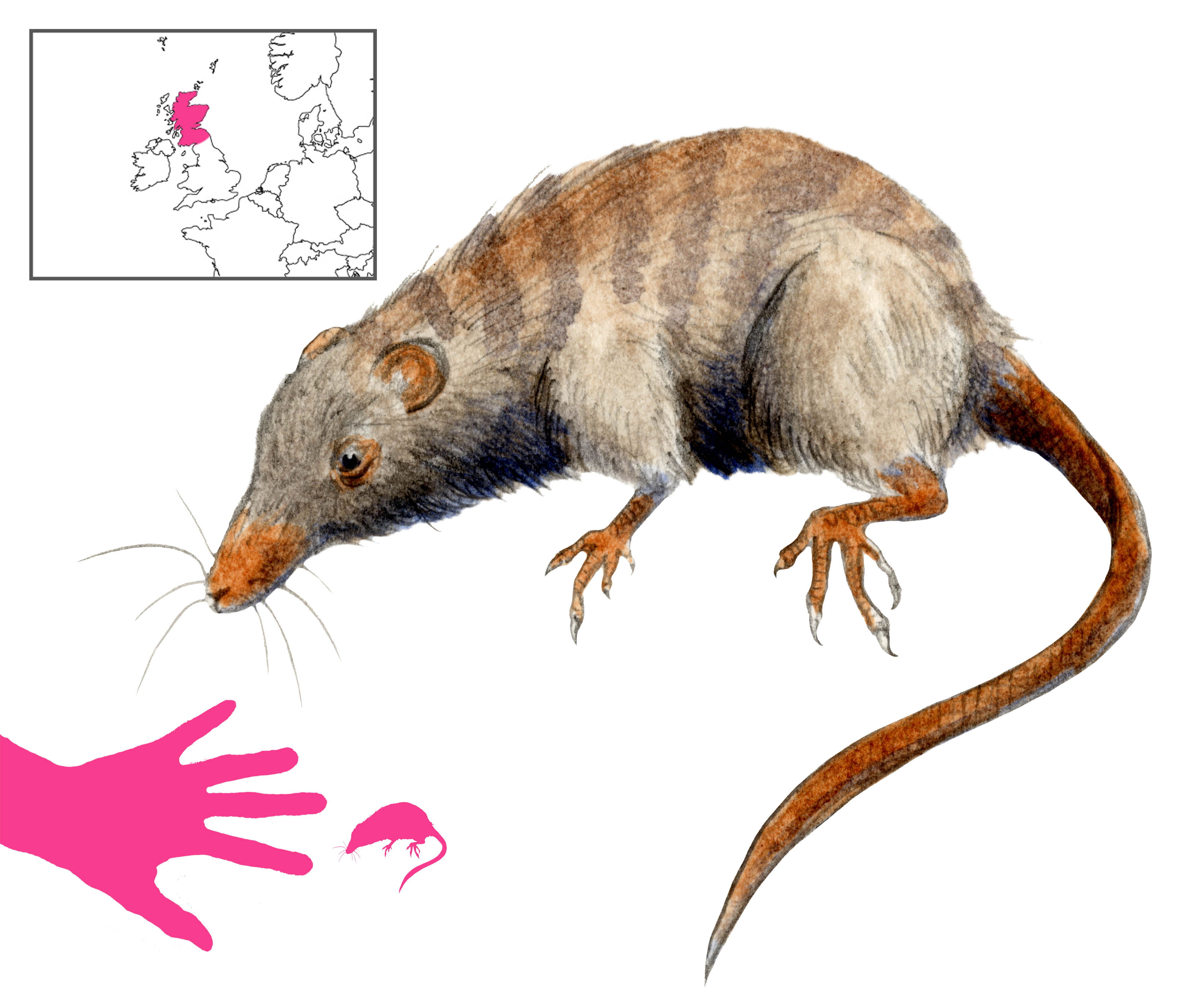
The Lavellan is a toxic mammal found in northern Scotland, primarily Caithness.

A lavellan’s appearance is unclear and unassuming; at the very least, it is believed to be small and furry. Sibbald believed it had the head and color of a marten, while other accounts describe it as resembling a shrew or a lizard. It has bright eyes and moves very quickly.

Lavellans are highly poisonous, and are capable of harming cattle from forty yards away. Their very breath is noxious. They are also lethal to humans, as told in one satirical song: “Let him not go away from the houses, to moss or wood, lest the Lavellan come and smite him”.

Farmers kill lavellans on sight and preserve their skin. Water in which a lavellan skin has been dipped is a certain remedy for lavellan poisoning. Boiling a lavellan head will also provide an antidote.

It has generally been assumed that the lavellan is a demonization of the water shrew, also known locally as water mole or blind mouse. The shrew’s saliva is mildly toxic but nowhere near as virulent as the lavellan’s. Harvie-Brown and Buckley, on the other hand, propose that the common lizard – brownish in color, bright-eyed, swift, and unfamiliar – was the originator of the lavellan. It may well be a combination of both.

References

Campbell, J. G. (1900) Superstitions of the Highlands and Islands of Scotland. James MacLehose and Sons, Glasgow.

Fleming, J. (1814) Contributions to the British Fauna. Memoirs of the Wernerian Natural History Society, Vol. II, Part I, pp. 238-251.

Harvie-Brown, J. A. and Buckley, T. E. (1887) A Vertebrate Fauna of Sutherland, Caithness, and West Cromarty. T. and A. Constable, Edinburgh University Press.

Pennant, T. (1818) British Zoology, vol. I. J. Christie, Dublin.

Bingfeng

Variations: Ping-feng, Pingpeng, Chuti/Ch’ou-t’i

Bingfeng final

The Bingfeng is an odd creature from the Guideways Through Mountains and Seas. It looks like a black pig with an elongate, tubular body, and it has two heads, one at each end. It may be found in the land of Shaman Xian. Borges, who referred to it as the Ping-feng and sourced it from the T’ai Kuang Chi, located it in the land of Magical Water.

Guo Pu speculated that the presence of two heads would have made the bingfeng extremely stubborn. Wen Yiduo, on the other hand, believed the heads were symbolic of hermaphroditism, representing the separate sexes.

A number of other two-headed Chinese animals have been recorded, but they have not been described in much detail. Their symbolism is assumed to be the same.

The Pingpeng, found on the mountain of Aoaoju in the Great Wilds to the West, is very similar but has two heads left and right, instead of front and back. It is probably the same animal as the Bingfeng.

The Chuti, or Ch’ou-t’i according to Borges, is found in the Great Wilds to the South between the Red River and the Desert of Shifting Sands. It also has two heads left and right, and is depicted with doglike features.

References

Borges, J. L.; trans. Hurley, A. (2005) The Book of Imaginary Beings. Viking.

Strassberg, R. E. (2002) A Chinese Bestiary: Strange Creatures from the Guideways Through Mountains and Seas. University of California Press.

Pilou

Variations: Er-pilour-lann

Pilou

Pilous are always heard and never seen. While their name suggests soft fur – pilou in its modern expression refers to a type of cotton – it actually refers to the men who pound apples into cider, using wooden pilons. Pilous walk with a regular, stomping tread, making a rhythmic sound like that of apples being mashed, and that is all anyone knows of them. Nevertheless, Dubois fancifully describes these lutins as resembling large garden dormice, and that is as good a description as any.

Pilous are native to the northwestern tip of France, specifically Brittany and Ile-et-Vilaine. They come out at night in the attic, in the rafters, in the walls, and start marching. They are not evil but mischievous, and delight in the noise they make. In Brittany, where they become Er-pilour-lann, they wield mallets with which they pound the walls of old houses.

Most encounters with them are about their disregard for human comfort. A farmhand once went into the barn to fetch some hay when the thumping begin, the din seemingly coming from everywhere. He called his uncle, who implored the pilous “Would you, please, stop your noise so I could get some hay for my mare?” They stopped, but the moment the uncle stepped into the barn they started up again, louder than ever.

Another time a group of men were in a barn when a pair of pilous started: one, two, one, two. “I’d like it better if there were three of you!” yelled one of the men, and sure enough a third pilou joined in. Other men started requesting more and more, and the number of pilous increased accordingly. The same stunt was later attempted by three bored young girls, but they requested too many, and soon the pilous were rattling their bed and knocking at their walls. The girls wisely went quiet, and the creatures eventually left.

Attempts to put pilous to use have failed. One miser left oakum fibers behind in the attic in hopes that the pilous would stomp them flat, but he returned in the morning to find the material shredded and scattered all over the attic.

References

d’Amézeuil, C. (1863) Récits Bretons. E. Dentu, Paris.

Dubois, P.; Sabatier, C.; and Sabatier, R. (2005) The Complete Encyclopedia of Elves, Goblins, and Other Little Creatures. Abbeville Press.

Orain, A. (1899) Le Monde des Ténèbres en Ile-et-Vilaine. Revue de Bretagne, de Vendée et d’Anjou, XXI, Paris.

Orain, A. (1901) Contes de L’Ile-et-Vilaine. J. Maisonneuve, Paris.

Le Rouzic, Z. (1924) Carnac: Légendes – Traditions – Coutumes et Contes du Pays. LaFolye Frères et Cie, Vannes.

Teelget

Variations: Teel get, Teelgeth, Delgeth
Teelget

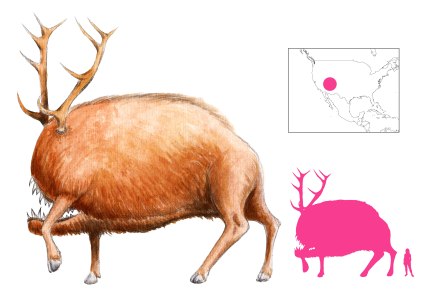
As one of the Anaye, the “Alien Gods” of Navajo folklore, Teelget was born from a human woman who resorted to unnatural and evil practices. In this case, his “father” was an antler. The creature born was round, hairy, and headless, and was cast away in horror; it was this creature that grew into the monster known as Teelget.

The origin of Teelget’s name is not known with certainty, but the “tê” makes reference to his horns. He is like an enormous, headless elk or antelope, rounded in shape, hairy like a gopher, with antlers he uses as deadly weapons. Coyote was his spy, and between him and the other Anaye they laid waste to the land, slaughtering many.

It was Nayenezgani, “Slayer of Alien Gods”, who finally put an end to Teelget’s reign of terror. Armed with his lightning arrows, the hero tracked Teelget down, finding the monster resting in the middle of a wide open plain.

How was Nayenezgani to sneak up on Teelget without being noticed? The grass offered no cover, and Teelget was sure to detect him and retaliate. As he considered his options, he was greeted by Gopher. “Why are you here?” said Gopher. “Nobody comes here, for all are afraid of Teelget”. When Nayenezgani explained that he was here to destroy Teelget, Gopher was more than happy to help. He said that he could provide a way to reach Teelget, and all he asked for as payment was the monster’s hide.

Gopher then excavated a tunnel that led right under the sleeping Teelget’s heart, and dug four tunnels – north, south, east, and west – for Nayenezgani to hide in after Teelget woke up. He even gnawed off the hair near Teelget’s heart, under the pretext that he needed it to line his nest.

That was all Nayenezgani needed. He crawled to the end of the tunnel and fired a chain-lightning arrow into Teelget’s heart, then ducked into the east tunnel. Enraged and in agony, Teelget gouged the east tunnel open with his antlers, only to find that Nayenezgani had moved to the south tunnel. He destroyed that, then the west tunnel, but he only managed to put an antler into the north tunnel before succumbing to his injury.

Nayenezgani couldn’t tell if Teelget had died or not, so Ground Squirrel volunteered to inspect. “Teelget never pays attention to me”, he explained. “If he is dead, I will dance and sing on his antlers”. Sure enough, Ground Squirrel celebrated on top of the fallen monster, and painted his face with Teelget’s blood; ground squirrels still have streaks on their face after that day. In some retellings Chipmunk fills this role, painting stripes down his back.

A chunk of antler and a piece of liver were taken by Nayenezgani as trophies, but Gopher went to work at once skinning Teelget. “I will wear his skin, so that when humans increase once more, they will be reminded of Teelget’s appearance”. And to this day, rounded, hairy gophers still wear the skin that Teelget once wore.

References

Alexander, H. B. (1916) The Mythology of All Races v. X: North American. Marshall Jones Company, Boston.

Locke, R. F. (1990) Sweet Salt: Navajo folktales and mythology. Roundtable Publishing Company, Santa Monica.

Matthews, W. (1897) Navaho legends. Houghton Mifflin and Company, New York.

O’Bryan, A. (1956) The Diné: Origin Myths of the Navaho Indians. Bulletin 163 of the Smithsonian Institution, Washington, D. C.

Zabraq

Variations: Zabrak; Rukh (al-Marwazi); Phalmant (Bochart)

Zabraq

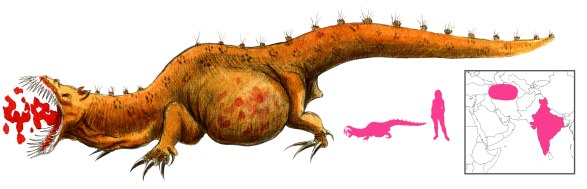
The Zabraq is one of the many exotic animals found in India. Bochart gave its location as the region of Dasht or Dist, the “gateway to Tartary”, and so presumably in the vicinity of Iran. It is also variously known as the Rukh and the Phalmant, although only the last term has seen use.

It is relatively modest in size, smaller than a cheetah, yellowish-red in color with flashing eyes and capable of leaping thirty to fifty cubits or more in one jump. Al-Marwazi makes it look like a camel, with two humps, tusks, and a large, membraneous tail, and adds that it is incredibly fast. Bochart, perhaps confusing its leaping distance with its size, makes it vast, prodigious, hideous, and forty cubits long, with bristling claws and teeth. Most importantly, it has highly acidic, weaponized urine and feces.

Zabraqs prey on animals up to the size of elephants, and kill them by flinging their caustic urine onto them with their tail. The tail of a zabraq can flatten and deform into a shovel shape to hold urine and dung before throwing it. The only animal zabraqs will avoid is the rhinoceros.

They are also fond of eating humans, and the only way to escape one is to climb a teak tree, which the zabraq cannot scale. Even that isn’t necessarily a safe place. When faced with treed prey, a zabraq will try to leap upwards and seize it before spouting its urine skyward, burning anything it touches like fire. However, if it cannot reach its prey through this stratagem, it turns towards the roots of the tree, roars in frustration until clots of blood erupt from its mouth, and expires.

Zabraq bile and testicles make potent poison; coated on weapons, it causes immediate death. Al-Marwazi goes further and specifies that the flesh, blood, saliva, and dung of the zabraq are all deadly.

Bochart reported this creature under the name of Phalmant and attributed it to Al-Damiri, although his account is entirely al-Mas’udi’s. Flaubert mentioned the phalmant it in his Temptation as a leopard howling so hard its belly bursts. The Dictionnaire Universel inexplicably turns it into a sea monster found on the coast of Tartary.

References

Berthelin, M. (1762) Abrégé du Dictionnaire Universel Francais et Latin, Tome III. Libraires Associés, Paris.

Bochart, S. (1675) Hierozoicon. Johannis Davidis Zunneri, Frankfurt.

Flaubert, G. (1885) La Tentation de Saint Antoine. Quantin, Paris.

Kruk, R. (2001) Of Rukhs and Rooks, Camels and Castles. Oriens, vol. 36, pp. 288-298.

al-Mas’udi, A. (1864) Les Prairies d’Or, t. III. Imprimerie Impériale, Paris.

Seznec, J. (1943) Saint Antoine et les Monstres: Essai sur les Sources et la Signification du Fantastique de Flaubert. PMLA, Vol. 58, No. 1, pp. 195-222.

Boongurunguru

Variations: Bonguru

Boongurunguru

According to the mythology of the Solomon Islands, there was once a time when the waters flooded the Earth. This great flood, the Ruarua, engulfed all of the islands, even the 4,000 feet high San Cristoval hills; those drowned in it turned into stone pillars, which can still be seen at Mwata. It was Umaroa, leader of the Muara clan, who saved his people by taking them, a sacred stone, and pairs of all the animals on board a great canoe. When the waters receded, Umaroa made landfall at Waimarai in the Arosi district, and offered a sacrifice in thanks. From there an adaro descended from a rainbow and guided them to their new home.

Umaroa is now buried there, and his sacred stone was laid on top of him. The area is now rich with magic, and visitors have to observe certain rules to avoid bad luck. Any trees cut down and left there will cause the lumberjacks to wander in circles, always returning to the cut tree. If there is a rainbow above the river, it cannot be crossed without making an offering to the adaro first. Names have particular strength there; ropes cannot be called ari but instead must be referred to as kunikuni (“to let down”), otherwise snakes will be summoned immediately.

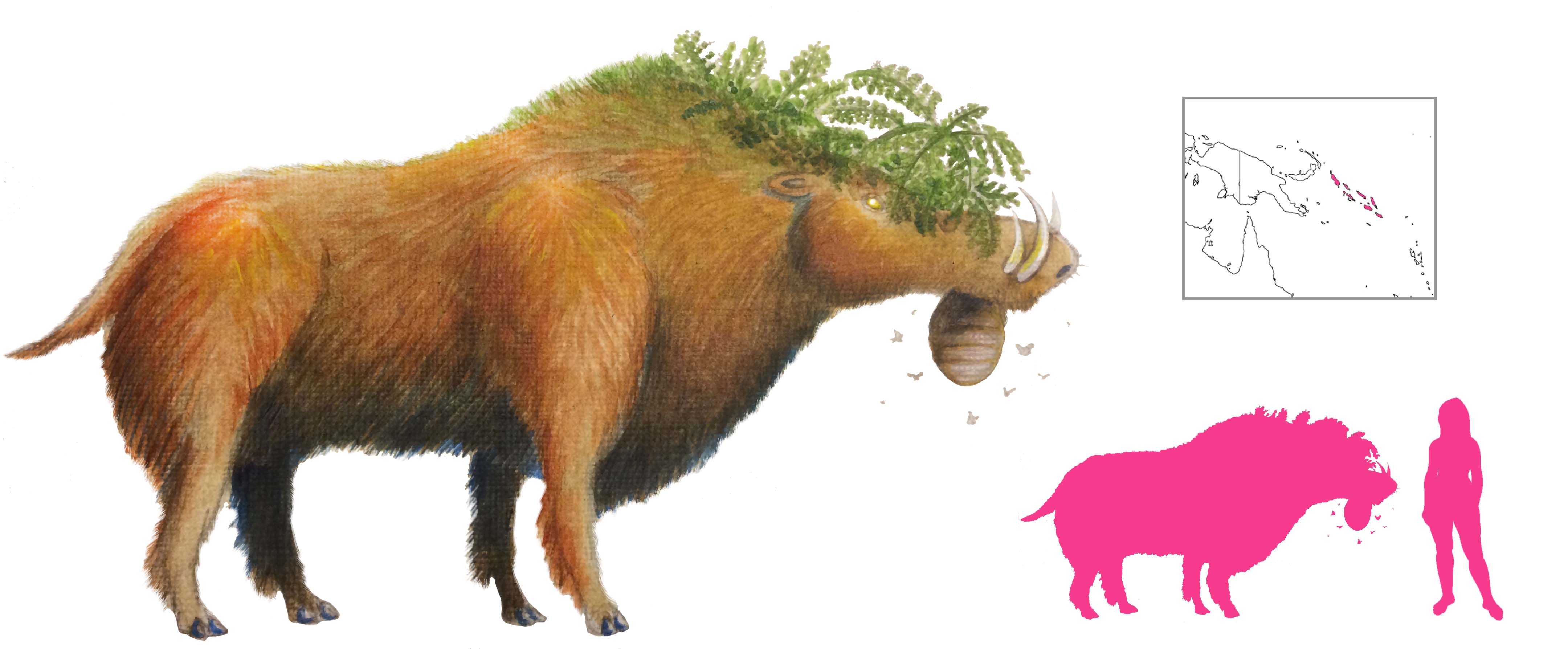
Of the spirits there, the most terrifying is Boongurunguru, the “pig-who-grunts”, the demon pig of Umaroa. He takes the form of a huge boar with ‘ama’ama ferns growing on his flattened head, and a buzzing nest of hornets located under his chin. He leads a herd of boars, all of them Boongurunguru, through the forest, goring and trampling anyone in their path. The appearance of a Boongurunguru foretells death; if the entire herd enters a village, everyone there will die. The boars get smaller and smaller as they approach a village, finally sneaking in at the size of mice, but they are no less deadly at that size.

If one hears Boongurunguru grunting and mentions that there must be pigs nearby, they are immediately surrounded by hundreds of venomous snakes – in front, behind, on either side, and falling out of the air.

This is because Boongurunguru has standards, and objects to being called a pig.

References

Fox, C. E. (1924) The Threshold of the Pacific. Kegan Paul, Trench, Trubner and Co., Ltd., London; Alfred A. Knopf, New York

Mackenzie, D. A. (1930) Myths from Melanesia and Indonesia. Gresham Publishing Company, Ltd., London

Ragache, C. C. and Laverdet, M. (1991) Les animaux fantastiques. Hachette.