Vouivre

Variations: Vaivre, Givre, Guivre, Wivre
Vouivre

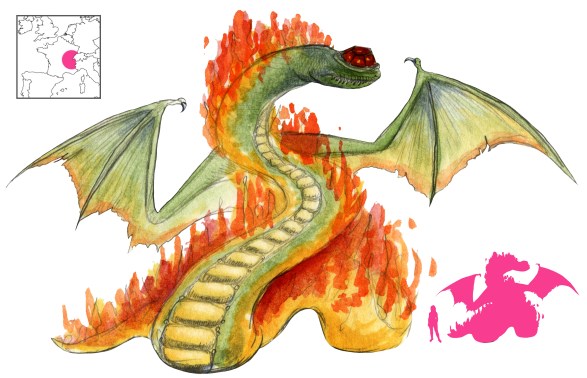
Vouivres, the great fiery serpents of France, have been reported primarily from remote, mountainous regions, where they haunt springs, wells, caves, deep ponds, and ruined castles. They are known from Bourgogne, Franche-Comté, Savoie, the Jura mountains, and neighboring areas, with possible relatives in the Aosta Valley and Switzerland.

The word “vouivre” is derived from the Latin vipera, or “viper”. Vouivres themselves are the spiritual descendants of Mélusine, stripped of her human features. They have been described as dragons, serpents, and fairies in the form of great reptiles; they are always the guardians of priceless treasures.

In its most simple definition, a Vouivre is a female dragon. Vouivres vary wildly in appearance, but are always female and associated with fire and water. The classic vouivre, as observed in Faverges, Fleury-la-Tour, Mont-Beuvray, Rosemont, Solutré, and Thouleurs, is an immense winged serpent covered with fire. Instead of eyes, a vouivre has a single large diamond or ruby in its head that guides it through the air. She removes it when bathing, leaving it blind and vulnerable to theft. Possession of a vouivre’s eye-stone would bring riches and happiness to anyone who stole it. The immense vouivre of Boëge guards treasure and wears a priceless golden necklace. In La Baume she is 4 meters long and covered in gems and pearls. She sometimes leaves gems behind where she lands. The Lucinges vouivre is a glowing red viper that whistles eerily in flight. The Gemeaux vouivre, which appeared between 2 and 3 in the afternoon, was hooded like a cobra.

In Brizon, she is equally likely to appear as a bird or a winged beech marten with a brilliant necklace as she is to have the form of a great serpent with wings and a diamond on its tail. Vouivres may not even look like animals. In Chevenoz she appears as a burning fireball streaking across the sky, in Saint-Jean-d’Aulps and Vallorcine she is a single-eyed tongue of fire, and in Le Biot she is a star whose appearance foretells war and strife. The Orgelet Castle vouivre looks like a red-hot iron bar in flight, and the vouivre of Sixt-Fer-À-Cheval is a plumed golden necklace that flies through the air.

One of the more effective ways of slaying a vouivre has been making a spiked barrel to hide in. At Condes, a man managed to steal a vouivre’s diamond and hide in a nail-studded washtub; the infuriated, blinded dragon killed herself trying to get to him. While another man at the Aosta Valley slew a vouivre in a similar manner, other prospective thieves have not been so lucky. The vouivre of Reyvroz had a necklace of great value, which was stolen by a man in a spiked barrel; she died and the thief died soon after. The vouivre of Samoëns had her pearl necklace stolen in the same manner, but she constricted the barrel anyway and made the thief return the necklace; she then disappeared and was never seen again. In Manigod, where grass would not grow for a couple of years after the vouivre’s passage, a man who stole her diamond was killed, his barrel smashed, and the gem retrieved.

Finally, as with all dragons, vouivres are vulnerable to the power of saints and other holy persons. The vouivre of Saint-Suliac was cast into a deep cave by Saint Suliac after she killed one of his monks. The location became known as the Trou de la Guivre, the Guivre’s Hole.

In Thollon-Les-Mémises, among other places, “vouivre” has become a byword for an unpleasant, nasty woman.

Modern versions of the vouivre, perhaps conflating her with Mélusine, have embellished with her the features of a seductive woman. Marcel Aymé makes her a wild girl of the forest with an entourage of vipers, and Dubois makes her a beautiful fairy who sheds her dragon skin when bathing.

References

Aymé, M. (1943) La Vouivre. Gallimard.

Dontenville, H. (1966) La France Mythologique. Tchou, Paris.

Dubois, P.; Sabatier, C.; and Sabatier, R. (1996) La Grande Encyclopédie des Fées. Hoëbeke, Paris.

Joisten, C. (2010) Êtres fantastiques de Savoie. Musée Dauphinois, Grenoble.

Monnier, D. (1819) Essai sur L’Origine de la Séquanie. Gauthier, Lons-Le-Saunier.

Sébillot, P. (1905) Le Folk-Lore de France, Tome Deuxième: La Mer et les Eaux Douces. Librairie Orientale et Américaine, Paris.

Mourioche

Variations: Guenne; Fausserole (possibly)

Mourioche

Nobody knows for sure where Mourioche came from. Some say that he (for lack of a better pronoun) was once a Breton man or a woman, versed in the dark arts, who sold their soul for a magical ointment. Other accounts make him a simple werewolf without control of his actions. Dubois whimsically claims he was once the court jester of an undersea kingdom, and was banished for bad behavior. There are even claims that he is the Devil himself.

It is more likely that Mourioche has always haunted Brittany, spreading his brand of cruel humor along the coastlines of Côtes-d’Armor and around Jugon-les-Lacs. He is a water-horse, and a shapeshifter; there is no end to the forms he has assumed, and he loves using his powers in creative ways. Mourioche is usually seen in the form of a yearling colt, pig, cow, or sheep, often with a pair of muscular arms.

Mourioche comes out at night, and preys on nocturnal travelers. Sometimes he is a horse standing by the side of the road, waiting for riders. His spine stretches as more and more people get on, then he gallops right into the lake, his laugh echoing in the darkness. At other times he wrestles passers-by, grappling with his brawny arms and throwing his victims into muddy ditches. He will jump onto men’s back and force them to carry him until they drop of exhaustion. He will follow people along the road, changing shape every time they turn to look at him, and making a sound like tearing canvas.

Drawn-out sadistic pranks are Mourioche’s favorite form of entertainment. A farmer of Saint-Cast once found Mourioche in the form of an abandoned ewe, and took him home to his barn. The next day, when he went to check on his new sheep, he found a cow; the day after, it had become a horse. On the fourth night, it was a sheep again, who laughed and said “Why do you check on me every morning? You’re weird!” It was then that the farmer saw that all his animals had been slaughtered. He reached for his shotgun, but Mourioche took off, destroying half the barn and abducting the farmer’s three children (who were never seen again). Mourioche is not without mercy, though, and he left behind a golden necklace.

Mourioche is not without his faults, however, and is baffled by anyone who doesn’t fear him. One man nonchalantly carried Mourioche all the way back home, and the shapeshifter fled when he called his wife. Another time Mourioche took a tailor on his back, who threatened to cut his ears off with his scissors. The tailor was returned to dry land very quickly.

In Matignon, parents would get their children to bed with a “hattaï, mon p’tit gars; Mourioche te prenrait!” (“hurry, my l’il lad, Mourioche will take you!). It is also said that of a frightened person that “il a eu peur comme s’il avait vu Mourioche” (“he’s scared as though he saw Mourioche”). To ward off Mourioche, one must curse him with “Mourioche, le diable t’écorche” (“Mourioche, the Devil flay you”).

The Fausserole of Saint-Cast is very similar, and may be another form of Mourioche. She likes to appear as a white beast, a dog or a calf, and has no qualms about tossing clergy around, as the rector of Saint-Cast found out.

References

Dubois, P.; Sabatier, C.; and Sabatier, R. (1992) La Grande Encyclopédie des Lutins. Hoëbeke, Paris.

Morvan, F. (1998) Vie et mœurs des lutins bretons. Actes Sud.

Sébillot, P. (1882) Traditions et superstitions de la Haute-Bretagne. Maisonneuve et Cie, Paris.

Sébillot, P. (1905) Le Folk-Lore de France, Tome Deuxième: La Mer et les Eaux Douces. Librairie Orientale et Américaine, Paris.

Sébillot, P. (1968) Le folklore de la Bretagne. Éditions G. P. Maisonneuve et Larose, Paris.

Codrille

Variations: Cocadrille, Cocodrille, Coquadrille, Cocatris

Codrille

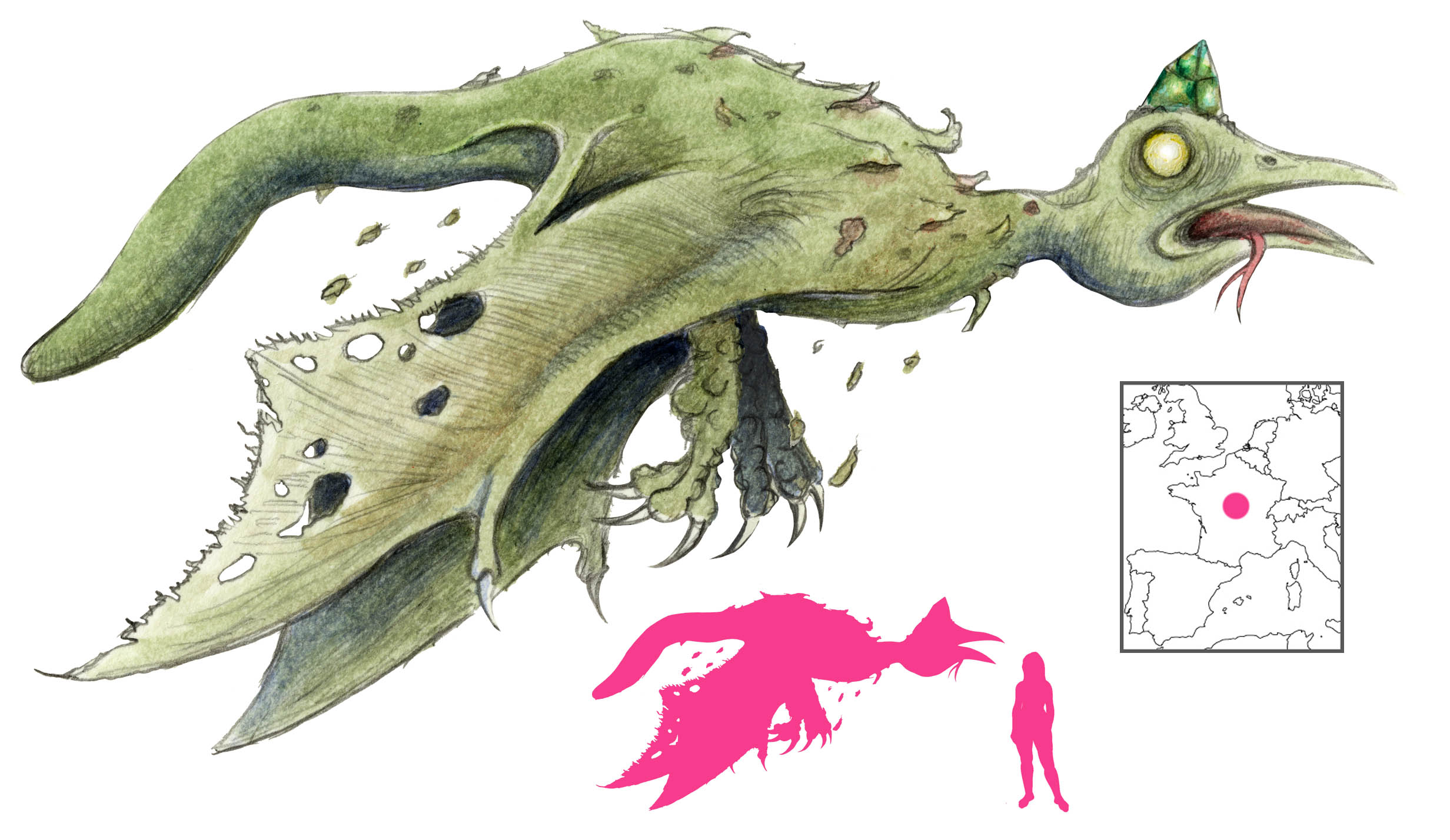
The Codrille, Cocadrille, or Codrille is a variety of basilisk or dragon native to central France, notably Berry, Maine, Poitou, Sologne, and Vendée. It combines features of basilisks and vouivres but without the redeeming aspects of either.

The name of the codrille was derived from the same etymological confusion that spawned the “cockatrice”. Starting with Crocodylus, the crocodile, practically a mythical creature in its own right, the name became progressively more garbled, becoming Cocodrillus, Cocodrille, Cocadrille, and Codrille. However, de la Salle derives it from coco and drille, meaning “rooster’s child”.

Unlike true basilisks, codrilles can grow to impressive size, becoming leathery-winged dragons at the last stage of their life cycle. The “crown” characteristic of basilisks manifests in the form of a brilliant gem on top of the codrille’s head. Codrilles can kill merely by looking at their victims, and emit an aura of disease and plague.

A codrille’s life is a complicated succession of metamorphoses. It hatches from a yolkless egg laid by a rooster, and incubated by the heat of the sun or of manure. To prevent those eggs from hatching, one must plant sprigs of ash in potential codrille breeding grounds. This should be done on the first day of May. Having other roosters around also helps, as they will devour the offspring of a codrille.

The codrille starts out its life as a very long, string-like snake. It is capable of killing right out of the egg – anyone who cracks a codrille egg and is seen by the newborn codrille dies instantly, but if they see the snake first, it dies instead. After a while, the juvenile codrille sprouts legs and becomes a salamander. During this stage of its life it will still die if seen first by humans, so it hides in deep wells, ruined tombs, and the masonry of houses, bringing bad luck to everyone living there and whistling ominously at night. It can debilitate a bull merely by crawling under it.

At the end of seven years the codrille reaches the adult stages. It grows spectacularly, sprouts wings, and metamorphoses into an enormous dragon. It spreads its wings and migrates towards the Tower of Babylon, breathing death and pestilence along its way. Its passage in the air dims the sun, and epidemics and plagues follow in its wake.

References

Sainéan, L. (1921) L’histoire naturelle et les branches connexes dans l’oeuvre de Rabelais. E. Champion, Paris.

de la Salle, L. (1875) Croyances et légendes du centre de la France, Tome Premier. Chaix et Cie., Paris.

Sébillot, P. (1906) Le Folk-lore de France, Tome Troisième: La Faune et la Flore. Librairie Orientale et Américaine, Paris.

Fayette

Fayette

The Fayettes (“little fairies”) live in the Forez region in France, today around the Loire basin. They are believed to be the descendants of the Greek nymphs, having escaped the advance of Christianity in the Mediterranean.

In France they are much tinier versions of their former selves, but their magical powers are undiminished. They guard the caves and forests, and can be seen dancing in the woods of Couroux, in the Beaujolais. Like any self-respecting fairy, they like to abduct children and leave insatiable changelings behind. Those fairy children are best brought to the mouth of a cave and threatened with violence, causing the fayette to return the stolen child. Te, vequio le tio, rends me le mio (“There, here’s yours, return mine”).

During the night, the fayettes do their laundry under the moon. Travellers in the woods are advised to sing at the top of their lungs to make sure they’re not mistaken for threats. At daybreak the fairies dissipate like fog, sometimes leaving behind solid gold washboards that would make anyone’s fortune.

During the day the fayettes take the form of moles, and take pleasure in ravaging gardens. This is why moles have pretty little pink hands.

References

Proth, M. (1868) Au Pays de l’Astrée. Librairie Internationale, Paris.

Sébillot, P. (1904) Le Folk-Lore de France, Tome Premier: Le Ciel et la Terre. Librairie Orientale et Américaine, Paris.

Malebête

Variations: Malbête, Malebàete, Malebeste (archaic), Bête d’Angles (Beast of Angles), Troussepoil

Malebete

Visitors to the French town of Angles, in the Vendée, are drawn to the beautiful church of Notre-Dame-des-Anges (Our Lady of the Angels). There, at the top of the bell tower, stands a monstrous stone bear glaring down on the city. Those visitors would be well advised to steer clear of its line of sight.

Long ago, it is said that a terrible beast ravaged the countryside of Angles. It was in the form of a great black bear, with shaggy, matted fur, and it became known as the Malebête – the “Evilbeast” or “Illbeast”. This monster had a predilection for young maidens, glutting itself almost exclusively on women. After feeding it would then wash itself in the nearby river, causing its hair to clump and stick out and granting the river the name of Troussepoil (“Hair-Raiser”, more or less).

The depredations of this demonic creature led to increasing concern. The river was running red with blood, and the female population was dwindling. None dared approach it, as its strength was greater than any knight’s. As it was an incarnation of the Devil himself, it became clear that only a sufficiently holy man would be capable of defeating it. The abbots of Fontaines and Talmont both went to face the beast, only to scurry away in terror when it charged them. The Pope’s envoy fasted for two days before confronting the Malebête, but barely escaped with his life and swore never to return.

Was there any man holy enough to destroy the Malebête? The answer came in the form of Father Martin, an old monk from the Angles cloister who spent most of his time isolated in contemplation of God. Perhaps out of desperation, he was begged to do something about this.

Leaning on a walking stick, dressed only in his ecclesiastical robes, Father Martin walked out to where the Malebête awaited him. To everyone’s amazement, the beast lowered its gaze in front of the hermit. “Follow me”, he said simply, and the Malebête did – as did the entire population of Angles. They followed Father Martin all the way back to the church, where he told the Malebête to climb the bell tower. Once at the top, it froze in place, and turned to stone.

Despite the rejoicing over the Malebête’s defeat, there were still a few voices of dissent in the form of a few girls who taunted Father Martin. “Since when are you the Devil’s shepherd?” they sneered. Father Martin merely smiled and looked up at the Malebête. “Henceforth, you shall feed only on the beauty of the girls of Angles”, he stated. And instantly all the women present became ugly and ran home in shame.

Since then, the resourceful women of Angles have found ways of avoiding the Malebête’s hungry gaze, and sneak safely into the church via a back door. Today the Malebête’s primary sustenance comes through the tourist industry.

This tale was first told by Benjamin Fillon, a dubious character who seems to have created the story out of whole cloth, making it a neo-myth of sorts. For one thing, the statue of the Malebête is of pre-Christian origin, predating its own legend; it was originally in a seated position, and was mutilated into its current shape. The Malebête’s story is also a familiar one, echoing many others told of anthropophagous monsters slain by righteous men.

References

Chaigne, L. (1942) La Vendée. F. Lanore, Paris.

Dillange, M. (1983) Eglises et Abbayes Romanes En Vendée. Jeanne Laffitte, Marseille.

Dubourg-Noves, P. (1996) Notre-Dame d’Angles. in Vendée. Congrès Archéologique de France, 151e Session. Musée des Monuments Francais, Paris.

Le Quellec, J. (1988) Le légendaire du Sud-Vendée: organisation spatio-mythique. Etuderies 3-4.

Trébucq, S. (1912) La chanson populaire et la vie rurale des Pyrénées à la Vendée. Feret et fils, Bordeaux.

Bosch

Bosch

Sometimes criminals face supernatural retribution for their crimes. In the Finistère region of Brittany, it is the victim that suffers instead. Crimes committed on board develop a life of their own and linger long after the guilty party has left the ship. Acts of greed summon evil spirits that populate the ship, bringing bad luck to the crew. In such cases humid straw must be burned to fumigate the ship. The demons can become small enough to hide in a thimble, so the smoke must reach every part of the ship. This must be performed before heading out to sea to avoid potential disaster.

In Audierne, committing a maritime theft actually guarantees good luck. The creature left behind is a Bosch, the physical manifestation of onboard theft. They have no clear appearance, and probably vary depending on the nature of the crime they embody. These wretched creatures come into existence after a theft occurs on a ship, and have a lifespan of a few months to a few years, at the end of which they weaken and disappear. During this time they hide in the bow of the ship and make life on board absolutely miserable. As long as a bosch is present, the nets will be empty, the wind will not blow, and bad luck will hound the crew.

Simply waiting for a bosch to die is therefore impractical. If a ship finds itself afflicted with a bosch, there are two ways to get rid of it. One is to steal an object from a “happy” ship, one whose crew is satisfied and whose catches are always plentiful. The ship should be moored near it, and during the following night the captain sneaks on board the other ship to steal some small object, usually a pair of oarlocks. The bosch will then go to other ship and become their problem.

If one does not wish to inflict the misery of a bosch on an innocent ship, the demon can be exorcised instead. The captain must steal a quantity of hay and hide it in the boat. At night he should set fire to the hay near the mizzenmast and yell “Devil on board!” The sailors, startled, will grab anything within reach and lash out randomly, beating every corner of the ship. Surrounded and beaten, faced with choking smoke and scorching flames, the terrified bosch dives into the sea.

References

van Hageland, A. (1973) La Mer Magique. Marabout, Paris.

Duphon

Duphon

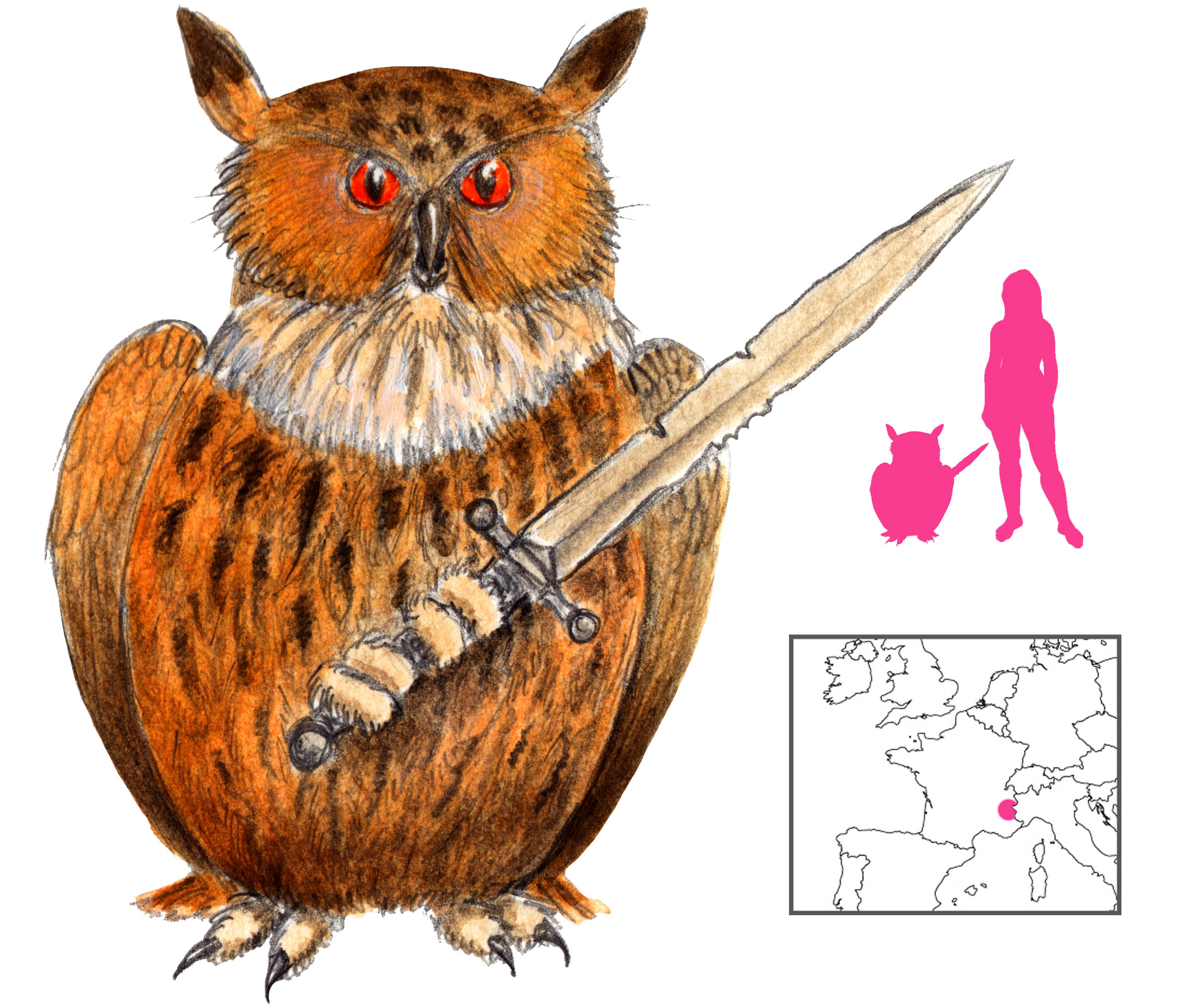
Eagle-owls are impressive animals. As the largest owls, they are top predators in their environments, even feeding on other birds of prey. Their size and eerie calls have ensured them a place in the folklore of many cultures.

It should then be unsurprising that the eagle-owl has been reinterpreted as a supernatural creature. The Duphon can be found in the Hautes-Alpes region of France, where it braids horse manes, pinches young women, and causes mischief and mayhem. The town of Serres preserves a duphon lair in the form of a stone door and ruined ramparts, known as the Trou du Duphon (“The Duphon’s Hole”).

References

van Gennep, A. (1948) Le folklore des Hautes-Alpes, Tome II. J. P. Maisonneuve et Cie, Paris.

del Hoyo, J.; Elliott, A.; Sargatal, J.; Christie, D.A.; & de Juana, E. (eds.) (2013) Handbook of the Birds of the World Alive. Lynx Edicions, Barcelona.

Ladoucette, J. C. F. (1848) Histoire, topographie, antiquités, usages, dialectes des Hautes-Alpes. Gide et Cie, Paris.

Pilou

Variations: Er-pilour-lann

Pilou

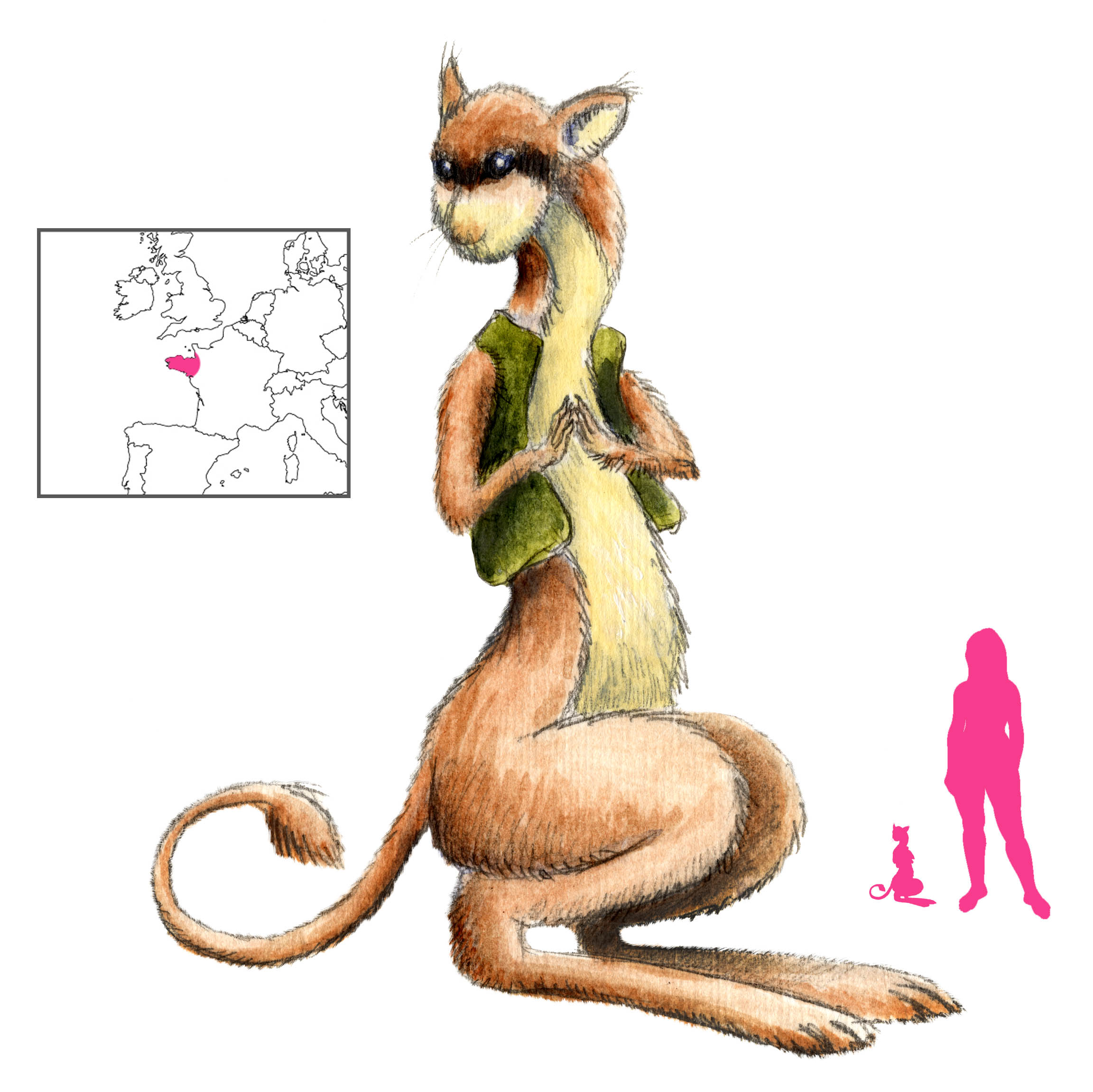
Pilous are always heard and never seen. While their name suggests soft fur – pilou in its modern expression refers to a type of cotton – it actually refers to the men who pound apples into cider, using wooden pilons. Pilous walk with a regular, stomping tread, making a rhythmic sound like that of apples being mashed, and that is all anyone knows of them. Nevertheless, Dubois fancifully describes these lutins as resembling large garden dormice, and that is as good a description as any.

Pilous are native to the northwestern tip of France, specifically Brittany and Ile-et-Vilaine. They come out at night in the attic, in the rafters, in the walls, and start marching. They are not evil but mischievous, and delight in the noise they make. In Brittany, where they become Er-pilour-lann, they wield mallets with which they pound the walls of old houses.

Most encounters with them are about their disregard for human comfort. A farmhand once went into the barn to fetch some hay when the thumping begin, the din seemingly coming from everywhere. He called his uncle, who implored the pilous “Would you, please, stop your noise so I could get some hay for my mare?” They stopped, but the moment the uncle stepped into the barn they started up again, louder than ever.

Another time a group of men were in a barn when a pair of pilous started: one, two, one, two. “I’d like it better if there were three of you!” yelled one of the men, and sure enough a third pilou joined in. Other men started requesting more and more, and the number of pilous increased accordingly. The same stunt was later attempted by three bored young girls, but they requested too many, and soon the pilous were rattling their bed and knocking at their walls. The girls wisely went quiet, and the creatures eventually left.

Attempts to put pilous to use have failed. One miser left oakum fibers behind in the attic in hopes that the pilous would stomp them flat, but he returned in the morning to find the material shredded and scattered all over the attic.

References

d’Amézeuil, C. (1863) Récits Bretons. E. Dentu, Paris.

Dubois, P.; Sabatier, C.; and Sabatier, R. (2005) The Complete Encyclopedia of Elves, Goblins, and Other Little Creatures. Abbeville Press.

Orain, A. (1899) Le Monde des Ténèbres en Ile-et-Vilaine. Revue de Bretagne, de Vendée et d’Anjou, XXI, Paris.

Orain, A. (1901) Contes de L’Ile-et-Vilaine. J. Maisonneuve, Paris.

Le Rouzic, Z. (1924) Carnac: Légendes – Traditions – Coutumes et Contes du Pays. LaFolye Frères et Cie, Vannes.

Jetin

Variations: J’tin, Crion

Jetin

Jetins (from jeter, “to throw”) are tiny lutins native to the seaside caves of Brittany. Their appearance is uncertain; Dubois suggests they are hirsute and rough-looking, with silver shoes. Despite their size – ranging from thumb-sized to 1.5 feet tall – they are incredibly strong, capable of lifting and tossing huge boulders with ease.

Always looking for a chance to show off their strength, jetins amuse themselves by throwing rocks around, sometimes over great distances. Standing stones, menhirs, all manner of megaliths; such stones are discarded playthings of the jetins.

Rock-throwing was not the only pastime the jetins enjoyed. They were also fond of tying knots in horse tails and releasing livestock, and, like any good fairy, they often exchanged human babies for one of their own. The ugly, wrinkled changelings they leave behind are never weaned and never grow. Jetins can be convinced to return stolen children by carrying the changeling to a jetin hole and threatening to kill it. The human baby will quickly be returned and swapped with the impostor.

The jetins shared their territory with the even tinier Fions and the secretive Fées des Houles (“Fairies of the Sea Caves”). Due to their size and their reclusive natures, none of these have been observed in great detail, although the Fées have been benevolent towards humans. The Crions, perhaps the same as jetins, were tiny dwarfs who carried the stones of Carnac on their shoulders.

Elsewhere, the discobolous function of the jetins is fulfilled by Gargantua and other giants, whose size is more proportionate to their strength, and the fairies known as Fileuses (“Weavers”).

References

Dubois, P.; Sabatier, C.; and Sabatier, R. (1992) La Grande Encyclopédie des Lutins. Hoëbeke, Paris.

Morvan, F. (1998) Vie et mœurs des lutins bretons. Actes Sud.

Sébillot, P. (1905) Le Folk-lore de France, Tome Deuxième: La Mer et les Eaux Douces. Librairie Orientale et Américaine, Paris.

Sébillot, P. (1907) Le Folk-lore de France, Tome Quatrième: Le Peuple et L’Histoire. Librairie Orientale et Américaine, Paris.

Lavandière de Nuit

Variations: Lavandière, Laveuse de Nuit (French); Kannerez Noz, Cannerez Noz, Gannerez Noz (Breton); Bean nighe, Bhean Nighe, Caoineachag, Nigheag Bheag a Bhroin (Gaelic); Washerwoman, Night Washerwoman, Washer of the Ford, Little Washer of Sorrow (English)

Lavandiere

The lavandières de nuit (“washerwomen of the night”) are present in some form or other from Scotland to Provence. Their exact nature is uncertain; sometimes they are ghosts, other times members of the fairy kingdom. Their best-documented haunt is Brittany.

Lavandières are female, and can be seen washing laundry in the odd hours of the night. They usually take the form of tall, gaunt, and withered crones, but the Gollières a Noz of Romandie are as beautiful as they are cruel. Some of them sing as they wash, earning them the name of kannerez noz (night singers). Their song is sadder than a De Profundis. Those of Morbihan have had their song recorded as follows:

Tors la guenille, tors // Le suaire des épouses des morts.

(Wring the rags, wring // the shroud of the wives of the dead).

Often a lavandière is condemned to wash a shroud in atonement for a sin committed in life. Some merely did laundry on Sunday. Others were greedy misers who denied decent clothing to the poor. The grimmest were those guilty of infanticide. The outline of a baby’s corpse could be seen in their blood-soaked sheets; try as they might, the blood never washed out, and the bones never whitened.

The bean nighe of the British Isles are women who died in childbirth before their time, and who are doomed to wash the clothes of those fated to drown until the day when they were meant to die. Their appearance foretells death. Some are aligned with the Morrigan, and wash the corpses of the dead. Cú Chulainn saw one, the daughter of Bodhbh, washing bloodstained clothes and weeping; he died in battle not long after.

In France, especially in Brittany, they call passers-by to help them wring out the laundry. This isn’t a choice – those who accept out of ill will get their arms broken, and those who refuse are drowned. To escape their clutches, one must wring in the same direction they do, turning clockwise when they turn clockwise and vice versa. But this has to be kept up all night, and the lavandières never tire. One false move and the unfortunate victim is crushed, wrung out, their corpse mangled beyond recognition. Even the strongest man is no match for a lavandière, who wrings humans out as easily as a pair of tights.

Another way of escaping their clutches is to tell them Diwasket ho poan ha me diwasko ma hini (“wring out your sins, and I will wring out mine”). Running away at top speed always helps, and lavandières cannot cross recently-ploughed fields. Finally, making the sign of the cross or reciting Biblical verses is always helpful.

The lavandière of Chantepie was a stingy woman who buried her husband in a dirty shroud. She continues to wash it every night.

The lavandières of Fond-de-Fond hold up the bodies of the recently-deceased.

In Landéda, the lavandières are powerless against the goodhearted, but tie the sinful into knots.

The lavandière of Noes Gourdais, near Dinan, appeared early in the morning and had a skull for a head.

The Mille-Lorraines of Lower Normandy form fairy circles around ponds.

Several lavandières gather in the pond of Roc-Reu, and drown anyone who tries to touch them.

Around Dinan, the teurdous (“twister”) is a rare male counterpart. He does not wash, but instead offers to help washerwomen wring out their laundry. If they accept, he breaks their arms.

The true nature of the lavandières is more prosaic. Unfamiliar sounds have been invoked – the croaking of frogs or toads, for instance, might have suggested the sound of washboards. The lavandières themselves may have had nothing supernatural about them. A number of flesh-and-blood women may have had reason to do laundry at night: those who worked during the day, those who did not wish to be seen doing menial work, those who wanted to clean the clothes of their illicit lovers… Anyone coming upon them could be forgiven for seeing them as ghosts.

Others managed to exploit the superstitious fear of lavandières. A garde-champêtre in Vaucluse once stumbled upon a pair of lavandières in spectral white clothes. “Wring the laundry!” they cackled, grabbing him by the collar. And wring he did, all night long. He also noted the fine quality of the cloth they were washing, but did not dare stop until morning, when they left. Only later did the warden find out that a nearby castle had been robbed of various items of clothing. He had spent the whole night helping the thieves wash their ill-gotten gains.

References

Dubois, P.; Sabatier, C.; and Sabatier, R. (1996) La Grande Encyclopédie des Fées. Hoëbeke, Paris.

Giraudon, D. La lavandière de nuit Ar gannerez-noz. In Loddo, D. and Pelen, J. (eds.) (2001) Êtres fantastiques des régions de France. L’Harmattan, Paris.

Kilfeather, A. (2003) Legend and wetland landscape in Ireland. Journal of Wetland Archaeology, 3, pp. 37-50.

Le Quellec, J. (1988) Le légendaire du Sud-Vendée: organisation spatio-mythique. Etuderies 3-4.

MacPhail, M. (1898) Folklore from the Hebrides III. Folklore, Vol. 9, No. 1, pp. 84-93.

Sand, G. (1877) Légendes Rustiques. Ancienne Maison Michel Lévy Frères, Paris.

Sébillot, P. (1881) Littérature orale de la Haute-Bretagne. Maisonneuve et Cie, Paris.

Sébillot, P. (1904) Le Folk-Lore de France, Tome Premier: Le Ciel et la Terre. Librairie Orientale et Américaine, Paris.

Sébillot, P. (1905) Le Folk-Lore de France, Tome Deuxième: La Mer et les Eaux Douces. Librairie Orientale et Américaine, Paris.

Sébillot, P. (1968) Le folklore de la Bretagne. Éditions G. P. Maisonneuve et Larose, Paris.