Arragouset

Variations: Arragousset, Sarregouset, Sarragouset

Arragouset 2

Jean Letocq, a shepherd on the west coast of Guernsey, woke up one morning to see hundreds of little people streaming out of the Creux des Fées (Fairies’ Hollow). They were armed to the teeth, carrying weapons made of sharpened shells. They told the man to bear their message: they wished to take human wives, and would be strongly displeased if women were not turned over to them. This ultimatum was refused, and so the fairies slaughtered every last man they encountered, dying the sea red with blood. The only survivors, a man and a boy of St. Andrew’s parish, hid in an abandoned oven for years.

They were the Arragousets, or Sarregousets as Hugo called them. We know that they were bellicose fairies of the sea, dwelling underwater and in seaside caves, ruling their own marine kingdom. One of their number once took a human woman for his wife, and her beauty and wit so enamored the other fairies that they had to follow suit.

With the men safely massacred, the Arragousets put down the sword and went native. They married the maidens and the newly-widowed, and lived peacefully on land. They made caring husbands and doting fathers, to the extent that the widows warmed to them, and the maidens were delighted with their fairy lovers.

Then, after years of peace, they disappeared as quickly as they had appeared. The circumstances remain mysterious. Sébillot suggests that they were recalled by their king, while MacCulloch states that their time on land was limited. Whatever the reason, all the Arragousets left the island and were never seen again.

Or rather, they went invisible, as their presence remained on Guernsey. They sired a new generation of boys and girls – intelligent, able sailors of small stature – and they returned regularly to watch over them. They did a hundred little favors in the hopes of finishing the work they had started. Arragousets are always ready to help their descendants, but they are pitiless in dealing with offenders.

Hugo said they can still be seen on stormy days, dancing in the clouds and longing to return to the land.

References

Dubois, P.; Sabatier, C.; and Sabatier, R. (1992) La Grande Encyclopédie des Lutins. Hoëbeke, Paris.

Hugo, V. (1866) Les Travailleurs de la Mer. Librairie Internationale, Paris.

MacCulloch, E. (1903) Guernsey Folk Lore. Elliot Stock, London.

Sébillot, P. (1905) Le Folk-lore de France, Tome Deuxième: La Mer et les Eaux Douces. Librairie Orientale et Américaine, Paris.

Munuanë

Variations: Munuane, Munuani

Munuane

Munuanë is either a single entity or an entire species of ogres native to the Guahibo people of Colombia and Venezuela. Many stories end with him being outsmarted and killed, which would be slightly inconvenient if he was one person.

Munuanë plies the waterways of the jungle on a makeshift raft. He is tall and powerful, with long grey hair, but his mouth is as toothless as a turtle’s. He loves eating human flesh, but his lack of teeth forces him to prepare his meals before eating them. Munuanë lacks eyes in his head, instead having them in his knees. Those eyes are his weak spot, as he is invulnerable everywhere but his knees. His wife is called Matasoropapénayo, or “Little-bone-of-the-crown”, and they live together in a hut in the deepest part of the jungle.

He is the “grandfather of fish”, and claims ownership over all the fish in the river. Fishermen are advised to bring in their catch as quickly as possible and not fish more than they need, as Munuanë hates greed, and mesmerizes overfishers into walking off ravines. Other times he shoots offenders with his arrow – Munuanë always carries around only one arrow, as he never misses his target. He is also an insatiable sexual predator, and his victims turn into termites.

It is said that a man once met Munuanë while out fishing, and did not manage to escape in time. Fortunately, Munuanë is not particularly bright, and accidentally shot the man’s reflection in the water instead of the man himself. By the time Munuanë had retrieved the arrow, his quarry had managed to swim away. Munuanë chased after the man and followed him to his village, where he ran rampant. But the man realized what Munuanë’s weakness was, shot him in the eye, and killed him instantly.

Such are the tales of Munuanë. Sometimes he is outsmarted by a powerful shaman. At other times a friendly spirit – Banajuli or Banaxuruni – is there to reveal his weak spot. Sometimes he is transformed into a rotten tree stump when he dies, with the arrow that killed him still embedded in the trunk. The entire forest cries out upon his death; he may be an ogre, but he also cares for the jungle and the fish of the river.

References

Kondo, R. L. W.; Kondo, V. F.; Maltoni, R.; Gómez, F. O.; Queixalós, F.; and Vargas, E.; Wilbert, J. and Simoneau, K. eds. (1992) Folk Literature of the Sikuani Indians. UCLA Latin American Center Publications, University of California, Los Angeles.

Stymphalian Bird

Variations: Stymphalide, Bird of Ares

Stymphalian bird 2

Pausanias theorized that the Stymphalian birds originated in Arabia, citing the presence of fierce desert birds known as the Stymphalides. He then admits that the population found at Stymphalos, in Arcadia, may have been the result of a few wayward birds making their way into Greece. Following this line of reasoning, Pausanias deduces that they earned the name of Stymphalides due to their fame in Greece, and the name then supplanted whatever name they originally had in Arabia!

The appearance of the Stymphalian birds is no less muddled. Their most feared weapon is the sharpened, pointed tips of their wing feathers, which they fling like darts to stab their prey. Sometimes their feathers and beaks are made of bronze or iron, the better for piercing armor. Pausanias described them as about crane-sized, but resembling the ibis in shape, but with a stronger bill; elsewhere he says they are like hawks or eagles. In Greek art they have been represented as ibises, swans, and other such waterfowl; at least one obol from Stymphalos shows a bird with a short crest and a stout, powerful bill. Finally, no doubt influenced by tales of harpies and sirens, the temple of Stymphalian Diana also has stone statues of virgins with birds’ feet.Stymphalian bird bw

It remains true that the Stymphalian birds were first and foremost associated with Lake Stymphalia. They terrorized the region, ravaging crops, killing people, and poisoning the ground with their dung. Fox suggests that the legend originated as a glamorization of a plague or pestilence rising from the marshes, which would explain their noxious qualities. While their feathered darts could pierce armor, they were powerless against a certain type of tree bark, which held them fast like quicklime. There was only so much bark to go around, though, and the birds seemed numberless.

It was this scourge that Heracles was sent to destroy. As his sixth labor, it was one of a list of impossible tasks, and indeed the vast numbers of birds seemed beyond the hero’s strength. Heracles got around this by exploiting a simple fact – despite their numbers and ferocity, Stymphalian birds were as easily spooked as sparrows. Fashioning a pair of bronze castanets, he made such a din that the flock took off in a panic; from there he shot a great number down with his arrows, while the remainder of the birds flew off and were never seen in Arcadia again.

That was not the end of the Stymphalian birds, as from Greece they made their way to the Black Sea and populated the Island of Ares, where they became sacred guardians to the god of war. It was this flock that Jason and his Argonauts encountered on their way to Colchis. While the birds of Ares managed to wound the Argonaut Oileus with a feather projectile, they were scared off once more by the noise of rattling bronze armor, but not before pelting the Argonauts with a hailstorm of feathers.

References

Aldington, R. and Ames, D. trans.; Guirand, F. (1972) New Larousse Encyclopedia of Mythology. Paul Hamlyn, London.

Ames, D. trans.; Guirand, F. (1963) Greek Mythology. From Mythologie Generale Larousse. Paul Hamlyn, London.

Apollonius, Coleridge, E.P. trans. (1889) The Argonautica. George Bell and Sons, London.

Fox, W. M. (1964) The Mythology of All Races v. I: Greek and Roman. Cooper Square Publishers, New York.

Pausanias, Levi, P. trans. (1979) Guide to Greece, volume 2: Southern Greece. Penguin Books, London.

Scarbo

Scarbo

Scarbo is a vampiric dwarf with specialized tastes. He enjoys nothing more than entering the rooms of poets, artists, and writers, and spending the night tormenting them. With his razor-sharp fangs, he bites into his host’s neck, then helpfully cauterizes the bloody wound with a metal finger heated red-hot.

He clambers around the victim’s room, scrabbling at the rafters, scratching at the bedposts. He whispers threats into their ears – and his creativity knows no bounds, as he describes in loving detail the burial shroud he has planned for his victim, the funeral that he will hold, and the sobbing children that will gather in his wake.

He spends the entire night in the room, growing larger as the moon rises, then, as dawn approaches, he flickers, turns blue and translucent, and winks out like a snuffed candle.

Scarbo’s primary contributions to the arts are the Gothic prose poem Gaspard de la Nuit, reportedly written by the Devil himself, and the piano piece of the same name by Ravel, which matches his fiendish activities with its fiendish difficulty.

References

Bertrand, L. (1904) Gaspard de la Nuit. Ambroise Vollard, Paris.

Isitwalangcengce

Isitwalangcengce

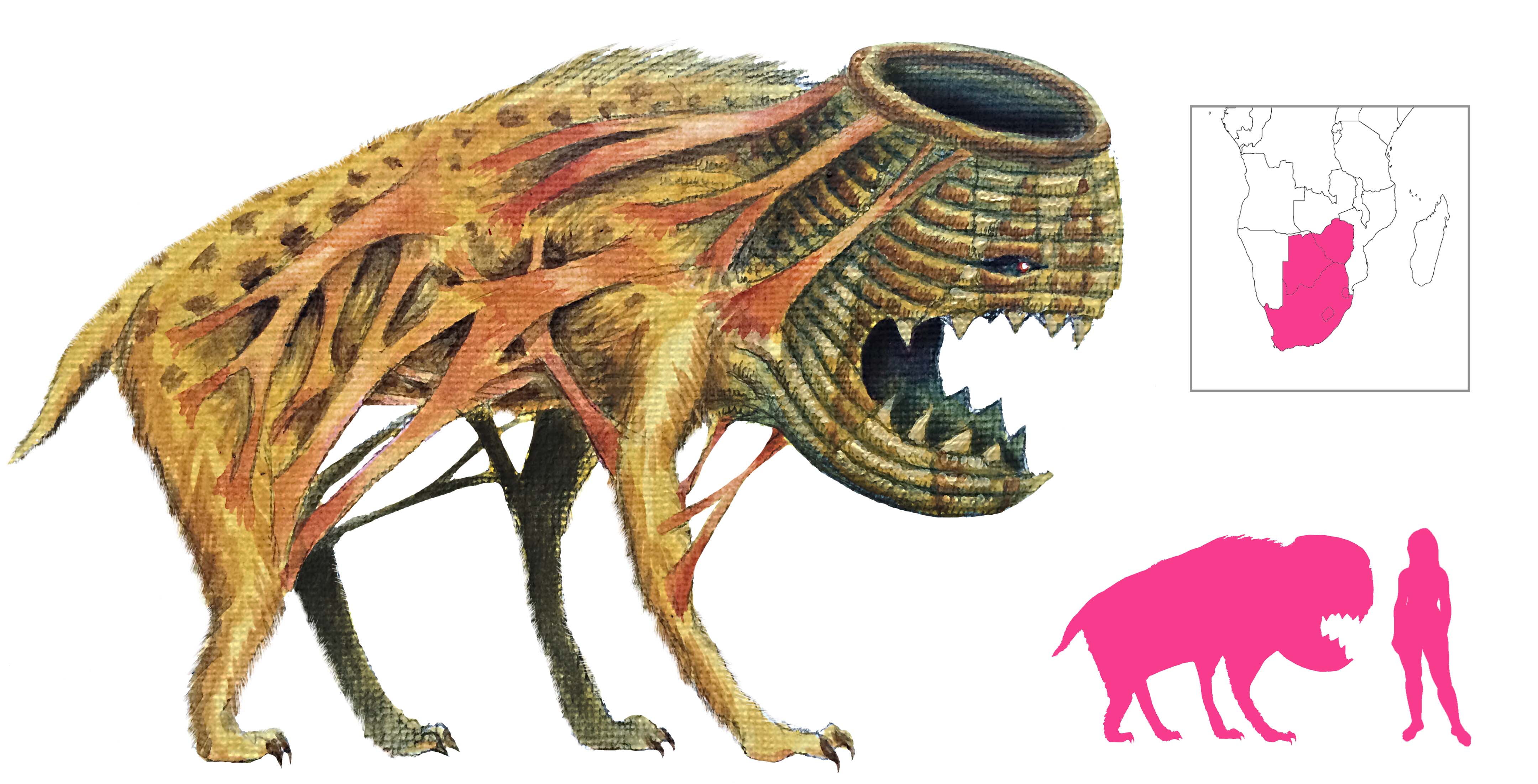
The Isitwalangcengce, or “Basket-bearer”, is hardly seen these days. Which is all the better, as this monster known to the Zulu people is a dedicated man-eater. Somewhat like a hyena in appearance, an Isitwalangcengce’s most notable feature is its basket-shaped head, complete with an opening in the top for carrying its prey.

Isitwalangcengces are powerful, and can easily overcome the bravest of men. They wait around villages during feast days, when children carrying freshly butchered meat go from house to house. They hide beside the doorway, and quickly stuff their victims into their head, carrying them off to eat. Isitwalangcengces do not actually eat all of their prey, but eat only the brain. An Isitwalangcengce will have a favorite rock to smash human heads on and lap up the contents.

If the Isitwalangcengce is strong, it is also dimwitted. This fact was exploited by one Zulu man who was being carried off in the basket. When the Isitwalangcengce passed through bushy terrain, the man reached out of the basket and pulled branches off, stuffing them into the cavity with him. Once he had filled the Isitwalangcengce’s head with sufficient branches, he grabbed onto a tree and hauled himself out. The Isitwalangcengce, meanwhile, noticed no difference in weight. By the time it reached the rocks and poured out a clump of branches and twigs, the man was long gone.

When the man returned to his village, he made sure to narrate his escapade in detail. News of that spread. Soon everyone knew to fill an Isitwalangcengce’s head with branches, and predation dropped drastically.

Now the Isitwalangcengce are mere nursery bogeys, good only for intimidating children. “If you aren’t good, the Isitwalangcengce will carry you off!” And the children smile to themselves, knowing that there’s always an easy way out.

References

Callaway, C. (1868) Nursery Tales, Traditions, and Histories of the Zulus. Trübner and Co., London.

Sapo Fuerzo

Variations: Strong Toad

Strong toad

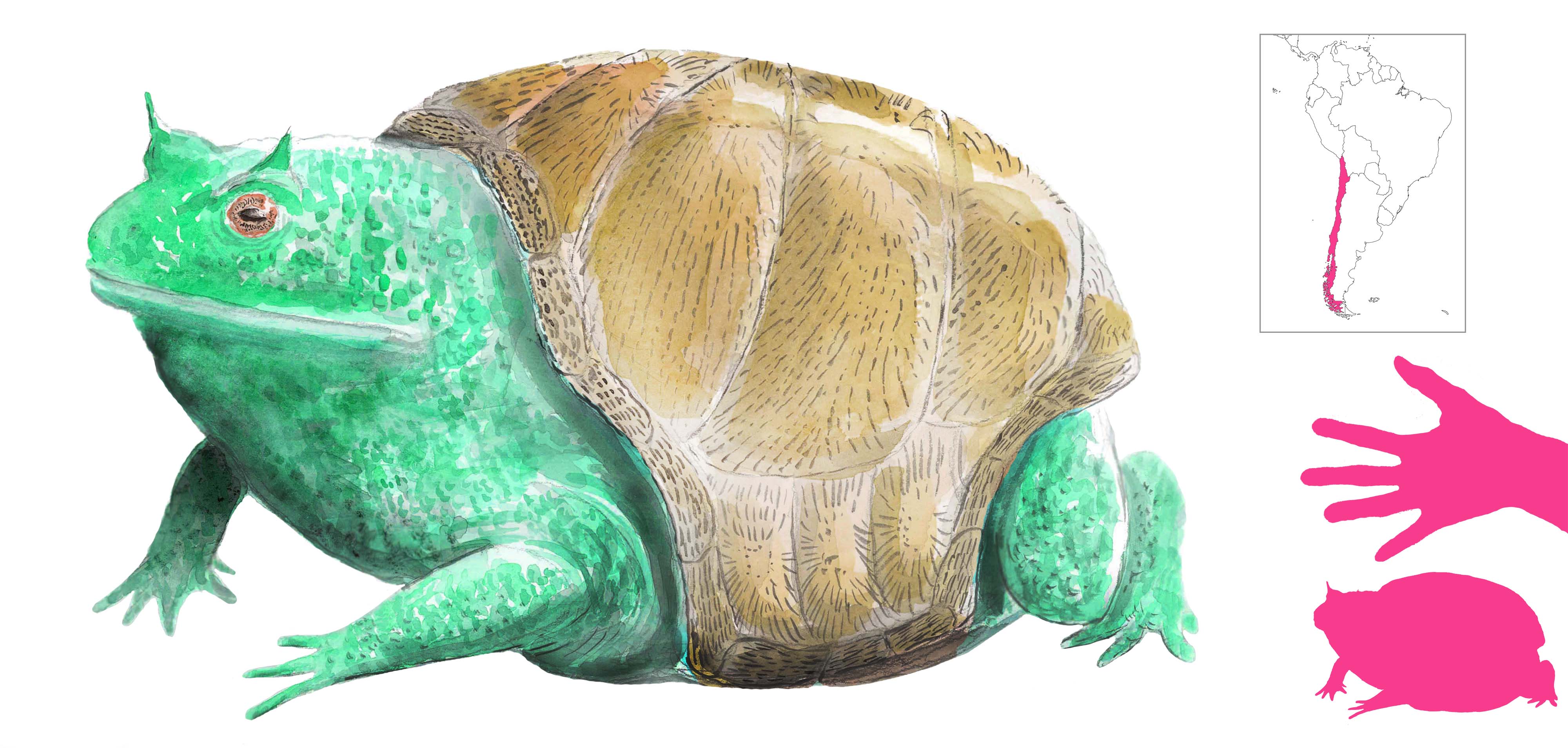
The sapo fuerzo, or “strong toad”, is a remarkable amphibian from the Andes of Chile. It can be easily distinguished from regular toads by its hard, turtle-like shell. It is phosphorescent, and glows in the dark like a firefly.

It earns its name from its supernatural powers and its incredible resilience. A sapo fuerzo is capable of attracting or repelling anything within its reach by the sheer power of its gaze. It can also regenerate and recover from virtually any injury, and the only way to kill one is burn it and reduce it completely to ashes.

References

Aguirre, S. M. (2003) Mitos de Chile. Random House, Editorial Sudamericana Chilena.

Cifuentes, J. V. (1947) Mitos y supersticiones (3rd Ed.). Editorial Nascimento, Santiago, Chile.

Boongurunguru

Variations: Bonguru

Boongurunguru

According to the mythology of the Solomon Islands, there was once a time when the waters flooded the Earth. This great flood, the Ruarua, engulfed all of the islands, even the 4,000 feet high San Cristoval hills; those drowned in it turned into stone pillars, which can still be seen at Mwata. It was Umaroa, leader of the Muara clan, who saved his people by taking them, a sacred stone, and pairs of all the animals on board a great canoe. When the waters receded, Umaroa made landfall at Waimarai in the Arosi district, and offered a sacrifice in thanks. From there an adaro descended from a rainbow and guided them to their new home.

Umaroa is now buried there, and his sacred stone was laid on top of him. The area is now rich with magic, and visitors have to observe certain rules to avoid bad luck. Any trees cut down and left there will cause the lumberjacks to wander in circles, always returning to the cut tree. If there is a rainbow above the river, it cannot be crossed without making an offering to the adaro first. Names have particular strength there; ropes cannot be called ari but instead must be referred to as kunikuni (“to let down”), otherwise snakes will be summoned immediately.

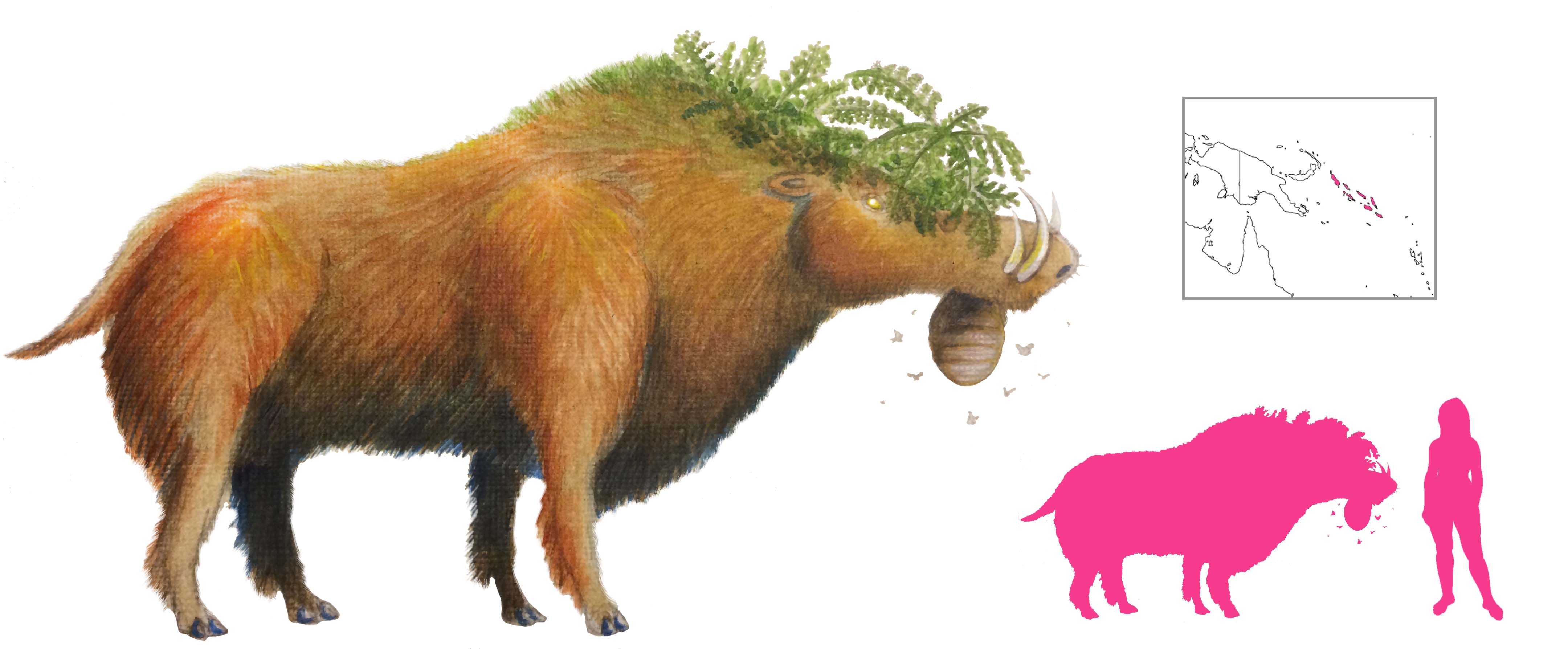
Of the spirits there, the most terrifying is Boongurunguru, the “pig-who-grunts”, the demon pig of Umaroa. He takes the form of a huge boar with ‘ama’ama ferns growing on his flattened head, and a buzzing nest of hornets located under his chin. He leads a herd of boars, all of them Boongurunguru, through the forest, goring and trampling anyone in their path. The appearance of a Boongurunguru foretells death; if the entire herd enters a village, everyone there will die. The boars get smaller and smaller as they approach a village, finally sneaking in at the size of mice, but they are no less deadly at that size.

If one hears Boongurunguru grunting and mentions that there must be pigs nearby, they are immediately surrounded by hundreds of venomous snakes – in front, behind, on either side, and falling out of the air.

This is because Boongurunguru has standards, and objects to being called a pig.

References

Fox, C. E. (1924) The Threshold of the Pacific. Kegan Paul, Trench, Trubner and Co., Ltd., London; Alfred A. Knopf, New York

Mackenzie, D. A. (1930) Myths from Melanesia and Indonesia. Gresham Publishing Company, Ltd., London

Ragache, C. C. and Laverdet, M. (1991) Les animaux fantastiques. Hachette.

Alp-luachra

Variations: Art-luachra, Arc-luachra, Airc-luachra, Dochi-luachair, Just-halver, Joint-eater, Mankeeper, Darklooker, Art-pluachra (mispronunciation)

Alp-luachra

Fairies are far removed from the sanitized Victorian ideal we are accustomed to. There are beautiful fairies; there are also ugly fairies, cruel fairies, and vile, parasitic fairies. The alp-luachra belongs to the last group.

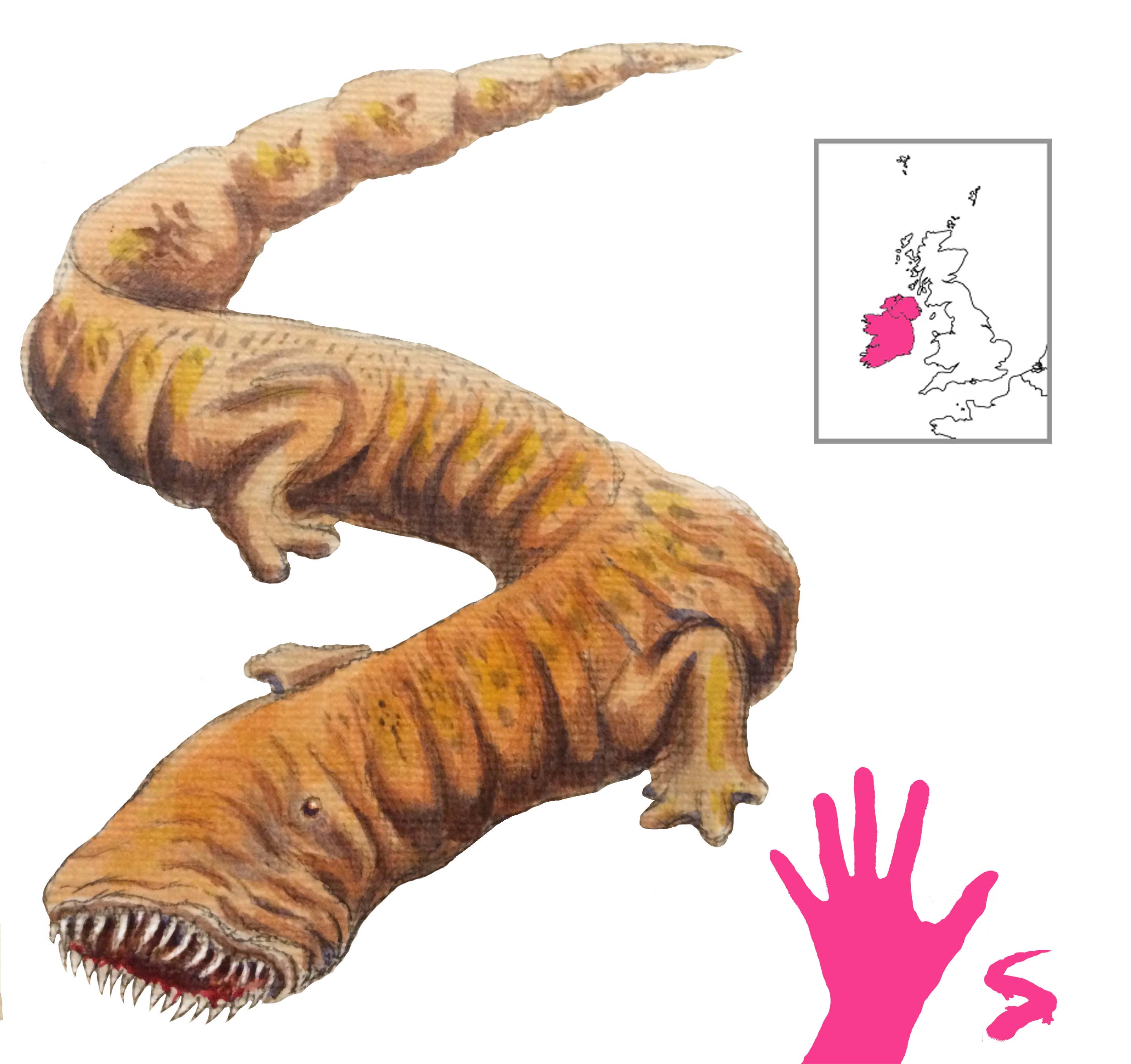
Native to Ireland, where it can be found across the island, the alp-luachra is a small, newt-like creature not unlike Ireland’s native smooth newt (Lissotriton vulgaris). It was born of ignorance and fear of the unknown – in this case, the habits of the newt. Any similarities end there, however. The smooth newt is a harmless denizen of ponds, while the alp-luachra lives off “the Pith or Quintessence of what the Man eats”, as Robert Kirk put it.

Infestation is simple enough. Anyone asleep outdoors is at risk. Alp-luachras slip into the open mouths of sleepers, and from there work their way into the stomach. The entire process is painless, and hosts are never aware of their slimy new occupants. That is, until the symptoms manifest themselves: pain in their sides as the alp-luachras make themselves comfortable, and increasing, insatiable hunger. The alp-luachras eat the food ingested by their hosts, growing larger, reproducing inside them until their wriggling becomes unbearable; meanwhile, their hosts waste away, becoming gaunt and emaciated. In the span of a few years, the unfortunate victim eventually dies of starvation, and the alp-luachras move out to find new victims.

As the alp-luachra’s glamour prevents it from being seen by physicians, it must be tricked into leaving the body by other means. Inhaling the strong fragrance of savory food can coax them to come out, as can eating very salty food. Once outside the body, the alp-luachra can be licked to cure burns.

Douglas Hyde recounts the story of one farmer from Connacht who suffered from alp-luachra infestation for half a year, until an itinerant beggar and the Prince of Coolavin told him how to get rid of them. He started by eating a large quantity of salted beef. While this made him thirsty (and no less hungry), it made the alp-luachras thirstier. He then lay down with his mouth open above a stream; the alp-luachras, sensing water, crawled out of his mouth and into the stream, one by one. All in all, he had been host to a dozen alp-luachras and their mother, seven times their size.

He never slept on the grass again.

References

Dubois, P.; Sabatier, C.; and Sabatier, R. (2005) The Complete Encyclopedia of Elves, Goblins, and Other Little Creatures. Abbeville Press.

Hyde, D. (1890) Beside the Fire. David Nutt, London.

Kirk, R. (1893) The Secret Commonwealth of Elves, Fauns, & Fairies. David Nutt, London.

Caspilly

Variations: Caspilli, Neemora (Persian)

Caspilly

The Caspilly is a “marvelously large, and strong” fish from the Indian Ocean, described by Ambroise Paré on the basis of two separate accounts by André Thevet.

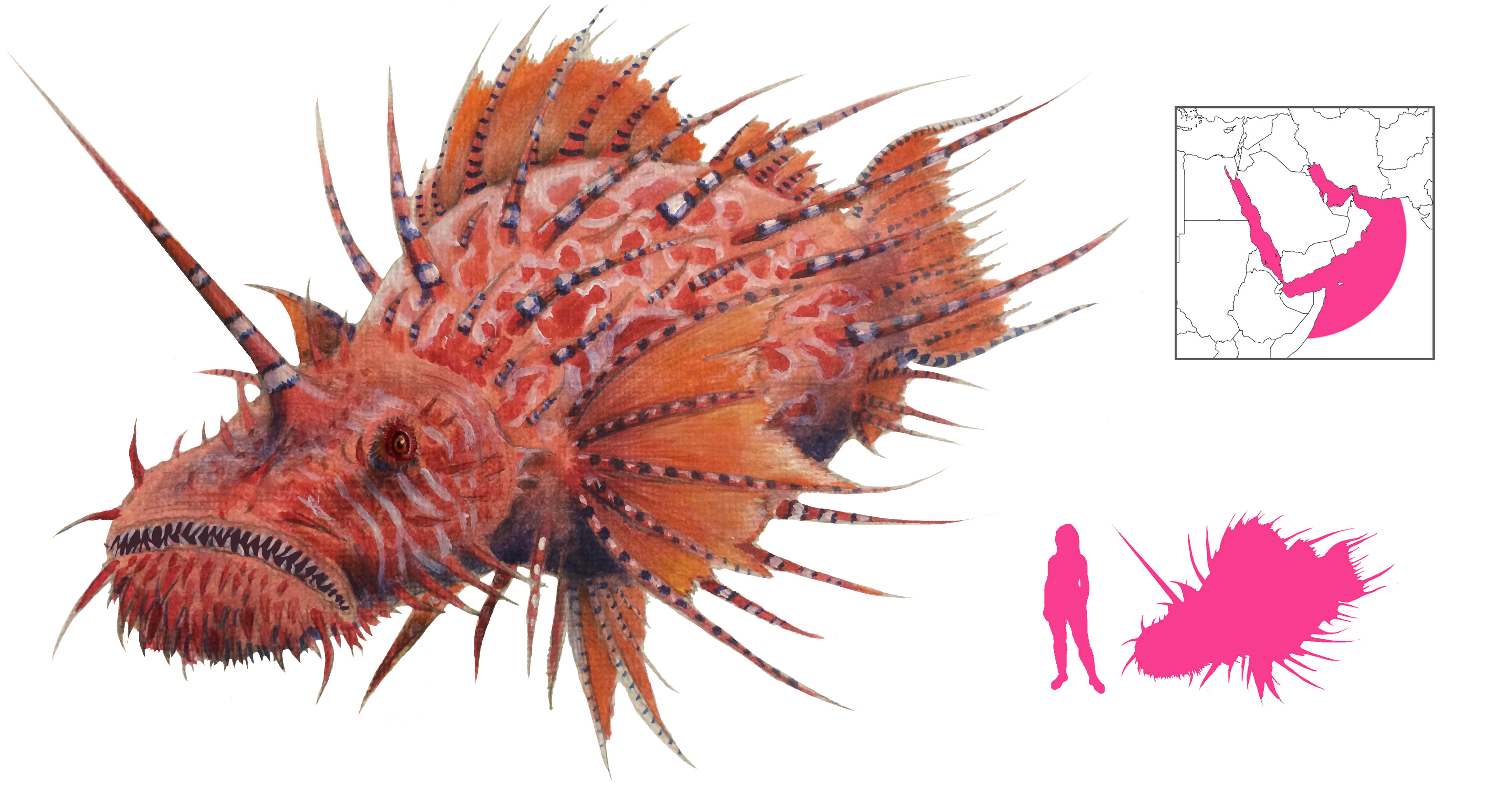
Thevet placed it in the Arabian Gulf, saying that it is known to the Arabs as caspilly, and to the Persians as neemora. The caspilly is almost as wide as it is long, but no more than two feet long. It has no scales, and its skin is spiky and barbed like that of a shark. On its forehead is a lancet-like spine, a foot and a half in length, that it keeps tucked along its nape. When it is hungry, it goes for the first fish it sees, stabbing it in the belly with its horn until its prey bleeds to death. Its teeth are venomous and bites are deadly. Applying a dead caspilly to a bite, on the other hand, will cure it. The horn is of great medicinal value, and caspilly are shot with arrows from a safe distance to retrieve such a prize.

Thevet also reports a nameless fish from the Peruvian sea, with a swordlike horn three feet long. This fish is a specialized whale killer. Upon seeing a whale, the fish will hide underneath before stabbing it in the navel with its horn, leaving the whale to writhe in its death throes and capsize nearby ships. Once the whale is dead, it can be eaten at leisure.

Paré economically combines both accounts, giving the caspilly a four-foot-long horn and making it the terror of the Arabian sea. He adds that the Arabs of the region hunt caspillys with giant hooks baited with camel meat. Any caspilly who greedily takes the bait will tire itself out on the line, eventually slowing down enough to be shot with arrows, brought onto ship, and bludgeoned to death. Caspilly flesh is edible, and caspilly alicorn is just as potent against venom as that of the unicorn.

In all likelihood the Caspilly was born from accounts of swordfish and killer whales, contaminated by lionfish and porcupinefish. The venomous bite may have been derived from the famed toxicity of pufferfish. Aldrovandi cautiously included it with his Herinaceus marinus, the porcupinefish, as Herinaceus arabus, the Arab hedgehog.

References

Aldrovandi, U. (1642) Monstrorum historia cum Paralipomenis historiae omnium animalium. Bononiae.

Paré, A. (1582) Discours d’Ambroise Paré – De la Licorne. Gabriel Buon, Paris.

Paré, A. (1614) Les Oeuvres d’Ambroise Paré. Nicolas Buon, Paris.

Thevet, A. (1575) La Cosmographie Universelle. Guillaume Chaudiere, Paris.

For the purposes of this book, deities, ghosts, and humans have been excluded. This is often down to a judgement call – some creatures are equal parts ghost and fairy, for instance.

After the primary name, a list of variations will be given. These include spelling variations, regional names, and other creatures that may be considered the same. The main text will clarify.

The primary art will always be subjective to some extent, and the artist will fill in blanks as they see fit. For what is known about the creature’s appearance, refer to the text.

The main art will be accompanied by a distribution map and a scale comparison. These will aim to be as accurate as possible, but the fact remains that they are often only educated guesses. Again, the text will contain the essential information.

Finally, all entries will have a references section. Lack of references has always been something that annoyed me, and I hope to remedy this somewhat.

I am indebted to your-vector-maps.com for their world map. The model in the scale images is currently exploring space on the Pioneer probes.