Vouivre

Variations: Vaivre, Givre, Guivre, Wivre

Vouivre

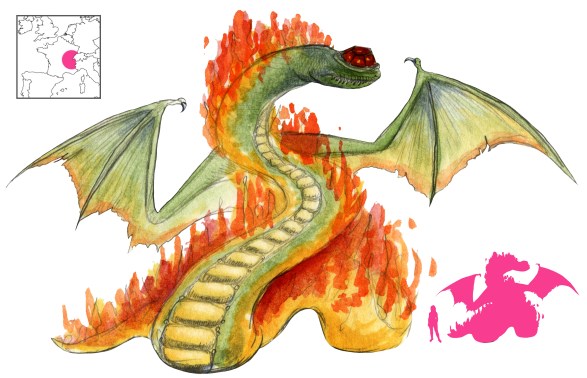
Vouivres, the great fiery serpents of France, have been reported primarily from remote, mountainous regions, where they haunt springs, wells, caves, deep ponds, and ruined castles. They are known from Bourgogne, Franche-Comté, Savoie, the Jura mountains, and neighboring areas, with possible relatives in the Aosta Valley and Switzerland.

The word “vouivre” is derived from the Latin vipera, or “viper”. Vouivres themselves are the spiritual descendants of Mélusine, stripped of her human features. They have been described as dragons, serpents, and fairies in the form of great reptiles; they are always the guardians of priceless treasures.

In its most simple definition, a Vouivre is a female dragon. Vouivres vary wildly in appearance, but are always female and associated with fire and water. The classic vouivre, as observed in Faverges, Fleury-la-Tour, Mont-Beuvray, Rosemont, Solutré, and Thouleurs, is an immense winged serpent covered with fire. Instead of eyes, a vouivre has a single large diamond or ruby in its head that guides it through the air. She removes it when bathing, leaving it blind and vulnerable to theft. Possession of a vouivre’s eye-stone would bring riches and happiness to anyone who stole it. The immense vouivre of Boëge guards treasure and wears a priceless golden necklace. In La Baume she is 4 meters long and covered in gems and pearls. She sometimes leaves gems behind where she lands. The Lucinges vouivre is a glowing red viper that whistles eerily in flight. The Gemeaux vouivre, which appeared between 2 and 3 in the afternoon, was hooded like a cobra.

In Brizon, she is equally likely to appear as a bird or a winged beech marten with a brilliant necklace as she is to have the form of a great serpent with wings and a diamond on its tail. Vouivres may not even look like animals. In Chevenoz she appears as a burning fireball streaking across the sky, in Saint-Jean-d’Aulps and Vallorcine she is a single-eyed tongue of fire, and in Le Biot she is a star whose appearance foretells war and strife. The Orgelet Castle vouivre looks like a red-hot iron bar in flight, and the vouivre of Sixt-Fer-À-Cheval is a plumed golden necklace that flies through the air.

One of the more effective ways of slaying a vouivre has been making a spiked barrel to hide in. At Condes, a man managed to steal a vouivre’s diamond and hide in a nail-studded washtub; the infuriated, blinded dragon killed herself trying to get to him. While another man at the Aosta Valley slew a vouivre in a similar manner, other prospective thieves have not been so lucky. The vouivre of Reyvroz had a necklace of great value, which was stolen by a man in a spiked barrel; she died and the thief died soon after. The vouivre of Samoëns had her pearl necklace stolen in the same manner, but she constricted the barrel anyway and made the thief return the necklace; she then disappeared and was never seen again. In Manigod, where grass would not grow for a couple of years after the vouivre’s passage, a man who stole her diamond was killed, his barrel smashed, and the gem retrieved.

Finally, as with all dragons, vouivres are vulnerable to the power of saints and other holy persons. The vouivre of Saint-Suliac was cast into a deep cave by Saint Suliac after she killed one of his monks. The location became known as the Trou de la Guivre, the Guivre’s Hole.

In Thollon-Les-Mémises, among other places, “vouivre” has become a byword for an unpleasant, nasty woman.

Modern versions of the vouivre, perhaps conflating her with Mélusine, have embellished with her the features of a seductive woman. Marcel Aymé makes her a wild girl of the forest with an entourage of vipers, and Dubois makes her a beautiful fairy who sheds her dragon skin when bathing.

References

Aymé, M. (1943) La Vouivre. Gallimard.

Dontenville, H. (1966) La France Mythologique. Tchou, Paris.

Dubois, P.; Sabatier, C.; and Sabatier, R. (1996) La Grande Encyclopédie des Fées. Hoëbeke, Paris.

Joisten, C. (2010) Êtres fantastiques de Savoie. Musée Dauphinois, Grenoble.

Monnier, D. (1819) Essai sur L’Origine de la Séquanie. Gauthier, Lons-Le-Saunier.

Sébillot, P. (1905) Le Folk-Lore de France, Tome Deuxième: La Mer et les Eaux Douces. Librairie Orientale et Américaine, Paris.

Araǵanaqlta’a

Variations: AraGanaqlta’a, AraGanaGalta’a; AraGanaqlate’e, AraGanaGalate’e; Owner of the Snakes, Father of the Snakes

Araganaqltaa

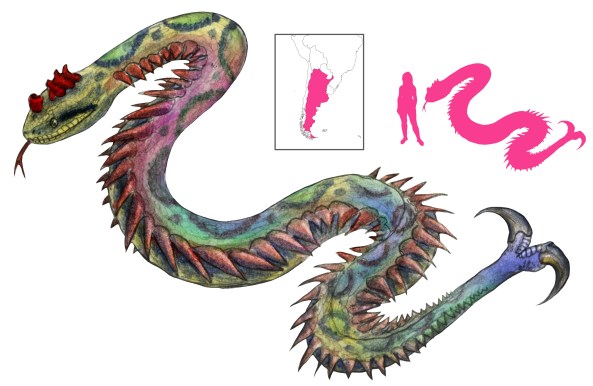
Araǵanaqlta’a is the father or owner of the snakes in Argentinian Toba folklore. It can be found in a range of habitats, but usually likes rivers and deep caves with access to water. In addition to snakes, which are all under its command, it is associated with water, rainbows, and storms.

The araǵanaqlta’a appears as a large, multicolored snake, 10 meters or more in length, resembling a bushmaster or fer-de-lance. It has a red crest, its “sign” (ndage), on top of its head, and a sawlike structure on either side of its body that allows it to move. An araǵanaqlta’a’s tail ends in two hooks which it uses to hold prey. The females are known as araganaqlate’e, the mother of the snakes.

Araǵanaqlta’a are shapeshifters, adjusting to fit their environment, and are also known in the form of four-legged snakes, as humans in elegant business attire, or as rheas with colorful necks. No matter what shape it takes, however, the araǵanaqlta’a always has its characteristic ndage, which identifies it as a powerful mythical creature.

Araǵanaqlta’a are intelligent and enjoy human conversation. These snakes will punish desecrators of nature and persecutors of snakes, but will reward those who they find worthy. After a hunter treated an araǵanaqlta’a with respect and obeisance, the snake promised him that he would have all he would ever need, and taught him how to heal the sick with his words.

References

Wilde, G. and Schamber, P. (2006) Simbolismo, Ritual, y Performance. Paradigma Indicial, Buenos Aires.

Wright, P. G. A semantic analysis of the symbolism of Toba mythical animals. In Willis, R. (Ed.) (1990) Signifying Animals: Human Meaning in the Natural World. Unwin Hyman, London.

Wright, P. G. (2008) Ser-en-el-sueño. Editorial Biblos, Buenos Aires.

Codrille

Variations: Cocadrille, Cocodrille, Coquadrille, Cocatris

Codrille

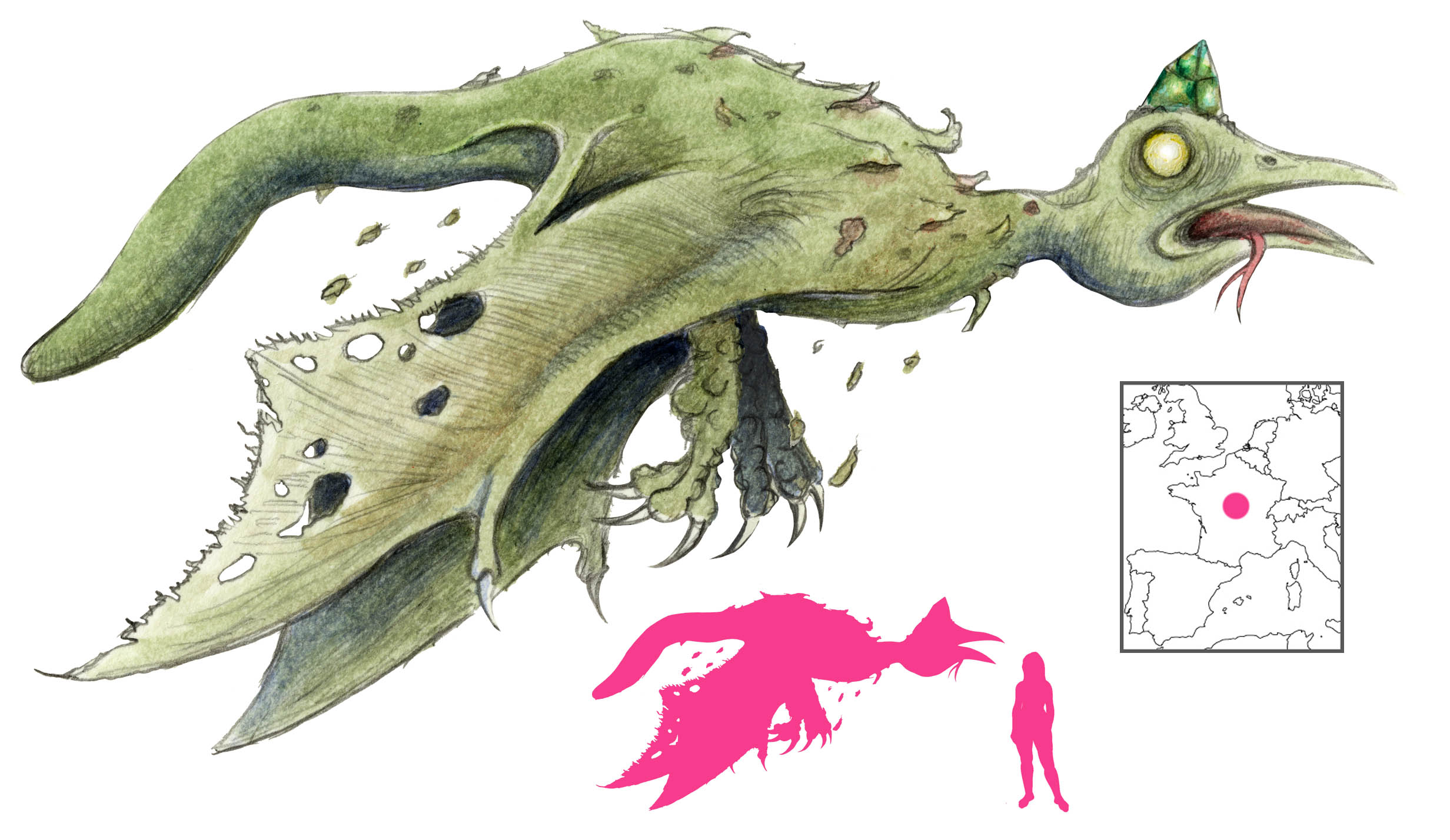
The Codrille, Cocadrille, or Codrille is a variety of basilisk or dragon native to central France, notably Berry, Maine, Poitou, Sologne, and Vendée. It combines features of basilisks and vouivres but without the redeeming aspects of either.

The name of the codrille was derived from the same etymological confusion that spawned the “cockatrice”. Starting with Crocodylus, the crocodile, practically a mythical creature in its own right, the name became progressively more garbled, becoming Cocodrillus, Cocodrille, Cocadrille, and Codrille. However, de la Salle derives it from coco and drille, meaning “rooster’s child”.

Unlike true basilisks, codrilles can grow to impressive size, becoming leathery-winged dragons at the last stage of their life cycle. The “crown” characteristic of basilisks manifests in the form of a brilliant gem on top of the codrille’s head. Codrilles can kill merely by looking at their victims, and emit an aura of disease and plague.

A codrille’s life is a complicated succession of metamorphoses. It hatches from a yolkless egg laid by a rooster, and incubated by the heat of the sun or of manure. To prevent those eggs from hatching, one must plant sprigs of ash in potential codrille breeding grounds. This should be done on the first day of May. Having other roosters around also helps, as they will devour the offspring of a codrille.

The codrille starts out its life as a very long, string-like snake. It is capable of killing right out of the egg – anyone who cracks a codrille egg and is seen by the newborn codrille dies instantly, but if they see the snake first, it dies instead. After a while, the juvenile codrille sprouts legs and becomes a salamander. During this stage of its life it will still die if seen first by humans, so it hides in deep wells, ruined tombs, and the masonry of houses, bringing bad luck to everyone living there and whistling ominously at night. It can debilitate a bull merely by crawling under it.

At the end of seven years the codrille reaches the adult stages. It grows spectacularly, sprouts wings, and metamorphoses into an enormous dragon. It spreads its wings and migrates towards the Tower of Babylon, breathing death and pestilence along its way. Its passage in the air dims the sun, and epidemics and plagues follow in its wake.

References

Sainéan, L. (1921) L’histoire naturelle et les branches connexes dans l’oeuvre de Rabelais. E. Champion, Paris.

de la Salle, L. (1875) Croyances et légendes du centre de la France, Tome Premier. Chaix et Cie., Paris.

Sébillot, P. (1906) Le Folk-lore de France, Tome Troisième: La Faune et la Flore. Librairie Orientale et Américaine, Paris.

Basilisk

Variations: Cockatrice, Basilisco, Basiliscos, Basiliscus, Basili-coc, Basilicok, Regulus (Small Prince), Codrille, Cocodrille, Cocadrille, Coquatrix, Harmena, Sibilus (Hisser), King of Serpents, Crested Crowing Cobra (potentially)

Basilisk

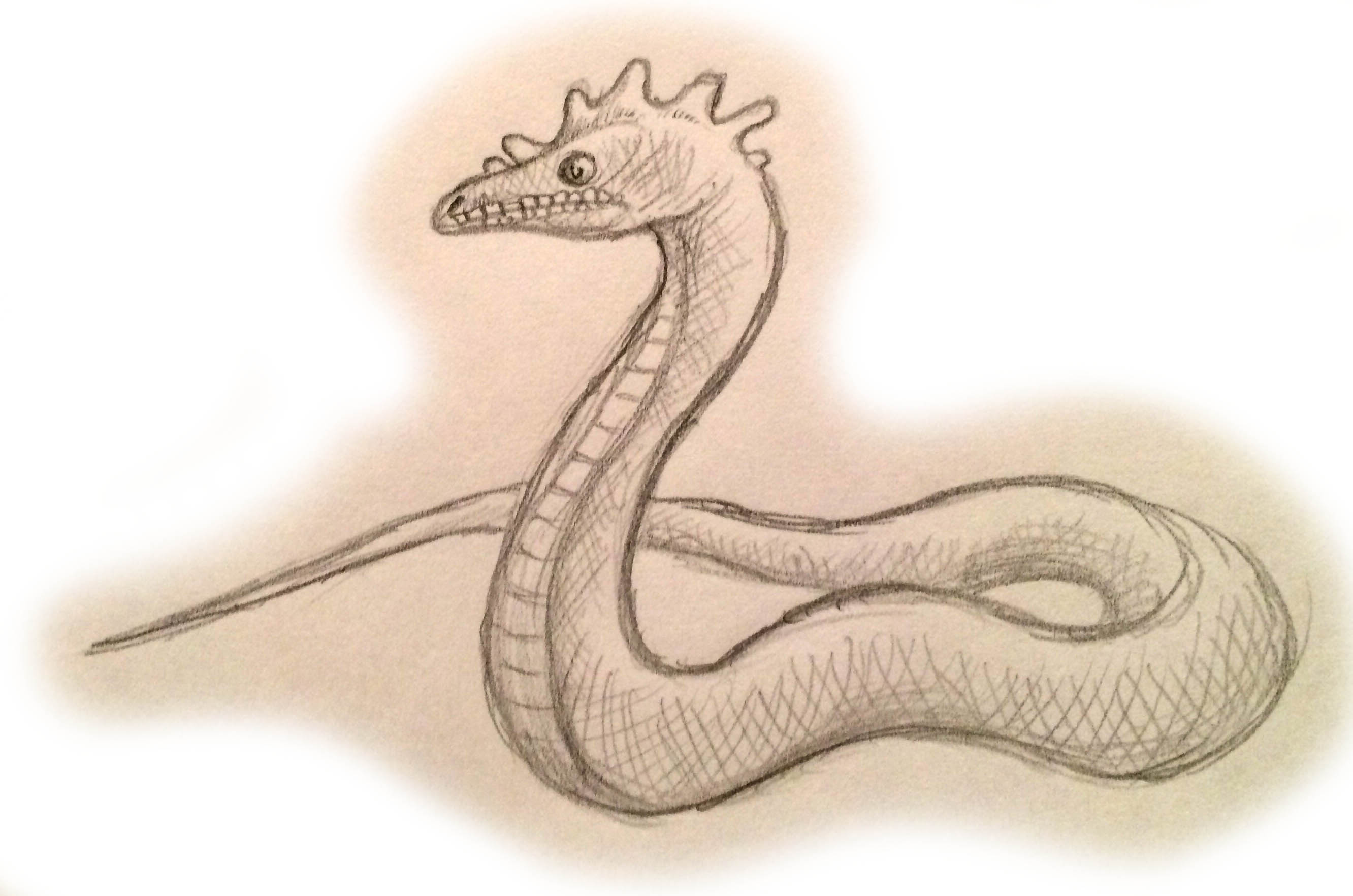
The Basilisk, the “little king” or “king of snakes”, is best known as a creature whose looks kill. Its primary claim to fame is a gaze that instantly kills anyone who sees it, or even anyone it looks at. The basilisk has appeared under a number of guises throughout the centuries, but there are at least a few constants. It is always deceptively small. It is a snake, or at least part snake, with or without rooster characteristics. It always has a crown – whether a white mark, a ring of hornlets, a rooster’s comb, or even a literal crown on its head. And finally, it is always extraordinarily virulent.
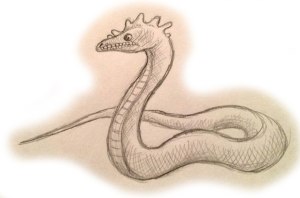
bas 1The basilisk is first and foremost a snake, born from the blood of Medusa as were all venomous snakes. It is found in the North African deserts – its very presence causes the desert, and it becomes frantic in the presence of water. At half a foot long, it is far from the biggest snake, but it is the king of snakes, traveling proudly with its head off the ground. It has a white spot or a crown on its head, and white markings down its back.

The exact nature of the basilisk’s deadliness is uncertain, as it is known to kill via venom, odor, and gaze. Murrus, one of Lucan’s soldiers, transfixed a basilisk with his spear, only to see the venom travel up his weapon and start corroding his hand. He survived by amputating his arm before the venom could reach his body. A basilisk can spit its venom skyward, frizzling up birds in flight. Its very gaze is deadly, as it can kill a man merely by looking at him with its gleaming red eyes. The regal nature of the basilisk and its propensity for projecting its venom suggest that cobras or spitting cobras were the origin of the legend.

Basilisks feared only three things: weasels, the crowing of roosters, and their own lethal gaze. The weasel was the only animal immune to the basilisk’s gaze and venom, making it the only natural predator of the king of snakes. Weasels were often sent into caves believed to harbor basilisks. This interaction also recalls that of the cobra and the mongoose. Basilisks also convulsed and died instantly upon hearing the crowing of a rooster. Travelers in the Libyan desert would be well advised to bring a rooster along with them. Topsell denied the possibility of basilisks perishing upon seeing each other, as “it is unpossible that any thing should hurt itself”; nonetheless, a basilisk in Vienna was killed by showing it a mirror.

With the passing of time the nature of the basilisk grew more and more confused. Various Biblical serpents were translated as basilisks. The basilisk gained more avian characteristics, including an origin in rooster eggs, and was confused with Cocodrillus (the crocodile); both of them were dangerous reptiles with small adversaries (the weasel for the basilisk, the hydrus for the crocodile). Further garbling of “cocodrillus” resulted in “cockatrice”. Wycliffe’s Bible had “cockatrice” as a translation of “basilisk”. Chaucer referred to the “basilicok”. With the accumulation of translation, grammar, and etymological errors, the basilisk (or cockatrice) became a hybrid of snake and rooster, with clawed wings, a rooster’s head, and a long serpentine tail (sometimes with an additional head at the end). This is the familiar cockatrice (or basilisk) of bestiaries, and an incarnation of the Devil himself. It further evolved into the alchemical cockatrice, holding its tail in its mouth, symbolizing the alchemical cycle and its mixed nature. The same nomenclatural confusion also gave rise to the Codrille, a basilisk from central France.

Despite efforts to separate the basilisk and the cockatrice – for example, making the basilisk a snake or lizard and the cockatrice a snake-rooster hybrid, or making them both snake-rooster hybrids, one with a snake head and the other with a rooster head – the fact remains that the names basilisk and cockatrice are interchangeable, and refer to the same animal. It is best to accept T. H. White’s statement that the cockatrice is “a medieval muddle” and leave it at that.
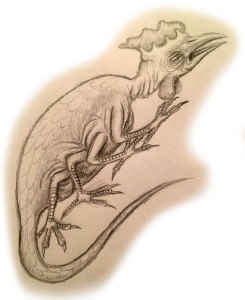
bas 2Cardano reported a basilisk found in the ruins of a demolished building in Milan. This particular specimen was wingless and featherless, with an egg-sized head that looked too large for its body. It had viper fangs, a bulky lizard-like body similar to that of the stellion, and only two stubby legs with catlike claws. The tail was as long as the body, with a swelling at its tip the size of the head. When standing up, it looked like a leathery, naked rooster.

Aldrovandi was apparently inspired by this animal for one of his images of the basilisk, helpfully giving it six more legs. Based on the description and appearance, it appears to have been inspired somewhat by scorpions. Ironically, while this eight-legged depiction has proven particularly enduring, Aldrovandi himself was apparently doubtful of its authenticity, placing this presumed African creature just before a couple rays preserved in the shape of basilisks. The true, snake-like basilisk is given a full-page spread. Aldrovandi also produces a couple of purported basilisk eggs.

Flaubert, taking considerable creative liberties, describes the basilisk as a huge violet snake with a three-lobed crest and two teeth, one on each jaw. It speaks to Saint Anthony, warning him that “I drink fire. I am fire – and I breathe it in from mists, pebbles, dead trees, animal fur, the surface of swamps. My temperature sustains volcanos; I bring out the gleam of gems and the color of metals.”

Finally, Hichens’ “crowing crested cobra” of sub-Saharan Africa appears to be some kind of basilisk. It resembles a cobra, but with a crest on its head and the call of a rooster.
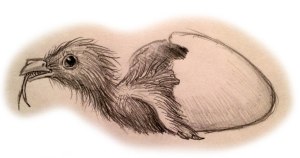
bas 3The life cycle of the basilisk is involved and complicated. The Egyptians believed it to be born from the egg of the ibis, while Neckham blames chickens. Basilisks are born from round shell-less eggs laid by old roosters in the summer (on a dungheap, in some accounts). Those eggs have to be incubated by a snake, a toad, or the rooster itself, eventually producing little terrors ready to kill at birth. As roosters may develop concretions that resemble eggs, and hens may look like roosters, any such fowl that seemed to be a male chicken laying an egg was immediately put to death. In 1474, one such heretical chicken was burned at the stake in Basle, in front of a large crowd.

The only plant immune to the withering gaze of the basilisk is rue, which is consumed by weasels to protect themselves from their enemies. Remedies for basilisk envenomation will always contain rue. A dead basilisk will ward away spiders, and one such basilisk carcass in Diana’s temple kept swallows at bay.

Borges quotes Quevedo as giving the paradox of the basilisk: its existence cannot be proven, as anyone who sees it and survives is a liar, and anyone who sees it and dies will not tell the tale.

The basilisk of biology, or Jesus Christ Lizard (Basiliscus) is a completely harmless South American lizard, known for walking on water. The lethal powers of the basilisk were also transposed by European settlers onto rattlesnakes, and the Mexican West Coast rattlesnake still bears the name of Crotalus basiliscus.

References

Aelian, trans. Scholfield, A. F. (1959) On the Characteristics of Animals, vol. I. Harvard University Press, Cambridge, Massachusetts.

Aldrovandi, U. (1640) Serpentum, et Draconum Historiae. Antonij Bernie, Bologna.

Barber, R. (1993) Bestiary. The Boydell Press, Woodbridge.

Borges, J. L.; trans. Hurley, A. (2005) The Book of Imaginary Beings. Viking.

Breiner, L. A. (1979) The Career of the Cockatrice. Isis, vol. 70, no. 1, pp. 30-47.

Breiner, L. A. (1979) Herbert’s Cockatrice. Modern Philology, vol. 77, no. 1, pp. 10-17.

Brown, T. (1658) Pseudodoxia Epidemica. Edward Dod, London.

Bulfinch, T. (1997) The Age of Fable. Macmillan, New York.

Cardano, G.; le Blanc, R. trans. (1556) Les Livres de Hierome Cardanus Médecin Milannois. Guillaume le Noir, Paris.

Evans, E. P. (1987) The Criminal Prosecution and Capital Punishment of Animals. Faber and Faber, London.

Flaubert, G. (1885) La Tentation de Saint Antoine. Quantin, Paris.

Hargreaves, J. (1983) The Dragon Hunter’s Handbook. Armada.

Hichens, W. (1937) African Mystery Beasts. Discovery (Dec): 369-373.

Isidore of Seville, trans. Barney, S. A.; Lewis, W. J.; Beach, J. A.; and Berghof, O. (2006) The Etymologies of Isidore of Seville. Cambridge University Press, Cambridge.

Lemnius, L. (1658) The Secret Miracles of Nature. Jo. Streater, London.

Liss, A. R. (1987) A Basilisk by Any Other Name… Teratology 35, pp. 277-279.

Lucan, trans. Rowe, N. (1720) Pharsalia. T. Johnson, London.

Pliny; Holland, P. trans. (1847) Pliny’s Natural History. George Barclay, Castle Street, Leicester Square.

de la Salle, L. (1875) Croyances et légendes du centre de la France, Tome Premier. Chaix et Cie., Paris.

Sax, B. (1994) The Basilisk and Rattlesnake, or a European Monster Comes to America. Society and Animals, vol. 2, no. 1.

Topsell, E. (1658) The History of Serpents. E. Cotes, London.

White, T. H. (1984) The Book of Beasts. Dover Publications, New York.
Haemorrhois

Variations: Haemorrhous, Haemorrhe, Blood-letter, Blood-flower, Affodius, Afudius, Alsordium, Halsordium, Sabrine (Topsell gives the last five as corrupted, barbarous versions)

Haemorrois

The Haemorrhois – “bleeder” or “blood-letter” – is one of the many Saharan snakes feared for its venom. True to its name, it produces a violent hemotoxin that forces its victims’ blood out of their bodies. Topsell seemed uncertain as to whether it was an asp or a viper, but its appearance and effect of its venom strongly imply a viper.

Descriptions of the haemorrhois consistently agree that it is one foot long and has horns of some sort. Aelian gave it bristling horns, but Aldrovandi sets the number to one. It is pitch black or fiery in color, with bright eyes; Topsell believed it to be sandy yellow with black spots. The head is broad, tapering to a short, pointed tail. The scales of a haemorrhois are rough and make a rustling sound as the snake moves, suggesting that it may have been inspired in part by the saw-scaled viper. They are slow and sluggish animals, and make winding nests in rocky areas.

Sexual dimorphism is known. Males tend to hold their head up when traveling, while females remain close to the ground. Aelian adds that the venom of female haemorrhois specifically targets the gums and fingernails.

Envenomation by a haemorrhois is particularly gruesome. As the venom spreads, blood begins to leave by every opening possible, draining out through the eyes, ears, nostrils, mouth, even the very pores. Scars reopen. Teeth and nails fall out. The entire body becomes one bleeding wound, and death comes through catastrophic blood loss. Lucan, in describing the fate of young Tullus, compared the dying Roman to a statue gushing water, weeping and sweating blood.

One of these snakes was encountered by Menelaus and his men in Egypt. Helen crushed it and extracted its poison for reasons unknown. Since then, all haemorrhois have been slow creepers.

Topsell recommends a number of substances as antidotes to haemorrhois bite. These cures include vine-leaves with honey; powdered haemorrhois head taken with water; garlic with fleur-de-lis oil as an emetic; and raisins. To staunch the bleeding, plasters made of vine leaves and honey or purslane and barley leaves should be applied, and the wound washed with cold water. Finally, he concedes that the same remedies used for other snakes may prove effective. Hard eggs with salted fish, or a potion of radish seeds, poppy juice, lily roots, daffodil, rue, trefoil, cinnamon, cassia, and sweet myrrh can help.

References

Aelian, trans. Scholfield, A. F. (1959) On the Characteristics of Animals, vol. III. Harvard University Press, Cambridge, Massachusetts.

Aldrovandi, U. (1640) Serpentum, et Draconum Historiae. Antonij Bernie, Bologna.

Batinski, E. (1992) Cato and the Battle with the Serpents. Syllecta Classica, Vol. 3, pp. 71-80.

Eldred, K. O. (2000) Poetry in Motion: the Snakes of Lucan. Helios 27.1, p. 63.

Isidore of Seville, trans. Barney, S. A.; Lewis, W. J.; Beach, J. A.; and Berghof, O. (2006) The Etymologies of Isidore of Seville. Cambridge University Press, Cambridge.

Lucan, trans. Rowe, N. (1720) Pharsalia. T. Johnson, London.

Topsell, E. (1658) The History of Serpents. E. Cotes, London.

Guariba-boia

Variations: Howler monkey snake

Guariba boia

Guariba-boia, the “howler monkey snake”, can be found in a wide stretch of the Amazon river, from Fonte Boa in the west to Urucurituba in the east, and in the lakes of the Rio Negro. It excavates tunnels in murky river bottoms, and hides in mud or thickets of water-plants. Usually its voice is the only sign of its existence.

As the name implies, a guariba-boia typically has the head of a howler monkey (guariba) on the body of a snake (boia). Sometimes it has the body of a howler monkey and the paws of an otter, and rarely it has the head of a sloth (although such a feature would seem hardly intimidating). Guariba-boias grow to about six meters long.

Guariba-boias announce their presence with loud, resonant howls that sound like an entire troop of howler monkeys. They roar from below water, and their calls are particularly loud on rainy nights.

While not as big as boiunas, guariba-boias are armed with needle-sharp fangs and lethal venom. Death by guariba-boia bite is swift and painful, after which the creature swallows its victim whole. A guariba-boia does not regularly seek out human prey, but will overturn canoes and kill the occupants if hungry enough.

References

Smith, N. J. H. (1996) The Enchanted Amazon Rain Forest. University Press of Florida, Gainesville.

Tsuchinoko

Variations: Bachi-hebi, Gigi-hebi, Koro, Koro-hebi, Nozuchi, Tsuchi-korobi

Tsuchinoko final

The Tsuchinoko (“child of the earth” or “mallet child”) is a snake native to Japan. Its primary characteristics are its unusual stocky appearance and its secretiveness. Sightings of tsuchinoko go at least as far back as 1807, in the Edo Period.

A tsuchinoko is easily recognized by its fat, dorsoventrally flattened appearance, reminiscent of a beer bottle, mallet, or pestle (tsuchi). It is this feature that has earned it its name, as well as the alternate name of nozuchi (“field mallet”). It is known as bachi-hebi and gigi-hebi in Akita Prefecture, koro and koro-hebi in Fukui Prefecture, and tsuchi-korobi in Tottori Prefecture.

tsuchinoko bwWhile rare and hard to find, the tsuchinoko is believed to be venomous. It can get around by rolling, as observed by witnesses; when spotted, it laughs and vanishes in a flash of light, causing the onlookers to fall ill. When angered, a tsuchinoko will hiss, spit, and even jump at its pursuer before biting with its fangs.

Recent years have greatly added to the tsuchinoko’s reputation, as reports of sightings have led to its promotion into a full-blown cryptid. The 2000 discovery of an alleged tsuchinoko skeleton in Yoshii, Okayama Prefecture, firmly cemented the snake’s existence in popular culture.

The true identity of tsuchinoko sightings are possibly the venomous yamakagashi (Rhabdophis tigrinus) or the dangerously venomous mamushi (Gloydius blomhoffi). The latter has caused human fatalities, and therefore any potential tsuchinokos should be treated with respect and given a wide berth.

References

Foster, M. D. (2009) Pandemonium and Parade: Japanese Monsters and the Culture of Yokai. University of California Press, Berkeley.

Foster, M. D. (2015) The Book of Yokai. University of California Press, Berkeley.

O’Shea, M. (2005) Venomous Snakes of the World. New Holland Publishers, London.

Seps

Variations: Sep, Sepedon

Seps

The Seps – “putrefaction” – is a deadly snake found in the deserts of Africa. It is especially feared for its corrosive venom, which melts flesh and bone alike to leave its victim a smear on the ground. Lucan awarded it the title of Libya’s greatest plague.

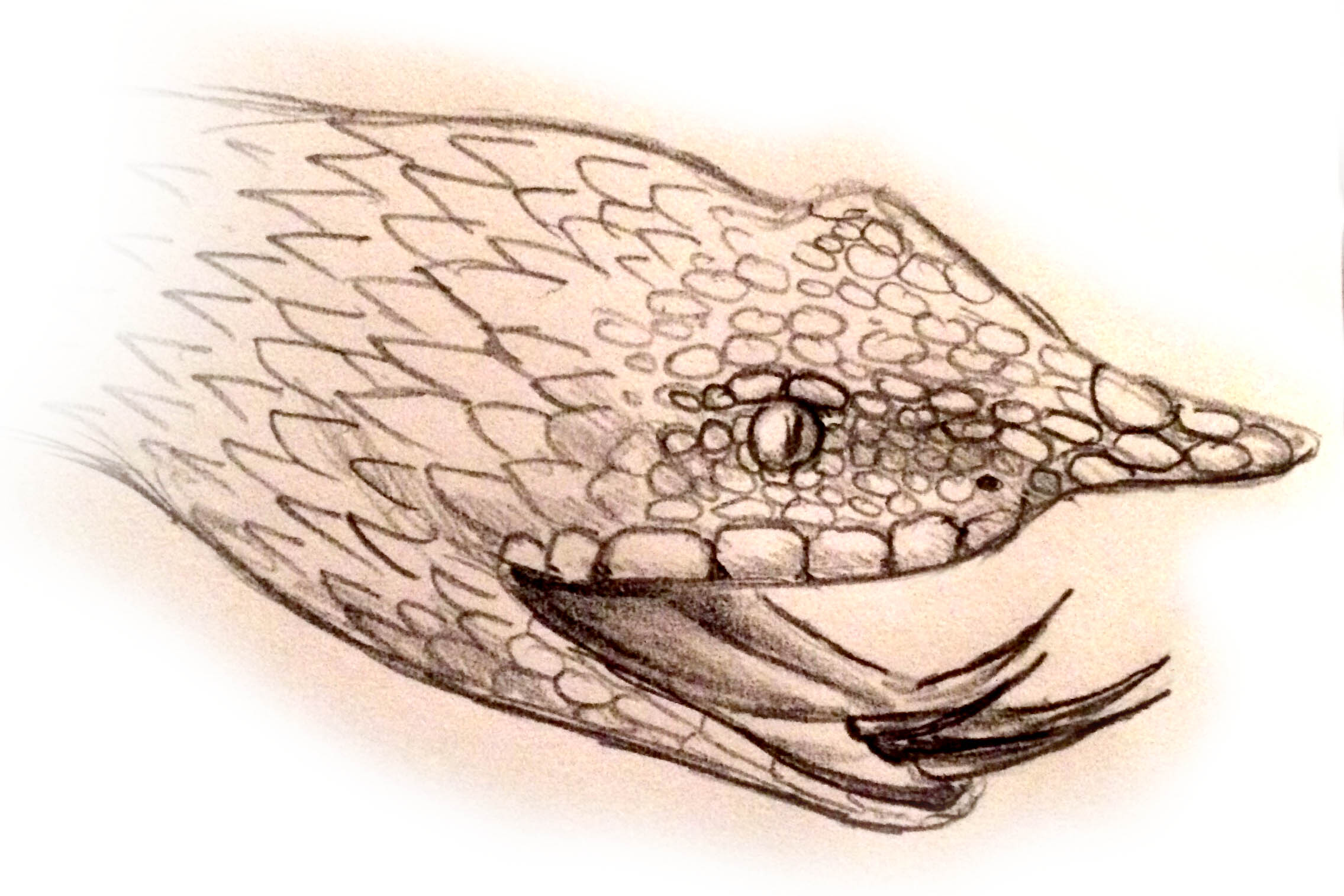
A seps is about two cubits (about a meter) long, and varicolored along its length; some say it can also change color like a chameleon. It uniquely has four hollow fangs in its lower jaw. Topsell attests to its speed, describing its motion as going “by spires and half-hoops”, possibly a reference to sidewinding. Aldrovandi gives the seps a horn on the nose and large triangular scales. Seps can be found in valleys, deserts, and under rocks. They can survive winters thanks to their natural warmth.

Seps bwSeps venom is highly virulent, causing massive necrosis and putrefaction of tissues. Skin, muscle, blood, bone – everything rots and dissolves away, and if the bite is not treated, the victim literally melts into oblivion, leaving nothing behind. Eldred points out that the original Greek seps killed in the same way as the dipsas – by inducing extreme thirst. Lucan alters that to better suit the snake’s name.

For antivenin, Topsell recommends the same measures as with other venomous snakes, as well as sponges soaked in warm vinegar; a concoction of ashes, butter, and honey; or otherwise millet, honey, bay, oxymel, and purslane.

Lucan describes the fate of a Roman soldier after being bitten by a seps. The unfortunate Sabellus’ skin, flesh, and sinews shriveled away from the bite, exposing bare bones before they, too, succumbed to the venom. The putrefying venom worked its way upward from the bite, and the soldier melted like a candle.

While no snake has venom as powerful as that of the seps, the symptoms of seps bite seem to be an exaggeration of actual necrosis caused by snake bite.

References

Aelian, trans. Scholfield, A. F. (1959) On the Characteristics of Animals, vol. II. Harvard University Press, Cambridge, Massachusetts.

Aldrovandi, U. (1640) Serpentum, et Draconum Historiae. Antonij Bernie, Bologna.

Batinski, E. (1992) Cato and the Battle with the Serpents. Syllecta Classica, Vol. 3, pp. 71-80.

Eldred, K. O. (2000) Poetry in Motion: the Snakes of Lucan. Helios 27.1, p. 63.

Isidore of Seville, trans. Barney, S. A.; Lewis, W. J.; Beach, J. A.; and Berghof, O. (2006) The Etymologies of Isidore of Seville. Cambridge University Press, Cambridge.

Lucan, trans. Rowe, N. (1720) Pharsalia. T. Johnson, London.

Topsell, E. (1658) The History of Serpents. E. Cotes, London.

Dipsas

Variations: Dipsa, Dipsades (pl.), Ammobates (“sand crawler”), Arida (“arid”), Kausone (“burner”), Melanurus (“black-tail”), Prester (“inflater”, erroneously), Situla (“bucket”), Torrida (“torrid”)

Dipsas

The Dipsas – “thirsty” or “thirst-causer”, among its many names – was one of the deadly snakes encountered by Cato’s army in the African desert. It was feared for its venom, which induced unquenchable, desperate thirst in its victims. Aelian and Aldrovandi believed it to be the same as the prester, a conclusion which Topsell disputed.

Aelian points out that the dipsas is white with two black stripes on its tail; Topsell mentions its black tail and black-and-yellow spots on its anterior; Aldrovandi pictures it with longitudinal black and white stripes and prominent scales on its head. Dipsades may be found near sources of water, including springs and marshes, and they will also lie in wait in ostrich nests.

The small size of the dipsas makes it easy to overlook, and its bite is painless; its victims often are oblivious to the cause of their unnatural thirst. The venom seeps into the bones, sets fire to the organs, absorbs vital fluids, and parches the tongue and throat. Sometimes victims are driven to drink so much that their stomachs explode; if there is no water around, they eventually succumb to internal burning.

Lucan describes the effect of a dipsas bite on the Roman standard-bearer Aulus, bitten after he accidentally stepped on a dipsas. No amount of water could quench his thirst, and, after trying in vain to drink up a river, he tore his wrists open in a last-ditch effort to drink his own blood. His suicide was practically a mercy.

Aelian mentions a tale told where a donkey, charged by Zeus with bestowing immortality on mankind, stopped by a spring to drink. That spring was guarded by a dipsas, which refused to allow the donkey to drink until it had given it the secret of immortality – and since then, the snake sheds its skin and rejuvenates itself, while humans, much like the unfortunate Gilgamesh, lost their chance at eternal youth. This story was also told by Sophocles and a number of other authors. Dipsades also guard a spring in the Pharsalia, and Cato (correctly) points out that snake venom is harmless in water. In both of these cases, we have the dipsas causing thirst not by its bite, but by denying access to water.

The descriptions of dipsas venom may be close to the actual effects of some snake venoms, notably the burning sensation and the parched throat. Nowadays Dipsas refers to a genus of New World snakes that only pose a threat to snails and slugs.

References

Aelian, trans. Scholfield, A. F. (1959) On the Characteristics of Animals, vol. II. Harvard University Press, Cambridge, Massachusetts.

Aldrovandi, U. (1640) Serpentum, et Draconum Historiae. Antonij Bernie, Bologna.

Batinski, E. (1992) Cato and the Battle with the Serpents. Syllecta Classica, Vol. 3, pp. 71-80.

Eldred, K. O. (2000) Poetry in Motion: the Snakes of Lucan. Helios 27.1, p. 63.

Isidore of Seville, trans. Barney, S. A.; Lewis, W. J.; Beach, J. A.; and Berghof, O. (2006) The Etymologies of Isidore of Seville. Cambridge University Press, Cambridge.

Lucan, trans. Rowe, N. (1720) Pharsalia. T. Johnson, London.

Topsell, E. (1658) The History of Serpents. E. Cotes, London.