Xi

Variations: Xi-Rhinoceros; Xiqu (potentially); Si, Si-Rhinoceros (potentially)

Xi

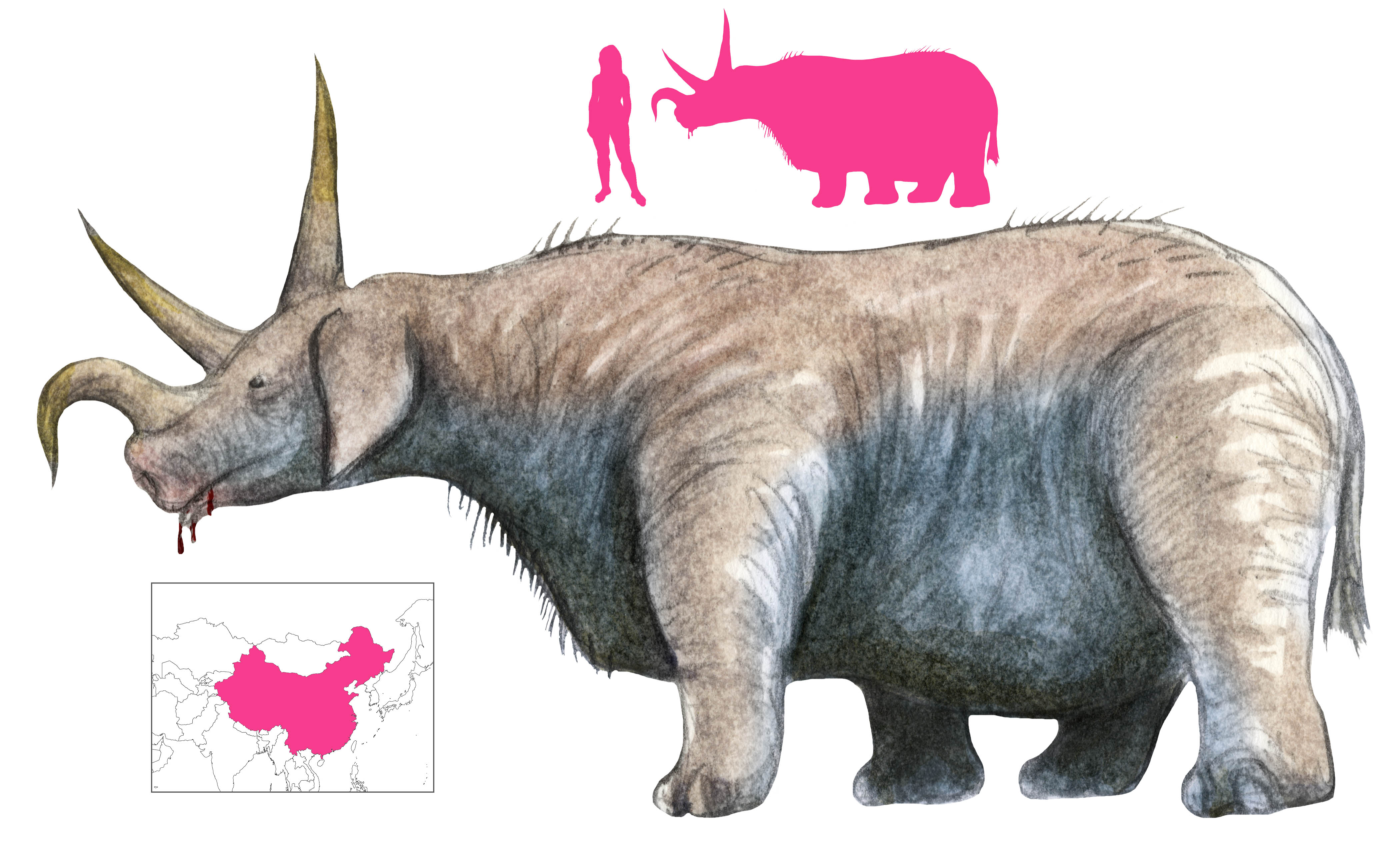
Among the wildlife to be found on Cauldron Mountain, Mount Min and Pray-and-Pass Mountain is the Xi. It is like a black water buffalo with a pig’s head, a large belly, and three-toed elephant’s feet on short legs. It has three horns, found on its nose, forehead, and crown. The nose horn does not fall off and helps it eat. Xi feed primarily on brambles, and therefore often drool blood. It may be the same animal as the Xiqu, which is a man-eating blue-black ox that makes sounds like a baby.

The Si is similar, but blue or green with a single horn weighing 1,333 pounds. Its thick skin could be used as armor.

Guo Pu mocked the Xi for its big nose, and the Si for its tough hide which ironically made it more desirable and vulnerable to human exploitation.

Both Xi and Si have been used interchangeably to refer to a number of large herbivores including oxen, yaks, and buffalo, but they are generally believed to be rhinos.

References

Strassberg, R. E. (2002) A Chinese Bestiary: Strange Creatures from the Guideways Through Mountains and Seas. University of California Press.

Barcädžy Calh

Variations: Wheel of Balsæg/Barsæg/Barsag/Balsag/Marsug/Father Ojnon, Thinking Wheel, Cutting Wheel

Wheel of Balsaeg

When Soslan or Sosryko, greatest of the Nart heroes, was born, his mother had him dipped in magical fire. The process rendered him immortal and invulnerable, but alas, the smith’s tongs had held him by the knees, which became his only weak spot.

After many adventures, Soslan was finally defeated by the jealous Syrdon. Aware of the hero’s weakness, Syrdon incited the devils to fire their arrows from below ground into his horse’s hooves. Like its master, the horse had only one weak spot, in this case the underside of its hooves.

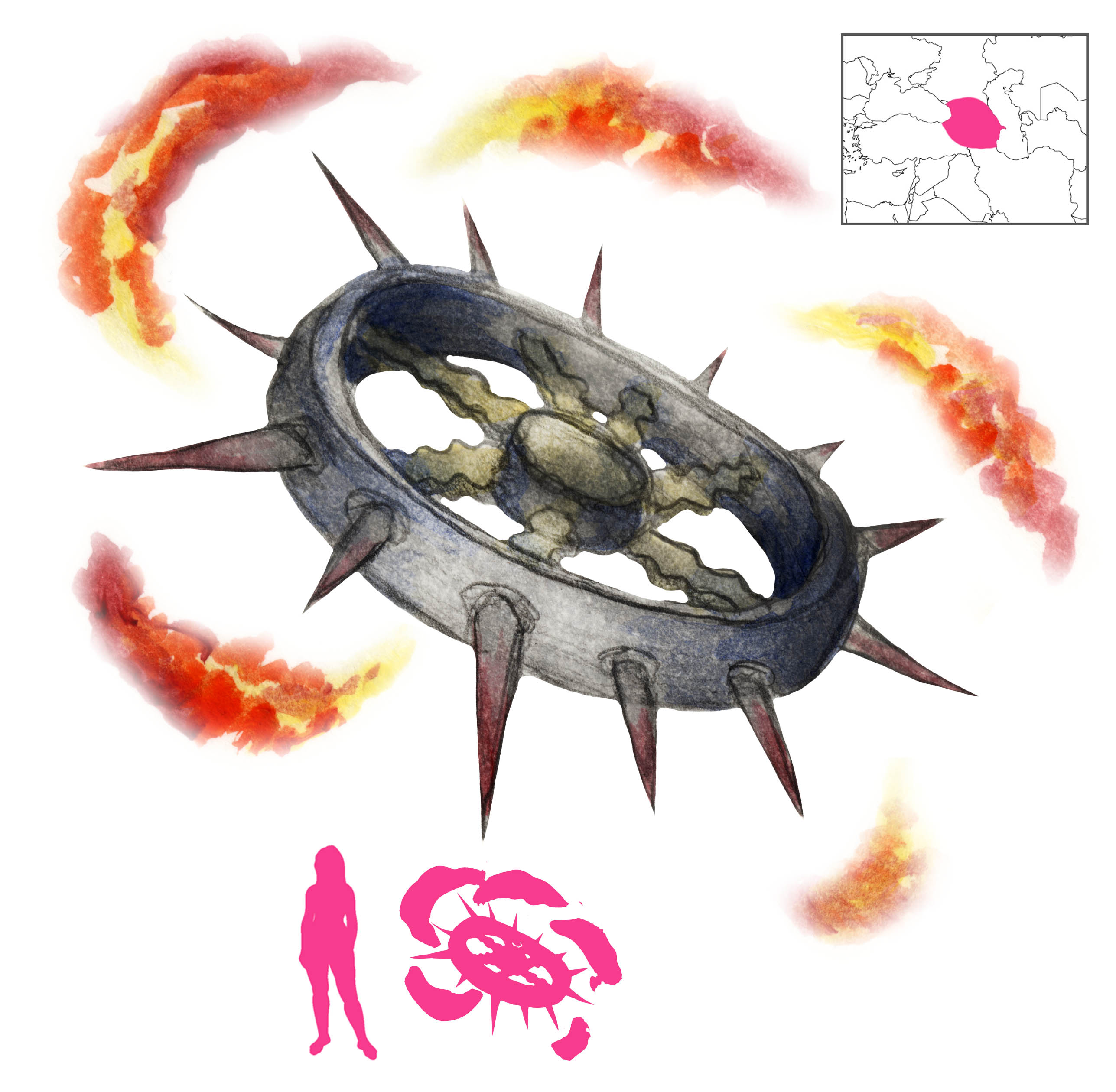
Once the horse fell, Syrdon called upon the enigmatic Barcädžy Calh, the Wheel of Balsæg or Cutting Wheel. The Wheel was a Thinking Machine, an intelligent and malevolent automaton that took the form of a razor-sharp metal wheel with steel teeth and flames bursting from it. It came rolling down from the heavens to the Earth, setting fire to plains and forests as it went on its headlong charge to the Black Sea. Only birch trees managed to avoid the flaming Wheel’s wrath. Soslan gave chase to it and captured it, but it escaped his grasp, flew at him, and sliced through his knees, leaving him for dead. The hero’s sons chased the Wheel back into the Black Sea, but it was already too late. The Narts buried him as he died; his last act from the grave was the impalement of Syrdon. Soslan’s nephew avenged him by breaking the Wheel in half.

Balsæg, also known as Barsæg, Marsug, and permutations thereof, remains unknown. Knowledge of his nature has been lost, save that he is the proprietor of the Wheel. In some accounts, the Daughter of the Sun sends the Wheel to kill Soslan; in others, it belongs to Father Ojnon – John the Baptist. It may have its origin as a solar symbol or accessory in solstice rituals. Finally, in some retellings the Wheel is reduced to a mere training discus, albeit a very sharp one. Soslan is tricked into bouncing it off his weak spot.

References

Cayla, F.; Quesnel, A.; Welply, M.; and Laverdet, M. (1997) Le guide illustré des mythes et légendes. Hachette, Paris.

Colarusso, J. (2002) Nart Sagas from the Caucasus. Princeton University Press.

Dumézil, G. (1978) Romans de Scythie et d’alentour. Bibliothèque Historique, Payot, Paris.

Littleton, C. S. (1979) The Holy Grail, the Cauldron of Annwn, and the Nartyamonga: A Further Note on the Sarmatian Connection. The Journal of American Folklore, vol. 92, no. 365, pp. 326-333.

Qiqirn

Variations: Quiquern

Qiqirn

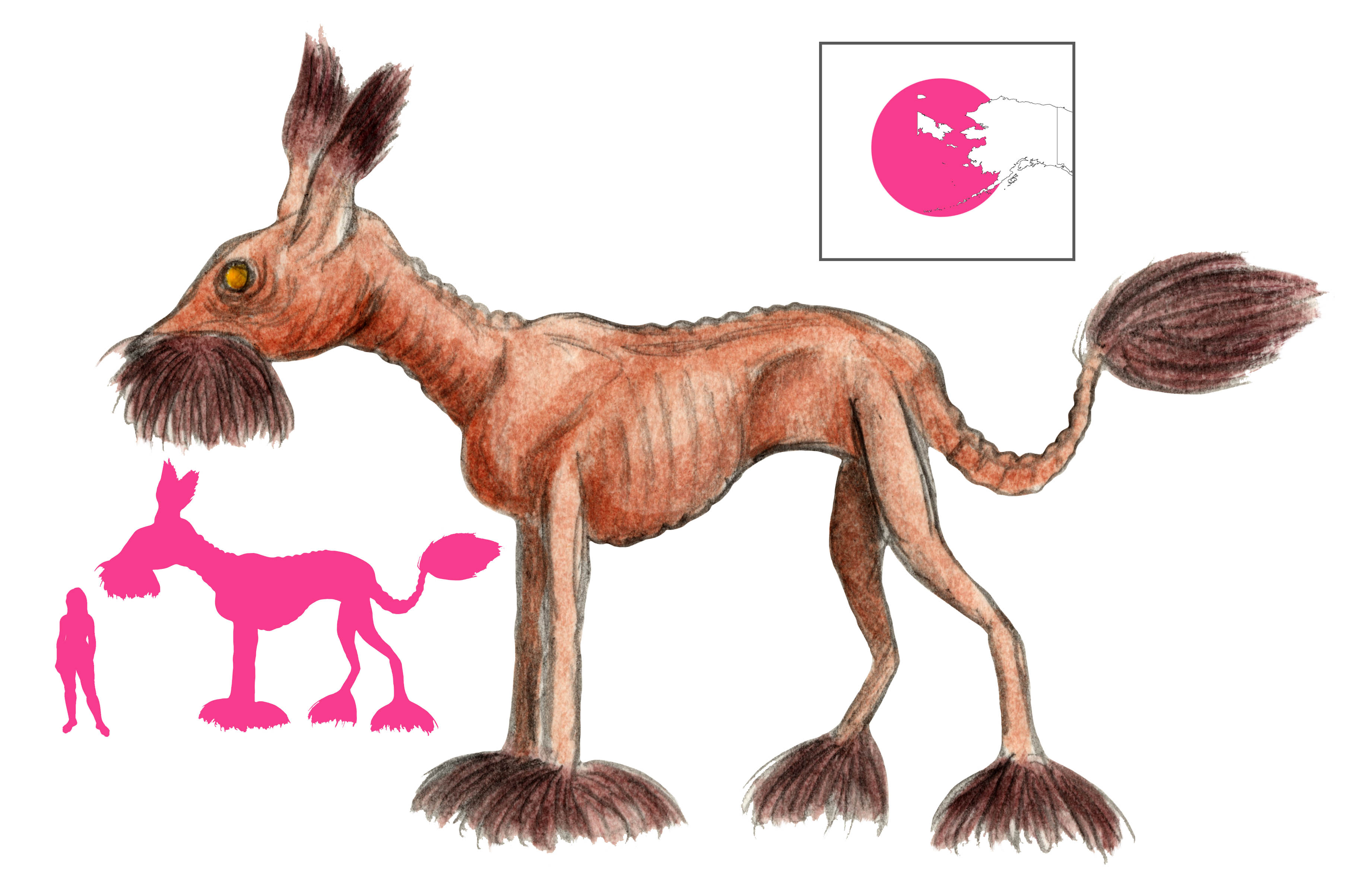
The Qiqirn is a huge dog of Inuit folklore. It is hairless except for its mouth, feet, and ear and tail tips. The mere presence of a qiqirn around men or dogs causes them to suffer fits, a state which ends only when the qiqirn leaves. However, the qiqirn is also extremely scared of humans, and will run away if an angakoq sees it.

Merkur suggests that the “fits” induced by the qiqirn’s presence may be a symbolic reference to shamanic initiation. It shares this feature with the initiatory bear spirit of Baffin Island.

In the Second Jungle Book, the qiqirn – as Quiquern – appears in a snowstorm as an enormous, toothless, and hairless dog, with two heads and eight pairs of legs. He leads two Inuit hunters towards more fruitful lands, and proves to be two sled dogs tied together.

References

Boas, F. The Central Eskimo. In Powell, J. W. (1888) Sixth Annual Report of the Bureau of Ethnology. Government Printing Office, Washington.

Kipling, R. (1921) The Second Jungle Book. Doubleday, Page & Company, Garden City.

Merkur, D. (1991) Powers Which We Do Not Know. University of Idaho Press, Moscow.

Devouring Gourd

Variations: Devouring Pumpkin; Sala Fruit (possibly)

Swallowing Gourd final

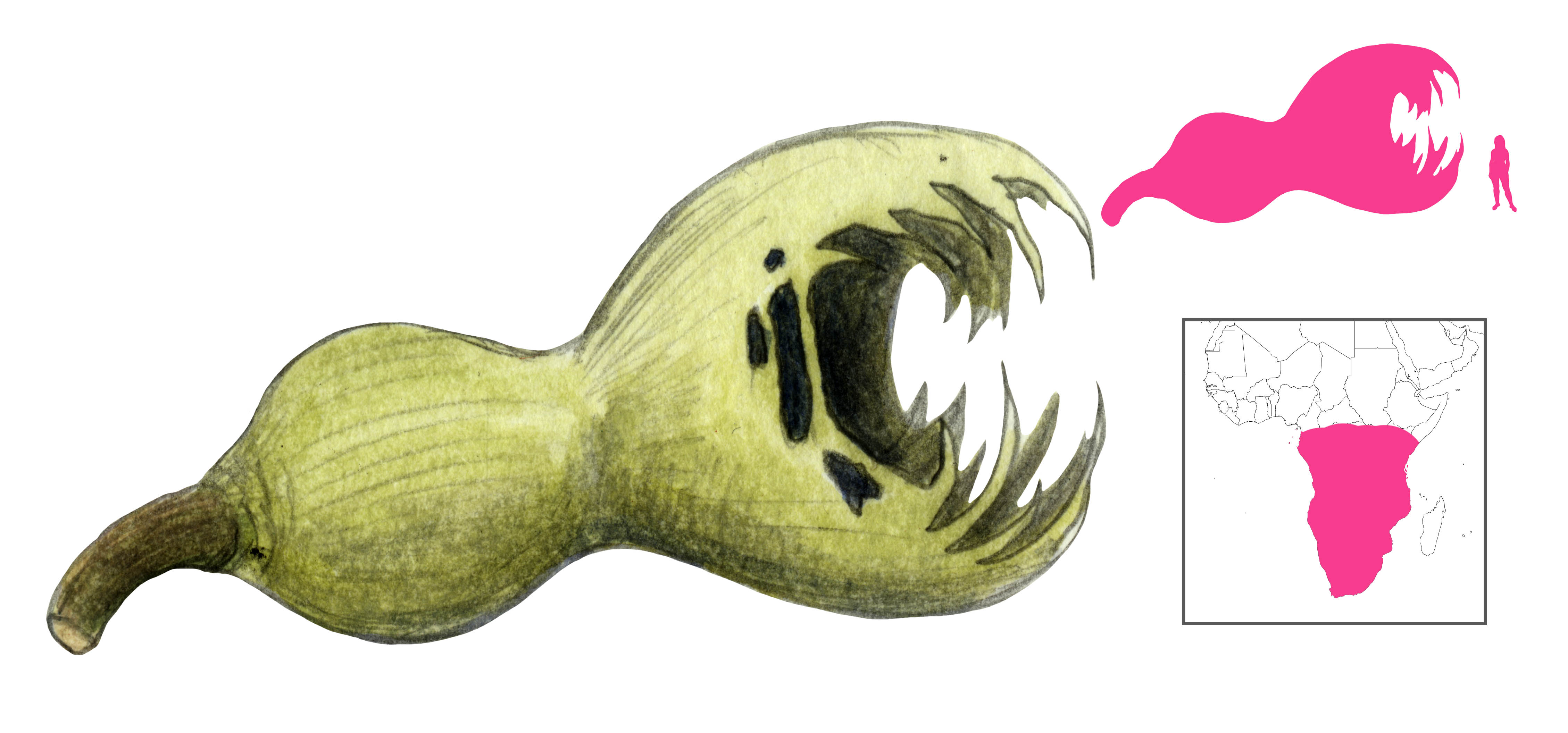
Not all swallowing monsters are animals. In Bantu folklore, gourds and pumpkins have the potential to grow into vast, devouring creatures. Such plants usually grow where evil sorcerers or ogres were slain.

The devouring gourd of Usambara was discovered by a group of little boys at play. “Look at how big that gourd is getting!” said one of the boys. To their surprise, the gourd responded. “If you pluck me, I’ll pluck you!” it said. The boys ran home and told their mother, who refused to believe them. But their sisters insisted on seeing the large gourd, and when they were taken to it, they said as their brothers had, “Look at how big that gourd is getting!” This time the gourd did not respond, and the girls went home to complain about their brothers being liars.

As the gourd was not plucked, it continued to grow. Eventually it became the size of a house, uprooted itself, and went about swallowing everyone in the village. After consuming everyone within reach, it rolled into a lake.

Only one woman had survived the gourd’s rampage, and she was pregnant. When her son was born, they lived together in the ruins of the village. When the son got around to asking where his father was, his mother told him “He was swallowed by a gourd, which is now in the lake”. The son decided to avenge his father, and went out to the lake where he could see the gourd’s ears sticking out of the water, and he proceeded to taunt the vegetable. “Gourd, come out!” he yelled. “Gourd, come out!” Annoyed and enraged, the gourd hauled itself out of the lake, but the boy was ready for it, and fired a volley of arrows into it. The tenth arrow killed it, and it died with a roar that could be heard all the way to Vuga. The boy cut it open with a knife, released the villagers unharmed, and went on to become a great leader of his people.

Gourds are not the only plants that devour and kill people. Another carnivorous plant, a pumpkin, grew over the burial location of an evil shapeshifting porcupine. It repeated everything that was said to it, and when an axe was brought to destroy it, it proceeded to swallow everyone. The poisonous Sala fruits of the Ronga have arms and legs, and wield spears ands shields.

References

Knappert, J. (1977) Bantu myths and other tales. E. J. Brill, Leiden.

Werner, A. (1968) Myths and legends of the Bantu. Frank Cass and Co. Ltd., London.

Bonnacon

Variations: Bonasus, Bonasos, Monassos, Monops; Bison, Maned Bison, European Bison, Aurochs, Urus, Urus Bonasus

Bonnacon

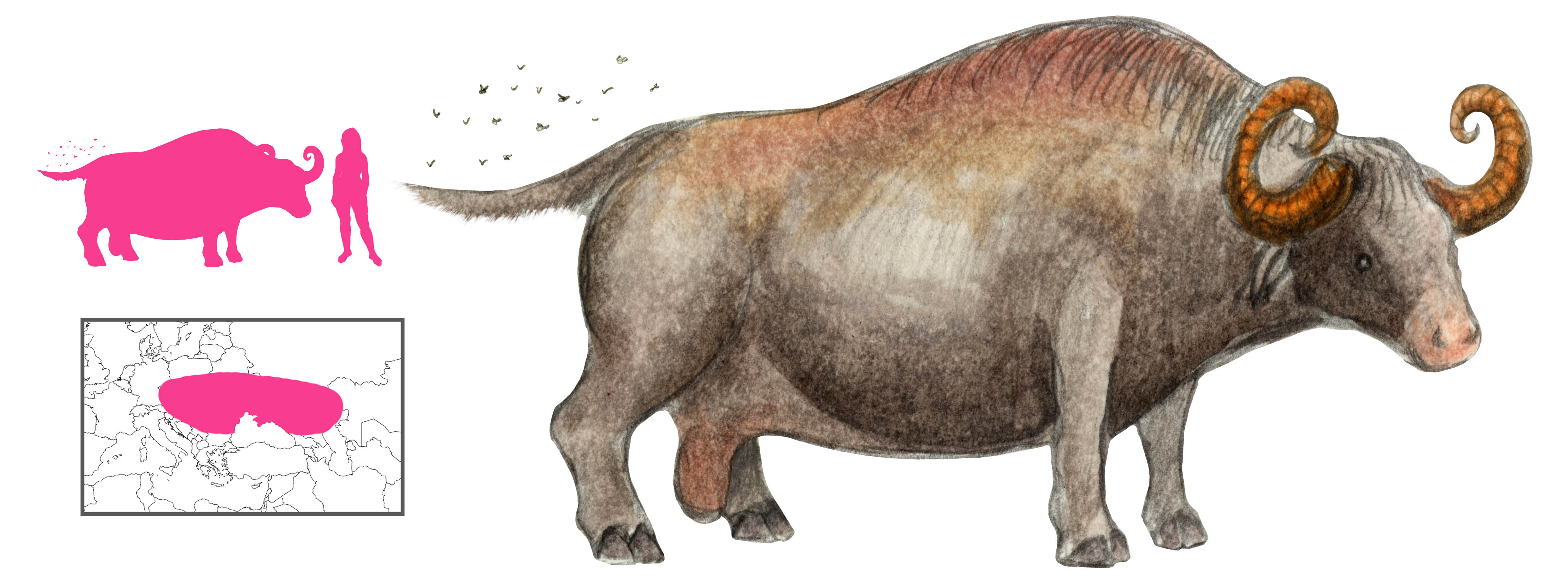
The Bonnacon’s range extends from Scythia in the east to Bulgaria, Macedonia, and Germany in the West. It would be a fine prize for hunters were it not for its remarkable flatulent defenses.

A bonnacon looks like a bull, but is squatter, with reddish fur shading to black, a short tail, and the shaggy mane of a horse. Its horns curl inwardly towards the head, making them of no use in self-defense.

When attacked, the bonnacon voids the contents of its intestines over an area of 3 acres (Aristotle gives a more conservative estimate of 4 fathoms). The noxious, acrid dung ignites and burns anything it touches, leaving a trail of flame in its wake.

The European bison (Bison bonasus) is generally believed to be the basis of the bonnacon.

References

Aelian, trans. Scholfield, A. F. (1959) On the Characteristics of Animals, vol. II. Harvard University Press, Cambridge, Massachusetts.

Cuba, J. (1539) Le iardin de santé. Philippe le Noir, Paris.

Pliny; Holland, P. trans. (1847) Pliny’s Natural History. George Barclay, Castle Street, Leicester Square.

Sainéan, L. (1921) L’histoire naturelle et les branches connexes dans l’oeuvre de Rabelais. E. Champion, Paris.

Unknown. (1538) Ortus Sanitatis. Joannes de Cereto de Tridino.

White, T. H. (1984) The Book of Beasts. Dover Publications, New York.

Az’-i-wû-gûm Ki-mukh’-ti

Variations: Walrus Dog

Aziwugum

Az’-i-wû-gûm Ki-mukh’-ti, the “Walrus Dog”, can be found roaming the rugged coastlines of Alaska. While not walrus-like, it lives with herds of walrus and acts as a protector of sorts. It is one of Raven’s many creations.

An az’-i-wû-gûm ki-mukh’-ti is rather like a large dog in general appearance, smaller than a walrus, elongate and slender, with a long, powerful rounded tail. Its body is covered with tough black scales which make it impervious to all but the best spears.

Walrus hunters in the Bering strait fear the az’-i-wû-gûm ki-mukh’-ti. Its muscular tail can easily kill a man, and at least one case is known of a walrus dog attacking an umiak and killing all aboard.

References

Nelson, E. W. (1900) The Eskimo about Bering Strait. Extract from the Eighteenth Annual Report of the Bureau of American Ethnology, Government Printing Office, Washington.

Mourioche

Variations: Guenne; Fausserole (possibly)

Mourioche

Nobody knows for sure where Mourioche came from. Some say that he (for lack of a better pronoun) was once a Breton man or a woman, versed in the dark arts, who sold their soul for a magical ointment. Other accounts make him a simple werewolf without control of his actions. Dubois whimsically claims he was once the court jester of an undersea kingdom, and was banished for bad behavior. There are even claims that he is the Devil himself.

It is more likely that Mourioche has always haunted Brittany, spreading his brand of cruel humor along the coastlines of Côtes-d’Armor and around Jugon-les-Lacs. He is a water-horse, and a shapeshifter; there is no end to the forms he has assumed, and he loves using his powers in creative ways. Mourioche is usually seen in the form of a yearling colt, pig, cow, or sheep, often with a pair of muscular arms.

Mourioche comes out at night, and preys on nocturnal travelers. Sometimes he is a horse standing by the side of the road, waiting for riders. His spine stretches as more and more people get on, then he gallops right into the lake, his laugh echoing in the darkness. At other times he wrestles passers-by, grappling with his brawny arms and throwing his victims into muddy ditches. He will jump onto men’s back and force them to carry him until they drop of exhaustion. He will follow people along the road, changing shape every time they turn to look at him, and making a sound like tearing canvas.

Drawn-out sadistic pranks are Mourioche’s favorite form of entertainment. A farmer of Saint-Cast once found Mourioche in the form of an abandoned ewe, and took him home to his barn. The next day, when he went to check on his new sheep, he found a cow; the day after, it had become a horse. On the fourth night, it was a sheep again, who laughed and said “Why do you check on me every morning? You’re weird!” It was then that the farmer saw that all his animals had been slaughtered. He reached for his shotgun, but Mourioche took off, destroying half the barn and abducting the farmer’s three children (who were never seen again). Mourioche is not without mercy, though, and he left behind a golden necklace.

Mourioche is not without his faults, however, and is baffled by anyone who doesn’t fear him. One man nonchalantly carried Mourioche all the way back home, and the shapeshifter fled when he called his wife. Another time Mourioche took a tailor on his back, who threatened to cut his ears off with his scissors. The tailor was returned to dry land very quickly.

In Matignon, parents would get their children to bed with a “hattaï, mon p’tit gars; Mourioche te prenrait!” (“hurry, my l’il lad, Mourioche will take you!). It is also said that of a frightened person that “il a eu peur comme s’il avait vu Mourioche” (“he’s scared as though he saw Mourioche”). To ward off Mourioche, one must curse him with “Mourioche, le diable t’écorche” (“Mourioche, the Devil flay you”).

The Fausserole of Saint-Cast is very similar, and may be another form of Mourioche. She likes to appear as a white beast, a dog or a calf, and has no qualms about tossing clergy around, as the rector of Saint-Cast found out.

References

Dubois, P.; Sabatier, C.; and Sabatier, R. (1992) La Grande Encyclopédie des Lutins. Hoëbeke, Paris.

Morvan, F. (1998) Vie et mœurs des lutins bretons. Actes Sud.

Sébillot, P. (1882) Traditions et superstitions de la Haute-Bretagne. Maisonneuve et Cie, Paris.

Sébillot, P. (1905) Le Folk-Lore de France, Tome Deuxième: La Mer et les Eaux Douces. Librairie Orientale et Américaine, Paris.

Sébillot, P. (1968) Le folklore de la Bretagne. Éditions G. P. Maisonneuve et Larose, Paris.

Nunda

Variations: Nundá, Eater of People

Nunda

The cat of Sultan Majnún was unusually fierce. One day it killed a calf, but the Sultan dismissed the event, stating that “the cat is mine, and the calf is also mine”. Then the cat proceeded to kill and eat a goat, then a cow, a donkey, a horse, and a camel, with the good Sultan shrugging each time. “I will not kill it, let it even eat a man”. Sure enough, the cat killed a human child next, and followed up with a man.

By this time the creature had grown large and monstrous on its diet of flesh, and it left the town on its own. It hid in the undergrowth outside city, and feasted on anyone who passed by, human or animal. At night, it would sneak into the dark roads and abduct hapless wanderers. Sultan Majnún still refused to see the danger. “You all want me to kill this cat. It’s my cat and everything it eats is mine”. He refused to address any more complaints, and the population of the town slowly dwindled. Anyone and anything not locked up indoors was at risk.

Eventually, it would come to pass that Sultan Majnún went out to look at the countryside with six of his sons, whereupon the cat pounced on them and killed three of the sons. It was then that Sultan Majnún finally came to his senses. “That is no longer my cat”, he said firmly. “That is a Nunda, and it will eat even me if I give it the chance”. He sent his soldiers to kill the nunda, but it killed some of them and scattered the rest.

Sultan Majnún’s seventh son, having heard of the carnage, swore a solemn oath that he would slay the nunda. “I shall find the nunda who killed my brothers”, he told his mother as he set out alone with a spear and a knife.

The young prince was nothing if not zealous. The first vaguely intimidating creature he ran into was a large dog, which he promptly killed and dragged home. “Mamá, wee, niulága nundá mla wátu“, he sang triumphantly. “O mother, I have killed the nunda, eater of people”. But his mother shook her head sadly and said “My son, this is not he, the nunda, eater of people. The nunda is much larger”.

So the son set out again, and successively killed a civet, a larger civet, a zebra, a giraffe, a rhinoceros, and an elephant, bringing each one back in turn only to be corrected by his mother. In time, he gathered a small group of followers, and managed to piece together a description of the nunda: it was elephant-sized or larger, had small ears, was broad and not long, had two blotches like a civet, and had a thick tail.

Finally, the youth’s efforts paid off, and the nunda was found asleep in the shade of a grove of trees. That was clearly the nunda, as it fit his mother’s description of it perfectly, and did not resemble anything else he had killed so far. He and his slaves fired their guns into the nunda at close range, but did not hang around for fear that it was still alive. Instead they slept through the night, and checked on it in the morning. The huge cat was undeniably dead.

The beast was dragged back to the city in triumph, and the prince sang of his victory, to which his mother chanted back “Mwanangu, ndiyeye nundá mla watu. My son, this is he, the nunda, eater of people”. The nunda’s carcass was buried, a house was built on top of it, and a guard was placed at the house.

This is but one tale of the insatiable nunda. It is another “swallowing monster”, and sometimes it swallows up the entire populace except for one hero. The hero kills the nunda and cuts it open, releasing the victims unharmed.

References

Steere, E. (1870) Swahili Tales. Bell & Daldy, London.

Bo

Variations: Poh

Bo

According to the Guideways through Mountains and Seas, the animal known as Bo can be found around Mount Winding-Center (identified as Mount Xue), where Huai-trees grow and where jade, realgar, and metals are plentiful. It can also be found on the plains of Mongolia and on islands in the Northern Sea. The existence of bo in the district of Shen Su was unknown to its residents, until a man called Leu Chang informed them by quoting the Shan Hai Jing for good measure.

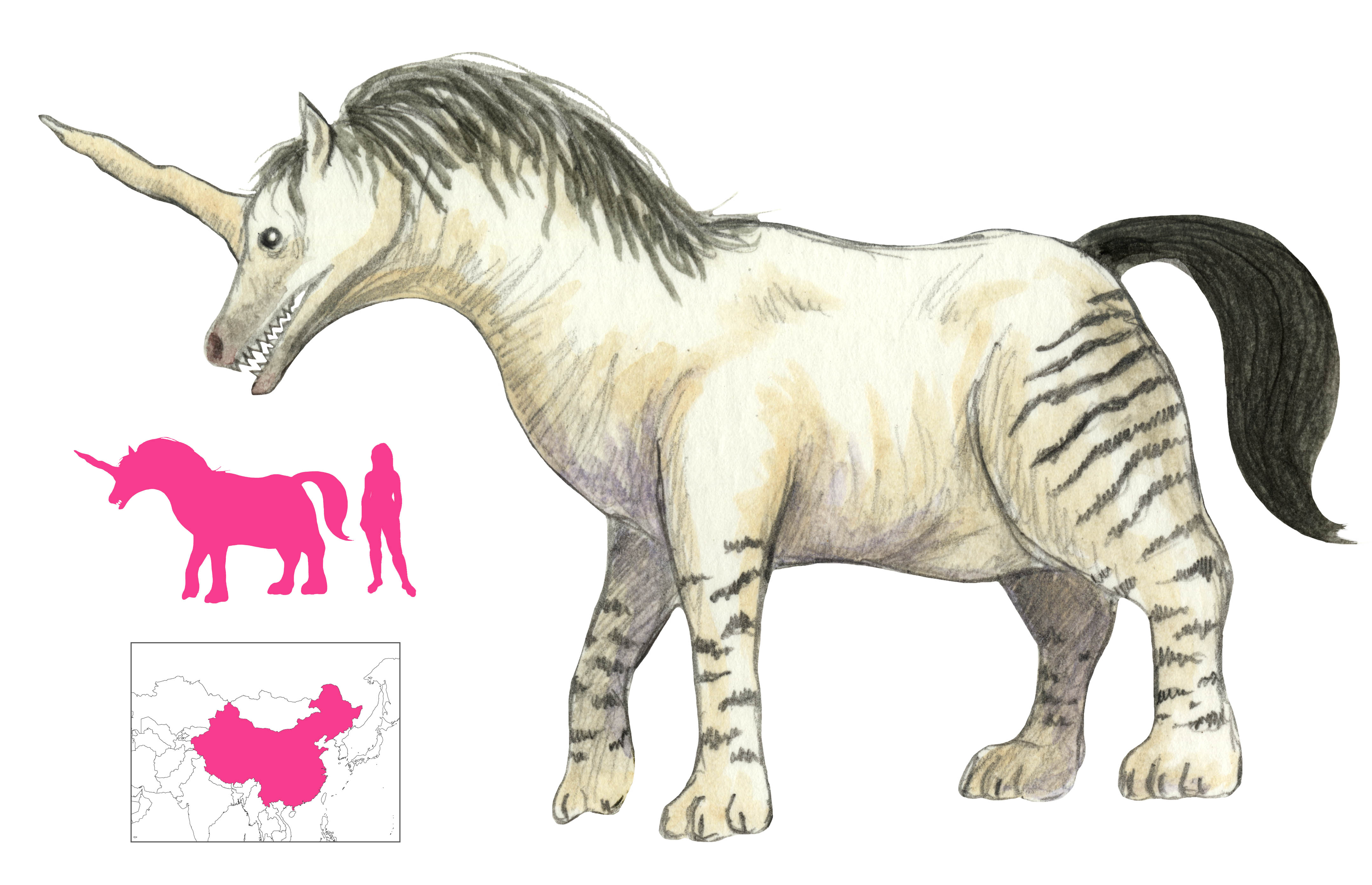
A bo looks like a horse with a white body and a black tail, with a single horn on its head. It has tiger’s feet and saw-like tiger’s teeth, and makes a sound like a rolling drum. Bo are strict carnivores that feed upon tigers and leopards, although other sources state that leopards eat bo, and bo in turn eat tigers. A bo will protect against weapons if its flesh is eaten, or if tamed and used as a soldier.

Bo are just and honorable animals, and will reward virtuous behavior accordingly. When the wise magistrate Chung Wa of the Kingdom of Peh Chi faced an invasion by a large number of carnivorous wild animals, six bo appeared and slaughtered the beasts in thanks for the magistrate’s goodness. Duke Huan of Qi’s horse looked like a bo, according to his prime minister Guan Zhong, but presumably did not eat tigers.

References

Gould, C. (1886) Mythical Monsters. W. H. Allen and Co., London.

Mathieu, R. (1983) Étude sur la mythologie et l’ethnologie de la Chine ancienne. Collège de France, Paris.

Strassberg, R. E. (2002) A Chinese Bestiary: Strange Creatures from the Guideways Through Mountains and Seas. University of California Press.

Shādawār

Variations: Shadhahvar, Shadhahwar, Shādhahvār, Shad-hawar, Shād-hawār, Shad-havar, Shadhawar, Shadahvar, Shadahwar, Shadawar, Sadahvar, Sadahwar, Sadhavvar, Sadhazar, Sadhazag, Sadhuzag, Aras, ‘rs, ‘rsh
Shad-hawar

The earliest references to the musical-horned unicorn are given by Jabir Ibn Hayyan, around 900 A.D., where it is referred to as the Aras. It was given its most popular incarnation as the Shādawār by Al-Qazwini, which was subsequently copied with modifications by Al-Damiri and Al-Mustawfi. It was found in the farthest reaches of Bilad al-Rum, the Byzantine Empire, a vague location which to Al-Qazwini must have sounded remote.

Exactly how the shādawār’s name should be written and pronounced is unclear. Its writing has varied from author to author and manuscript to manuscript, sometimes starting with a Sā instead of a Shā, with the middle consonant being either a d or a dh (pronounced “the”), and ending in wār (Arabic) or vār (Persian). The spelling chosen here is ultimately arbitrary and based on Ettinghausen and Jayakar’s recommendations, and the most prevalent transliterations. The name is of unknown origin, but Hayyan’s aras is probably derived from “oryx”.

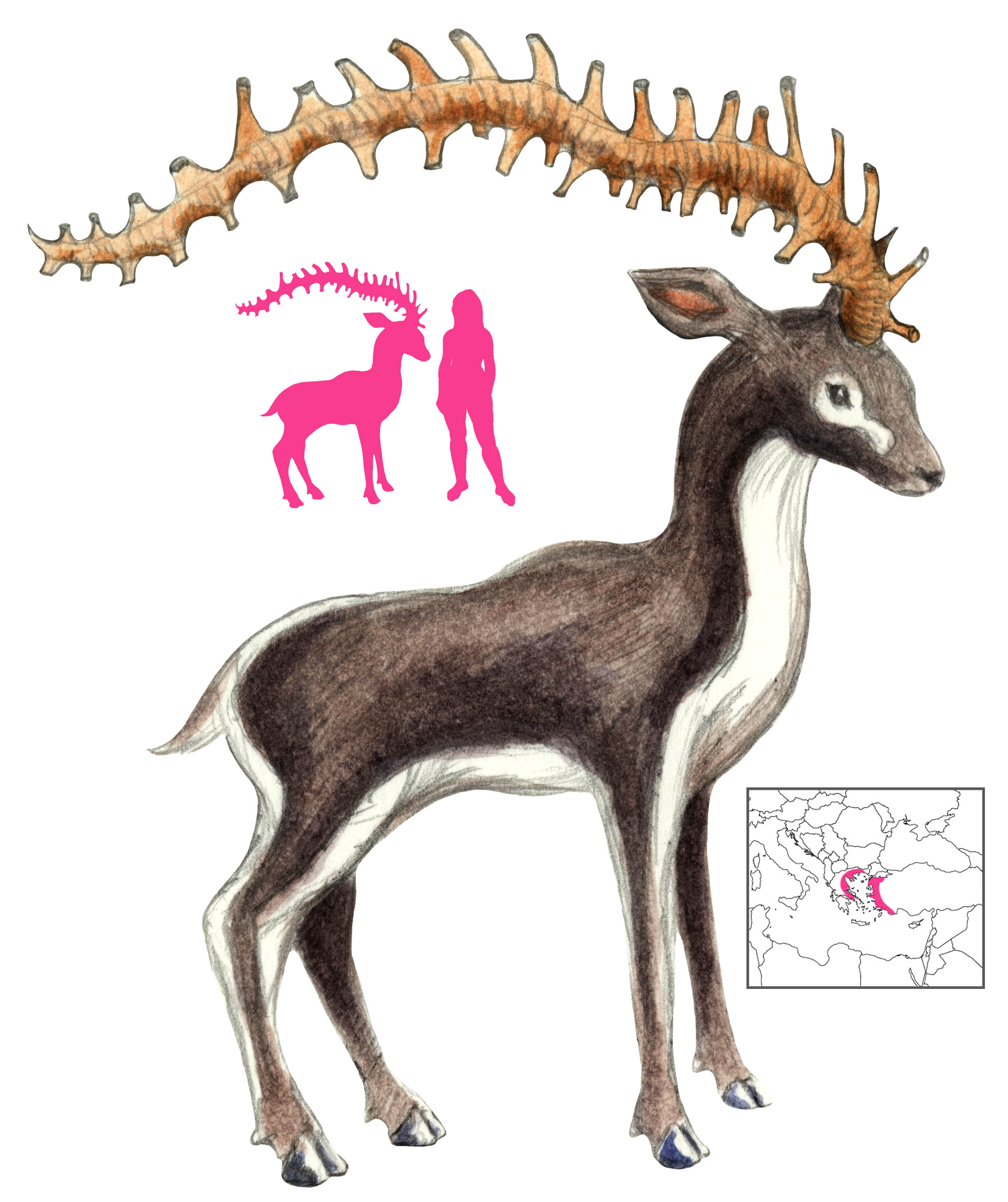
Unlike the more rhinocerine karkadann, the shādawār is an antelope-like ungulate with a single horn, but in this case it is long and hollow. There are forty-two hollow branches in the horn, and wind whistling through these flute-like holes results in beautiful, stirring melodies, so lovely that other animals will gather around to listen. Shādawār horns were offered to kings, who would hang them up as musical intruments. Depending on the angle they were held at, they would produce an enthralling tune or a sad dirge that moved all listeners to tears.

The shādawār has been incorrectly described as a flesh-eater, using its music to attract potential prey. In fact, Al-Qazwini makes no mention of any carnivorous tendencies. Al-Mustawfi, however, combines Al-Qazwini’s account of the shādawār with that of the carnivorous Sirānis immediately preceding it. It is the sirānis that lures prey to it with its music, and not the herbivorous shādawār.

Al-Damiri and Bochart give it seventy-two branches on its horn. Flaubert goes further and describes his “sadhuzag” as a black deer with the head of a bull, and a thicket of white horns on its head. It speaks to Anthony, describing its unique powers. “My seventy-four antlers are hollow as flutes. When I turn towards the South wind, sounds come out that attract enraptured beasts. Snakes coil around my legs, wasps cling to my nostrils, and parrots, doves, and ibises roost in my branches. – Listen! … But when I turn to the North wind, my antlers, thicker than a battalion of lances, exhale a howl; forests shudder, rivers retreat, fruit bulbs burst, and grasses stand on end like the hair of a coward. – Listen!”

References

Bochart, S. (1675) Hierozoicon. Johannis Davidis Zunneri, Frankfurt.

el-Cheikh, N. M. Byzantium through the Islamic Prism from the Twelfth to the Thirteenth Century. In Laiou, A. E. and Mottahedeh, R. P. (2001) The Crusades from the Perspective of Byzantium and the Muslim World. Dumbarton Oaks Research Library and Collection, Washington, D. C.

Contadini, A. Musical Beasts: The Swan-Phoenix in the Ibn Bakhtishu’ Bestiaries. In O, Kane, B. (2005) The Iconography of Islamic Art. Edinburgh University Press.

Contadini, A. (2012) A World of Beasts: A Thirteenth-Century Illustrated Arabic Book on Animals (the Kitab Na’t al-Hayawan) in the Ibn Bakhtishu’ Tradition. Brill, Leiden.

al-Damiri, K. (1891) Hayat al-hayawan al-kubra. Al-Matba’ah al-Khayriyah, Cairo.

Ettinghausen, R. (1950) The Unicorn. Studies in Muslim Iconography, Freer Gallery of Art Occasional Papers Vol. 1, No. 3, Washington.

Flaubert, G. (1885) La Tentation de Saint Antoine. Quantin, Paris.

Jayakar, A. S. G. (1908) ad-Damiri’s Hayat al-Hayawan (A Zoological Lexicon). Luzac and Co., London.

Kraus, P. (1986) Jabir Ibn Hayyan : Contribution à l’historie des idées scientifiques dans l’Islam. Société d’Édition Les Belles Lettres, Paris.

al-Qazwini, Z. (1849) Zakariya ben Muhammed ben Mahmud el-Cazwini’s Kosmographie. Erster Theil: Die Wunder der Schöpfung. Ed. F. Wüstenfeld. Dieterichsche Buchhandlung, Göttingen.