Az’-i-wû-gûm Ki-mukh’-ti

Variations: Walrus Dog

Aziwugum

Az’-i-wû-gûm Ki-mukh’-ti, the “Walrus Dog”, can be found roaming the rugged coastlines of Alaska. While not walrus-like, it lives with herds of walrus and acts as a protector of sorts. It is one of Raven’s many creations.

An az’-i-wû-gûm ki-mukh’-ti is rather like a large dog in general appearance, smaller than a walrus, elongate and slender, with a long, powerful rounded tail. Its body is covered with tough black scales which make it impervious to all but the best spears.

Walrus hunters in the Bering strait fear the az’-i-wû-gûm ki-mukh’-ti. Its muscular tail can easily kill a man, and at least one case is known of a walrus dog attacking an umiak and killing all aboard.

References

Nelson, E. W. (1900) The Eskimo about Bering Strait. Extract from the Eighteenth Annual Report of the Bureau of American Ethnology, Government Printing Office, Washington.

Tabib al-Bahr

Variations: Doctor of the Sea, Sea Doctor

Tabib-al-bahr

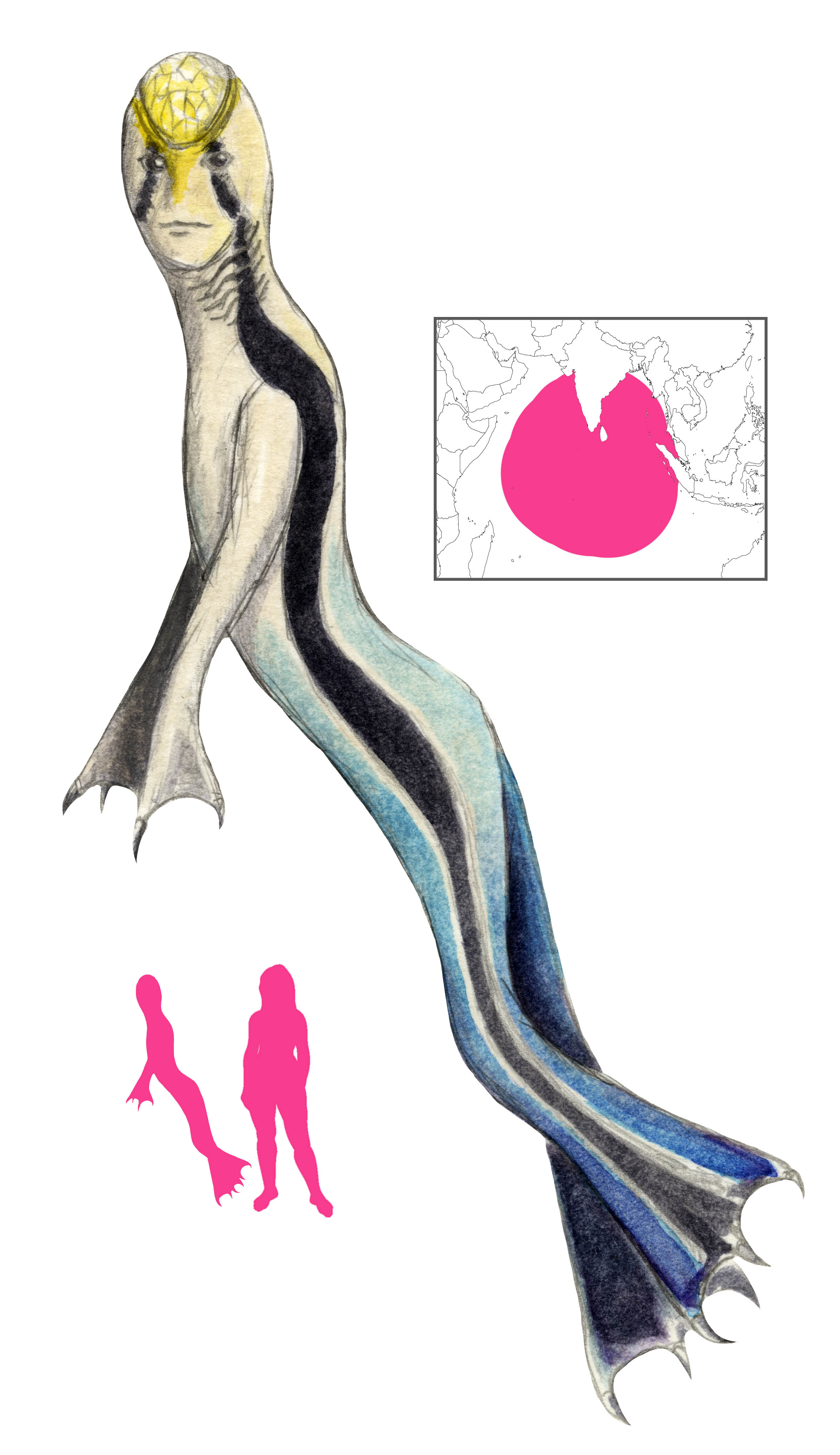
The mysterious Tabib al-Bahr, the “Doctor of the Sea”, is found in the writings of the alchemist Jabir ibn Hayyan. Its appearance is not very clear; we know that it is a fish with a yellow gemstone in its forehead, and that it is also human in shape. This marine animal, despite its considerable magical powers, is very caring and altruistic. It derives its name from the gemstone in its head, which can heal any ailment; it attends to other sea creatures by rubbing its head twice or thrice on their injuries, healing them instantly. Perhaps because of this self-sacrificing nature, the tabibs also do not resist capture by humans, instead waiting patiently for the right time to escape.

The gemstone of a tabib al-bahr is of great value to alchemy. If the creature is slaughtered and its stone taken out of its head, it can be used to create gold out of silver. It was that gemstone that drew Jabir ibn Hayyan into seeking out the tabib al-bahr.

After enlisting the aid of a number of skilled sailors, Jabir set sail into the Indian Ocean. He eventually found a group of tabib al-bahrs near the unknown island of Sindiyyāt. The net was cast, and one of the creatures was caught. It started striking its cheeks in a feminine act of desperation, and Jabir realized that the tabib they had caught was a young woman of great beauty. She was taken on board and imprisoned in a small cabin; she seemed incapable of speech beyond mumbling in an unknown language. Jabir was given the chance to test her powers by bringing in a sailor with torticollis. After the tabib rubbed her gemstone on his arms and legs, he was immediately cured.

This situation was not to last long. One of the sailors, a young man, fell in love with the strange creature, and Jabir allowed them to live together in the cabin. Eventually she became pregnant and gave birth to a boy, human in all aspects except for a marvelous, shining forehead. As the boy grew, the mother was eventually given free reign of the boat, as she seemed attached to the crew, keeping them company, tending to their injuries, and caring for her son. Unfortunately that was not the case, and after a long inspection of all possible escape routes, she finally climbed over the railing and dove into the water. Her husband was brokenhearted, but he swore to care for the son she left behind.

Eventually the ship sailed into a storm from which there seemed to be no escape. Throwing anchors into the water did nothing to hold the ship, and it was on the verge of capsizing. That was when they saw their tabib al-bahr sitting calmly on the surface and waving to them. All the sailors begged her to save them, and in response she transformed into a colossal fish, big enough to stretch from one end of the sea to the other. By swallowing huge quantities of seawater, she lowered the sea level enough for the storm to be quelled. While the sailors worried over whether or not she’d swallow them next, her son dove into the sea after her. The next day he returned to the ship, and his forehead now had a yellow gemstone in it.

Later on Jabir had the opportunity to catch two more tabib al-bahrs, one of which was sacrificed for its gemstone. Jabir marveled at it, a wondrous artifact the likes of which humans would never make.

This tale may not be meant literally, and it has generally been taken as some kind of alchemical allegory. His scribes agreed, noting that it is “very symbolic”, with elements representative of fire and water.

The alchemist-poet Ibn Arfa’ra’sahu dedicated several verses to the tabib al-bahr, saying that “the truest of scientists have vouched for it, Plato and his student Aristotle”.

References

Mahmud, Z. N. (1961) Jabir ibn Hayyan. Maktabat Misr.

Kraus, P. (1986) Jabir Ibn Hayyan : Contribution à l’historie des idées scientifiques dans l’Islam. Société d’Édition Les Belles Lettres, Paris.

Mourioche

Variations: Guenne; Fausserole (possibly)

Mourioche

Nobody knows for sure where Mourioche came from. Some say that he (for lack of a better pronoun) was once a Breton man or a woman, versed in the dark arts, who sold their soul for a magical ointment. Other accounts make him a simple werewolf without control of his actions. Dubois whimsically claims he was once the court jester of an undersea kingdom, and was banished for bad behavior. There are even claims that he is the Devil himself.

It is more likely that Mourioche has always haunted Brittany, spreading his brand of cruel humor along the coastlines of Côtes-d’Armor and around Jugon-les-Lacs. He is a water-horse, and a shapeshifter; there is no end to the forms he has assumed, and he loves using his powers in creative ways. Mourioche is usually seen in the form of a yearling colt, pig, cow, or sheep, often with a pair of muscular arms.

Mourioche comes out at night, and preys on nocturnal travelers. Sometimes he is a horse standing by the side of the road, waiting for riders. His spine stretches as more and more people get on, then he gallops right into the lake, his laugh echoing in the darkness. At other times he wrestles passers-by, grappling with his brawny arms and throwing his victims into muddy ditches. He will jump onto men’s back and force them to carry him until they drop of exhaustion. He will follow people along the road, changing shape every time they turn to look at him, and making a sound like tearing canvas.

Drawn-out sadistic pranks are Mourioche’s favorite form of entertainment. A farmer of Saint-Cast once found Mourioche in the form of an abandoned ewe, and took him home to his barn. The next day, when he went to check on his new sheep, he found a cow; the day after, it had become a horse. On the fourth night, it was a sheep again, who laughed and said “Why do you check on me every morning? You’re weird!” It was then that the farmer saw that all his animals had been slaughtered. He reached for his shotgun, but Mourioche took off, destroying half the barn and abducting the farmer’s three children (who were never seen again). Mourioche is not without mercy, though, and he left behind a golden necklace.

Mourioche is not without his faults, however, and is baffled by anyone who doesn’t fear him. One man nonchalantly carried Mourioche all the way back home, and the shapeshifter fled when he called his wife. Another time Mourioche took a tailor on his back, who threatened to cut his ears off with his scissors. The tailor was returned to dry land very quickly.

In Matignon, parents would get their children to bed with a “hattaï, mon p’tit gars; Mourioche te prenrait!” (“hurry, my l’il lad, Mourioche will take you!). It is also said that of a frightened person that “il a eu peur comme s’il avait vu Mourioche” (“he’s scared as though he saw Mourioche”). To ward off Mourioche, one must curse him with “Mourioche, le diable t’écorche” (“Mourioche, the Devil flay you”).

The Fausserole of Saint-Cast is very similar, and may be another form of Mourioche. She likes to appear as a white beast, a dog or a calf, and has no qualms about tossing clergy around, as the rector of Saint-Cast found out.

References

Dubois, P.; Sabatier, C.; and Sabatier, R. (1992) La Grande Encyclopédie des Lutins. Hoëbeke, Paris.

Morvan, F. (1998) Vie et mœurs des lutins bretons. Actes Sud.

Sébillot, P. (1882) Traditions et superstitions de la Haute-Bretagne. Maisonneuve et Cie, Paris.

Sébillot, P. (1905) Le Folk-Lore de France, Tome Deuxième: La Mer et les Eaux Douces. Librairie Orientale et Américaine, Paris.

Sébillot, P. (1968) Le folklore de la Bretagne. Éditions G. P. Maisonneuve et Larose, Paris.

Zitiron

Variations: Zityron, Zytyron; Albiron; Barchora; Miles; Soldier, Soldier of the Sea, Man-at-arms of the Sea; Soldat de Mer, Gendarme de Mer; Sea Turtle

Zitiron

The Zitiron (perhaps a corruption of Ketos or whale), or Soldier of the Sea, is a heavily armored marine fish. It has a rough and hard skin over its head like a helmet, and a long and wide shield hanging from its neck, attached by thick veins and nerves stretching from neck to shoulders. Its thick arms are two-fingered. It is long and wide, more or less triangular in shape, with a fish’s tail at its end. A zitiron is impervious to arrows, and can only be killed by bludgeoning it with hammers; it defends itself with its armor and with swipes of its strong arms.

Illustrators took the description of armor rather literally, turning the zitiron into a sort of merman encumbered with full plate armor, helmet, shield, and sword.

It is not hard to see a turtle in the zitiron’s description. Turtle shells have also been used as shields by various cultures, making the resemblance even more appropriate. Albertus Magnus asserted that Flemish and German fisherman give the name of “soldier” to turtles, because they have a helmet and a shield. The desire to see analogues of terrestrial entities in the sea completed the zitiron.

References

de Cantimpré, T. (1280) Liber de natura rerum. Bibliothèque municipale de Valenciennes.

Paré, A. (1614) Les Oeuvres d’Ambroise Paré. Nicolas Buon, Paris.

Magnus, A.; Kitchell, K. F. and Resnick, I. M. trans. (1999) On Animals: A Medieval Summa Zoologica, v. II. The Johns Hopkins University Press, Baltimore.

Unknown. (1538) Ortus Sanitatis. Joannes de Cereto de Tridino.

Vallot, M. (1834) Mémoire sur le Limacon de la Mer Sarmatique. Mémoires de L’Académie des Sciences, Arts, et Belles-Lettres de Dijon, Partie des Sciences, Frantin, Dijon.

Bocarin

Variations: Manati

Bocarin

Thevet’s visit to the island of Hispaniola turned up a number of unusual and exotic creatures, one of which is a grass-eating fish known as the Bocarin or Manati.

Found in both rivers and the ocean, the bocarin looks primarily like a full wineskin tapering from the navel to the end of the tail. This corpulent monster is 20 feet long and 10 feet wide, and has grey skin with sparse hair. It has two legs at its shoulders, which it uses to swim with, and round, four-toed elephant’s feet with prominent nails. Its head is like that of an ox, except with a smaller face, much smaller eyes, and a much larger and fleshier chin. Females bocarins give birth to live young, and suckle them from teats much like whales do.

Thevet deemed it to be the most deformed and grotesque fish he had ever seen in that part of the world, but for all its ugliness it did have its uses. Its flesh tasted more like veal than like fish, and was fine to eat. Its skin was used to make shoes, its fat was used in leather-making and as ointment. Stones known as enar-onacpy in a bocarin’s head, ground into powder and taken with white wine, were remedies against kidney and bladder stones.

A Spaniard swore to Thevet that a bocarin had been kept for 20 or 30 years in a pond, and eventually became so tame that it would let people scratch its back and ride on it. But Thevet saw that as absurd, as who could imagine a fish being tamed in such a way, let alone a monstrously ugly one like the bocarin?

References

Lestringent, F. (1997) Le Brésil d’André Thevet. Éditions Chandeigne, Paris.

Thevet, A. (1558) Les Singularitez de la France Antarctique. Maurice de la Porte, Paris.

Thevet, A. (1575) La Cosmographie Universelle. Guillaume Chaudiere, Paris.

Hrosshvalur

Variations: Hrosshvalr, Hrosshualar, Hrosshveli, Rosshvalur, Equinus Cetus, Horse-whale; Saehestur (Sea Horse); Stökkull (Jumper, probably erroneously); Stori Svinhvalur (Large Pig-whale); Pollur (Tenacious One); Monoculus

Hrosshvalur

The Hrosshvalur, or “Horse-whale”, is among the most cruel and dreaded of the Icelandic illhveli, or “Evil Whales”. Only the Stökkull and Raudkembingur rival it in malice. It is irredeemably evil and is unfit for eating, its flesh vanishing from the pot if cooked, and its consumption was banned by law.

The hrosshvalur is easily confused with its fellow illhveli; notably, it has a red crest similar to the raudkembingur, and tends to jump onto ships like the stökkull. It is distinguished from those two by its enormous eyes, which have earned it the nickname of Monoculus (“One-Eyed”). It earned its name from a somewhat equine head, a flowing red mane covering more or less of its neck, a horse’s tail, and a call like a horse neighing. It also smells bad, is covered with fine fur, and its insides are like those of a horse. Jon Gudmundsson, who confused it with the stökkull, depicted it with a dappled back. These whales grow 30 to 80 cubits (15 to 40 meters) long.

As with other illhveli, the hrosshvalur delights in destroying ships. A hrosshvalur will charge over the waves at high speed, holding its head just above the water with its mane trailing behind. These whales sink ships by jumping onto them, or pressing their weight on them until they capsize. Horse-whales are also portents of bad weather, and can create huge waves by whipping their tails. A number of euphemistic names are used to refer to horse-whales, to avoid attracting their attention. While not as easily distractable as raudkembingurs and stökkulls, their large eyes are a notable weakness.

In the 13th century, a hrosshvalur that surfaced alongside a ship was bombarded with every heavy implement available, which caused it to sink back below the waves. Another hrosshvalur attacked the heroes Hjalmper and Olvir; it was defeated with the help of a Skeljungur (“shell whale”), vagnhvalur (“chariot whale”, or killer whale), and two vultures. A cutlass thrown into one of its large eyes weakened it significantly, and it was torn apart by the whales.

Hrosshvalurs are also associated with the dark arts. The size and ferocity of the horse-whale made it an excellent accomplice for sorcerers and witches bent on destruction, and a perfect form to assume when causing chaos. In the Kormaks saga, the witch Dorveig transforms herself into a hrosshvalur to attack the brothers Kormakr and Dorgils. They recognize her from her eyes, and drive her off by throwing a javelin into her back.

It is generally believed that the hrosshvalur was derived from the walrus, and ultimately gave it its name by converting hval-hross to walrus. However, it was clear early on that it and the walrus were very different animals, as Gudmundsson separately describes both the hrosshvalur and the walrus (rostungur) in detail.

References

Davidsson, O. (1900) The Folk-lore of Icelandic Fishes. The Scottish Review, October, pp. 312-332.

Dillmann, F. Les Yeux de Dorveig: À propos de la métamorphose en hrosshvalr d’une sorcière de la Kormaks saga. In Heizmann, W. and van Nahl, A. (2003) Runica – Germanica – Medievalia. Walter de Gruyter, Berlin.

Fraser, F. C. An Early 17th Century Record of the Californian Grey Whale in Icelandic Waters. In Pilleri, G. (1970) Investigations on Cetacea, vol. II. Benteli AG, Bern.

Hermansson, H. (1924) Jon Gudmundsson and his Natural History of Iceland. Islandica, Cornell University Library, Ithaca.

Hlidberg, J. B. and Aegisson, S.; McQueen, F. J. M. and Kjartansson, R., trans. (2011) Meeting with Monsters. JPV utgafa, Reykjavik.

Larson, L. M. (1917) The King’s Mirror. Twayne Publishers Inc., New York.

Sarmatian Sea Snail

Variations: Sarmatian Snail, Limaçon de la Mer Sarmatique, Philosmon (Greek, potentially), Aknib (Turkish, potentially), Albakr (Tartar, potentially), Lucrab (Arabic, potentially), Cochlea Sarmatica

Sarmatian Sea Snail

Anyone wishing to make a book on monstrous fishes should head to the Sarmatian Sea, exhorts Thevet. There, in what is now known as the Baltic Sea, may be found enough nightmares to satisfy the most avid teratologist.

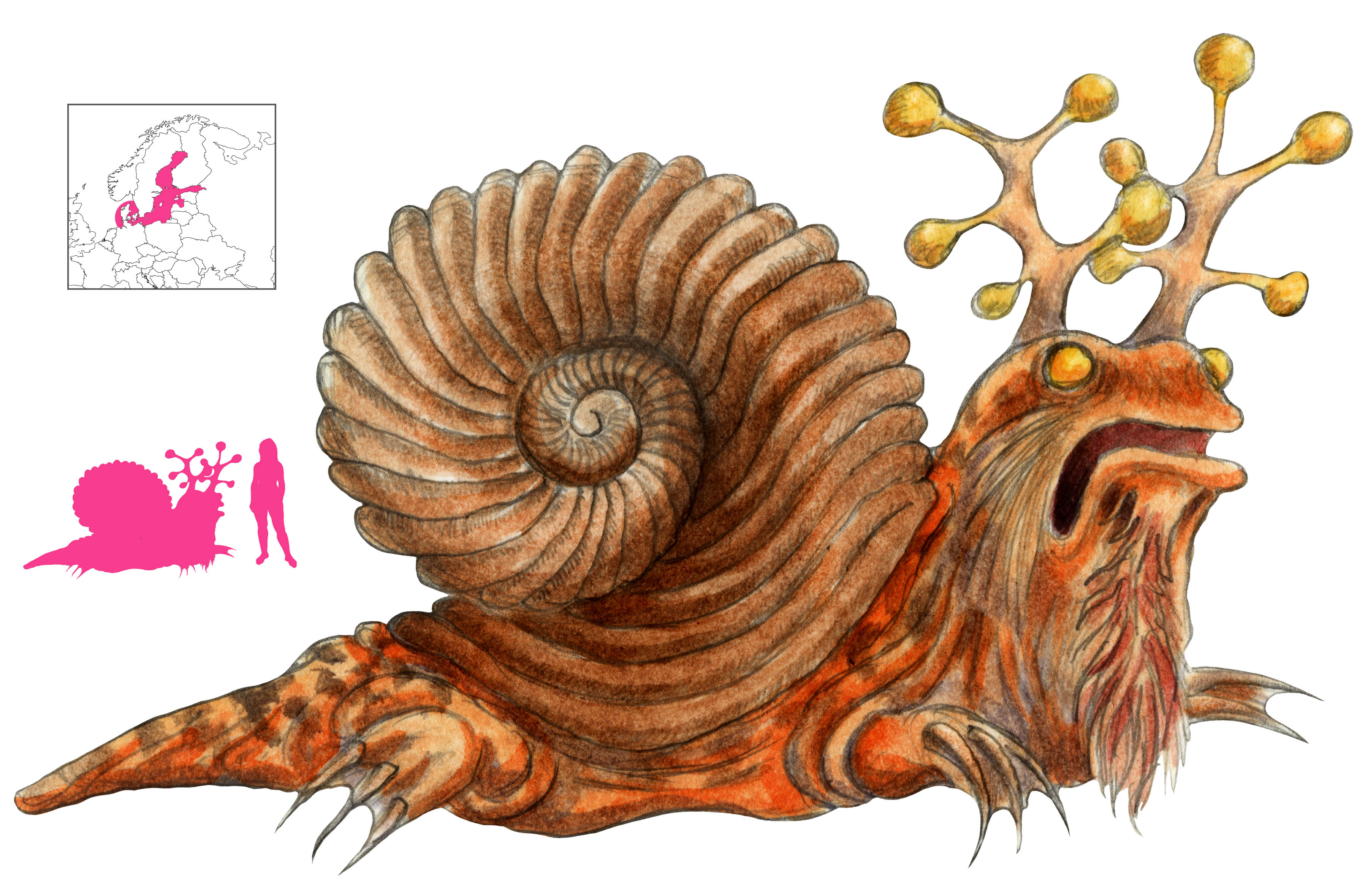
One of these is an enormous snail, the size of a barrel. It has antlers like those of a stag, equipped with gleaming, pearl-like tips. It has a rounded cat-like snout with whiskers, and glowing eyes that light its path like candles. Its mouth is deeply slit, and a hideous fleshy excrescence dangles below it. Its neck is thick, and its tail is long, multicolored, and mottled like a tiger’s. Unlike most other snails, it has four feet armed with hooked claws.

While amphibious, the giant snail is usually out in the open sea, and is rarely seen on the coast due to its wariness.  During good weather it will crawl up onto the beach to graze. Its flesh is tasty and good to eat, and helps against liver and lung problems, much like the meat of large Madagascan turtles cures leprosy.

Thevet reports the Sarmatian Sea snail from Denmark, and mentions having seen similar creatures in the Black Sea, where they are known as Philosmon by the Greeks, Aknib by the Turks, Albakr by the Tartars, and Lucrab by the Arabs. These may well be the same animal.

Linnaeus cautiously included the Sarmatian Sea snail as Cochlea Sarmatica in a footnote, admitting that “fabulosa est“.

It is most likely that this giant snail was born of confusion between the shells of turtles and the shells of snails. Thevet was also working with a number of notes taken at different times, and it does not seem implausible that he muddled them together to create chimeras. Turtles were long seen as bizarre creatures, and the Ortus Sanitatis represents them as snails with legs, making them the basis for the giant snail. Further confusion with seals led to the whiskers and large eyes, and the antlers were provided by branching fungi. For all we know, none of these were from the Baltic Sea.

References

Linnaeus, C. (1759) Animalium Specierum. Theodor Haak, Leiden.

Paré, A. (1614) Les Oeuvres d’Ambroise Paré. Nicolas Buon, Paris.

Thevet, A. (1575) La Cosmographie Universelle. Guillaume Chaudiere, Paris.

Unknown. (1538) Ortus Sanitatis. Joannes de Cereto de Tridino.

Vallot, M. (1834) Mémoire sur le Limacon de la Mer Sarmatique. Mémoires de L’Académie des Sciences, Arts, et Belles-Lettres de Dijon, Partie des Sciences, Frantin, Dijon.

Aloés

Aloes

The Aloés is a large fish from the Caribbean around Hispaniola, reported by Thevet. It looked like a goose in general shape, with the top of its skull in the shape of a bon-chrétien (Williams) pear. It had four underslung fins, a fish-like tail, and no scales on its plump body. Several could be observed swimming alongside the boats, along with shoals of fish, and they looked remarkably like geese diving in and out of the waves.

References

Paré, A. (1614) Les Oeuvres d’Ambroise Paré. Nicolas Buon, Paris.

Thevet, A. (1575) La Cosmographie Universelle. Guillaume Chaudiere, Paris.

A-mi’-kuk

Variations: Ă-mi’-kuk, Ä-mi’-kuk

A-mi-kuk

Kayakers in the cold seas of the Arctic Circle are the A-mi’-kuk’s favorite prey. The last thing they see are the a-mi’-kuk’s prehensile tentacles exploding from under the surface and wrapping around them, dragging both kayaker and boat under.

The a-mi’-kuk is large, leathery-skinned, and slimy. Its four long tentacular arms are used for seizing prey and swimming rapidly through the water. There is no escaping it – it will follow prey taking refuge on ice by swimming below it and bursting out onto the surface. Making for land is equally futile, as the a-mi’-kuk can swim through the earth with as much ease as it does through water.

A-mi’-kuks around St. Michael, Alaska, are known to migrate underground to inland lakes. The presence of one is a good sign for the lake. When an a-mi’-kuk leaves its lake, the channel it digs drains it dry, but when it returns the sea returns with it.

Nelson proposed the octopus as the origin of the a-mi’-kuk. He also gives ä-mi’-kuk as the name of the sea otter; what bearing this has on the legendary creature is unknown.

References

Nelson, E. W. (1887) Report upon Natural History Collections Made in Alaska Between the Years 1877 and 1881. Arctic Series of Publications Issued in Connection with the Signal Service, Government Printing Office, Washington.

Nelson, E. W. (1900) The Eskimo about Bering Strait. Extract from the Eighteenth Annual Report of the Bureau of American Ethnology, Government Printing Office, Washington.

Raudkembingur

Variations: Rauðkembingur, Raudkembingr, Rauðkembingr, Raudkempingur, Red-comb, Red-crest; Raudkembir (Red-crester); Raudkinni (Red-cheek); Raudkinnung, Raudkinnungur (Red-cheeker); Raudgrani (Red-snout); Raudhofdi (Redhead); Kembingur (Crest); Kembir (Crester); Faxi (Maned)
Raudkembingur

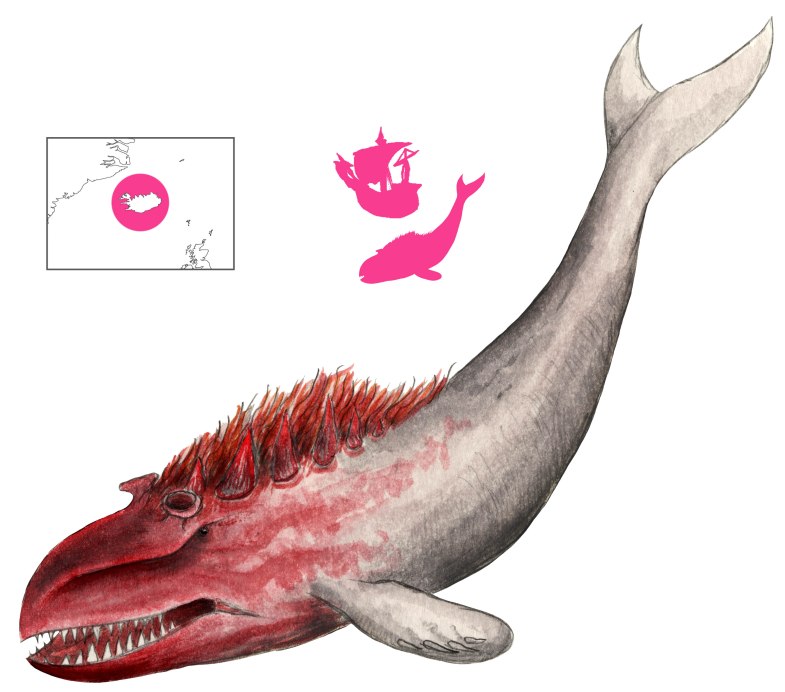
Of all the illhveli, or evil whales that ply Icelandic waters, the Raudkembingur (“red comb” or “red crest”) is the most savage and bloodthirsty. It may not have the size or raw power of some of the other whales, but it is unmatched in ferocity and determination to harm boats. As with all illhveli, the raudkembingur is an abomination, and eating its inedible flesh is forbidden. Boiling its meat causes it to disappear from the pot.

The nature of the red comb or crest that gives the raudkembingur its name is unclear. Accounts refer to a crest of bristly hair, a mane like a horse, or even a row of finlets; its extent varies from depiction to depiction, but Jon Gudmundsson restricts it to the neck. The crest is a bright red on a coffee-brown body with a pink belly; other accounts say it is reddish all over, or has red cheeks or a red head. Sometimes there are red streaks from the mouth to the trunk, as if drawn in blood. The head itself, as depicted by Gudmundsson, is almost saurian in appearance, with sharp teeth in both jaws. It either has a small dorsal fin or none at all.

Raudkembingurs grow to twenty to forty cubits (10-20 m) in length. They are elongate, streamlined, and very fast swimmers. Their movement is accompanied by massive amounts of foam and the whale’s ominous neighing. This, along with the red mane, makes the raudkembingur confusable with the hrosshvalur, and the two have become interchangeable over time. Hrosshvalurs, however, can be easily distinguished by their dappled coloration, horse’s tail, and enormous eyes.

There is no limit to the malice and evil of the raudkembingur. Its mere presence is enough to dissuade fishermen from an area. It will play dead for half a month, floating innocuously on the surface of the water until someone is foolish enough to approach it. Once a boat is within range, the whale puts its bulk and teeth to use, leaping onto the vessel, destroying it, and drowning all aboard. Much like a shark is followed by pilotfish, the raudkembingur regularly has a beluga whales or narwhals (nahvalur – “corpse whale”) following in its wake. These smaller, harmless whales clean up after the raudkembingur and eat its plentiful leftovers.

If anything, the whale’s single-minded love of destruction represents the best hope of foiling it. If a boat escapes it, and it does not destroy another within the same day, it will die of frustration. One raudkembingur destroyed eighteen boats in the course of one day, but a nineteenth boat managed to escape by dressing a piece of wood in clothes and tossing it overboard. The raudkembingur, believing it to be a human, kept trying fruitlessly to drown it while the boat made its escape.

Raudkembingurs will also overexert themselves to death when pursuing prey. A boat captained by Eyvindur Jónsson off Fljót ran into a raudkembingur, and the crewmen reacted by rowing for land as fast as possible until they reached safety at the inlet of Saudanesvik. The sea then turned red as the raudkembingur breathed its last. The boat itself earned the nickname of Hafrenningur (Ocean Runner) after this feat.

Like the hrosshvalur, the demonic raudkembingur is also associated with sorcery and metamorphoses. One tale tells of a callous young man at Hvalsnes who was cursed by the elfs into becoming a monstrous red-headed whale. He wreaked havoc in Faxafjord and Hvalfjordur, until he tried to chase a priest up-river. The red-head died of exhaustion in Hvalvatn Lake, and its bones can still be seen there.

It is generally believed that the raudkembingur and hrosshvalur are monstrous aggrandizements of the walrus (itself derived from hvalhross – “whale-horse”). If the walrus is indeed the origin, however, it has become fully dissociated from its descendants. Gudmundsson realistically depicts both the walrus and the two illhveli, making it very clear that the latter are indeed whales. Otto Fabricius believed the raudkembingur to be inspired by the maned Steller’s sea lion, all the way from Kamchatka.

References

Arnason, J.; Powell, G. E. J. and Magnusson, E. trans. (1864) Icelandic Legends. Richard Bentley, London.

Davidsson, O. (1900) The Folk-lore of Icelandic Fishes. The Scottish Review, October, pp. 312-332.

Fraser, F. C. An Early 17th Century Record of the Californian Grey Whale in Icelandic Waters. In Pilleri, G. (1970) Investigations on Cetacea, vol. II. Benteli AG, Bern.

Hermansson, H. (1924) Jon Gudmundsson and his Natural History of Iceland. Islandica, Cornell University Library, Ithaca.

Hlidberg, J. B. and Aegisson, S.; McQueen, F. J. M. and Kjartansson, R., trans. (2011) Meeting with Monsters. JPV utgafa, Reykjavik.

Kapel, F. O. (2005) Otto Fabricius and the Seals of Greenland. Meddelelser om Grønland Bioscience, Copenhagen.

Larson, L. M. (1917) The King’s Mirror. Twayne Publishers Inc., New York.