Tosetáx

Variations: Tsamtáx, Tsamtás (pl.)

Tosetax

According to the Nivaklé of Paraguay, dry seasons are exacerbated by the Tsamtás serpents, which lie in the middle of the sky and radiate heat. A tsamtáx will intercept and eat the Fanxás or thunderbirds flying from the south and bringing rain with them. Only the shamans can prevent this state of things by tearing down the tsamtás nest, making them fall to their death and allowing the rainy season to return.

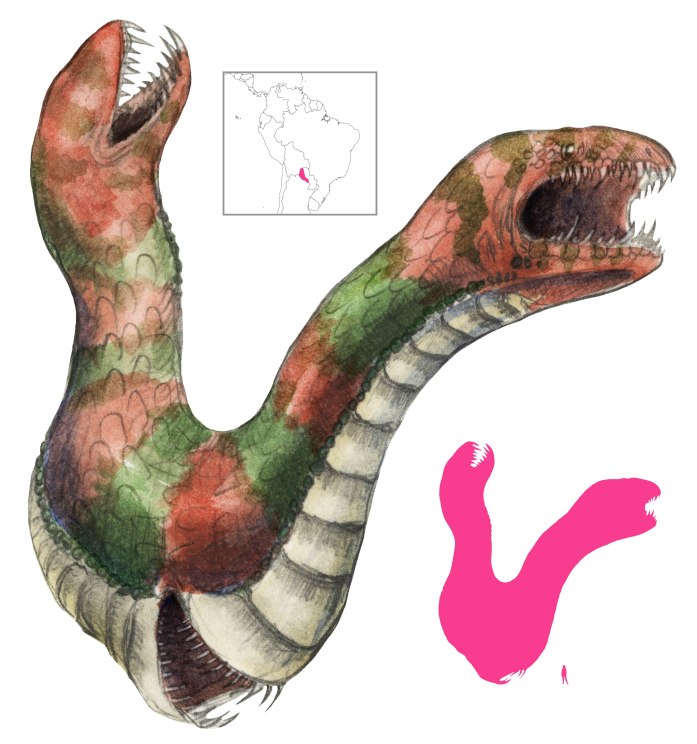
Tosetáx is even more terrifying. He arrived after the tsamtás had been dealt with, and installed himself in the center of the sky. Tosetáx is an enormous green and red snake, with three mouths – one at the head, one at the tail, and one in the middle of his body. As with the tsamtás, Tosetáx was waiting to ambush the returning thunderbirds.

Tosetáx was defeated by five powerful shamans who turned themselves into snakes. One of the shamans coiled himself around Tosetáx and, by turning and coiling, took him to the north out of the thunderbirds’ flight path. There the shamans cut off the serpent’s three mouths and cut him in half, killing him.

References

Chase-Sardi, M.; Costa, M. M.; Mashnshnek, C. O.; Siffredi, A.; Tomasini, J. A.; Wilbert, J. and Simoneau, K. eds. (1987) Folk Literature of the Nivaklé Indians. UCLA Latin American Center Publications, University of California, Los Angeles.

Romŝiwamnari’

Variations: Romŝiwamnare’

Romsiwamnari

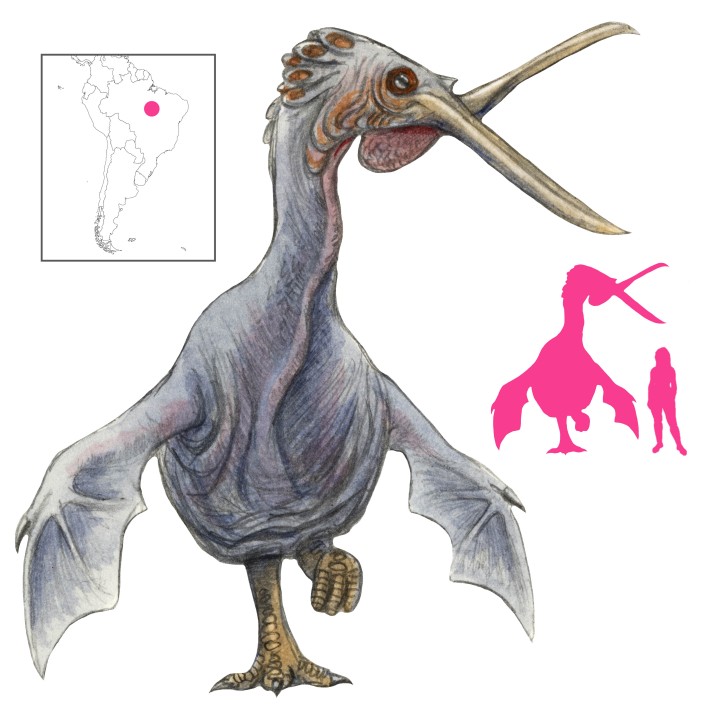
The Romŝiwamnari’ are forest and cave demons, known to the Šerente people of Tocantins, Brazil. They look like large birds with flabby, flightless bat’s wings, armed with beaks like scissors. Their call is an eerie whistle. Romŝiwamnari’ also appear as tapirs, or as stout humans with prominent teeth and a howler monkey’s tail. When in human guise, a romŝiwamnari’ resembles the Pope – a relic of missionary activity in Brazil.

Romŝiwamnari’ not only prey upon the living, but also ambush and consume the souls of the dead. A sufficiently powerful shaman can kill them while in the realm of death, but other souls are greedily devoured.

A man of the krara’ society and his pregnant wife once encoutered a pair of romŝiwamnari’ in a cave. The man held the monsters off as long as he could while his wife escaped, but he was outmatched and decapitated by the romŝiwamnari’. The woman brought the news to the rest of the village, and the other krara’ launched an assault on the romŝiwamnari’ cave. Three of the villagers were killed in the battle, but they slew the two romŝiwamnari’ – unaware that there were two more in hiding. However, the boy the woman gave birth to grew into a mighty hero in less than a year, and he avenged his father by burning the romŝiwamnari’ bones and killing the other two demons. The romŝiwamnari’ were not seen again in that area.

References

Crocker, W. H.; Giaccaria, B.; Heide, A.; Lea, V.; Melatti, J. C.; Nimuendajú, C.; Seeger, A.; Verswijver, G.; Vidal, L.; Wilbert, J. and Simoneau, K. (eds.) (1984) Folk Literature of the Gê Indians, v. 2. UCLA Latin American Center Publications, University of California, Los Angeles.

Nimuendajú, C.; Lowie, R. H. (trans.) (1942) The Šerente. The Southwest Museum, Los Angeles.

Yuanat

Yuanat

The Yuanat is a type of serpent reported by Thevet from the island of Hispaniola, or Cuba. It lives in trees, on land, and in the water, making it fish, fowl, and land beast.

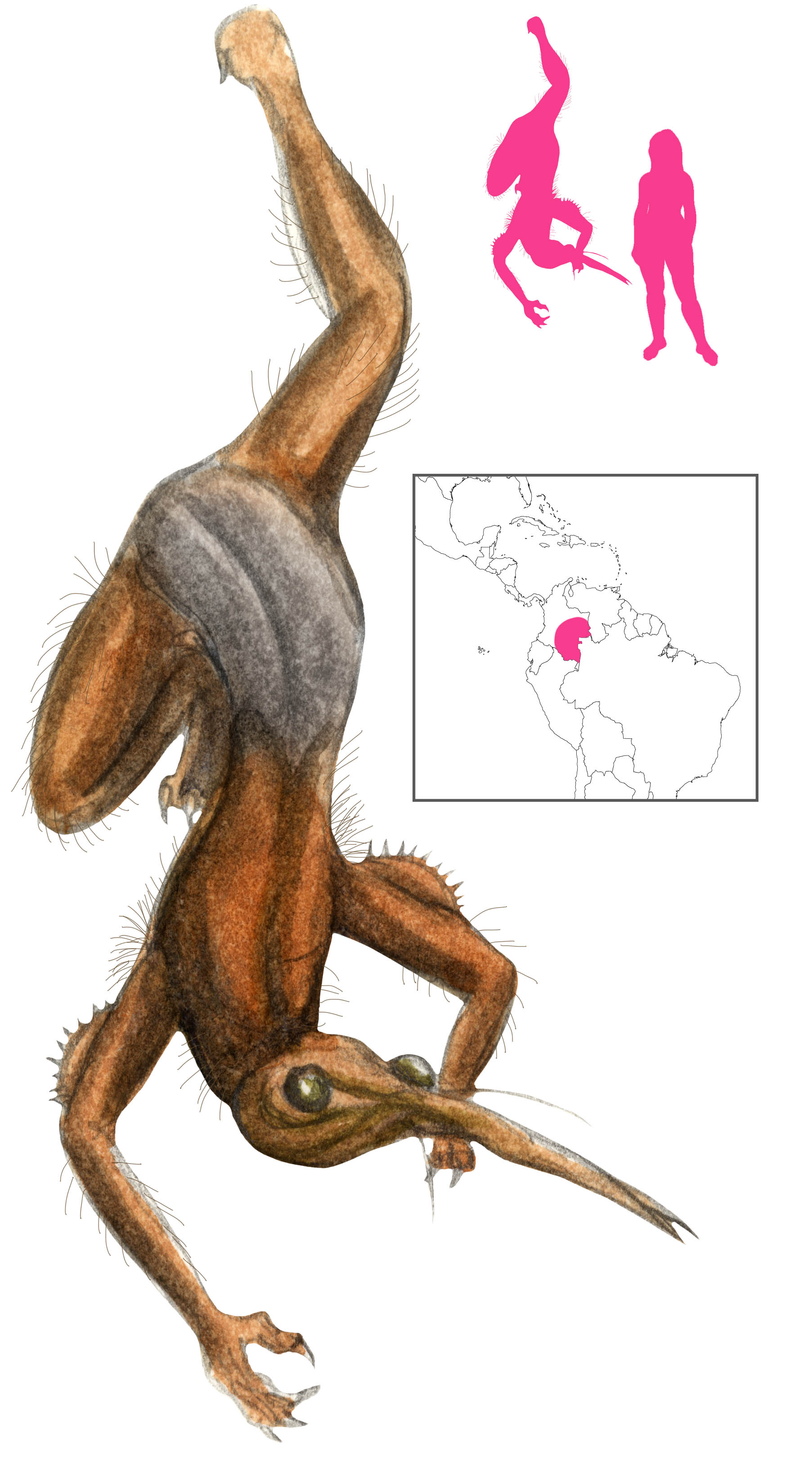
This greatly terrifying creature is about the size of a rabbit and is frightful to behold. It has the tail of a lizard, and four weak bird’s legs, with the forelegs longer than the hindlegs and long claws on each toe. Its teeth are sharp. It has a spine running down its back like the fin of a fish. Underneath its throat there is a colorful flap of skin reaching down to its belly, its varied hues making it hard to tell which color is dominant. It can swim well, and is completely mute.

Despite its horrifying appearance, the yuanat tastes excellent, and its flesh is more highly prized than that of rabbits. It is also so gentle and harmless that the natives would keep a yuanat on a leash for ten or twelve days before eating it, and it would never attempt to harm them. However, Thevet notes that yuanat meat is harmful to those who have had the pox, as it causes the disease to return in full force.

References

Thevet, A. (1575) La Cosmographie Universelle. Guillaume Chaudiere, Paris.

Khodumodumo

Variations: Kholomodumo, Modumo o Moholo, Khamapa, Kammapa, Khanyapa

Khodumodumo

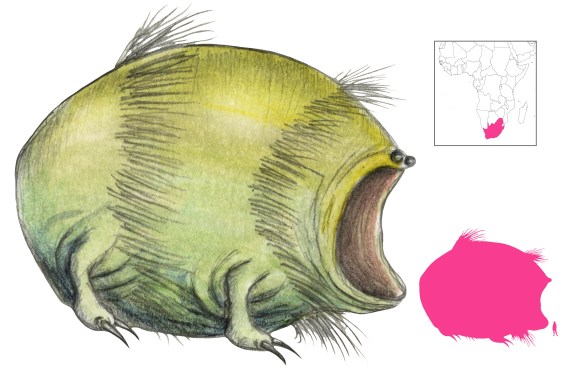
The swallowing monster of the Basuto people of South Africa and Lesotho is called Khodumodumo. The name of Khodumodumo is an archaic Sesotho term, most likely meaning “great noise”, although Hichens refers to the “gaping-mouthed bush monster”. Modern Sesotho often makes it into kholomodumo. Its synonym and possible ancestor is Kammapa, a giant river python. Khodumodumo’s amorphous appearance is undefined, and it is vast in size. It has multiple sharp tongues which it uses as weapons.

Once Khodumodumo went about swallowing every living thing in its path, man and beast alike, lumbering through towns and villages and engulfing their inhabitants. Only one pregnant woman survived, as she had been hiding on a manure heap, and the ashes masked her appearance and scent. Eventually the bloated Khodumodumo dragged itself off and wedged its massive body in a mountain pass.

Eventually the woman gave birth to a baby boy, and went off to fetch some manure powder to lie on, as tradition dictates. She returned to find her son fully grown, dressed in skins, with divining beads around his neck, and armed with assagais. “Where is my son?” she asked, marveling at the heroic figure in front of her. “I am your son, Senkatana”, he said. “Mother, where is the rest of the village?” “Alas, Khodumodumo ate them all”, she lamented. “And the cattle?” “The cattle too”. “And the dogs?” “The dogs too”. “And the poultry?” “The poultry too”.

Senkatana demanded that his mother show him where the beast had gone to. “See the big hill in the pass?” she said. “That is Khodumodumo”. Despite his mother’s warnings, Senkatana went to face Khodumodumo alone. When it saw him, it opened its mouth wide and tried to spear him with its tongues, but Senkatana chopped them off one by one. He circled around the beast, which was too fat to turn around and face him, and stabbed it with his assagais until it was dead.

He then started to cut open Khodumodumo, but had to avoid cutting the people imprisoned inside. His first cut accidentally injured a man, and then he had to avoid stabbing a cow, a goat, a dog, and a hen before he could finally release Khodumodumo’s victims. Senkatana then went on to become a great chief, but the man he had inadvertently stabbed continued to bear a grudge. The resentful man and others jealous of the hero attempted to assassinate him multiple times, until Senkatana, weary of the hatred of mankind, allowed himself to be killed.

References

Hichens, W. (1937) African Mystery Beasts. Discovery (Dec): 369-373.

Jacottet, E. (1888) Légendes et contes Bassoutos. Revue des Traditions Populaires, v. 3, Maisonneuve et Ch. Leclerc, Paris.

Werner, A. (1968) Myths and legends of the Bantu. Frank Cass and Co. Ltd., London.

Isiququmadevu

Variations: Usiququmadevu (flattering); Isikqukqumadevu, Usikqukqumadevu; Unomabunge; O’gaul’-iminga; O-nsiba-zimakqembe

Isiququmadevu

When Untombinde, the king’s daughter, set out for the mythical Ilulange River, she took with her two hundred maidens to be her escorts. She was determined to bathe in one of its pools despite her parents’ warnings of dire consequences. Once there, she and her handmaidens undressed and played in the water, but when they came back out their clothes, their beautiful bracelets and jewels and finery were all gone. Isiququmadevu had taken them.

Isiququmadevu, “Smelly Whiskers”, is a mountainous “swallowing monster” from Bantu and Zulu folklore. She is bearded, bloated, hairless, and squatting, with an enormous mouth capable of engulfing entire villages. Other clues as to her appearance are given in her many epithets, which include Unomabunge (“Mother of Beetles”), O’gaul’-iminga (“Feller of Lofty Thorn-trees”), and O-nsiba-zimakqembe (“She Whose Feathers are Long and Broad”).

Naturally the royal cortège was mortified, and entreated the isiququmadevu to return their belongings. “Untombinde, the king’s daughter, brought us here, she is to blame”. One by one they recuperated their effects, until Untombinde was left. “Beseech Usiququmadevu”, they told her, using a more personal and flattering name for the monster. But Untombinde – perhaps miffed by her companions’ accusations – refused. “I am the king’s daughter”, she said haughtily, “and I will never entreat the isiququmadevu”. Whereupon the monster seized her and took her into the pool.

King Usikulumi despaired for his daughter, fearing she was lost forever, and ordered his troops to slay the isiququmadevu. But the monster hauled herself onto the bank, and swallowed the entire army in one gulp. She then followed their trail back to the village, and swallowed the men, the women, the children, the dogs, the cattle, every living thing she found there.

Among her victims were two adorable twin children whose father was the only villager who escaped the isiququmadevu’s attack. He resolved to kill the creature, arming himself with his assagai and following her back into the woods. First he met a herd of buffaloes. “Where has Usiququmadevu gone? She has taken my children”. Acknowledging his plight, the buffaloes told him he was on the right track with a “forward, forward!” Next he met some leopards and an elephant, who advised him to keep on going. Finally he found the isiququmadevu herself, replete and squatting. “I seek Usiququmadevu, who has taken my children!” he announced. “Forward, forward!” said the isiququmadevu, but the man was not as dimwitted as she had hoped, and he stabbed her with his spear until she died. Then all her victims climbed out, none the worse for wear, with Untombinde, defiant and proud, coming out last.

In another isiququmadevu story, it is Usitungusobenthle, a young woman who had been abducted by pigeons to be their queen, who brings about the creature’s demise. She returns to her village after escaping her captors only to find it empty, with the isiququmadevu sleeping nearby. She cut it open with a knife, and released all its victims.

Another princess, Uluthlazase, actually stood up to an isiququmadevu and tried to wrest her clothes from the monster. She held on so firmly that the isiququmadevu could not remove her, and the two fought each other to a stalemate. When it left to get assistance from other isiququmadevu, Uluthlazase collected her effects and wisely escaped.

References

Callaway, C. (1868) Nursery Tales, Traditions, and Histories of the Zulus. Trübner and Co., London.

Koopman, A. (2002) Zulu Names. University of Natal.

Werner, A. (1968) Myths and legends of the Bantu. Frank Cass and Co. Ltd., London.

Araǵanaqlta’a

Variations: AraGanaqlta’a, AraGanaGalta’a; AraGanaqlate’e, AraGanaGalate’e; Owner of the Snakes, Father of the Snakes

Araganaqltaa

Araǵanaqlta’a is the father or owner of the snakes in Argentinian Toba folklore. It can be found in a range of habitats, but usually likes rivers and deep caves with access to water. In addition to snakes, which are all under its command, it is associated with water, rainbows, and storms.

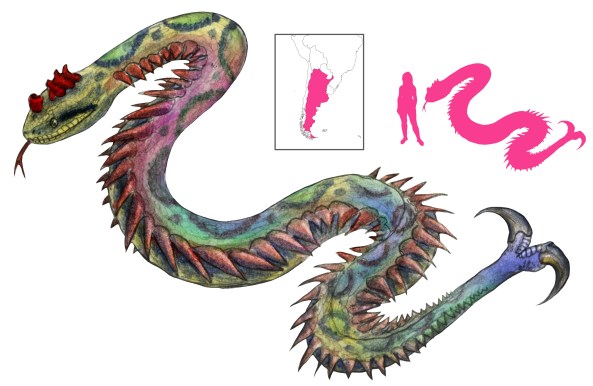
The araǵanaqlta’a appears as a large, multicolored snake, 10 meters or more in length, resembling a bushmaster or fer-de-lance. It has a red crest, its “sign” (ndage), on top of its head, and a sawlike structure on either side of its body that allows it to move. An araǵanaqlta’a’s tail ends in two hooks which it uses to hold prey. The females are known as araganaqlate’e, the mother of the snakes.

Araǵanaqlta’a are shapeshifters, adjusting to fit their environment, and are also known in the form of four-legged snakes, as humans in elegant business attire, or as rheas with colorful necks. No matter what shape it takes, however, the araǵanaqlta’a always has its characteristic ndage, which identifies it as a powerful mythical creature.

Araǵanaqlta’a are intelligent and enjoy human conversation. These snakes will punish desecrators of nature and persecutors of snakes, but will reward those who they find worthy. After a hunter treated an araǵanaqlta’a with respect and obeisance, the snake promised him that he would have all he would ever need, and taught him how to heal the sick with his words.

References

Wilde, G. and Schamber, P. (2006) Simbolismo, Ritual, y Performance. Paradigma Indicial, Buenos Aires.

Wright, P. G. A semantic analysis of the symbolism of Toba mythical animals. In Willis, R. (Ed.) (1990) Signifying Animals: Human Meaning in the Natural World. Unwin Hyman, London.

Wright, P. G. (2008) Ser-en-el-sueño. Editorial Biblos, Buenos Aires.

Abúhukü

Variations: Abúhuwa (pl.)

Abuhuwa

The victims of the Abúhuwa, the rainforest demons of the Cubeo people of the Colombian Amazon, are easily recognized. An abúhukü will cut a hole in the skull before sucking out the contents of the body. Sometimes prey is rolled in palm leaves and tenderized. Either way, they leave an empty skin hanging from a branch.

Abúhuwa are nocturnal creatures who embody disease, death, and all that is evil. They associate with the spirits of dead poisoners, murderers, and male adulterers, and are described as misty creatures from the realm of darkness. Their name is derived from “whiteness”, or the foaming of rapids. Like almost all other Amazonian ogres, the abúhuwa are hairy and foul-smelling, associating them with bestial sexuality and death respectively. In addition to that, they have an extra face in the back of their head, and sticky bodies that make escape from their embrace impossible. The females have long pendulous breasts and prefer to kill men, while the males attack women, often killing mothers and abducting their children to raise as their own. Such abúhuwa changelings become cannibals themselves.

The abúhuwa were once far more common, and were allied with a race of evil jaguars that worked with them to decimate human populations. Humanity got a respite after a series of floods and fires that reduced the numbers of both predators.

Abúhuwa are fortunately quite stupid, and can easily be outwitted by children. They are relegated to the status of nursery bogies, reflected in a sort of tag game where one child plays the part of the abúhukü. The grotesqueness of the abúhuwa makes them easier to confront and mock.

Armpit hair from an abúhukü makes a potent ingredient in poisons. To obtain it, an abúhukü must be caught during a lunar eclipse, and the hair from its left armpit must be cut with a corn husk, reduced to ash, mixed with water and turned into paste, and left to dry. It keeps well in a gourd sealed with beeswax.

Capsicum smoke is toxic to abúhuwa, and they can be easily driven away by burning peppers. When killed, they turn into sloths.

References

Goldman, I. (1979) The Cubeo Indians of the Northwest Amazon. University of Illinois Press, Urbana.

Goldman, I. (2004) Cubeo Hehénewa Religious Thought. Columbia University Press, New York.

Smith, N. J. H. (1996) The Enchanted Amazon Rain Forest. University Press of Florida, Gainesville.

Aíǰe

Variations: Aíge, Spirit-Tadpole

Aige

The Aíǰe is associated with the Bororo of Brazil and Bolivia, and in particular the Páiwoe and Aróroe clans. It is a gigantic tadpole, somewhat like a hippopotamus.

Rubúgu of the Páiwoe first found the aíǰe while walking through a swamp. He liked the little animal and decided to keep it, taking it home in a vessel of water. Rubúgu had great plans for his little pet, and wanted it to become something great and amazing, so before covering its container with a fan he told it “Grow for me; thrive and become an extraordinary creature”.

And grow the aíǰe did. It became larger, and stronger, and it could sing a loud, buzzing song. Rubúgu had to keep switching it to increasingly large containers to support its bulk, and eventually he had nowhere left to put it. He tried doing a dance for the aíǰe, but the tadpole rejected Rubúgu’s mediocre talents. Instead, Chief Baitogógo of the Aróroe took the aíǰe, and honored it with a macaw-feather headdress and a marvelous dance, both of which pleased the tadpole greatly. Baitogógo told the aíǰe that it had to live in ponds, swamps, and lakes away from the Bororo, for it was so big and the magic of its song so powerful, it could pose a serious threat.

The aíǰe accepted, and before leaving it told Baitogógo that if the Bororo missed it, then they should fashion little tadpole sculptures in remembrance. Those figurines could be tied to a stick and swung in the air, making an amphibian buzzing much like aíǰe did. Thus the aíǰe went on to become one of the totems of the Bororo.

References

Albisetti, C.,; Colbacchini, A.; and Venturelli, A. J.; Wilbert, J. and Simoneau, K. eds. (1983) Folk Literature of the Bororo Indians. UCLA Latin American Center Publications, University of California, Los Angeles.

Tapirê-iauara

Variations: Tapir Nymph, Onça d’Água (Water Jaguar), Onça Pé de Boi (Cow-legged Jaguar), Paraná Pura Iuraretê (Turtle/Jaguar that Dwells in River Side Channels), Tai-açu-iara (potentially)

Tapire-iauara

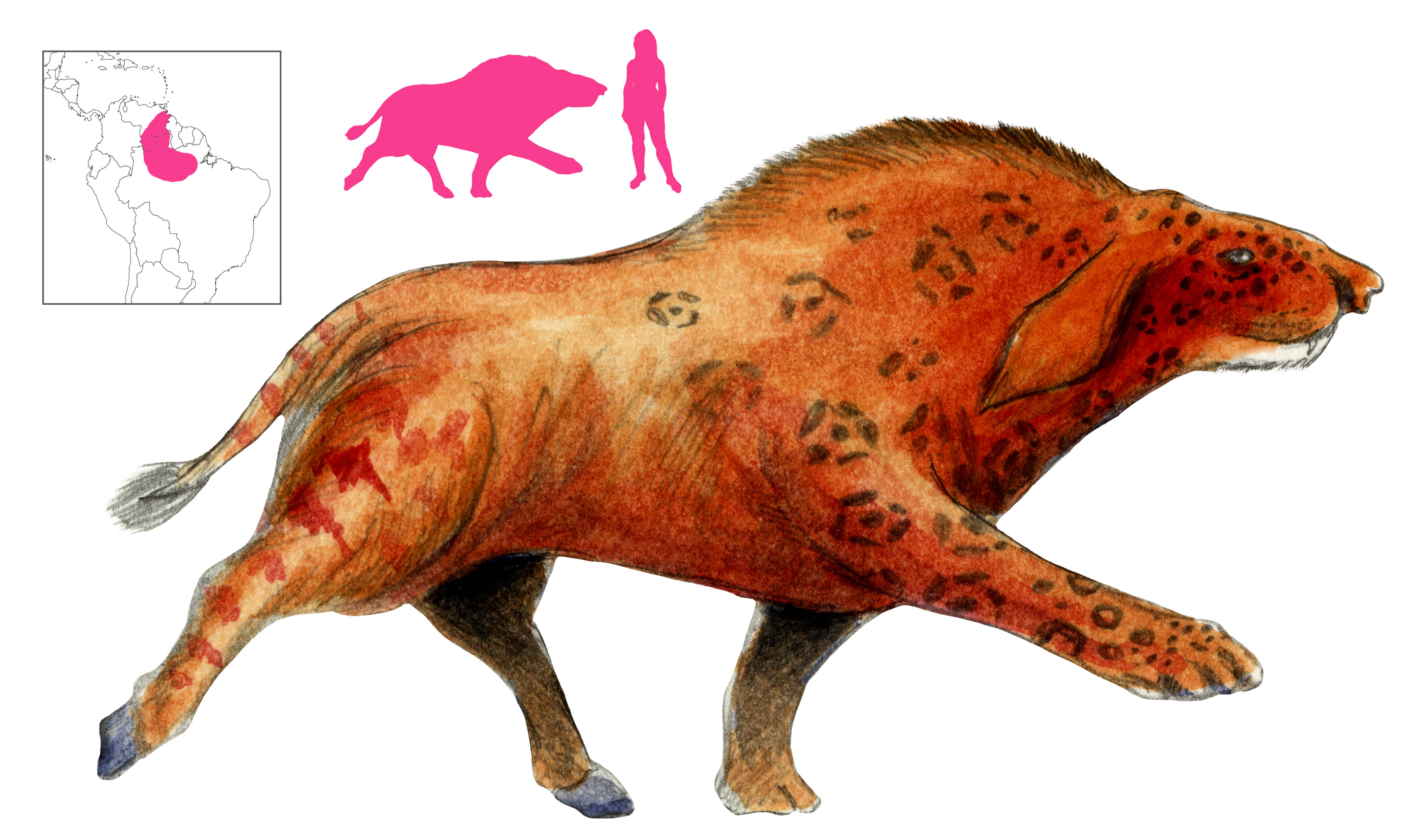
The Tapirê-iauara, or Tapir Nymph, enjoys a wide distribution in the Amazon, from the Orinoco in Venezuela to the Rio Negro, the Madeira, the Tapajós, and the Amazon down to Pará. Sightings have been reported from around Codajás, Fonte Boa, Itacoatiara, Nova Olinda, Oriximiná, Santarém, and Urucurituba. It lives in slower-moving waters, near groves of aninga or palm trees, and avoids human settlements.

The name tapirê-iauara is etymologically complex. Tapiré is Tupi for “tapir”, while y is “water” and ara is “lady” in língua geral; it also draws from the Tupi uara (“dweller”) or yguara (“dweller in water”). Hence, “tapir water-lady” or “tapir nymph” is a rough translation. This same derivation gives us the Amazonian nymphs Yara and Oyoára, the sea monster Hipupiara, and Paraná Pura Iuraretê, which was apparently a giant turtle creature that later was subsumed into the tapirê-iauara (iuraretê meaning either “turtle” or “jaguar”).

Reports of the tapirê-iauara appearance have varied somewhat. Most accounts agree that it resembles a cow-sized jaguar with a reddish waterproof coat, a thick mane, long droopy ears half a meter in length, and an overpowering stench (catinga). It may have jaguar legs, or the forelegs of a jaguar and hooved, donkey-like hindlegs. It may have horse legs with or without catlike paws, duck feet, or large otter paws. Variations in fur color include red, gold, and black with a cream patch in the chest. It notably does not look much like a tapir.

A tapirê-iauara is heard and smelled before it is seen. The large, finlike ears flap noisily against the water as it swims, while its putrid odor precedes it. From a safe distance, it’s merely nauseating; at close quarters the stench of a tapirê-iauara is enough to cause fainting and outright death. Tapirê-iauaras can also mesmerize prey into standing still before pouncing on them.

Tapirê-iauaras have a broad diet that includes large fish, capybaras, caimans, and humans. They are attracted to hauls of fish and the halitosis resulting from eating poorly-cooked fish. They often show up to inspect fishermens’ catches – or the fishermen themselves. When they do, they are fast, persistent, and resilient, relying on their odor to weaken prey before killing it with their sharp teeth and claws. One fisherman had to empty 12 slugs from a .22 rifle into a pursuing tapirê-iauara before the beast expired. Other fishermen have not been so lucky, having their catches stolen at best or being dragged into the river and devoured at worst.

Sometimes the stink of a tapirê-iauara is enough to cause a human’s shadow (and therefore soul) to depart. A person who has lost their shadow in this way is said to be assombrado. They can recover their soul by inhaling the fumes of a fire made with leaves, sticks, and the bones of undercooked piranhas.

Caraña resin (Protium heptaphyllum) is repulsive to tapirê-iauaras, and anyone concerned about tapirê-iauara attack should equip themselves with some before heading into the Amazon. Tapirê-iauaras also cannot climb, and so shelter should be sought in trees. As the tapirê-iauara’s odor will cause fainting and potentially falling out of the tree, secure branches must be found.

The Tai-açu-iara from around Parintins is similar and may be the same animal. It appears as a black piglike creature with jaguar paws.

References

Smith, N. J. H. (1981) Man, Fishes, and the Amazon. Columbia University Press, New York.

Smith, N. J. H. (1996) The Enchanted Amazon Rain Forest. University Press of Florida, Gainesville.

Dodo

Variations: Kadindi, Kaddodi, Kadda, Swallower-of-Men

Dodo

The Dodo is a monstrous humanoid creature from the folklore of the Hausa people. He can be found lurking in the deep forests and swamps of sub-Saharan West Africa, with a range including Sudan, Ghana, Nigeria, and the Côte d’Ivoire. The dodo has nothing in common with the extinct flightless bird of the same name, and probably was derived from tales of giant snakes.

Not much is known about a dodo’s appearance. He – for the dodo is always male – is the King of Beasts, and can just as easily be the lion, the python, the elephant, or the rhinoceros. A dodo is humanoid in appearance and large in size, as he has to stoop to get through doors. He has long, shaggy black hair. He has a keen sense of smell, and can detect meat from far away. He has some degree of magic powers, but cannot cross running water (paradoxically, dodos also live in ponds and streams). Most importantly, the dodo has a vast mouth glowing red from the inside, a seemingly infinite stomach capacity, and a taste for human flesh. As one of the African “swallowing monsters”, a dodo can easily engulf an entire village.

A dodo is often a self-invited guest, eating more and more until there is nothing left. This is not always a bad thing. Once a miser and his son were preparing to butcher a freshly-slaughtered ox in the forest, far from prying eyes. They decided to cook it in a nearby fire – a fire which turned out to be a dodo’s glowing, cavernous mouth.

“Well well”, said the dodo. “Who has invited me?” The miser, hoping to placate him, said “I did!” and gave him a leg of beef, which the dodo put away in his bag. “Does a man invite a friend to a feast for such a small morsel?” said the dodo. In response, the miser gave him another leg. “Does a man invite a friend to a feast for such a small morsel?” The next two legs followed, then half the bull, then the remainder of the bull. “Does a man invite a friend to a feast for such a small morsel?” “But there is nothing left!” protested the man. “You are also meat”, came the response. Terrified, the miser shoved his son forward, and the dodo tossed him into his bag. Finally, he grabbed the miser himself. “What about you?” he said, throwing him into his bag as well. The dodo went to collect firewood, but in the meantime the father and son managed to cut their way out of the bag and made their escape. The dodo returned, shrugged, and got a meal of roast beef. The miser vowed he would never be greedy again, and devoted the rest of his life to sharing his food and wealth with others.

While dodos readily eat meat, they are also fond of taking human women as their wives, sometimes fathering repulsive half-dodo children with them. Dodos like to strike bargains with prospective spouses, promising to help them for the price of marriage; sometimes those “bargains” are more straightforward, consisting of “Would you like me to eat you or marry you?” Such unions are never happy, and the wife will always try to escape her captor.

One dodo story tells of a young woman, pregnant with her first child, drawing water from a stream. Another woman, jealous of her companion and looking to get her scolded, threw dirt in her pot before leaving. But as the pregnant woman tried to carry her water pot, a dodo came out of the water and helped her with her load. Before she could protest, he stated “If you give birth to a boy, he will be my friend. If your child is a girl, she will be my wife”. And with that, he disappeared back into the water.

The mother soon gave birth, and her jealous rival was prompt to report the news to the dodo. “She gave birth to a girl”, she announced, and the dodo was immensely pleased. He was content to wait over the years, until the girl had become a woman as beautiful as her mother. On the day of the girl’s wedding, the jealous woman once more reported the news to the dodo, and he decided to show up uninvited.

“Kadindi has arrived”, he boomed, as everyone stared at him. “I have come to collect the payment I am due”. The daughter was obviously unhappy about marrying the monster, so instead her father gave the dodo a horse, part of the bride’s dowry. “Here is the payment for your debt”, he said, and the dodo swallowed the horse. But that was not enough. Next he ate all of the cattle, all of the wedding feast, all of the guests, and finally the father and mother. There was only the daughter left, and in desperation she prayed to the heavens. “Dodo has come to demand payment”, she implored. In response to her prayer, a knife fell out of the sky, and it was promptly swallowed as well – killing the dodo, cutting open his belly, and causing all the livestock, food, guests, and parents to come out unharmed. The wedding went on as planned.

References

Tremearne, A. J. N. (1913) Hausa Superstitions and Customs. J. Bale and Sons and Danielsson, Ltd., London.