Katthveli

Variations: Katthvalur, Kettuhvalur; Kattfiskur (Cat-fish); Kisa (Kitty); Bísill (Feline); Sea-cat

Katthveli

The Katthveli (“Cat-whale”), is one of Iceland’s many evil whales or “illhveli”. It is generally smaller and of a less harmful nature than its larger brethren, and has even been tamed on occasion. As with other illhveli, it is inedible and will zero in on anyone who mentions its name. Speaking about it at sea is considered highly foolish.

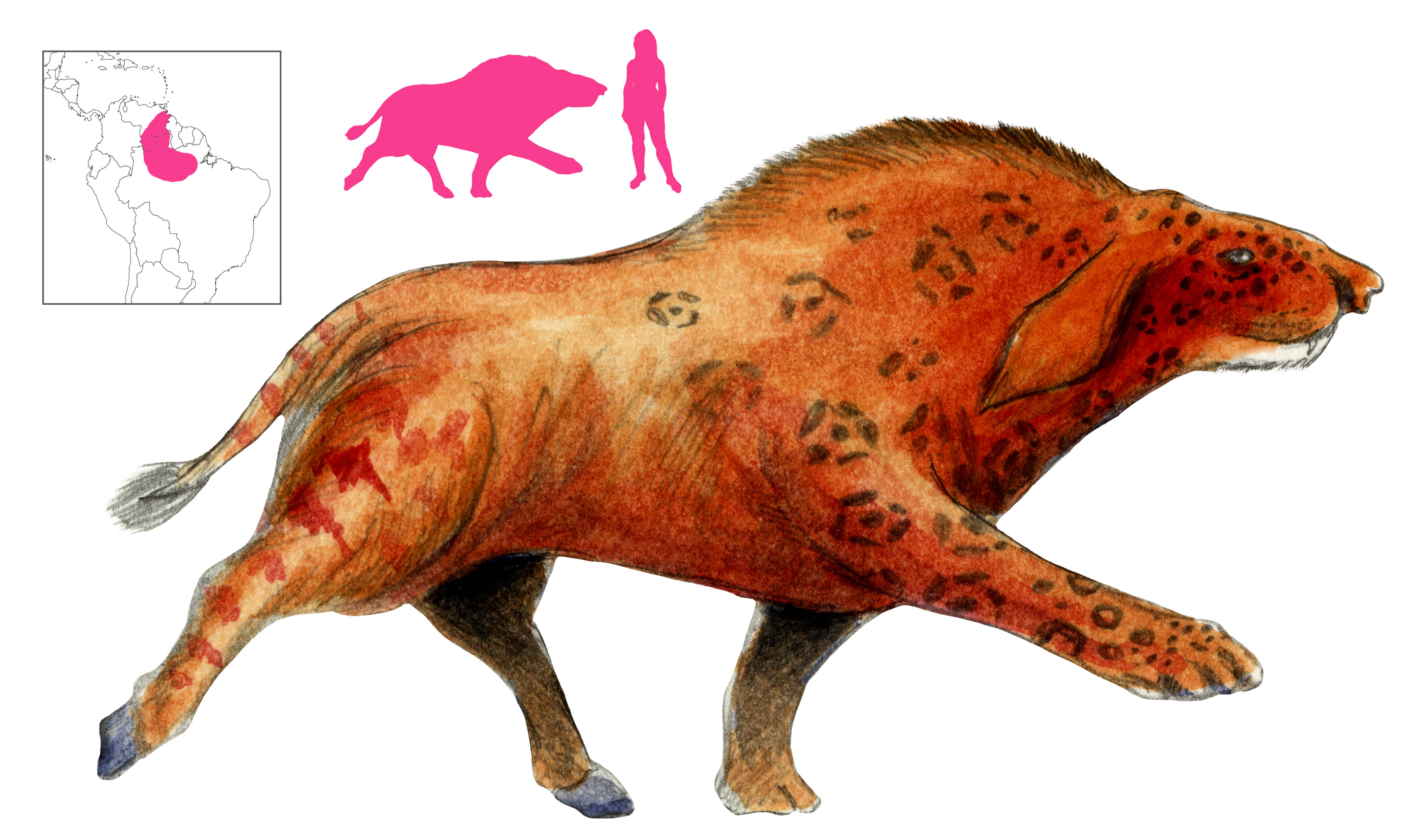
The katthveli has been described as a seal, dolphin, or whale with bulky forequarters and narrower hindquarters, with the mouth of a leopard, the strength of a lion, and the hunger of a hound. It earns its name from the long, furzy whiskers on its snout and the sounds it makes, ranging from a purr when it exhales to mews and hisses when agitated. It is fairly small and kittenish at 16 cubits (8 meters), with a short rounded head with nodules that resemble ears. It has short, sharp teeth protruding from its upper jaw, and Saint Brendan adds that it has boar’s tusks. The eyes gleam brazenly. The flippers are large, and nasty hooked claws are present. Known colors include pink, grey, peaty brown, and countershaded; the one encountered near the Faroe Islands was pale under the chin and had woolly skin.

Katthvelis have been known to school with rorquals and large fish. These whales are cruel and vicious, using their speed and agility to swim underneath boats and flip them. One katthveli chased a boat off the Skálanesbjarg cliffs, but gave up after it was outsped by the rowers. Another one intercepted a ship at Héradsflói and remained alongside it, preventing the sailors from fishing and following them with its eyes. Harpooning it was ruled out as nobody wanted to provoke it, and it eventually dove and disappeared by nightfall. Ásmundur Helgason and his companions were attacked by one off Seley Island; it rammed their boat and stuck its head through the hull. After a terrifying struggle, they managed to push it out and make for safety despite the damage. A Faroese katthveli at Suðuroy reared out of the water and put its flippers on the gunwale of a boat, hissing and spitting like a cat and snapping at the sailors until one quick-thinking man put his gun in its mouth and fired, whereupon it slid off into the depths.

St. Brendan encountered a “sea-cat” the size of a horse on a small island. It had originally been brought as a pup along with twelve pilgrim sailors, and was quite friendly and tame, but soon grew bigger and hungrier and eventually ate all but one of the sailors, who took refuge in a small stone church. St. Brendan prayed for aid, and immediately a great whale lunged out of the sea and seized the sea-cat, pulling it into the sea where they both drowned each other.

The wolffish Anarhichas lupus was also known colloquially as the cat-fish or sea-cat in older English, and may be associated with the katthveli. If it was born from mistaken identity, a large seal such as the walrus or bearded seal is a more plausible contender.

References

Cunningham, J. T. (1896) The Natural History of the Marketable Marine Fishes of the British Islands. MacMillan and Co., London.

Joensen, J. P. Tradition and Changes in the Concepts of Water-Beings in Faroese Folklore. In  Lysaght, P.; Ó Catháin, S.; and Ó hÓgáin, D. (1996) Islanders and Water-Dwellers. Proceedings of the Celtic-Nordic-Baltic Folklore Symposium, DBA Publications, Dublin.

Hlidberg, J. B. and Aegisson, S.; McQueen, F. J. M. and Kjartansson, R., trans. (2011) Meeting with Monsters. JPV utgafa, Reykjavik.

Stokes, W. S. (1890) Lives of Saints from the Book of Lismore. Clarendon Press, Oxford.

Tsemaus

Variations: Tsemaus, Chemouse, Narhnarem-tsemaus, Snag, Supernatural Snag, Tsem’aus, Tcamaos, Tca’maos, Tidewalker, Ts’um’os, Tsamaos, Kanem Ktsem’aus; Weegyet, Wi’git
Tsemaus

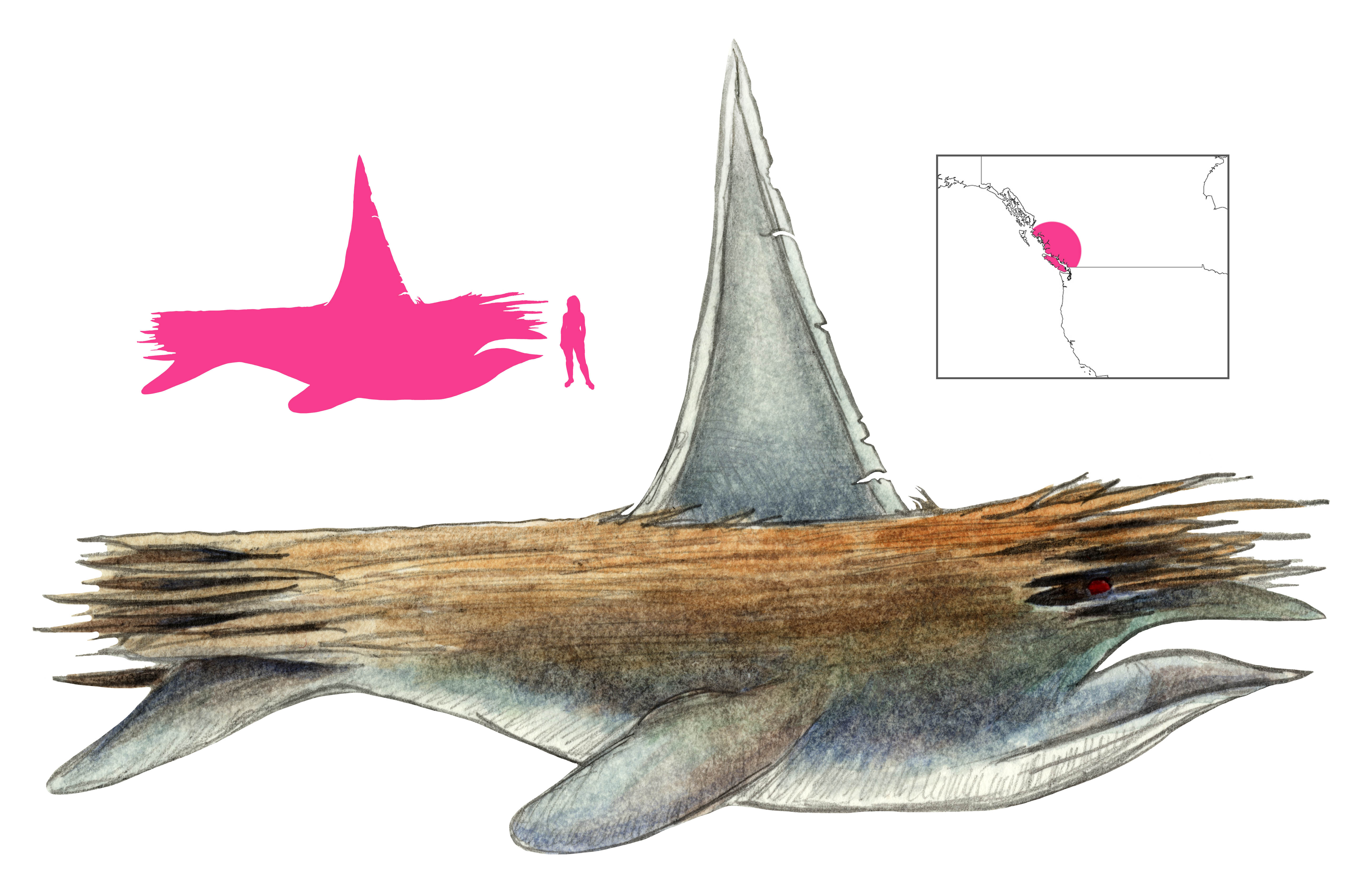
The Tsemaus (“Snag”) or Narhnarem-Tsemaus (“Supernatural Snag”) is the personification of river snags., floating logs, and other hazards of the water. It is found in the folklore and art of the Pacific Northwest, notably in Tsimshian and Haida culture around the mouth of the Skeena River.

One of its names, Wi’git or Weegyet, connects it to Raven the trickster, and it is one of his many forms. The creator and trickster Nanki’islas also assumed the form of a tsemaus after he was done.

A tsemaus can vary a lot in appearance, much like the driftwood it imitates, but it almost always has a snag for a dorsal fin – or is itself a snag. It can be as simple as a dead log with a tail that can swim against the current. It can be a huge sea lion with dorsal fins and blowholes, or an enormous grizzly bear with a downturned mouth like a dogfish and two sharp snags protruding from its back, with or without one or more sharp fins of a killer whale. It can be a hybrid of bear and killer whale, or raven and killer whale, with multiple bodies. It can be a large frog covered in seaweed with a snag sticking out of its back, and can even be a canoe or a schooner. Meurger states that it can cleave swimmers with its fin.

The tsemaus uses its fin to destroy boats. It has no problem swimming upstream and plowing through log jams. If angered it breaches and lands on canoes, smashing them to bits, or makes huge waves to capsize boats. It drowns people, who then become killer whales.

It is found as a crest on the totem poles of the coastal clans.

References

Barbeau, M. (1950) Totem poles. Bulletin No. 119, Anthropological Series No. 30, National Museum of Canada, Ottawa.

Barbeau, M. (1953) Haida Myths Illustrated in Argillite Carvings. Bulletin No. 127, Anthropological Series No. 32, National Museum of Canada, Ottawa.

Boas, F. (1951) Primitive Art. Capitol Publishing Company, New York.

Deans, J. (1893) Totem Posts at the World’s Fair. The American Antiquarian and Oriental Journal, Vol. XV, No. 4, pp. 281-286.

Meurger, M. (1988) Lake Monster Traditions: A Cross-Cultural Analysis. Fortean Tomes, London.

Swanton, J. R. (1909) Contributions of the Ethnology of the Haida. Memoirs of the American Museum of Natural History, Vol. VIII.
Whowie

Variations: Whowhie

Whowie

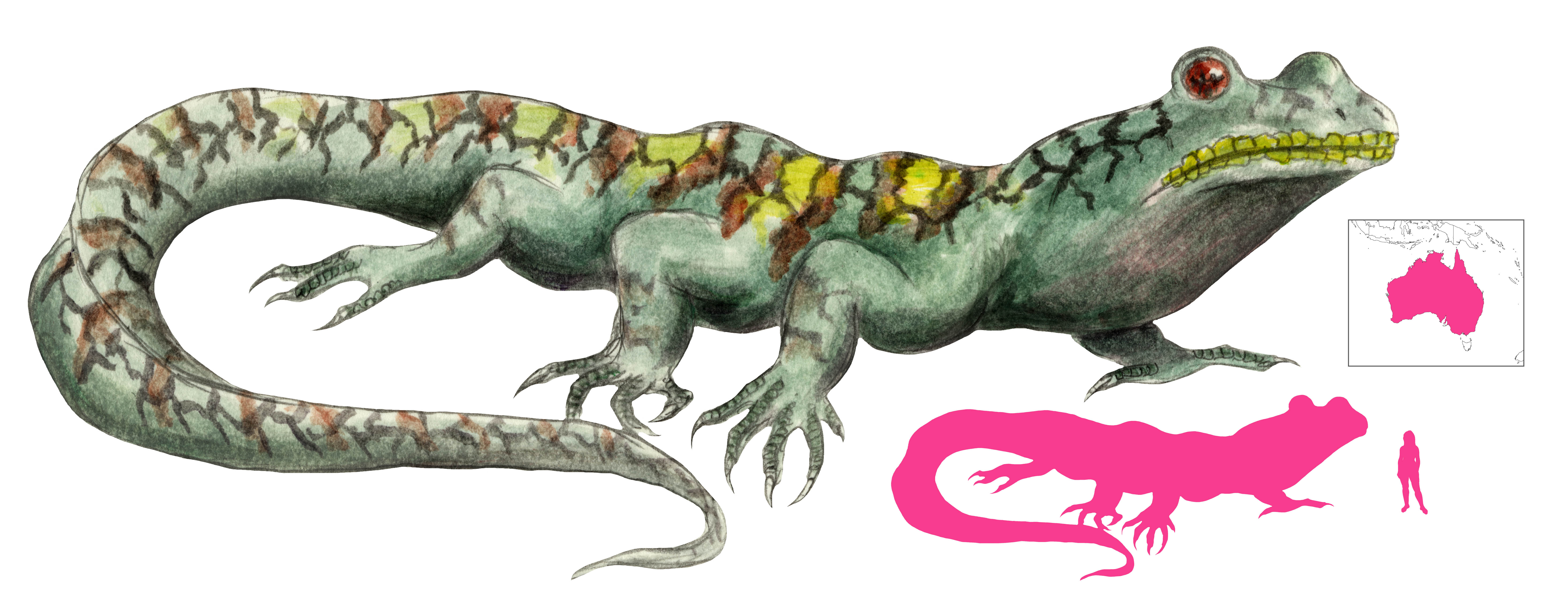
The Whowie was the terror of the Murray River in the Riverina district of Australia. He was like an enormous goanna, about twenty feet long, with six goanna legs and a huge frog-like head; he was perhaps somewhat like the huge monitor lizards that once roamed southern Australia. While very slow in his movement, he had no reason to be fast, as everyone fleed in terror from him. At night, the whowie would crawl into grounds where people were sleeping, and proceed to devour anyone who couldn’t get away. Thirty to sixty people could disappear down his cavernous mouth during one of those raids. During the day he would sleep in his cave on the Murray River, or bask along the riverbank; his movements created the sandhills of Riverina.

With the passage of time, the depredations of the whowie were starting to take their toll on the inhabitants. The water-rat tribe was first to convene, as they had suffered most from the whowie’s attention. The chief solemnly announced that they had no choice but to flee to a safer land or face certain annihilation. “I shall let you decide what we shall do”, he told his people. It was an elder who stood up and implored his people to stay. “We have lived here all our lives; we have always had plenty to eat, and much to do along the river. Now we dare not go there because of the whowie. Let us think of some other way by which we may be rid of this menace”.

A strict night guard was instated, and the aid of several other tribes was called for. The water-rats searched for the whowie, and found footprints leading into the cave’s one opening. As the whowie’s cave was many miles long, they knew it would take a week for him to return to the outside, and so they had all the time they needed.

Soon help had arrived from all over, from the kangaroo, platypus, eagle, magpie, cockatoo, lizard, snake, opossum and crow tribes, and many more besides. After holding a corroboree and spending a night in celebration, dancing, and storytelling, all of them busied themselves gathering sticks. The sticks were gathered into bundles and piled up halfway in the cave and at the entrance. Then, when they believed the whowie was soon to appear, they set the wood on fire.

Smoke and flames filled the cave, and the whowie roared and coughed angrily – but what good were his teeth and claws against smoke and fire? He struggled upwards through the cave for six days and appeared on the seventh burned, blinded, and gasping for breath. That was when the tribes descended upon him with spears, axes, and nulla-nullas, inflicting mortal wounds on their enemy. The giant lizard could only drag himself back into his cave, and was never seen again.

Now the whowie can still be heard sighing from deep inside the cave on the Murray River. He is dying, or perhaps his spirit has survived underground in some form. But either way he is harmless, and has become nothing more than a bogey with whom parents can threaten their children into good behavior.

References

Molnar, R. E. (2004) Dragons in the Dust. Indiana University Press, Bloomington.

Reed, A. W. (1965) Myths and Legends of Australia. A. H. and A. W. Reed, Sydney.

Smith, W. R. (2003) Myths and Legends of the Australian Aborigines. Dover Publications, Mineola.

Nauthveli

Variations: Nauthvalur, Nautshval (Ox-whale); Nautfiskur (Ox-fish); Kýrhvalur (Cow-whale); Fjósi (Byre-whale); Baulhveli (Bellow-whale); Búrhvalur, Sperm Whale

Nauthveli

The Nauthveli or Nauthvalur (“Ox-whale”) is one of the many illhveli or “evil whales” of Iceland. It is the second biggest of the evil whales, and like the others, it is inedible and will show up if its name is said out loud.

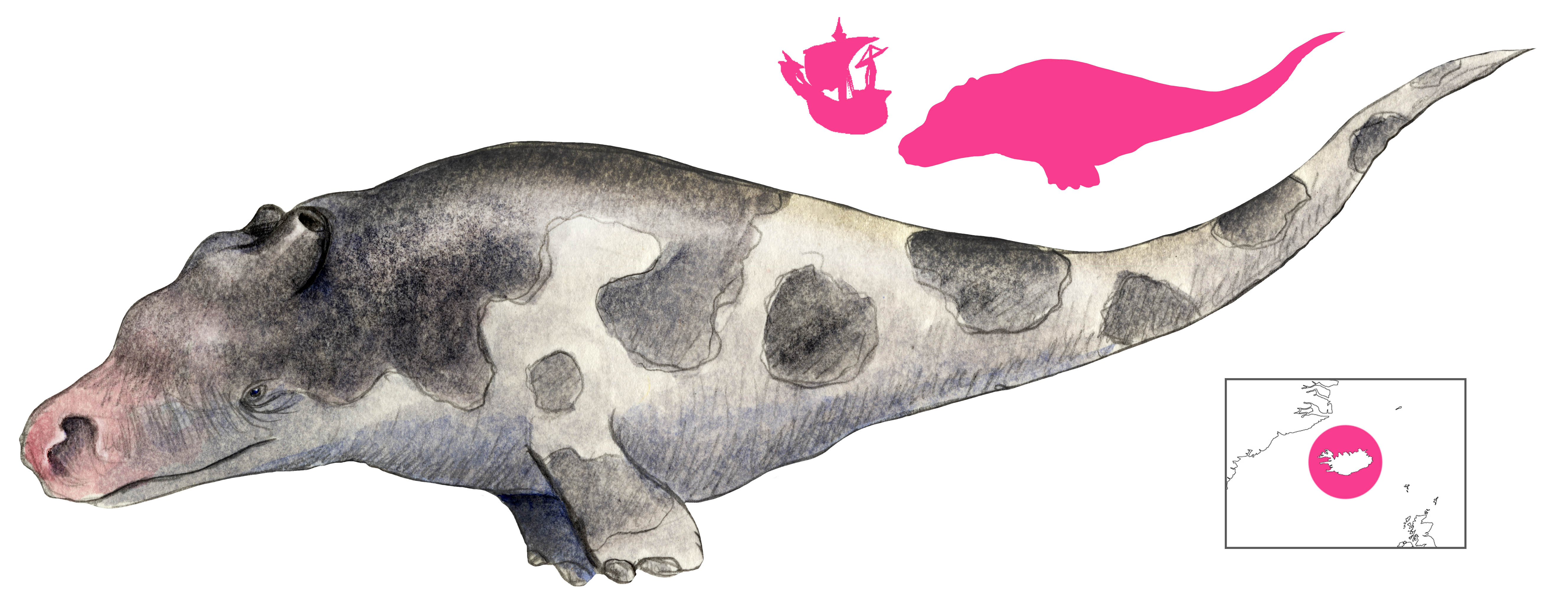
A nauthveli is a toothed whale, bicolored much like a cow. The large head is similar to that of a bull and has two nodules on top. The trunk tapers off, wormlike, and lacks fins.

However, the nauthveli is named not for its appearance, but rather for the terrifying bull-like bellow it makes when hungry, a sound like that of roaring, maddened bulls. The call of a nauthveli is made in the open sea or near the shore, and can be heard reverberating over long distances. The vibrations cause the ground to shake and knock oars out of sailors’ hands. Going out to sea is forbidden if nauthveli bellowing can be heard.

As will all evil whales, the nauthveli delights in killing men and scuttling smaller boats, but it has a particular fondness for beef. The bellow of a nauthveli is hypnotic to cattle, compelling them to run off cliffs and headlong into the sea. There the nauthveli plays with them like a cat does with a mouse before biting them in half and eating them. The whales are attracted to cattle on board ship; one nauthveli off Grimsey harassed a vessel until they released the one cow on board, who promptly dove into the sea. Cattle have to be locked up for days until the nauthveli’s spell wears off, and indeed cow-herding was strongly discouraged in areas where nauthvelis had been heard. Sacrificing one bull or cow usually satisfies the nauthveli, making it safe to go out to sea again.

Gudmundsson listed the nauthveli as synonymous with the búrhvalur or sperm whale.

References

Davidsson, O. (1900) The Folk-lore of Icelandic Fishes. The Scottish Review, October, pp. 312-332.

Hermansson, H. (1924) Jon Gudmundsson and his Natural History of Iceland. Islandica, Cornell University Library, Ithaca.

Hlidberg, J. B. and Aegisson, S.; McQueen, F. J. M. and Kjartansson, R., trans. (2011) Meeting with Monsters. JPV utgafa, Reykjavik.

Bonnacon

Variations: Bonasus, Bonasos, Monassos, Monops; Bison, Maned Bison, European Bison, Aurochs, Urus, Urus Bonasus

Bonnacon

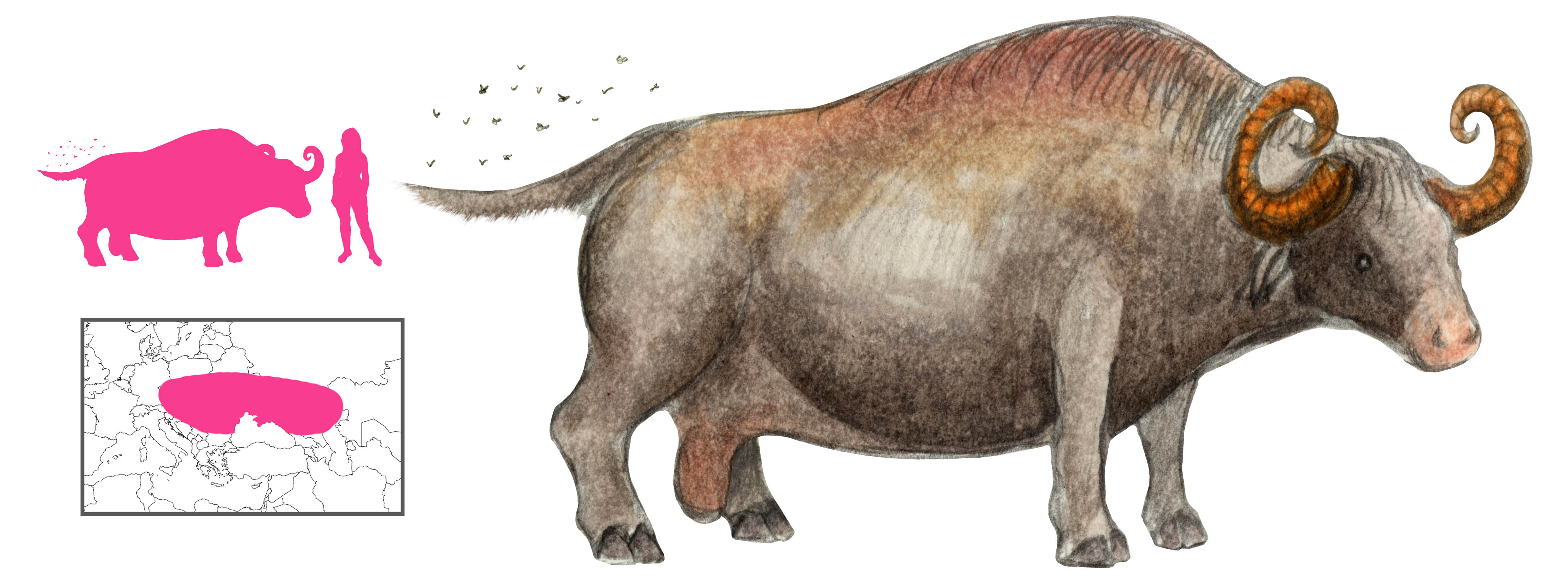
The Bonnacon’s range extends from Scythia in the east to Bulgaria, Macedonia, and Germany in the West. It would be a fine prize for hunters were it not for its remarkable flatulent defenses.

A bonnacon looks like a bull, but is squatter, with reddish fur shading to black, a short tail, and the shaggy mane of a horse. Its horns curl inwardly towards the head, making them of no use in self-defense.

When attacked, the bonnacon voids the contents of its intestines over an area of 3 acres (Aristotle gives a more conservative estimate of 4 fathoms). The noxious, acrid dung ignites and burns anything it touches, leaving a trail of flame in its wake.

The European bison (Bison bonasus) is generally believed to be the basis of the bonnacon.

References

Aelian, trans. Scholfield, A. F. (1959) On the Characteristics of Animals, vol. II. Harvard University Press, Cambridge, Massachusetts.

Cuba, J. (1539) Le iardin de santé. Philippe le Noir, Paris.

Pliny; Holland, P. trans. (1847) Pliny’s Natural History. George Barclay, Castle Street, Leicester Square.

Sainéan, L. (1921) L’histoire naturelle et les branches connexes dans l’oeuvre de Rabelais. E. Champion, Paris.

Unknown. (1538) Ortus Sanitatis. Joannes de Cereto de Tridino.

White, T. H. (1984) The Book of Beasts. Dover Publications, New York.

Zitiron

Variations: Zityron, Zytyron; Albiron; Barchora; Miles; Soldier, Soldier of the Sea, Man-at-arms of the Sea; Soldat de Mer, Gendarme de Mer; Sea Turtle

Zitiron

The Zitiron (perhaps a corruption of Ketos or whale), or Soldier of the Sea, is a heavily armored marine fish. It has a rough and hard skin over its head like a helmet, and a long and wide shield hanging from its neck, attached by thick veins and nerves stretching from neck to shoulders. Its thick arms are two-fingered. It is long and wide, more or less triangular in shape, with a fish’s tail at its end. A zitiron is impervious to arrows, and can only be killed by bludgeoning it with hammers; it defends itself with its armor and with swipes of its strong arms.

Illustrators took the description of armor rather literally, turning the zitiron into a sort of merman encumbered with full plate armor, helmet, shield, and sword.

It is not hard to see a turtle in the zitiron’s description. Turtle shells have also been used as shields by various cultures, making the resemblance even more appropriate. Albertus Magnus asserted that Flemish and German fisherman give the name of “soldier” to turtles, because they have a helmet and a shield. The desire to see analogues of terrestrial entities in the sea completed the zitiron.

References

de Cantimpré, T. (1280) Liber de natura rerum. Bibliothèque municipale de Valenciennes.

Paré, A. (1614) Les Oeuvres d’Ambroise Paré. Nicolas Buon, Paris.

Magnus, A.; Kitchell, K. F. and Resnick, I. M. trans. (1999) On Animals: A Medieval Summa Zoologica, v. II. The Johns Hopkins University Press, Baltimore.

Unknown. (1538) Ortus Sanitatis. Joannes de Cereto de Tridino.

Vallot, M. (1834) Mémoire sur le Limacon de la Mer Sarmatique. Mémoires de L’Académie des Sciences, Arts, et Belles-Lettres de Dijon, Partie des Sciences, Frantin, Dijon.

Hrosshvalur

Variations: Hrosshvalr, Hrosshualar, Hrosshveli, Rosshvalur, Equinus Cetus, Horse-whale; Saehestur (Sea Horse); Stökkull (Jumper, probably erroneously); Stori Svinhvalur (Large Pig-whale); Pollur (Tenacious One); Monoculus

Hrosshvalur

The Hrosshvalur, or “Horse-whale”, is among the most cruel and dreaded of the Icelandic illhveli, or “Evil Whales”. Only the Stökkull and Raudkembingur rival it in malice. It is irredeemably evil and is unfit for eating, its flesh vanishing from the pot if cooked, and its consumption was banned by law.

The hrosshvalur is easily confused with its fellow illhveli; notably, it has a red crest similar to the raudkembingur, and tends to jump onto ships like the stökkull. It is distinguished from those two by its enormous eyes, which have earned it the nickname of Monoculus (“One-Eyed”). It earned its name from a somewhat equine head, a flowing red mane covering more or less of its neck, a horse’s tail, and a call like a horse neighing. It also smells bad, is covered with fine fur, and its insides are like those of a horse. Jon Gudmundsson, who confused it with the stökkull, depicted it with a dappled back. These whales grow 30 to 80 cubits (15 to 40 meters) long.

As with other illhveli, the hrosshvalur delights in destroying ships. A hrosshvalur will charge over the waves at high speed, holding its head just above the water with its mane trailing behind. These whales sink ships by jumping onto them, or pressing their weight on them until they capsize. Horse-whales are also portents of bad weather, and can create huge waves by whipping their tails. A number of euphemistic names are used to refer to horse-whales, to avoid attracting their attention. While not as easily distractable as raudkembingurs and stökkulls, their large eyes are a notable weakness.

In the 13th century, a hrosshvalur that surfaced alongside a ship was bombarded with every heavy implement available, which caused it to sink back below the waves. Another hrosshvalur attacked the heroes Hjalmper and Olvir; it was defeated with the help of a Skeljungur (“shell whale”), vagnhvalur (“chariot whale”, or killer whale), and two vultures. A cutlass thrown into one of its large eyes weakened it significantly, and it was torn apart by the whales.

Hrosshvalurs are also associated with the dark arts. The size and ferocity of the horse-whale made it an excellent accomplice for sorcerers and witches bent on destruction, and a perfect form to assume when causing chaos. In the Kormaks saga, the witch Dorveig transforms herself into a hrosshvalur to attack the brothers Kormakr and Dorgils. They recognize her from her eyes, and drive her off by throwing a javelin into her back.

It is generally believed that the hrosshvalur was derived from the walrus, and ultimately gave it its name by converting hval-hross to walrus. However, it was clear early on that it and the walrus were very different animals, as Gudmundsson separately describes both the hrosshvalur and the walrus (rostungur) in detail.

References

Davidsson, O. (1900) The Folk-lore of Icelandic Fishes. The Scottish Review, October, pp. 312-332.

Dillmann, F. Les Yeux de Dorveig: À propos de la métamorphose en hrosshvalr d’une sorcière de la Kormaks saga. In Heizmann, W. and van Nahl, A. (2003) Runica – Germanica – Medievalia. Walter de Gruyter, Berlin.

Fraser, F. C. An Early 17th Century Record of the Californian Grey Whale in Icelandic Waters. In Pilleri, G. (1970) Investigations on Cetacea, vol. II. Benteli AG, Bern.

Hermansson, H. (1924) Jon Gudmundsson and his Natural History of Iceland. Islandica, Cornell University Library, Ithaca.

Hlidberg, J. B. and Aegisson, S.; McQueen, F. J. M. and Kjartansson, R., trans. (2011) Meeting with Monsters. JPV utgafa, Reykjavik.

Larson, L. M. (1917) The King’s Mirror. Twayne Publishers Inc., New York.

Sarmatian Sea Snail

Variations: Sarmatian Snail, Limaçon de la Mer Sarmatique, Philosmon (Greek, potentially), Aknib (Turkish, potentially), Albakr (Tartar, potentially), Lucrab (Arabic, potentially), Cochlea Sarmatica

Sarmatian Sea Snail

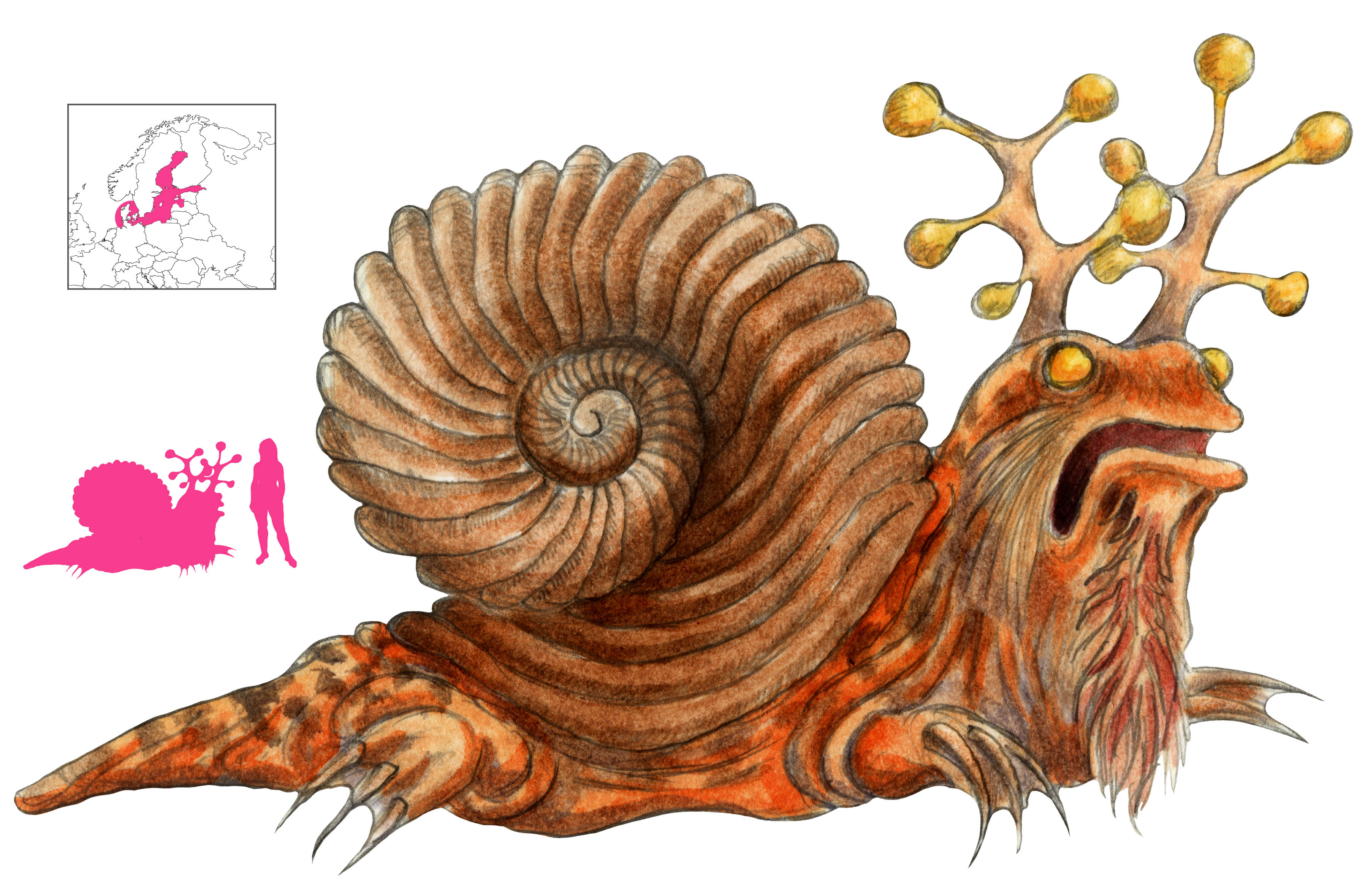
Anyone wishing to make a book on monstrous fishes should head to the Sarmatian Sea, exhorts Thevet. There, in what is now known as the Baltic Sea, may be found enough nightmares to satisfy the most avid teratologist.

One of these is an enormous snail, the size of a barrel. It has antlers like those of a stag, equipped with gleaming, pearl-like tips. It has a rounded cat-like snout with whiskers, and glowing eyes that light its path like candles. Its mouth is deeply slit, and a hideous fleshy excrescence dangles below it. Its neck is thick, and its tail is long, multicolored, and mottled like a tiger’s. Unlike most other snails, it has four feet armed with hooked claws.

While amphibious, the giant snail is usually out in the open sea, and is rarely seen on the coast due to its wariness.  During good weather it will crawl up onto the beach to graze. Its flesh is tasty and good to eat, and helps against liver and lung problems, much like the meat of large Madagascan turtles cures leprosy.

Thevet reports the Sarmatian Sea snail from Denmark, and mentions having seen similar creatures in the Black Sea, where they are known as Philosmon by the Greeks, Aknib by the Turks, Albakr by the Tartars, and Lucrab by the Arabs. These may well be the same animal.

Linnaeus cautiously included the Sarmatian Sea snail as Cochlea Sarmatica in a footnote, admitting that “fabulosa est“.

It is most likely that this giant snail was born of confusion between the shells of turtles and the shells of snails. Thevet was also working with a number of notes taken at different times, and it does not seem implausible that he muddled them together to create chimeras. Turtles were long seen as bizarre creatures, and the Ortus Sanitatis represents them as snails with legs, making them the basis for the giant snail. Further confusion with seals led to the whiskers and large eyes, and the antlers were provided by branching fungi. For all we know, none of these were from the Baltic Sea.

References

Linnaeus, C. (1759) Animalium Specierum. Theodor Haak, Leiden.

Paré, A. (1614) Les Oeuvres d’Ambroise Paré. Nicolas Buon, Paris.

Thevet, A. (1575) La Cosmographie Universelle. Guillaume Chaudiere, Paris.

Unknown. (1538) Ortus Sanitatis. Joannes de Cereto de Tridino.

Vallot, M. (1834) Mémoire sur le Limacon de la Mer Sarmatique. Mémoires de L’Académie des Sciences, Arts, et Belles-Lettres de Dijon, Partie des Sciences, Frantin, Dijon.

Aloés

Aloes

The Aloés is a large fish from the Caribbean around Hispaniola, reported by Thevet. It looked like a goose in general shape, with the top of its skull in the shape of a bon-chrétien (Williams) pear. It had four underslung fins, a fish-like tail, and no scales on its plump body. Several could be observed swimming alongside the boats, along with shoals of fish, and they looked remarkably like geese diving in and out of the waves.

References

Paré, A. (1614) Les Oeuvres d’Ambroise Paré. Nicolas Buon, Paris.

Thevet, A. (1575) La Cosmographie Universelle. Guillaume Chaudiere, Paris.