Bès Kěmwar

Variations: Hantu Ulat (Malay), Maggot Spirit, Riverside Maggot Spirit, Tip-of-Leaf Maggot Spirit, Caterpillar Spirit; Bès Kěmwar Jě’la, Hantu Ulat Duri, Thorny Maggot Spirit; Bès Kěmwar Sòk, Hantu Ulat Bulu, Hairy Caterpillar Spirit; Bès Kěmwar Těrbang, Hantu Ulat Terbang, Flying-Maggot Spirit
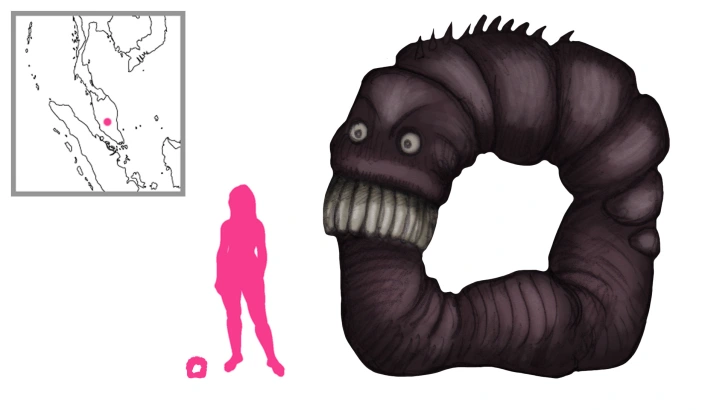
Bes Kemwar

The Bès Kěmwar, “maggot spirit”, is one of the many bès or disease spirits known to the Jah Hut of Malaysia. A polyvalent spirit, it is depicted as a maggot or caterpillar, with variants distinguished by hair, thorns, wings, and other details. It eats rice, vegetables, and other crops. It is responsible for aches in bones, joints, and muscles. If its caterpillar hair falls into water and that water is drunk, it causes coughing and bleeding in the throat. Maggot spirits are also known to live in rotten tree trunks and feed in them. Anyone who approaches the fallen tree will be bitten in the leg by the spirit, causing redness, swelling, and itching. All the toenails fall off but the swelling will be gone by two or three months.

The riverside maggot spirit lives by the river and appears only during the jungle-fruit season in February. It flies onto the heads of old people and causes all their hair to fall off.

The tip-of-leaf maggot spirit feeds on the leaves of coconut and rice. To prevent this attack on crops, a pawang must bless the plants with a pounded mixture of daun setawa and kunyit mulai, which is burned to ashes and scattered over the plantation.

Bès Kěmwar Jě’la, the thorny-maggot spirit, lives on leaves. It causes restlessness and rheumatism.

Bès Kěmwar Sòk, the hairy caterpillar spirit, lives on the tips of tree branches. Its hair drops into drinking water and causes irritation and swelling in the throat. This affliction can be cured by a poyang while in its early stages, but untreated victims will eventually die as they cannot eat or drink.

Bès Kěmwar Těrbang, the flying-maggot spirit, lives in bushes and eats the leaves of the daun mengkirai tree. Its urine and stool falls on anyone who passes under the tree, causing the victim to become bald and swollen. In the evening it flies onto the roofs of houses and opens them up. Children seeing its eyes reflecting like mirrors will be terrified into crying. Burning daun-kesim keeps this nocturnal nuisance away.

References

Werner, R. (1975) Jah-hět of Malaysia, Art and Culture. Penerbit Universiti Malaya, Kuala Lumpur.

Bès

Variations: Hantu (Malay)

The Bès are the evil spirits of the Jah Hut, an Orang Asli people from peninsular Malaysia. They are true spirits, existing independently and not emerging from humans alive or dead. The vast majority of bès, or hantu as they are known in Malay, are malevolent beings associated with disease. Far less numerous than the bès are the jin (underground spirits), nabi (guardian spirits), and kemoch (spirits of the dead).

All the bès were created along with ‘iblis, the evil one, by Proman, God’s assistant, who botched the creation of the first man. Their great stronghold is a Pauh Janggi Bringin Sungsang, a “Giant Mango Tree Entwined by a Strangler Fig”, that stands beyond the ocean. From there they sally forth to cause all kinds of trouble. God allows it because the bès keep the world in balance, taking life that others may in turn live.

Sickness is caused by the influence of the bès. This usually happens by night – while we sleep, our soul leaves our body and wanders in the jungle. A bès who finds that soul will prevent it from returning, and the owner of the soul will fall ill.

Healing is the duty of the puyang or medicine man. It is their job to locate the missing soul and return it with the help of the good spirits, otherwise their charge will die. The běni’sòy ceremony is used in those cases. It involves drawing the evil spirits out of the body and transferring them into a palm leaf bundle brushed over the skin. Once the bès is trapped, the bundle can be safely disposed of.

Spiritual wood carvings of the bès in question are made to help draw the evil spirit out. These carvings establish an iconography for the bès and allow us to see them as the Jah Hut do.

References

Teoh, B. S. (1986) Bes Hyang Dney: A Jah Hut Myth of Peninsular Malaysia. Journal of the Malaysian Branch of the Royal Asiatic Society, 59(2), pp. 139-144.

Werner, R. (1975) Jah-hět of Malaysia, Art and Culture. Penerbit Universiti Malaya, Kuala Lumpur.
Bès Bulong

Variations: Hantu Bulong (Malay), Bulong, Spirit Bulong

Bes Bulong

Bès Bulong, the spirit Bulong or simply Bulong, is a bès or spirit from the folklore of the Jah Hut people of Malaysia. It walks around by night. If it sees anyone walking about between midnight and 6:00 AM, it will pull out that person’s soul and leave them unconscious.

References

Werner, R. (1975) Jah-hět of Malaysia, Art and Culture. Penerbit Universiti Malaya, Kuala Lumpur.
Bayfart

Bayfart

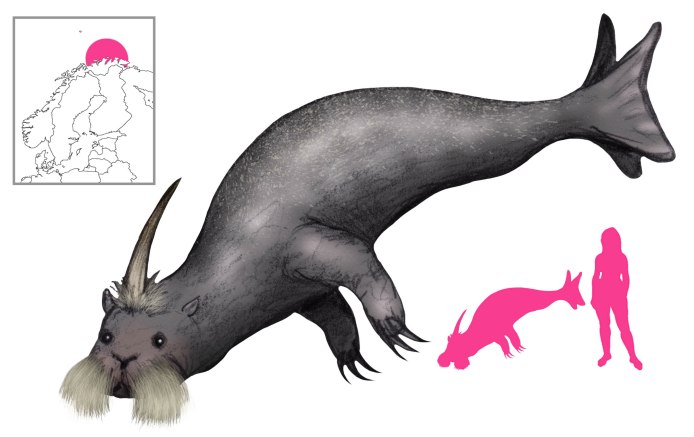
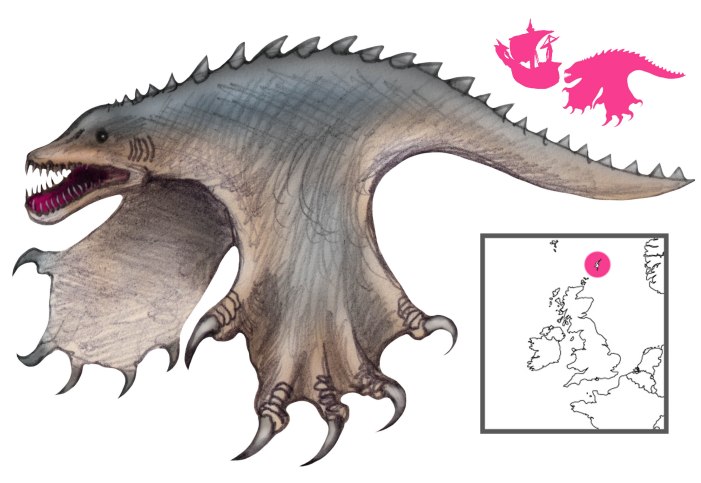
The Bayfart is an animal whose existence is reported by the inhabitants of Finnmark. It is something like a seal, roughly the same size and shape. Its fur is greyish. It has small ears and a single horn on its head surrounded by hair, and hog-like bristles around its nose. Its forelegs have claws as long as a lion’s, while its has two flippers for hind legs.

Thevet received a bayfart skin from a Scotsman, who obtained it in Denmark in 1570. It had been caught in the Northern Sea.

References

Thevet, A. (1575) La Cosmographie Universelle. Guillaume Chaudiere, Paris.

Bès Dangon

Variations: Hantu Punggong (Malay), Buttock Spirit

Bes Dangon

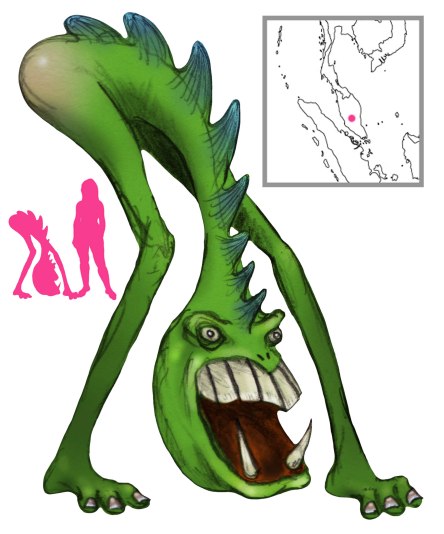
The Bès Dangon, “buttock spirit”, is a bès or spirit from the folklore of the Jah Hut people of Malaysia. It lives on the top of coconut trees, and the heat of its urine and stool eventually kills the trees. Anyone who tries to climb an inhabited tree is kicked back down.

References

Werner, R. (1975) Jah-hět of Malaysia, Art and Culture. Penerbit Universiti Malaya, Kuala Lumpur.
Bregdi

Bregdi

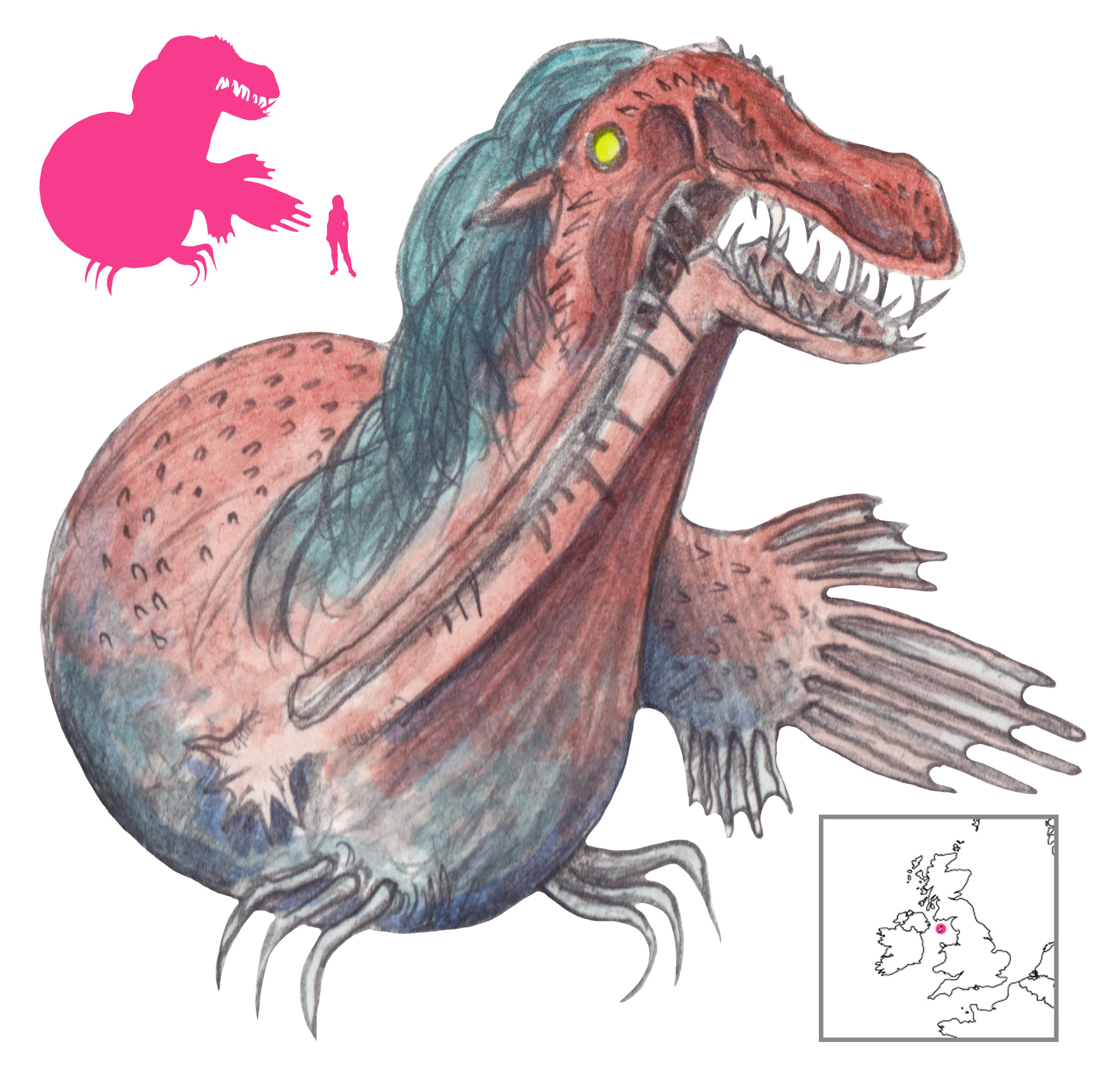
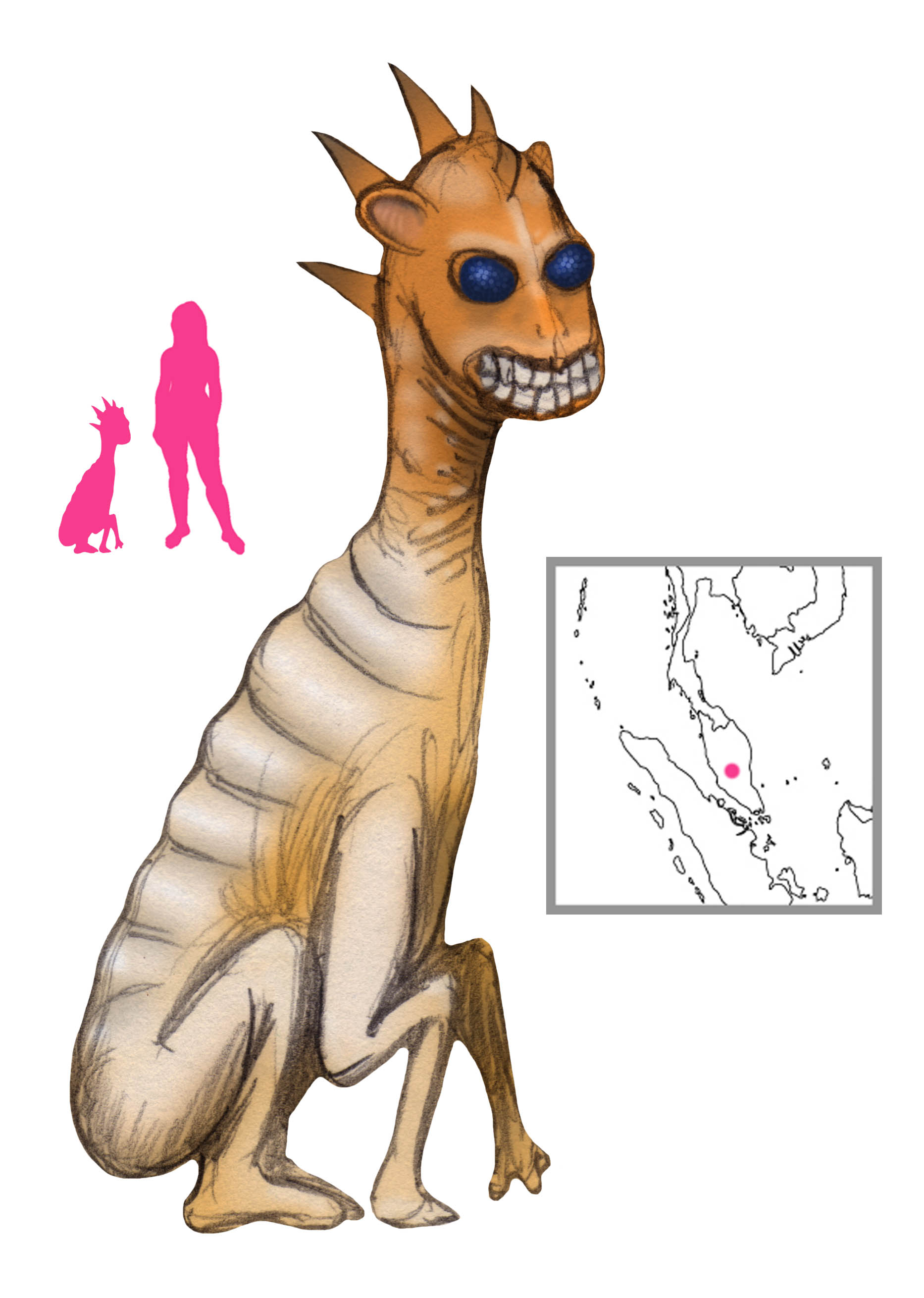
A malicious sea monster from Shetland waters, the Bregdi is feared for its habit of chasing boats. Once it has caught up with a boat, it wraps its long fins around it, putting them up over the gunwales, and dives with the boat in its deadly embrace.

Fortunately a bregdi’s attentions can be deterred in two ways. Like many other supernatural creatures, the bregdi hates the touch of cold steel. A simple skuni (knife) is more than enough to combat it. Slashing the fins as soon as they appear over the gunwales will make it let go and flee. It is also terrified of amber beads, and a single amber bead thrown at a bregdi is enough to scare it off.

References

Angus, J. S. (1914) A Glossary of the Shetland Dialect. Alexander Gardner, Paisley.

Fleming, M. (2002) Not of this World: Creatures of the Supernatural in Scotland. Mercat Press, Edinburgh.

Bès Jě’la Kòy

Variations: Hantu Kepala Berduri (Malay), Spiky-head Spirit

The Bès Jě’la Kòy, “spiky-head spirit”, is one of many bès or spirits from the folklore of the Jah Hut people of Malaysia. It lives on top of termite hills and knows how long every person will live. If it judges that a person’s lifespan is too short, it will take them into the termite hill to be friends with it forever.

A spiky-head spirit takes one person a year into its termite hill.

References

Werner, R. (1975) Jah-hět of Malaysia, Art and Culture. Penerbit Universiti Malaya, Kuala Lumpur.
Bøjg

Variations: Boyg, Bøjgen, Bojgen, Bøygen, Boygen, The Great Bøjg of Etnedal

Bojg

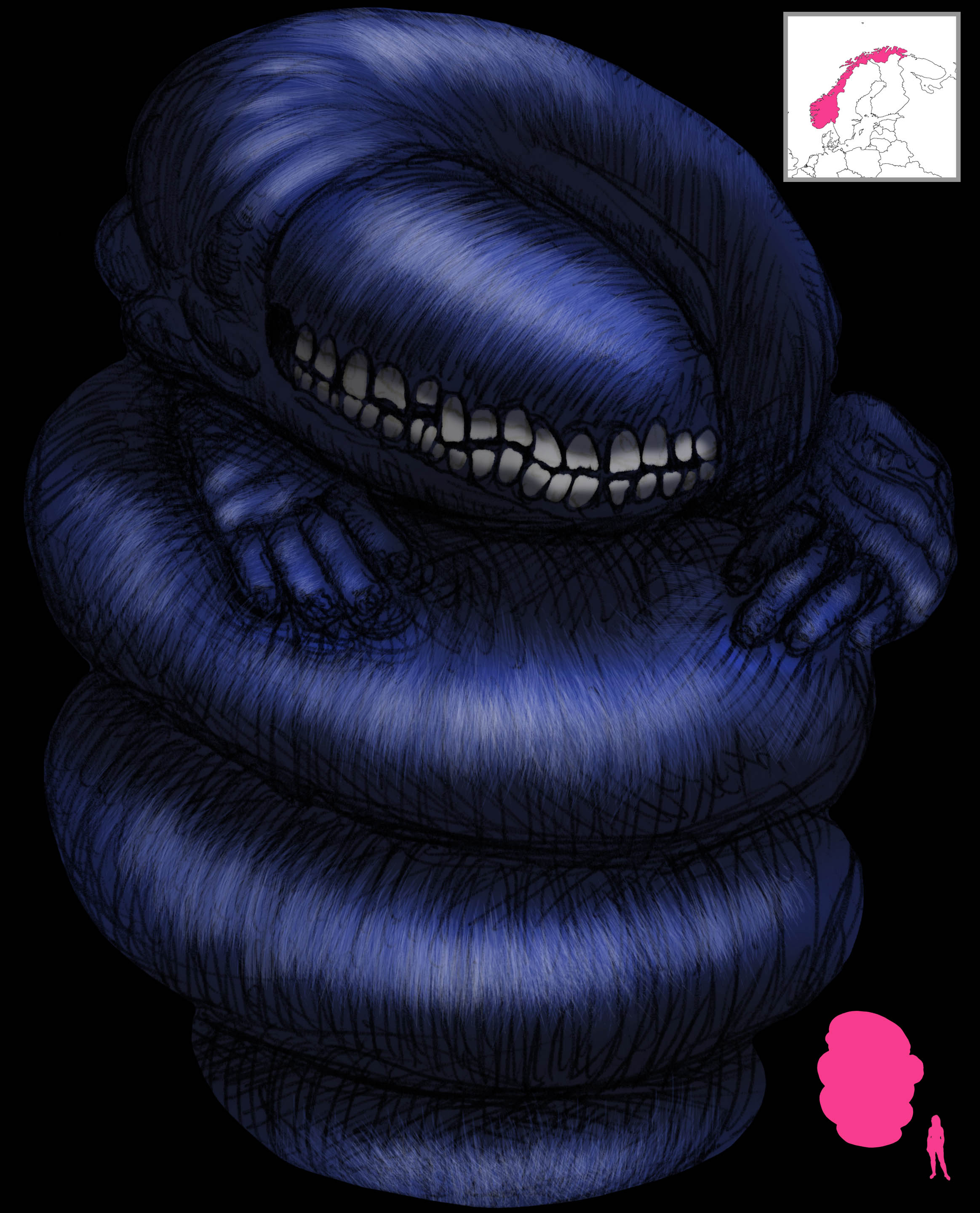
The Great Bøjg of Etnedal is a troll encountered by Peer Gynt in his Gutsbrandal adventures. It was memorable enough that Ibsen included it in his version of Peer Gynt, making it an even more otherworldly creature.

The Bøjg is vast, slimy, slippery, persistent, and shapeless. In the original fairytale, it has a head, which lessens its shapelessness somewhat. Ibsen describes it as a misty, slimy being, neither dead nor alive. Running into it is like running into a nest of sleepy growling bears. Its name comes from bøje, to bend, implying something twisting but also something that forces you to turn elsewhere, conquering without attacking. It coils around houses in the dark, or encircles its victims and bewilders them. Attacking the Bøjg directly is futile.

Wherever Gynt turns, he finds himself running into the clammy unpleasant mass. The Bøjg blocks his path to a mountain hut and nothing Gynt does can defeat it. In the fairytale Gynt fires three shots into the Bøjg’s head but to no avail; he eventually defeats the Bøjg through trickery. In Ibsen’s play the Bøjg is overcome by women, psalms, and church bells.

Within Ibsen’s symbolism it is seen as an insurmountable obstacle, a being of compromise and lethargy.

References

Hopp, Z.; Ramholt, T. trans. (1961) Norwegian Folklore Simplified. Iohn Griegs Boktrykkeri, Bergen.

Ibsen, H., Watts, P. trans. (1970) Peer Gynt. Penguin Books, Harmondsworth.

Bifang

Variations: Bifang-bird

Bifang

The Bifang can be found on barren Mount Zhang’e in China. It looks like a crane but has only one leg; it has a white beak and red markings on a green background. Its call sounds like its name.

A bifang is an omen of inexplicable fire starting in town. This is probably connected to its red color. It was not always an evil omen, however, as it appears as a benevolent attendant of the Yellow Thearch in the Master Hanfei, and is the divine essence of wood in the Master of Huainan.

Some sources have the bifang itself as the arsonist, using fire it carries in its beak. Mathieu equates it with the Chinese crane, whose habit of standing on one leg may have inspired the bifang’s appearance.

References

Mathieu, R. (1983) Étude sur la mythologie et l’ethnologie de la Chine ancienne. Collège de France, Paris.

Strassberg, R. E. (2002) A Chinese Bestiary: Strange Creatures from the Guideways Through Mountains and Seas. University of California Press.

Beisht Kione Dhoo

Variations: [Yn] Beisht [y] Kione Dhoo ([The] Beast of [the] Black Head); [Yn] Beisht Kione ([The] Beast of Head) (erroneously)

Beisht Kione Dhoo

Fishermen on the Isle of Man have traditionally observed a number of customs. Whistling on board “bothers the wind” and is discouraged. Sticking a knife in the mast on the appropriate side causes the wind to blow from that direction. Losing items on board is bad luck; borrowing items from “lucky” boats brings good luck. Four-footed land animals should not be mentioned by name, but instead by a circuitous sea-name – rats, for instance, are “long-tailed fellows”. Cold iron is a remedy to most acts of bad luck.

Then there is a number of sea creatures that can wreak havoc on fishing vessels. Of the the Beisht Kione Dhoo, the Beast of Black Head, is the most terrifying. It makes its home in the sea-caves on Black Head, near Spanish Head at the southern tip of the Isle of Man. The few who have seen it say it has a head like that of a large horse, and it can be heard roaring by fishermen off Spanish Head. Some say it is the soul of a man killed by pirates in order to protect their treasure hidden in the headland’s caves. Nobody has attempted to claim that treasure.

To placate the Beisht and bring on good luck, rum is left in the cave at Spanish Head. Fishermen heading out to sea would throw a glassful of rum overboard in hopes that the Beisht will grant them a bountiful catch.

References

Broderick, G. (1984) A Handbook of Late Spoken Manx: Grammar and Texts. Max Niemeyer, Tübingen.

Killip, M. (1976) The Folklore of the Isle of Man. Rowman and Littlefield, New Jersey.

Rose, C. (2000) Giants, Monsters, and Dragons. W. W. Norton and Co., New York.