Tsemaus

Variations: Tsemaus, Chemouse, Narhnarem-tsemaus, Snag, Supernatural Snag, Tsem’aus, Tcamaos, Tca’maos, Tidewalker, Ts’um’os, Tsamaos, Kanem Ktsem’aus; Weegyet, Wi’git
Tsemaus

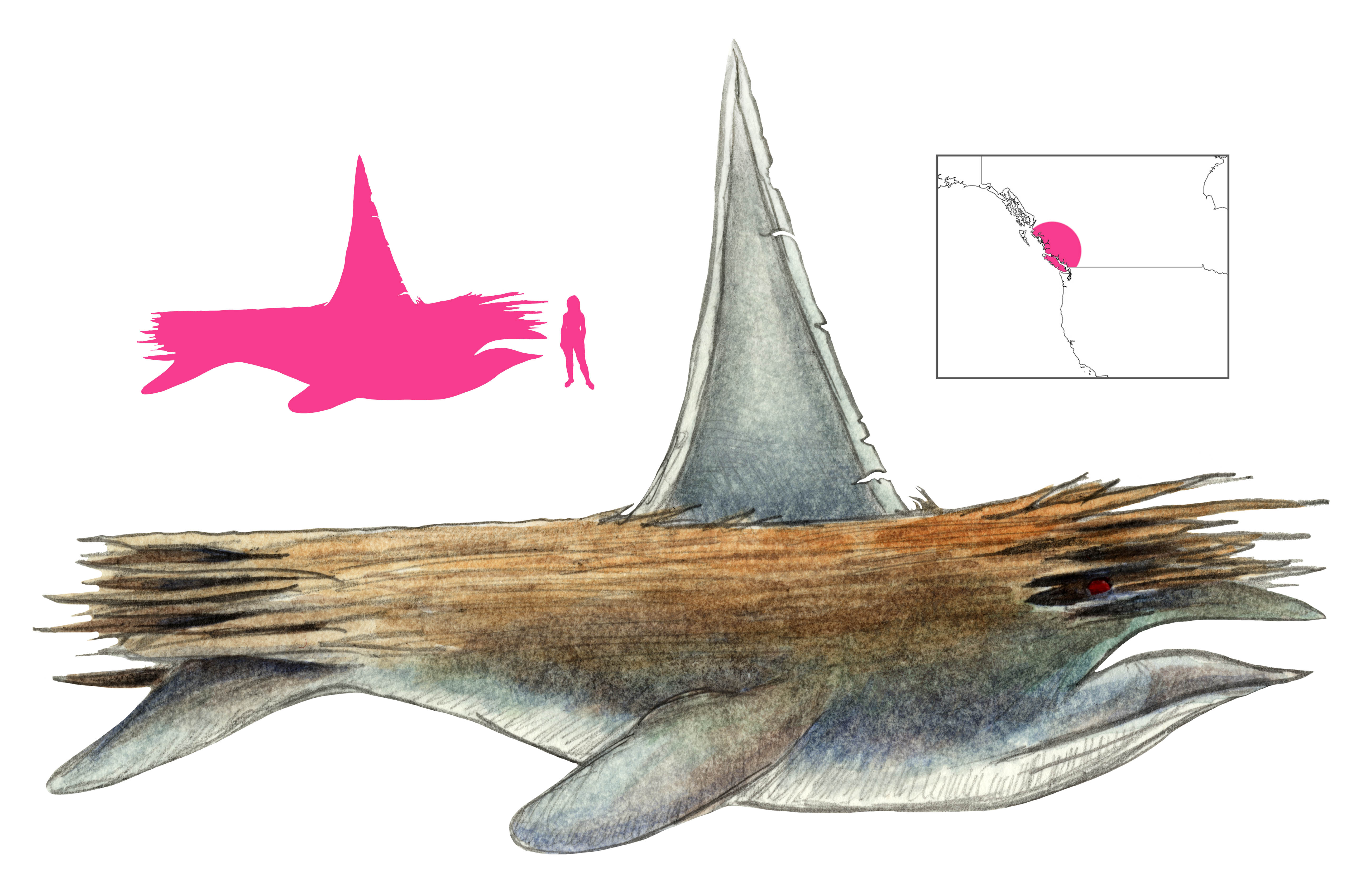
The Tsemaus (“Snag”) or Narhnarem-Tsemaus (“Supernatural Snag”) is the personification of river snags., floating logs, and other hazards of the water. It is found in the folklore and art of the Pacific Northwest, notably in Tsimshian and Haida culture around the mouth of the Skeena River.

One of its names, Wi’git or Weegyet, connects it to Raven the trickster, and it is one of his many forms. The creator and trickster Nanki’islas also assumed the form of a tsemaus after he was done.

A tsemaus can vary a lot in appearance, much like the driftwood it imitates, but it almost always has a snag for a dorsal fin – or is itself a snag. It can be as simple as a dead log with a tail that can swim against the current. It can be a huge sea lion with dorsal fins and blowholes, or an enormous grizzly bear with a downturned mouth like a dogfish and two sharp snags protruding from its back, with or without one or more sharp fins of a killer whale. It can be a hybrid of bear and killer whale, or raven and killer whale, with multiple bodies. It can be a large frog covered in seaweed with a snag sticking out of its back, and can even be a canoe or a schooner. Meurger states that it can cleave swimmers with its fin.

The tsemaus uses its fin to destroy boats. It has no problem swimming upstream and plowing through log jams. If angered it breaches and lands on canoes, smashing them to bits, or makes huge waves to capsize boats. It drowns people, who then become killer whales.

It is found as a crest on the totem poles of the coastal clans.

References

Barbeau, M. (1950) Totem poles. Bulletin No. 119, Anthropological Series No. 30, National Museum of Canada, Ottawa.

Barbeau, M. (1953) Haida Myths Illustrated in Argillite Carvings. Bulletin No. 127, Anthropological Series No. 32, National Museum of Canada, Ottawa.

Boas, F. (1951) Primitive Art. Capitol Publishing Company, New York.

Deans, J. (1893) Totem Posts at the World’s Fair. The American Antiquarian and Oriental Journal, Vol. XV, No. 4, pp. 281-286.

Meurger, M. (1988) Lake Monster Traditions: A Cross-Cultural Analysis. Fortean Tomes, London.

Swanton, J. R. (1909) Contributions of the Ethnology of the Haida. Memoirs of the American Museum of Natural History, Vol. VIII.
Qiqirn

Variations: Quiquern

Qiqirn

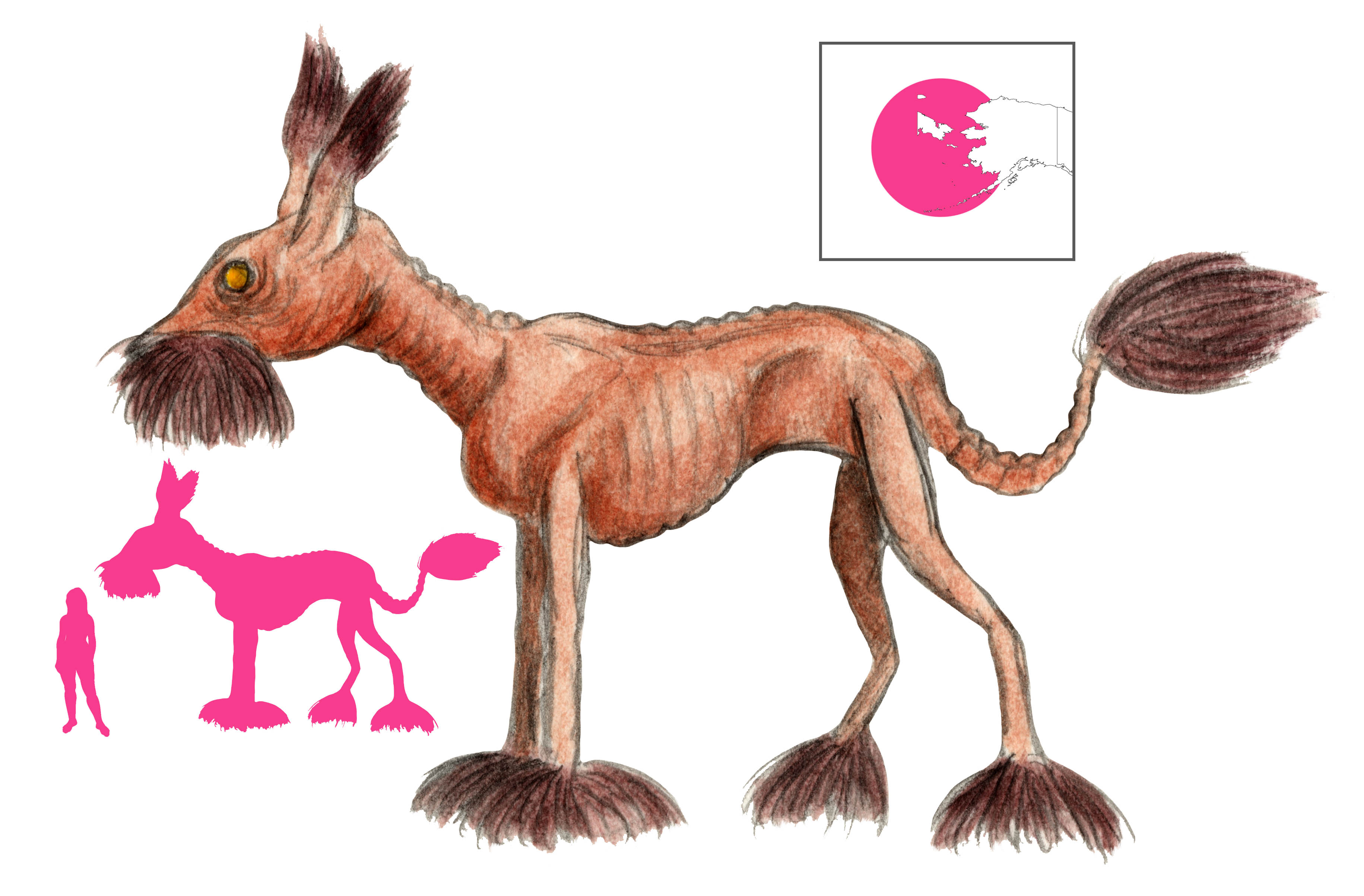
The Qiqirn is a huge dog of Inuit folklore. It is hairless except for its mouth, feet, and ear and tail tips. The mere presence of a qiqirn around men or dogs causes them to suffer fits, a state which ends only when the qiqirn leaves. However, the qiqirn is also extremely scared of humans, and will run away if an angakoq sees it.

Merkur suggests that the “fits” induced by the qiqirn’s presence may be a symbolic reference to shamanic initiation. It shares this feature with the initiatory bear spirit of Baffin Island.

In the Second Jungle Book, the qiqirn – as Quiquern – appears in a snowstorm as an enormous, toothless, and hairless dog, with two heads and eight pairs of legs. He leads two Inuit hunters towards more fruitful lands, and proves to be two sled dogs tied together.

References

Boas, F. The Central Eskimo. In Powell, J. W. (1888) Sixth Annual Report of the Bureau of Ethnology. Government Printing Office, Washington.

Kipling, R. (1921) The Second Jungle Book. Doubleday, Page & Company, Garden City.

Merkur, D. (1991) Powers Which We Do Not Know. University of Idaho Press, Moscow.

Whowie

Variations: Whowhie

Whowie

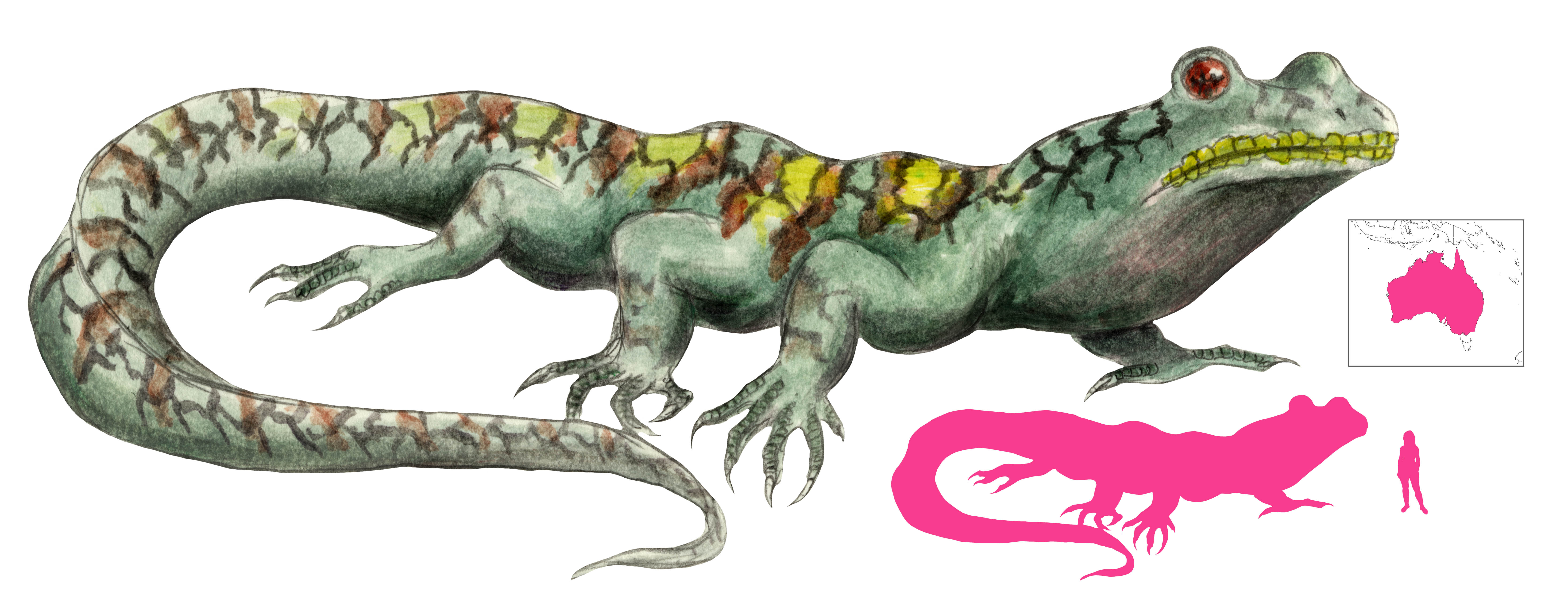
The Whowie was the terror of the Murray River in the Riverina district of Australia. He was like an enormous goanna, about twenty feet long, with six goanna legs and a huge frog-like head; he was perhaps somewhat like the huge monitor lizards that once roamed southern Australia. While very slow in his movement, he had no reason to be fast, as everyone fleed in terror from him. At night, the whowie would crawl into grounds where people were sleeping, and proceed to devour anyone who couldn’t get away. Thirty to sixty people could disappear down his cavernous mouth during one of those raids. During the day he would sleep in his cave on the Murray River, or bask along the riverbank; his movements created the sandhills of Riverina.

With the passage of time, the depredations of the whowie were starting to take their toll on the inhabitants. The water-rat tribe was first to convene, as they had suffered most from the whowie’s attention. The chief solemnly announced that they had no choice but to flee to a safer land or face certain annihilation. “I shall let you decide what we shall do”, he told his people. It was an elder who stood up and implored his people to stay. “We have lived here all our lives; we have always had plenty to eat, and much to do along the river. Now we dare not go there because of the whowie. Let us think of some other way by which we may be rid of this menace”.

A strict night guard was instated, and the aid of several other tribes was called for. The water-rats searched for the whowie, and found footprints leading into the cave’s one opening. As the whowie’s cave was many miles long, they knew it would take a week for him to return to the outside, and so they had all the time they needed.

Soon help had arrived from all over, from the kangaroo, platypus, eagle, magpie, cockatoo, lizard, snake, opossum and crow tribes, and many more besides. After holding a corroboree and spending a night in celebration, dancing, and storytelling, all of them busied themselves gathering sticks. The sticks were gathered into bundles and piled up halfway in the cave and at the entrance. Then, when they believed the whowie was soon to appear, they set the wood on fire.

Smoke and flames filled the cave, and the whowie roared and coughed angrily – but what good were his teeth and claws against smoke and fire? He struggled upwards through the cave for six days and appeared on the seventh burned, blinded, and gasping for breath. That was when the tribes descended upon him with spears, axes, and nulla-nullas, inflicting mortal wounds on their enemy. The giant lizard could only drag himself back into his cave, and was never seen again.

Now the whowie can still be heard sighing from deep inside the cave on the Murray River. He is dying, or perhaps his spirit has survived underground in some form. But either way he is harmless, and has become nothing more than a bogey with whom parents can threaten their children into good behavior.

References

Molnar, R. E. (2004) Dragons in the Dust. Indiana University Press, Bloomington.

Reed, A. W. (1965) Myths and Legends of Australia. A. H. and A. W. Reed, Sydney.

Smith, W. R. (2003) Myths and Legends of the Australian Aborigines. Dover Publications, Mineola.

Nauthveli

Variations: Nauthvalur, Nautshval (Ox-whale); Nautfiskur (Ox-fish); Kýrhvalur (Cow-whale); Fjósi (Byre-whale); Baulhveli (Bellow-whale); Búrhvalur, Sperm Whale

Nauthveli

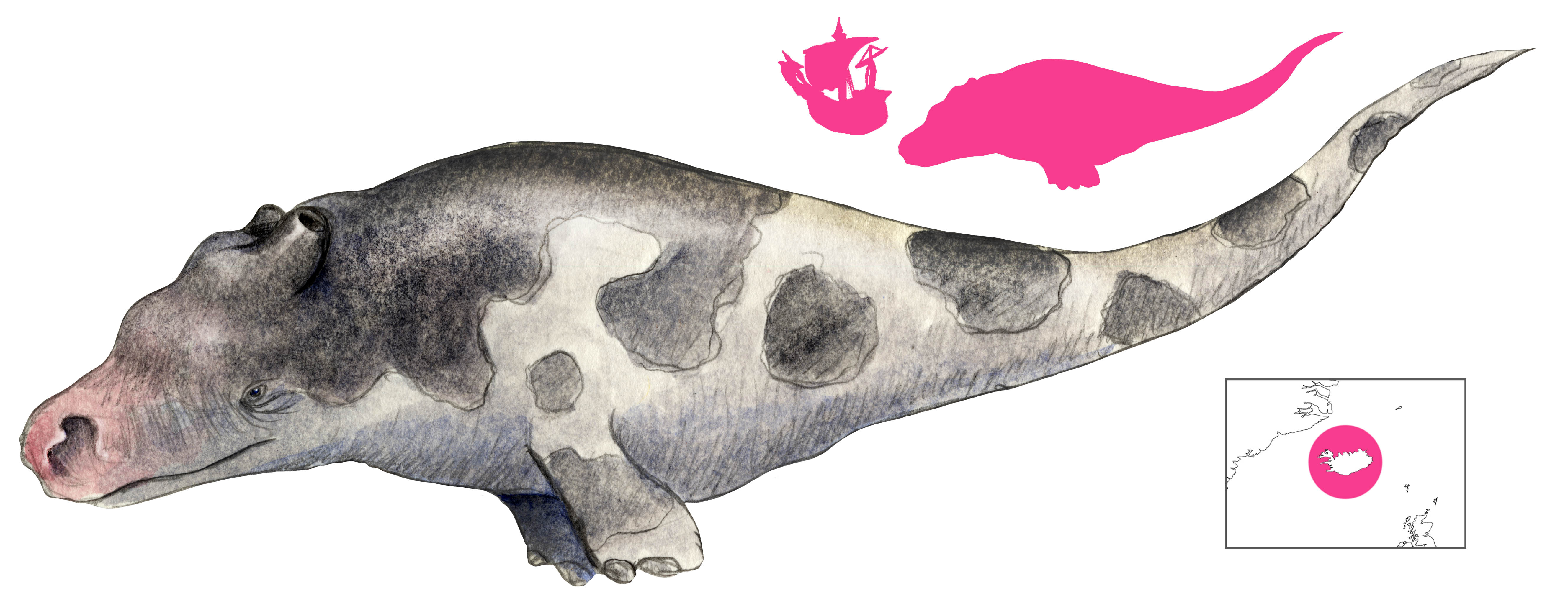
The Nauthveli or Nauthvalur (“Ox-whale”) is one of the many illhveli or “evil whales” of Iceland. It is the second biggest of the evil whales, and like the others, it is inedible and will show up if its name is said out loud.

A nauthveli is a toothed whale, bicolored much like a cow. The large head is similar to that of a bull and has two nodules on top. The trunk tapers off, wormlike, and lacks fins.

However, the nauthveli is named not for its appearance, but rather for the terrifying bull-like bellow it makes when hungry, a sound like that of roaring, maddened bulls. The call of a nauthveli is made in the open sea or near the shore, and can be heard reverberating over long distances. The vibrations cause the ground to shake and knock oars out of sailors’ hands. Going out to sea is forbidden if nauthveli bellowing can be heard.

As will all evil whales, the nauthveli delights in killing men and scuttling smaller boats, but it has a particular fondness for beef. The bellow of a nauthveli is hypnotic to cattle, compelling them to run off cliffs and headlong into the sea. There the nauthveli plays with them like a cat does with a mouse before biting them in half and eating them. The whales are attracted to cattle on board ship; one nauthveli off Grimsey harassed a vessel until they released the one cow on board, who promptly dove into the sea. Cattle have to be locked up for days until the nauthveli’s spell wears off, and indeed cow-herding was strongly discouraged in areas where nauthvelis had been heard. Sacrificing one bull or cow usually satisfies the nauthveli, making it safe to go out to sea again.

Gudmundsson listed the nauthveli as synonymous with the búrhvalur or sperm whale.

References

Davidsson, O. (1900) The Folk-lore of Icelandic Fishes. The Scottish Review, October, pp. 312-332.

Hermansson, H. (1924) Jon Gudmundsson and his Natural History of Iceland. Islandica, Cornell University Library, Ithaca.

Hlidberg, J. B. and Aegisson, S.; McQueen, F. J. M. and Kjartansson, R., trans. (2011) Meeting with Monsters. JPV utgafa, Reykjavik.

Devouring Gourd

Variations: Devouring Pumpkin; Sala Fruit (possibly)

Swallowing Gourd final

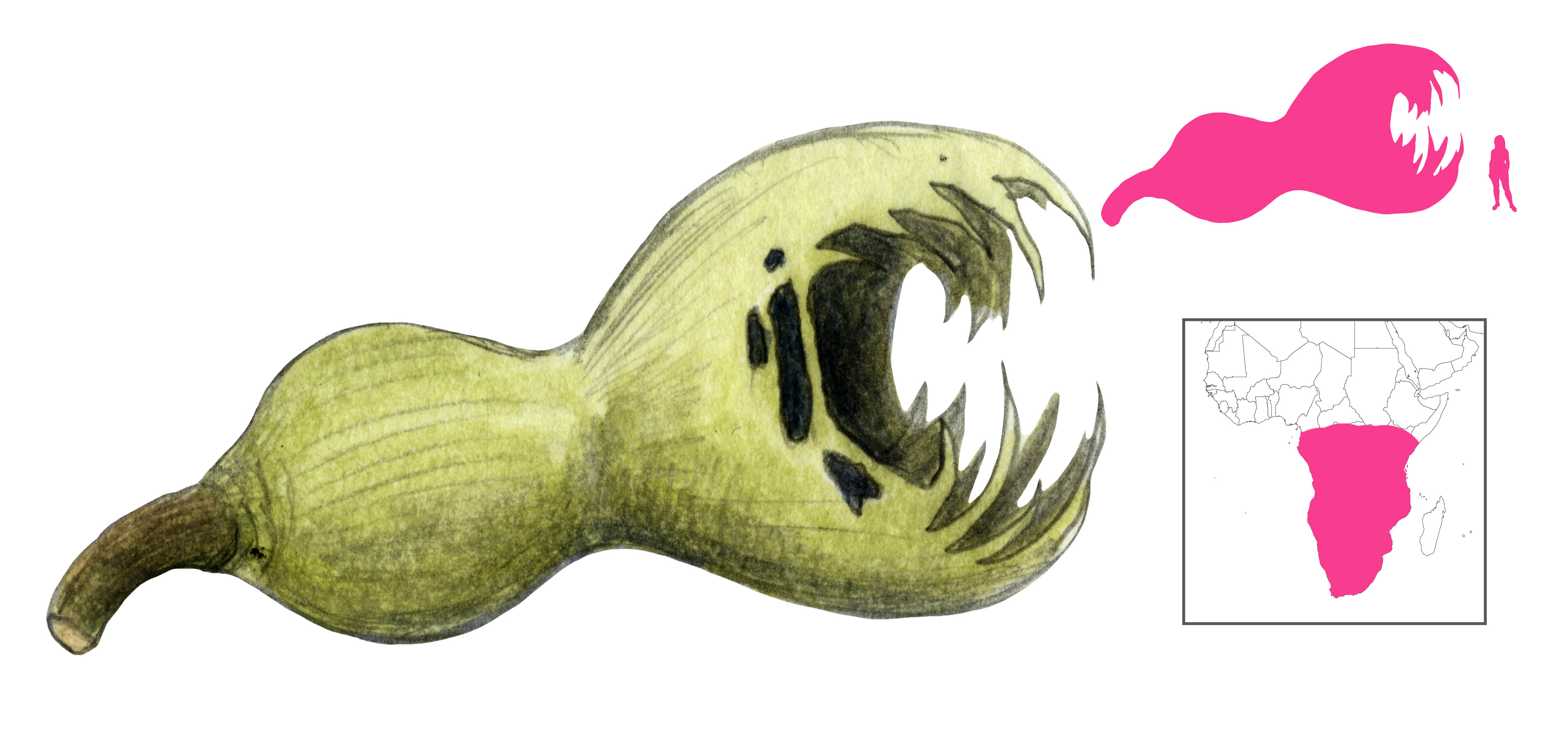
Not all swallowing monsters are animals. In Bantu folklore, gourds and pumpkins have the potential to grow into vast, devouring creatures. Such plants usually grow where evil sorcerers or ogres were slain.

The devouring gourd of Usambara was discovered by a group of little boys at play. “Look at how big that gourd is getting!” said one of the boys. To their surprise, the gourd responded. “If you pluck me, I’ll pluck you!” it said. The boys ran home and told their mother, who refused to believe them. But their sisters insisted on seeing the large gourd, and when they were taken to it, they said as their brothers had, “Look at how big that gourd is getting!” This time the gourd did not respond, and the girls went home to complain about their brothers being liars.

As the gourd was not plucked, it continued to grow. Eventually it became the size of a house, uprooted itself, and went about swallowing everyone in the village. After consuming everyone within reach, it rolled into a lake.

Only one woman had survived the gourd’s rampage, and she was pregnant. When her son was born, they lived together in the ruins of the village. When the son got around to asking where his father was, his mother told him “He was swallowed by a gourd, which is now in the lake”. The son decided to avenge his father, and went out to the lake where he could see the gourd’s ears sticking out of the water, and he proceeded to taunt the vegetable. “Gourd, come out!” he yelled. “Gourd, come out!” Annoyed and enraged, the gourd hauled itself out of the lake, but the boy was ready for it, and fired a volley of arrows into it. The tenth arrow killed it, and it died with a roar that could be heard all the way to Vuga. The boy cut it open with a knife, released the villagers unharmed, and went on to become a great leader of his people.

Gourds are not the only plants that devour and kill people. Another carnivorous plant, a pumpkin, grew over the burial location of an evil shapeshifting porcupine. It repeated everything that was said to it, and when an axe was brought to destroy it, it proceeded to swallow everyone. The poisonous Sala fruits of the Ronga have arms and legs, and wield spears ands shields.

References

Knappert, J. (1977) Bantu myths and other tales. E. J. Brill, Leiden.

Werner, A. (1968) Myths and legends of the Bantu. Frank Cass and Co. Ltd., London.

Bonnacon

Variations: Bonasus, Bonasos, Monassos, Monops; Bison, Maned Bison, European Bison, Aurochs, Urus, Urus Bonasus

Bonnacon

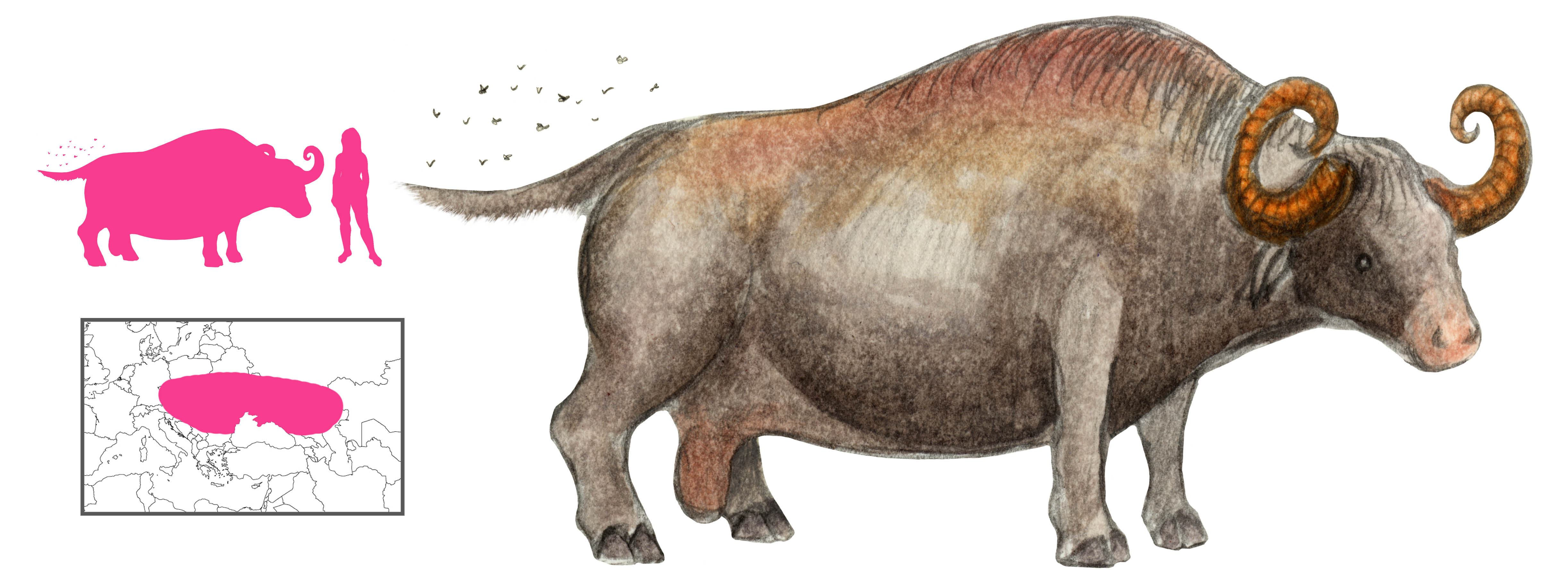
The Bonnacon’s range extends from Scythia in the east to Bulgaria, Macedonia, and Germany in the West. It would be a fine prize for hunters were it not for its remarkable flatulent defenses.

A bonnacon looks like a bull, but is squatter, with reddish fur shading to black, a short tail, and the shaggy mane of a horse. Its horns curl inwardly towards the head, making them of no use in self-defense.

When attacked, the bonnacon voids the contents of its intestines over an area of 3 acres (Aristotle gives a more conservative estimate of 4 fathoms). The noxious, acrid dung ignites and burns anything it touches, leaving a trail of flame in its wake.

The European bison (Bison bonasus) is generally believed to be the basis of the bonnacon.

References

Aelian, trans. Scholfield, A. F. (1959) On the Characteristics of Animals, vol. II. Harvard University Press, Cambridge, Massachusetts.

Cuba, J. (1539) Le iardin de santé. Philippe le Noir, Paris.

Pliny; Holland, P. trans. (1847) Pliny’s Natural History. George Barclay, Castle Street, Leicester Square.

Sainéan, L. (1921) L’histoire naturelle et les branches connexes dans l’oeuvre de Rabelais. E. Champion, Paris.

Unknown. (1538) Ortus Sanitatis. Joannes de Cereto de Tridino.

White, T. H. (1984) The Book of Beasts. Dover Publications, New York.

Az’-i-wû-gûm Ki-mukh’-ti

Variations: Walrus Dog

Aziwugum

Az’-i-wû-gûm Ki-mukh’-ti, the “Walrus Dog”, can be found roaming the rugged coastlines of Alaska. While not walrus-like, it lives with herds of walrus and acts as a protector of sorts. It is one of Raven’s many creations.

An az’-i-wû-gûm ki-mukh’-ti is rather like a large dog in general appearance, smaller than a walrus, elongate and slender, with a long, powerful rounded tail. Its body is covered with tough black scales which make it impervious to all but the best spears.

Walrus hunters in the Bering strait fear the az’-i-wû-gûm ki-mukh’-ti. Its muscular tail can easily kill a man, and at least one case is known of a walrus dog attacking an umiak and killing all aboard.

References

Nelson, E. W. (1900) The Eskimo about Bering Strait. Extract from the Eighteenth Annual Report of the Bureau of American Ethnology, Government Printing Office, Washington.

Butatsch Cun Ilgs

Variations: Butatsch-ah-ilgs (erroneously, apparently a typo in Rose’s encyclopedia)

Butatsch Cun Ilgs

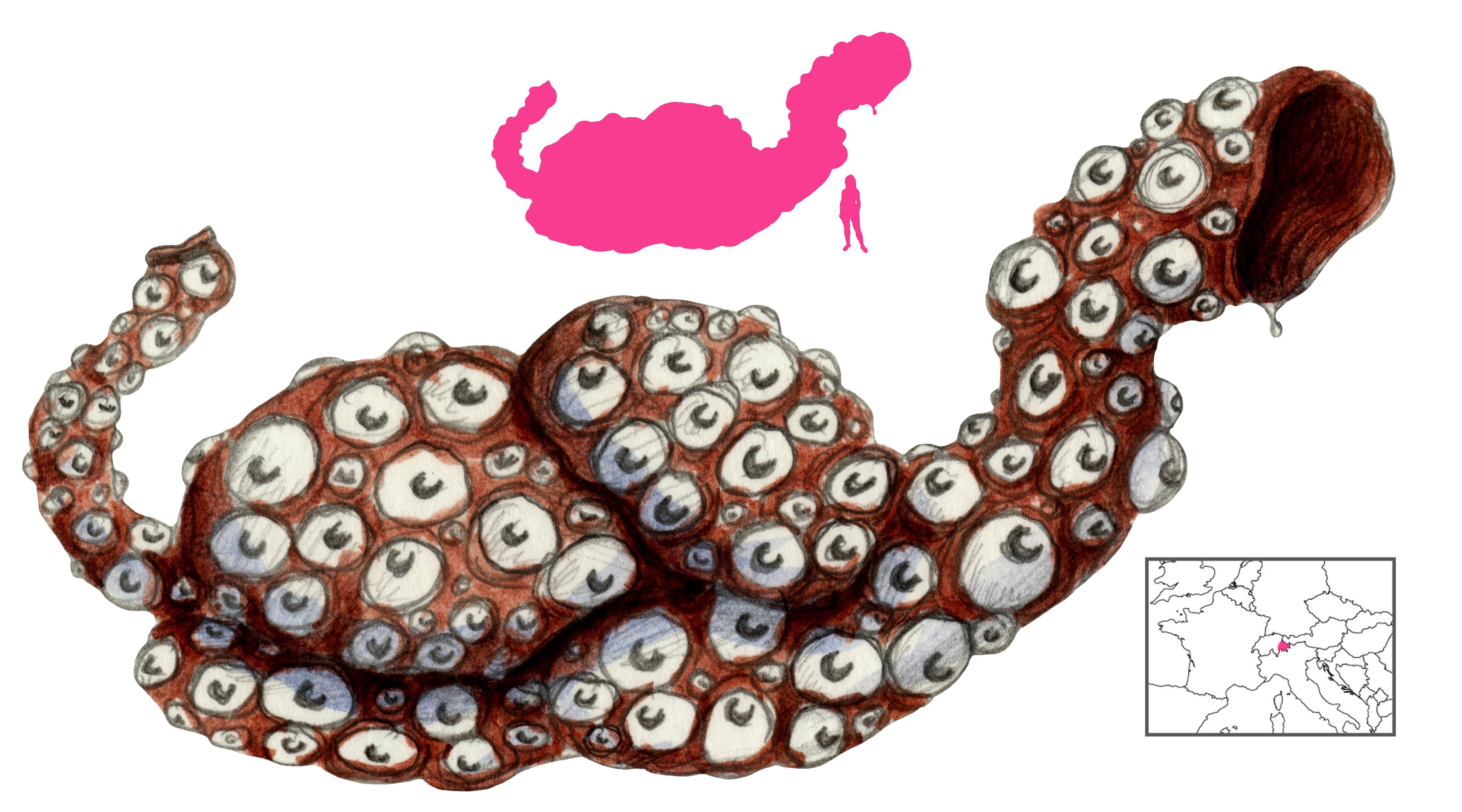
The Lüschersee, a small Swiss alpine lake nestled in the heather-covered hills of Graubünden, seems tranquil enough on the surface. Yet it is said that the lake’s waters reach down to the center of the Earth, where eternal fires rage. This is the home of the Butatsch Cun Ilgs, the “Cow’s Stomach”.

Long ago, during a more feudal time, the shepherds of Graubünden were in a constant struggle for freedom from the cruel barons and lords of the land. Their masters were prone to treating them unjustly, and even harming them for sport. A group of noblemen once returned from an ibex hunt to find herds of cattle and sheep grazing peacefully by the Lüschersee. Naturally they decided to kill them. With loud whoops and peals of laughter, they drove the animals before them, hacking at them with their swords and forcing them into the lake to drown. The peasants could only watch as the lords mocked them.

It was then that the water started to foam and bubble, and the Butatsch cun ilgs heaved itself onto the shore. It had the appearance of an enormous cow’s stomach, and was covered with thousands of eyes. The eyes had hypnotic powers, and if they focused on one point, bone-melting flames would erupt.

Mesmerized by the Butatsch cun ilgs, the lords stood dumbly as the enormous mass trampled and crushed them. Butatsch cun ilgs slipped back into the water after killing them all, leaving the shepherds terrified but unharmed.

Since then Butatsch cun ilgs has only reappeared twice, in 100-year intervals. The second time it came out of the Lüschersee, it gouged the rapids of the Nolla along its path. The third time was during a terrifying thunderstorm, when the monster of the Lüschersee slithered through a rivulet, tearing out the banks, causing massive landslides, and creating ravines.

After this last appearance – the starmentusa notg or “Night of Terror” – the Butatsch cun ilgs was not seen again. Yet sometimes a distant, unearthly bellowing can be heard over the still waters of the lake… “The Lüschersee roars”, say the shepherds, and bring the hay in.

References

Burde-Schneidewind, G. (1977) Historische Volkssagen Aus Dem 13. Bis 19. Jahrhundert. Akademie-Verlag, Berlin.

Derichsweiler, W. Das Safiental. In Schweizer Alpenclub (1919) Jahrbuch das Schweizer Alpenclub. Stämpfl & Co., Bern.

Jecklin, D. (1874) Volksthümliches aus Graubünden. Orell Füssli & Co., Zürich.

Rose, C. (2000) Giants, Monsters, and Dragons. W. W. Norton and Co., New York.

Danghu

Variations: Danghu-bird

Danghu

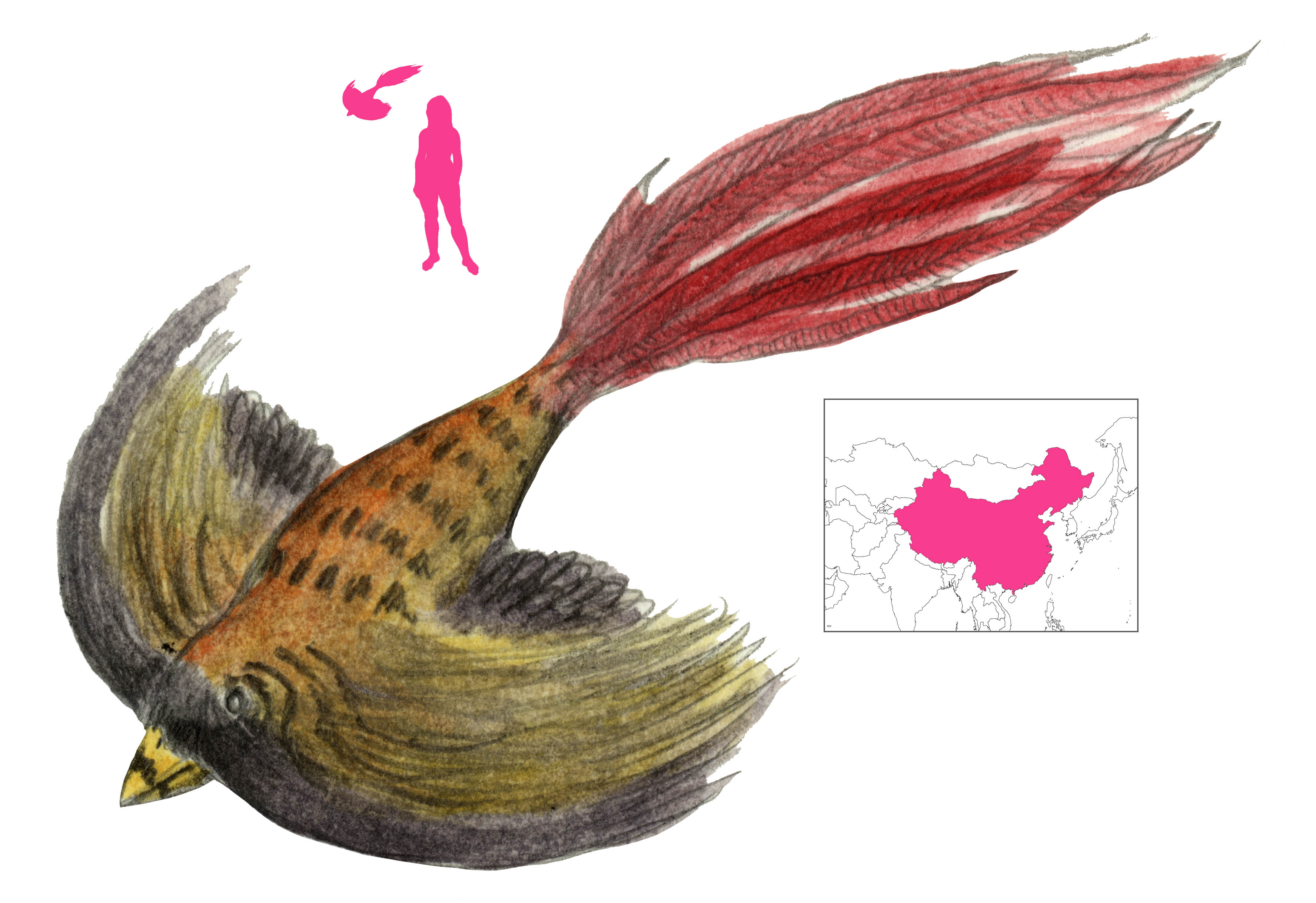
Upper-Shen Mountain or Shangshen is a rugged, rocky peak with no vegetation on it, but there are hazelnut groves at its base. There, Danghu birds can be seen flying from branch to branch. A danghu looks like a pheasant, but it flies using its hypertrophied whiskers and throat feathers. Consuming a danghu protects from and cures myopia. Guo Pu extolled the virtues of the danghu, using it as a metaphor for the economical mindset of Daoism as it makes do with what it has.

Mathieu suggests that this bird is the masked Japanese grosbeak (Eophona personata), which is nonetheless unwhiskered and unpheasantlike.

References

Mathieu, R. (1983) Étude sur la mythologie et l’ethnologie de la Chine ancienne. Collège de France, Paris.

Strassberg, R. E. (2002) A Chinese Bestiary: Strange Creatures from the Guideways Through Mountains and Seas. University of California Press.