Animalito

Animalito

During his time in Spain, Prosper Mérimée was introduced to a number of current superstitions by his traveling companion Vicente. This worthy Valencian informed him of certain animalitos, “little animals”, available for purchase in France from unscrupulous sorcerers.

Nobody knows what they look like save that they are tiny animals that live in reeds. The notorious embellisher Dubois gives them dog mouths and lizard heads. The reed an animalito lives in is sold with a knot in one end and a sturdy cork in the other.

Animalitos are magical beings, capable of granting their owners any wish, any request they desire. Napoleon had one of these imps with him, which prevented him from being killed while in Spain. Only silver bullets can harm those protected by an animalito.

In return for their services, the animalitos request a steep price. They have to be fed every 24 hours. They crave the flesh of unbaptized children, and if that is not available (as is often the case), their master has to cut a piece of flesh from his or her own body. Vicente recounts the tale of an old friend, Romero the footman, who cured his lung disease with the help of animalitos. Now he can run from Valencia to Murcia without breaking a sweat, but his bones show through his skin, his eyes are sunken…

The animalitos are eating him alive.

References

Dubois, P.; Sabatier, C.; and Sabatier, R. (1992) La Grande Encyclopédie des Lutins. Hoëbeke, Paris.

Mérimée, P. Les Sorcières Espagnoles. In Mérimée, P. (1873) Dernières Nouvelles de Prosper Mérimée. Michel Lévy Frères, Paris.

Bakunawa

Variations: Baconaua (Hiligaynon)

Bakunawa

The Asian eclipse monster has analogues in China, India, Malaysia, Mongolia, Thailand, and the South Sea Islands. In the Philippines, where the legend is widespread, it is usually a dragon or serpent or even an enormous bird. Bakunawa, “Eclipse”, is one of the best-known.

The Bakunawa of the Cebuano, or Baconaua as it is known to the Hiligaynon, is a colossal, fishlike dragon as large as the Negros and Cebu islands. It resembles a shark, with gills, a lake-sized mouth, and a striking red tongue. Whiskers one palmo long adorn its mouth. In addition to its powerful ash-gray wings, it has smaller wings along its sides.

Long ago there were seven moons in the sky. Bakunawa gobbled them up one by one until it came to the last and largest moon. It failed to swallow it, and tried to bite it into manageable chunks, sinking its teeth deep into the moon’s surface. To this day the bakunawa’s teeth-marks can still be seen on the moon. Every now and then the bakunawa will take to the sky and attempt to finish the job it started by swallowing the moon, causing an eclipse. To make it release the moon, utensils are clanged loudly together to startle it.

The bakunawa’s den is in the deepest parts of the sea. In January, February, and March its head faces north and its tail south; in April, May, and June its head faces west and its tail east, in July, August, and September its head points south and its tail north; and in October, November, and December its head is east and its tail west. The positions of the bakunawa during those four phases are used to divine the best time to build houses.

A children’s game called Bakunawa for 10 or more players involves one player as Buan, the moon, while another is Bakunawa. The remainder form a circle, holding hands and facing inwards. The moon starts inside the circle and Bakunawa is outside. The goal of the children in the circle is to prevent Bakunawa from entering the circle and capturing the moon – the moon itself cannot leave the circle. Bakunawa can ask individual players “What chain is this?” and they can answer that it is an iron, copper, abaca, or any material they can think of. When Bakunawa captures the moon, the players exchange roles or swap with players in the circle.

References

Jocano, F. L. (1969) The Traditional World of Malitbog. Bookman Printing House, Quezon City.

de Lisboa, M. (1865) Vocabulario de la Lengua Bicol. Establecimento Tipografico del Colegio de Santo Tomas, Manila.

Ramos, M. D. (1971) Creatures of Philippine Lower Mythology. University of the Philippines Press, Quezon.

Ramos, M. D. (1973) Filipino Cultural Patterns and Values. Island Publishers, Quezon City.

Ramos, M. D. (1990) Tales of Long Ago in the Philippines. Phoenix Publishing House, Quezon City.

Reyes-Tolentino, F. and Ramos, P. (1935) Philippine Folk Dances and Games. Silver, Burdett and Company, New York.

Onchú

Variations: Enfield; Alphyn; Water-dog, Sea-dog

Onchu

The Onchú, “Water-dog”, is a peculiar Irish creature with a long history of phonetic transformation. It is better known as the Enfield or Alphyn.

Of the three variants it is the enfield that has the most defined morphotype. It has the head of a fox, the chest of a greyhound, the talons of an eagle, the body of a lion, and the hindlegs and tail of a wolf. A more simple description gives it the head of a fox, the breast and forelegs of an eagle, and the hindquarters of a wolf, combining the cunning of the first, the honor of the second, and the ferocity of the third. There may be a mane and a lion’s tail. Enfields are rarely used in heraldry, most notably appearing in green as the crest of the O’Kelly family of Ireland. This is traditionally attributed to an incident when Tadhg Mór Ua Ceallaigh, the ancestor of the O’Kellys of Hy-Many, fell in battle against the Danes at Clontarf. An enfield or dog-like creature emerged from the sea and protected Tadhg Mor’s body until it was recovered.

As for the alphyn, it vaguely resembles a tiger, sometimes with the same clawed forelimbs as the enfield. It shares its name with the term alphyn or alfin for the chess bishop, itself derived from al-fil, “the elephant”, but this is coincidental. Elephants were well-known in bestiaries long before the decidedly unproboscidean alphyn, which appears at the end of the fifteenth century.

The word onchú is more ancient than enfield or alphyn, and is probably derived from cú, “hound”, and on, “water” (as in onfais, “plunging”, and onfaisech, “diver”). It is synonymous with doburchú, the otter (literally “water dog”). Therefore the onchú can be inferred to be a dog or dog-like animal that lives at least partly in water. Onchú also is used to mean “banner”, or “standard”, suggesting that the use of the onchú on battle-standards was common enough that the name was transferred to the item – and that its use preceded the battle of Clontarf.

The confusion only increases with the pluralization of onchú to give onchoin or onchainn. Onchainn in turn became onfainn following the trend of ch conversion (e.g. Dunphy from Donnchaidh). Williams traces phonetic vagaries and lists a sequence of alterations: onfainn to anchainn to anfainn to anfaill to anfild to enfild. Anfaill also gave rise to the less-successful alternative name of alphyn. Further assimilation with the heraldic sea-dog gave the onchú/enfield/alphyn a mane and clawed, bird-like forelegs.

Since then onchú has been used as a term for a large water beast. It is wild, fearsome, valorous, heroic, with reptilian and venomous qualities (probably the origin of its green color). The onchú that lived between Loch Con and Loch Cuilinn killed nine men. Muiredach pursued it into the water and slew it, earning the title of Cú Choingelt, “Hound of the Pasturage”.

Williams proposes the adoption of onchú as the official Gaelic term for the animal. Enfield remains an acceptable English version.

References

Barber, R. and Riches, A. (1971) A Dictionary of Fabulous Beasts. The Boydell Press, Ipswich.

Cooke, T. L. (1859) Proceedings, November Meeting. The Journal of the Kilkenny and South-East of Ireland Archaeological Society, v. 2. McGlashan and Gill, Dublin.

Vinycomb, J. (1906) Fictitious and Symbolic Creatures in Art, with Special Reference to their Use in British Heraldry. Chapman and Hall, London.

Williams, N. J. A. (1989) Of Beasts and Banners: The Origin of the Heraldic Enfield. The Journal of the Royal Society of Antiquaries of Ireland, v. 119, pp. 62-78.

Poreskoro

Poreskoro

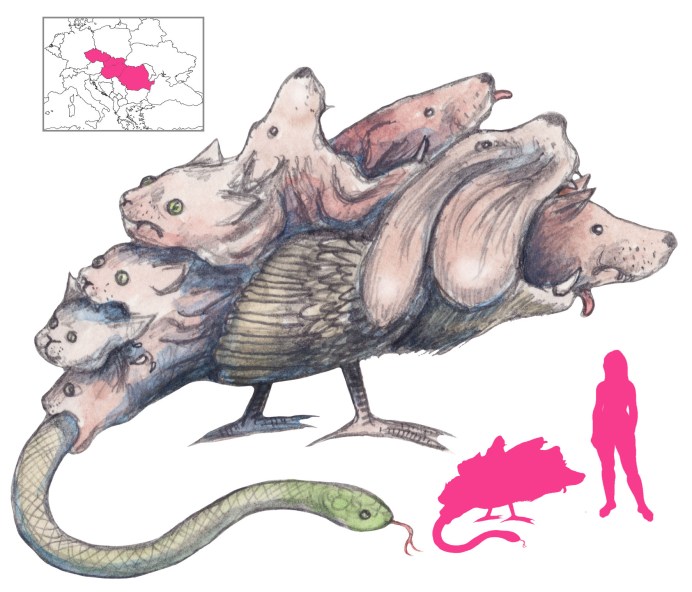
Poreskoro, “Tailed” or “Caudate”, is the ninth and final child of Ana, the ultimate Romani demon of disease produced from an unhappy and abusive relationship between Queen Ana of the Keshalyi and the King of the Loçolico.

After the failed attempt at sterilization that produced Minceskro, the distraught Keshalyi fed their Queen a mixture of cat hair, powdered snake, and hair from the hound of hell. This time the result was Poreskoro. A bird with four dog heads, four cat heads, and a snake tail with a forked tongue, Poreskoro is a hermaphrodite who does not require a mate to produce offspring. Its children are bubonic plague, cholera, smallpox, and all the pestilences, epidemics, and pandemics known to humanity. Poreskoro dwells deep underground with its offspring; its appearance on the surface heralds widespread destruction and disease.

It is small comfort, then, that even the King of the Loçolico had a shock upon seeing this monstrous child, and realized that his marriage was going nowhere. He and Ana divorced under two conditions – first, that the Loçolico would leave the Keshalyi alone as long as Ana was alive; second, that every Keshalyi nymph having reached the age of 999 would be given away to the Loçolico.

So it came to pass that Ana lived in blessed seclusion in an isolated mountain castle, rarely leaving, and sustained by the Keshalyi. Every morning three of the nymphs visit her and give her a single drop of blood from their left hand to keep her alive. She sometimes appears in the form of a golden toad, but more often she is only heard saying the word ana, meaning “bring” or “pass”. If you hear that, then you must pick up a frog, beetle, or other small animal and toss it into a bush, otherwise Ana will crush you under a rock.

As for her demonic children, they live on, and the diseases they spawn are endless.

References

Clébert, J. P. (1976) Les Tziganes. Tchou, Paris.

Clébert, J. P.; Duff, C. trans. (1963) The Gypsies. Vista Books, London.

Meyers Brothers Druggist (1910) Demons of Disease. Meyers Brothers Druggist, v. 31, p. 141.

Pavelčík, N. and Pavelčík, J. (2001) Myths of the Czech Gypsies. Asian Folklore Studies, v. 60, pp. 21-30.

Huayramama

Huayramama

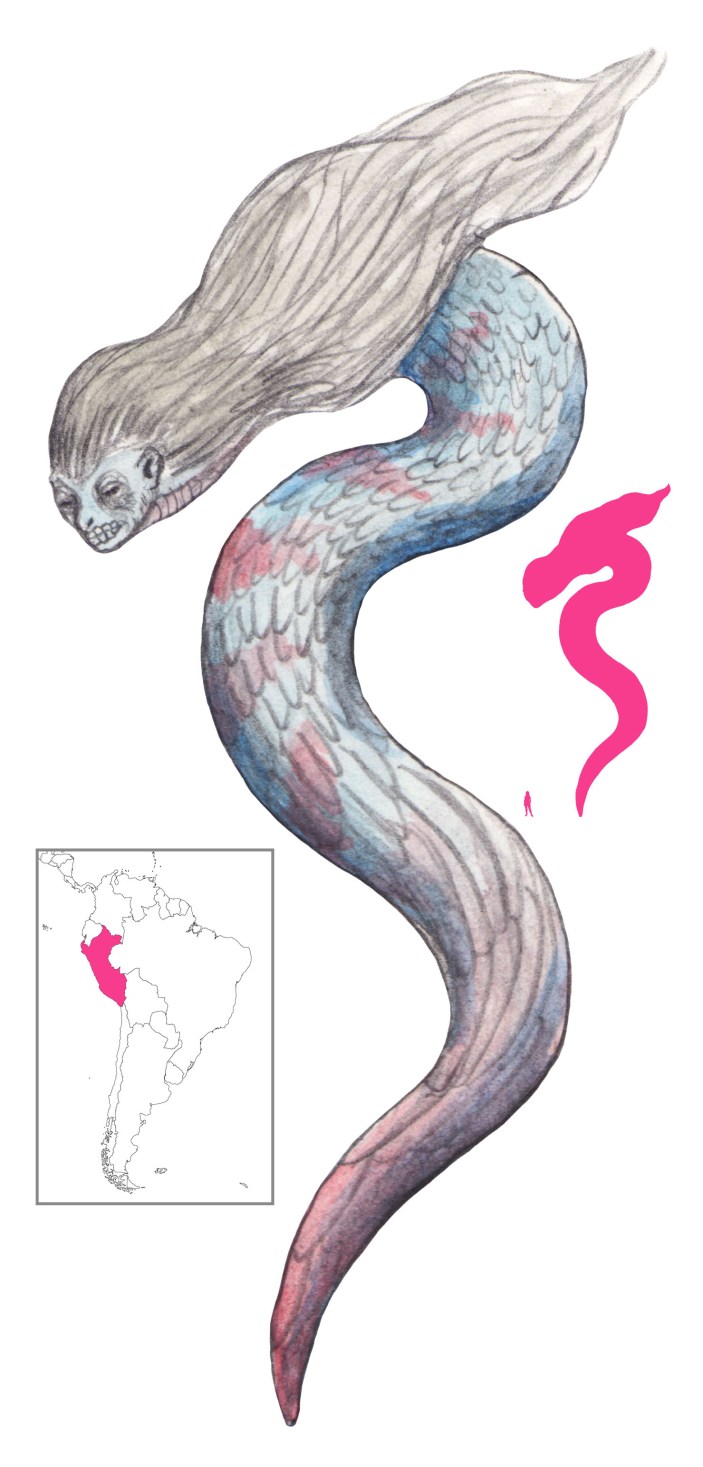
Huayramama, “Mother of the Wind”, is one of the three ancient snake mothers of the Peruvian Amazon. She has no direct biological counterpart, but is believed to be an enormous boa with an old woman’s face and very long hair that tangles in the clouds – in comparison, her counterparts the Sachamama and the Yakumama are the boa constrictor and the anaconda, respectively.

The guardian of the air and the daughter of the red huayracaspi or “wind tree”, she is herself the mother of all the good and evil winds. Huayramama also grants power to deserving healers and shamans, giving them control over the weather.

Don Emilio Shuña was one such man. After fasting for nine days and drinking ayahuasca tea brewed from the huayracaspi, he was rewarded by the appearance of Huayramama, her long body billowing in the sky and her hair trailing behind her. She landed on his house and proclaimed “OK, man, here I am. What is it you wish?” “I want to control the wind, the rain, and anything from the sky”, said Don Emilio. Huayramama granted him his wish on condition he fasted for an additional forty-five days. At the end of that period of fasting, Don Emilio gained the magical powers he asked for, and was taught songs by the Huayramama herself. He could control weather, heal those afflicted by evil winds, return crops to life, and revitalize dying fisheries. When the Huayramama’s malevolent children tried to stir up trouble, he drove those winds under the trees through fasting, singing, drinking huayracaspi tea and blowing tobacco smoke. Huayramama would touch his head to strengthen him in times of need. He also used his powers for simpler blessings, such as preventing rain to allow local boys to play football in peace.

At the end of a long and charmed life, Don Emilio finally died. Perhaps it was rival sorcerers who murdered him, or perhaps the evil winds finally won. All who knew him wept. He was buried under the huayracaspi in the middle of the forest, for as he said, “that tree is my mother”.

References

Galeano, J. G.; Morgan, R. and Watson, K. trans. (2009) Folktales of the Amazon. Libraries Unlimited, Westport.

Yakumama

Variations: Yakumaman, Yacumama, Yacumaman; Puragua; Anaconda

Yakumama

Yakumama, “Mother of the Waters”, is one of the three ancient snake mothers of the Peruvian Amazon. She is the anaconda magnified and empowered, in the same way as the Sachamama is the boa constrictor. She appears as a gigantic anaconda with blue scales and eyes glowing like the headlights of a boat. Yakumama is the same creature known as Boíuna or Cobra Grande in Brazil.

The Yakumama can often be found resting on the banks of the river, her tail trailing away into the water. She is capable of entrancing prey into immobility with her gaze and drawing victims to her like a magnet. When happy, she blesses people with plentiful rain and abundant fish. When angry – which can happen for no discernible reason – she summons storms, fogs, and whirlpools in addition to putting her enormous bulk to destructive use. Sometimes Yakumama swallows all the fish and prevents fishermen from catching them, or flies into the sky and causes downpours that ruin crops. Offerings of food and aguardiente can placate her.

After years of work in the forest, a man decided to returnt to Iquitos. He set off down the Napo River on a large boat, bringing with him his family, servants, lumber, and livestock. Soon a storm broke, and he ignored warnings from native fishermen that Yakumama was around, only to get caught in a whirlpool. Prayer to God did nothing, but tossing food and aguardiente in calmed the whirlpool. But still the man pressed on, into a sticky, bluish fog that all other animals avoided. The storm raged until an enormous wave lifted the boat and lodged it in the branches of a capirona tree. Then they saw Yakumama rise from the river, water flowing off her glistening coils as yaras rode her back and laughed at the humans. Yakumama proceeded to gobble up the lumber, the livestock, the cargo raft, several trees, and an island before going back under. The man, his life’s work obliterated, limped back to the native village with his family. He was greeted warmly and offered food and a place by the fire, and there he was told of Yakumama the ever-changing.

The presence of outboard motors and large ships have driven Yakumama away. She is hardly seen nowadays.

References

Galeano, J. G.; Morgan, R. and Watson, K. trans. (2009) Folktales of the Amazon. Libraries Unlimited, Westport.

Stiglich, G. (1913) Geografia Comentada del Peru. Casa Editoria Sanmarti, Lima.

von Tschudi, J. J.; Ross, T. trans. (1847) Travels in Peru during the Years 1838-1842. David Bogue, London.

Sachamama

Variations: Sach’amama, Sacha-mama, Sach’a-mama, Sacha Mama, Sach’a Mama; Boa constrictor

Sachamama

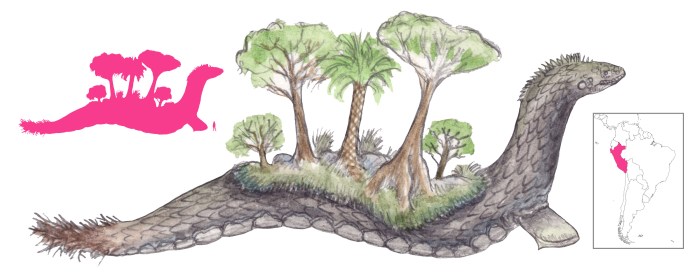
Sachamama, “Mother of the Forest”, is one of the three ancient snake mothers of the Peruvian Amazon. She is the mythological boa constrictor, in the same way as the Yakumama is the anaconda. Sachamama is about forty meters long and two meters wide, with an iguana-like head and scales like stone plates. There is a bulldozer-like blade under her neck. Trees, bushes, vines, fungi, and all sorts of living things grow on her back, such that she never moves unless provoked.

Not that Sachamama needs to move. She has magnetic or hypnotic powers capable of drawing to her any animal that passes in front of her head. The animals living on her also have those magnetic powers. She can also cause storms, rain, and lightning, inducing fevers and headaches in anyone foolish enough to intrude in her domain. Illnesses caused by the Sachamama require shamanistic intervention to cure, usually involving chants and lots of tobacco smoke.

The plants growing on Sachamama’s back are unique – a veritable pharmacopoeia of medicinal herbs that would save countless lives if the Sachamama allowed it. There is boa huasca, a liana with healing resin. Lluasca huasca is another vine whose phlegm-like resin heals facial blemishes. Puma huasca and puma sanango are vines whose cooked stem and cooked root (respectively) cure sorcery and evil spells, and whose spirits are jaguars. Zorrapilla or shabumpilla is a herb that heals cuts and injuries. The lluvia caspi (“rain tree”), rayo caspi (“lightning tree”), or trueno caspi (“thunder tree”) is an enormous tree whose bark, cooked and eaten, grants the ability to create and quell storms.

Most encounters wth the Sachamama occurred during the rubber boom in Peru, when many rubber harvesters found themselves entering the snake’s domain. A man and his wife collecting rubber once sat by the trunk of what seemed to be a huge fallen tree. When they cut into it with their machetes, it bled; when they built a fire, the trees shook, and a torrential downpour extinguished the fire. Next day the “fallen tree” had vanished. In its spot was a wide road. The man consulted a shaman who told him what he was dealing with. “The Sachamama lives in one place but she has moved. She doesn’t like trespassers”. Despite the shaman and his wife’s advice, the man decided to follow the road and find Sachamama. He came upon the tree trunk in a meadow, in the midst of human and animal bones, and at the end of the meadow was a cave where mesmerized animals were congregating. The “trunk” was Sachamama’s tail, and the “cave” her mouth! He cut through the trance with his machete and ran for his life.

References

Galeano, J. G.; Morgan, R. and Watson, K. trans. (2009) Folktales of the Amazon. Libraries Unlimited, Westport.

Montes, F.; Harrison, K. trans.; in Posey, D. A. (ed.) (1999) Cultural and Spiritual Values of Biodiversity. United Nations Environment Programme, Intermediate Technology Publications, London.

Stiglich, G. (1913) Geografia Comentada del Peru. Casa Editoria Sanmarti, Lima.

Carbunclo

Variations: Carbunco, Carbúnculo; Añapitan, Agnapitan; Inuyucoy (Pira); Oñánge-píta (“Devil”, Guarani); Carbuncle, Glow Beast (English)

Carbunclo

Carbunclo (Spanish) and carbuncle (English) are both derived from the Latin carbunculus, “little coal”. This has been used historically to refer to the garnet and the ruby, medically to a type of abscess, and teratologically to a glowing South American creature associated with riches.

Sightings of the carbunclo come from the southernmost countries – Argentina, Chile, and Paraguay. Multiple accounts of its appearance are given, and it may vary from area to area. A carbunclo has a shining mirror on its head, like a glowing coal, from which it gets its name. The creature itself produces a bright bluish-white glow from its body, easily distinguishable from wood fires and visible from over a league away. A carbunclo is larger than a mouse, perhaps cat-sized, and has a segmented body shaped like a small corn cob. The light is produced from within and shines out through junctures in the body segments. A bivalved shell resembling a rock is present. If an enemy is detected, the shell clamps shut, extinguishing the light and camouflaging the creature as an ordinary stone. Father Narciso y Barcel wrote in 1791 that the “lid” is covered in exquisite plumage, and there are beautiful spots on its breast. Carbunclos are also capable of leaping and running swiftly. Eulogio Rojas, observing a carbunclo from one meter away in 1879, noted more than four legs. In Chiloé carbunclos guard treasure and are cat-sized quadrupeds with glowing beards on their chins.

Carbunclos move about at night like enormous glow-worms in search of food and water. They have keen senses and are quick to escape or close their shells at the slightest sound. During the drought of 1925, flashing lights were seen descending the hill of Tulahuén to the valley of the Rio Grande; this was interpreted as a family of carbunclos desperate for water.

These glowing creatures have long been sought by miners and prospectors, as they are believed to hold untold riches within their bodies. Nobody as yet has succeeded in capturing one. Martin del Barco Centenera hunted the carbunclo in vain, and said that whoever could obtain the creature’s stone would be assured joy and fortune. By virtue of their excellent camouflage, sharp hearing, and impenetrable habitat, the carbunclos have kept their secrets, and no amount of careful searching has shed further light on them.

References

Aguirre, S. M. (2003) Mitos de Chile. Random House, Editorial Sudamericana Chilena.

Borges, J. L.; trans. di Giovanni, N. T. (1969) The Book of Imaginary Beings. Clarke, Irwin, & Co., Toronto.

Centenera, M. B. (1836) La Argentina o la Conquista del Rio de la Plata. Imprenta del Estado, Buenos Aires.

Cifuentes, J. V. (1947) Mitos y supersticiones (3rd Ed.). Editorial Nascimento, Santiago, Chile.

Oviedo, G. F. (1852) Historia General y Natural de las Indias, v. II: 1. Imprenta de la Real Academia de la Historia, Madrid.

Southey, R. (1812) Omniana, or Horae Otiosiores, v. II.  Longman, Hurst, Rees, Orme, and Brown, Paternoster Row, London.

Minceskro

Variations: Minceskre, Minčeskre, Minceskol

Minceskro

Minceskro, “the one who came up from the female genitals”, is the eighth child and fourth daughter of Ana, Queen of the Keshalyi, and the King of the Loçolico. She and her siblings are all Roma demons of disease produced from an abusive and unnatural union.

By the time Lolmisho the Red Mouse was born, Ana was in a state of despair at the vile children she had mothered. She begged Melalo to sterilize her and prevent further demons from being born. The two-headed bird obliged, telling her to bury herself in a dung heap. But instead of having the desired effect, all that accomplished was allowing a dung beetle to enter her body.

From that dung beetle was born Minceskro, a hairy little beetle that crawls over the body and enters the bloodstream. She is the cause of blood maladies and venereal diseases – gonorrhea, leucorrhea, syphilis… Her husband is Lolmisho, and their children are measles, smallpox, scarlet fever, and many more besides.

Minceskro’s origin has led to a traditional remedy for syphilis consisting of burying the patient in manure and sprinkling them with firewater. This procedure drives out the beetle and heals the ulcers.

References

Clébert, J. P. (1976) Les Tziganes. Tchou, Paris.

Clébert, J. P.; Duff, C. trans. (1963) The Gypsies. Vista Books, London.

Meyers Brothers Druggist (1910) Demons of Disease. Meyers Brothers Druggist, v. 31, p. 141.

Pavelčík, N. and Pavelčík, J. (2001) Myths of the Czech Gypsies. Asian Folklore Studies, v. 60, pp. 21-30.

Camphruch

Variations: Camphur (Paré), Camphurch (Aldrovandi)

Camphruch

The only description of the piscivorous Camphruch is provided by Thevet, who places this unusual unicorn in the Maluku Islands. Paré copies Thevet’s account but locates his “camphur” in Ethiopia, on the Isle of Molucca (!). Aldrovandi refers to the “camphurch”.

The camphruch is amphibious, living on land and in water like a crocodile. It is as big as a doe and has a thick grayish mane around the neck. The single horn on its forehead is three and a half feet long, as thick as a man’s arm at its thickest, and is movable like an Indian rooster’s comb. The forelegs are cloven deer’s hooves. The hindlegs are webbed like those of a goose. Camphruchs feed on fish and swim in both fresh and salt water.

Some believe that it is a species of unicorn, and that its horn neutralizes poisons. It is held in high regard in the islands, and the king of one island proudly bears the name of Camphruch – his courtiers have to make do with the names of lesser beasts, fish, and fruits.

Many of Thevet’s accounts were second or third hand. It is entirely possible that the camphruch was born from a muddle of multiple descriptions – narwhal, fur seal, beaver, goose, and antelope may have contributed. A much later dictionary entry dispenses with all that and describes the “camphur” as a single-horned Arabian donkey.

References

Paré, A. (1582) Discours d’Ambroise Paré – De la Licorne. Gabriel Buon, Paris.

Thevet, A. (1575) La Cosmographie Universelle. Guillaume Chaudiere, Paris.

Vallot, D. M. (1821) Explication des Caricatures en Histoire Naturelle. Mémoires de l’Academie des Sciences, Arts, et Belles-lettres de Dijon.