Qiqirn

Variations: Quiquern

Qiqirn

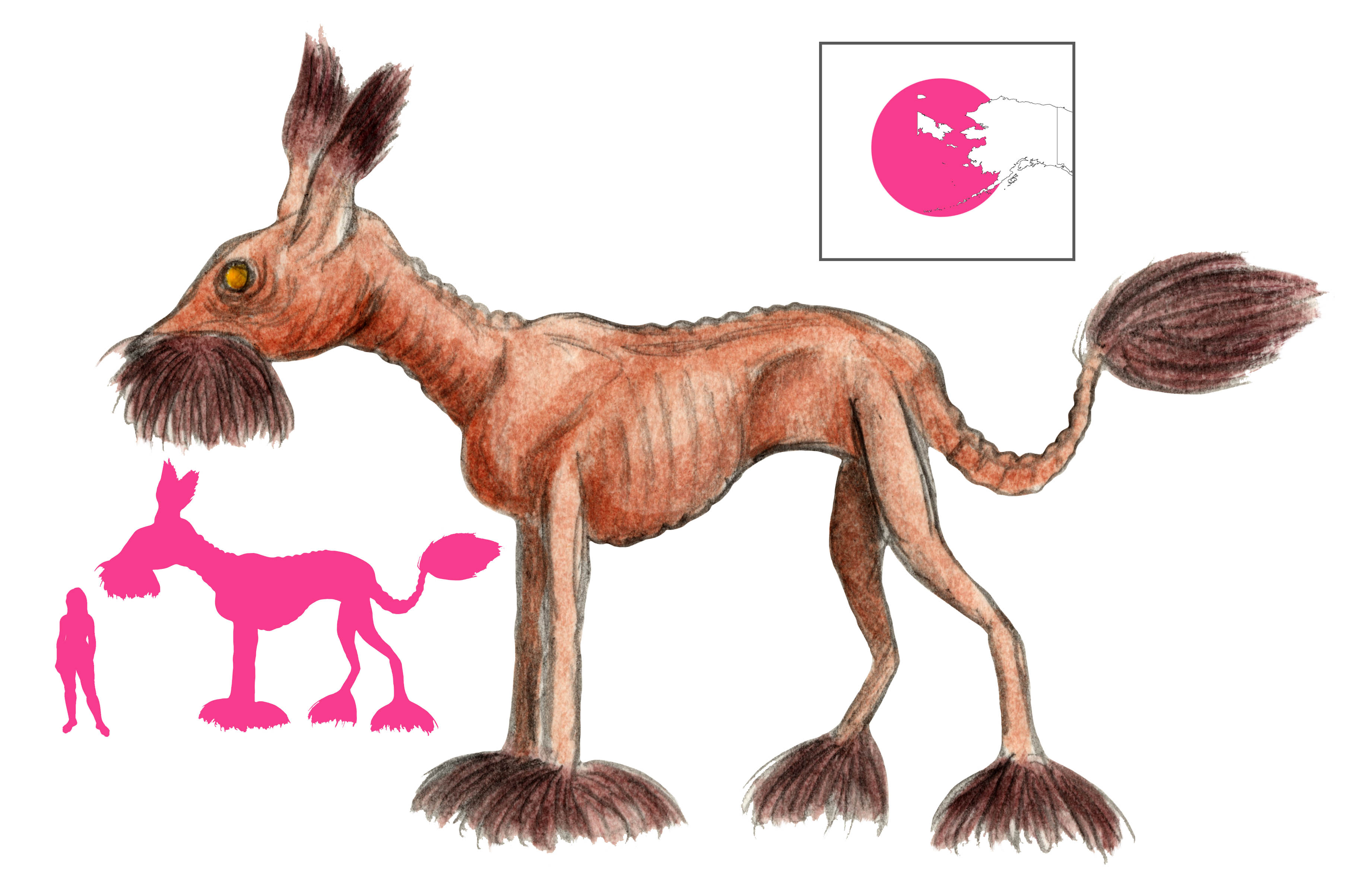
The Qiqirn is a huge dog of Inuit folklore. It is hairless except for its mouth, feet, and ear and tail tips. The mere presence of a qiqirn around men or dogs causes them to suffer fits, a state which ends only when the qiqirn leaves. However, the qiqirn is also extremely scared of humans, and will run away if an angakoq sees it.

Merkur suggests that the “fits” induced by the qiqirn’s presence may be a symbolic reference to shamanic initiation. It shares this feature with the initiatory bear spirit of Baffin Island.

In the Second Jungle Book, the qiqirn – as Quiquern – appears in a snowstorm as an enormous, toothless, and hairless dog, with two heads and eight pairs of legs. He leads two Inuit hunters towards more fruitful lands, and proves to be two sled dogs tied together.

References

Boas, F. The Central Eskimo. In Powell, J. W. (1888) Sixth Annual Report of the Bureau of Ethnology. Government Printing Office, Washington.

Kipling, R. (1921) The Second Jungle Book. Doubleday, Page & Company, Garden City.

Merkur, D. (1991) Powers Which We Do Not Know. University of Idaho Press, Moscow.

Bonnacon

Variations: Bonasus, Bonasos, Monassos, Monops; Bison, Maned Bison, European Bison, Aurochs, Urus, Urus Bonasus

Bonnacon

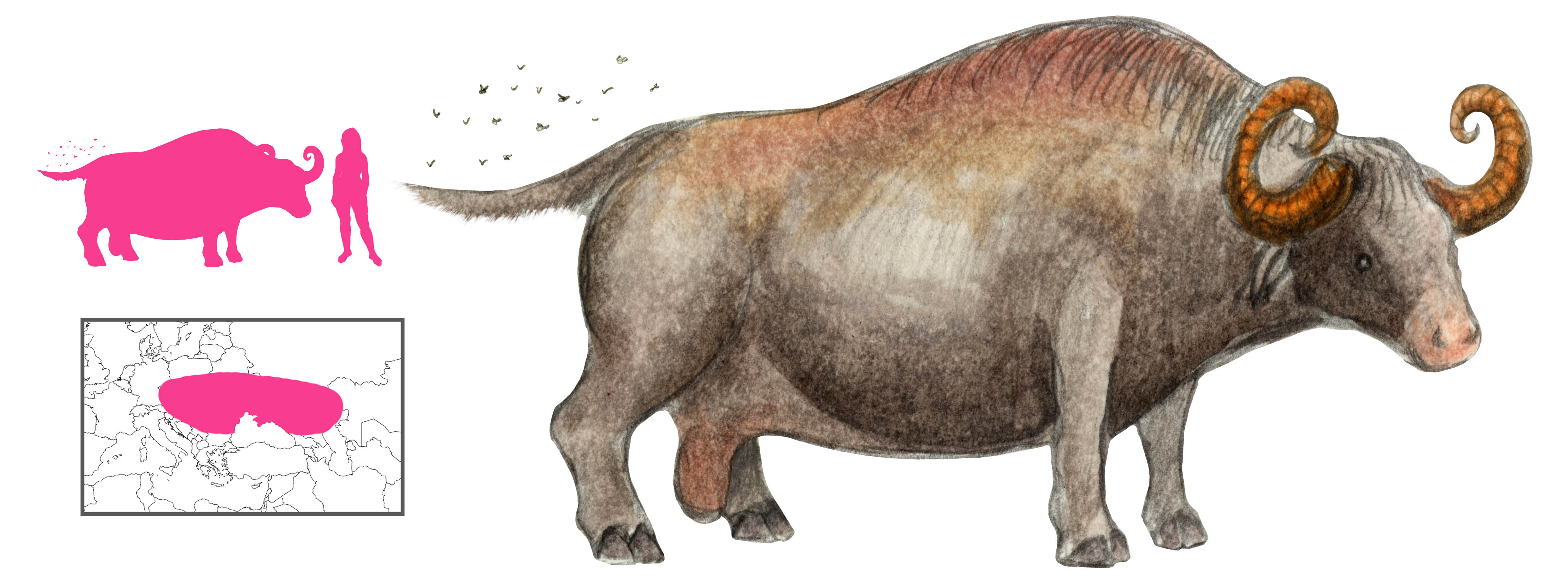
The Bonnacon’s range extends from Scythia in the east to Bulgaria, Macedonia, and Germany in the West. It would be a fine prize for hunters were it not for its remarkable flatulent defenses.

A bonnacon looks like a bull, but is squatter, with reddish fur shading to black, a short tail, and the shaggy mane of a horse. Its horns curl inwardly towards the head, making them of no use in self-defense.

When attacked, the bonnacon voids the contents of its intestines over an area of 3 acres (Aristotle gives a more conservative estimate of 4 fathoms). The noxious, acrid dung ignites and burns anything it touches, leaving a trail of flame in its wake.

The European bison (Bison bonasus) is generally believed to be the basis of the bonnacon.

References

Aelian, trans. Scholfield, A. F. (1959) On the Characteristics of Animals, vol. II. Harvard University Press, Cambridge, Massachusetts.

Cuba, J. (1539) Le iardin de santé. Philippe le Noir, Paris.

Pliny; Holland, P. trans. (1847) Pliny’s Natural History. George Barclay, Castle Street, Leicester Square.

Sainéan, L. (1921) L’histoire naturelle et les branches connexes dans l’oeuvre de Rabelais. E. Champion, Paris.

Unknown. (1538) Ortus Sanitatis. Joannes de Cereto de Tridino.

White, T. H. (1984) The Book of Beasts. Dover Publications, New York.

Az’-i-wû-gûm Ki-mukh’-ti

Variations: Walrus Dog

Aziwugum

Az’-i-wû-gûm Ki-mukh’-ti, the “Walrus Dog”, can be found roaming the rugged coastlines of Alaska. While not walrus-like, it lives with herds of walrus and acts as a protector of sorts. It is one of Raven’s many creations.

An az’-i-wû-gûm ki-mukh’-ti is rather like a large dog in general appearance, smaller than a walrus, elongate and slender, with a long, powerful rounded tail. Its body is covered with tough black scales which make it impervious to all but the best spears.

Walrus hunters in the Bering strait fear the az’-i-wû-gûm ki-mukh’-ti. Its muscular tail can easily kill a man, and at least one case is known of a walrus dog attacking an umiak and killing all aboard.

References

Nelson, E. W. (1900) The Eskimo about Bering Strait. Extract from the Eighteenth Annual Report of the Bureau of American Ethnology, Government Printing Office, Washington.

Sirānis

Variations: Sirānas, Suryānās, Sirinā, Siwānis

Siranis

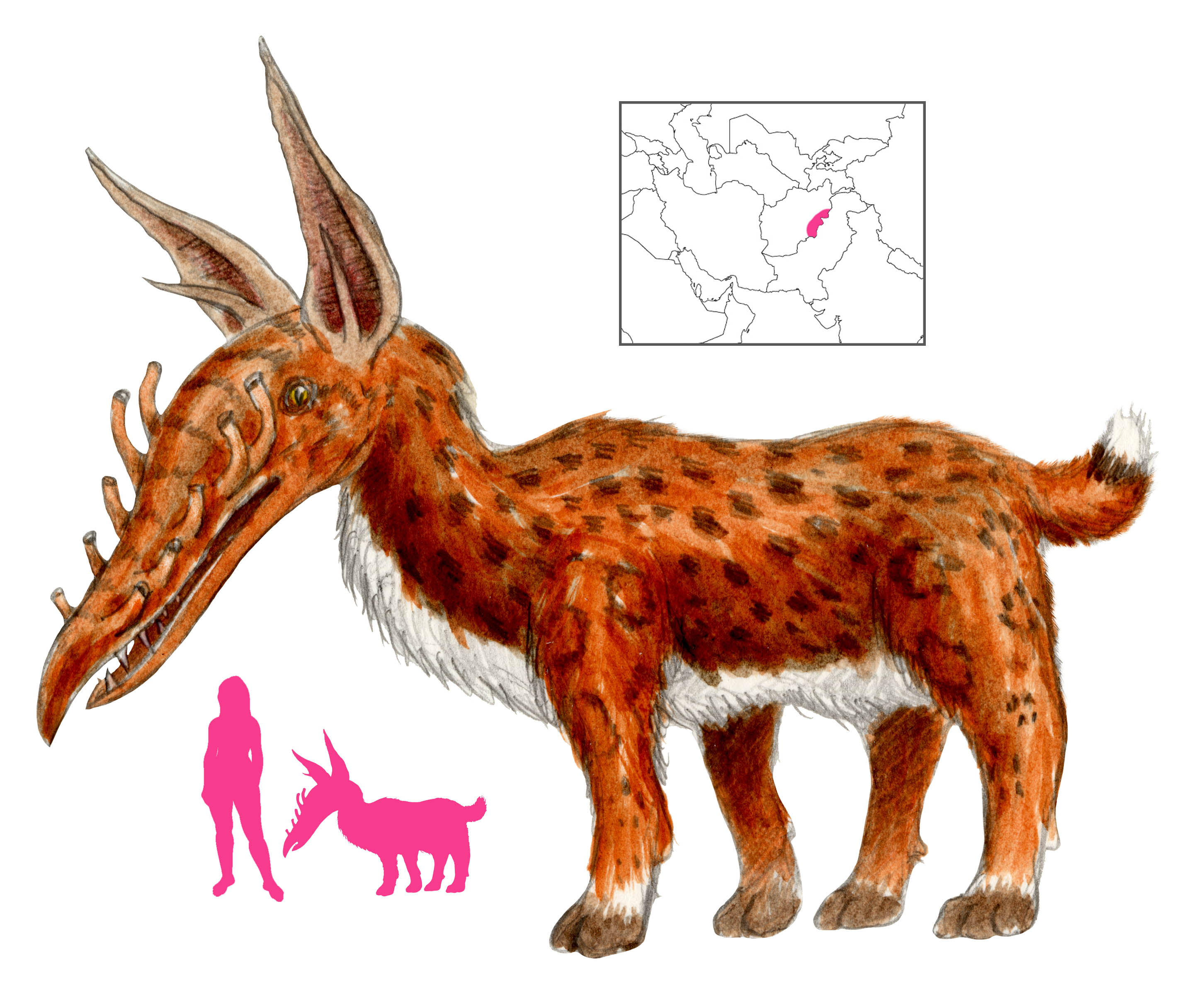
According to al-Qazwini, the Sirānis can be found in the undergrowth of Kabul and Zabulistan. Its name is derived from the Greek siren, from which the sirānis evolved beyond recognition.

Originally the sirānis was believed to be a marine animal with seven openings in its mouth, and which used its seven toes to play its snout like a musical instrument. This description, in turn, came to be that of the Qaqnus or Arghun, which was known by the same name as well. Sirinā was also the name of a system of walls with holes in them that replicated the call of the sirānis, and which was used by the Byzantines to attract and capture that animal.

Al-Qazwini, however, places the sirānis firmly on land as a carnivorous mammal with 12 openings in its snout. When it breathes, those orifices produce a pleasant sound like that of the mizmar or flute; indeed, it is said that it was the inspiration for the musical instruments.

A sirānis uses its musical prowess to capture prey. It produces a melody so entrancing that animals gather around it and swoon in wonder, giving the sirānis an open buffet to choose from. If none of the animals present are satisfactory, it lets out an earsplitting screech that scares its audience away.

In time, the proximity of the sirānis to the shādawār in al-Qazwini’s text led later authors to combine them, granting the more iconographically defined shādawār the predatory nature of the sirānis.

References

Contadini, A. Musical Beasts: The Swan-Phoenix in the Ibn Bakhtishu’ Bestiaries. In O, Kane, B. (2005) The Iconography of Islamic Art. Edinburgh University Press.

Contadini, A. (2012) A World of Beasts: A Thirteenth-Century Illustrated Arabic Book on Animals (the Kitab Na’t al-Hayawan) in the Ibn Bakhtishu’ Tradition. Brill, Leiden.

Ettinghausen, R. (1950) The Unicorn. Studies in Muslim Iconography, Freer Gallery of Art Occasional Papers Vol. 1, No. 3, Washington.

al-Qazwini, Z. (1849) Zakariya ben Muhammed ben Mahmud el-Cazwini’s Kosmographie. Erster Theil: Die Wunder der Schöpfung. Ed. F. Wüstenfeld. Dieterichsche Buchhandlung, Göttingen.

Bocarin

Variations: Manati

Bocarin

Thevet’s visit to the island of Hispaniola turned up a number of unusual and exotic creatures, one of which is a grass-eating fish known as the Bocarin or Manati.

Found in both rivers and the ocean, the bocarin looks primarily like a full wineskin tapering from the navel to the end of the tail. This corpulent monster is 20 feet long and 10 feet wide, and has grey skin with sparse hair. It has two legs at its shoulders, which it uses to swim with, and round, four-toed elephant’s feet with prominent nails. Its head is like that of an ox, except with a smaller face, much smaller eyes, and a much larger and fleshier chin. Females bocarins give birth to live young, and suckle them from teats much like whales do.

Thevet deemed it to be the most deformed and grotesque fish he had ever seen in that part of the world, but for all its ugliness it did have its uses. Its flesh tasted more like veal than like fish, and was fine to eat. Its skin was used to make shoes, its fat was used in leather-making and as ointment. Stones known as enar-onacpy in a bocarin’s head, ground into powder and taken with white wine, were remedies against kidney and bladder stones.

A Spaniard swore to Thevet that a bocarin had been kept for 20 or 30 years in a pond, and eventually became so tame that it would let people scratch its back and ride on it. But Thevet saw that as absurd, as who could imagine a fish being tamed in such a way, let alone a monstrously ugly one like the bocarin?

References

Lestringent, F. (1997) Le Brésil d’André Thevet. Éditions Chandeigne, Paris.

Thevet, A. (1558) Les Singularitez de la France Antarctique. Maurice de la Porte, Paris.

Thevet, A. (1575) La Cosmographie Universelle. Guillaume Chaudiere, Paris.

Nunda

Variations: Nundá, Eater of People

Nunda

The cat of Sultan Majnún was unusually fierce. One day it killed a calf, but the Sultan dismissed the event, stating that “the cat is mine, and the calf is also mine”. Then the cat proceeded to kill and eat a goat, then a cow, a donkey, a horse, and a camel, with the good Sultan shrugging each time. “I will not kill it, let it even eat a man”. Sure enough, the cat killed a human child next, and followed up with a man.

By this time the creature had grown large and monstrous on its diet of flesh, and it left the town on its own. It hid in the undergrowth outside city, and feasted on anyone who passed by, human or animal. At night, it would sneak into the dark roads and abduct hapless wanderers. Sultan Majnún still refused to see the danger. “You all want me to kill this cat. It’s my cat and everything it eats is mine”. He refused to address any more complaints, and the population of the town slowly dwindled. Anyone and anything not locked up indoors was at risk.

Eventually, it would come to pass that Sultan Majnún went out to look at the countryside with six of his sons, whereupon the cat pounced on them and killed three of the sons. It was then that Sultan Majnún finally came to his senses. “That is no longer my cat”, he said firmly. “That is a Nunda, and it will eat even me if I give it the chance”. He sent his soldiers to kill the nunda, but it killed some of them and scattered the rest.

Sultan Majnún’s seventh son, having heard of the carnage, swore a solemn oath that he would slay the nunda. “I shall find the nunda who killed my brothers”, he told his mother as he set out alone with a spear and a knife.

The young prince was nothing if not zealous. The first vaguely intimidating creature he ran into was a large dog, which he promptly killed and dragged home. “Mamá, wee, niulága nundá mla wátu“, he sang triumphantly. “O mother, I have killed the nunda, eater of people”. But his mother shook her head sadly and said “My son, this is not he, the nunda, eater of people. The nunda is much larger”.

So the son set out again, and successively killed a civet, a larger civet, a zebra, a giraffe, a rhinoceros, and an elephant, bringing each one back in turn only to be corrected by his mother. In time, he gathered a small group of followers, and managed to piece together a description of the nunda: it was elephant-sized or larger, had small ears, was broad and not long, had two blotches like a civet, and had a thick tail.

Finally, the youth’s efforts paid off, and the nunda was found asleep in the shade of a grove of trees. That was clearly the nunda, as it fit his mother’s description of it perfectly, and did not resemble anything else he had killed so far. He and his slaves fired their guns into the nunda at close range, but did not hang around for fear that it was still alive. Instead they slept through the night, and checked on it in the morning. The huge cat was undeniably dead.

The beast was dragged back to the city in triumph, and the prince sang of his victory, to which his mother chanted back “Mwanangu, ndiyeye nundá mla watu. My son, this is he, the nunda, eater of people”. The nunda’s carcass was buried, a house was built on top of it, and a guard was placed at the house.

This is but one tale of the insatiable nunda. It is another “swallowing monster”, and sometimes it swallows up the entire populace except for one hero. The hero kills the nunda and cuts it open, releasing the victims unharmed.

References

Steere, E. (1870) Swahili Tales. Bell & Daldy, London.

Tapirê-iauara

Variations: Tapir Nymph, Onça d’Água (Water Jaguar), Onça Pé de Boi (Cow-legged Jaguar), Paraná Pura Iuraretê (Turtle/Jaguar that Dwells in River Side Channels), Tai-açu-iara (potentially)

Tapire-iauara

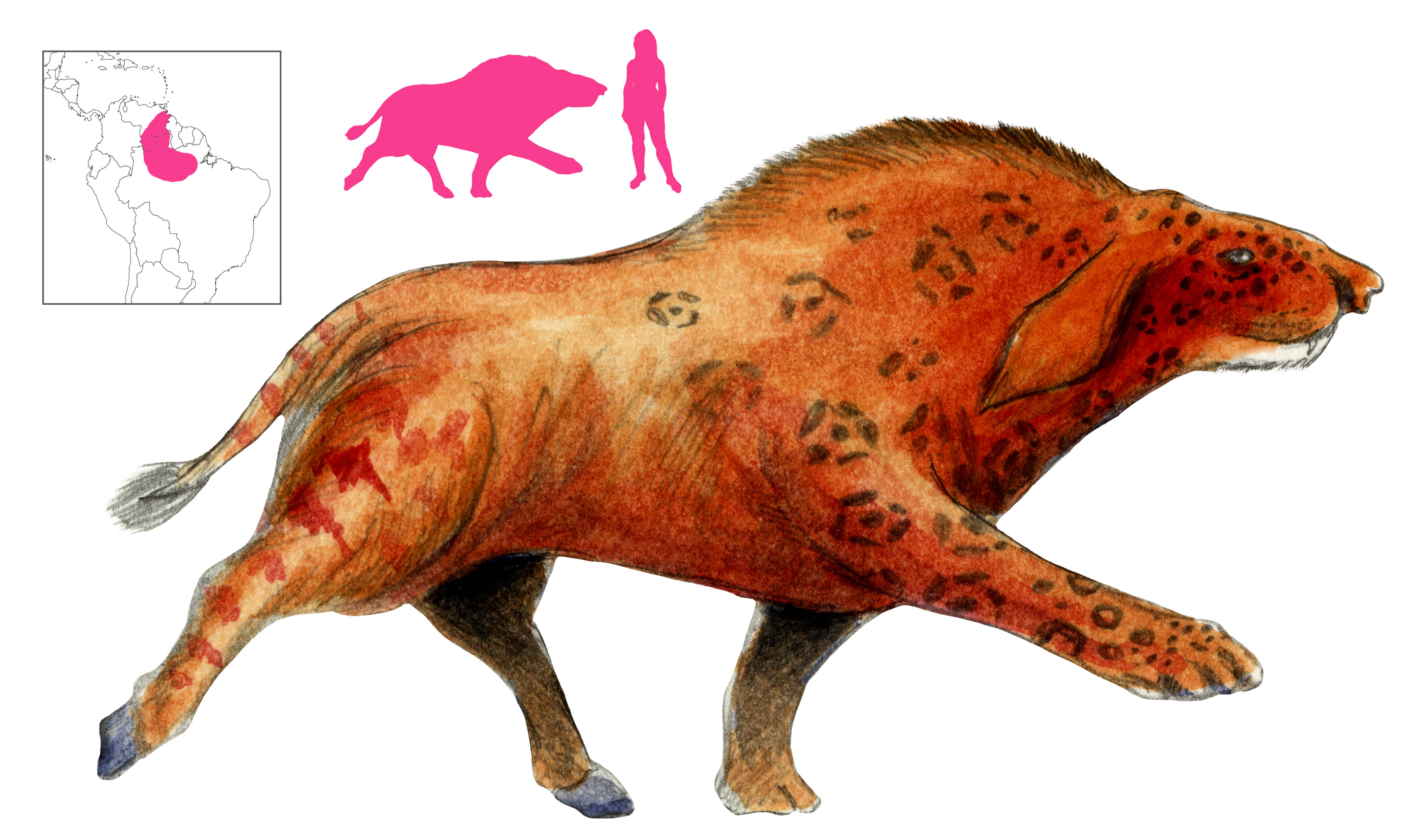
The Tapirê-iauara, or Tapir Nymph, enjoys a wide distribution in the Amazon, from the Orinoco in Venezuela to the Rio Negro, the Madeira, the Tapajós, and the Amazon down to Pará. Sightings have been reported from around Codajás, Fonte Boa, Itacoatiara, Nova Olinda, Oriximiná, Santarém, and Urucurituba. It lives in slower-moving waters, near groves of aninga or palm trees, and avoids human settlements.

The name tapirê-iauara is etymologically complex. Tapiré is Tupi for “tapir”, while y is “water” and ara is “lady” in língua geral; it also draws from the Tupi uara (“dweller”) or yguara (“dweller in water”). Hence, “tapir water-lady” or “tapir nymph” is a rough translation. This same derivation gives us the Amazonian nymphs Yara and Oyoára, the sea monster Hipupiara, and Paraná Pura Iuraretê, which was apparently a giant turtle creature that later was subsumed into the tapirê-iauara (iuraretê meaning either “turtle” or “jaguar”).

Reports of the tapirê-iauara appearance have varied somewhat. Most accounts agree that it resembles a cow-sized jaguar with a reddish waterproof coat, a thick mane, long droopy ears half a meter in length, and an overpowering stench (catinga). It may have jaguar legs, or the forelegs of a jaguar and hooved, donkey-like hindlegs. It may have horse legs with or without catlike paws, duck feet, or large otter paws. Variations in fur color include red, gold, and black with a cream patch in the chest. It notably does not look much like a tapir.

A tapirê-iauara is heard and smelled before it is seen. The large, finlike ears flap noisily against the water as it swims, while its putrid odor precedes it. From a safe distance, it’s merely nauseating; at close quarters the stench of a tapirê-iauara is enough to cause fainting and outright death. Tapirê-iauaras can also mesmerize prey into standing still before pouncing on them.

Tapirê-iauaras have a broad diet that includes large fish, capybaras, caimans, and humans. They are attracted to hauls of fish and the halitosis resulting from eating poorly-cooked fish. They often show up to inspect fishermens’ catches – or the fishermen themselves. When they do, they are fast, persistent, and resilient, relying on their odor to weaken prey before killing it with their sharp teeth and claws. One fisherman had to empty 12 slugs from a .22 rifle into a pursuing tapirê-iauara before the beast expired. Other fishermen have not been so lucky, having their catches stolen at best or being dragged into the river and devoured at worst.

Sometimes the stink of a tapirê-iauara is enough to cause a human’s shadow (and therefore soul) to depart. A person who has lost their shadow in this way is said to be assombrado. They can recover their soul by inhaling the fumes of a fire made with leaves, sticks, and the bones of undercooked piranhas.

Caraña resin (Protium heptaphyllum) is repulsive to tapirê-iauaras, and anyone concerned about tapirê-iauara attack should equip themselves with some before heading into the Amazon. Tapirê-iauaras also cannot climb, and so shelter should be sought in trees. As the tapirê-iauara’s odor will cause fainting and potentially falling out of the tree, secure branches must be found.

The Tai-açu-iara from around Parintins is similar and may be the same animal. It appears as a black piglike creature with jaguar paws.

References

Smith, N. J. H. (1981) Man, Fishes, and the Amazon. Columbia University Press, New York.

Smith, N. J. H. (1996) The Enchanted Amazon Rain Forest. University Press of Florida, Gainesville.

Raiju

Variations: Raijū, Thunder-animal, Thunder-beast

Raiju

In Japan, it is said that lightning cannot pass through a mosquito-net – and neither can the Raiju. These creatures also hate the smell of incense.

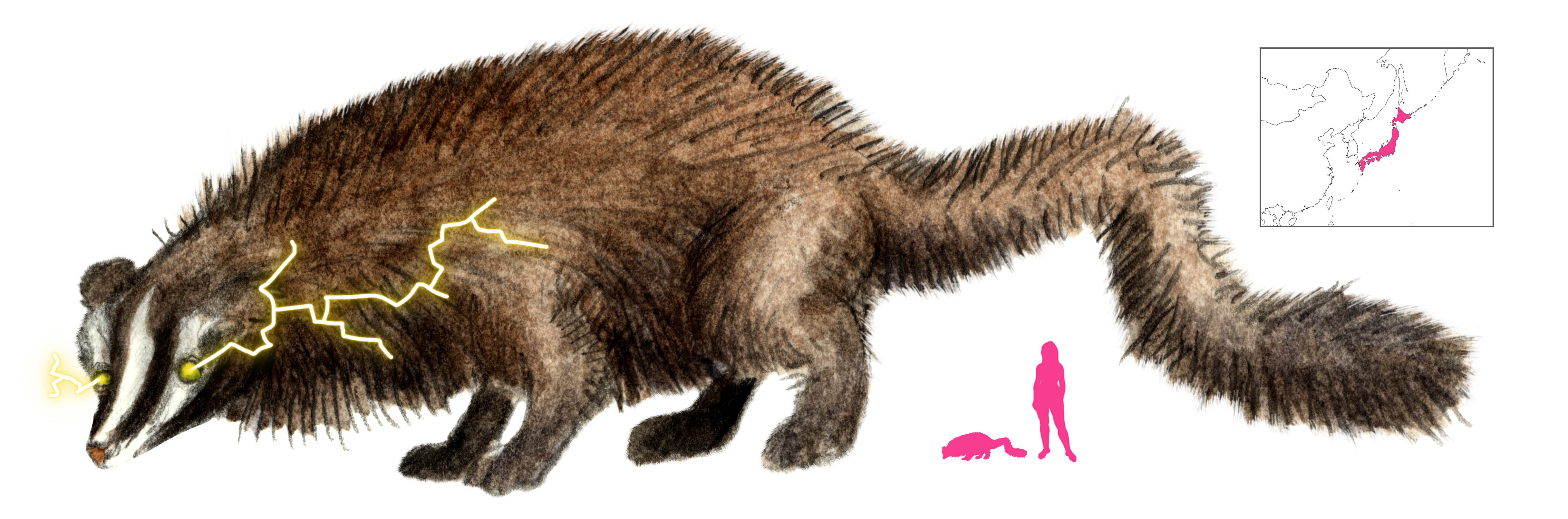
A raiju, or thunder-beast, ranges from dog to squirrel in general appearance, but usually resembles a badger. It falls from the sky with the lightning, and jumps from tree to tree. After the storm has passed, evidence of the raiju’s presence can be seen in the torn, deeply gouged treetrunks and woodwork where a raiju dug its claws in. Such raiju-damaged trees can be harvested for bark that cures toothache.

Raijus will pounce on anyone taking shelter beneath a tree, and will enter any house unprotected by mosquito netting or incense. They also love to eat human navels, and so it is vital to keep one’s navel protected during a thunderstorm, sleeping face-down if necessary.

Despite their elusive nature, raijus have been captured on multiple occasions. The Edo period in particular has many such cases across Japan, and it is believed the Chinese Bencao gangmu text was the inspiration for the raiju craze. One raiju got tangled in the ropes of a well and was taken alive. Another raiju was exhibited (for a fee) in a brass cage in the Temple of Tenjin in Matsue. It looked like a badger, and was said to sleep during fair weather, but during storms it would become active, with its eyes flashing.

The masked palm civet or hakubishin (Paguma larvata) is the most likely contender for the originator of the raiju. This badger-like animal was brought over to Japan from mainland Asia perhaps as early as the Edo period, its unfamiliar nature leading to tales of lightning beasts.

References

Foster, M. D. (2015) The Book of Yokai. University of California Press, Berkeley.

Hearn, L. (1910) Glimpses of Unfamiliar Japan (Second Series). Bernhard Tauchnitz, Leipzig.

Shādawār

Variations: Shadhahvar, Shadhahwar, Shādhahvār, Shad-hawar, Shād-hawār, Shad-havar, Shadhawar, Shadahvar, Shadahwar, Shadawar, Sadahvar, Sadahwar, Sadhavvar, Sadhazar, Sadhazag, Sadhuzag, Aras, ‘rs, ‘rsh
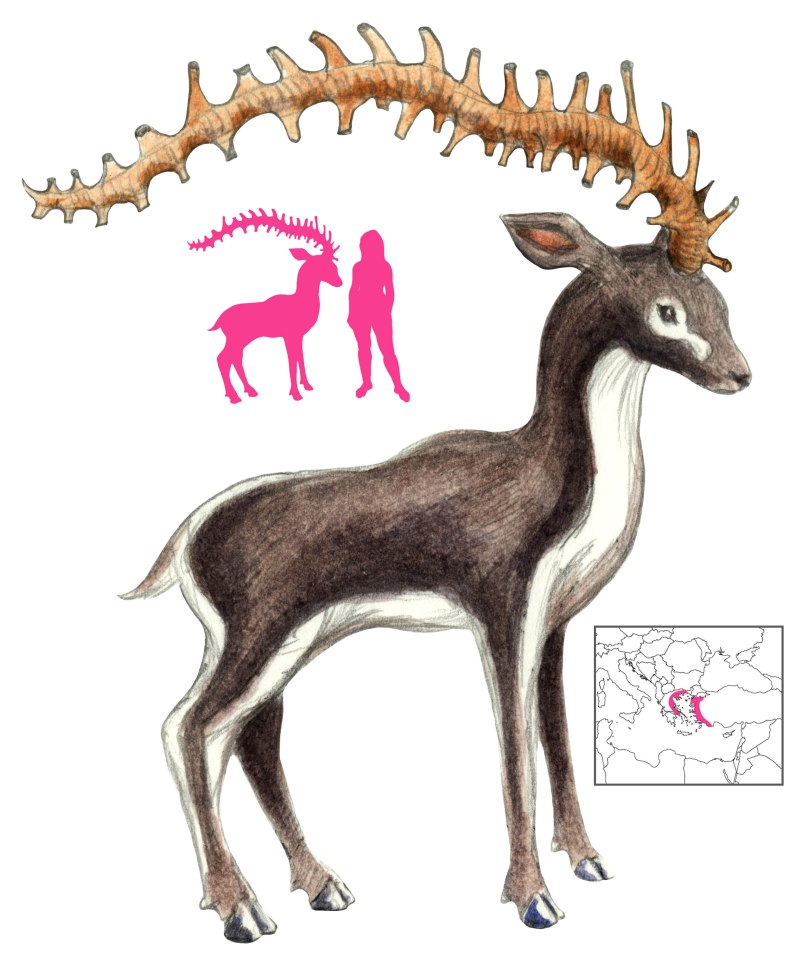
Shad-hawar

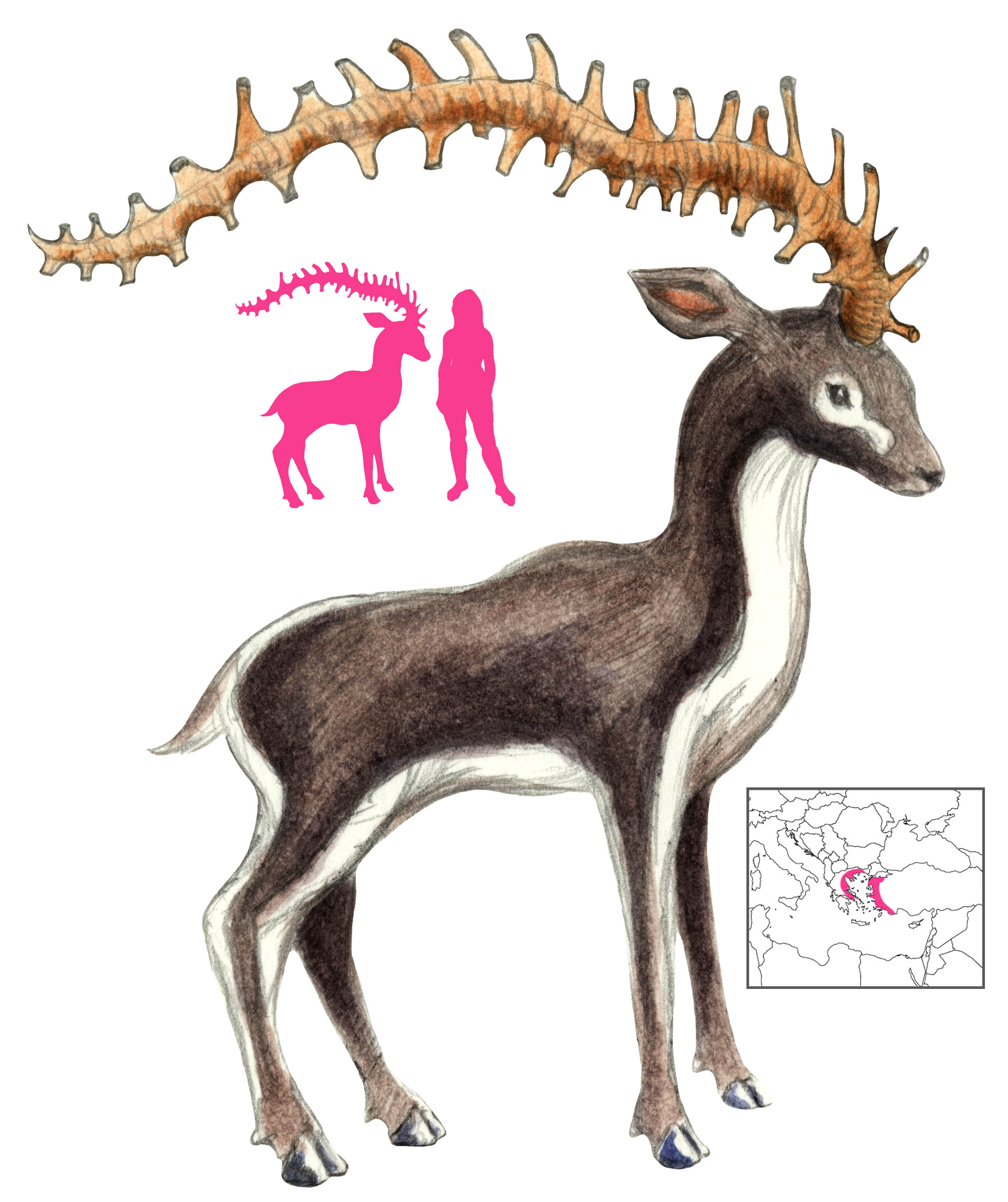
The earliest references to the musical-horned unicorn are given by Jabir Ibn Hayyan, around 900 A.D., where it is referred to as the Aras. It was given its most popular incarnation as the Shādawār by Al-Qazwini, which was subsequently copied with modifications by Al-Damiri and Al-Mustawfi. It was found in the farthest reaches of Bilad al-Rum, the Byzantine Empire, a vague location which to Al-Qazwini must have sounded remote.

Exactly how the shādawār’s name should be written and pronounced is unclear. Its writing has varied from author to author and manuscript to manuscript, sometimes starting with a Sā instead of a Shā, with the middle consonant being either a d or a dh (pronounced “the”), and ending in wār (Arabic) or vār (Persian). The spelling chosen here is ultimately arbitrary and based on Ettinghausen and Jayakar’s recommendations, and the most prevalent transliterations. The name is of unknown origin, but Hayyan’s aras is probably derived from “oryx”.

Unlike the more rhinocerine karkadann, the shādawār is an antelope-like ungulate with a single horn, but in this case it is long and hollow. There are forty-two hollow branches in the horn, and wind whistling through these flute-like holes results in beautiful, stirring melodies, so lovely that other animals will gather around to listen. Shādawār horns were offered to kings, who would hang them up as musical intruments. Depending on the angle they were held at, they would produce an enthralling tune or a sad dirge that moved all listeners to tears.

The shādawār has been incorrectly described as a flesh-eater, using its music to attract potential prey. In fact, Al-Qazwini makes no mention of any carnivorous tendencies. Al-Mustawfi, however, combines Al-Qazwini’s account of the shādawār with that of the carnivorous Sirānis immediately preceding it. It is the sirānis that lures prey to it with its music, and not the herbivorous shādawār.

Al-Damiri and Bochart give it seventy-two branches on its horn. Flaubert goes further and describes his “sadhuzag” as a black deer with the head of a bull, and a thicket of white horns on its head. It speaks to Anthony, describing its unique powers. “My seventy-four antlers are hollow as flutes. When I turn towards the South wind, sounds come out that attract enraptured beasts. Snakes coil around my legs, wasps cling to my nostrils, and parrots, doves, and ibises roost in my branches. – Listen! … But when I turn to the North wind, my antlers, thicker than a battalion of lances, exhale a howl; forests shudder, rivers retreat, fruit bulbs burst, and grasses stand on end like the hair of a coward. – Listen!”

References

Bochart, S. (1675) Hierozoicon. Johannis Davidis Zunneri, Frankfurt.

el-Cheikh, N. M. Byzantium through the Islamic Prism from the Twelfth to the Thirteenth Century. In Laiou, A. E. and Mottahedeh, R. P. (2001) The Crusades from the Perspective of Byzantium and the Muslim World. Dumbarton Oaks Research Library and Collection, Washington, D. C.

Contadini, A. Musical Beasts: The Swan-Phoenix in the Ibn Bakhtishu’ Bestiaries. In O, Kane, B. (2005) The Iconography of Islamic Art. Edinburgh University Press.

Contadini, A. (2012) A World of Beasts: A Thirteenth-Century Illustrated Arabic Book on Animals (the Kitab Na’t al-Hayawan) in the Ibn Bakhtishu’ Tradition. Brill, Leiden.

al-Damiri, K. (1891) Hayat al-hayawan al-kubra. Al-Matba’ah al-Khayriyah, Cairo.

Ettinghausen, R. (1950) The Unicorn. Studies in Muslim Iconography, Freer Gallery of Art Occasional Papers Vol. 1, No. 3, Washington.

Flaubert, G. (1885) La Tentation de Saint Antoine. Quantin, Paris.

Jayakar, A. S. G. (1908) ad-Damiri’s Hayat al-Hayawan (A Zoological Lexicon). Luzac and Co., London.

Kraus, P. (1986) Jabir Ibn Hayyan : Contribution à l’historie des idées scientifiques dans l’Islam. Société d’Édition Les Belles Lettres, Paris.

al-Qazwini, Z. (1849) Zakariya ben Muhammed ben Mahmud el-Cazwini’s Kosmographie. Erster Theil: Die Wunder der Schöpfung. Ed. F. Wüstenfeld. Dieterichsche Buchhandlung, Göttingen.
Catoblepas

Variations: Katoblepas, Catablepon, Katoblepon, Catobleponta, Gorgon (erroneously)

Catoblepas

The Catoblepas, “that which looks downwards”, is probably the most hideous and repulsive of living things, so horrid that its mere glance is lethal. Pliny locates it in Ethiopia, around the source of the Nile, Aelian puts it in Libya, and Topsell gives a range of Hesperia and Lybia.

According to Pliny, the body of a catoblepas is of small size, and its limbs are heavy, but its massive head is too heavy to be held up and always looks downwards. This is a good thing, as anyone who saw the eyes of a catoblepas died.

Aelian gives more detail, describing it as the size of a bull, but with a grim expression, shaggy eyebrows, and small bloodshot eyes. It looks downwards, and has a horselike mane that starts on its head and covers its face. The catoblepas feeds on poisonous plants; when threatened, it shudders and raises its mane in warning before opening its mouth and belching a foul, toxic gas. This gas poisons the air around it, and anything that breathes it loses its voice, collapses in convulsions, and dies. Other animals give it a wide berth because of this. There is no mention of a deadly gaze.

Topsell combines the catoblepas with the Gorgon, stating that the myth of Perseus originated from a war with African Amazons led by Medusa. The snake-hair of the gorgons was inspired by the catoblepas’ messy mane. His fanciful description borrows liberally from gorgons and adds thick eyelids, scales like a dragon, tusks like a boar, no hair on the head, wings, human hands, and a size between that of a bull and a calf. He also denies that a catoblepas can kill with its breath, which is unheard of in the animal world; it is far more likely to kill with its eyes like the well-known cockatrice. He gives as proof an anecdote of Marius’ soldiers encountering a catoblepas and thinking it a sheep, only to die immediately when it looked up at them. It was eventually killed in an ambush by spear-men, and its skin was sent to the temple of Hercules in Rome.

It is in Flaubert’s Temptation that we get the most nightmarish vision of the catoblepas. Here it is a sprawling, long-maned black buffalo with the head of a pig dragging on the ground. Its neck is long and thin like an emptied intestine. It is also granted the power of speech, addressing Anthony. “Fat, melancholy, wild, I perpetually feel the warmth of mud under my belly, hiding infinite rot under my armpit. My skull is so heavy that I cannot lift it. I roll it around me, slowly; – and, jaws opened, I tear with my tongue poisonous herbs watered with my breath. Once, I ate my paws by accident. No-one, Anthony, has ever seen my eyes, or those who have seen them are dead. If I lifted my eyelids – my pink and swollen eyelids, straight away, you would die”.

Cuvier suggested that this maned, hoofed, and downward-looking abomination of nature was inspired by the harmless gnu or wildebeest.

References

Aelian, trans. Scholfield, A. F. (1959) On the Characteristics of Animals, vol. II. Harvard University Press, Cambridge, Massachusetts.

Borges, J. L.; trans. Hurley, A. (2005) The Book of Imaginary Beings. Viking.

Flaubert, G. (1885) La Tentation de Saint Antoine. Quantin, Paris.

Pliny; Holland, P. trans. (1847) Pliny’s Natural History. George Barclay, Castle Street, Leicester Square.

Topsell, E. (1658) The History of Four-footed Beasts. E. Cotes, London.