Bruch

Variations: Bruchus, Brucha (pl.)

bruch

If the Hortus Sanitatis is to be believed, a young locust is far more dangerous than its adult counterparts. Referred to as a bruchus, it is an immature stage lasting until the animal can fly, and is distinguished by absent or undeveloped wings and a yellow color. As bruchi cannot fly, they remain in one place and gnaw fruiting plants down to the roots.

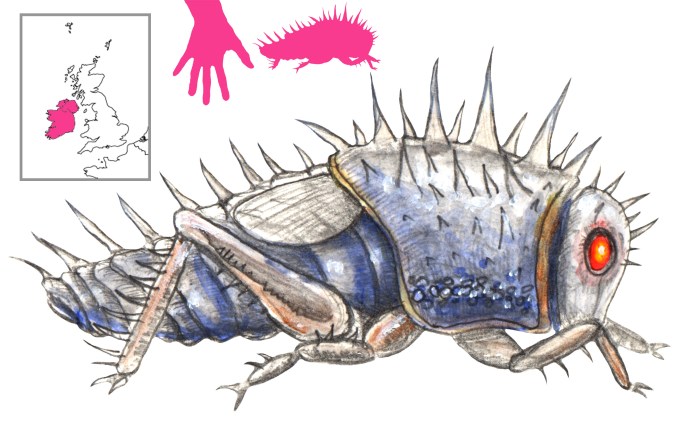
The Epistil Ísu, the Irish version of the pseudo-epigraphic Sunday Letter, describes the Bruch (pluralized as Brucha) differently. Here as before, the bruch is separated from its adult, and both are used to punish people who disrespect Sundays. A bruch has iron bristles and fiery eyes. Swarms of brucha go into the vineyards of sinners and cut the branches, roll about in the fallen grapes to impale them on their spikes, and carry the fruit off into their lairs – much like Pliny’s hedgehogs, which doubtlessly inspired this account.

Brucha apparently mature into locusts, which have iron wings that scythe wheat and make the ears fall. They too are avengers of Sunday.

References

Borsje, J. (1994) The Bruch in the Irish Version of the Sunday Letter. Ériu, v. XLV, pp. 83-98.

Borsje, J. (1996) From Chaos to Enemy: Encounters with Monsters in Early Irish Texts. Brepols Publishers, Turnhout.

Cuba, J. (1539) Le iardin de santé. Philippe le Noir, Paris.

carnivores-logo

Ah yes, the 90s, back when men were XTREME, women were XTREME, and toys were THE KOOLEST EVER. Toy manufacturers were constantly outdoing themselves in making XTREME action figures, and in a post-Transformers landscape, the importance of a storyline to enhance the play pattern was recognized.

Makers of toy cars in particular had to reinvent themselves. Making die-cast toys was becoming increasingly expensive, forcing them to cut corners (more on that in a later post); worse, they were losing in popularity to the XTREME newcomers. That’s when increasingly bizarre lines of “cars” were produced and died with a whimper. They were not huge sellers, but they were pretty cool- sorry, I mean XTREME. This post is dedicated to one such short-lived line.

Matchbox’s Carnivores (Carnivores, get it?) were short-lived and obscure by any account. There was only one wave produced in 1995, and nothing else after that. The backstory was fairly flimsy – car-monsters battling each other in an XTREME post-apocalyptic landscape – and the marketing was half-hearted (Skull Shooter, for instance, didn’t even get advertised on the back of the packaging). They did make a catchy ad for them with a bit of claymation, though. Nowadays they lurk in the dark recesses of eBay.

https://www.youtube.com/watch?v=MHNy5diaoKI

What connection do I have with them? Back in 1995, I was presented with the opportunity of having either a Carnivore or The Illustrated Book of Myths. I chose the latter, obviously, but the toys and their box art remained etched in my young mind. It wasn’t until years later that I found out what those things were.

There were seven Carnivores in total. All of them had “Ax-L Action”, which is to say that the wheels made their legs move around like they were crawling forward. Two of those were “deluxes” slightly larger than the others and with more action features. As for the creatures themselves, well… let’s see what they have to offer. I will be using the box art because it’s even more gloriously monstery than the toys.

iron-claw

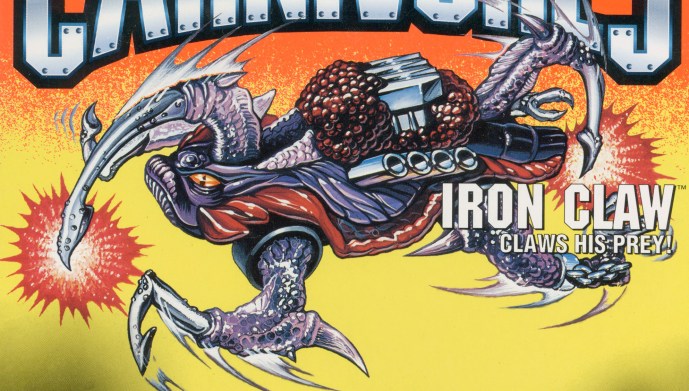
Iron Claw is fairly typical of the “basic” line, with crawling legs and a simple action feature – in this case, pressing the back claw causes the front claw to stab downwards. Iron Claw himself (only male pronouns are used, because girls aren’t allowed to play with XTREME car monsters) appears to be some kind of slug (or at least a mollusc), with a round sucker mouth, the eponymous iron claws, and an engine block in his back uncomfortably surrounded with tubercular tumorous tissue. He’s beautiful.

buzz-off

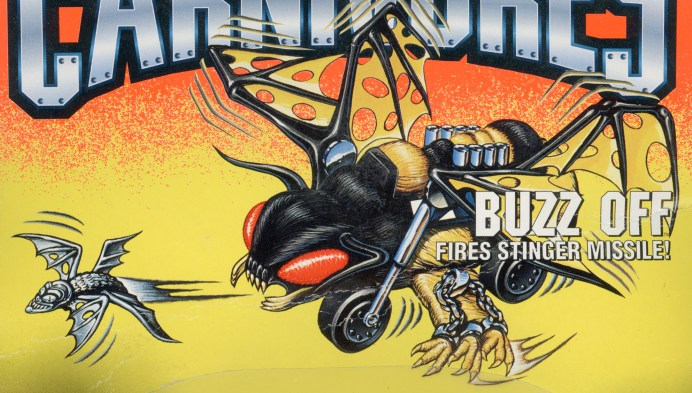
Buzz Off is much easier to narrow down: a giant car-wasp, with ragged membranous wings and three pairs of legs. And bull horns, apparently. But what’s with the chains? You will note that almost all the Carnivores have broken chains on their legs. Were they once tied up? Are they a top secret government experiment gone wrong? The world may never know.

Buzz Off’s gimmick is a “stinger missile”, a missile that can be spring-loaded and fired a short distance. It also appears to be sentient. Maybe they chat with each other in between dismembering prey.

chomper

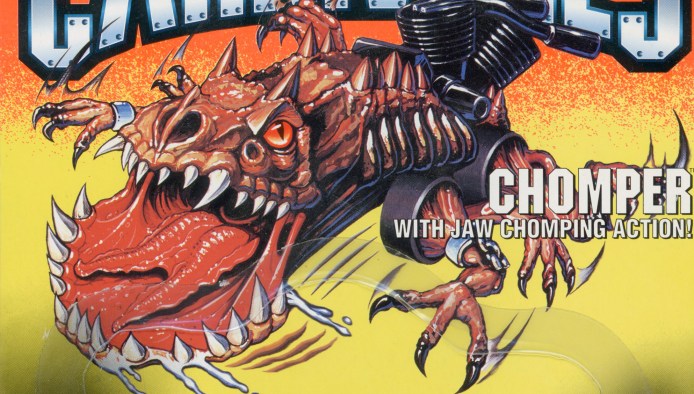
A huge mouth, teeth, drool, wrinkly skin… Yup, this hits all the right buttons. Chomper’s gimmick is straightforward: he chomps stuff. This is the sort of thing that could keep you busy forever. Chomper seems rather toadlike, but I want to imagine that it’s a mutated horned lizard. And can also shoot blood from its eyeballs.

spitfire

Spitfire is apparently some kind of squid? But it also has a ring of teeth and tentacles with claws attached to them? Yeah, I don’t know either. This one’s gimmick is spewing “deadly venom” – OK, water – that you load up and fire by pressing the soft plastic engine block on the back.

skull-shooter

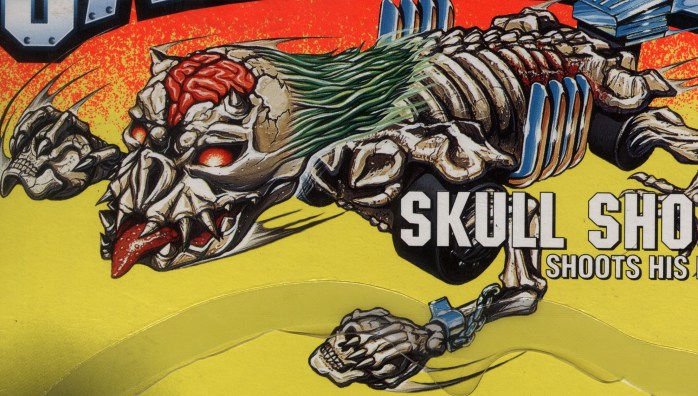
Skull Shooter, the zombie skeleton of the bunch, is the “secret” Carnivore, being largely unadvertised. He’s grabbing a pair of human skulls, so apparently the Carnivores share the Earth with us, and it gives us a sense of scale. He doesn’t seem to correspond with any known animal as far as I can tell.

Oh, and he shoots his own spring-loaded head off as a weapon. Metal.

venom-spitter

Venom Spitter is one of the two “deluxe” Carnivores, and is a large creature that’s mostly mouth and which has stolen Spitfire’s venom-spewing powers. It’s not clear what it’s mean to be, but the first thing I think of when I see that huge mouth and those tusks is a hippopotamus.

bite-wing

Bite Wing, finally, is the other “deluxe” and is the most unconventional Carnivore, being not a car but a helicopter that evolved from some kind of mutated bat. It also has what seems to be an insect’s thorax and abdomen, so it’s another one of those darn GMOs.

It comes with not one, but two “parasite bombs” that look like secondarily flightless vampire bats. And they too seem to have a mind of their own. Do they make small talk while being carried by their “parent”? Do they monitor Carnivore activity from on high?Are they good cops or loose cannons? Do they like lattes? So many questions, but the closure of the line in 1995 means that there will never be answers.

Carnivores are © Matchbox.

Selamóðir

Variations: Seal Mother

selamodir

The Selamóðir, or “Seal Mother”, is the protector of the harbor seals and grey seals of Iceland. It is called by seals when persecuted, or it may appear of its own accord to defend its charges. Unlike most seals, it can be found inland as well as at sea, in freshwater and saltwater.

Seal mother or not, a selamóðir is a monstrous sight. It is like a seal in general appearance, but of “unusual dimensions”, “terrifying size”, or simply the size of a large foreign dog with short legs. It is reddish-pink in color (perhaps with a red neck), with flashing eyes and a back like an island. There is a tuft of hair, like brushwood or heather, between its eyes.

Seal mothers may be found wherever seals gather, and ferociously attack anything that approaches their “children”. There is one report of a selamóðir charging out of the sea to scare off would-be seal hunters, and others of selamóðirs swimming upriver.

A selamóðir was also one of the three monsters inhabiting the Lagarfljót river. It slept under the waterfall, and was much feared until it was vanquished and transfixed to a rock.

References

Hlidberg, J. B. and Aegisson, S.; McQueen, F. J. M. and Kjartansson, R., trans. (2011) Meeting with Monsters. JPV utgafa, Reykjavik.

Each Uisge

Variations: Each-uisge, Water horse

each-uisge

While the kelpie plies the rivers and streams of Scotland, the lochs and seas are home to the far more dangerous Each Uisge, literally the “Water Horse”. Each uisges are carnivorous, and relish human flesh. While other water-horses are content with playing pranks, tossing riders into ponds and laughing at their lot, an each uisge’s actions are always predatory. In addition to hunting humans, they will also reproduce with farm animals, siring foals with flashing eyes, strong limbs, distended nostrils, and an indomitable spirit.

Like kelpies, each uisges are shapeshifters and can assume a wide variety of forms, from sea life to attractive human beings. Their most common guise, however, is that of a fine horse, standing by the waterside and waiting to be mounted. Such horses are always magnificent, sleek, and wild-looking, and their neighs can wake people up all around the mountains.

The each uisge in human form is attractive and charming, but always has some features that give it away – horse’s hooves, for instance, or hair full of sand and seaweed, or a tendency to whinny in pain. In such cases where an each uisge lover was found out, it is usually killed by the girl’s father or brothers before it can devour her. Regardless of the shape it has taken, an each uisge’s carcass will turn into formless jellyfish slime by the next day.

Sometimes the each uisge is a large bird, although this may be confusing it with the boobrie. More worrisome features have been observed, including viciously hooked, 17-inch long beaks, enormous claws, and footprints larger than an elephant’s. An each uisge observed at the Isle of Arran was light grey, with a parrot-like beak and a body longer than an elephant’s.

For all their carnivorous nature, each uisges can be easily tamed by slipping a cow’s cap or shackle onto it, turning it docile and harmless. If the cap or shackle ever falls off, the each uisge immediately gallops off for the safety of the loch, possibly dragging its would-be master with it. Each uisges can also be tamed by stealing their magic bridles. They use them to see fairies and demons, and are vulnerable without them. Finally, like many other evil creatures, each uisges avoid crosses and other religious symbols.

Every loch in Scotland has its own each uisge. Loch Treig was said to have the fiercest each uisges. Loch Eigheach means “Horse Loch” and is home to a much-feared each uisge, with a deadly charm and a silky grey hide. It would yell triumphantly as it bore its prey into the water.

Seven girls and a boy once found an each uisge on a Sunday afternoon near Aberfeldy. It was in the form of a pony, and it continued grazing as the first girl jumped onto its back. One by one, the other girls followed their friend onto the pony, but only the boy noticed that the pony’s back grew longer to accommodate its riders. Finally, the pony tried to get him on as well. “Get on my back!” it said, and the boy ran, hiding in the safety of the rocks. The terrified girls found that their hands stuck to the each uisge’s back, and they could only scream as it dove into the loch. The next day, seven livers floated to the surface.

The son of the Laird of Kincardine encountered an each-uisge near Loch Pityoulish. He and his friends found a black horse with a bridle, reins, and saddle all made of silver. They got onto it and immediately found themselves on a one-way trip to the loch, their hands glued to the reins. Fortunately for the heir of Kincardine, the youth had only touched the reins with one finger, and freed himself by cutting it off, but he could only watch as the water-horse took his friends with it.

While the water-horse legend may be pervasive and universal in northern Europe, some of the each uisge’s appearances may be more prosaic. The beak and large footprints of some each uisges suggest a leatherback turtle more than they do a horse.

References

Fleming, M. (2002) Not of this World: Creatures of the Supernatural in Scotland. Mercat Press, Edinburgh.

Gordon, S. (1923) Hebridean Memories. Cassell and Company Limited, London.

MacKinlay, J. M. (1893) Folklore of Scottish Lochs and Springs. William Hodge & Co., Glasgow.

Parsons, E. C. M. (2004) Sea monsters and mermaids in Scottish folklore: Can these tales give us information on the historic occurrence of marine animals in Scotland? Anthrozoös 17 (1), pp. 73-80.

A short interlude to explain a bit about how the art for A Book of Creatures is made. Like every artist, I’m my own worst critic and think my work is awful, but I do feel obliged to explain how I make the things that I believe could have been done so much better if only I’d used more ultramarine.

Most of the art in ABC is acrylics and pencil, with touchups on Photoshop. Some paintings (the Sinad, Dijiang, and all the Libyan snakes) were done in watercolor and pencil, for no real reason other than “it seemed like a good idea at the time”. The extent of Photoshop adjusting varies from 0 to extensive, depending on how much I hated the final result. To my eternal shame, I have not yet figured out how to paint on Photoshop, but I swear I will one day. Eventually…

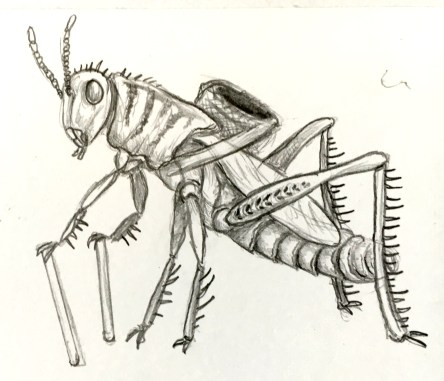
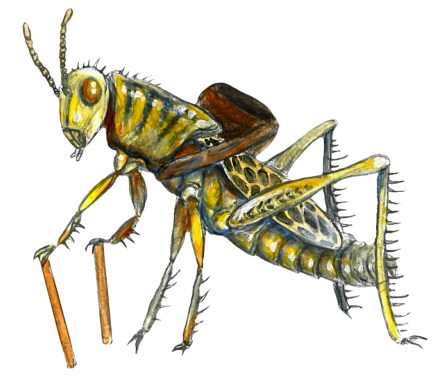
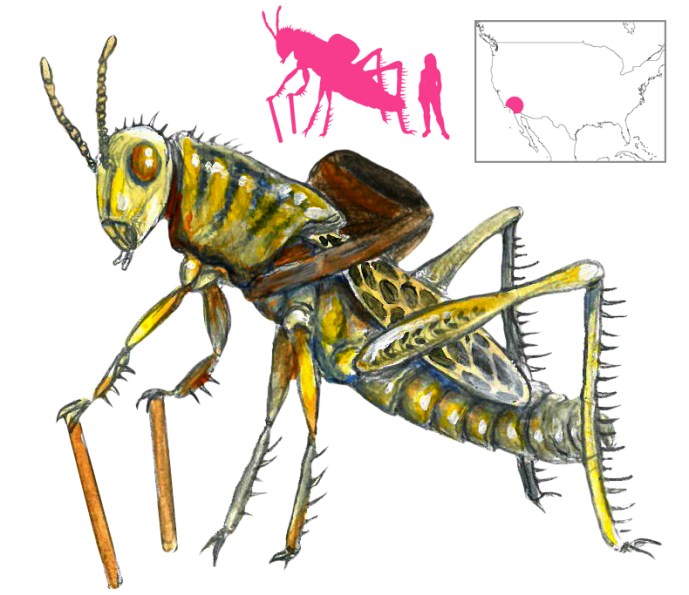
For my example, I will be following the creation of Haakapainiži, everyone’s favorite murderous anthropophagous eye-gouging grasshopper. Like all good paintings, Haakapainiži started out with a sketch, and before the sketch came the research. I knew Haakapainiži should be a grasshopper, but what kind of grasshopper? I love lubber grasshoppers, and their reduced wings, spikes, and poison seemed ideal for a ground-based menace like Haakapainiži.

1

Once the rough sketch is done, I start filling in details. This includes the basket, patterns, and textures. Probably because I’m used to painting animals, I don’t like to add lots of unnecessary detail for the sake of adding detail. This may or may not be a good thing. Spikes were an obvious addition, as were the little chevrons on the thighs. The stripes were added to give more of a predatory look.

I cannot stress how important it is to make a good underlying drawing. In my experience with acrylics, bad painting can be saved by good drawing, but no amount of good painting can save a bad drawing.

2

Now the fun starts. I usually use acrylics like watercolors, laying successive washes of increasingly dark colors, then picking out shadows and highlights. It was at this stage I decided to give Haakapainiži a colorful network pattern on his wings, like real lubbers have. It was also at this stage that I smudged paint on the paper. Fortunately, that’s what Photoshop erasing is for! And you thought thought an artist’s life was glamorous…

3

Light washes are followed up with darker ones, stronger colors. I decided to stick with a yellow palette in keeping with the desert theme, but actual lubber grasshoppers are really pretty and colorful. Don’t eat them.

4

Finally, I added shades of red in the eyes and around the body, and made the painting more three-dimensional by putting blue in the shadows and picking out highlights with undiluted white paint.

5

All that was left to do was erase everything that wasn’t Haakapainiži and do the usual entry format. For a change, I thought it was good enough that it didn’t need much adjusting in Photoshop besides tweaking levels.

And that’s how it’s done!

Calopus

Variations: Aeternae, Analopos, Antalope, Antholops, Aptaleon, Aptolos, Pantolops; Jachamur, Jachmur, Jamur, Yamur (Bochart); Chatloup (erroneously)

Calopus

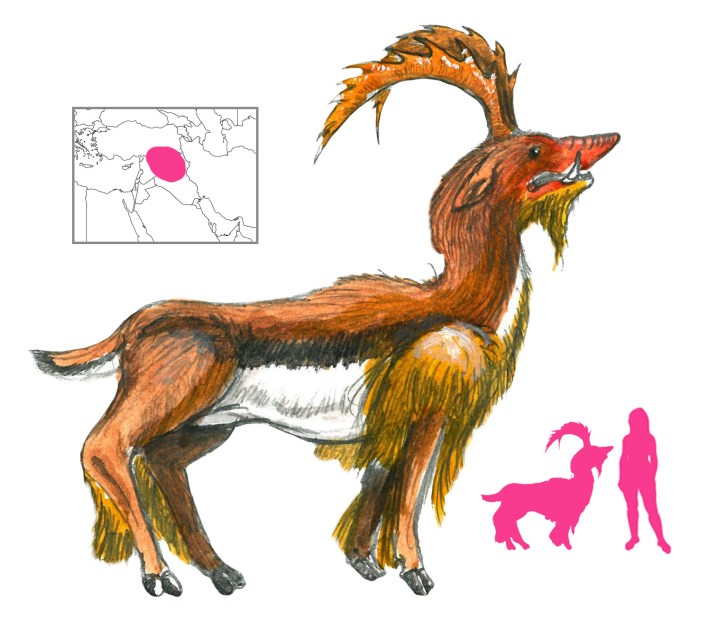
The antelope was known to the Greeks as Analopos (and variations thereof, derived from the Coptic Pantolops according to Bochart) and to the Romans as Calopus, “pretty foot” . These creatures were believed to inhabit India, Syria, and the Euphrates basin, and were fond of drinking the cool Euphrates water.

A calopus resembled a roe deer in appearance and size, with the exception of large saw-toothed horns growing out of their heads. These horns can be used to shred branches and human limbs alike, but are also easily entangled in thickets. A calopus trapped in this way will cry out, making it easily found and killed by hunters.

Alexander the Great encountered a number of these antelopes in India, where at least one obscure account refers to them as “aeternae”. The creatures pierced the Macedonian shields with their horns, but they were no match for Alexander’s soldiers, who slew anywhere from five thousand and four hundred to eight thousand five hundred and fifty of them. This, Topsell concludes, is the reason why we barely see any more of these animals.

Possible identities for the calopus include a number of antelopes, but also the moose, whose tree-shredding behavior may have inspired the calopus’ serrated weapons.

The “chatloup” (“catwolf”) name popularized by Barber and Rose appears to be a corruption of calopus.

References

Barber, R. and Riches, A. (1971) A Dictionary of Fabulous Beasts. The Boydell Press, Ipswich.

Bochart, S. (1675) Hierozoicon. Johannis Davidis Zunneri, Frankfurt.

Cuba, J. (1539) Le iardin de santé. Philippe le Noir, Paris.

Rose, C. (2000) Giants, Monsters, and Dragons. W. W. Norton and Co., New York.

Topsell, E. (1658) The History of Four-footed Beasts. E. Cotes, London.

de Xivrey, J. B. (1836) Traditions Tératologiques. L’Imprimerie Royale, Paris.

Behemoth

Variations: Shor Ha-bar (“Wild Ox”), Bahamut, Bahamoot

behemoth

Behemoth is the plural form of the Hebrew behemah, or “animal”; appropriately, the word is used to describe a creature of vast size and bulk.

The best-known reference to Behemoth is offered in the Biblical book of Job (40:15-24), where it is mentioned in God’s whirlwind tour of humbling natural wonders. The Behemoth eats grass like an ox, and its strength is in its muscular loins and tight-knit thigh sinews. Its tail stiffens like a cedar, its bones are like bronze, and its legs like iron bars. Despite its power, it is apparently passive and indolent, lying in marshes under lotus plants, and feeding in the mountains alongside the wild animals. Behemoth does not fear the river when it rushes into its mouth, and cannot be taken with hooks; only God can approach it.

Psalms 50:10 makes reference to “the behemoth on a thousand hills”, nowadays translated to “the cattle on a thousand hills”. The Midrash elaborates on that, making the Behemoth large enough to sit on the thousand mountains it feeds on, and making it drink six to twelve months’ worth of the Jordan River in one gulp.

The Talmud gives the Behemoth further cosmic significance. The behemoth were created male and female, but to prevent them destroying the Earth, God castrated the male and preserved the female in the World-to-Come for the righteous. This vision of the Behemoth has been interpreted as metaphoric, with the Behemoth representing materialism and the physical world.

If Behemoth is an animal known to us today, the primary candidates are the wild ox, the elephant, and the hippopotamus. The wild ox seems dubious, otherwise the Behemoth would not eat grass “like” an ox. The elephant’s trunk may have been the basis for the “tail”, but the description refers to stiffening, something which the hippo’s tail does. Another possibility is that the “tail” is in a fact a euphemism, and the description refers to the virility and vigor of the bull hippopotamus. Further details – living in water, feeding on land, a mouth big enough for the Jordan to rush into, terrifying power – all but prove that the hippopotamus is the subject of Job’s verses. Bochart agreed, heading his discussion of Behemoth with “non esse elephantum, ut volunt, sed hippopotamum“.

The Arabian Bahamut is a further magnification of the already-large Behemoth, turning it into a vast cosmic fish, one of the foundations on which the Earth stands. It is so big that all the seas and oceans of the Earth placed in its nostril would be like a mustard seed in a desert.

Behemoth is now a synonym for any large animal. Buel gives us behemoth as a possible originator of the word “mammoth”, alongside the Latin mamma and the Arabic mehemot.

The suggestion that Behemoth is a late-surviving dinosaur is best left unaddressed.

References

Bochart, S. (1675) Hierozoicon. Johannis Davidis Zunneri, Frankfurt.

Borges, J. L.; trans. Hurley, A. (2005) The Book of Imaginary Beings. Viking.

Buel, J. W. (1887) Sea and Land. Historical Publishing Company, Philadelphia.

Coogan, M. D.; Brettler, M. Z.; Newsom, C.; Perkins, P. (eds.) (2010) The New Oxford Annotated Bible. Oxford University Press, Oxford.

Slifkin, N. (2011) Sacred Monsters. Zoo Torah, Jerusalem.

You may be reading A Book of Creatures, but have you considered reading other books of creatures? Perhaps you just finished reading The Crystal Witch’s Encyclopedia of Elemental Birds and Beasts and are wondering whether or not it’s adequately researched? Or maybe you’re just one of my annoying fans convinced that I have the last word to say about mythical creatures? (I do) Your sleepless nights are over, as today’s Wednesday Interlude brings us the recurring feature of book reviews. In the thorough ABC style you’ve come know and love, the reviews will address everything a monster hunter would find important. And what better way to start than with Carol Rose’s Giants, Monsters & Dragons? Check it out on Amazon, and on Alibris.

Do note that all comments on Giants, Monsters & Dragons apply equally to its companion book Spirits, Fairies, Leprechauns and Goblins.

51sMuM-qVyL


Giants, Monsters & Dragons

by Carol Rose

Giants, Monsters & Dragons (GMD from here on) is about as close as you can get to a cornerstone of modern bestiaries. No other book is as influential, having served as the basis for countless pages of online information and leading to the popularization of many obscure creatures. It is not, however, without its faults, as we shall soon see.

Scope

GMD aims to cover a dizzying array of creatures, by and large “monstrous”, with the more humanoid entities covered in Spirits, Fairies, Leprechauns and Goblins. Rose outlines the criteria at the beginning as 1) the creature must not be divine or have divine powers, and 2) must be mythological, folkloric, or have some supernatural origin. Of course, no classification scheme is perfect, and this includes such entries for Titans (surely on the rank of gods?) and creatures from popular modern fiction such as Olog-hai – neither of which will make it anywhere in ABC.

What is undeniable is the vast amount of creatures on offer. The best-represented are English, Classical, and United States “Fearsome Critters”, but the book spans the globe, bringing in the Mi-ni-wa-tu and the Cheeroonear alike. For many of us, this is the first time we came across the Butatsch Cun Ilgs and the Carcolh, even if they were misnamed. Rose has done an amazing job putting this menagerie between two covers, and so the quantity – if not the quality – is exemplary.

Organization

GMD is organized by alphabetical order, which is a safe, standard choice for an encyclopedia. The entries are connected to the numbered bibliography and are amply cross-referenced, although some entries could do with a bit more referencing beyond “monster”. There are extensive appendices organizing creature by locality and general type as well, making GMD very user-friendly.

Text

Rose’s text is factual and academic, with little in the way of amusing asides or artistic flourishes. Entries start with “X is the name of a…” This is not a criticism; this format of writing, while lacking in poetry, is perfect for a serious encyclopedic volume, while other books overdo the florid descriptions.

Images

The illustrations are all black and white, copyright-expired type pictures. They are not especially evocative or interpretive, but do a good job of showing what people at the time thought. At their best when actually depicting the creature in question (e.g. the Aloés on page 14), they are at their worst when used as generics for something much weirder (e.g. “Sea serpents much like the fearsome Muirdris” on page 259, or the unicorn giant for the Aeternae on page 5). As with the text, I have no problem with any of this, and they work just fine for an encyclopedic work. What does bother me is the lack of attribution for the images beyond “Scala Art Resource” or the like, and the lack of original context.

Research

This is where my primary criticisms come in. As an English author, Rose is (as are most bestiary writers) necessarily biased towards English-language creatures. Non-English creatures can end up with butchered names, such as the retention of superfluous definite articles in “lou carcolh” and “al-mi’raj”, the use of “djinn” in the singular (and the separation of “djinn” and “jinn”), and the painful mangling of “angka”. Others are harder to pinpoint, such as “butatsch cun ilgs” becoming “butatsch-ah-ilgs”.

GMD’s bibliography clocks in at almost 200 references, but many are themselves compilation bestiaries, such as Borges’ Book of Imaginary Beings, Barber and Riches’ Dictionary or Meurger and Gagnon’s Lake Monster Traditions. In many cases, those bestiaries are the sole reference for an entry, and these can in turn pass on errors. The “Celphie” as reported by Barber and Riches is one such example, as are the multiple misattributions and jokes concocted by Borges. The “zaratan” entry is a particularly bad offender, not only passing on Borges’ misspelling but also misrepresenting the chain of literary events, mistaking the modern translator Palacios for a medieval author (“… the Zaratan has entered Arab and Islamic legends through the work of the ninth-century zoologist Al-Jahiz, later refuted by the Spanish naturalist and author Miguel Palacios in his version of the Book of Animals, and thence copied into a ninth-century Anglo-Saxon bestiary…”).

Not as much of a problem on their own, these research and linguistic errors have since propagated and have become hard to eradicate. They are straightforward to correct with the right sources, but without them it is all too easy to take them at face value.

Summary

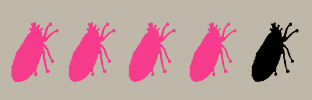
Giants, Monsters & Dragons has some concerning research issues, and lacks eye-candy artwork, but for a complete encyclopedia of a lot of mythical creatures you can do no better. While I would suggest not taking everything in it for granted, this remains an unavoidable milestone of the genre. Besides, I’ve read it a lot so I’ve got a soft spot for it. 4 out of 5 gigelorums, down to 3 if you’re a strict rater, research errors bother you, and you have no access to primary sources.
4

Flyðrumóðir

Variations: Flyðrumóðirin (pl.), Halibut Mother; Laxamóðir (Salmon Mother), Laxamóðirin (pl.); Silungamóðir (Trout Mother), Silungamóðirin (pl.)

Flydrumodir

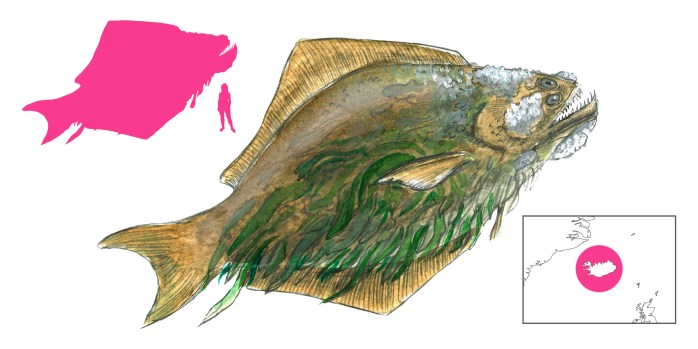
The Flyðrumóðir, or “Halibut Mother”, is fairly representative of the Icelandic móðirin, the “mothers” of certain species of fishes. These creatures look like huge, monstrous versions of their namesakes, and they protect their smaller kin fiercely.

A flyðrumóðir looks like the halibut it protects, but it is much larger, growing to the size of a fishing boat. Its body, which turns grey on both sides with age, is covered with shells, barnacles, and seaweed, making it look like a small island when it surfaces.

While the flyðrumóðir has been said to be the mother of all fishes in the sea, its true “children” are the halibut. It is followed by schools of halibut out at sea, and it protects them if they are persecuted. A schooner in Faxaflói attracted (and escaped) the attention of a flyðrumóðir after it hauled up 40 halibuts. Another fishing boat owned by Archdeacon Hannes Stephensen was less lucky; it caught a flyðrumóðir on a coffin-nail hook, but was capsized by the halibut mother with all hands lost.

Even catching a flyðrumóðir is not necessarily a good thing. After the halibut mother of Breiðafjörður was snagged on a golden hook and filleted, the waters of the area ceased to produce fish, and the angler who caught the giant halibut never again caught a fish in his life.

Similar fish mothers include the freshwater Laxamóðir, “Salmon Mother” and Silungamóðir, “Trout Mother”. Both of these resemble oversized salmon and trout, respectively. Salmon mothers will swim out of salmon-rich rivers, tearing through fishing nets along their way. The big-headed trout mothers are bad luck to catch, and should be released whenever possible.

References

Hlidberg, J. B. and Aegisson, S.; McQueen, F. J. M. and Kjartansson, R., trans. (2011) Meeting with Monsters. JPV utgafa, Reykjavik.

Haakapainiži

Variations: Hakapainije; Nikama (Giant); Aatakapitsi (Chemehuevi); Taünara; Grasshopper

Haakapainizi temp

Haakapainiži, the Grasshopper as he is known to the Kawaiisu, is an unpleasant ogre from Southern California, although he lives on a rock in a Nevadan lake. His counterpart in Chemehuevi folklore is Aatakapitsi, and their tales are parallel.

Haakapainiži takes several forms, but the best known is that of a giant grasshopper walking on two canes, with a basket on his back. His legs are armed with viciously sharp spikes. His legs are long enough to allow him to walk the 20 miles between Inyokern and Onyx in one step. He also appears as a giant, a harmless-looking old man, and a swarm of grasshoppers. Haakapainiži sings as he walks, hiding his evil intentions.

Children are Haakapainiži’s prey, and he stuffs them in his basket for devouring later. As such he is correctly classified as a bogey, and parents will quell children with warnings of “Haakapainiži is coming!”

Once Haakapainiži met a young girl. He coughed up mucus into his hand and presented it to her, saying “Come get this fat, grandchild”. When she did, he tossed her in her basket and carried her off to Nevada, where he ate her. He repeated the same trick with a little boy, but the lad grabbed onto an overhead branch and escaped the basket.

Another time, Haakapainiži slept alongside the Quail Sisters, who saw no reason to doubt the singing insect’s words. “I will sleep above your heads, and don’t worry, I won’t stretch during my sleep”. Sure enough, the sisters woke up in the morning unscathed. “What a nice old man”, they said to themselves, before Haakapainiži stretched his spiked legs and gouged out their eyes.

The Yucca Date Worm girls fell afoul of Aatakapitsi in the same fashion. Their husband Kwanantsitsi, the Red-Tailed Hawk, restored their eyes, then set out to avenge them. Yet every time he approached Aatakapitsi, the giant seemed to shrink until he disappeared entirely, leaving nothing but a swarm of grasshoppers. Exasperated, Kwanantsitsi hunted down the grasshoppers with a stick until they were all dead. This time, when he backed away, he saw the giant’s lifeless body.

Haakapainiži was killed by Mouse, who heated an arrow-sharpening stone in a fire and tossed it into the grasshopper’s mouth. “Close your eyes and open your mouth, I’ll feed you one of my children”, said Mouse, and allowed the heated rock to burn Haakapainiži’s insides. Both Mouse’s home and the petrified remains of Haakapainiži can be seen at Inyokern.

References

Laird, C. (1976) The Chemehuevis. Malki Museum Press, Morongo Indian Reservation, Banning.

Zigmond, M. L. (1980) Kawaiisu Mythology. Ballena Press, Socorro.