Great-hand

Great-hand

The Old Town of Edinburgh is honeycombed with cellars, passages, and tunnels. These subterranean labyrinths are home to ancient horrors long forgotten by the residents. Great-hand is one of these.

Great-hand lives in the tunnel beneath the Royal Mile, stretching from the Castle to the Palace of Holyrood. Once used by soldiers for surprise attacks, it eventually fell into disuse. Then Great-hand moved in and the passage was abandoned completely. Nobody ever left the tunnel alive.

The only thing that has ever been seen of Great-hand is a hand – an enormous grisly hand, with fingernails like the claws of an eagle. If that hand is attached to a body, none have seen it.

After a while of avoiding the tunnel, a piper declared he would cross the tunnel, playing his pipes the whole way to verify his progress. Taking his dog along with him, he entered through the cave near the Castle, and the sound of his pipes could be heard traveling underground as he went down the hill. Then, at the Heart of Midlothian, the music stopped. The attending crowd went back to the entrance of the cave to see the dog running out in abject terror, completely hairless. The passage was blocked up from both ends.

Similar stories are told across Scotland involving haunted caves, foolhardy pipers, and dogs shedding their hair with fright. They are cautionary tales warning of the perils of the underground.

References

Fleming, M. (2002) Not of this World: Creatures of the Supernatural in Scotland. Mercat Press, Edinburgh.

Wako

Variations: Waco

Wako

The Wako are tsawekuri, animal spirits in the folklore of the Cuiva of Colombia and Venezuela. They look like pacas, with spots and long vicious fangs. Wako dig caves with many small exits and hiding-places, and live there in large numbers. Their call sounds like ao, ao, ao, ao.

Wako are carnivorous and anthropophagous. Anyone who ventures into their caves is hunted down and devoured. However, they refuse to chase anyone who is naked.

A Cuiva man who was left by his wife once made the suicidal decision to dig into a wako nest. Despite his son’s entreaties, he dug into the hole where a wako had been seen, feeling around with his hand and pulling it out quickly. His actions startled the wako, who ran out of their burrow calling ao, ao, ao, ao. There was nothing left of him after they were done.

Another man descended into a wako cave to avenge his pregnant wife, who had been eaten by the wako. He successfully exterminated the entire nest of wako.

References

Arcand, B.; Coppens, W.; Kerr, I.; and Gómez, F. O.; Wilbert, J. and Simoneau, K. eds. (1991) Folk Literature of the Cuiva Indians. UCLA Latin American Center Publications, University of California, Los Angeles.

Trochus

Variations: Rota

Trochus

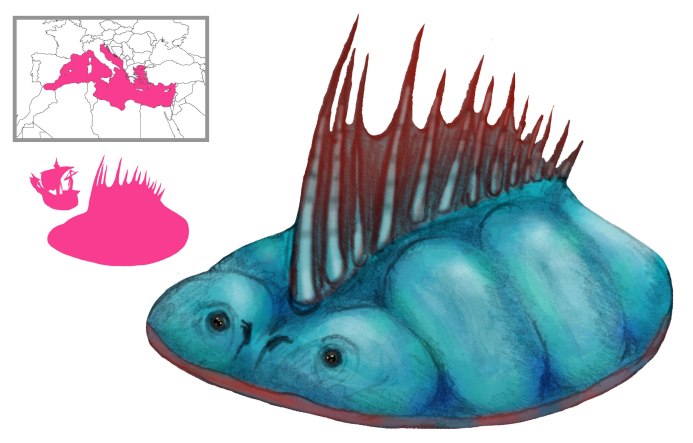
The Trochus, “wheel”, or Rota is a huge sea-monster known to swim close to shore in large groups. Schools (pods?) of these have been seen off Athos and Sigeum.

A trochus is fortunately timid, despite having a crest and spines of great size that show above the water. It revolves and contracts and dives deep, uncoiling and rolling and returning to the surface.

The wheel-like resemblance suggests a jellyfish or ray, but the size and behavior makes it clear that the trochus is a whale surfacing and diving.

References

Aelian, trans. Scholfield, A. F. (1959) On the Characteristics of Animals, vol. III. Harvard University Press, Cambridge, Massachusetts.

Chang Nam

Variations: Ye Thin (Myanmar); Water Elephant

Chang Nam

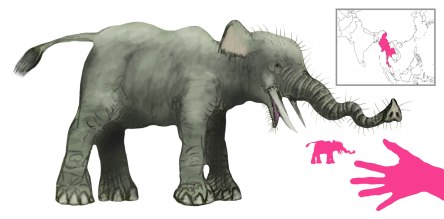
The Chang Nam, or “water elephant”, is native to the jungle streams of Thailand. Its equivalent in Myanmar is called the Ye Thin.

A chang nam looks like a miniature replica of an elephant. It is no bigger than a rat but has a trunk and sharp little tusks and all the hallmarks of elephants.

These water elephants are extremely dangerous. Merely seeing a chang nam’s shadow causes instant death. A chang nam will also stab footprints and reflections in the water with its tusks, bringing about the death to the owner of the footprint or reflection.

It seems uncertain whether the chang nam has a purely supernatural origin or if it has some real animal as its basis. Nonetheless, stuffed chang nam skins are available for sale to gullible tourists; these are manipulated frog or rodent skins with tusks attached.

References

Wood, W. A. R. (1965) Consul in Paradise: Sixty-nine Years in Siam. Souvenir Press, London.

Làlomèna

Variations: Làlimèna

Lalomena

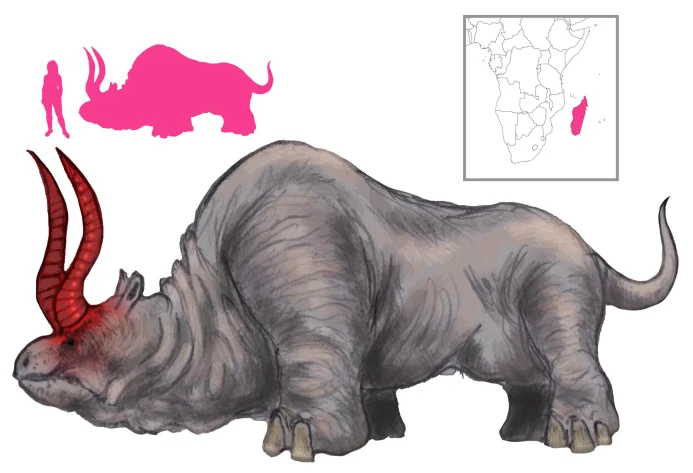
The Làlomèna is found in the waterways of Madagascar. It has two very red horns and looks like an ox. It is among the strongest of aquatic animals, but little more is known of its appearance and attributes.

Sub-fossil remains of Madagascan hippos have been referred to as làlomèna bones.

References

Sibree, J. (1896) Madagascar Before the Conquest. Macmillan, New York.

Issitôq

Issitoq

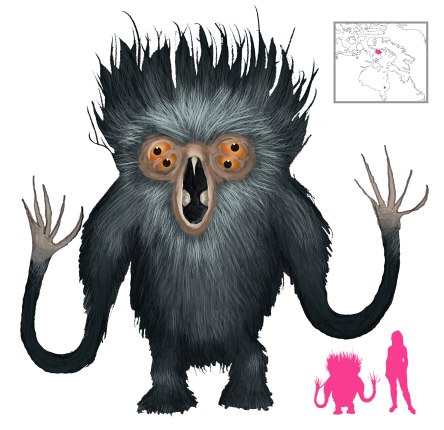
Issitôq, “giant eye”, is a gloomy helping spirit that appeared to the Iglulik Inuit mystic Anarqâq. As Anarqâq had just lost his parents, Issitôq consoled him. “You must not be afraid of me; I, too, struggle with sad thoughts, so I will go with you and be your helping spirit”.

Issitôq has short bristly hair that stands straight up. Each of its eyes is in two sections. Its mouth is vertical, with a single long tooth at the top and two shorter ones at the side. It specializes in finding taboo-breakers.

References

Rasmussen, K. (1929) Intellectual Culture of the Iglulik Eskimos. Glydendalske Boghandel, Nordisk Forlag, Copenhagen.

Guiamala

Variations: Ghiamala

Guiamala

The Guiamala is found in the African kingdoms of Gadoua and Giaca (or Gadda and Jaka), east of the kingdom of Bambuk. It is a huge animal, taller than an elephant but not as bulky, and capable of moving swiftly. It is a sort of camel, having a long neck, a camel-like head, and a dromedary’s hump or two on its back. Its legs are incredibly long to allow it to stand over 20 feet tall. For defense the guiamala is equipped with seven straight, pointed horns, each about two feet long. The horns are black, covered with tawny hair and a black point. The hair falls off after the horn has grown to a certain length. The hooves are cloven like an ox’s.

Guiamalas are not picky eaters, and will eat thorns and other low-quality browse. They also eat very little, allowing them to survive in arid areas. They are docile and harmless and could feasibly make good pack animals. Their flesh is edible and tender.

References

Delisle de Sales, J. C. (1769) Dictionnaire Theorique et Pratique de Chasse et de Pesche. J. B. G. Musier, Paris.

Labat, J. B. (1728) Nouvelle Relation de l’Afrique Occidentale, t. IV. Pierre-Francois Giffart, Paris.

Beisht Kione Dhoo

Variations: [Yn] Beisht [y] Kione Dhoo ([The] Beast of [the] Black Head); [Yn] Beisht Kione ([The] Beast of Head) (erroneously)

Beisht Kione Dhoo

Fishermen on the Isle of Man have traditionally observed a number of customs. Whistling on board “bothers the wind” and is discouraged. Sticking a knife in the mast on the appropriate side causes the wind to blow from that direction. Losing items on board is bad luck; borrowing items from “lucky” boats brings good luck. Four-footed land animals should not be mentioned by name, but instead by a circuitous sea-name – rats, for instance, are “long-tailed fellows”. Cold iron is a remedy to most acts of bad luck.

Then there is a number of sea creatures that can wreak havoc on fishing vessels. Of the the Beisht Kione Dhoo, the Beast of Black Head, is the most terrifying. It makes its home in the sea-caves on Black Head, near Spanish Head at the southern tip of the Isle of Man. The few who have seen it say it has a head like that of a large horse, and it can be heard roaring by fishermen off Spanish Head. Some say it is the soul of a man killed by pirates in order to protect their treasure hidden in the headland’s caves. Nobody has attempted to claim that treasure.

To placate the Beisht and bring on good luck, rum is left in the cave at Spanish Head. Fishermen heading out to sea would throw a glassful of rum overboard in hopes that the Beisht will grant them a bountiful catch.

References

Broderick, G. (1984) A Handbook of Late Spoken Manx: Grammar and Texts. Max Niemeyer, Tübingen.

Killip, M. (1976) The Folklore of the Isle of Man. Rowman and Littlefield, New Jersey.

Rose, C. (2000) Giants, Monsters, and Dragons. W. W. Norton and Co., New York.

Lushu

[image pending]

South of the Niu-Trees Mountain in China has red metal on its southern slope and white metal on its northern slope. It is also home to the Lushu, which looks like a horse with a white head, a red tail, and stripes like a tiger. Its cry is like a human singing. Wearing the lushu from one’s belt ensures the conception of many descendants.

While the Shan Hai Jing is unclear on the subject, Guo Pu clarifies that a piece of the lushu’s skin and hair ensures fertility. Its red tail may be a symbol of its vigor and potency.

The stripes suggest that the lushu may be inspired by a number of striped ungulates – zebras, wild donkeys, or even okapis. Mathieu cites the polygamy of zebras and the historical virility of donkeys, but it probably is not an extinct species of red-tailed zebra.

References

Mathieu, R. (1983) Étude sur la mythologie et l’ethnologie de la Chine ancienne. Collège de France, Paris.

Strassberg, R. E. (2002) A Chinese Bestiary: Strange Creatures from the Guideways Through Mountains and Seas. University of California Press.

Fei

Variations: Fei-beast

Fei

The Fei or Fei-beast can be found on Great Mountain, the eighth and last of China’s Eastern Mountains. It is shaped liked an ox, with a white head and a single eye. Its tail is that of a snake.

When a fei moves over grass, the plants below it wither and die. When it crosses a stream, the water evaporates at its touch. Its appearance is an omen of worldwide plague and wars.

References

Mathieu, R. (1983) Étude sur la mythologie et l’ethnologie de la Chine ancienne. Collège de France, Paris.

Strassberg, R. E. (2002) A Chinese Bestiary: Strange Creatures from the Guideways Through Mountains and Seas. University of California Press.