Carbunclo

Variations: Carbunco, Carbúnculo; Añapitan, Agnapitan; Inuyucoy (Pira); Oñánge-píta (“Devil”, Guarani); Carbuncle, Glow Beast (English)

Carbunclo

Carbunclo (Spanish) and carbuncle (English) are both derived from the Latin carbunculus, “little coal”. This has been used historically to refer to the garnet and the ruby, medically to a type of abscess, and teratologically to a glowing South American creature associated with riches.

Sightings of the carbunclo come from the southernmost countries – Argentina, Chile, and Paraguay. Multiple accounts of its appearance are given, and it may vary from area to area. A carbunclo has a shining mirror on its head, like a glowing coal, from which it gets its name. The creature itself produces a bright bluish-white glow from its body, easily distinguishable from wood fires and visible from over a league away. A carbunclo is larger than a mouse, perhaps cat-sized, and has a segmented body shaped like a small corn cob. The light is produced from within and shines out through junctures in the body segments. A bivalved shell resembling a rock is present. If an enemy is detected, the shell clamps shut, extinguishing the light and camouflaging the creature as an ordinary stone. Father Narciso y Barcel wrote in 1791 that the “lid” is covered in exquisite plumage, and there are beautiful spots on its breast. Carbunclos are also capable of leaping and running swiftly. Eulogio Rojas, observing a carbunclo from one meter away in 1879, noted more than four legs. In Chiloé carbunclos guard treasure and are cat-sized quadrupeds with glowing beards on their chins.

Carbunclos move about at night like enormous glow-worms in search of food and water. They have keen senses and are quick to escape or close their shells at the slightest sound. During the drought of 1925, flashing lights were seen descending the hill of Tulahuén to the valley of the Rio Grande; this was interpreted as a family of carbunclos desperate for water.

These glowing creatures have long been sought by miners and prospectors, as they are believed to hold untold riches within their bodies. Nobody as yet has succeeded in capturing one. Martin del Barco Centenera hunted the carbunclo in vain, and said that whoever could obtain the creature’s stone would be assured joy and fortune. By virtue of their excellent camouflage, sharp hearing, and impenetrable habitat, the carbunclos have kept their secrets, and no amount of careful searching has shed further light on them.

References

Aguirre, S. M. (2003) Mitos de Chile. Random House, Editorial Sudamericana Chilena.

Borges, J. L.; trans. di Giovanni, N. T. (1969) The Book of Imaginary Beings. Clarke, Irwin, & Co., Toronto.

Centenera, M. B. (1836) La Argentina o la Conquista del Rio de la Plata. Imprenta del Estado, Buenos Aires.

Cifuentes, J. V. (1947) Mitos y supersticiones (3rd Ed.). Editorial Nascimento, Santiago, Chile.

Oviedo, G. F. (1852) Historia General y Natural de las Indias, v. II: 1. Imprenta de la Real Academia de la Historia, Madrid.

Southey, R. (1812) Omniana, or Horae Otiosiores, v. II.  Longman, Hurst, Rees, Orme, and Brown, Paternoster Row, London.
Balbal

balbal

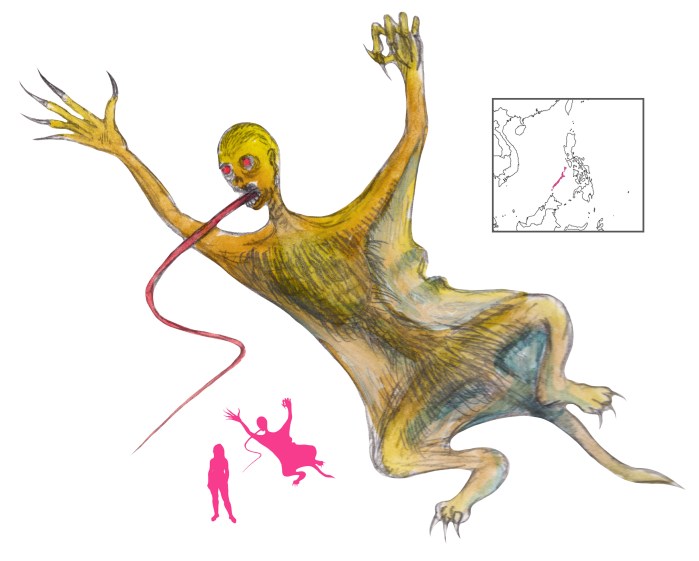
Hooked nails, gliding flight, and a long, long tongue are the hallmarks of the Balbal. While its depredations are described in Tagbanua folklore, it is itself accused of hailing from predominantly Muslim Moro country. They have also been described as friendly with and indistinguishable from crocodiles.

Balbals appear before a corpse is buried. Gliding like flying squirrels or bats, these humanoid creatures land on thatched roofs and use their curved claws to rip their way through the straw. Once a hole has been cleared, the long tongue is used to lick up the corpse, skin, flesh, bones, and all. The corpse is then replaced by a banana stalk, identical to the deceased in every way except for a telltale lack of fingerprints.

Light and loud noises scare off balbals. Branches of Blumea balsamifera, known in the Philippines as sambong, sobosob, and gabon, will keep them away from a bedside. Finally, prompt burial is always effective.

References

Fox, R. B. (1982) Religion and Society among the Tagbanuwa of Palawan Island, Philippines. Monograph No. 9, National Museum, Manila.

MacClintock, S. (1903) The Philippines: A Geographical Reader. American Book Company, New York.

Ramos, M. D. (1971) Creatures of Philippine Lower Mythology. University of the Philippines Press, Quezon.

Rahara

Variations: The Beast

rahara

Deep, permanent lagoons in Brazil and Venezuela are home to the Rahara. According to the Yanomami, this aquatic monster once lived in a large lagoon called Akrawa. Since then the rahara has moved upstream in the Orinoco, finding suitable lagoons to inhabit, or enlarging small lagoons to better fit inside. A rahara lagoon never dries out and can be recognized by observing the shore – there are tracks leading in, but none leading out.

The rahara is the uncle of the anaconda, and grows to greater sizes. It may or may not have feet. Its serpentine body is like a rotten pawpaw tree or a manioc strainer. It is capable of drawing people towards it and swallowing them whole. A rahara will be attracted to fire as it is sure to find a meal there; it will also rush out of its submarine hole to swallow anyone foolish enough to say its name out loud, so it is usually referred to as “the beast”. When in a good mood, raharas make a snapping sound and alert others to their presence. Silence is dangerous.

Raharas have pets in the form of hoatzins and curassows, which roost above the waterholes to entice hunters.  Snakes are also associated with the raharas. One talking boa constrictor turned into a live baby rahara after being shot dead by a hunter. It was kept as a pet in a water-filled palm spathe until it grew big enough to devour its entire adopted village. Finally, the raharas are responsible for floods, tsunamis, and other water-based disasters.

It is advisable to avoid known rahara haunts, and refrain from drinking, bathing, or fishing in those waters. A messenger once ignored those warnings and bathed in such a pond, and was immediately swallowed by a rahara. He called out “Help! Over here!” from inside the creature’s belly, and men arrived from the village with bamboo lances. They began running the rahara – and its prey – through. “Stop! You’re hurting me!” he screamed from inside, but they ignored him until both he and the rahara were dead.

Presumably the man was not well-liked.

References

Albert, B.; Becher, H.; Borgman, D. M.; Cocco, L.; Colchester, M. E. M.; Finkers, J.; Knobloch, F.; Lizot, J.; and Wilbert, J.; Wilbert, J. and Simoneau, K. eds. (1990) Folk Literature of the Yanomami Indians. UCLA Latin American Center Publications, University of California, Los Angeles.

Lizot, J.; Simon, E. trans. (1985) Tales of the Yanomami. Cambridge University Press, Cambridge.

Eloko

Variations: Biloko (plural)

eloko

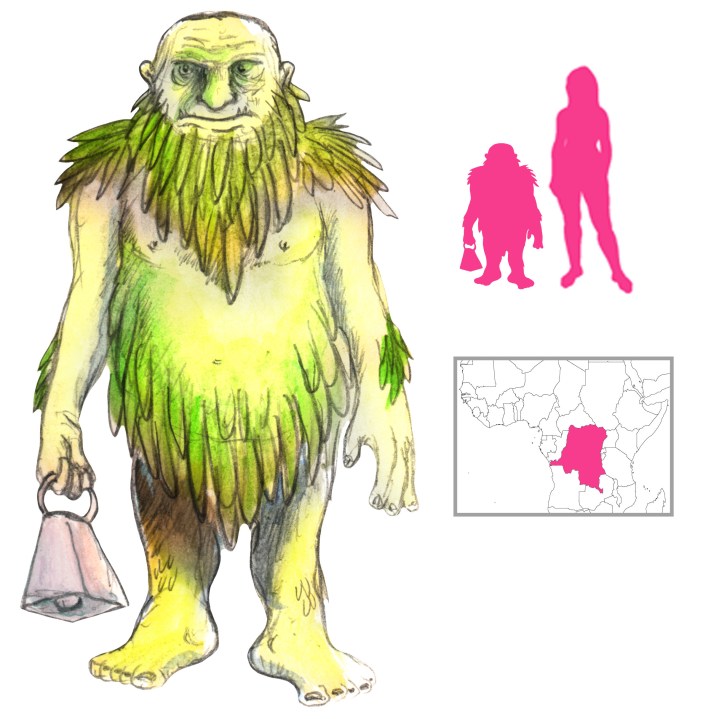
The Biloko of the Congo are vile, cannibalistic dwarfs or trolls of Nkundo folklore. They make their homes inside hollow trees, and they smell of the Congo’s rainforest. An Eloko has grass for a beard, clothes made of  leaves, and usually carries a bell, which is used to attract and bewitch unsuspecting humans. Despite their size, biloko are far stronger than the average human, and only heroes and sorcerers can defeat them.

Biloko represent the dangers of the forest, of going out alone, and of toying with danger. They are invoked to dissuade people from straying both physically and mentally, and warn husbands of the dangers of abandoning their wives. They may also represent various gangrenous diseases, as they slowly eat their victim away, eventually killing them by ending with the liver, where the spirit resides.

A Nkundo man once built a fenced-in hut in the forest to find game. Whenever the husband left for the village, he would warn his wife. “Remember, if you hear the sound of a little bell, don’t answer or you will die!” Yet as the monotonous hours went by, the wife found herself entranced by the ringing of a bell deep in the forest, coming closer and closer. Finally she ran outside calling to the eloko. “I’m here! Come to me!” she cried, and the eloko duly appeared. “Here I am, I have come to you”, he announced. The wife was overjoyed and prepared a meal for her guest, but the eloko refused the fried bananas and fish. “I only eat human meat, and I am so hungry…” he wheedled. “You are a delicious woman. Give me a piece of flesh”. The woman willingly proffered her arm, and the eloko took a portion of meat, which he roasted and devoured. Then he left, leaving the woman to bandage her wound in silence.

When her husband returned, he saw his wife bedridden and in pain. “I have sores”, she said. “Then take the bandage off, and have some medicine for it”. She refused, and would not explain further. But the next day the same gruesome episode repeated itself – the husband left, the wife entertained the eloko, and the eloko left the wife with another deep injury.

This time the husband did not believe his wife’s excuses, and decided to lie in wait instead of returning to the village. When the eloko returned that day, he pulled out a knife told the woman that this time he desired her liver. The husband immediately fired an arrow into the dwarf, then ran him through with his spear and decapitated him. But the eloko had already stabbed the wife in the liver, and she died. Those who love danger will die in it; or, those who play with fire will get burnt.

Other encounters with biloko treat them more as an enemy tribe than as forest bogeys. Likinda, Itonde, and Lianja, the grandsons of the spirit of Death Ilelangonda, went to war with the biloko, and tricked them into an ambush by scattering mbole-fruits on the path. They slaughtered all the biloko this way save for the wizard Inkankanga and his wife. Likinda caught up with them by turning himself into a baby, causing Inkankanga’s wife to pick him up and care for him. Then he climbed up a tree to throw fruits down to his adopted parents, but instead he transformed himself into a fruit and allowed Inkankanga to swallow him. The terrified eloko sorcerer killed his wife for being the cause of his impending doom, and then spent the rest of the day imploring Likinda not to kill him. Finally he fell into depressed acceptance, and the bored Likinda cut him up from the inside out. He returned to the village, where his story was celebrated with peals of laughter.

References

Knappert, J. (1971) Myths and Legends of the Congo. Heinemann Educational Books, London.

Knappert, J. (1977) Bantu myths and other tales. E. J. Brill, Leiden.

Indombe

indombe

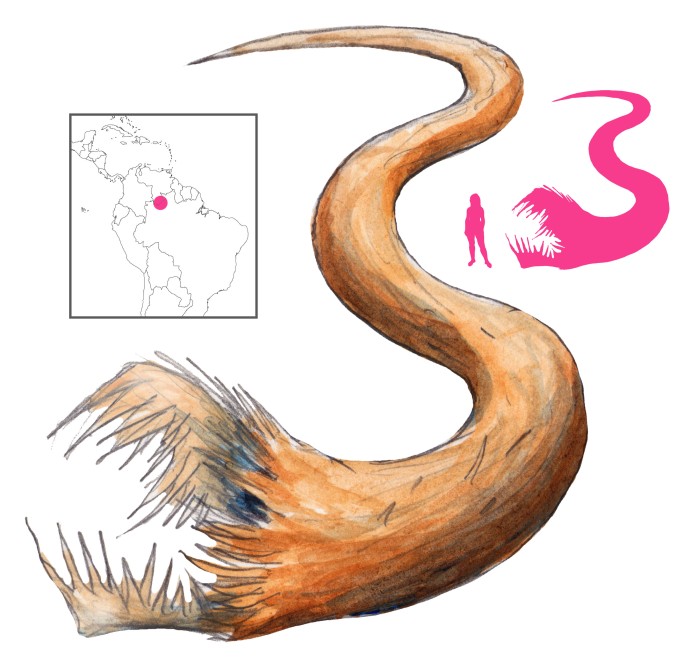
Indombe is fire, Indombe is life, Indombe is motherhood, Indombe is a slave to the power of death. She is an enormous copper snake over three feet wide, and several miles in length, and she makes her home in the trees of the Congo. Her cupreous body glows red with internal heat; she is immeasurably old, associated with the sun and the sunset in particular. Her tale is mysterious and metaphorical, and her ancestry is probably Semitic.

Itonde, hero and creator figure of the Congo, had been sent on a bizarre errand. His sister-in-law was pregnant, and she had developed a craving for snakes, so Itonde and his brother Lofale went into the forest to find them. There they saw Indombe coiled in a tree, shining bright as the sun. “Great Indombe”, said Itonde, “come down and let us talk together”. As Indombe refused to leave her perch, Itonde started chanting: “Indombe of the Bakongo, come down so I may carry you!” The giant snake was furious. “How dare you try to bewitch me?” she roared, causing her flames to flare and illuminate the entire forest. She then put her red-hot head on Itonde’s shoulder, severely burning him and leaving him for dead.

Fortunately for Itonde he was the owner of a magic bell, and he rang it, immediately recovering from his injuries. He did not want Indombe to gain the advantage of nightfall, so he captured the sun itself. Indombe next tried to constrict him, but Itonde kept ringing his bell, causing him to grow taller and stronger while the snake weakened.

It was in this state that Itonde triumphantly carried Indombe back to his village. He set her down outside the entrance of the village, and Indombe immediately coiled around the village and swallowed every last man, woman, and child. “You monster!” cried Itonde. “I’ll kill you, cut you up, and eat you!” Itonde produced his enchanted machete, and Indombe, seeing her death approaching, warned the hero. “If you kill me, eat me all today; you will not survive if you leave a single piece”. She was then promptly decapitated, cut into slices, and fried in oil. Itonde ate every piece, but left the inedible head, putting it under his bed.

Next morning, he awake to the horrifying discovery that Indombe was still there – but was now a ghost! “I told you eat all of me” she explained, “so now I return as a spirit, to aid you and show you a good place to live”. The spectral copper snake led Itonde to her village, a beautiful, disease-free location for future generations. Itonde then found out that Lofale was dead, killed by Indombe; but he could not avenge himself on a ghost, so he sought out a man in the forest. His quarry tried to hide by transforming into the first sugar-cane, but Itonde found and killed him as an expiatory sacrifice, discovering sugar-cane in the process.

“This village shall be yours because you are a strong fighter”, said Indombe. “Your name shall now be Ilelangonda. Farewell to you all”. With that the ghostly snake coiled up, jumped into the river, and disappeared.

References

Knappert, J. (1971) Myths and Legends of the Congo. Heinemann Educational Books, London.

Okpe

okpe

Okpe is a massive, quadrupedal ogre from Argentinian and Chilean Tehuelche folklore. He looks like a pig made of impregnable solid rock, without soft spots or weaknesses. Okpe preys on children, luring them with braised meat before carrying them off in a device on his back. Children captured by Okpe are taken into the jungle and devoured. Attempts to thwart his actions fail, as he is impervious to conventional weaponry.

Once Okpe abducted an older child, who had the presence of mind to hold onto an overhead branch and escape his captor. While Okpe sought his victim and screamed for him to return, the child ran back to his village. There a mare was butchered – as the Tehuelche do in emergencies – and its skin was stretched out on the ground. When Okpe trundled through in pursuit of the boy, he slipped on the stretched hide and fell so heavily that his stony armor rattled! Okpe started to cry in defeat, crying so hard that his tears caused a flood that went up as high as his teeth. He never bothered the Tehuelche again.

References

Borgatello, M.; Bórmida, M.; Casamiquela, R. M.; Baleta, M. E.; Escalada, F. A.; Harrington, T.; Hughes, W.; Lista, R.; Samitier, M. L.; and Siffredi, A.; Wilbert, J. and Simoneau, K. eds. (1984) Folk Literature of the Tehuelche Indians. UCLA Latin American Center Publications, University of California, Los Angeles.

Oókempán

ookempan

Oókempán is an ogre known to the Tehuelche of Argentina and Chile. He looks like a very large man, but has a shell on his back and moves around on all fours like a pig. Oókempán abducts children, enticing them with a bit of meat before slinging them into a box on his back and carrying them off. Any child playing on their own is at risk of being taken and presumably eaten. Attempts to stop Oókempán will fail, as his hard shell prevents any damage from reaching him; his weakness is in his heel, which is unprotected.

It was Oóuk’en, “truth”, the man incapable of lying, who put an end to Oókempán’s kidnappings. He interceded after a child escaped by grabbing hold of an overhead branch as Oókempán passed under it. Oóuk’en went to meet Oókempán at the top of a cliff. “What did you do with the children?” he asked the ogre. “I took them to increase my people”, replied Oókempán. “I only eat rhea, and I needed them to hunt for me”. After some more small talk, Oóuk’en pushed Oókempán off the cliff, shattering his shell and killing him.

The presence of fossil elephant bones in the region have been seen as evidence of Oókempán’s existence.

References

Borgatello, M.; Bórmida, M.; Casamiquela, R. M.; Baleta, M. E.; Escalada, F. A.; Harrington, T.; Hughes, W.; Lista, R.; Samitier, M. L.; and Siffredi, A.; Wilbert, J. and Simoneau, K. eds. (1984) Folk Literature of the Tehuelche Indians. UCLA Latin American Center Publications, University of California, Los Angeles.

Qasoǵonaǵa

Variations: Gasogonaga, Kasogonagá, Kasogongá, QasoGonaGa; Lightning; Owner of Storms/Lightning

qasogonaga

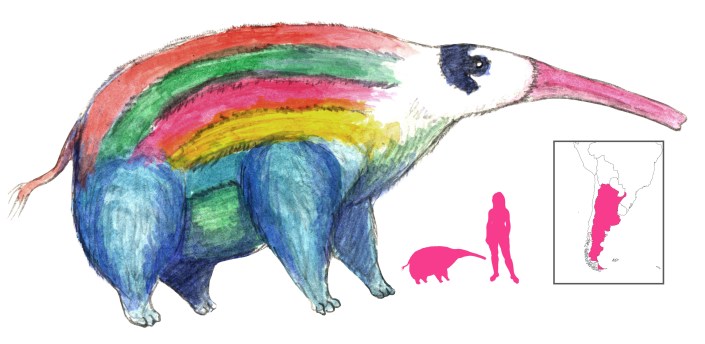
For the Toba of Argentina, lighning takes the form of a small, hairy creature called Qasoǵonaǵa, the Owner of Storms. It is an anteater, or perhaps an elephant, with a long snout, long rainbow-colored hair, and four tiny feet. Qasoǵonaǵa can also appear in human form, retaining a small head and shaggy body. As Qasoǵonaǵa has been referred to by both male and female pronouns, there are probably more than one of these beings.

Qasoǵonaǵa, as the Owner of Storms, lives in the skies and is responsible for storms and other meteorological conditions. Lightning comes out of its mouth, while its angry roars become thunder. It is responsible for rain, or lack thereof.

While Qasoǵonaǵa may be a mighty force of nature, it can be quite friendly and grateful for help granted it by the Toba. Often a Qasoǵonaǵa falls to the earth, and has to be returned there by human intervention, as it is too small to return there on its own. In such cases a bonfire must be built, and Qasoǵonaǵa placed on top before it is ignited. The rising smoke will carry Qasoǵonaǵa back into the sky, and the happy anteater will reward its benefactor with powerful shamanic powers. Qasoǵonaǵa will also cause or stop torrential rain if its helper requests it.

References

Cordeux, E. J.; Karsten, R.; Lehmann-Nitsche, R.; Mětraux, A.; Newbery, S. J.; Palavecino, E.; and Terán, B. R. D.; Wilbert, J. and Simoneau, K. eds. (1982) Folk Literature of the Toba Indians. UCLA Latin American Center Publications, University of California, Los Angeles.

Wright, P. G. A semantic analysis of the symbolism of Toba mythical animals. In Willis, R. (Ed.) (1990) Signifying Animals: Human Meaning in the Natural World. Unwin Hyman, London.

Wright, P. G. Dream, Shamanism, and Power among the Toba of Formosa Province. In Langdon, E. J. M. and Baer, G. (Eds.) (1992) Portals of Power. University of New Mexico Press.

Wright, P. G. (2008) Ser-en-el-sueño. Editorial Biblos, Buenos Aires.

Kori

kori

The Cuiva of Colombia and Venezuela tell of the Kori, a destructive aquatic monster. It has the appearance of a giant anteater, except far larger, and it lives underwater in the rivers. It uses its large claws to dig under riverbanks, causing their collapse, and that is why this is such a common occurrence in the rainforest. A kori can also cause strong gales to destroy constructions, and can turn soil into water to drown people.

A kori once collapsed a riverbank near a Cuiva village, killing most of the inhabitants. Only one man managed to escape by transforming himself into a howler monkey and climbing to the top of a tree, where he sat trembling and watching the kori. Even that wasn’t enough, as the kori eventually knocked down the tree and killed the monkey hiding there.

Word of the massacre reached the Cuiva, and after mourning the dead they set out to avenge them. The father of the howler-monkey man led the hunt, armed with a harpoon, while the others followed with poisoned arrows. Once found, the kori was riddled with harpoons and arrows while it was too weakened to fight back. It tried transmuting the ground to water, but it was only shallow water, and the warriors continued firing poisoned arrows until the enormous anteater died. The leader of the hunt chopped off the kori’s claws and made them into a necklace as payment for his son. The rest of the anteater’s body was left for the vultures.

References

Arcand, B.; Coppens, W.; Kerr, I.; and Gómez, F. O.; Wilbert, J. and Simoneau, K. eds. (1991) Folk Literature of the Cuiva Indians. UCLA Latin American Center Publications, University of California, Los Angeles.

Mantabungal

Mantabungal

The Mantabungal is known to the Tagbanua of Palawan, in the Philippines. It is found primarily in the forests of Mount Victoria in Baraki, and is the most feared of the mountain demons.

A mantabungal is like a cow in body and voice, but lacks horns. It has a long coat of shaggy hair that reaches the ground. Its monstrous mouth has two pairs of huge incisors – two above and two below – that it uses to tear its victims to shreds.

One man reported hearing bovine moos while gathering gum in the mountains. Spooked and disoriented in the darkness, he ran aimlessly into the forest as far as he could and spent the night shivering miserably under a tree. When he returned to camp, he found that the mantabungal had destroyed everything he had touched. His hut, gear, and even the firewood had been dismantled and chewed to bits.

References

Fox, R. B. (1982) Religion and Society among the Tagbanuwa of Palawan Island, Philippines. Monograph No. 9, National Museum, Manila.

Ramos, M. D. (1971) Creatures of Philippine Lower Mythology. University of the Philippines Press, Quezon.