Caladrius

Variations: Charadrius, Caradrius, Caladres, Kladrius, Icterus, Galgulus, Stone-curlew
Caladrius

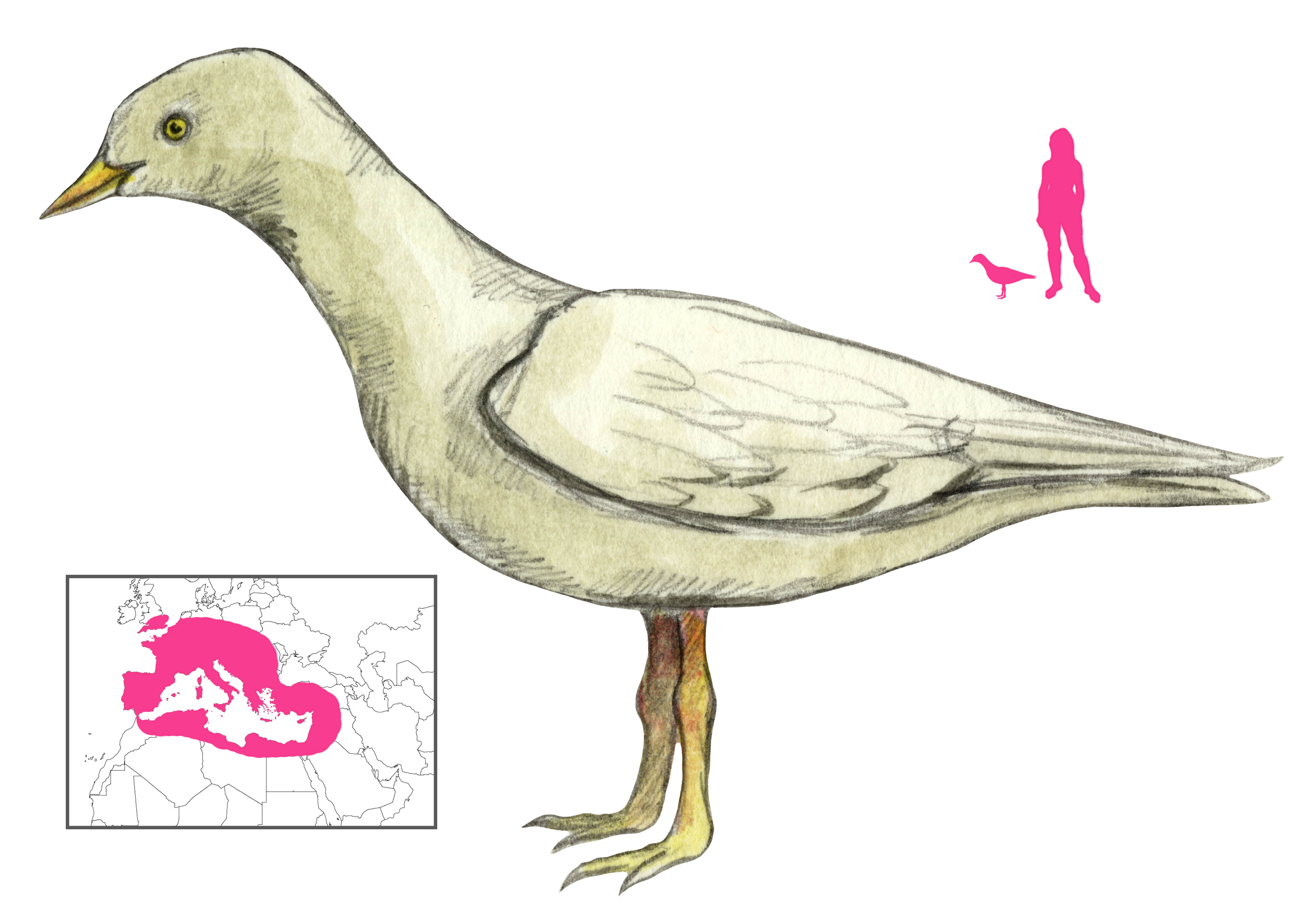
The Caladrius is a miraculous healing bird, believed to range from Europe to Jerusalem. It is generally believed to have originated from the stone-curlew, with other influences including seagulls, falcons, herons, ibises, owls, and any of a number of plovers (Charadriidae).

A caladrius is a waterbird the size of a hen or dove. It has immaculately white plumage, with a long neck, yellow eyes, beak, and legs, and rarely straight goat’s horns. Earlier accounts refer to it as being yellow, while others grant it reddish wings, spots, and a yellow-tinged dark color. It is an unclean bird and must not be eaten.

In its simplest form, the caladrius will cure jaundice by returning the stare of a patient who gazes intently at it. This connection to jaundice was inspired by the striking, staring yellow eyes of the stone-curlew. Its dung and the marrow of its thigh-bones will cure blindness.

A caladrius knows if a patient will live or die. It will look at someone who will be cured, and look away from someone doomed to die. Sometimes all it takes to be cured is touching the caladrius. The caladrius touches its beak to the patient’s mouth, taking disease and sickness into itself, and flies into the sky, where the sun burns the illness into oblivion.

This equates the pure and flawless caladrius with Christ, as it looks at and heals the faithful, granting them life, taking sins away in the process. The caladrius was iconographically represented in the role of a healer, sitting on the bedstead of a sick person and either looking to or away from the patient.

It was often kept in the court of kings for its curative powers. The sale of live caladrius was a potentially lucrative business, but merchants had to hide their specimens to avoid having people come in to see them and get cured for free.

References

Aelian, trans. Scholfield, A. F. (1959) On the Characteristics of Animals, vol. III. Harvard University Press, Cambridge, Massachusetts.

de Beauvais, P.; Baker, C. ed. (2010) Le Bestiaire. Honoré Champion, Paris.

Druce, G. C. (1912) The Caladrius and its Legend, Sculptured upon the Twelfth-Century Doorway of Alne Church, Yorkshire. Archaeological Journal, vol. 69, pp. 381-416.

del Hoyo, J.; Elliott, A.; Sargatal, J.; Christie, D.A.; & de Juana, E. (eds.) (2013) Handbook of the Birds of the World Alive. Lynx Edicions, Barcelona.

White, T. H. (1984) The Book of Beasts. Dover Publications, New York.

Wright, T. (1845) The Archaeological Album. Chapman and Hall, London.
Chonchón

Variations: Chonchon, Chonchoñ, Chon Chón, Chuncho, Chucho, Chuchu, Chaihue; Chonchones (pl.); Cocorote, Corocote (Venezuela); Cuscungo (Ecuador); Tecolote, Telocote (Mexico)

Chonchon

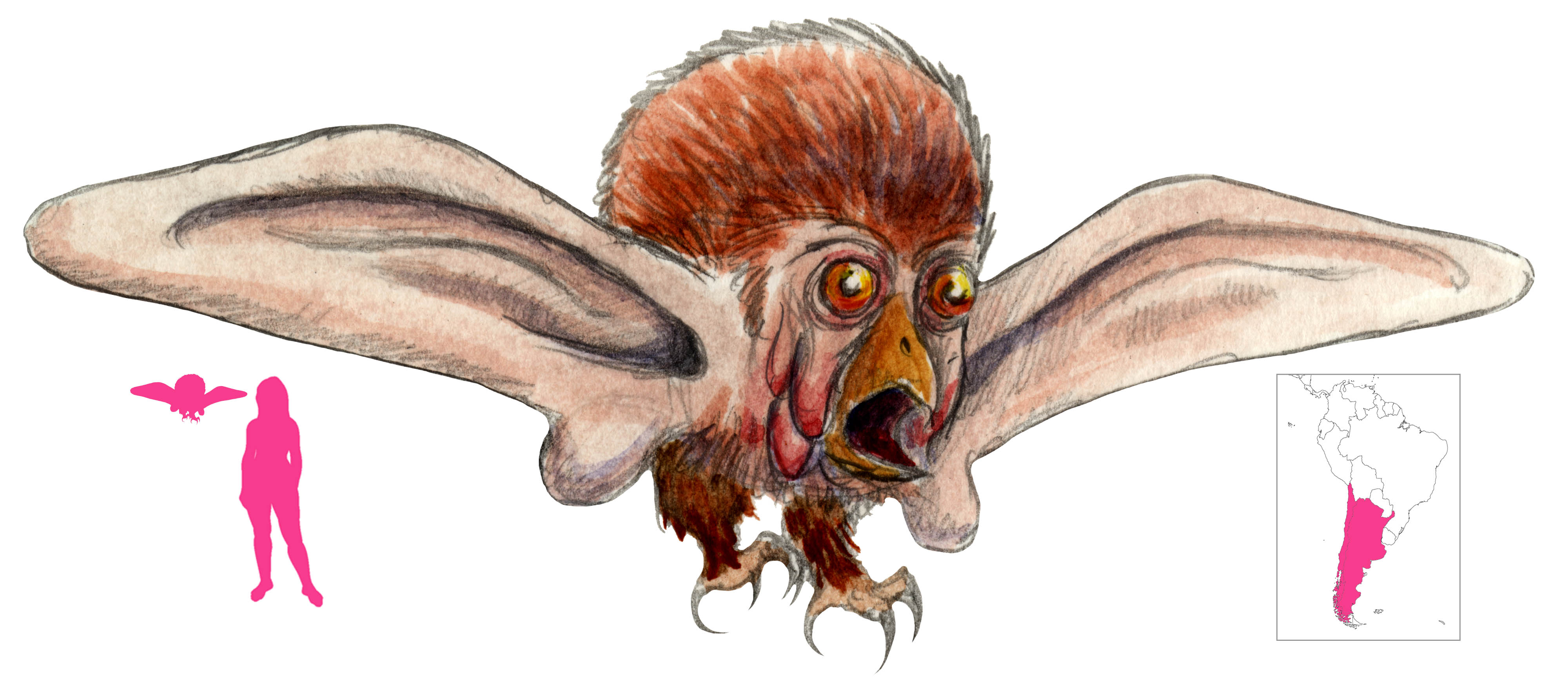
The Chonchón is a bird of ill omen from Chile and Argentina; it originally hails from Araucanian Mapuche folklore. Chonchón is also the name of a kind of kite.

In its simplest form it is a bird of the night, an owl (Strix rufipes) that flies on silent wings during the night to announce illness, death, or some other unwelcome event. When its croaking is heard it is advised to throw ash into the air and utter a few prayers in the hopes of turning away its evil.

The chonchón is also said to be a calcu or evil sorcerer in disguise. It resemble a human head, with oversized wing-like ears that allow it to fly. During the night, these sorcerers’ heads detach themselves from their bodies and fly around to cause mischief, invisible to most, their ominous tué, tué, tué call announcing misfortune. They have the same powers as sorcerers do, and have been known to suck the blood of sleepers.

In order to repel chonchones, several methods are recommended. These include drawing a Solomon’s seal on the ground, laying out a waistcoat in a specified manner, or reciting certain phrases or hymns such as the Magnificat, the Doce Palabras Redobladas, “Saint Cyprian goes up, Saint Cyprian goes down, Saint Cyprian goes to the mountain, Saint Cyprian goes to the valley”, or “Jesus goes ahead, follow him behind”. Doing any of these actions forces the chonchón to leave, or even fall to the ground where it can be destroyed. If the headless body of a chonchón sorcerer is found, turning it onto its stomach prevents the chonchón from returning to it. Finally, a more humane means of dealing with a chonchón is to yell “Come back tomorrow for some salt!” The next day, the chonchón in its human guise will show up and sheepishly request the promised salt. Except perhaps for the last method, most interference with the ways of chonchones will eventually incur the revenge of the chonchón or its friends.

One chonchón was reportedly grounded in Limache when someone made a Solomon’s seal, causing a large bird with red wattles to fall out of the sky. It was decapitated and its head fed to a dog, whose belly swelled up as though it had eaten a human head. Later the local gravedigger told that unknown persons had come to bury a headless body.

Not all chonchones are irredeemably evil, however. A Mapuche man in Galvarino once woke up early in the morning to find his wife’s body without her head. He immediately realized that she was a chonchón, and turned the body onto its stomach to prevent the head from reattaching. As expected, a chonchón soon flew heavily into the house, flapping and staggering as though blind. It then turned into a dog and whined pleadingly to be reunited with its body. The man took pity on it and allowed it to do so, and it became his wife once more. “Every night I leave, without you knowing, and visit distant lands”, she explained. She begged him not to tell anyone, and swore she would never harm him, and both kept their word; the story became known only after the wife died of natural causes.

Some authorities separate the chonchón from the chuncho, with the former being the sorcerous flying head and the latter the owl. Their calls are also different, with the chuncho hooting chun, chun, chun. They have further owl equivalents in the Venezuelan cocorote, the Ecuadorian cuscungos, and the Mexican tecolote. It is also compared to the myth of the voladora, a witch who flies while cackling loudly.

All this is quite unfair to the owls themselves, which benefit the farmers by eating mice, rats, and other vermin.

References

Aguirre, S. M. (2003) Mitos de Chile. Random House, Editorial Sudamericana Chilena.

Borges, J. L.; trans. di Giovanni, N. T. (1969) The Book of Imaginary Beings. Clarke, Irwin, & Co., Toronto.

Cifuentes, J. V. (1947) Mitos y supersticiones (3rd Ed.). Editorial Nascimento, Santiago, Chile.

Coluccio, F. and Coluccio, S. (2006) Diccionario Folklórico Argentino. Corregidor, Buenos Aires.

Rodríguez, Z. (1875) Diccionario de Chilenismos. El Independiente, Santiago.

Soustelle, G. and Soustelle, J. (1938) Folklore Chilien. Institut International de Coopération Intellectuelle, Paris.

Catoblepas

Variations: Katoblepas, Catablepon, Katoblepon, Catobleponta, Gorgon (erroneously)

Catoblepas

The Catoblepas, “that which looks downwards”, is probably the most hideous and repulsive of living things, so horrid that its mere glance is lethal. Pliny locates it in Ethiopia, around the source of the Nile, Aelian puts it in Libya, and Topsell gives a range of Hesperia and Lybia.

According to Pliny, the body of a catoblepas is of small size, and its limbs are heavy, but its massive head is too heavy to be held up and always looks downwards. This is a good thing, as anyone who saw the eyes of a catoblepas died.

Aelian gives more detail, describing it as the size of a bull, but with a grim expression, shaggy eyebrows, and small bloodshot eyes. It looks downwards, and has a horselike mane that starts on its head and covers its face. The catoblepas feeds on poisonous plants; when threatened, it shudders and raises its mane in warning before opening its mouth and belching a foul, toxic gas. This gas poisons the air around it, and anything that breathes it loses its voice, collapses in convulsions, and dies. Other animals give it a wide berth because of this. There is no mention of a deadly gaze.

Topsell combines the catoblepas with the Gorgon, stating that the myth of Perseus originated from a war with African Amazons led by Medusa. The snake-hair of the gorgons was inspired by the catoblepas’ messy mane. His fanciful description borrows liberally from gorgons and adds thick eyelids, scales like a dragon, tusks like a boar, no hair on the head, wings, human hands, and a size between that of a bull and a calf. He also denies that a catoblepas can kill with its breath, which is unheard of in the animal world; it is far more likely to kill with its eyes like the well-known cockatrice. He gives as proof an anecdote of Marius’ soldiers encountering a catoblepas and thinking it a sheep, only to die immediately when it looked up at them. It was eventually killed in an ambush by spear-men, and its skin was sent to the temple of Hercules in Rome.

It is in Flaubert’s Temptation that we get the most nightmarish vision of the catoblepas. Here it is a sprawling, long-maned black buffalo with the head of a pig dragging on the ground. Its neck is long and thin like an emptied intestine. It is also granted the power of speech, addressing Anthony. “Fat, melancholy, wild, I perpetually feel the warmth of mud under my belly, hiding infinite rot under my armpit. My skull is so heavy that I cannot lift it. I roll it around me, slowly; – and, jaws opened, I tear with my tongue poisonous herbs watered with my breath. Once, I ate my paws by accident. No-one, Anthony, has ever seen my eyes, or those who have seen them are dead. If I lifted my eyelids – my pink and swollen eyelids, straight away, you would die”.

Cuvier suggested that this maned, hoofed, and downward-looking abomination of nature was inspired by the harmless gnu or wildebeest.

References

Aelian, trans. Scholfield, A. F. (1959) On the Characteristics of Animals, vol. II. Harvard University Press, Cambridge, Massachusetts.

Borges, J. L.; trans. Hurley, A. (2005) The Book of Imaginary Beings. Viking.

Flaubert, G. (1885) La Tentation de Saint Antoine. Quantin, Paris.

Pliny; Holland, P. trans. (1847) Pliny’s Natural History. George Barclay, Castle Street, Leicester Square.

Topsell, E. (1658) The History of Four-footed Beasts. E. Cotes, London.

Codrille

Variations: Cocadrille, Cocodrille, Coquadrille, Cocatris

Codrille

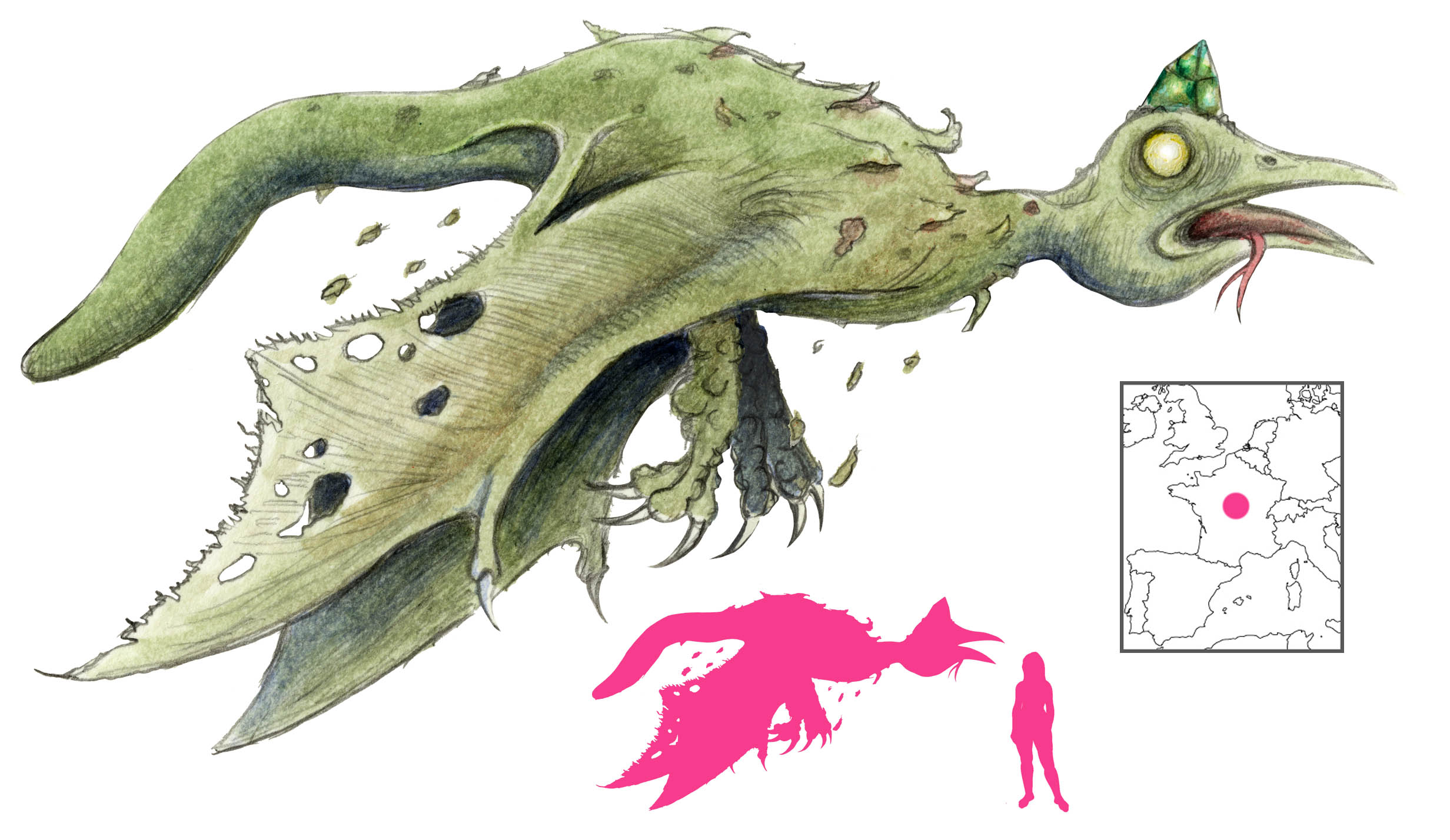
The Codrille, Cocadrille, or Codrille is a variety of basilisk or dragon native to central France, notably Berry, Maine, Poitou, Sologne, and Vendée. It combines features of basilisks and vouivres but without the redeeming aspects of either.

The name of the codrille was derived from the same etymological confusion that spawned the “cockatrice”. Starting with Crocodylus, the crocodile, practically a mythical creature in its own right, the name became progressively more garbled, becoming Cocodrillus, Cocodrille, Cocadrille, and Codrille. However, de la Salle derives it from coco and drille, meaning “rooster’s child”.

Unlike true basilisks, codrilles can grow to impressive size, becoming leathery-winged dragons at the last stage of their life cycle. The “crown” characteristic of basilisks manifests in the form of a brilliant gem on top of the codrille’s head. Codrilles can kill merely by looking at their victims, and emit an aura of disease and plague.

A codrille’s life is a complicated succession of metamorphoses. It hatches from a yolkless egg laid by a rooster, and incubated by the heat of the sun or of manure. To prevent those eggs from hatching, one must plant sprigs of ash in potential codrille breeding grounds. This should be done on the first day of May. Having other roosters around also helps, as they will devour the offspring of a codrille.

The codrille starts out its life as a very long, string-like snake. It is capable of killing right out of the egg – anyone who cracks a codrille egg and is seen by the newborn codrille dies instantly, but if they see the snake first, it dies instead. After a while, the juvenile codrille sprouts legs and becomes a salamander. During this stage of its life it will still die if seen first by humans, so it hides in deep wells, ruined tombs, and the masonry of houses, bringing bad luck to everyone living there and whistling ominously at night. It can debilitate a bull merely by crawling under it.

At the end of seven years the codrille reaches the adult stages. It grows spectacularly, sprouts wings, and metamorphoses into an enormous dragon. It spreads its wings and migrates towards the Tower of Babylon, breathing death and pestilence along its way. Its passage in the air dims the sun, and epidemics and plagues follow in its wake.

References

Sainéan, L. (1921) L’histoire naturelle et les branches connexes dans l’oeuvre de Rabelais. E. Champion, Paris.

de la Salle, L. (1875) Croyances et légendes du centre de la France, Tome Premier. Chaix et Cie., Paris.

Sébillot, P. (1906) Le Folk-lore de France, Tome Troisième: La Faune et la Flore. Librairie Orientale et Américaine, Paris.

Chimera

Variations: Chimaera, Chimaira

Chimera

The Chimera or Chimaera (“goat”) was the daughter of Typhon and Echidna. She was the terror of Lycia in southern Turkey, killing people and livestock and torching crops.

Homer describes her as being a lion in front, a serpent behind, and a goat in the middle, with the power of breathing fire. Hesiod specifies that she had three heads. The lion’s head was in its customary place, the snake’s head was on the end of the tail, and the goat’s head emerged tumorously from the middle. Hyginus gives all three heads the ability to breathe fire, while Apollodorus states that only the goat head could do so, functioning as some kind of shoulder-mounted flamethrower.

While Homer’s description might suggest a lion’s head, a goat’s body, and a snake’s tail, the Chimera has been consistently represented in Greek art with multiple heads. Usually she is mostly lion with a snake tail; the goat has proven tricky to depict convincingly, ranging from a head to the entire front half of a goat. Some Etruscan renditions add wings. The iconography behind the Chimera may go back farther, and may be of Asian origin. The term has also been used to describe various unrelated hybrid animals, with or without multiple heads.

She was finally slain by Bellerophon, who had been sent to Lycia to die. The wife of King Proitos had fallen madly in love with him; after he rejected her advances, she told her husband that Bellerophon had tried to seduce her. Enraged, the king dispatched Bellerophon to Iobates of Lycia, bearing a message requesting him to kill the messenger. Iobates sent him to battle the Chimera – surely an impossible task.

But Bellerophon had the favor of the gods, and the aid of the winged horse Pegasus. Mounted on Pegasus’ back, he easily flew out of range of the Chimera’s fiery breath, and shot her to death with arrows. Some accounts add that he rammed a lump of lead into her throat, where it melted and suffocated her.

Chimera bwChimera was a study in contradictions. Her three components did not make any sense together. Her name meant “goat”, but the goat was the least coherent part of her, reduced to a mere head in an anatomically dubious position. Evidently something so contradictory as the Chimera needed a rational explanation, even to the ancient Greeks. Plutarch believed she was inspired by a pirate captain, whose ship was decorated with the three component animals. Servius Honoratus said she was a loose interpretation of the Lycian landscape. Mount Chimera was a volcano, with snakes at its base, goats wandering around its heights, and a pride of lions at the top. Bellerophon, arriving on his ship Pegasus, set fire to the mountain and eradicated the dangerous animals.

The Etruscans dedicated the Chimera to the supreme god Tinia. The Etruscan Arezzo bronze of the Chimera remains the most enduring image produced of her. As a hybrid she was both celestial and chthonic, representing the year and the seasons. The lion, hot and strong, was summer; the snake, cold and ground-dwelling, was winter; and the transitory goat was spring and summer.

In The Temptation of Saint Anthony, the Chimera is a great, green-eyed, dragon-winged creature with a luxuriant mane; she is as capricious as desire and imagination. She reveals breathtaking new perspectives to humans, pours insanity, ambitions, hopes, and dreams into their minds, drives people to dangerous quests, and kills anyone content in wisdom. She is woefully incompatible with the rational, stoic Sphinx, and their attempts at copulation fail.

“Chimera” has entered our vocabulary in a number of ways, always in reference to incongruity. A chimera or something chimeric is fanciful, improbable, and imaginary. A chimera can also mean an organism with distinct cells from different zygotes. Finally, Chimaera is a genus of deep-sea fish, named after its bizarre appearance.

References

Bazopoulou-Kyrkanidou, E. (2001) Chimeric Creatures in Greek Mythology and Reflections in Science. American Journal of Medical Genetics 100:66-80.

Borges, J. L.; trans. Hurley, A. (2005) The Book of Imaginary Beings. Viking.

Flaubert, G. (1885) La Tentation de Saint Antoine. Quantin, Paris.

Hesiod; trans. Elton, C. A. (1832) The Theogony. In Hesiod. A. J. Valpy, London.

Homer, trans. Buckley, T. A. (1851) The Iliad of Homer. Henry G. Bohn, London.

Locatelli, D. and Rossi, F. (2010) Les Étrusques: Pouvoir – religion – vie quotidienne. Série Civilisations, Hazan.

Roes, A. (1934) The Representation of the Chimaera. The Journal of Hellenic Studies, Vol. 54, Part 1, pp. 21-25.

Schmitt, M. L. (1966) Bellerophon and the Chimaera in Archaic Greek Art. American Journal of Archaeology, Vol. 70, No. 4, pp. 341-347.

Smith, R. S. and Trzaskoma, S. M. (2007) Apollodorus’ Library and Hyginus’ Fabulae. Hackett Publishing Company, Indianapolis.

Till, B. (1980) Some Observations on Stone Winged Chimeras at Ancient Chinese Tomb Sites. Artibus Asiae, Vol. 42, No. 4, pp. 261-281.

Caspilly

Variations: Caspilli, Neemora (Persian)

Caspilly

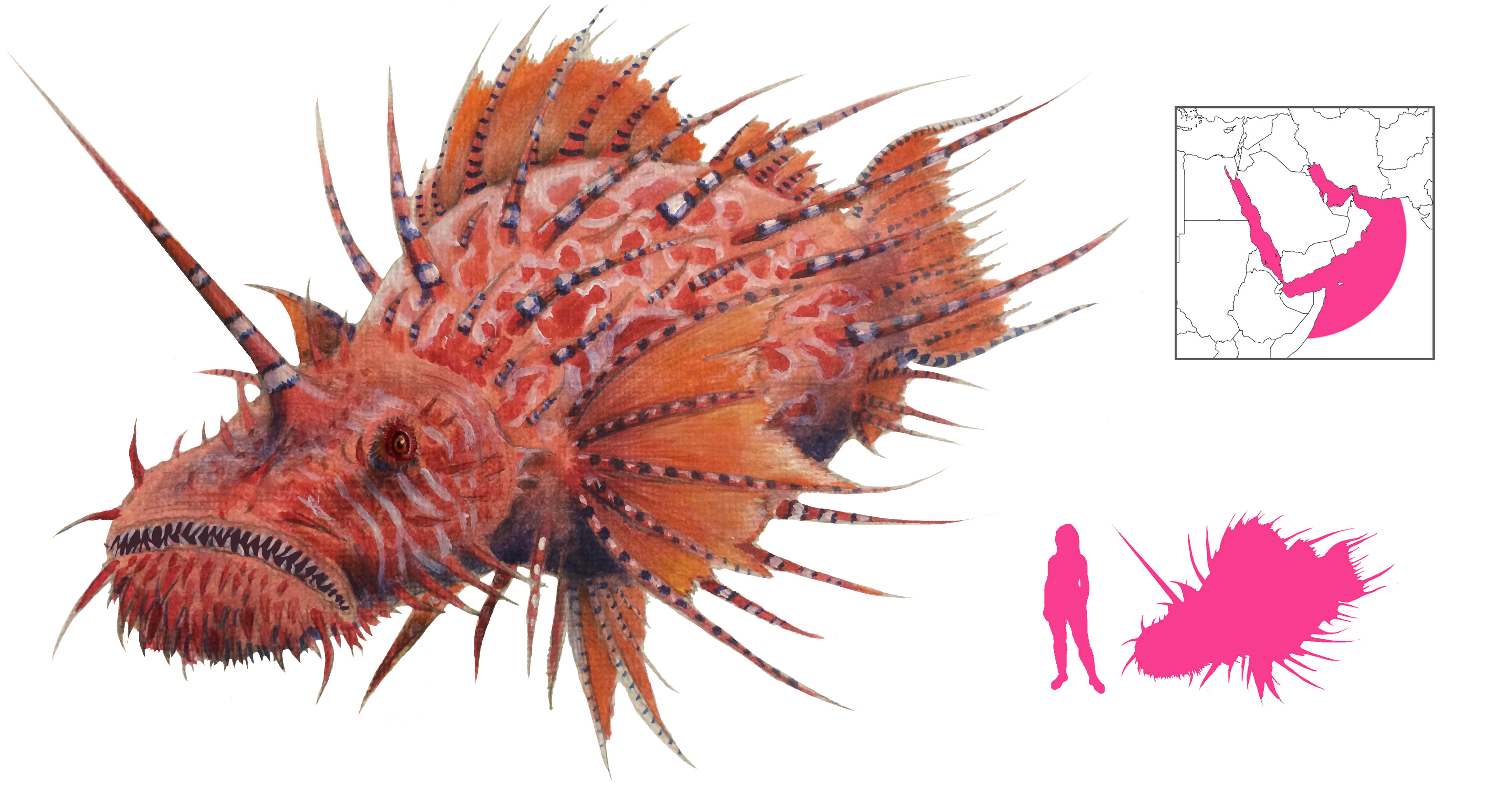
The Caspilly is a “marvelously large, and strong” fish from the Indian Ocean, described by Ambroise Paré on the basis of two separate accounts by André Thevet.

Thevet placed it in the Arabian Gulf, saying that it is known to the Arabs as caspilly, and to the Persians as neemora. The caspilly is almost as wide as it is long, but no more than two feet long. It has no scales, and its skin is spiky and barbed like that of a shark. On its forehead is a lancet-like spine, a foot and a half in length, that it keeps tucked along its nape. When it is hungry, it goes for the first fish it sees, stabbing it in the belly with its horn until its prey bleeds to death. Its teeth are venomous and bites are deadly. Applying a dead caspilly to a bite, on the other hand, will cure it. The horn is of great medicinal value, and caspilly are shot with arrows from a safe distance to retrieve such a prize.

Thevet also reports a nameless fish from the Peruvian sea, with a swordlike horn three feet long. This fish is a specialized whale killer. Upon seeing a whale, the fish will hide underneath before stabbing it in the navel with its horn, leaving the whale to writhe in its death throes and capsize nearby ships. Once the whale is dead, it can be eaten at leisure.

Paré economically combines both accounts, giving the caspilly a four-foot-long horn and making it the terror of the Arabian sea. He adds that the Arabs of the region hunt caspillys with giant hooks baited with camel meat. Any caspilly who greedily takes the bait will tire itself out on the line, eventually slowing down enough to be shot with arrows, brought onto ship, and bludgeoned to death. Caspilly flesh is edible, and caspilly alicorn is just as potent against venom as that of the unicorn.

In all likelihood the Caspilly was born from accounts of swordfish and killer whales, contaminated by lionfish and porcupinefish. The venomous bite may have been derived from the famed toxicity of pufferfish. Aldrovandi cautiously included it with his Herinaceus marinus, the porcupinefish, as Herinaceus arabus, the Arab hedgehog.

References

Aldrovandi, U. (1642) Monstrorum historia cum Paralipomenis historiae omnium animalium. Bononiae.

Paré, A. (1582) Discours d’Ambroise Paré – De la Licorne. Gabriel Buon, Paris.

Paré, A. (1614) Les Oeuvres d’Ambroise Paré. Nicolas Buon, Paris.

Thevet, A. (1575) La Cosmographie Universelle. Guillaume Chaudiere, Paris.