The Nkala is one of several sorcerous familiars associated with witchcraft in Zambia. A nkala kills people by eating their shadows. Anyone in possession of a nkala, therefore, has obtained it for criminal purposes.
It takes the form of a crab, 4 feet long, almost as wide as it is long. It has a head at either end, each head resembling that of a hippo, complete with the lumps by the eyes. Sometimes those are described as “nose-like projections”. It eats shadows with both heads at the same time.
To kill a nkala, medicine is prepared from nkala remains and placed in a duiker horn sealed with wax. A second duiker horn is partially filled and used as a whistle to attract the nkala. Once the creature shows itself in response to the whistle, it is shot. The “noses”, large claws, and some of the other claws are taken for use in medicine.
References
Melland, F. H. (1923) In Witch-bound Africa. J. B. Lippincott Company, Philadelphia.
Turner, V. (1975) Revelation and Divination in Ndembu Ritual. Cornell University Press, Ithaca.
White, C. M. N. (1948) Witchcraft, Divination and Magic among the Balovale Tribes. Africa: Journal of the International African Institute, 18(2), pp. 81-104.
The Wulver lives alone in a cave halfway up a steep knowe on the Isle of Unst in Shetland. He stands upright like a man, but has a wolf’s head and a body covered in short brown hair.
A peaceful loner, the Wulver never harms people as long as he isn’t harmed. He likes to fish, and for hours will sit upon a rock, the “Wulver’s Stane”, and catch yearling coalfish. Frequently he will leave a gift of a few fish on the windowsill of the poor and old of Shetland.
References
Angus, J. S. (1914) A Glossary of the Shetland Dialect. Alexander Gardner, Paisley.
Fleming, M. (2002) Not of this World: Creatures of the Supernatural in Scotland. Mercat Press, Edinburgh.
Saxby, J. M. E. (1932) Shetland Traditional Lore. Grant and Murray Limited, Edinburgh.
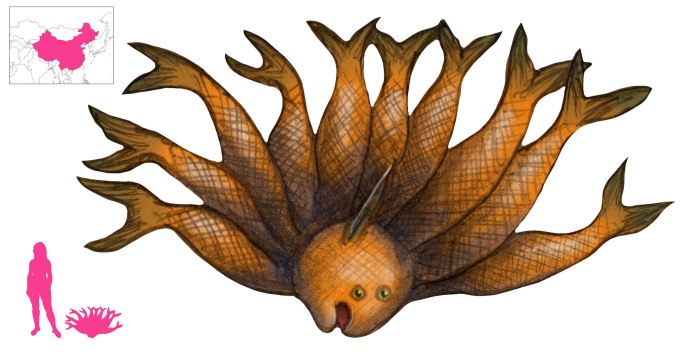
The Heluo Zhi Yu or Heluo-fish can be found in China’s Tower River. These unusual fishes have one head and ten bodies each, and bark like dogs. Eating them cures tumors.
According to Yang Shen’s encomium, a heluo-fish can transform itself into a Never-Old Bird, which steals rice grains from threshing pestles, falls into the mortar, and dies.
The single head and multiple tails may be a description of an octopus.
References
Mathieu, R. (1983) Étude sur la mythologie et l’ethnologie de la Chine ancienne. Collège de France, Paris.
Strassberg, R. E. (2002) A Chinese Bestiary: Strange Creatures from the Guideways Through Mountains and Seas. University of California Press.
Victoria
Nyanza is home to the Lukwata. The deeds and misdeeds of this great sea-serpent
are told on both sides of the lake, from Uganda to the Kavirondo (Winam) Gulf
in Kenya. The lukwata is commonly lumped with the dingonek, but the lukwata’s
pedigree is far older. Lukwata is also the name of a Baganda clay charm which,
when hidden in the king’s house, presents theft in the village, but this seems
unrelated.
The lukwata
has been around from time immemorial and makes occasional appearances. It is a
huge and terrifying lake demon, a serpent, a cetacean, or perhaps a giant fish.
It is associated with whirlpools in the lake. Ja-Luo fishermen have tales of
the lukwata attacking their canoes. The Baganda, Kavirondo, and Wasoga of the
north shore of lake Nyanza used to sacrifice livestock to it. The lukwata’s
disappearance coincided with the sleeping-sickness epidemic, and it was
believed that the muzungu
(foreigners) caused the disease by killing the lukwata, thus bringing its wrath
upon the people.
W. Grant,
Provincial Commissioner of Jinja, saw a lukwata swimming down the Napoleon
Gulf; its head was out of the water but it was too far to make out its
features. Clement Hill of the Foreign Office had a far closer encounter when a
lukwata off Homa Mountain tried unsuccessfully to seize a man on the bow of
Hill’s ship. He saw a lizard-like head, roundish and dark-colored, on a
four-foot-long neck attached to a large, rounded mass that formed the body.
Some sort of tail seemed to be trailing behind.
E. G.
Wayland, head of the Geological Survey of Uganda, claimed to have heard the
lukwata’s distant bellowing. He was shown pieces of lukwata bone, and was told
that the lukwata fought epic battles with crocodiles. Pieces of skin lost in
those struggles were used for potent amulets.
The most
complete account of a lukwata’s appearance is recorded by H. Bell, who shot one
on the western border of Uganda near the Semliki River and Lake Albert. The
creature, which was identified as a small lukwata by a native boy, was deemed
to resemble Hill’s serpent. It had a snakelike head, a neck several inches
long, a tail a few inches long, and flippers like a sea turtle’s. Instead of a
hard shell, the lukwata had a thick, soft, rubbery carapace. Bell believed that
the lukwata – evidently an odd species of turtle – would, at the surface, give
the impression of a bulky, long-necked animal.
Balukwata
are not particularly smart. A Baganda folktale tells of the friendship between
a lukwata and a monkey. It came to pass that the King of the balukwata took
ill, and his wizard told him to eat the heart of a monkey as a cure. The King
offered great rewards to any of the balukwata who would bring him the heart of
a monkey. So the lukwata went to the home of his friend the monkey and hailed
him. “How are you? You should come visit me, my wife and sons want to see you”.
“But I cannot swim”, said the monkey. “I’ll carry you on my back”, said the
lukwata, and they were off. Halfway across the lake, the lukwata, having a
crisis of conscience, decided to tell the monkey the truth. “I’m really sorry,
but our King is sick and needs your heart”. The monkey thought fast. “You silly
thing”, he told the lukwata, “I don’t have my heart with me. I leave it behind
so I can jump through the trees. Take me back and I’ll fetch my heart from the
branch where I left it”. Of course, the unsuspecting lukwata swam back, and the
monkey escaped to safety in the trees – but not before mocking his erstwhile friend’s
intelligence.
References
Bell, H.
(1948) Witches & Fishes. Edward
Arnold & Co., London.
Bronson, E.
B. (1910) In Closed Territory. A. C.
McClurg & Co., Chicago.
Cunningham, J. F. (1905)
Uganda and its peoples. Hutchinson
& Co., London.
Hattersley, C. W. (1900)
An English Boy’s Life and Adventures in
Uganda. The Religious Tract Society, London.
Heuvelmans,
B.; Garnett, R. trans. (1958) On the Track of Unknown Animals. Rupert
Hart-Davis, London.
Hobley, C.
W. (1913) On Some Unidentified Beasts.
The Journal of the East Africa and Uganda Natural History Society, III(6), pp.
48-52.
Johnston,
H. (1902) The Uganda Protectorate.
Hutchinson & Co., London.
Pilkington,
G. L. (1911) A Hand-book of Luganda.
Richard Clay & Sons, Limited, London.
The Loðsilungur, or “Shaggy Trout”, is one of
the most toxic fishes to inhabit Iceland. The earliest accounts date from the
mid-17th century, where it is obliquely referred to as the
“poisonous menace”. Illness and death follow the consumption of a loðsilungur.
The appearance of the Icelandic shaggy
trout varies, but a trout-like shape and the presence of hair are diagnostic.
Loðsilungurs tend to be ugly and strange. The one described in Nordri in 1855 had a beard of reddish
hair on its lower jaw and neck as well as hairy patches on its sides and hairy
fins. Another account distinguishes between trout with shaggy hair near the
front of their head, and trout with hairy manes on either side. The adipose fin
is either reduced or absent, and scales may not be present. The most detailed
description specifies that it is no bigger than an Arctic char, and is often
the size of a man’s finger. The tail is narrower and the front thicker than in
other trout. The small, deep-set eyes are set ahead of a bulbous skull. The
short snout has a distinctive overbite. The teeth are pitch black. Finally, the
loðsilungur is covered with fine, downy, cottony-white hair. This hair, the
namesake of the trout, resembles mold and is visible only when the fish is dead
and in the water; on dry land it lies flat against the scales and becomes
invisible. This makes it easier to confuse with edible trout – and makes it
that much more deadly.
Across Iceland the tale is told of a
tragic group poisoning. In 1692 the inhabitants of the farm called Gröf were
found dead around a table with a cooked loðsilungur. Two brothers in a hunting
lodge near Gunnarssonavatn Lake died with plates of trout on their knees. The
most notorious poisoning incident is that of the Kaldrani farm, where an entire
household were killed by a meal of loðsilungur. Only one young pauper girl had
no appetite at the time, and avoided a terrible death.
Dogs and
birds of prey, normally indiscriminate in their eating habits, will refuse to
eat a loðsilungur. The shaggy trout are also
tenacious and will cling stubbornly to life as long as possible. A group of
fishermen in Hoffellsvatn Lake found that out the hard way; they left a catch
of fish out overnight, only to find a live loðsilungur squirming on top of the
pile. The entire catch was discarded and the lake abandoned.
References
Davidsson,
O. (1900) The Folk-lore of Icelandic Fishes. The Scottish Review,
October, pp. 312-332.
Hlidberg,
J. B. and Aegisson, S.; McQueen, F. J. M. and Kjartansson, R., trans. (2011) Meeting
with Monsters. JPV utgafa, Reykjavik.
The Ilomba
is one of several familiar spirits associated with sorcerers and witchcraft in
Zambia. Malomba appear as snakes with human heads and share the features and
emotions of their owners. As malomba are obtained through deliberate sorcery in
order to kill enemies or steal food, anyone suspected of having an ilomba is up
to no good. That said, powerful chiefs and hunters are said to have their own
malomba to protect them from witchcraft. Owners of malomba are usually male.
Evil
sorcerers can make malomba in a number of ways. Most commonly, a mixture of
certain medicines and water is made and placed on a piece of bark. Five duiker
horns are placed next to this. A plait of luwamba
or mbamba (spiky grass) is made to
about 15-18 inches long and 0.5-1 inch wide; the duiker horns are placed at one
end of this plait. Fingernail parings from the client are put in the horns, and
blood taken from the client’s forehead and chest are mixed with the medicine.
Some of the concoction is drunk by the client, while the rest is sprinkled onto
the plait with a second luwamba
plait. After the first sprinkling, the plait turns ash-white. The second
sprinkling turns it into a snake. The third gives it a head and shoulders that
resemble the client in miniature, including any jewelry present. The shoulders
soon fade away to leave only the head.
The ilomba
then addresses its master. “You know and recognize me, you see that our faces
are similar?” When the client answers both questions in the affirmative, then
they are given their ilomba.
Once
obtained, an ilomba will live wherever the owner desires it to, but usually
this is in riverside reeds. Soon it makes its first demand for the life of a
person. The owner can then designate the chosen target, and the ilomba kills
the victim. It kills by eating its victim’s life, by consuming their shadow, or
by simply feasting on their flesh or swallowing them whole. Then it returns and
crawls over its owner, licking them. People who keep mulomba become sleek and
fat and clean, are possessed of long life, and will not die until all their
relatives are dead. This comes at a steep price, however, as the ilomba will hunger
again, and continue eating lives. If it is not allowed to feed itself, its
owner will grow weak and ill until the ilomba feeds again.
Soon the
unnatural death toll will be noticed, and a sorcerer is called in to divine the
hiding place of the ilomba. To kill an ilomba, a sorcerer will sprinkle nsompu medicine around its suspected
lair. This causes the water level to rise and the ground to rumble. First fish,
then crabs, and finally the ilomba itself appear. The snake is promptly shot
with a poisoned arrow – and its owner feels its pain. They die at the same
time.
References
Melland, F.
H. (1923) In Witch-bound Africa. J.
B. Lippincott Company, Philadelphia.
Turner, V.
(1975) Revelation and Divination in
Ndembu Ritual. Cornell University Press, Ithaca.
White, C. M. N. (1948) Witchcraft, Divination and Magic among the
Balovale Tribes. Africa: Journal of the International African Institute,
18(2), pp. 81-104.
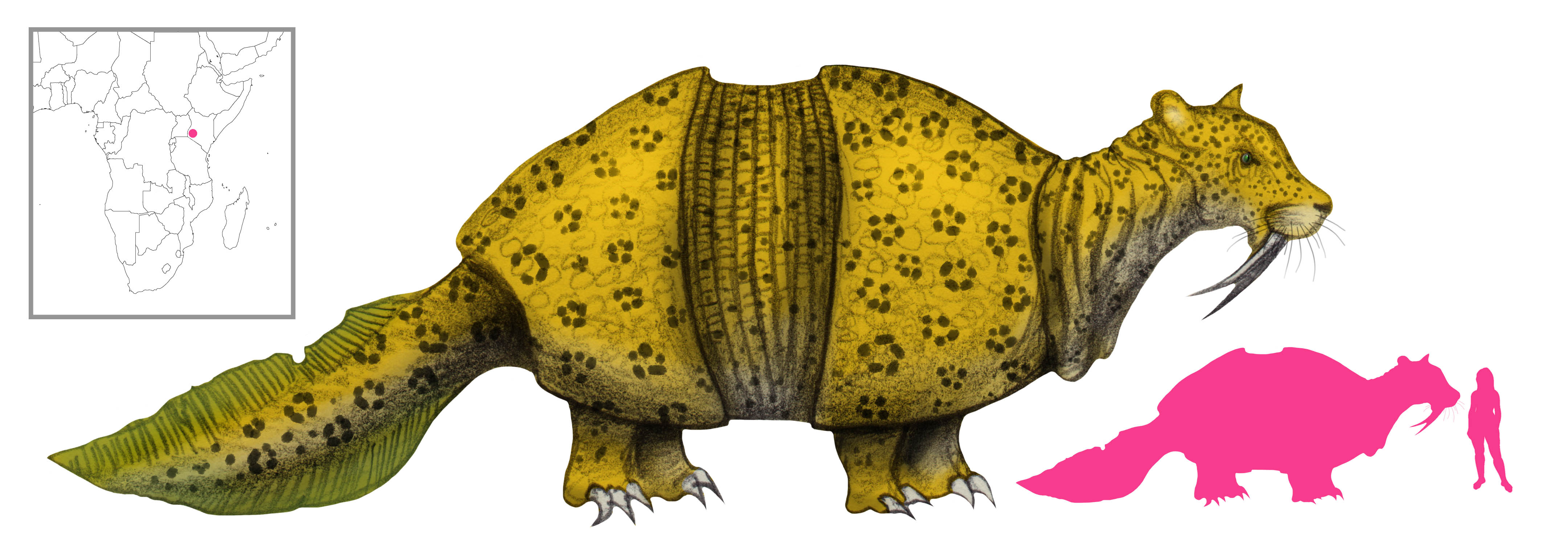
The Dingonek is a creature that lives in the Maggori River in Kenya, as well as in Lake Nyanza (Victoria). Our primary source for the dingonek comes from big-game hunter John Alfred Jordan, as recorded by Edgar Beecher Bronson. As a tale told by one big-game hunter to another, there is no reason to believe there was any embellishment or exaggeration involved.
Legends of aquatic monsters predate Jordan’s account, but they describe a generic large water python. Clement Hill claimed to have seen one in Lake Nyanza that attempted to seize a man on the prow of his boat. It had a dark, roundish head.
The dingonek as described by Jordan is a cross between a sea serpent, a leopard, and a whale. It is fourteen or fifteen feet long. Its head is similar in shape and markings to that of a leopard, but is the size of a lioness’ head. There are two long white fangs protruding downwards from the upper jaw. The back is broad like that of a hippo, patterned and colored like a leopard, and “scaled like an armadillo”. The tail, used for aquatic propulsion, is broad and finned. When ashore, the dingonek leaves behind prints as wide as a hippo’s but with reptilian claw-marks.
A .303 shot behind the ear had no effect on the dingonek. It reared straight up out of the water, and Jordan ran for his life. The dingonek was not seen again.
Hobley tells of another man who swears he saw a dingonek. When the Mara River was in flood, the eyewitness said he saw a creature floating down the river on a big log. It had its tail in the water, but its length was estimated to be sixteen feet. It had scales, spots like a leopard, and a head like an otter, but no long fangs. When shot at, it slipped into the water and disappeared. Apart from the (surely inaccurate) length given, this is a good account of a Nile monitor lizard.
Finally, rock art from a cave in Brakfontein Ridge, South Africa, has been claimed to depict a walrus-like dingonek, but the location is far from the dingonek’s habitat, and the association is arbitrary.
Heuvelmans initially believed the dingonek to be an odd species of prehistoric crocodile. Later he revised this to create an aquatic saber-toothed cat whose wet fur clumped and gave the appearance of scales.
As armadillos are New World animals, modern reconstructions have assumed the armadillo “scales” to be those of a pangolin instead. Other recent additions include a single horn and a stinger tail, neither of which have any basis.
Cryptozoologists have equated the dingonek with a number of other creatures, including the far better known Lukwata, the Ndamathia, and the Ol-umaina or Ol-maima of the Mara River. This is known to the Masai and has been described by Hobley as fifteen feet in length and scaly with a dog-like or otter-like head, leopard spots, small ears “marked somewhat after the fashion of a puff adder”, a short neck, short legs with claws. It may be seen sunning itself on logs and riverbanks, and dives into the water when threatened. Hobley’s ol-umaina account is copied by Heuvelmans, who expresses some confusion at the “ears” comment but otherwise affirms that the dingonek and the ol-umaina are one and the same. Shuker corrects the name to ol-maima.
All of this is moot. Ol-maima (or, more correctly ɔl-máɨ́má) is the Maa term for a cripple or a Nile monitor lizard (owing to its waddling movement on land). The descriptions are exaggerated but recognizable accounts of monitor lizards – as the dingonek itself almost certainly is.
References
Bronson, E. B. (1910) In Closed Territory. A. C. McClurg & Co., Chicago.
Bryant, A. T. (1948) The Zulu People. Shuter and Shooter, Pietermaritzburg.
Conway, J.; Kosemen, C. M.; and Naish, D. (2013) Cryptozoologicon Vol. I. Irregular Books.
Heuvelmans, B.; Garnett, R. trans. (1958) On the Track of Unknown Animals. Rupert Hart-Davis, London.
Hobley, C. W. (1913) On Some Unidentified Beasts. The Journal of the East Africa and Uganda Natural History Society, III(6), pp. 48-52.
Oswald, F. (1915) Alone in the Sleeping-Sickness Country. Kegan Paul, Trench, Trubner & Co., London.
Payne, D. L. and Ole-Kotikash, L. (2008) Maa Dictionary. University of Oregon, accessed online.
Shuker, K. P. N. (1995) In Search of Prehistoric Survivors. Blandford, London.
Stow, G. W. and Bleek, D. F. (1930) Rock-paintings in South Africa. Methuen & Co. Ltd., London.
Roeschaard’s
name is attributed to his call of “Roes, roes, roes!” Etymologically it may be
derived from the Scandinavian ruske,
“to rush at”; the Anglo-Saxon breosan,
“terrify”, or the Dutch roezen,
“making a din”. It may also simply be another variant of Osschaard, derived
from ors, “horse” or “mount”, and hard, “strong”. Sometimes the name is used
to simply mean the devil.
The 1874
almanac of Blankenberge tells of the dreadful storm of 1791. It destroyed the hut
of a suspected witch on the beach, and the inhabitants were overjoyed, smashing
what little was left of the ruins. Then a spinechilling sound rang out over the
dunes – “Roes, roes, roes!” A huge black dog with bells around its neck came
running down the dunes, and the villagers scattered. That dog was Roeschaard.
Roeschaard
puts his shapeshifting powers to use in performing cruel pranks. There is no
limit to the forms he can take. He turns into a fish and allows himself to be
caught before destroying the net. He gets into boats and tips them over. He
pounces on people’s backs and rides them to exhaustion. In the form of a baby, he
allows people to take him home before laughing wickedly and escaping, calling
out “Roes, roes, roes!” behind him.
The sailors
of Blankenberge eventually found a way to escape Roeschaard’s attentions. By
giving themselves a second baptism and a new name, they would break
Roeschaard’s power over them. The ceremony undertaken by new sailors involved
being splashed with salt water while the following formula was intoned:
I baptize you,
and may Roeschaard, the thrice-ugly one, turn away. Turn, turn, turn, your name
is [here the requisite sea-name was given]
Thus if
Roeschaard came to claim someone, they could simply tell him they were not the
person he was looking for. Since then Roeschaard’s power has been in decline.
References
van Hageland, A. (1973) La Mer Magique. Marabout, Paris.
de Vries,
A. (2007) Flanders: a cultural history.
Oxford University Press, Oxford.
Found in maritime
Flanders, land of Waas, and especially Hamme, near Dendermonde, Osschaert is
one of several mischievous shapeshifters that plague Belgium. He was
particularly around the chapel of Twee Bruggen.
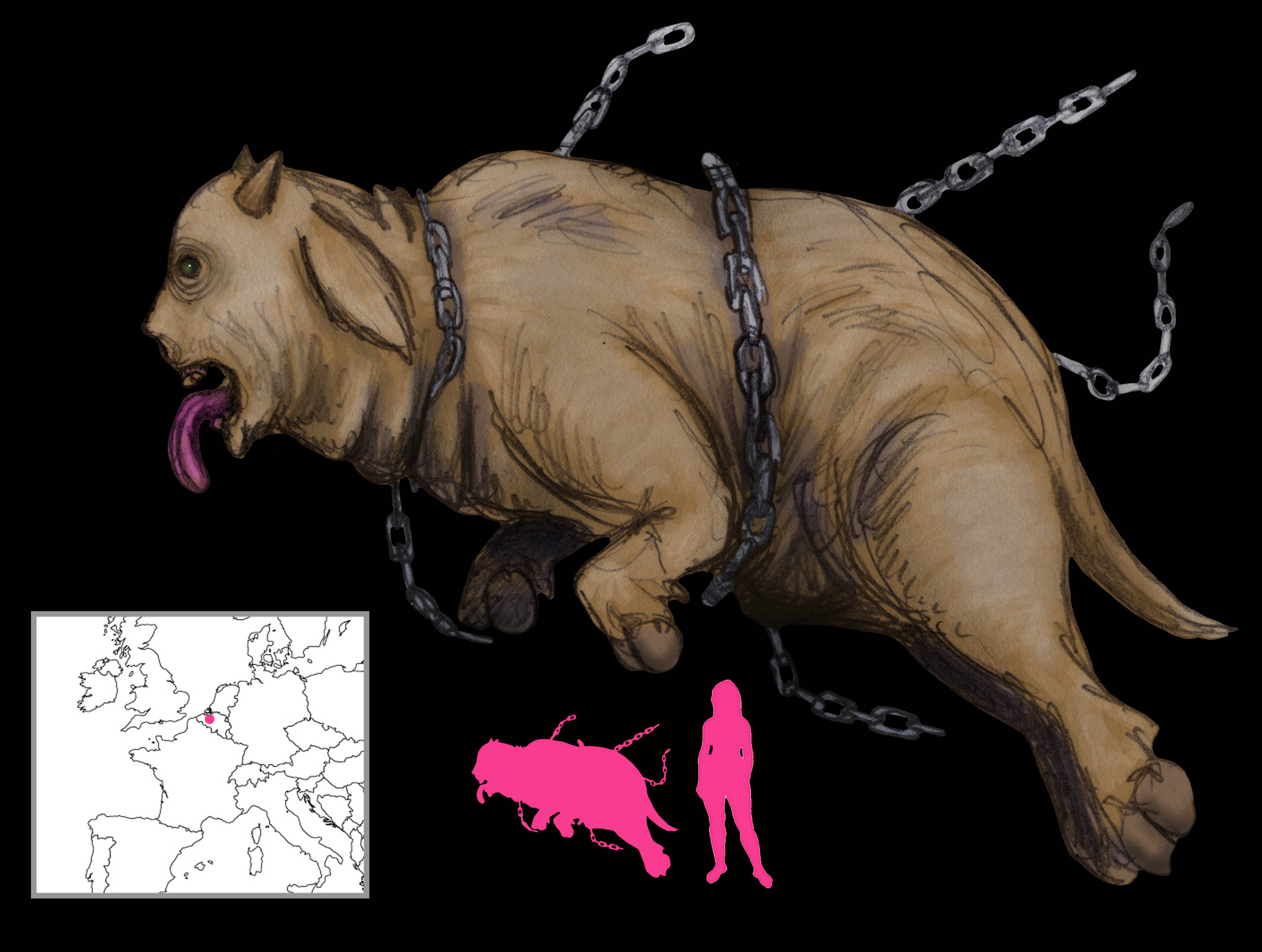
According to van Hageland, his name may be a combination of ors, an archaic word denoting a horse or more generally a mount, or os, an ox, with hard, meaning “strong” or “valiant”. In this sense, Osschaard or Osschaert is a headstrong and dangerous steed.
As with others of his kind, Osschaert appears in countless forms, most notably a human-headed bull with heavy chains on its legs and feet. He has also appeared as a dog, a rabbit, a horse, a giant, a dwarf… At Knoche-sur-mer, where he serves as a bogey to frighten children, he is a ghost with a bull’s head. Commonly he drags a long length of chain behind him.
Osschaert is
mischievous rather than actively evil. He delights in jumping on the backs of
people and forcing them to carry him until they collapse. He is just as likely
to jump off his mount’s shoulders to dive into a woman’s basket, causing her to
stagger under the sudden load. Osschaert particularly enjoys tormenting sinners
and wicked people, and will target them above all others.
He rules
over all the water in the area, so the first fish caught is returned as an
appeasing gift to Osschaert. Not that he’s guaranteed to ensure a good catch.
And beware of catching fish without thanking Osschaert! One fisherman dragged
his catch onto the beach only to find himself pinned down for an hour by Osschaert;
when he was finally released his catch had disappeared. Another fisherman
pulled an incredibly heavy net onto his boat, only to find it full of horse
manure.
At the
church of Twee Bruggen, daring Osschaert out loud to scratch you will result in
a mauling. Specifically, one only has to utter the formula Grypke, Grypke grauw, wilt gy my grypen, grypt my nou (“Grypke,
Grypke grey, if you will gripe me, gripe me now”) and Osschaert will appear on
your back and ride you to the nearest crossroads or image of the Virgin Mary.
In fact, in areas where people dared Osschaert to appear resulted in the spirit
becoming more cruel and aggressive due to being repeatedly called upon.
A young man
of Doel, crossing a field by night, found himself face to face with an
enormous, monstrous horse. “This is Osschaert”, he thought to himself. “I must
get out of his way”. He decided to pass through the churchyard, but then met a
dog the size of a horse on the main road. He crossed himself and took another
path to the churchyard, but there was Osschaert in the form of a rabbit,
jumping back and forth towards him. He tried to turn around the churchyard,
only to find Osschaert waiting for him in the shape of a donkey with enormous
fiery eyes the size of plates! That was the point when the man gave up, jumped
the wall, and ran home in a cold sweat.
Another
man, a fisherman of Kieldrecht named Blommaert, thought he could outsmart
Osschaert. He usually placed his catch of fish in a water-tub near the window.
One night he found that some fish were missing; not only that, but there were
ashes on the hearth, as though someone had broiled the fish on the embers.
Blommaert could find no signs of break-in, and concluded Osschaert was behind
this mischief. When the same thing happened a second time, he decided to cure
Osschaert of his thieving behavior. He covered the entire hearth with
horse-dung, and scattered some ashes over it to disguise it. Osschaert showed
up as usual, pronouncing “Blommeken, vischkens braeyen”, but when he tried to
cook the fish it ended up spoiled with the dung. He ran away screaming and
cursing in frustration. Blommaert celebrated his cunning revenge – but alas, it
does not pay to outwit Osschaert. The next day, when Blommaert drew in his net,
he found it extraordinarily heavy. After much effort, he hauled it on deck, and
found it to be full to cracking with horse-dung. Osschaert laughed loud and
long, and Blommaert returned home angry and defeated.
Today Osschaert
is retired, if not dead. A priest at Hamme was said to have banished Osschaert
to wander at the sea-shore for ninety-nine years. And at Spije, Malines, one
can see Osschaert’s coffin. It is a small coffin-shaped bridge over a stream.
References
van Hageland, A. (1973) La Mer Magique. Marabout, Paris.
Harou, A. (1905) Mythologie et folk-lore de l’enfance. Revue des Traditions Populaires, v. XX, p. 96.
Thorpe, B. (1852) Northern Mythology, v. III. Edward Lumley, London.
The first notable record of Kludde’s appearance was penned in 1840 in Ternat, by the Baron of Saint-Genois. This back-riding shapeshifter appears in Brabant and Flanders, notably in Merchtem and in Dendermonde, where he lives in the Dendre. In Ostend he is considered a necker or nix, and the flat country knows him as a werewolf. He causes fear and confusion and drinks green pond-water, but avoids crosses and consecrated areas.
Kludde
comes out at night in the Flemish mists. He has earned his name from the call
he cries while fleeing – “Kludde, Kludde”! As a shapeshifter, he has no fixed
appearance, and Kludde has been encountered in the forms of a great black dog
with a rattling chain around its neck, a half-starved horse, a sheep, a cat, a bat,
a frog, or even a tree. The only constant in Kludde’s transformations is the
presence of two dancing blue flames that flit ahead of him. These are Kludde’s
eyes.
The pranks
Kludde plays are mischievous but not deadly. In the guise of a black dog or werewolf
he will jump onto a person’s neck, and vanish after wrestling his victim to the
ground. As a horse, he tricks people into riding him, only to gallop full-tilt
and fling his rider into a body of water. As his erstwhile jockey flounders in
the water, Kludde lies on his belly and laughs loud and long, vanishing only
when the victim emerges from the water. As a tree, Kludde appears as a small
and delicate sapling, before growing to such a height that his branches are
lost in the clouds. This unexpected event shocks and unnerves all who see it,
and amuses Kludde.
It is
foolish to evade Kludde, as he can wind like a snake in any direction, foiling
attempts to outmaneuver him. Trying to seize him is like grabbing air, and it
leaves burns behind. He can also make himself invisible to some people and not
to others, driving travelers out of their minds as they try to describe the
protean creature tailing them – yet when their companions look behind, they see
nothing but an empty road.
References
de Blécourt, W. (2007) “I
Would Have Eaten You Too”: Werewolf
Legends in the Flemish, Dutch, and German Area. Folklore 118, pp. 23-43.
van Hageland, A. (1973) La Mer Magique. Marabout, Paris.
de Plancy,
J. C. (1863) Dictionnaire Infernal.
Henri Plon, Paris.
Thorpe, B. (1852) Northern Mythology, v. III. Edward
Lumley, London.






 A Book of Creatures