Ziphius

Variations: Ziph, Ziphio, Ziphij, Xiphia, Xiphias, Zyffwal

Ziphius

The Ziphius is a huge and horrifying sea monster, reportedly found in northern seas and near the Scandinavian coast. It resembles a whale in shape and size, but with a viciously sharp beak and terrifying bulging eyes. The beak and bristly hair around the head and neck combine to give it an owlish appearance. The ziphius also has a pointed dorsal fin, paw-like flippers, and horizontal stripes down its length. It is a carnivore, feeding on seals and sailors alike.

The Ortus Sanitatis gives it four fully-formed legs and tail, making it look more like a beaked lion or even a hedgehog. Olaus Magnus describes its hideous, beaked head, comparing it to an owl (or a toad in the French translation). It has a deep maw, horrid large eyes, and a knife-like dorsal fin used to tear holes in ships. Gessner compared it to the physeterus. Munster showed it swallowing a sea calf, and emphasizes the fact that it is horrible.

Today Ziphius refers to the harmless and rarely seen Cuvier’s beaked whale. Killer whales probably were a more significant contribution to the image of the ziphius, as were swordfishes – ziphius is derived from xiphias, or sword.

De Montfort interpreted the ziphius differently. As it had a hooked beak and blazing eyes, he believed that it must have been a distortion of the giant squid or kraken.

References

van Duzer, C. (2013) Sea Monsters on Medieval and Renaissance Maps. The British Library, London.

Gessner, C. (1560) Nomenclator aquatilium animantium. Christoph Froschoverus.

Magnus, O. (1555) Historia de gentibus septentrionalibus. Giovanni M. Viotto, Rome.

Magnus, O. (1561) Histoire des pays septentrionaus. Christophle Plantin, Antwerp.

de Montfort, P. D. (1801) Histoire Naturelle, Générale et Particuliere des Mollusques, Tome Second. F. Dufart, Paris.

Munster, S. (1552) La Cosmographie Universelle. Henry Pierre.

Unknown. (1538) Ortus Sanitatis. Joannes de Cereto de Tridino.

Zabraq

Variations: Zabrak; Rukh (al-Marwazi); Phalmant (Bochart)
Zabraq

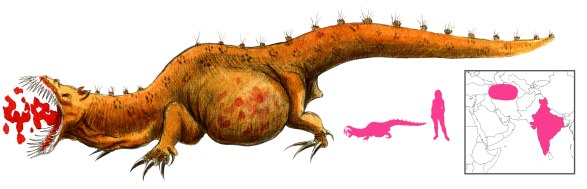
The Zabraq is one of the many exotic animals found in India. Bochart gave its location as the region of Dasht or Dist, the “gateway to Tartary”, and so presumably in the vicinity of Iran. It is also variously known as the Rukh and the Phalmant, although only the last term has seen use.

It is relatively modest in size, smaller than a cheetah, yellowish-red in color with flashing eyes and capable of leaping thirty to fifty cubits or more in one jump. Al-Marwazi makes it look like a camel, with two humps, tusks, and a large, membraneous tail, and adds that it is incredibly fast. Bochart, perhaps confusing its leaping distance with its size, makes it vast, prodigious, hideous, and forty cubits long, with bristling claws and teeth. Most importantly, it has highly acidic, weaponized urine and feces.

Zabraqs prey on animals up to the size of elephants, and kill them by flinging their caustic urine onto them with their tail. The tail of a zabraq can flatten and deform into a shovel shape to hold urine and dung before throwing it. The only animal zabraqs will avoid is the rhinoceros.

They are also fond of eating humans, and the only way to escape one is to climb a teak tree, which the zabraq cannot scale. Even that isn’t necessarily a safe place. When faced with treed prey, a zabraq will try to leap upwards and seize it before spouting its urine skyward, burning anything it touches like fire. However, if it cannot reach its prey through this stratagem, it turns towards the roots of the tree, roars in frustration until clots of blood erupt from its mouth, and expires.

Zabraq bile and testicles make potent poison; coated on weapons, it causes immediate death. Al-Marwazi goes further and specifies that the flesh, blood, saliva, and dung of the zabraq are all deadly.

Bochart reported this creature under the name of Phalmant and attributed it to Al-Damiri, although his account is entirely al-Mas’udi’s. Flaubert mentioned the phalmant it in his Temptation as a leopard howling so hard its belly bursts. The Dictionnaire Universel inexplicably turns it into a sea monster found on the coast of Tartary.

References

Berthelin, M. (1762) Abrégé du Dictionnaire Universel Francais et Latin, Tome III. Libraires Associés, Paris.

Bochart, S. (1675) Hierozoicon. Johannis Davidis Zunneri, Frankfurt.

Flaubert, G. (1885) La Tentation de Saint Antoine. Quantin, Paris.

Kruk, R. (2001) Of Rukhs and Rooks, Camels and Castles. Oriens, vol. 36, pp. 288-298.

al-Mas’udi, A. (1864) Les Prairies d’Or, t. III. Imprimerie Impériale, Paris.

Seznec, J. (1943) Saint Antoine et les Monstres: Essai sur les Sources et la Signification du Fantastique de Flaubert. PMLA, Vol. 58, No. 1, pp. 195-222.
Mi’raj

Variations: Al-Mi’raj (usually erroneously), Miraj (lacking the ‘ayn), Mirag (see previous, also Egyptian pronunciation)

Miraj

When Alexander the Great visited Jazirat al-Tinnin – the Dragon’s Island – he was immediately presented with an opportunity to play the hero. The inhabitants of this unspecified island in the Indian Ocean were terrorized by a fire-breathing dragon, which would exact a tribute of two oxen a day to be left at the opening of its lair. Ever the tactician, Alexander stuffed two ox-skins with pitch, sulfur, and other unpalatable substances, and had them dropped off for the dragon; the reptile perished soon after eating them.

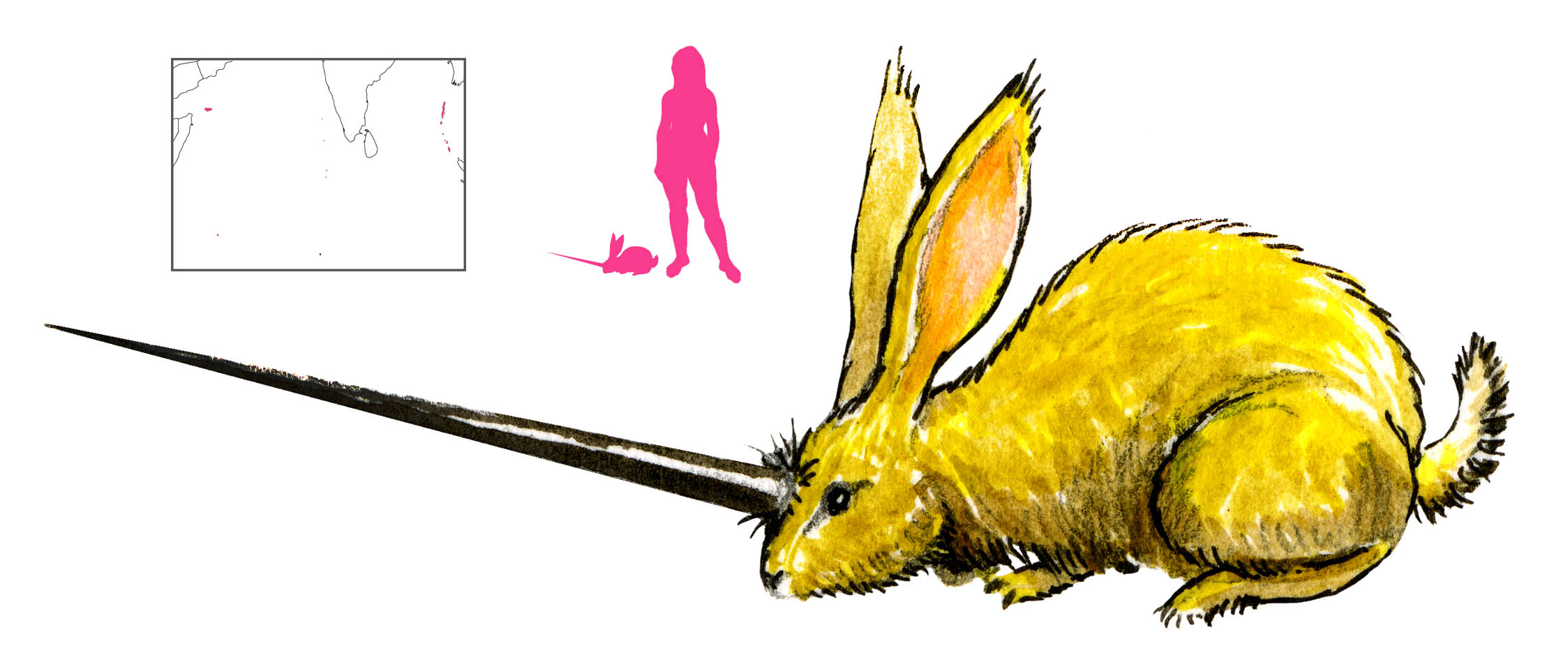
Among the gifts Alexander was given for this sauroctonous feat was a Mi’raj, a creature resembling a yellow rabbit with a single black horn on its forehead. It was apparently so aggressive that wild animals would flee at the sight of it – a feature it shared with the karkadann, and which may have arisen from confusion between the two unicorns. It certainly wasn’t fierce enough to avoid being captured (alive or dead).

The exact pronunciation of the name is unclear, as with the absence of diacritics, “mi’raj” may as well be “mu’raj”. It is sometimes rendered as Al-mi’raj, literally “The mi’raj”; this is unnecessary in English, and any usage of this term preceded with “the” or “an” is redundant. Bochart (and by extension Flaubert) refers to it as “mirag”, which is correct in Egyptian Arabic but drops the difficult ‘ayn.

Al-Qazwini was the first to report the story of Alexander and the mi’raj. Al-Damiri describes the mi’raj as “great [and] marvelous”.

If there is any factual basis for the existence of the mi’raj, it may well have been a rabbit with facial tumors caused by papillomaviruses. The same has been used to explain the origin of the jackalope, a North American hybrid used to fool tourists and usually created by grafting horns on a jackrabbit skin.

References

Bochart, S. (1675) Hierozoicon. Johannis Davidis Zunneri, Frankfurt.

Al-Damiri, K. (1891) Hayat al-hayawan al-kubra. Al-Matba’ah al-Khayriyah, Cairo.

Ettinghausen, R. (1950) The Unicorn. Studies in Muslim Iconography, Freer Gallery of Art Occasional Papers Vol. 1, No. 3, Washington.

Al-Qazwini, Z. (1849) Zakariya ben Muhammed ben Mahmud el-Cazwini’s Kosmographie. Erster Theil: Die Wunder der Schöpfung. Ed. F. Wüstenfeld. Dieterichsche Buchhandlung, Göttingen.

Seznec, J. (1943) Saint Antoine et les Monstres: Essai sur les Sources et la Signification du Fantastique de Flaubert. PMLA, Vol. 58, No. 1, pp. 195-222.
Zimmer, C. (2011) A Planet of Viruses. University of Chicago Press.

Puaka

Variations: Puwaka, Puaki

Puaka

The Puaka (“Pig”) is a Dusun demon that guards water in eddies, and resembles a pig with a razor-sharp tongue. Puakas like to feed from trees, and stand on each other’s backs until they reach the branches.

When you meet a Puaka, it will attack if you move, and come to a halt if you stop. If it catches up with you, it will lick your bones clean. To lose the Puaka it is recommended to cross a stream; the creature may follow you across the stream, but once on dry land it will pause to lick itself dry, licking the flesh off its bones in the process.

“Puaka” and similar terms have meant pig in a number of languages – puaka in Rarotongan, Mangarevan, Rotuma, and Malay, vuaka in Fiji, puwaka in Malay, pua’a in Samoan, puaa in Tahitian, Marquesan, and Hawaiian, buaka in Tongan, and poaka in Maori. While this has been alternately compared to the Sanskrit sukara, the Latin porcus, and the English porker, the word seems to have had its own unique Polynesian origin. In some areas puaka has come to denote the pig-like demon; sometimes it loses its meaning as “pig” altogether, possibly due to the influence of Islam.

References

Mackenzie, D. A. (1930) Myths from Melanesia and Indonesia. Gresham Publishing Company, Ltd., London.

Sinad

Variations: Sinād, Sénad, Senad

Sinad 2

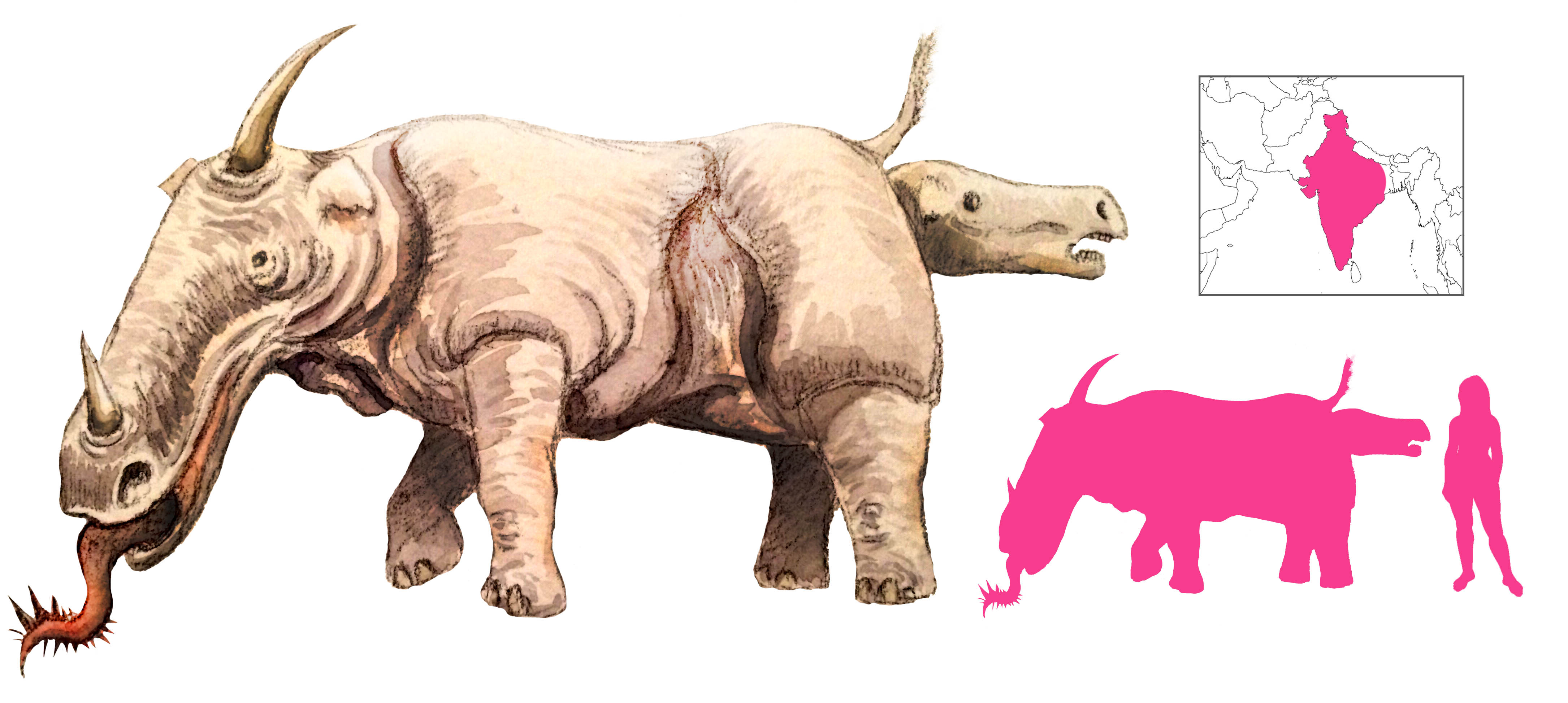
The Sinad is an Indian creature of uncertain appearance and dubious maternal instinct, described by Al-Jahiz, Al-Qazwini, and a number of other Muslim authors. Its primary characteristics – also attributed to the karkadann – were its sharp, thorny tongue and its unusual method of giving birth.

Al-Qazwini describes the sinad as similar to but smaller than an elephant, and larger than an ox. When the female is ready to give birth, the young sinad would stick its head out of its mother’s womb, feeding on grass and waiting until it was mature enough to run away. This was because the mother sinad, following her parental instincts, would attempt to lick her calf clean – in the process flaying the flesh off its bones. Once it was large enough, the calf would squirm out and gallop to safety.

This lethal tongue was also associated with the karkadann, and representations of them became blurred. Some images of the sinad are elephantine, while others came to follow the established iconography of the karkadann, giving it one or two horns. Al-Gharnati stated that the kings of China tortured people by having a karkadann lick them. Marco Polo, in his disillusioned report on the unicorn, said that its deadliest weapon was its tongue.

Flaubert, in his Temptation of Saint Anthony, makes an allusion to the Sénad as a three-headed bear that tears its cubs apart with its tongue. Here he conflates the sinad as described by Bochart with Pliny’s description of the bear licking its amorphous newborn cubs into shape. The three heads are a Flaubertian flourish.

References

Ettinghausen, R. (1950) The Unicorn. Studies in Muslim Iconography, Freer Gallery of Art Occasional Papers Vol. 1, No. 3, Washington.

Flaubert, G. (1885) La Tentation de Saint Antoine. Quantin, Paris.

Pliny; Holland, P. trans. (1847) Pliny’s Natural History. George Barclay, Castle Street, Leicester Square.

Polo, M. (1965) The Travels. Penguin Classics, London.

Al-Qazwini, Z. (1849) Zakariya ben Muhammed ben Mahmud el-Cazwini’s Kosmographie. Erster Theil: Die Wunder der Schöpfung. Ed. F. Wüstenfeld. Dieterichsche Buchhandlung, Göttingen.

Seznec, J. (1943) Saint Antoine et les Monstres: Essai sur les Sources et la Signification du Fantastique de Flaubert. PMLA, Vol. 58, No. 1, pp. 195-222.
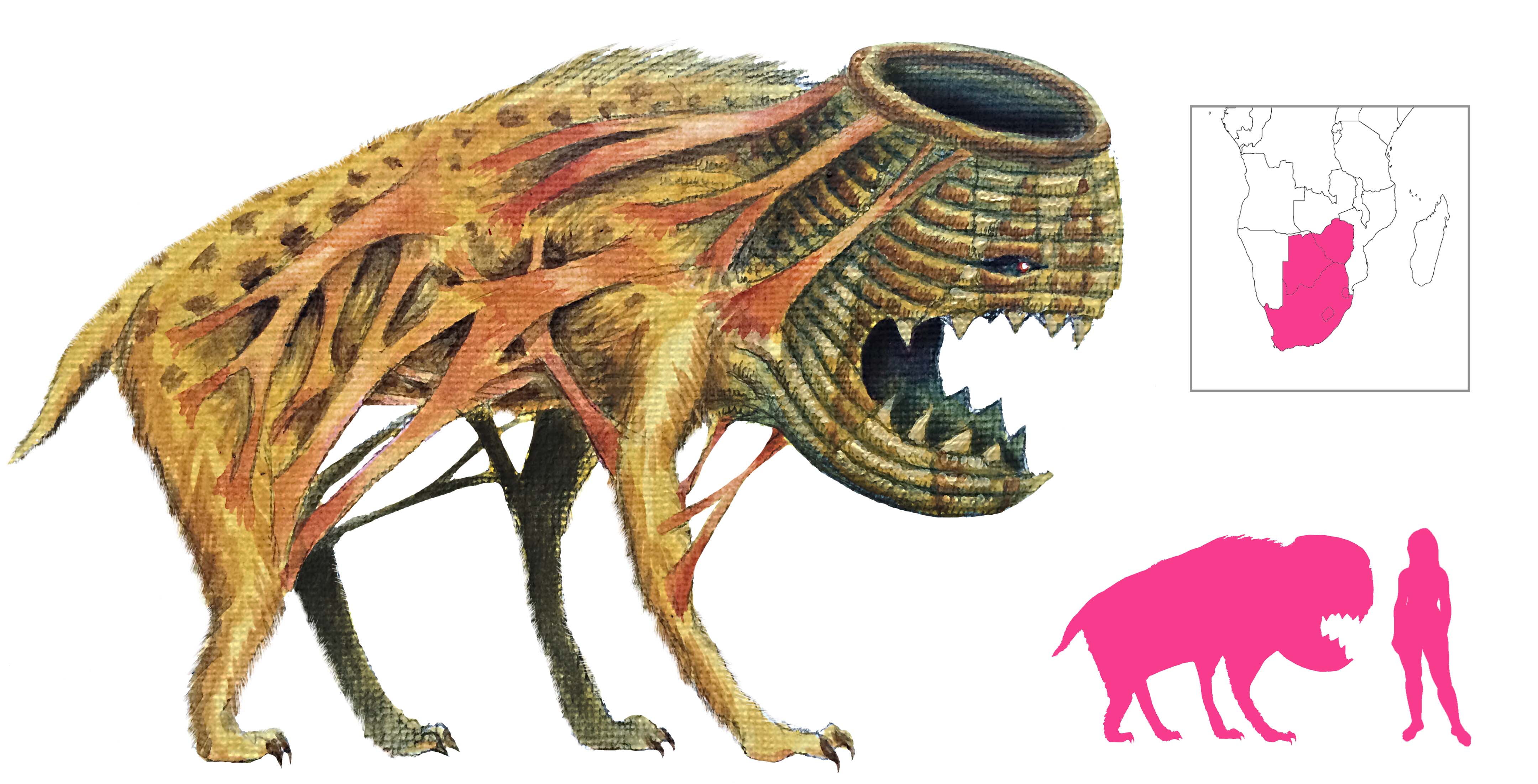
Isitwalangcengce

Isitwalangcengce

The Isitwalangcengce, or “Basket-bearer”, is hardly seen these days. Which is all the better, as this monster known to the Zulu people is a dedicated man-eater. Somewhat like a hyena in appearance, an Isitwalangcengce’s most notable feature is its basket-shaped head, complete with an opening in the top for carrying its prey.

Isitwalangcengces are powerful, and can easily overcome the bravest of men. They wait around villages during feast days, when children carrying freshly butchered meat go from house to house. They hide beside the doorway, and quickly stuff their victims into their head, carrying them off to eat. Isitwalangcengces do not actually eat all of their prey, but eat only the brain. An Isitwalangcengce will have a favorite rock to smash human heads on and lap up the contents.

If the Isitwalangcengce is strong, it is also dimwitted. This fact was exploited by one Zulu man who was being carried off in the basket. When the Isitwalangcengce passed through bushy terrain, the man reached out of the basket and pulled branches off, stuffing them into the cavity with him. Once he had filled the Isitwalangcengce’s head with sufficient branches, he grabbed onto a tree and hauled himself out. The Isitwalangcengce, meanwhile, noticed no difference in weight. By the time it reached the rocks and poured out a clump of branches and twigs, the man was long gone.

When the man returned to his village, he made sure to narrate his escapade in detail. News of that spread. Soon everyone knew to fill an Isitwalangcengce’s head with branches, and predation dropped drastically.

Now the Isitwalangcengce are mere nursery bogeys, good only for intimidating children. “If you aren’t good, the Isitwalangcengce will carry you off!” And the children smile to themselves, knowing that there’s always an easy way out.

References

Callaway, C. (1868) Nursery Tales, Traditions, and Histories of the Zulus. Trübner and Co., London.

Boongurunguru

Variations: Bonguru

Boongurunguru

According to the mythology of the Solomon Islands, there was once a time when the waters flooded the Earth. This great flood, the Ruarua, engulfed all of the islands, even the 4,000 feet high San Cristoval hills; those drowned in it turned into stone pillars, which can still be seen at Mwata. It was Umaroa, leader of the Muara clan, who saved his people by taking them, a sacred stone, and pairs of all the animals on board a great canoe. When the waters receded, Umaroa made landfall at Waimarai in the Arosi district, and offered a sacrifice in thanks. From there an adaro descended from a rainbow and guided them to their new home.

Umaroa is now buried there, and his sacred stone was laid on top of him. The area is now rich with magic, and visitors have to observe certain rules to avoid bad luck. Any trees cut down and left there will cause the lumberjacks to wander in circles, always returning to the cut tree. If there is a rainbow above the river, it cannot be crossed without making an offering to the adaro first. Names have particular strength there; ropes cannot be called ari but instead must be referred to as kunikuni (“to let down”), otherwise snakes will be summoned immediately.

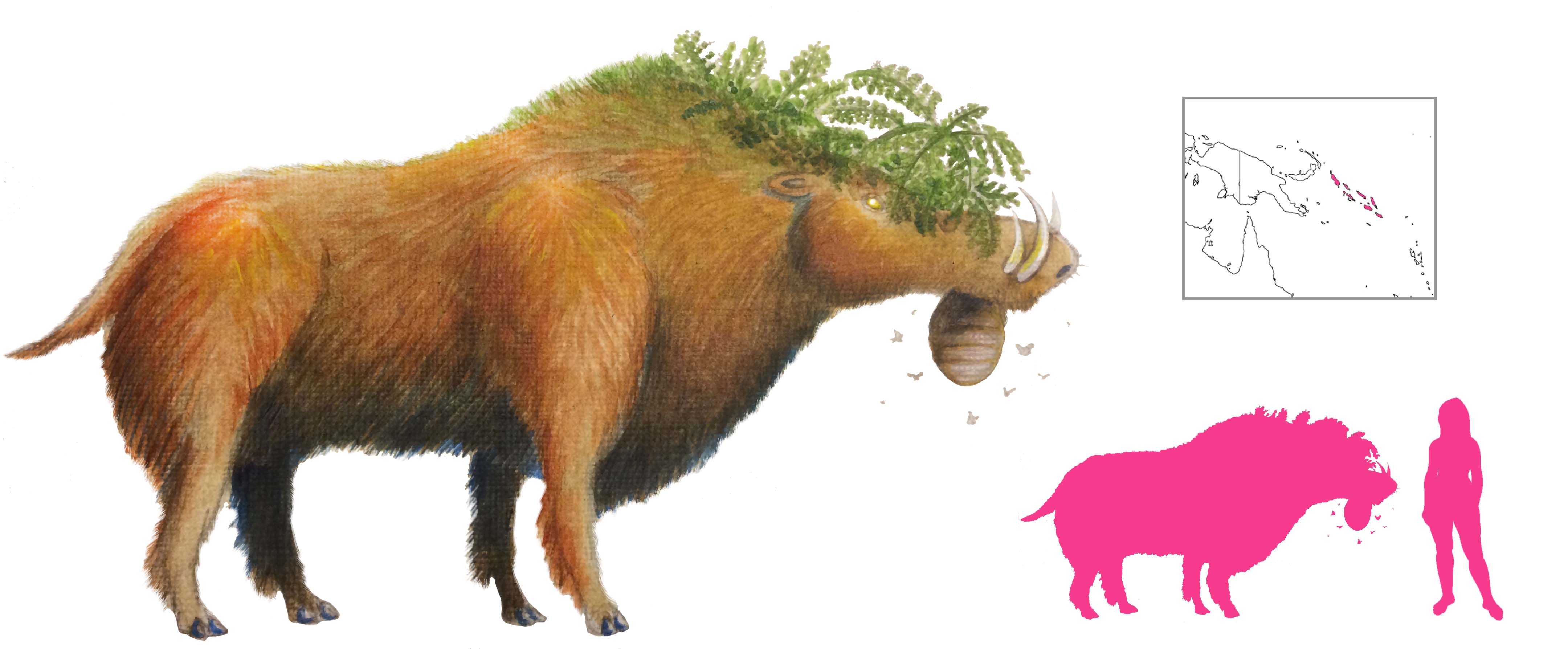
Of the spirits there, the most terrifying is Boongurunguru, the “pig-who-grunts”, the demon pig of Umaroa. He takes the form of a huge boar with ‘ama’ama ferns growing on his flattened head, and a buzzing nest of hornets located under his chin. He leads a herd of boars, all of them Boongurunguru, through the forest, goring and trampling anyone in their path. The appearance of a Boongurunguru foretells death; if the entire herd enters a village, everyone there will die. The boars get smaller and smaller as they approach a village, finally sneaking in at the size of mice, but they are no less deadly at that size.

If one hears Boongurunguru grunting and mentions that there must be pigs nearby, they are immediately surrounded by hundreds of venomous snakes – in front, behind, on either side, and falling out of the air.

This is because Boongurunguru has standards, and objects to being called a pig.

References

Fox, C. E. (1924) The Threshold of the Pacific. Kegan Paul, Trench, Trubner and Co., Ltd., London; Alfred A. Knopf, New York

Mackenzie, D. A. (1930) Myths from Melanesia and Indonesia. Gresham Publishing Company, Ltd., London

Ragache, C. C. and Laverdet, M. (1991) Les animaux fantastiques. Hachette.