Okay, I’m cheating a little. Those aren’t exactly obscure or modern – in fact, they’re some of the best-known, oldest, and most enduring mythical creatures. But they are unique renditions of those creatures, and have influenced modern views of them in surprising ways, including providing the answer to a mystery that has plagued DnD scholars.

In its April 23, 1951 issue, LIFE Magazine ran a short (4 pages) article titled “Mythical Monsters”, subtitled “These Beasts Existed Only In Man’s Imagination”. It featured seven mythical creatures illustrated by another of my favorite illustrators, Rudolf Freund (I really need to do an effortpost on LIFE artists including Lewicki and Freund). They are beautiful, detailed, and feature some… unusual design choices.

Su

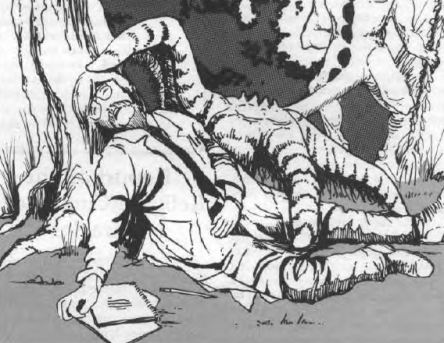
The depiction of the su is representative of Freund’s approach. Reading a mustached woman’s face, palm-frond tail, tiger stripes, frog babies, and ample udders into the description is definitely a first.

Griffin

The griffin, on the other hand, is standard, although modern artists would give it eagle’s forelimbs. Pedants would argue that this isn’t a griffin but an opinicus. They’re wrong.

Yale

The yale in particular looks like it could actually exist, and I love the dynamic pose it’s in.

Basilisk

Going to go out on a limb here and claim that this here is the reason why so many basilisks today are drawn as lizards instead of little crowned snakes or freaky reptochickenmutants. Nothing in the text suggest anything lizardy either, so Freund may have been elaborating here.

Disclaimer: the break in its middle is because it’s spread across two pages.
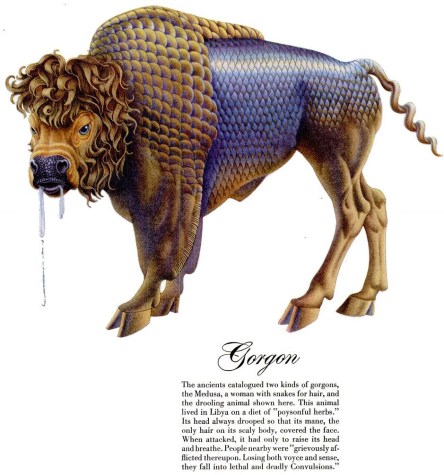
Gorgon

Looks familiar? That’s right, LIFE used Topsell’s gorgon (itself a renamed catoblepas). In turn, I humbly suggest that this was the inspiration for Dungeons and Dragons’ gorgon. You can stop worrying about where Gygax got his gorgon from and start sleeping easy.
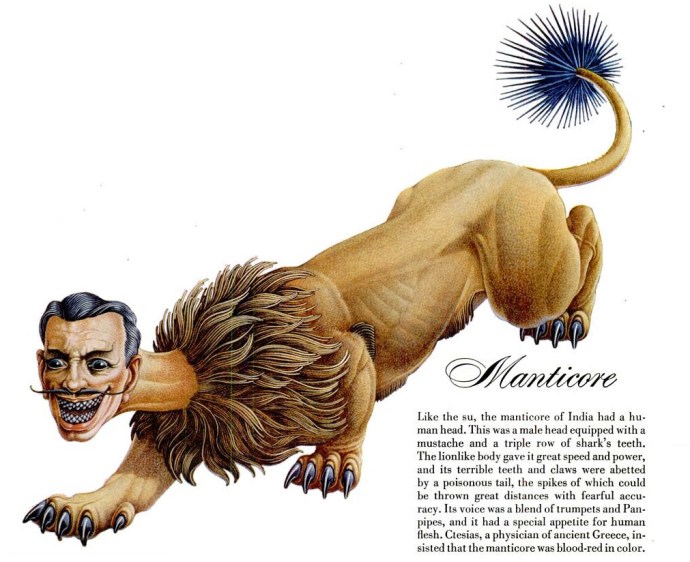
Manticore

Freund’s manticore is scarier than anything else. It’s also the most dapper of manticores. Check out that handlebar mustache and the slicked hair! I suspect the manticore in Page and Ingpen’s encyclopedia of Things That Never Were was based in part on this. References to this manticore pop up in odd places, including…
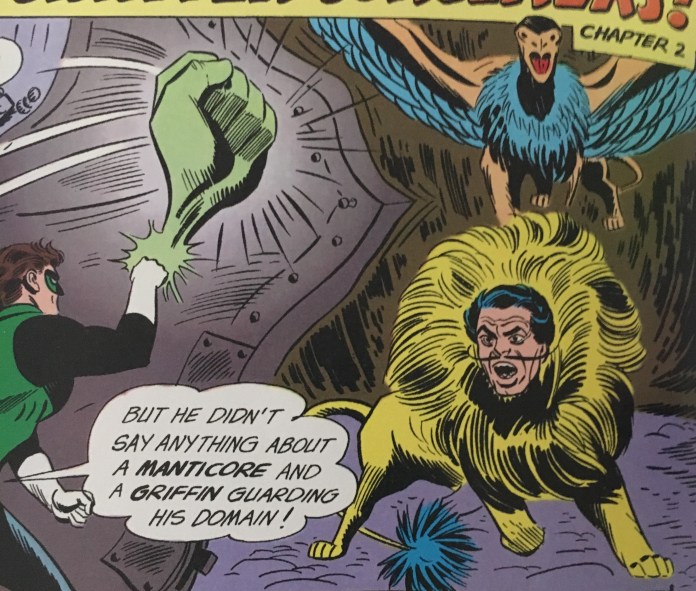
JLA manticore

… that one JLA comic where a manticore and a griffin double-team our heroes. The manticore is yellow, of course.

I always thought that was a cop-out weakness too.
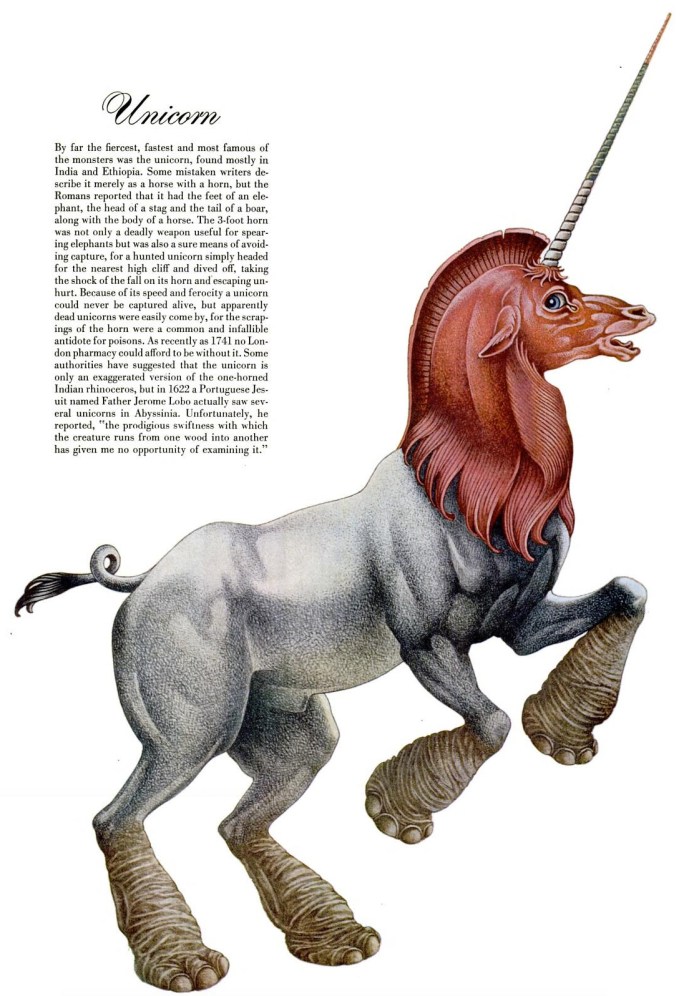
Unicorn

The last and best is this spectacular unicorn. I love the different colors and the mismatched elephant feet. This is exactly what unicorns should look like – garbled third and fourth hand accounts of rhinos.

Beisht Kione Dhoo

Variations: [Yn] Beisht [y] Kione Dhoo ([The] Beast of [the] Black Head); [Yn] Beisht Kione ([The] Beast of Head) (erroneously)

Beisht Kione Dhoo

Fishermen on the Isle of Man have traditionally observed a number of customs. Whistling on board “bothers the wind” and is discouraged. Sticking a knife in the mast on the appropriate side causes the wind to blow from that direction. Losing items on board is bad luck; borrowing items from “lucky” boats brings good luck. Four-footed land animals should not be mentioned by name, but instead by a circuitous sea-name – rats, for instance, are “long-tailed fellows”. Cold iron is a remedy to most acts of bad luck.

Then there is a number of sea creatures that can wreak havoc on fishing vessels. Of the the Beisht Kione Dhoo, the Beast of Black Head, is the most terrifying. It makes its home in the sea-caves on Black Head, near Spanish Head at the southern tip of the Isle of Man. The few who have seen it say it has a head like that of a large horse, and it can be heard roaring by fishermen off Spanish Head. Some say it is the soul of a man killed by pirates in order to protect their treasure hidden in the headland’s caves. Nobody has attempted to claim that treasure.

To placate the Beisht and bring on good luck, rum is left in the cave at Spanish Head. Fishermen heading out to sea would throw a glassful of rum overboard in hopes that the Beisht will grant them a bountiful catch.

References

Broderick, G. (1984) A Handbook of Late Spoken Manx: Grammar and Texts. Max Niemeyer, Tübingen.

Killip, M. (1976) The Folklore of the Isle of Man. Rowman and Littlefield, New Jersey.

Rose, C. (2000) Giants, Monsters, and Dragons. W. W. Norton and Co., New York.

Lushu

[image pending]

South of the Niu-Trees Mountain in China has red metal on its southern slope and white metal on its northern slope. It is also home to the Lushu, which looks like a horse with a white head, a red tail, and stripes like a tiger. Its cry is like a human singing. Wearing the lushu from one’s belt ensures the conception of many descendants.

While the Shan Hai Jing is unclear on the subject, Guo Pu clarifies that a piece of the lushu’s skin and hair ensures fertility. Its red tail may be a symbol of its vigor and potency.

The stripes suggest that the lushu may be inspired by a number of striped ungulates – zebras, wild donkeys, or even okapis. Mathieu cites the polygamy of zebras and the historical virility of donkeys, but it probably is not an extinct species of red-tailed zebra.

References

Mathieu, R. (1983) Étude sur la mythologie et l’ethnologie de la Chine ancienne. Collège de France, Paris.

Strassberg, R. E. (2002) A Chinese Bestiary: Strange Creatures from the Guideways Through Mountains and Seas. University of California Press.

Untitled-1

Les Animaux Fantastiques

Claude-Catherine Ragache and Marcel Laverdet

I seem to be stuck on sumptuously illustrated books recently. I mentioned this some time back and I thought I’d talk about it here. Les Animaux Fantastiques (LAF) is one of the first books on the subject of mythical creatures that I’ve read (came out 1997). It is also out of print, and has the misfortune of sharing a name with Fantastic Beasts in French. An English translation exists but I’ve never seen it. What’s so special about it then? Let’s find out.

You can purchase the book at extortionate prices from here. Hopefully elsewhere at better prices and/or in English as well.

Scope

LAF is a children’s storybook, to sell it short. It’s a collection of short stories that can be read by or to children, and they are all illustrated in beautiful color by the underrated Marcel Laverdet.

It also happens to be part of a myths and legends storybook series, each centered around a type of legend – Arthurian, Celtic, Egyptian, Greek… In this case, all the stories are about fantastic beasts in one way or another.

This is not a compendium of creatures, does not claim to be one, and is not being reviewed as such. But it does have a wide variety of worldwide creature stories.

Organization

Random. Creature stories all over the place. There’s no real organization to the book.

Text

Easy reading in French, and presumably in English as well. The stories aren’t that startling or spectacular, but they read well and are nice retellings. Some of them are quite obscure too. They range from retellings of stories (Bellerophon and the Chimera), dramatizations of creature accounts (Boongurunguru), short accounts of various creatures, and so on.

Images

The paintings are the main selling point of LAF, and they deliver in spades. They’re colorful, detailed, sometimes cartoony… In fact, I’ll break with ABC review tradition and let a modest sample of illustrations do the talking.

IMG_8312

Tiddalik the frog (not explicitly named as such) about to explode.

IMG_8313

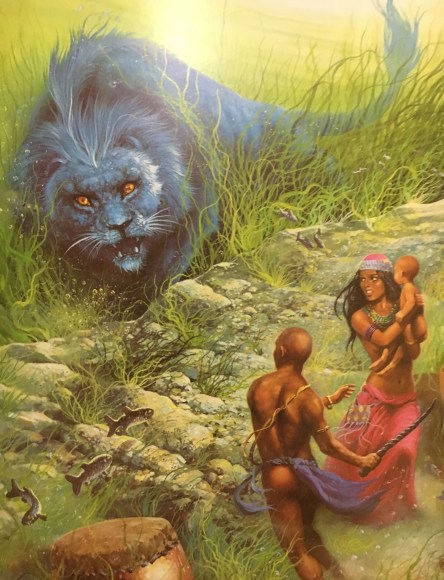
An underwater lion of Africa. Incidentally, this tale inspired some research into odd-colored lions in folklore, but the original folktale collected by Frobenius and Fox in African Genesis (1999) makes no mention of the lions being blue. The blue color is an authorial addition, sorry to say.

IMG_8314

The dreaded Boongurunguru of the Solomon Islands and its demon horde of boars.

IMG_8316

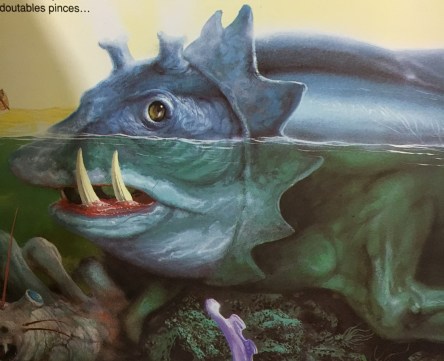
A Ziph (Ziphius) attacking a sea serpent.

IMG_8317

A Trolual, with a giant Scandinavian lobster lurking off-camera.

IMG_8318

Creature overload! Phoenix, Unicorn, Vouivre, and… Chipique? Chipekwe, maybe? Odd spelling, and even odder artistic license employed – the text describes it as having the head of a crocodile on a snake’s body!

IMG_8320

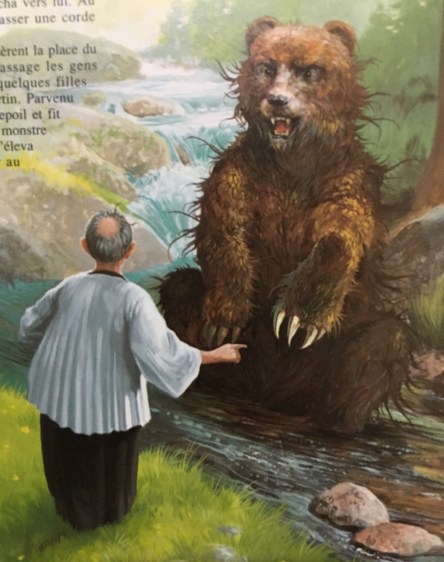
The Malebete or Troussepoil, getting, erm, what-for.

Research


There’s a lot of obscure creatures in there, but no literature cited. Which means that I had to grow up knowing those things but not where they came from, and which led me in turn to finding a lot of great sources. There are also some strange interpretations (blue lions, tengus as firebirds…)

Good for a children’s book, less so for research.

Summary

Lovely, lovely, lovely. I love the pictures in this, I would definitely rate it as one of the creature books that got me into creatures. But it’s not particularly academic, does not cite sources, and makes some errors. I give it 4/5, commutable to 3/5 or 5/5 depending on how strict or generous I’m feeling. Great introduction to the world of fantastic beasts though.

4

Utelif

Variations: Uletif (Paré), Pristis, Saw-fish, Sawfish

Utelif

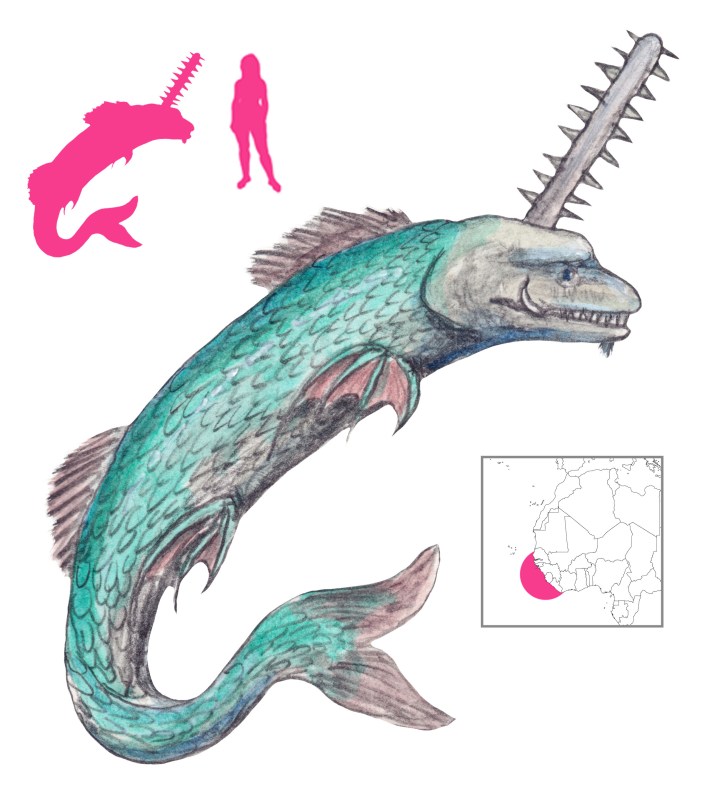
Thevet describes the monstrous Utelif as a fish found along the African coast, from Guinea to Ethiopia. It has a three-foot long, four-finger wide saw on its forehead. This weapon is very sharp on both sides. It is much like a killer whale, but its skin is scaly instead of leathery. Thevet includes a drawing of it and contrasts it with that of Rondelet, who was sadly mistaken in putting the saw on the creature’s nose.

Ambroise Paré predictably copies Thevet’s account but changes the name to uletif. Like Thevet, he is in possession of the remarkable saw, a serrated horn weighing five pounds with fifty-one sharp teeth divided on either side (25 on one, 26 on the other). It is colored like a sole above and is white below. As the uletif is believed to be a marine unicorn, its horn has the same antivenomous qualities as that of the unicorn. He dismisses the popular claim that the saw is a snake’s tongue.

Aldrovandi includes the likeness of the utelif in his discussion of the Pristis or sawfish.

References

Aldrovandi, U. (1613) De Piscibus, Libri V. Bononiae.

Paré, A. (1582) Discours d’Ambroise Paré – De la Licorne. Gabriel Buon, Paris.

Thevet, A. (1575) La Cosmographie Universelle. Guillaume Chaudiere, Paris.

Rondelet (1554) Libri de Piscibus Marinis. Matthiam Bonhomme, Lyon.

Vallot, D. M. (1821) Explication des Caricatures en Histoire Naturelle. Mémoires de l’Academie des Sciences, Arts, et Belles-lettres de Dijon.

Serra

Variations: Serre, Pristis, Vivella, Sawfish, Saw-fish, Flying Fish

Serra

The Serra (“saw”) or Saw-fish is a mainstay of bestiaries. Traditionally identified with the sawfish, it also includes features of the flying fish and comes with a ready moral message for the benefit of faithful readers.

Pliny mentions a fish named Pristis which is two hundred cubits (over 90 meters) long, is viviparous, and seemingly covered with hair. Pristis was also a common name given by Romans to ships. Isidore of Seville gives us the ur-description of the serra as a fish with a serrated (serratus) crest which cuts through boats as it swims under them.

Later additions expanded on this account. The serra is a huge seagoing fish or monster with gigantic fins. When it sees a ship, it spreads its fins, catching the wind, and chases after the vessel in an attempt to outspeed it. After two hundred yards the serra gets bored, folds its wings, and sinks back into the ocean. The ship represents the Righteous, who press on in the face of adversity, while the serra represents fickle and lazy people who start out trying to be Christians but discourage easily.

Why the serra chases after the ship is uncertain. The moral suggests jealousy, but the propensity of the serra to slice up ships with its saw-crest implies a more malevolent motive. Other accounts describe it as more bloodthirsty, sinking ships to feast on sailors, while some (perhaps confused with dolphins?) are said to take pity on sinking ships and lift them out of the waves.

The serra does not fly, instead using its massive fins move like a sailboat, but medieval artists commonly show it flying above ships anyway. Eventually the serra’s iconography was muddled with the dragon’s, and it became another dog-like or reptilian winged monster.

The position of the saw has also been a subject of contention. Isidore of Seville’s crest (crista) was interpreted in ways ranging from a rooster’s comb to a saw-edged dorsal fin. None of them locate the saw on the end of the nose.

Buel regards the sawfish as an innocent and inoffensive creature. The occasional attacks on boats are attributed to parasitic copepods, whose burrowing into the sawfish’s flesh drives the creature into delirious agony and causes it to lash out at anything nearby.

References

Aldrovandi, U. (1613) De Piscibus, Libri V. Bononiae.

Buel, J. W. (1887) Sea and Land. Historical Publishing Company, Philadelphia.

Cuba, J. (1539) Le iardin de santé. Philippe le Noir, Paris.

Druce, G. C. (1919) On the Legend of the Serra or Saw-fish. Proceedings of the Society of Antiquaries, Second Series, v. 31.

Hippeau, C. (1852) Le Bestiaire Divin de Guillaume, Clerc de Normandie. A. Hardel, Caen.

Isidore of Seville, trans. Barney, S. A.; Lewis, W. J.; Beach, J. A.; and Berghof, O. (2006) The Etymologies of Isidore of Seville. Cambridge University Press, Cambridge.

Pliny; Bostock, J. and Riley, H. T. trans. (1900) The Natural History of Pliny, v. II. George Bell and Sons, London.

White, T. H. (1984) The Book of Beasts. Dover Publications, New York.

Ompax

Variations: Ompax spatuloides

Ompax

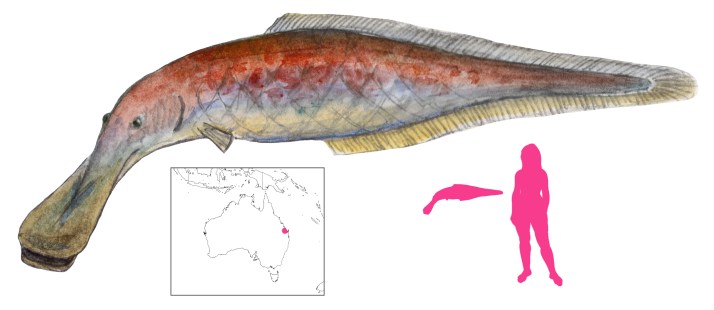
What would you do if your breakfast was a species new to science? Carl Theodore Staiger, director of the Brisbane Museum, was faced with this conundrum in August of 1872. During his visit to Gayndah, Queensland, he was served an unusual duck-billed fish for breakfast. The worthy naturalist decided to have the specimen sketched. He then went ahead and ate the specimen anyway.

The entire description of Ompax spatuloides is derived from the sketch and Staiger’s recollection (sadly, we are not told of the Ompax’s gastronomical merits). Count F. de Castelnau described it as a ganoid fish something like a paddlefish, eighteen inches long and dirty mahogany in color. The spatulate beak is similar to a platypus’, the eyes are small and near the top of the head, the pectoral fins are small, and the dorsal, caudal, and ventral fins appear to be connected. It can only be found in a single water hole in the Burnett River, alongside the lungfish Ceratodus.

Ompax spatuloides was listed in several catalogues of Queensland fishes, despite immediate and scathing criticism from other ichthyologists. O’Shaughnessy remarked that “all the characters of [the Ompax] are gathered from a drawing made after and not before the repast… the Record thinks he would be scarcely justified in admitting Ompax spatuloides, sp. n., into the system.”

The mystery of the Ompax was solved by someone writing to the Sydney Bulletin under the name of “Waranbini”. The author confesses that the Gayndah locals prepared a fish for Staiger’s breakfast by assembling the head of a lungfish, the body of a mullet, and the tail of an eel (and, presumably, the bill of a platypus). It was cooked and introduced as a new species, one that might not be seen again for months, and Staiger fell for it hook, line, and sinker. Since then, unusual fish were met in the Gayndah district with an exclamation of “it must be an Ompax!”

References

Castelnau, F. L. P. (1879) On a New Ganoïd Fish from Queensland. Proceedings of the Linnean Society of New South Wales, v. 3, no. 1, pp. 164-165.

Whitley, G. P. (1933) Ompax spatuloides Castelnau, a Mythical Australian Fish. The American Naturalist, v. 67, no. 713, pp. 563-567.

Who remembers TORG? I do but I never played it. I remember this RPG because one of the primary gamebooks – The Living Land sourcebook – somehow found its way into a second-hand bookstore in my third-world country, so of course I had to go forth and talk about it.

The premise is that Our Earth has been invaded by bad guys from various realities, and they’re forcing their realities on ours. North America has become a lost world of religious dinosaurs. France has become an alternate history version of itself where the Avignon Popes won, developed cyberware, and turned the place into a Catholic cyberpunk dystopia. Egypt is now run by pulp pharaohs and weird science. Southeast Asia has become a new Victorian England populated by Gothic nightmares. California is a cyberdemon-infested hellscape. More than usual. It’s a really cool concept but the only thing I know about it is what I could get from the books. I have no idea how it plays out. If you’re interested the current holders are kickstarting an update.

I don’t pretend to be a connoisseur of RPGs, but I do pretend to be a connoisseur of creatures, and TORG has plenty from different areas. There’s the standard Tolkien-ripoff fantasy world (yawn), but I do appreciate this adorable muppety Cockatrice.

cockatrice

As well as this kelpie.

kelpie

The Living Land was my introduction to TORG, so you can imagine my dismay when I found out it was the least popular setting. But… dinosaurs? TORG came out pre-Jurassic Park so the dinos are all inaccurate lumbering lizards (and unfortunately, the remake has stated “our raptors don’t have feathers either”. Gah!) But it has so much potential! It’s like Stephen King’s The Mist except it’s dinosaurs. And they could easily have advanced biotech instead of nonliving weapons…. but I digress. One of the coolest sapient races of all are the stalengers, which are flying stained glass fuzzy starfishes. Yes.

stalenger

“You okay there buddy? Speak to me, bro. Speak to me.”

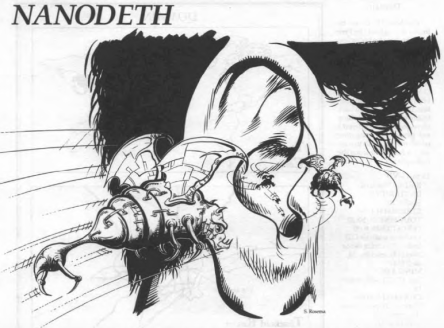
Then you get things like cyber-enhanced hunter-killer insects like these adorbs little things.

liquefier
nanodeth

That’s right, if you hadn’t guessed by now, Tharkold and the Cyberpapacy are the cosms of METAL. \m/

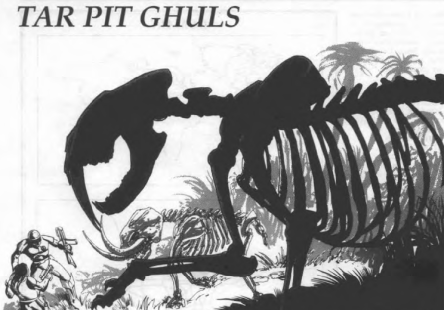
tar pit ghul

Undead subfossil La Brea creatures? Why not?

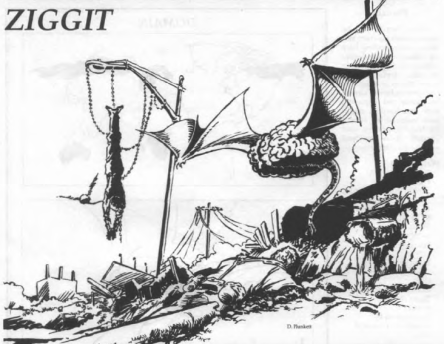
I don’t know about you but one of my life’s goals has been to become a flying disembodied brain with cyber enhancements. I’m glad TORG has made this a reality. I want to be a ziggit. Called Stardust. I can see it happening.

ziggit

The gamemaster’s paradise is surely Orrorsh, where anything and everything is a disguised Horror ready to kill you. Children’s toys? Medical instruments? Household objects? They’re all Horrors, and they will make you Die Horribly. Have I mentioned how much I love anything OF DOOM?

pop weasel
doctor's little helper
TEDDY BEAR OF DOOM

Of course I saved the best for last. This is it. Unironically my favorite of all creatures. Nothing I do will ever compare to this image of perfection.

ROTARY MOWER OF DOOM

I love everything about this.

What I’m saying is that if you can’t appreciate how wonderful a ROTARY MOWER OF DOOM is then you’re a shriveled joyless husk, thank you and good evening.

Devil-jack Diamond-fish

Variations: Diamond fish, Devil fish, Jack fish, Garjack, Litholepe, Litholepe adamantin, Litholepis adamantinus

Devil-jack Diamond-fish

John James Audubon is remembered today as an artist and ornithologist of considerable import. His practical jokes are less well known, and began with the unexpected arrival of Constantine Samuel Rafinesque at Hendersonville, Kentucky.

Rafinesque was a brilliant, enthusiastic, “exceedingly remarkable”, and very eccentric young naturalist who tested Audubon’s hospitality. After they had retired to bed, Audubon was roused by a commotion coming from Rafinesque’s room. As he describes it, “I saw my guest running naked, holding the handle of my favorite violin, the body of which he had battered to pieces in attempting to kill the bats which had entered the open window!” Rafinesque was convinced the bats were new species. Audubon was not amused.

Perhaps to avenge his smashed violin, Audubon decided to take advantage of Rafinesque’s credulity and eagerness to describe new species. He solemnly supplied Rafinesque with 10 drawings of completely fictitious fish, which were duly named and described in detail. The likes of the bigmouth sturgeon and the flatnose doublefin caused headaches for ichthyologists and tarnished Rafinesque’s reputation beyond repair.

The Devil-jack Diamond-fish (Litholepis adamantinus) is surely the most remarkable of those faux fishes, as evidenced by Rafinesque’s breathless description. This “wonder of the Ohio” is found only as far up as the falls and probably in the Mississippi as well. Rafinesque claimed to have seen it from a distance, and seen some of its scales, but otherwise he “principally relied upon the description and figure given [him] by Mr. Audubon”.

We are fortunate enough to have a complete and detailed description of the devil-jack. It is classified among the garfish but is quite unique. The body is blackish and fusiform, 4 to 10 feet long and up to 400 pounds in weight. The head takes up a fourth of the total length. The snout alone is large (as long as the head), convex above, and obtuse. The eyes are small and black, with the nostrils in front of them. The mouth is transverse and has large angular teeth. Dorsal and anal fins are of equal length, the tail is obtusely bilobed, and there is no lateral line. The body is covered in oblique rows of conical pentagonal brown scales, half an inch to one inch in diameter; they become the color of turtle shell when dried.

The scales are the devil-jack’s main claim to fame, as they are hard as flint, completely bulletproof, and repel hooks. They produce sparks when struck against steel. Only nets or the strongest hooks can take a devil-jack. It is inedible and a voracious hunter, usually seen lying motionless at the surface like a log. The scales are a miracle of nature, for “they strike fire with steel! and are ball proof!” [sic]

References

Jordan, D. S. (1886) Rafinesque. The Popular Science Monthly, June 1886.

Rafinesque, C. S. (1820) Ichthyologia Ohiensis. W. G. Hunt, Lexington, Kentucky.

Fei

Variations: Fei-beast

Fei

The Fei or Fei-beast can be found on Great Mountain, the eighth and last of China’s Eastern Mountains. It is shaped liked an ox, with a white head and a single eye. Its tail is that of a snake.

When a fei moves over grass, the plants below it wither and die. When it crosses a stream, the water evaporates at its touch. Its appearance is an omen of worldwide plague and wars.

References

Mathieu, R. (1983) Étude sur la mythologie et l’ethnologie de la Chine ancienne. Collège de France, Paris.

Strassberg, R. E. (2002) A Chinese Bestiary: Strange Creatures from the Guideways Through Mountains and Seas. University of California Press.