Tiddalik

Variations: Tiddalick, Karaknitt
Tiddalik

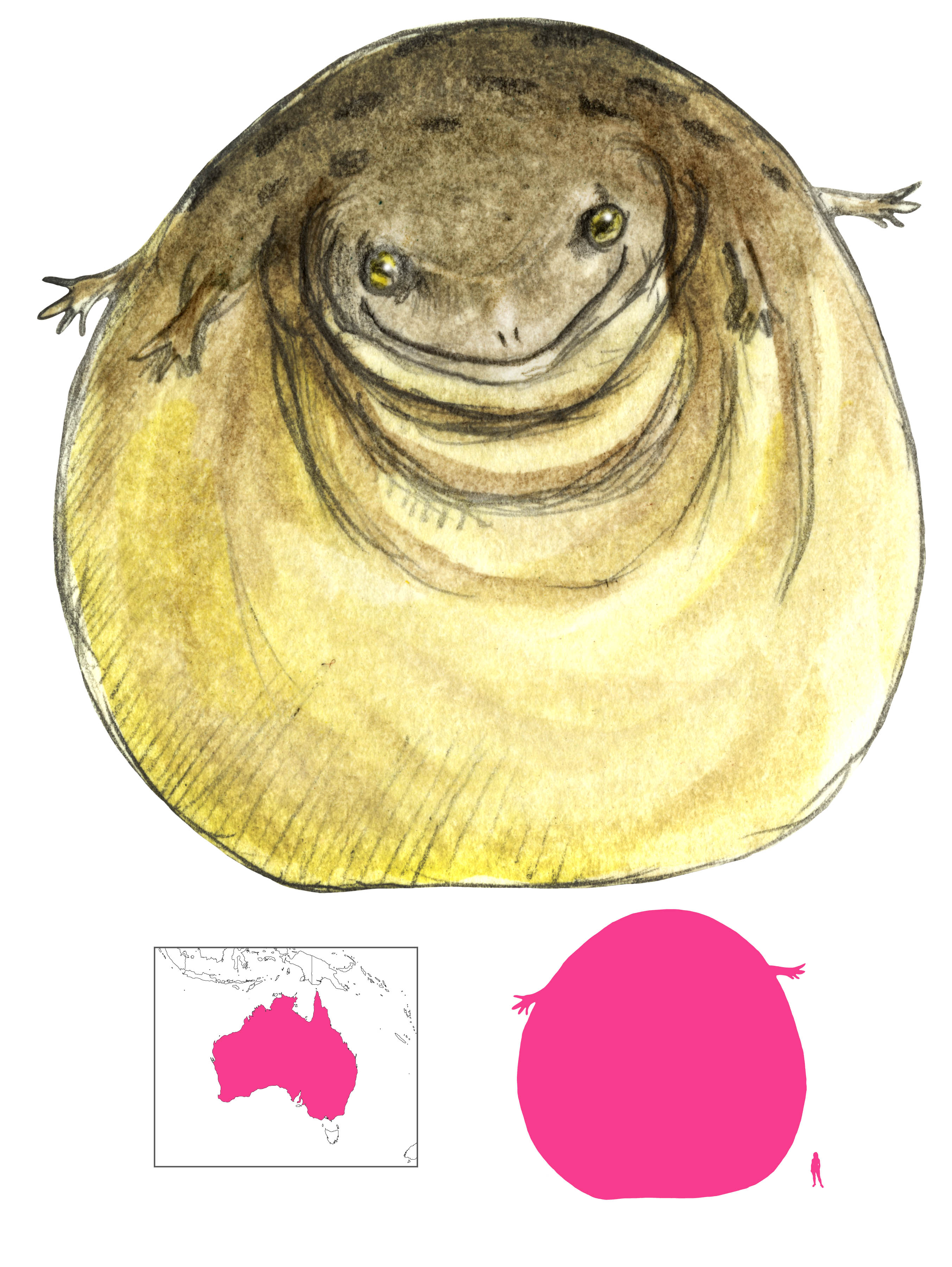
Tiddalik the frog was thirsty. He got up one day in the Australian bush and decided he needed more water. He began by drinking down all the water in his pond. After that, he crawled out of the hole left behind and drained the nearby waterholes. Then he swilled down the closest river, and followed its tributaries, drinking them down one by one. Billabongs and lakes were gobbled up, and Tiddalik grew bigger and bigger. Finally, once there was no water left in sight, Tiddalik stopped. He was now a bloated, mountainous creature filled with water and incapable of moving. He could only sit there and stare, content at last.

Soon, as the lack of water became painfully evident, the animals started to gather around Tiddalik. His size and thick skin made him impervious to anything they could do, and rain was nowhere in sight. It was Goorgourgahgah, the Kookaburra, who hit upon the solution. “We must make him laugh”, he said. “That way he’ll open his mouth and all the water will come out”.

As the champion laugher, Goorgourgahgah went first. He flew in front of Tiddalik’s face, laughing at the top of his lungs. He tumbled in the air, told jokes, and guffawed till he was hoarse. Tiddalik blinked impassively.

All the other animals tried their luck. Kangaroo turned somersaults. Koala made weird noises. Frilled Lizard ran around with his frill open. Wombat rolled around in the dirt. Brolga danced and squawked. But nothing they did seemed to get to Tiddalik, and the more they tried the thirstier they got. The monstrous frog merely continued to observe them with his globular eyes.

Then, as the other animals began to despair, Noyang the Eel stepped solemnly up. Everyone held their breath as Noyang straightened and balanced precariously on his tail. A ripple went through Tiddalik’s bloated body. Noyang began to twist and contort himself, forming hoops, spirals, springs, whirling around like a top… Tiddalik’s smile broadened, and he started to shake. Finally, Noyang tied himself in knots, and Tiddalik started to laugh hysterically – and all the water he held inside poured out, flooding the land before returning to its rightful place. Many died in the flood; Pelican took it upon himself to save as many as he could, but got aggressive when the human woman he wanted for a wife refused him. He painted his black feathers white to go to war, but was accidentally killed by another pelican who didn’t recognize him – pelicans today are both black and white in his honor.

When all had cleared, Tiddalik had shrunken back into a tiny frog once more. He had laughed so hard that he lost his voice, and could only croak hoarsely. Today, his descendants the water-holding frogs (Cyclorana platycephala) still practice every night in the hopes of regaining that voice, and still try to drink large quantities of water on a much smaller scale.

After losing all the water of the world, Tiddalik also came to resent anyone who tried to hoard water for themselves. When Echidna tried to keep a secret cache of water, it was Tiddalik who followed him and dove into the subterranean pond. “This water belongs to everyone!” he snapped. “You have no right to keep it to yourself!” The other animals punished Echidna by tossing him into a thornbush, and to this day he still has the thorns embedded in his back as a painful reminder of his greed.

References

Morton, J. (2006) Tiddalik’s Travels: The Making and Remaking of an Aboriginal Flood Myth. Advances in Ecological Research, vol. 39.

Ragache, C. C. and Laverdet, M. (1991) Les animaux fantastiques. Hachette.

Reed, A. W. (1965) Myths and Legends of Australia. A. H. and A. W. Reed, Sydney.

Reed, A. W. (1978) Aboriginal Legends: Animal Tales. A. H. and A. W. Reed, Sydney.
Tapirê-iauara

Variations: Tapir Nymph, Onça d’Água (Water Jaguar), Onça Pé de Boi (Cow-legged Jaguar), Paraná Pura Iuraretê (Turtle/Jaguar that Dwells in River Side Channels), Tai-açu-iara (potentially)

Tapire-iauara

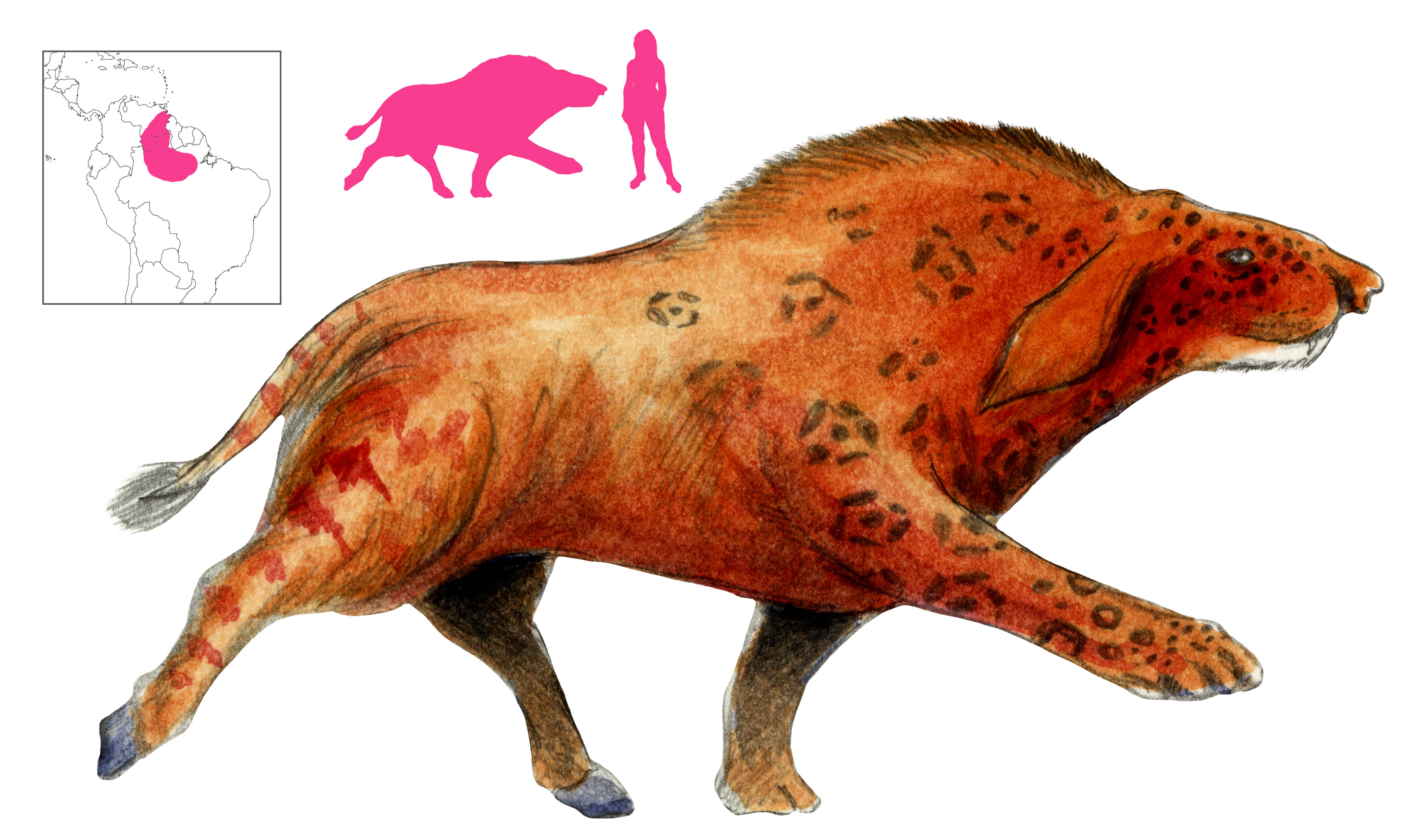
The Tapirê-iauara, or Tapir Nymph, enjoys a wide distribution in the Amazon, from the Orinoco in Venezuela to the Rio Negro, the Madeira, the Tapajós, and the Amazon down to Pará. Sightings have been reported from around Codajás, Fonte Boa, Itacoatiara, Nova Olinda, Oriximiná, Santarém, and Urucurituba. It lives in slower-moving waters, near groves of aninga or palm trees, and avoids human settlements.

The name tapirê-iauara is etymologically complex. Tapiré is Tupi for “tapir”, while y is “water” and ara is “lady” in língua geral; it also draws from the Tupi uara (“dweller”) or yguara (“dweller in water”). Hence, “tapir water-lady” or “tapir nymph” is a rough translation. This same derivation gives us the Amazonian nymphs Yara and Oyoára, the sea monster Hipupiara, and Paraná Pura Iuraretê, which was apparently a giant turtle creature that later was subsumed into the tapirê-iauara (iuraretê meaning either “turtle” or “jaguar”).

Reports of the tapirê-iauara appearance have varied somewhat. Most accounts agree that it resembles a cow-sized jaguar with a reddish waterproof coat, a thick mane, long droopy ears half a meter in length, and an overpowering stench (catinga). It may have jaguar legs, or the forelegs of a jaguar and hooved, donkey-like hindlegs. It may have horse legs with or without catlike paws, duck feet, or large otter paws. Variations in fur color include red, gold, and black with a cream patch in the chest. It notably does not look much like a tapir.

A tapirê-iauara is heard and smelled before it is seen. The large, finlike ears flap noisily against the water as it swims, while its putrid odor precedes it. From a safe distance, it’s merely nauseating; at close quarters the stench of a tapirê-iauara is enough to cause fainting and outright death. Tapirê-iauaras can also mesmerize prey into standing still before pouncing on them.

Tapirê-iauaras have a broad diet that includes large fish, capybaras, caimans, and humans. They are attracted to hauls of fish and the halitosis resulting from eating poorly-cooked fish. They often show up to inspect fishermens’ catches – or the fishermen themselves. When they do, they are fast, persistent, and resilient, relying on their odor to weaken prey before killing it with their sharp teeth and claws. One fisherman had to empty 12 slugs from a .22 rifle into a pursuing tapirê-iauara before the beast expired. Other fishermen have not been so lucky, having their catches stolen at best or being dragged into the river and devoured at worst.

Sometimes the stink of a tapirê-iauara is enough to cause a human’s shadow (and therefore soul) to depart. A person who has lost their shadow in this way is said to be assombrado. They can recover their soul by inhaling the fumes of a fire made with leaves, sticks, and the bones of undercooked piranhas.

Caraña resin (Protium heptaphyllum) is repulsive to tapirê-iauaras, and anyone concerned about tapirê-iauara attack should equip themselves with some before heading into the Amazon. Tapirê-iauaras also cannot climb, and so shelter should be sought in trees. As the tapirê-iauara’s odor will cause fainting and potentially falling out of the tree, secure branches must be found.

The Tai-açu-iara from around Parintins is similar and may be the same animal. It appears as a black piglike creature with jaguar paws.

References

Smith, N. J. H. (1981) Man, Fishes, and the Amazon. Columbia University Press, New York.

Smith, N. J. H. (1996) The Enchanted Amazon Rain Forest. University Press of Florida, Gainesville.

Tsenahale

Variations: Tse’nahale, Tse’na’hale, Tsanahale

Tsenahale

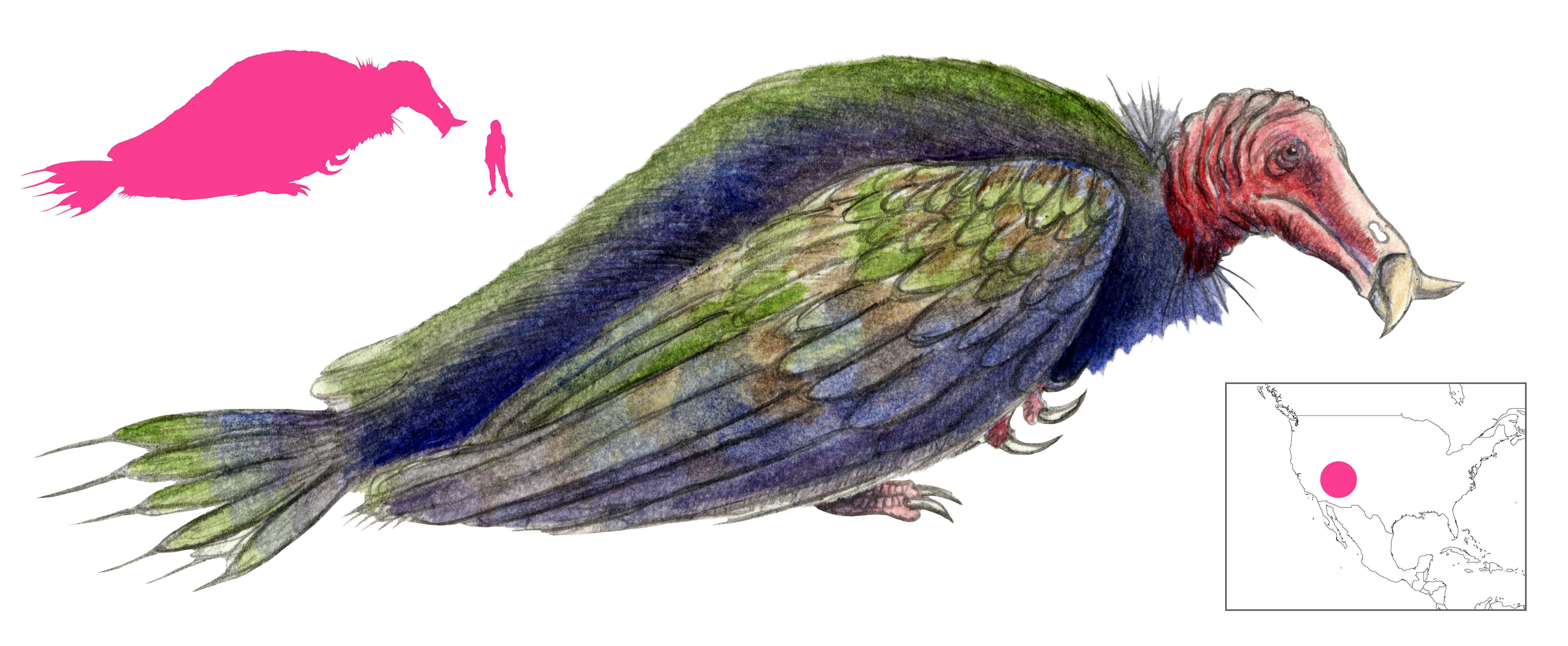
The Tsenahale were two of the Anaye, or “Alien Gods”, who plagued the land of the Navajo. They were born after men and women were separated, and the women resorted to unnatural practices as an outlet. In the case of the Tsenahale, the “father” was a pile of feathers; their mother must have been particularly desperate.

When the first Tsenahale was born, it was a misshapen creature with feathers on its back and shoulders. Its mother abandoned it in horror, but it survived and grew into a monstrous, bird-like creature likened to a huge eagle or a harpy. By the time Nayenezgani, the “Slayer of Alien Gods”, set out to rid the land of the Tsenahale, the Tsenahale were two in number, male and female. The male preyed solely on men, while the female hunted women. Raven was their spy.

Nayenezgani found the nest of the Tsenahale on Tse’bit’ai, the “Winged Rock”, or Shiprock as it is also known. As he approached, the male Tsenahale dive-bombed him, his huge wings whipping up a whirlwind as he swooped at him from four different directions. He seized him in his talons on the fourth attempt. The bird flew off with him and dropped him into the nest from a great height, but Nayenezgani was protected by his life-feather, and was unharmed. He cut open a bag of Teelget’s blood and let it spill, convincing the Tsenahale that he was safely dead.

As the two Tsenahale chicks approached him, Nayenezgani tried to silence them. “It’s not dead! It said ‘Sh!’ to us!” they screeched. “That’s air leaving the body. Just eat it”, snapped the father, before winging off.

Of course, Nayenezgani miraculously came back to life as soon as the Tsenahale was gone, and confronted the chicks. They were blue as a heron, with big eyes and sharp eagle beaks. “When will your father return?” asked Nayenezgani. “When we have a thunderstorm, he will be on that rock”, answered the chicks. “And your mother?” “When we have a rain shower, she will be on that crag”.

Soon a great storm formed, with thunder and lightning, and the male Tsenahale flew out of the clouds and perched on the rock as expected. Nayenezgani slew him with a single lightning arrow. Then the mother arrived in pouring rain, carrying with her a dead Pueblo woman in beautiful turquoise finery. Nayenezgani shot her in turn.

“What about us?” cried the chicks. “Are you going to kill us?” But Nayenezgani spared them. “You are not grown, and would grow into killers; but I will make something useful of you”. He picked the older chick up and told it “You will provide feathers for rites, and bones for whistles”. He swung it around four times and threw it into the air, turning it into a majestic eagle. Then he picked up the younger chick, telling it “Your voice will tell the future; sometimes you will lie, sometimes you will tell the truth”. He swung it as well, and it turned into an owl, which he threw into a crevice in the cliff.

As for the feathers of the Tsenahale, Nayenezgani took the largest from each wing as trophies. The others were plucked, and were metamorphosed into sparrows, warblers, chickadees, wrens, and all the little birds of the world.

References

Alexander, H. B. (1916) The Mythology of All Races v. X: North American. Marshall Jones Company, Boston.

Locke, R. F. (1990) Sweet Salt: Navajo folktales and mythology. Roundtable Publishing Company, Santa Monica.

Matthews, W. (1897) Navaho legends. Houghton Mifflin and Company, New York.

O’Bryan, A. (1956) The Diné: Origin Myths of the Navaho Indians. Bulletin 163 of the Smithsonian Institution, Washington, D. C.

Trolual

Variations: Trolwal, Trolval, Teufelwal, Teuffelwal, Devil Whale

Trolual

The Trolual or “devil whale” is one of the more familiar sights on ancient ocean maps. These malevolent cetaceans are mostly found in the northern Atlantic around Scandinavia.

Troluals are depicted as enormous whales with prominent tusks, frills, paws, and large scales on their body. They are as big as mountains, and may have vegetation growing on their backs.

A sleeping trolual on the surface of the ocean looks deceptively like a small island. Sailors will land on it, walk around, even start a fire – and then the whale awakens and sinks below the waves, drowning anyone unfortunate enough to remain on it. Unlike most other island monsters, troluals will also take a more proactive approach by crushing and overturning ships, making them a significant navigational hazard.

Fortunately, troluals can be distracted from their murderous intentions. One strategy is the sounding of trumpets, which are loud enough to momentarily startle and confuse the trolual. Barrels thrown overboard will also divert the whale’s attention. As the trolual plays with its new toys, the ship can sail to safety.

Even the great troluals are not immune to exploitation by humans. Munster states that the inhabitants of Iceland build their houses out of the bones of these whales.

The only major literary appearance of a trolual is in the fabulous tale of Alector, where one surfaces off the coast of the Asian Tangut Empire and ravages harbors every full moon. It is defeated and slain with the help of a magical flying hippopotamus.

References

Aneau, B. (1560) Alector, Histoire Fabuleuse. Pierre Fradin, Lyon.

van Duzer, C. (2013) Sea Monsters on Medieval and Renaissance Maps. The British Library, London.

Gessner, C. (1560) Nomenclator aquatilium animantium. Christoph Froschoverus.

Munster, S. (1552) La Cosmographie Universelle. Henry Pierre.

Nigg, J. (2013) Sea Monsters: A Voyage around the World’s Most Beguiling Map. University of Chicago Press.

Tsuchinoko

Variations: Bachi-hebi, Gigi-hebi, Koro, Koro-hebi, Nozuchi, Tsuchi-korobi

Tsuchinoko final

The Tsuchinoko (“child of the earth” or “mallet child”) is a snake native to Japan. Its primary characteristics are its unusual stocky appearance and its secretiveness. Sightings of tsuchinoko go at least as far back as 1807, in the Edo Period.

A tsuchinoko is easily recognized by its fat, dorsoventrally flattened appearance, reminiscent of a beer bottle, mallet, or pestle (tsuchi). It is this feature that has earned it its name, as well as the alternate name of nozuchi (“field mallet”). It is known as bachi-hebi and gigi-hebi in Akita Prefecture, koro and koro-hebi in Fukui Prefecture, and tsuchi-korobi in Tottori Prefecture.

tsuchinoko bwWhile rare and hard to find, the tsuchinoko is believed to be venomous. It can get around by rolling, as observed by witnesses; when spotted, it laughs and vanishes in a flash of light, causing the onlookers to fall ill. When angered, a tsuchinoko will hiss, spit, and even jump at its pursuer before biting with its fangs.

Recent years have greatly added to the tsuchinoko’s reputation, as reports of sightings have led to its promotion into a full-blown cryptid. The 2000 discovery of an alleged tsuchinoko skeleton in Yoshii, Okayama Prefecture, firmly cemented the snake’s existence in popular culture.

The true identity of tsuchinoko sightings are possibly the venomous yamakagashi (Rhabdophis tigrinus) or the dangerously venomous mamushi (Gloydius blomhoffi). The latter has caused human fatalities, and therefore any potential tsuchinokos should be treated with respect and given a wide berth.

References

Foster, M. D. (2009) Pandemonium and Parade: Japanese Monsters and the Culture of Yokai. University of California Press, Berkeley.

Foster, M. D. (2015) The Book of Yokai. University of California Press, Berkeley.

O’Shea, M. (2005) Venomous Snakes of the World. New Holland Publishers, London.

Teelget

Variations: Teel get, Teelgeth, Delgeth

Teelget

As one of the Anaye, the “Alien Gods” of Navajo folklore, Teelget was born from a human woman who resorted to unnatural and evil practices. In this case, his “father” was an antler. The creature born was round, hairy, and headless, and was cast away in horror; it was this creature that grew into the monster known as Teelget.

The origin of Teelget’s name is not known with certainty, but the “tê” makes reference to his horns. He is like an enormous, headless elk or antelope, rounded in shape, hairy like a gopher, with antlers he uses as deadly weapons. Coyote was his spy, and between him and the other Anaye they laid waste to the land, slaughtering many.

It was Nayenezgani, “Slayer of Alien Gods”, who finally put an end to Teelget’s reign of terror. Armed with his lightning arrows, the hero tracked Teelget down, finding the monster resting in the middle of a wide open plain.

How was Nayenezgani to sneak up on Teelget without being noticed? The grass offered no cover, and Teelget was sure to detect him and retaliate. As he considered his options, he was greeted by Gopher. “Why are you here?” said Gopher. “Nobody comes here, for all are afraid of Teelget”. When Nayenezgani explained that he was here to destroy Teelget, Gopher was more than happy to help. He said that he could provide a way to reach Teelget, and all he asked for as payment was the monster’s hide.

Gopher then excavated a tunnel that led right under the sleeping Teelget’s heart, and dug four tunnels – north, south, east, and west – for Nayenezgani to hide in after Teelget woke up. He even gnawed off the hair near Teelget’s heart, under the pretext that he needed it to line his nest.

That was all Nayenezgani needed. He crawled to the end of the tunnel and fired a chain-lightning arrow into Teelget’s heart, then ducked into the east tunnel. Enraged and in agony, Teelget gouged the east tunnel open with his antlers, only to find that Nayenezgani had moved to the south tunnel. He destroyed that, then the west tunnel, but he only managed to put an antler into the north tunnel before succumbing to his injury.

Nayenezgani couldn’t tell if Teelget had died or not, so Ground Squirrel volunteered to inspect. “Teelget never pays attention to me”, he explained. “If he is dead, I will dance and sing on his antlers”. Sure enough, Ground Squirrel celebrated on top of the fallen monster, and painted his face with Teelget’s blood; ground squirrels still have streaks on their face after that day. In some retellings Chipmunk fills this role, painting stripes down his back.

A chunk of antler and a piece of liver were taken by Nayenezgani as trophies, but Gopher went to work at once skinning Teelget. “I will wear his skin, so that when humans increase once more, they will be reminded of Teelget’s appearance”. And to this day, rounded, hairy gophers still wear the skin that Teelget once wore.

References

Alexander, H. B. (1916) The Mythology of All Races v. X: North American. Marshall Jones Company, Boston.

Locke, R. F. (1990) Sweet Salt: Navajo folktales and mythology. Roundtable Publishing Company, Santa Monica.

Matthews, W. (1897) Navaho legends. Houghton Mifflin and Company, New York.

O’Bryan, A. (1956) The Diné: Origin Myths of the Navaho Indians. Bulletin 163 of the Smithsonian Institution, Washington, D. C.