Eintykára

Variations: Tapezu’á, Honey Man
Eintykara multiple

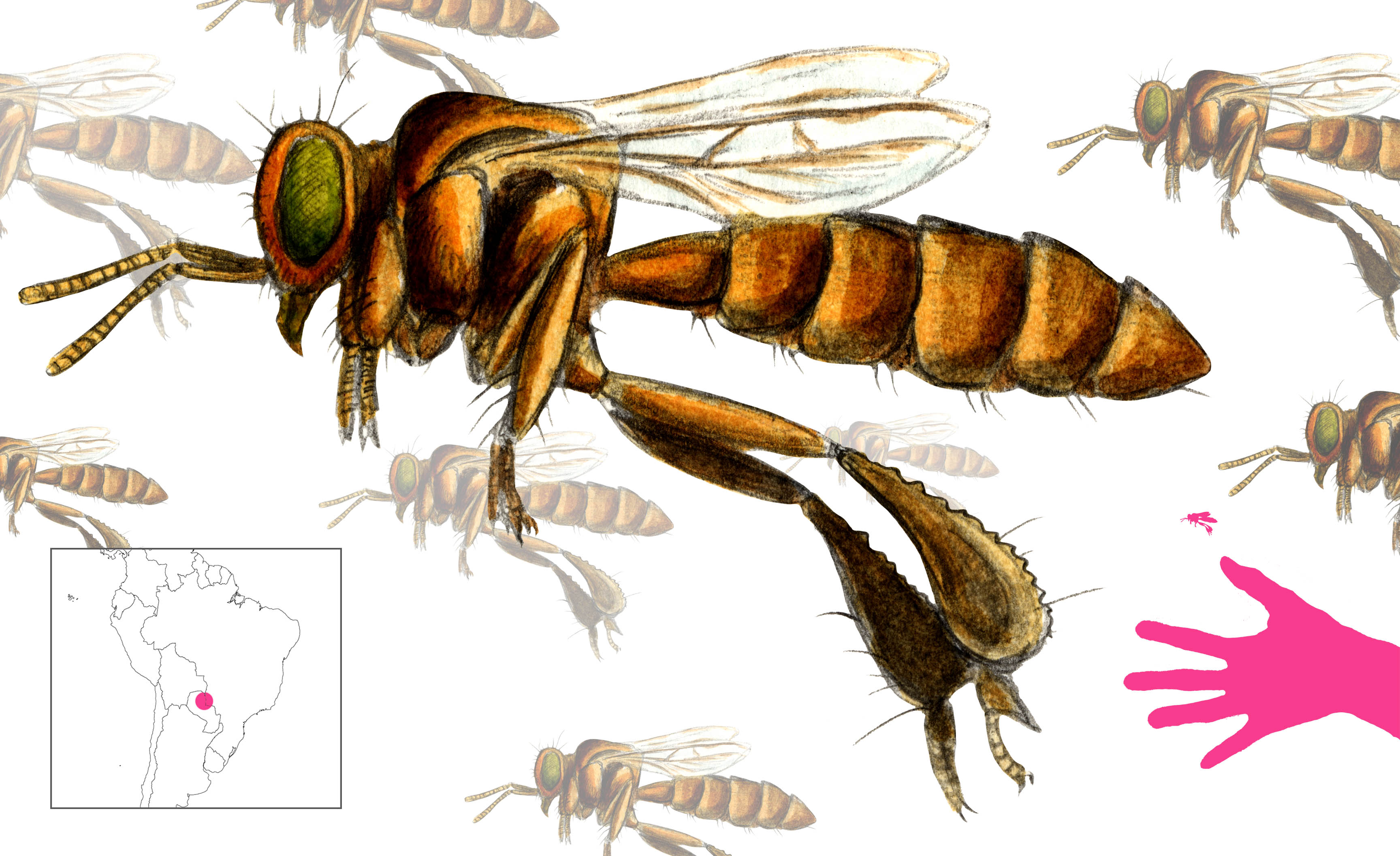
The Eintykára stingless bees, as told by the Chamacoco of Paraguay, are those that produce the golden honey. This honey can induce mild hallucinogenic effects, due to the presence of an ergot fungus on the plants the bees visit. But even more remarkable is their ability to swarm together and shapeshift into a man.

Eintykára hives have long, tubular wax entrances through which the bees enter and leave. An older single woman used to pass by such a hive every day, and its suggestive appearance made her mind wander. “Oh, what a beautiful eintykára hive!” she would say. “If only it were a handsome man who would make love to me…”

She continued to fantasize about the phallic hive, day in and day out. Eventually she started referring to it as her husband. “Ah, there is my husband again. He’s still there. If only he were a man, I would marry him on the spot”.

Finally, one night she was visited by a stranger. He was unlike any man she had seen – his skin was milky white, and his hair was as golden as honey. “Who are you?” she asked, stunned by his beauty. “I am Eintykára, the hive you desired and talked to for so long. I wish to take you as my wife, and support you and your people”.

And so it came to pass that the woman married Eintykára, and they had children together. He was unnaturally intelligent, and a diligent, tireless worker admired by the entire village. He never seemed to eat; instead, he would go into the forest, transform into a swarm of bees, and then reintegrate after collecting enough nectar. His “waste” was beeswax and eintykára honey, which he would distribute to all. That is why some of the Chamacoco are fair-skinned, for they are among his descendants.

Another eintykára was also known to have joined a Chamacoco village, but he and his adopted people were tragically killed in a raid by a neighboring tribe. They set fire to the houses, and though he tried to turn into an eintykára swarm and fly away, enough of his bees were incinerated to kill him.

References

Cañedo, J. A.; Belaieff, J.; Cordeu, E. J.; Frič, A. V.; Métraux, A.; and Pittini, R.; Wilbert, J. and Simoneau, K. eds. (1992) Folk Literature of the Chamacoco Indians. UCLA Latin American Center Publications, University of California, Los Angeles.
Yara-ma-yha-who

Yara ma ya who

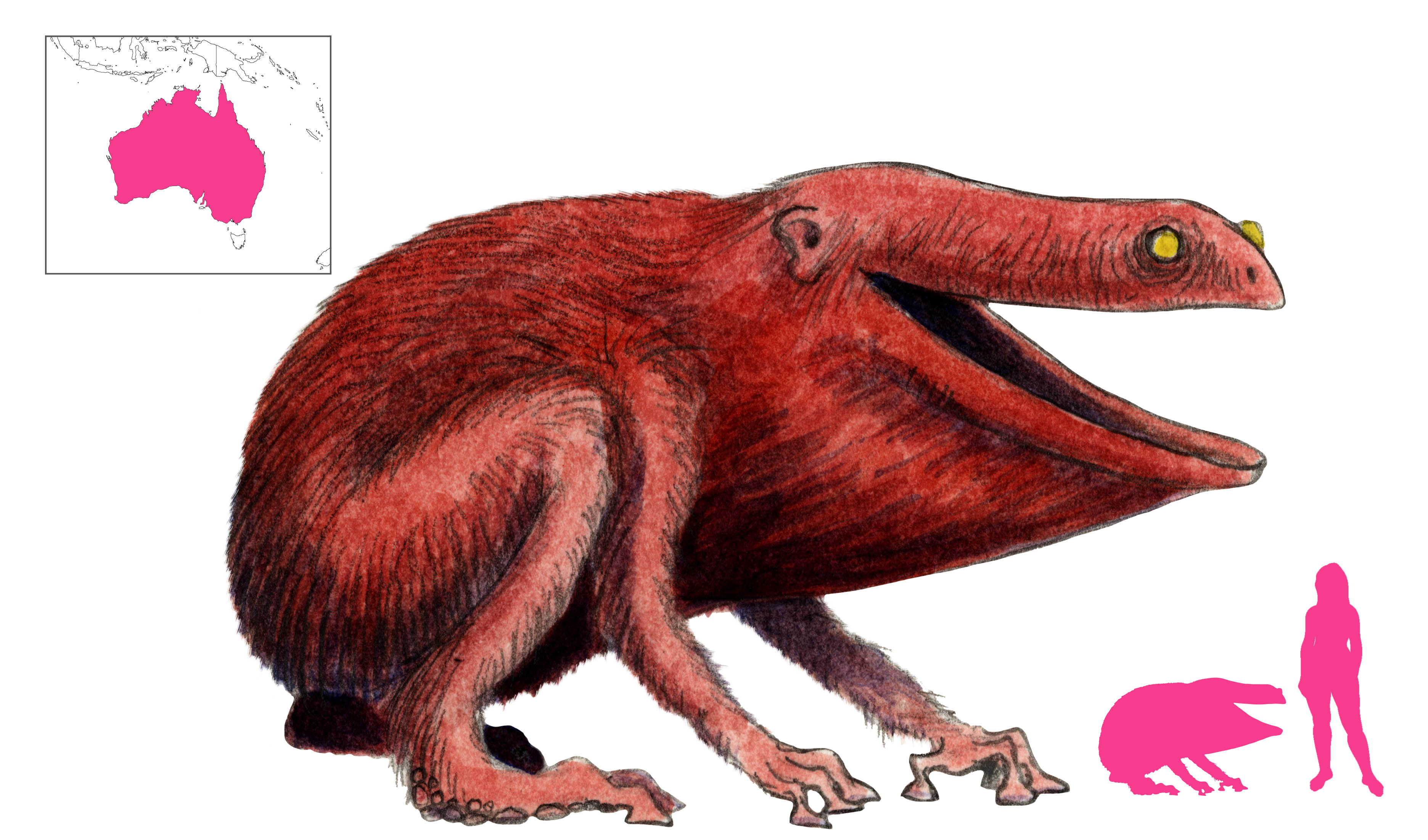
The Yara-ma-yha-who of Australia are restricted to the forests of the Pacific coast, and their absence elsewhere should be considered a blessing. They are primarily nursery bogies, dissuading children from frequenting dangerous areas.

A yara-ma-yha-who is a grotesque sight, and would be amusing were it not for its ghastly habits. Not more than four feet tall, red, and covered with fur, a yara-ma-yha-who has a disproportionately large head. It can open its toothless mouth like a snake, and its throat and belly are similarly distensible. An adult man can be easily swallowed by a yara-ma-yha-who without discomfort. Its fingers and toes are equipped with suction cups. Yara-ma-yha-who are good climbers, but can only waddle like cockatoos on land.

Thick-leaved fig trees are the yara-ma-yha-who’s favorite haunt. They can wait for days in the branches until some hapless traveler, perhaps seeking shelter from sun or rain, lies under the tree. Lone children are their favorite prey.

When a yara-ma-yha-who attacks, it attaches its hands and feet on its victim’s body, using the suction cups to drain the blood out of them. It does not empty them entirely, but only enough to make them faint. It then leaves its victim for a while, eventually returning to swallow them whole, head first. A little dance lets the food slide down, the meal is washed down with water, and the yara-ma-yha-who takes a nap.

After waking up, the yara-ma-yha-who vomits its prey out. The human is almost always alive and playing dead; there is no reason to fight back as the creature can overpower the strongest man. The yara-ma-yha-who takes five paces, then returns and pokes his victim’s sides with a stick. Then it walks away ten paces before returning to tickle the human under the arm or neck. A fifty-yard stroll is followed up by more tickling, then the yara-ma-yha-who goes behind a bush and sleeps.

This ritual is always repeated. The yara-ma-yha-who know that if they fail to carry out these actions, the spirit of the fig tree will mumble in their ears, causing them to transform into glowing tree mushrooms.

For this reason it is safest to play dead until this point, when you get to your feet and run. “Where have you gone, my victim?” calls the yara-ma-yha-who if it hears you escaping, but its awkward gait makes it easy to outrun. After failing to recapture prey, a spiteful yara-ma-yha-who will drink up all the water in nearby wells and water-holes, leading people to seek liquid from tree sap – and thus end up exposed to yara-ma-yha-who attack.

It is important not to let a yara-ma-yha-who swallow you multiple times. The second time you are swallowed and regurgitated, you become shorter and completely hairless. By the third time you are shorter still, and thick hair grows over your body. Eventully, after enough cycles of swallowing and vomiting, you become a yara-ma-yha-who yourself.

Heuvelmans believed the yara-ma-yha-who was inspired by tarsiers. Furry, big-eyed, and with suction-cup fingers, it is more a mammalian frog than anything else.

References

Heuvelmans, B. (1958) On the Track of Unknown Animals. Rupert Hart-Davis, London.

Smith, W. R. (2003) Myths and Legends of the Australian Aborigines. Dover Publications, Mineola.

Guariba-boia

Variations: Howler monkey snake

Guariba boia

Guariba-boia, the “howler monkey snake”, can be found in a wide stretch of the Amazon river, from Fonte Boa in the west to Urucurituba in the east, and in the lakes of the Rio Negro. It excavates tunnels in murky river bottoms, and hides in mud or thickets of water-plants. Usually its voice is the only sign of its existence.

As the name implies, a guariba-boia typically has the head of a howler monkey (guariba) on the body of a snake (boia). Sometimes it has the body of a howler monkey and the paws of an otter, and rarely it has the head of a sloth (although such a feature would seem hardly intimidating). Guariba-boias grow to about six meters long.

Guariba-boias announce their presence with loud, resonant howls that sound like an entire troop of howler monkeys. They roar from below water, and their calls are particularly loud on rainy nights.

While not as big as boiunas, guariba-boias are armed with needle-sharp fangs and lethal venom. Death by guariba-boia bite is swift and painful, after which the creature swallows its victim whole. A guariba-boia does not regularly seek out human prey, but will overturn canoes and kill the occupants if hungry enough.

References

Smith, N. J. H. (1996) The Enchanted Amazon Rain Forest. University Press of Florida, Gainesville.

Mbielu-mbielu-mbielu

Mbielu3

The Mbielu-mbielu-mbielu, or “animal with planks growing out of its back”, is a little-known creature restricted to the Likouala-aux-Herbes in the Congo.

It has only ever been seen in the water with only its back protruding, exposing large “planks” with algal growth between them. What it looks like underwater remains unknown. The mbielu-mbielu-mbielu does not show any aggressive behavior and is presumably herbivorous.

Mbielu3 sketch

The suggestion that it is a late-surviving stegosaur is dubious at best, considering that stegosaurs went extinct long before the end of the Cretaceous (with the possible exception of the disputable Dravidosaurus).

References

Mackal, R. (1987) A living dinosaur? E. J. Brill, New York.

Weishampel, D. B.; Dodson, P.; and Osmolska, H. (2004) The Dinosauria, 2nd Edition. University of California Press, Berkeley.

Kayeri

Variations: Kayéri, Cayeri

Kayeri

When it rains, the Kayeri are sure to appear. These creatures from the folklore of the Cuiva of Colombia and Venezuela are seasonal beings, seen in the rainy season and especially after a recent rainfall. In drier seasons they remain underground or underneath the roots of a tree, and use the holes made by ants to reach the surface. The presence of anthills in the rainy season is a sure sign of kayeri presence.

The appearance of a kayeri is nebulous at best. He is clearly humanoid in shape, and acts as such; he also has a yellow or blue-green hat. All the mushrooms of the forest are kayeri. The agouti, the broad-leaved unkuaju plant, and the Ficus vine are also kayeri, and dragonflies can become Kayeri. The coyoweri fruit is their invention. The only word in their vocabulary is “mu” or “mü“.

Kayeri are strong and run fast. They feed exclusively on cows, and they can easily pick up a cow and run away with it. When they eat a cow, they devour flesh, entrails, horn, hoof, and bone in one sitting, leaving nothing behind. The virile kayeri are bigamous by nature, and have two wives each, but they are fond of human females as well, whom they entrance and bewitch into coming to them. In addition to decimating herds of cattle, they rob, murder, kidnap, rape, and cause all sorts of evil.

The best way to kill a kayeri is to shoot it in the kidneys with a bone-tipped arrow, as they are quite invulnerable elsewhere. Once dead, the kayeri turns into a harmless stone.

One story is told of a hunter whose two daughters were abducted by a kayeri. The father managed to catch up with him and shoot him with a bone-tipped arrow before he could harm the daughters, and the kayeri fell into the river and became a pebble. As the family made for safety they could hear the ominous “mu, mu, mu” of kayeri beating trees with sticks, as they do when they are upset. “He fell out of his hammock and broke his back!” yelled the father, and they reached home without further trouble.

References

Arcand, B.; Coppens, W.; Kerr, I.; and Gómez, F. O.; Wilbert, J. and Simoneau, K. eds. (1991) Folk Literature of the Cuiva Indians. UCLA Latin American Center Publications, University of California, Los Angeles.

Puaka

Variations: Puwaka, Puaki

Puaka

The Puaka (“Pig”) is a Dusun demon that guards water in eddies, and resembles a pig with a razor-sharp tongue. Puakas like to feed from trees, and stand on each other’s backs until they reach the branches.

When you meet a Puaka, it will attack if you move, and come to a halt if you stop. If it catches up with you, it will lick your bones clean. To lose the Puaka it is recommended to cross a stream; the creature may follow you across the stream, but once on dry land it will pause to lick itself dry, licking the flesh off its bones in the process.

“Puaka” and similar terms have meant pig in a number of languages – puaka in Rarotongan, Mangarevan, Rotuma, and Malay, vuaka in Fiji, puwaka in Malay, pua’a in Samoan, puaa in Tahitian, Marquesan, and Hawaiian, buaka in Tongan, and poaka in Maori. While this has been alternately compared to the Sanskrit sukara, the Latin porcus, and the English porker, the word seems to have had its own unique Polynesian origin. In some areas puaka has come to denote the pig-like demon; sometimes it loses its meaning as “pig” altogether, possibly due to the influence of Islam.

References

Mackenzie, D. A. (1930) Myths from Melanesia and Indonesia. Gresham Publishing Company, Ltd., London.

Munuanë

Variations: Munuane, Munuani

Munuane

Munuanë is either a single entity or an entire species of ogres native to the Guahibo people of Colombia and Venezuela. Many stories end with him being outsmarted and killed, which would be slightly inconvenient if he was one person.

Munuanë plies the waterways of the jungle on a makeshift raft. He is tall and powerful, with long grey hair, but his mouth is as toothless as a turtle’s. He loves eating human flesh, but his lack of teeth forces him to prepare his meals before eating them. Munuanë lacks eyes in his head, instead having them in his knees. Those eyes are his weak spot, as he is invulnerable everywhere but his knees. His wife is called Matasoropapénayo, or “Little-bone-of-the-crown”, and they live together in a hut in the deepest part of the jungle.

He is the “grandfather of fish”, and claims ownership over all the fish in the river. Fishermen are advised to bring in their catch as quickly as possible and not fish more than they need, as Munuanë hates greed, and mesmerizes overfishers into walking off ravines. Other times he shoots offenders with his arrow – Munuanë always carries around only one arrow, as he never misses his target. He is also an insatiable sexual predator, and his victims turn into termites.

It is said that a man once met Munuanë while out fishing, and did not manage to escape in time. Fortunately, Munuanë is not particularly bright, and accidentally shot the man’s reflection in the water instead of the man himself. By the time Munuanë had retrieved the arrow, his quarry had managed to swim away. Munuanë chased after the man and followed him to his village, where he ran rampant. But the man realized what Munuanë’s weakness was, shot him in the eye, and killed him instantly.

Such are the tales of Munuanë. Sometimes he is outsmarted by a powerful shaman. At other times a friendly spirit – Banajuli or Banaxuruni – is there to reveal his weak spot. Sometimes he is transformed into a rotten tree stump when he dies, with the arrow that killed him still embedded in the trunk. The entire forest cries out upon his death; he may be an ogre, but he also cares for the jungle and the fish of the river.

References

Kondo, R. L. W.; Kondo, V. F.; Maltoni, R.; Gómez, F. O.; Queixalós, F.; and Vargas, E.; Wilbert, J. and Simoneau, K. eds. (1992) Folk Literature of the Sikuani Indians. UCLA Latin American Center Publications, University of California, Los Angeles.

Boongurunguru

Variations: Bonguru

Boongurunguru

According to the mythology of the Solomon Islands, there was once a time when the waters flooded the Earth. This great flood, the Ruarua, engulfed all of the islands, even the 4,000 feet high San Cristoval hills; those drowned in it turned into stone pillars, which can still be seen at Mwata. It was Umaroa, leader of the Muara clan, who saved his people by taking them, a sacred stone, and pairs of all the animals on board a great canoe. When the waters receded, Umaroa made landfall at Waimarai in the Arosi district, and offered a sacrifice in thanks. From there an adaro descended from a rainbow and guided them to their new home.

Umaroa is now buried there, and his sacred stone was laid on top of him. The area is now rich with magic, and visitors have to observe certain rules to avoid bad luck. Any trees cut down and left there will cause the lumberjacks to wander in circles, always returning to the cut tree. If there is a rainbow above the river, it cannot be crossed without making an offering to the adaro first. Names have particular strength there; ropes cannot be called ari but instead must be referred to as kunikuni (“to let down”), otherwise snakes will be summoned immediately.

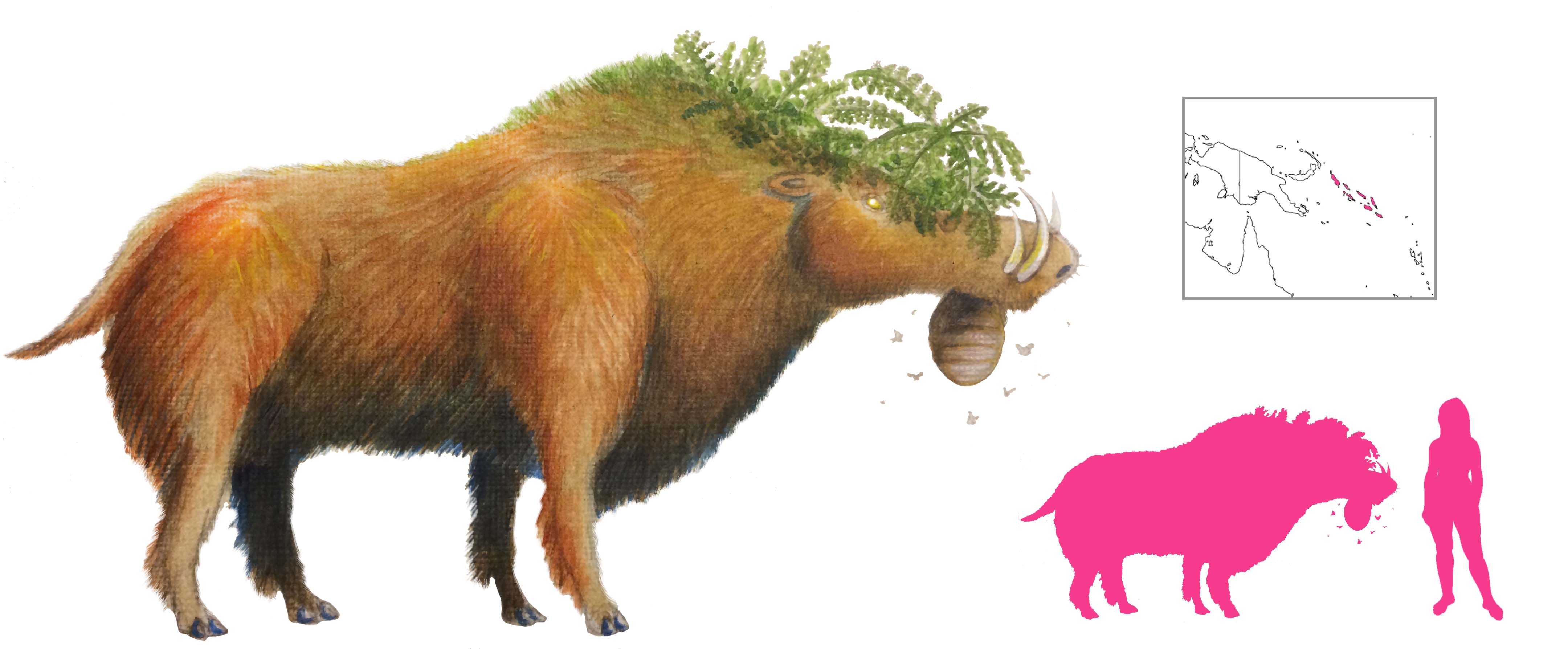
Of the spirits there, the most terrifying is Boongurunguru, the “pig-who-grunts”, the demon pig of Umaroa. He takes the form of a huge boar with ‘ama’ama ferns growing on his flattened head, and a buzzing nest of hornets located under his chin. He leads a herd of boars, all of them Boongurunguru, through the forest, goring and trampling anyone in their path. The appearance of a Boongurunguru foretells death; if the entire herd enters a village, everyone there will die. The boars get smaller and smaller as they approach a village, finally sneaking in at the size of mice, but they are no less deadly at that size.

If one hears Boongurunguru grunting and mentions that there must be pigs nearby, they are immediately surrounded by hundreds of venomous snakes – in front, behind, on either side, and falling out of the air.

This is because Boongurunguru has standards, and objects to being called a pig.

References

Fox, C. E. (1924) The Threshold of the Pacific. Kegan Paul, Trench, Trubner and Co., Ltd., London; Alfred A. Knopf, New York

Mackenzie, D. A. (1930) Myths from Melanesia and Indonesia. Gresham Publishing Company, Ltd., London

Ragache, C. C. and Laverdet, M. (1991) Les animaux fantastiques. Hachette.