Tapirê-iauara

Variations: Tapir Nymph, Onça d’Água (Water Jaguar), Onça Pé de Boi (Cow-legged Jaguar), Paraná Pura Iuraretê (Turtle/Jaguar that Dwells in River Side Channels), Tai-açu-iara (potentially)

Tapire-iauara

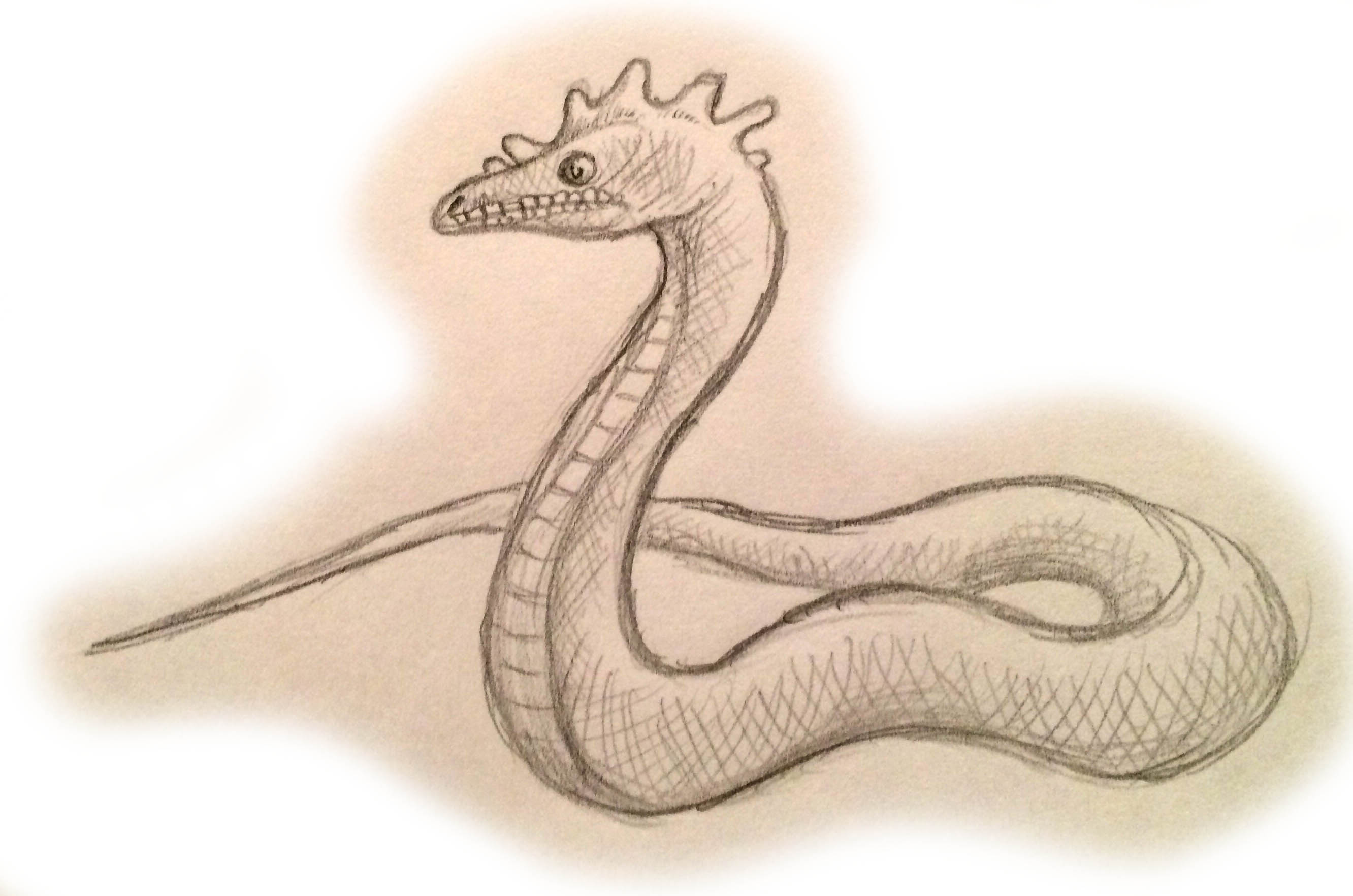
The Tapirê-iauara, or Tapir Nymph, enjoys a wide distribution in the Amazon, from the Orinoco in Venezuela to the Rio Negro, the Madeira, the Tapajós, and the Amazon down to Pará. Sightings have been reported from around Codajás, Fonte Boa, Itacoatiara, Nova Olinda, Oriximiná, Santarém, and Urucurituba. It lives in slower-moving waters, near groves of aninga or palm trees, and avoids human settlements.

The name tapirê-iauara is etymologically complex. Tapiré is Tupi for “tapir”, while y is “water” and ara is “lady” in língua geral; it also draws from the Tupi uara (“dweller”) or yguara (“dweller in water”). Hence, “tapir water-lady” or “tapir nymph” is a rough translation. This same derivation gives us the Amazonian nymphs Yara and Oyoára, the sea monster Hipupiara, and Paraná Pura Iuraretê, which was apparently a giant turtle creature that later was subsumed into the tapirê-iauara (iuraretê meaning either “turtle” or “jaguar”).

Reports of the tapirê-iauara appearance have varied somewhat. Most accounts agree that it resembles a cow-sized jaguar with a reddish waterproof coat, a thick mane, long droopy ears half a meter in length, and an overpowering stench (catinga). It may have jaguar legs, or the forelegs of a jaguar and hooved, donkey-like hindlegs. It may have horse legs with or without catlike paws, duck feet, or large otter paws. Variations in fur color include red, gold, and black with a cream patch in the chest. It notably does not look much like a tapir.

A tapirê-iauara is heard and smelled before it is seen. The large, finlike ears flap noisily against the water as it swims, while its putrid odor precedes it. From a safe distance, it’s merely nauseating; at close quarters the stench of a tapirê-iauara is enough to cause fainting and outright death. Tapirê-iauaras can also mesmerize prey into standing still before pouncing on them.

Tapirê-iauaras have a broad diet that includes large fish, capybaras, caimans, and humans. They are attracted to hauls of fish and the halitosis resulting from eating poorly-cooked fish. They often show up to inspect fishermens’ catches – or the fishermen themselves. When they do, they are fast, persistent, and resilient, relying on their odor to weaken prey before killing it with their sharp teeth and claws. One fisherman had to empty 12 slugs from a .22 rifle into a pursuing tapirê-iauara before the beast expired. Other fishermen have not been so lucky, having their catches stolen at best or being dragged into the river and devoured at worst.

Sometimes the stink of a tapirê-iauara is enough to cause a human’s shadow (and therefore soul) to depart. A person who has lost their shadow in this way is said to be assombrado. They can recover their soul by inhaling the fumes of a fire made with leaves, sticks, and the bones of undercooked piranhas.

Caraña resin (Protium heptaphyllum) is repulsive to tapirê-iauaras, and anyone concerned about tapirê-iauara attack should equip themselves with some before heading into the Amazon. Tapirê-iauaras also cannot climb, and so shelter should be sought in trees. As the tapirê-iauara’s odor will cause fainting and potentially falling out of the tree, secure branches must be found.

The Tai-açu-iara from around Parintins is similar and may be the same animal. It appears as a black piglike creature with jaguar paws.

References

Smith, N. J. H. (1981) Man, Fishes, and the Amazon. Columbia University Press, New York.

Smith, N. J. H. (1996) The Enchanted Amazon Rain Forest. University Press of Florida, Gainesville.

A-mi’-kuk

Variations: Ă-mi’-kuk, Ä-mi’-kuk

A-mi-kuk

Kayakers in the cold seas of the Arctic Circle are the A-mi’-kuk’s favorite prey. The last thing they see are the a-mi’-kuk’s prehensile tentacles exploding from under the surface and wrapping around them, dragging both kayaker and boat under.

The a-mi’-kuk is large, leathery-skinned, and slimy. Its four long tentacular arms are used for seizing prey and swimming rapidly through the water. There is no escaping it – it will follow prey taking refuge on ice by swimming below it and bursting out onto the surface. Making for land is equally futile, as the a-mi’-kuk can swim through the earth with as much ease as it does through water.

A-mi’-kuks around St. Michael, Alaska, are known to migrate underground to inland lakes. The presence of one is a good sign for the lake. When an a-mi’-kuk leaves its lake, the channel it digs drains it dry, but when it returns the sea returns with it.

Nelson proposed the octopus as the origin of the a-mi’-kuk. He also gives ä-mi’-kuk as the name of the sea otter; what bearing this has on the legendary creature is unknown.

References

Nelson, E. W. (1887) Report upon Natural History Collections Made in Alaska Between the Years 1877 and 1881. Arctic Series of Publications Issued in Connection with the Signal Service, Government Printing Office, Washington.

Nelson, E. W. (1900) The Eskimo about Bering Strait. Extract from the Eighteenth Annual Report of the Bureau of American Ethnology, Government Printing Office, Washington.

Basilisk

Variations: Cockatrice, Basilisco, Basiliscos, Basiliscus, Basili-coc, Basilicok, Regulus (Small Prince), Codrille, Cocodrille, Cocadrille, Coquatrix, Harmena, Sibilus (Hisser), King of Serpents, Crested Crowing Cobra (potentially)

Basilisk

The Basilisk, the “little king” or “king of snakes”, is best known as a creature whose looks kill. Its primary claim to fame is a gaze that instantly kills anyone who sees it, or even anyone it looks at. The basilisk has appeared under a number of guises throughout the centuries, but there are at least a few constants. It is always deceptively small. It is a snake, or at least part snake, with or without rooster characteristics. It always has a crown – whether a white mark, a ring of hornlets, a rooster’s comb, or even a literal crown on its head. And finally, it is always extraordinarily virulent.
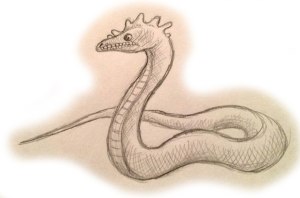
bas 1The basilisk is first and foremost a snake, born from the blood of Medusa as were all venomous snakes. It is found in the North African deserts – its very presence causes the desert, and it becomes frantic in the presence of water. At half a foot long, it is far from the biggest snake, but it is the king of snakes, traveling proudly with its head off the ground. It has a white spot or a crown on its head, and white markings down its back.

The exact nature of the basilisk’s deadliness is uncertain, as it is known to kill via venom, odor, and gaze. Murrus, one of Lucan’s soldiers, transfixed a basilisk with his spear, only to see the venom travel up his weapon and start corroding his hand. He survived by amputating his arm before the venom could reach his body. A basilisk can spit its venom skyward, frizzling up birds in flight. Its very gaze is deadly, as it can kill a man merely by looking at him with its gleaming red eyes. The regal nature of the basilisk and its propensity for projecting its venom suggest that cobras or spitting cobras were the origin of the legend.

Basilisks feared only three things: weasels, the crowing of roosters, and their own lethal gaze. The weasel was the only animal immune to the basilisk’s gaze and venom, making it the only natural predator of the king of snakes. Weasels were often sent into caves believed to harbor basilisks. This interaction also recalls that of the cobra and the mongoose. Basilisks also convulsed and died instantly upon hearing the crowing of a rooster. Travelers in the Libyan desert would be well advised to bring a rooster along with them. Topsell denied the possibility of basilisks perishing upon seeing each other, as “it is unpossible that any thing should hurt itself”; nonetheless, a basilisk in Vienna was killed by showing it a mirror.

With the passing of time the nature of the basilisk grew more and more confused. Various Biblical serpents were translated as basilisks. The basilisk gained more avian characteristics, including an origin in rooster eggs, and was confused with Cocodrillus (the crocodile); both of them were dangerous reptiles with small adversaries (the weasel for the basilisk, the hydrus for the crocodile). Further garbling of “cocodrillus” resulted in “cockatrice”. Wycliffe’s Bible had “cockatrice” as a translation of “basilisk”. Chaucer referred to the “basilicok”. With the accumulation of translation, grammar, and etymological errors, the basilisk (or cockatrice) became a hybrid of snake and rooster, with clawed wings, a rooster’s head, and a long serpentine tail (sometimes with an additional head at the end). This is the familiar cockatrice (or basilisk) of bestiaries, and an incarnation of the Devil himself. It further evolved into the alchemical cockatrice, holding its tail in its mouth, symbolizing the alchemical cycle and its mixed nature. The same nomenclatural confusion also gave rise to the Codrille, a basilisk from central France.

Despite efforts to separate the basilisk and the cockatrice – for example, making the basilisk a snake or lizard and the cockatrice a snake-rooster hybrid, or making them both snake-rooster hybrids, one with a snake head and the other with a rooster head – the fact remains that the names basilisk and cockatrice are interchangeable, and refer to the same animal. It is best to accept T. H. White’s statement that the cockatrice is “a medieval muddle” and leave it at that.
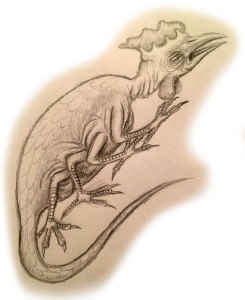
bas 2Cardano reported a basilisk found in the ruins of a demolished building in Milan. This particular specimen was wingless and featherless, with an egg-sized head that looked too large for its body. It had viper fangs, a bulky lizard-like body similar to that of the stellion, and only two stubby legs with catlike claws. The tail was as long as the body, with a swelling at its tip the size of the head. When standing up, it looked like a leathery, naked rooster.

Aldrovandi was apparently inspired by this animal for one of his images of the basilisk, helpfully giving it six more legs. Based on the description and appearance, it appears to have been inspired somewhat by scorpions. Ironically, while this eight-legged depiction has proven particularly enduring, Aldrovandi himself was apparently doubtful of its authenticity, placing this presumed African creature just before a couple rays preserved in the shape of basilisks. The true, snake-like basilisk is given a full-page spread. Aldrovandi also produces a couple of purported basilisk eggs.

Flaubert, taking considerable creative liberties, describes the basilisk as a huge violet snake with a three-lobed crest and two teeth, one on each jaw. It speaks to Saint Anthony, warning him that “I drink fire. I am fire – and I breathe it in from mists, pebbles, dead trees, animal fur, the surface of swamps. My temperature sustains volcanos; I bring out the gleam of gems and the color of metals.”

Finally, Hichens’ “crowing crested cobra” of sub-Saharan Africa appears to be some kind of basilisk. It resembles a cobra, but with a crest on its head and the call of a rooster.
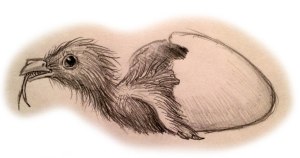
bas 3The life cycle of the basilisk is involved and complicated. The Egyptians believed it to be born from the egg of the ibis, while Neckham blames chickens. Basilisks are born from round shell-less eggs laid by old roosters in the summer (on a dungheap, in some accounts). Those eggs have to be incubated by a snake, a toad, or the rooster itself, eventually producing little terrors ready to kill at birth. As roosters may develop concretions that resemble eggs, and hens may look like roosters, any such fowl that seemed to be a male chicken laying an egg was immediately put to death. In 1474, one such heretical chicken was burned at the stake in Basle, in front of a large crowd.

The only plant immune to the withering gaze of the basilisk is rue, which is consumed by weasels to protect themselves from their enemies. Remedies for basilisk envenomation will always contain rue. A dead basilisk will ward away spiders, and one such basilisk carcass in Diana’s temple kept swallows at bay.

Borges quotes Quevedo as giving the paradox of the basilisk: its existence cannot be proven, as anyone who sees it and survives is a liar, and anyone who sees it and dies will not tell the tale.

The basilisk of biology, or Jesus Christ Lizard (Basiliscus) is a completely harmless South American lizard, known for walking on water. The lethal powers of the basilisk were also transposed by European settlers onto rattlesnakes, and the Mexican West Coast rattlesnake still bears the name of Crotalus basiliscus.

References

Aelian, trans. Scholfield, A. F. (1959) On the Characteristics of Animals, vol. I. Harvard University Press, Cambridge, Massachusetts.

Aldrovandi, U. (1640) Serpentum, et Draconum Historiae. Antonij Bernie, Bologna.

Barber, R. (1993) Bestiary. The Boydell Press, Woodbridge.

Borges, J. L.; trans. Hurley, A. (2005) The Book of Imaginary Beings. Viking.

Breiner, L. A. (1979) The Career of the Cockatrice. Isis, vol. 70, no. 1, pp. 30-47.

Breiner, L. A. (1979) Herbert’s Cockatrice. Modern Philology, vol. 77, no. 1, pp. 10-17.

Brown, T. (1658) Pseudodoxia Epidemica. Edward Dod, London.

Bulfinch, T. (1997) The Age of Fable. Macmillan, New York.

Cardano, G.; le Blanc, R. trans. (1556) Les Livres de Hierome Cardanus Médecin Milannois. Guillaume le Noir, Paris.

Evans, E. P. (1987) The Criminal Prosecution and Capital Punishment of Animals. Faber and Faber, London.

Flaubert, G. (1885) La Tentation de Saint Antoine. Quantin, Paris.

Hargreaves, J. (1983) The Dragon Hunter’s Handbook. Armada.

Hichens, W. (1937) African Mystery Beasts. Discovery (Dec): 369-373.

Isidore of Seville, trans. Barney, S. A.; Lewis, W. J.; Beach, J. A.; and Berghof, O. (2006) The Etymologies of Isidore of Seville. Cambridge University Press, Cambridge.

Lemnius, L. (1658) The Secret Miracles of Nature. Jo. Streater, London.

Liss, A. R. (1987) A Basilisk by Any Other Name… Teratology 35, pp. 277-279.

Lucan, trans. Rowe, N. (1720) Pharsalia. T. Johnson, London.

Pliny; Holland, P. trans. (1847) Pliny’s Natural History. George Barclay, Castle Street, Leicester Square.

de la Salle, L. (1875) Croyances et légendes du centre de la France, Tome Premier. Chaix et Cie., Paris.

Sax, B. (1994) The Basilisk and Rattlesnake, or a European Monster Comes to America. Society and Animals, vol. 2, no. 1.

Topsell, E. (1658) The History of Serpents. E. Cotes, London.

White, T. H. (1984) The Book of Beasts. Dover Publications, New York.

Múshveli

Variations: Mushveli, Mousewhale; Hafmús, Hafmus (“Sea-mouse”)

Mushveli

The chimaera, ratfish, or rabbitfish (Chimaera monstrosa) is a small and completely harmless deep-sea fish. Evidently its legendary counterpart the Múshveli, or “mousewhale”, is enormous and highly dangerous. As one of the illhveli (“evil whales”) of Iceland, it is inedible and delights in causing death and destruction.

Múshvelis are mostly mouth, ear, and tail. The gaping, deeply split mouth is large enough to swallow a rowboat in a single gulp, and the large, prominent ears stick out like sails while the animal swims. A long whiplike tail without a fin allows the múshveli to swim at terrifying speeds, so fast that the sea churns ahead of it. Instead of fins, there are two stumpy hoofed legs. These animals are over ten meters long, and light gray or brownish-black in color.

Múshvelis sink ships by ramming them or rearing up, placing their feet on the gunwales, and pushing down until the ship capsizes. If a múshveli is sighted, the best course of action is usually to make for shore as fast as possible, and once there make for higher ground. Unlike most other evil whales, múshvelis can clamber onto the beach with their stubby legs, but they are out of their element and give up quickly. One múshveli ran a boat aground and followed the sailors as far as it could. It easily shrugged off three bullets, and eventually returned to the sea with the next high tide.

Large boats are usually impregnable to múshvelis. In one account, two Icelandic fishermen on a small boat were alerted to the presence of a múshveli by the roar of the foaming sea. It was making right for their boat, and terror made them freeze up. Fortunately, the crew of a French fishing schooner saw their plight, and steered their boat into the múshveli’s path. The sea-mouse rammed the ship so hard that it listed to one side, but remained afloat. The múshveli continued to take its rage out on the French schooner while the fishermen were taken aboard to safety, and eventually the monstrous whale gave up and disappeared.

References

Davidsson, O. (1900) The Folk-lore of Icelandic Fishes. The Scottish Review, October, pp. 312-332.

Hlidberg, J. B. and Aegisson, S.; McQueen, F. J. M. and Kjartansson, R., trans. (2011) Meeting with Monsters. JPV utgafa, Reykjavik.

Aksar

Aksar

Among the cavalcade of creatures Anthony faces in the Temptation is Aksar, described as “the python Aksar, sixty cubits long, who terrified Moses”. Thompson, drawing heavily from Flaubert, uses the basilisk of the Temptation for the appearance of Aksar, describing him as seventy cubits long, violet-colored, with a three-lobed crest and a single tooth in each jaw. He repeats Moses’ fear of Aksar, making him “the avatar of God’s red justice flaming far” and “the visible embodiment of all that is horrible, the incarnation of a desolation not merely physical, but of the soul.”

Flaubert derived Aksar from Bochart’s Hierozoicon. The original Aksar is far stranger than Flaubert leads us to believe.

Aksar is a monster of the apocalypse from Arabian legend. He is sixty cubits (almost 30 meters) long, and has the head of an ox, the eyes of a pig, the ears of an elephant, the antlers of a stag, the neck of an ostrich, the forequarters of a lion, the hindquarters of a cat, the tail of a ram, the legs of a camel, and the color of a leopard. There is no mention of any python characteristics.

God dragged Aksar out from his lair and brought him before Moses, who was greatly alarmed and requested the beast be removed from his sight. At the end of days, it is said Aksar will fly out with Moses’ staff, using it to mark people’s faces as “believers” or “unbelievers”.

There are some who say there is more than one of these creatures. Those people are hopefully mistaken.

References

Bochart, S. (1675) Hierozoicon. Johannis Davidis Zunneri, Frankfurt.

Flaubert, G. (1885) La Tentation de Saint Antoine. Quantin, Paris.

Seznec, J. (1943) Saint Antoine et les Monstres: Essai sur les Sources et la Signification du Fantastique de Flaubert. PMLA, Vol. 58, No. 1, pp. 195-222.

Thompson, J. W. (1921) The Lost Oracles: a Masque. W. M. Mill, Chicago.

Guariba-boia

Variations: Howler monkey snake

Guariba boia

Guariba-boia, the “howler monkey snake”, can be found in a wide stretch of the Amazon river, from Fonte Boa in the west to Urucurituba in the east, and in the lakes of the Rio Negro. It excavates tunnels in murky river bottoms, and hides in mud or thickets of water-plants. Usually its voice is the only sign of its existence.

As the name implies, a guariba-boia typically has the head of a howler monkey (guariba) on the body of a snake (boia). Sometimes it has the body of a howler monkey and the paws of an otter, and rarely it has the head of a sloth (although such a feature would seem hardly intimidating). Guariba-boias grow to about six meters long.

Guariba-boias announce their presence with loud, resonant howls that sound like an entire troop of howler monkeys. They roar from below water, and their calls are particularly loud on rainy nights.

While not as big as boiunas, guariba-boias are armed with needle-sharp fangs and lethal venom. Death by guariba-boia bite is swift and painful, after which the creature swallows its victim whole. A guariba-boia does not regularly seek out human prey, but will overturn canoes and kill the occupants if hungry enough.

References

Smith, N. J. H. (1996) The Enchanted Amazon Rain Forest. University Press of Florida, Gainesville.

Chimera

Variations: Chimaera, Chimaira

Chimera

The Chimera or Chimaera (“goat”) was the daughter of Typhon and Echidna. She was the terror of Lycia in southern Turkey, killing people and livestock and torching crops.

Homer describes her as being a lion in front, a serpent behind, and a goat in the middle, with the power of breathing fire. Hesiod specifies that she had three heads. The lion’s head was in its customary place, the snake’s head was on the end of the tail, and the goat’s head emerged tumorously from the middle. Hyginus gives all three heads the ability to breathe fire, while Apollodorus states that only the goat head could do so, functioning as some kind of shoulder-mounted flamethrower.

While Homer’s description might suggest a lion’s head, a goat’s body, and a snake’s tail, the Chimera has been consistently represented in Greek art with multiple heads. Usually she is mostly lion with a snake tail; the goat has proven tricky to depict convincingly, ranging from a head to the entire front half of a goat. Some Etruscan renditions add wings. The iconography behind the Chimera may go back farther, and may be of Asian origin. The term has also been used to describe various unrelated hybrid animals, with or without multiple heads.

She was finally slain by Bellerophon, who had been sent to Lycia to die. The wife of King Proitos had fallen madly in love with him; after he rejected her advances, she told her husband that Bellerophon had tried to seduce her. Enraged, the king dispatched Bellerophon to Iobates of Lycia, bearing a message requesting him to kill the messenger. Iobates sent him to battle the Chimera – surely an impossible task.

But Bellerophon had the favor of the gods, and the aid of the winged horse Pegasus. Mounted on Pegasus’ back, he easily flew out of range of the Chimera’s fiery breath, and shot her to death with arrows. Some accounts add that he rammed a lump of lead into her throat, where it melted and suffocated her.

Chimera bwChimera was a study in contradictions. Her three components did not make any sense together. Her name meant “goat”, but the goat was the least coherent part of her, reduced to a mere head in an anatomically dubious position. Evidently something so contradictory as the Chimera needed a rational explanation, even to the ancient Greeks. Plutarch believed she was inspired by a pirate captain, whose ship was decorated with the three component animals. Servius Honoratus said she was a loose interpretation of the Lycian landscape. Mount Chimera was a volcano, with snakes at its base, goats wandering around its heights, and a pride of lions at the top. Bellerophon, arriving on his ship Pegasus, set fire to the mountain and eradicated the dangerous animals.

The Etruscans dedicated the Chimera to the supreme god Tinia. The Etruscan Arezzo bronze of the Chimera remains the most enduring image produced of her. As a hybrid she was both celestial and chthonic, representing the year and the seasons. The lion, hot and strong, was summer; the snake, cold and ground-dwelling, was winter; and the transitory goat was spring and summer.

In The Temptation of Saint Anthony, the Chimera is a great, green-eyed, dragon-winged creature with a luxuriant mane; she is as capricious as desire and imagination. She reveals breathtaking new perspectives to humans, pours insanity, ambitions, hopes, and dreams into their minds, drives people to dangerous quests, and kills anyone content in wisdom. She is woefully incompatible with the rational, stoic Sphinx, and their attempts at copulation fail.

“Chimera” has entered our vocabulary in a number of ways, always in reference to incongruity. A chimera or something chimeric is fanciful, improbable, and imaginary. A chimera can also mean an organism with distinct cells from different zygotes. Finally, Chimaera is a genus of deep-sea fish, named after its bizarre appearance.

References

Bazopoulou-Kyrkanidou, E. (2001) Chimeric Creatures in Greek Mythology and Reflections in Science. American Journal of Medical Genetics 100:66-80.

Borges, J. L.; trans. Hurley, A. (2005) The Book of Imaginary Beings. Viking.

Flaubert, G. (1885) La Tentation de Saint Antoine. Quantin, Paris.

Hesiod; trans. Elton, C. A. (1832) The Theogony. In Hesiod. A. J. Valpy, London.

Homer, trans. Buckley, T. A. (1851) The Iliad of Homer. Henry G. Bohn, London.

Locatelli, D. and Rossi, F. (2010) Les Étrusques: Pouvoir – religion – vie quotidienne. Série Civilisations, Hazan.

Roes, A. (1934) The Representation of the Chimaera. The Journal of Hellenic Studies, Vol. 54, Part 1, pp. 21-25.

Schmitt, M. L. (1966) Bellerophon and the Chimaera in Archaic Greek Art. American Journal of Archaeology, Vol. 70, No. 4, pp. 341-347.

Smith, R. S. and Trzaskoma, S. M. (2007) Apollodorus’ Library and Hyginus’ Fabulae. Hackett Publishing Company, Indianapolis.

Till, B. (1980) Some Observations on Stone Winged Chimeras at Ancient Chinese Tomb Sites. Artibus Asiae, Vol. 42, No. 4, pp. 261-281.