Devouring Gourd

Variations: Devouring Pumpkin; Sala Fruit (possibly)
Swallowing Gourd final

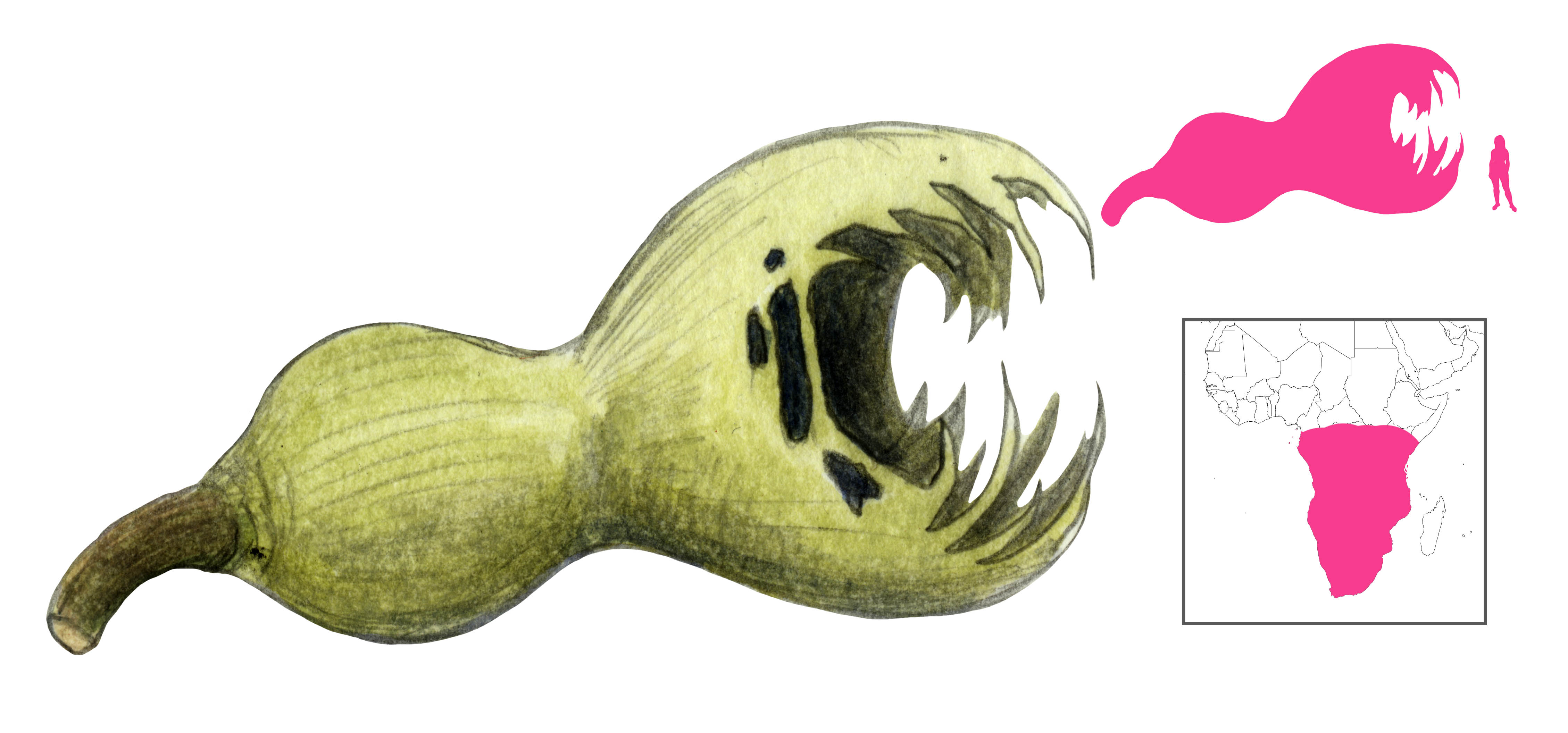
Not all swallowing monsters are animals. In Bantu folklore, gourds and pumpkins have the potential to grow into vast, devouring creatures. Such plants usually grow where evil sorcerers or ogres were slain.

The devouring gourd of Usambara was discovered by a group of little boys at play. “Look at how big that gourd is getting!” said one of the boys. To their surprise, the gourd responded. “If you pluck me, I’ll pluck you!” it said. The boys ran home and told their mother, who refused to believe them. But their sisters insisted on seeing the large gourd, and when they were taken to it, they said as their brothers had, “Look at how big that gourd is getting!” This time the gourd did not respond, and the girls went home to complain about their brothers being liars.

As the gourd was not plucked, it continued to grow. Eventually it became the size of a house, uprooted itself, and went about swallowing everyone in the village. After consuming everyone within reach, it rolled into a lake.

Only one woman had survived the gourd’s rampage, and she was pregnant. When her son was born, they lived together in the ruins of the village. When the son got around to asking where his father was, his mother told him “He was swallowed by a gourd, which is now in the lake”. The son decided to avenge his father, and went out to the lake where he could see the gourd’s ears sticking out of the water, and he proceeded to taunt the vegetable. “Gourd, come out!” he yelled. “Gourd, come out!” Annoyed and enraged, the gourd hauled itself out of the lake, but the boy was ready for it, and fired a volley of arrows into it. The tenth arrow killed it, and it died with a roar that could be heard all the way to Vuga. The boy cut it open with a knife, released the villagers unharmed, and went on to become a great leader of his people.

Gourds are not the only plants that devour and kill people. Another carnivorous plant, a pumpkin, grew over the burial location of an evil shapeshifting porcupine. It repeated everything that was said to it, and when an axe was brought to destroy it, it proceeded to swallow everyone. The poisonous Sala fruits of the Ronga have arms and legs, and wield spears ands shields.

References

Knappert, J. (1977) Bantu myths and other tales. E. J. Brill, Leiden.

Werner, A. (1968) Myths and legends of the Bantu. Frank Cass and Co. Ltd., London.

Mourioche

Variations: Guenne; Fausserole (possibly)

Mourioche

Nobody knows for sure where Mourioche came from. Some say that he (for lack of a better pronoun) was once a Breton man or a woman, versed in the dark arts, who sold their soul for a magical ointment. Other accounts make him a simple werewolf without control of his actions. Dubois whimsically claims he was once the court jester of an undersea kingdom, and was banished for bad behavior. There are even claims that he is the Devil himself.

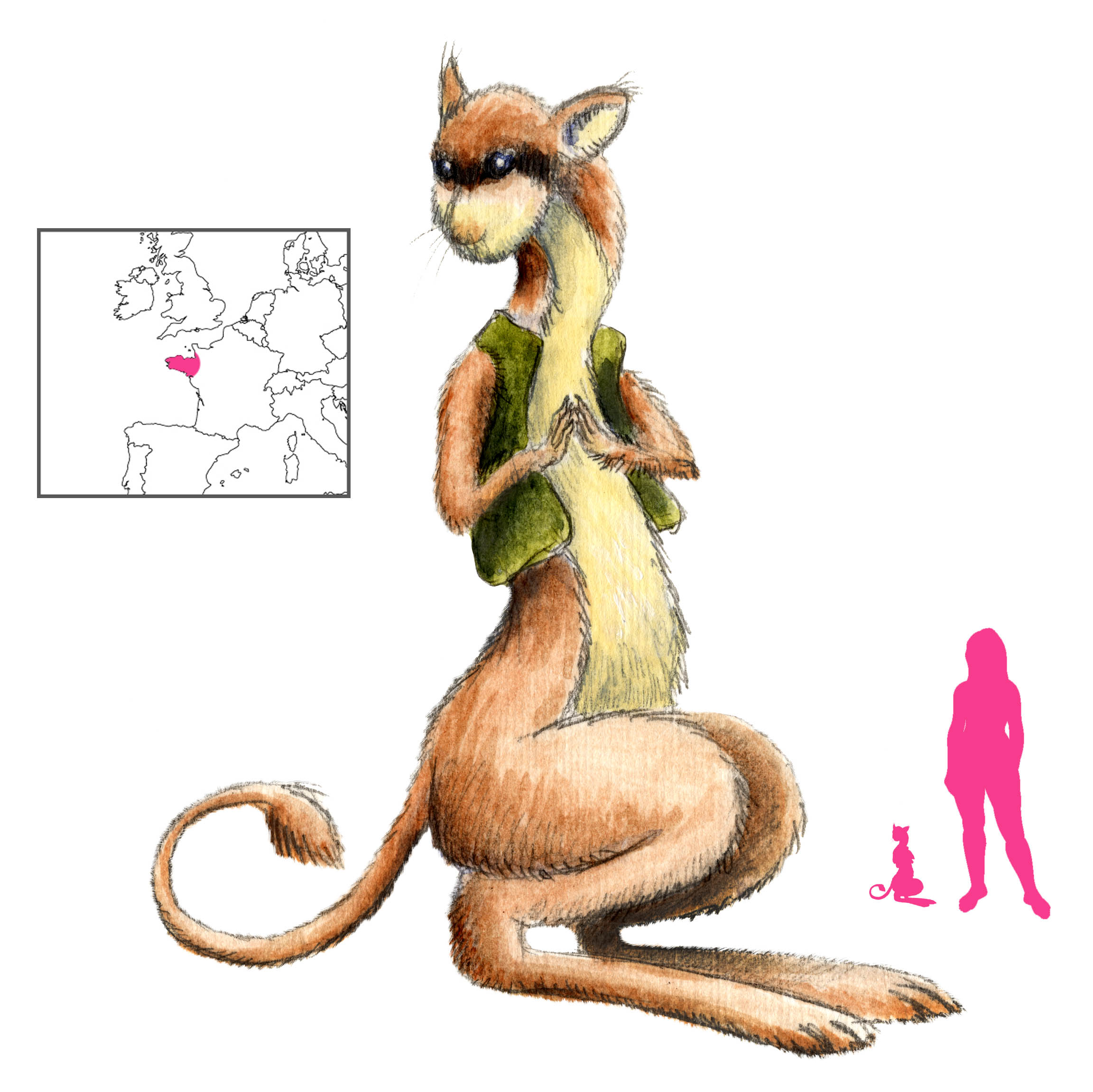
It is more likely that Mourioche has always haunted Brittany, spreading his brand of cruel humor along the coastlines of Côtes-d’Armor and around Jugon-les-Lacs. He is a water-horse, and a shapeshifter; there is no end to the forms he has assumed, and he loves using his powers in creative ways. Mourioche is usually seen in the form of a yearling colt, pig, cow, or sheep, often with a pair of muscular arms.

Mourioche comes out at night, and preys on nocturnal travelers. Sometimes he is a horse standing by the side of the road, waiting for riders. His spine stretches as more and more people get on, then he gallops right into the lake, his laugh echoing in the darkness. At other times he wrestles passers-by, grappling with his brawny arms and throwing his victims into muddy ditches. He will jump onto men’s back and force them to carry him until they drop of exhaustion. He will follow people along the road, changing shape every time they turn to look at him, and making a sound like tearing canvas.

Drawn-out sadistic pranks are Mourioche’s favorite form of entertainment. A farmer of Saint-Cast once found Mourioche in the form of an abandoned ewe, and took him home to his barn. The next day, when he went to check on his new sheep, he found a cow; the day after, it had become a horse. On the fourth night, it was a sheep again, who laughed and said “Why do you check on me every morning? You’re weird!” It was then that the farmer saw that all his animals had been slaughtered. He reached for his shotgun, but Mourioche took off, destroying half the barn and abducting the farmer’s three children (who were never seen again). Mourioche is not without mercy, though, and he left behind a golden necklace.

Mourioche is not without his faults, however, and is baffled by anyone who doesn’t fear him. One man nonchalantly carried Mourioche all the way back home, and the shapeshifter fled when he called his wife. Another time Mourioche took a tailor on his back, who threatened to cut his ears off with his scissors. The tailor was returned to dry land very quickly.

In Matignon, parents would get their children to bed with a “hattaï, mon p’tit gars; Mourioche te prenrait!” (“hurry, my l’il lad, Mourioche will take you!). It is also said that of a frightened person that “il a eu peur comme s’il avait vu Mourioche” (“he’s scared as though he saw Mourioche”). To ward off Mourioche, one must curse him with “Mourioche, le diable t’écorche” (“Mourioche, the Devil flay you”).

The Fausserole of Saint-Cast is very similar, and may be another form of Mourioche. She likes to appear as a white beast, a dog or a calf, and has no qualms about tossing clergy around, as the rector of Saint-Cast found out.

References

Dubois, P.; Sabatier, C.; and Sabatier, R. (1992) La Grande Encyclopédie des Lutins. Hoëbeke, Paris.

Morvan, F. (1998) Vie et mœurs des lutins bretons. Actes Sud.

Sébillot, P. (1882) Traditions et superstitions de la Haute-Bretagne. Maisonneuve et Cie, Paris.

Sébillot, P. (1905) Le Folk-Lore de France, Tome Deuxième: La Mer et les Eaux Douces. Librairie Orientale et Américaine, Paris.

Sébillot, P. (1968) Le folklore de la Bretagne. Éditions G. P. Maisonneuve et Larose, Paris.

Raiju

Variations: Raijū, Thunder-animal, Thunder-beast

Raiju

In Japan, it is said that lightning cannot pass through a mosquito-net – and neither can the Raiju. These creatures also hate the smell of incense.

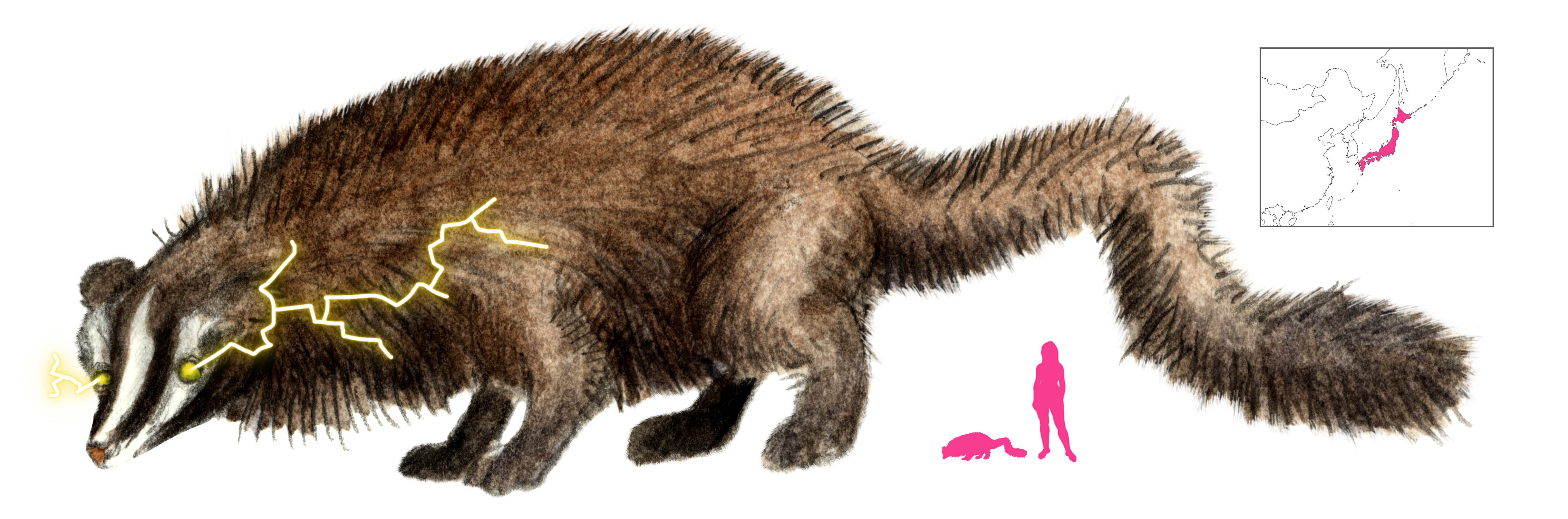
A raiju, or thunder-beast, ranges from dog to squirrel in general appearance, but usually resembles a badger. It falls from the sky with the lightning, and jumps from tree to tree. After the storm has passed, evidence of the raiju’s presence can be seen in the torn, deeply gouged treetrunks and woodwork where a raiju dug its claws in. Such raiju-damaged trees can be harvested for bark that cures toothache.

Raijus will pounce on anyone taking shelter beneath a tree, and will enter any house unprotected by mosquito netting or incense. They also love to eat human navels, and so it is vital to keep one’s navel protected during a thunderstorm, sleeping face-down if necessary.

Despite their elusive nature, raijus have been captured on multiple occasions. The Edo period in particular has many such cases across Japan, and it is believed the Chinese Bencao gangmu text was the inspiration for the raiju craze. One raiju got tangled in the ropes of a well and was taken alive. Another raiju was exhibited (for a fee) in a brass cage in the Temple of Tenjin in Matsue. It looked like a badger, and was said to sleep during fair weather, but during storms it would become active, with its eyes flashing.

The masked palm civet or hakubishin (Paguma larvata) is the most likely contender for the originator of the raiju. This badger-like animal was brought over to Japan from mainland Asia perhaps as early as the Edo period, its unfamiliar nature leading to tales of lightning beasts.

References

Foster, M. D. (2015) The Book of Yokai. University of California Press, Berkeley.

Hearn, L. (1910) Glimpses of Unfamiliar Japan (Second Series). Bernhard Tauchnitz, Leipzig.

Malebête

Variations: Malbête, Malebàete, Malebeste (archaic), Bête d’Angles (Beast of Angles), Troussepoil

Malebete

Visitors to the French town of Angles, in the Vendée, are drawn to the beautiful church of Notre-Dame-des-Anges (Our Lady of the Angels). There, at the top of the bell tower, stands a monstrous stone bear glaring down on the city. Those visitors would be well advised to steer clear of its line of sight.

Long ago, it is said that a terrible beast ravaged the countryside of Angles. It was in the form of a great black bear, with shaggy, matted fur, and it became known as the Malebête – the “Evilbeast” or “Illbeast”. This monster had a predilection for young maidens, glutting itself almost exclusively on women. After feeding it would then wash itself in the nearby river, causing its hair to clump and stick out and granting the river the name of Troussepoil (“Hair-Raiser”, more or less).

The depredations of this demonic creature led to increasing concern. The river was running red with blood, and the female population was dwindling. None dared approach it, as its strength was greater than any knight’s. As it was an incarnation of the Devil himself, it became clear that only a sufficiently holy man would be capable of defeating it. The abbots of Fontaines and Talmont both went to face the beast, only to scurry away in terror when it charged them. The Pope’s envoy fasted for two days before confronting the Malebête, but barely escaped with his life and swore never to return.

Was there any man holy enough to destroy the Malebête? The answer came in the form of Father Martin, an old monk from the Angles cloister who spent most of his time isolated in contemplation of God. Perhaps out of desperation, he was begged to do something about this.

Leaning on a walking stick, dressed only in his ecclesiastical robes, Father Martin walked out to where the Malebête awaited him. To everyone’s amazement, the beast lowered its gaze in front of the hermit. “Follow me”, he said simply, and the Malebête did – as did the entire population of Angles. They followed Father Martin all the way back to the church, where he told the Malebête to climb the bell tower. Once at the top, it froze in place, and turned to stone.

Despite the rejoicing over the Malebête’s defeat, there were still a few voices of dissent in the form of a few girls who taunted Father Martin. “Since when are you the Devil’s shepherd?” they sneered. Father Martin merely smiled and looked up at the Malebête. “Henceforth, you shall feed only on the beauty of the girls of Angles”, he stated. And instantly all the women present became ugly and ran home in shame.

Since then, the resourceful women of Angles have found ways of avoiding the Malebête’s hungry gaze, and sneak safely into the church via a back door. Today the Malebête’s primary sustenance comes through the tourist industry.

This tale was first told by Benjamin Fillon, a dubious character who seems to have created the story out of whole cloth, making it a neo-myth of sorts. For one thing, the statue of the Malebête is of pre-Christian origin, predating its own legend; it was originally in a seated position, and was mutilated into its current shape. The Malebête’s story is also a familiar one, echoing many others told of anthropophagous monsters slain by righteous men.

References

Chaigne, L. (1942) La Vendée. F. Lanore, Paris.

Dillange, M. (1983) Eglises et Abbayes Romanes En Vendée. Jeanne Laffitte, Marseille.

Dubourg-Noves, P. (1996) Notre-Dame d’Angles. in Vendée. Congrès Archéologique de France, 151e Session. Musée des Monuments Francais, Paris.

Le Quellec, J. (1988) Le légendaire du Sud-Vendée: organisation spatio-mythique. Etuderies 3-4.

Trébucq, S. (1912) La chanson populaire et la vie rurale des Pyrénées à la Vendée. Feret et fils, Bordeaux.

Gigelorum

Variations: Giolcam-daoram

Gigelorum

The Gigelorum or Giolcam-daoram is the smallest of all known creatures. It makes nests in the ears of mites, and as no description of it has been given, any depiction of it will be purely conjectural.

References

Campbell, J. G. (1900) Superstitions of the Highlands and Islands of Scotland. James MacLehose and Sons, Glasgow.

Robinson, M. (1965) Some Fabulous Beasts. Folklore, Vol. 76, No. 4, pp. 273-287.

Pilou

Variations: Er-pilour-lann

Pilou

Pilous are always heard and never seen. While their name suggests soft fur – pilou in its modern expression refers to a type of cotton – it actually refers to the men who pound apples into cider, using wooden pilons. Pilous walk with a regular, stomping tread, making a rhythmic sound like that of apples being mashed, and that is all anyone knows of them. Nevertheless, Dubois fancifully describes these lutins as resembling large garden dormice, and that is as good a description as any.

Pilous are native to the northwestern tip of France, specifically Brittany and Ile-et-Vilaine. They come out at night in the attic, in the rafters, in the walls, and start marching. They are not evil but mischievous, and delight in the noise they make. In Brittany, where they become Er-pilour-lann, they wield mallets with which they pound the walls of old houses.

Most encounters with them are about their disregard for human comfort. A farmhand once went into the barn to fetch some hay when the thumping begin, the din seemingly coming from everywhere. He called his uncle, who implored the pilous “Would you, please, stop your noise so I could get some hay for my mare?” They stopped, but the moment the uncle stepped into the barn they started up again, louder than ever.

Another time a group of men were in a barn when a pair of pilous started: one, two, one, two. “I’d like it better if there were three of you!” yelled one of the men, and sure enough a third pilou joined in. Other men started requesting more and more, and the number of pilous increased accordingly. The same stunt was later attempted by three bored young girls, but they requested too many, and soon the pilous were rattling their bed and knocking at their walls. The girls wisely went quiet, and the creatures eventually left.

Attempts to put pilous to use have failed. One miser left oakum fibers behind in the attic in hopes that the pilous would stomp them flat, but he returned in the morning to find the material shredded and scattered all over the attic.

References

d’Amézeuil, C. (1863) Récits Bretons. E. Dentu, Paris.

Dubois, P.; Sabatier, C.; and Sabatier, R. (2005) The Complete Encyclopedia of Elves, Goblins, and Other Little Creatures. Abbeville Press.

Orain, A. (1899) Le Monde des Ténèbres en Ile-et-Vilaine. Revue de Bretagne, de Vendée et d’Anjou, XXI, Paris.

Orain, A. (1901) Contes de L’Ile-et-Vilaine. J. Maisonneuve, Paris.

Le Rouzic, Z. (1924) Carnac: Légendes – Traditions – Coutumes et Contes du Pays. LaFolye Frères et Cie, Vannes.

Pyrallis

Variations: Pyrausta, Piralis

Pyrallis

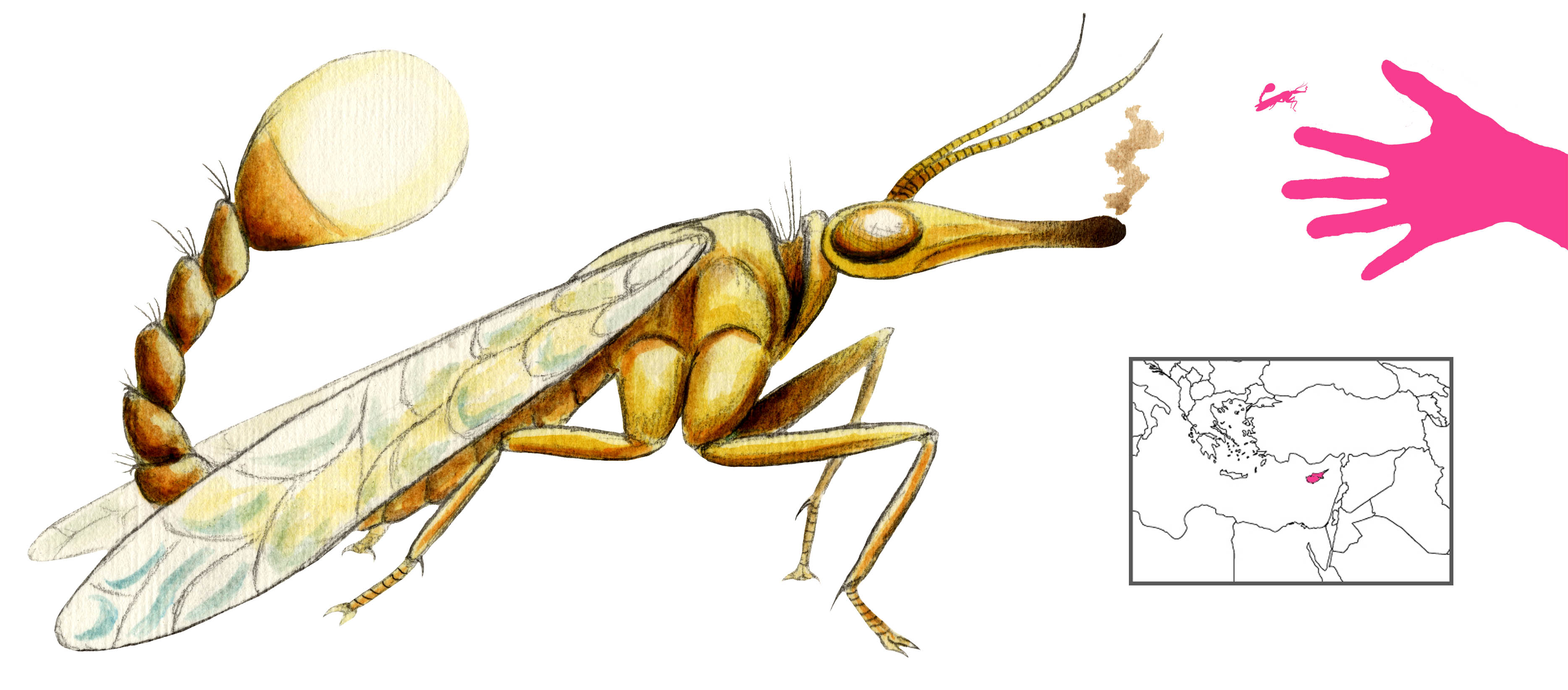
The Pyrallis or Pyrausta is an insect native to the copper-smelting furnaces of Cyprus. It resembles a large fly with four legs.

A pyrallis can only be seen within a fire, flitting and flying through the flames. It cannot survive outside fire, and dies instantly if it flies out of it. In fact, Pliny believed the pyrallis was born from the fire itself.

There is a persistent rumor that the pyrallis has dragon features or something to do with dragons, but this is inaccurate. This misconception likely stems from the whimsical book Inventorum Natura, which presents an entirely fictitious “lost” Plinian manuscript.

References

Pliny; Bostock, J. and Riley, H. T. trans. (1857) The Natural History of Pliny, v. III. Henry G. Bohn, London.

Unknown. (1538) Ortus Sanitatis. Joannes de Cereto de Tridino.

Woodruff, U. (1979) Inventorum Natura. Paper Tiger, England.

Polevik

Variations: Polevoi, Polievik, Poludnitsa, Poludnica

Polevik

The Polevik or Polevoi (from pole, “field”) is the Russian spirit of fields, plains, and noontime.

His appearance varies considerably. In Belozersk District and the northern forest regions he is a man dressed in white. In Iaroslavl Province he is an ugly little old man. In Orel Province he is black as the earth, his head covered with green grass, and he wears no clothing. In Tula Province he looks like a shaggy-furred Leshy. Sometimes his eyes are different colors. His skin and hair mirror the soil and vegetation of the fields, and his height grows and shrinks with the crops.

Unlike some of the other spirits, the polevik can be benevolent or evil. A polevik is primarily seen at noon. He likes to lead peasants astray, losing them in endless yellow golden stalks of grain. He disapproves of laziness, and will strangle drunkards sleeping in the fields. Poleviks are capable of seeing the future, and in Iaroslavl Province their appearance is an ill omen. Poleviks are also accomplished horsemen and will ride horses across the fields at breakneck speed, running over anyone in their path.

The female equivalent of the polevik, sometimes replacing him entirely, is the Poludnitsa, Poludnica, or Midday Spirit (from poluden or polden, “noon”). She can be a tall, beautiful woman in white; in Siberia she is an old curly-haired crone dressed in rags, while she has horses’ hoofs in Moravia. In summer, during harvest time, she walks through the fields, protecting the grain. If she sees someone working at midday she pulls their hair violently, twists their heads, and breaks their bones. Other times she quizzes people on agriculture, inflicting disease upon them if they fail to answer correctly. She enjoys misleading children in cornfields.

Polevik children run around the fields catching birds for their parents to eat. They will smother anyone sleeping on the edges of the field.

While poleviks can be destructive, a happy polevik will aid with the harvest, and crops will always be successful under a polevik’s patronage. To earn a polevik’s good will one must leave an offering of two eggs and an old rooster who can no longer crow, in a ditch when nobody is around. Traditional observances must also be followed, and nobody should work at noon.

With the advent of Christianity, poleviks and poludnitsas became mere bogeys, monsters used to frighten children out of cornfields.

References

Aldington, R. and Ames, D. trans.; Guirand, F. (1972) New Larousse Encyclopedia of Mythology. Paul Hamlyn, London.

Dubois, P.; Sabatier, C.; and Sabatier, R. (1992) La Grande Encyclopédie des Lutins. Hoëbeke, Paris.

Ivanits, L. J. (1989) Russian Folk Belief. M. E. Sharpe, Inc., Armonk, New York.

MacCulloch, J. A. and Machal, J. (1918) The Mythology of All Races v. III: Celtic and Slavic. Marshall Jones Company, Boston.

Nurikabe

Nurikabe

The Nurikabe (“plaster wall”) is a type of yokai that resembles a large wall with varying amounts of anthropomorphic elements. It may have legs, hands, and facial features; sometimes it looks somewhat like a flattened elephant with three eyes. Nurikabe were first reported from Kyushu, specifically Fukuoka and Oita Prefectures, but have since then moved to the rest of Japan.

Nighttime travelers are the primary targets of the nurikabe. It appears without warning, blocking further movement, and any attempts to bypass it are futile. Sometimes it impedes without materializing, slowing travelers down as though they were slogging through tar.

Nurikabe will disappear if struck at the base with a stick, but doing so to the upper part of the wall has no effect.

The tanuki no nurikabi, or nurikabe caused by tanuki, is a variant from Oita Prefecture. It prevents its victims from seeing ahead of them.

References

Foster, M. D. (2015) The Book of Yokai. University of California Press, Berkeley.