Erymanthian Boar

Erymanthian Boar

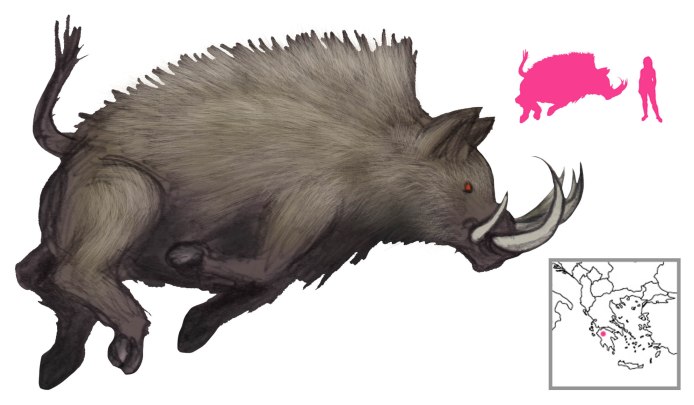
The Erymanthian Boar was a monstrous boar that made its home around Mount Erymanthos in Arcadia. It ravaged the land of Psophis, killing people and livestock and tearing up crops.

Heracles was commanded to bring the Erymanthian boar alive for his fourth labor. Along the way the demigod had an unfortunate and tragic encounter with the centaurs, one which would have severe repercussions in the future. Eventually Heracles found the boar and scared it out of its thicket with a mighty shout. After a long chase, the boar was tired out and and forced it into a snowdrift, where it was easily captured and brought back to Eurystheus. In a comic scene that graces many a Grecian urn, the cowardly king hid in a large storage jar until Heracles took the boar away.

After that the boar presumably met its demise, either at the hands of Heracles or elsewhere. The tusks of the Erymanthian boar were on display at the sanctuary of Apollo in Cumae, Italy, but Pausanias believed this claim to be highly dubious.

References

Buxton, R. (2004) The Complete World of Greek Mythology. Thames & Hudson Ltd, London.

Pausanias, Levi, P. trans. (1979) Guide to Greece, volume 2: Southern Greece. Penguin Books, London.

Smith, R. S. and Trzaskoma, S. M. (2007) Apollodorus’ Library and Hyginus’ Fabulae. Hackett Publishing Company, Indianapolis.

Angont

Angont

According to the Huron, the Angont is the source of death, disease, and all the misfortunes of the world. It is a monstrous snake that lives in a number of dark and secluded areas, including lakes, rivers, deep woods, under rocks, and in caves.

When sorcerers wish to kill someone, they rub items – hair, splinters, animal claws, wheat leaves, and so on – with angont flesh. Any such object becomes malevolent, penetrating deep into a victim’s vitals down to bone marrow, and bringing with it agonizing pain and sickness that eventually consumes and kills its host. Only the discovery and removal of the cursed object can prevent and cure this.

References

Vimont, B. (1858) Relations des Jésuites, v. II. Augustin Coté, Quebec.

Bès Bulong

Variations: Hantu Bulong (Malay), Bulong, Spirit Bulong

Bes Bulong

Bès Bulong, the spirit Bulong or simply Bulong, is a bès or spirit from the folklore of the Jah Hut people of Malaysia. It walks around by night. If it sees anyone walking about between midnight and 6:00 AM, it will pull out that person’s soul and leave them unconscious.

References

Werner, R. (1975) Jah-hět of Malaysia, Art and Culture. Penerbit Universiti Malaya, Kuala Lumpur.

Akampeshimpeshi

Variations: Lightning

Akampeshimpeshi

According to the Lamba people of Zambia, there is a great lake of water above the dome of the sky. This lake is held back by a weir protected by guardians appointed by Lesa (God). Sometimes Lesa appoints children to guard it, and their irresponsible playing makes holes in the weir and allow the water to spill to earth as rain. When Lesa appoints grown men to guard the weir, then there is no rain.

Lightning (akampeshimpeshi) is caused by the guardians of the weir swinging and tossing their knives (imyele). The knives do not fall – if they did, the earth would be destroyed.

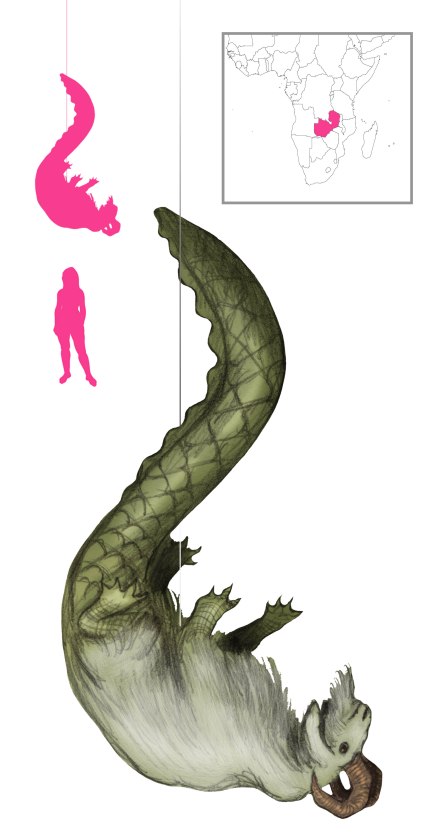
When a flash of lightning hits the ground, an animal descends to the ground on the end of a long cobweb. It looks like a goat, with beard and horns, but has the feet and tail of a crocodile. Usually it returns to the sky on its string of web; if the cobweb breaks, the animal will be trapped on the ground and cry like a goat. In this state it is very dangerous and might kill people, so it is mobbed, killed, and burned by the Lambas. Anyone trying to slay this beast must have protective medicine (ubwanga bwayamba) to avoid being killed themselves.

References

Doke, C. M. (1931) The Lambas of Northern Rhodesia. George G. Harrap and Company Ltd., London.

Anaye

Variations: Alien Gods; Bil, Binaye Ahani, Ditsi’n, Hakaz Estsán, San, Sasnalkahi, Teelget, Tiein, Tse’nagahi, Tsenahale, Tsetahotsiltali, Ya’, Yeitso, and others

The Anaye or “Alien Gods” are a group of ancient monsters who plagued the Navajo. They were born as a result of a grand social experiment – the separation of the sexes. Early on in the history of humanity, men and women quarreled often. They tried living apart for a while, but boredom and starvation eventually reunited them.

It was not without repercussions. The women who had been separated from the men resorted to various implements to relieve their sexual frustration. The Anaye were “fathered” by those unnatural acts, and their parentage was expressed in various ways. Yeitso, who was “fathered” by a stone, had flint armor; the horned Teelget’s “father” was an antler; the Tsenahale inherited their avian nature from a pile of feathers; and the limbless Binaye Ahani came from a sour cactus.

Each of the Anaye was born and abandoned by their horrified mothers, but survived long enough to become a threat. They ravaged the land, killing and eating as they pleased.

The Anaye reign of terror was brought to an end by the hero twins Nayenezgani, “Slayer of Alien Gods”, and To’badzistsini, “Child of Water”. They were the sons of Tsohanoai the Sun-carrier by Estsanatlehi, “Changing Woman”, and Yolkai’ Estsan, “White Shell Woman”, respectively.

The hero twins grew up rapidly and soon decided to find their father and their purpose. Along the way they met Spider Woman, who gifted them with a calming incantation and life-feathers that would protect them in the direst of circumstances. From Spider Woman’s house they passed through a series of environmental hazards. These included Tse’yeinti’li, the “Rocks that Crush”, a narrow chasm that would clap shut and kill travelers; Lokaadikisi, the “Cutting Reeds” with knifelike leaves; Xoc Detsahi the “Needle Cactus”, a field of animate cacti with vicious spines; Saitád the “Seething Sands”, mountainous dunes that engulfed climbers; and Totsozi the “Spreading Stream” that would widen itself to drown swimmers. Each of those malevolent terrain features were outwitted and subdued into turn.

When the twins reached Tsohanoai’s house they came face to face with two bear guardians, but Spider Woman’s sacred words calmed them. They did the same with two guardian snakes, two guardian winds, and two guardian lightnings, appeasing each in turn. Once inside the twins were hidden by Tsohanoai’s attendants in the four coverings of the sky to await their father.

Tsohanoai’s arrival was tempestuous. “Who are the two who entered today?” he bellowed. But the sun-carrier’s wife responded craftily. “Who are you to speak? Two youths came here looking for their father. If you see nobody but me, whose sons are these?” In a rage, Tsohanoai seized the bundle of robes and shook them out – the robe of the dawn, the robe of blue sky, the robe of yellow evening light, the robe of darkness – and the twins came tumbling out. He threw them against spikes of white shell in the East, spikes of turquoise in the South, spikes of haliotis in the West, and spikes of black rock in the North, and throughout it all they clung to Spider Woman’s feathers and were unharmed.

“I wish those were indeed my children”, sighed Tsohanoai. From then on he came to recognize his sons, and aided them in their quest to rid the world of the Anaye. After slaying their first Anaye, the titanic Yeitso, Tobadzistsini returned home to care for his and his brother’s mothers. But Nayenezgani earned his name that day, and went on to slay the remainder of the great Anaye. After Yeitso, Nayenezgani killed the carnivorous elk Teelget, the Tsenahale birds of prey, the kicking monster Tsetahotsiltali, the Binaye Ahani and their lethal gaze, Sasnalkahi the tracking bear, and many more besides.

But not all of the Anaye were killed. Tse’nagahi, the “Traveling Stone”, was spared after it swore to do no more evil. There was also a number of minor Anaye still in hiding – wretched, lonely, threadbare creatures that inspired pity rather than fear. Each of them managed to convince Nayenezgani of its importance in the scheme of things.

When Nayenezgani went to find San (Old Age), he found a wizened old woman, white-haired, bent and wrinkled. “I have come on a cruel errand, grandmother. I am here to kill you”, he said apologetically. “Why would you kill me?” she said weakly. “I have never harmed a single person. If you kill me then the human race will stand still. Boys will not become fathers. The old will not die and make room for the young. If you spare me I will help you increase the people”. So Nayenezgani spared San.

Then he set out to find Hakaz Estsán (Cold Woman). She lived on the highest peaks where snow lies on the ground all year. She was an old woman, lean, naked, shivering from head to toe, teeth chattering, eyes streaming constantly, with only snow-buntings for company. “Grandmother, I shall be a cruel man and kill you, that men may no longer die of cold”, he told her. “Kill me if you must”, chattered Hakaz Estsán. “But without me it will be permanently hot. The land will become dry. Water will disappear, and the people will perish in turn”. So Nayenezgani spared her as well.

Next was Tiein (Poverty). This was not one but two creatures, an old man and an old woman, both clad in filthy tattered rags and crouching in an empty house. “Grandmother, grandfather, I shall be a cruel man, for I am here to kill you” he stated. “Do not kill us”, said the old man. “Without us nothing would change, everything would be static. But we make clothing wear out and make people go out and fashion new and beautiful clothes. Let us live that people may continue making new things”. So Nayenezgani spared the couple.

Then there was Ditsi’n (Hunger). This was the chief of the Hunger People, and he was a massive, obese man with nothing to eat but the little brown cactus. “I shall be cruel”, announced Nayenezgani, “and kill you that people may no longer suffer of hunger”. But Ditsi’n said “Do not kill us, for without us, people would not care about food, they would not cook and prepare meals, they would lose the pleasures of hunting and cooking”. And they were spared as well.

Of the other minor Anaye less is told. We know that Ya’ (Louse) pleaded for its life, arguing that its presence taught compassion, that people would ask their friends to groom them, and so it was spared. As for Bil (Sleep), it made its case in a more direct (and humiliating) manner – by touching Nayenezgani with his finger and sending the hero into a blissful slumber.

Only then, when Nayenezgani had returned from sparing the last of the minor Anaye, did he and his brother rest. They went to the valley of the San Juan River, and they dwell there to this day.

References

Alexander, H. B. (1916) The Mythology of All Races v. X: North American. Marshall Jones Company, Boston.

Locke, R. F. (1990) Sweet Salt: Navajo folktales and mythology. Roundtable Publishing Company, Santa Monica.

Matthews, W. (1897) Navaho legends. Houghton Mifflin and Company, New York.

O’Bryan, A. (1956) The Diné: Origin Myths of the Navaho Indians. Bulletin 163 of the Smithsonian Institution, Washington, D. C.

Reichard, G. A. (1950) Navaho Religion: A Study of Symbolism. Bollingen Foundation Inc., New York.
Ccoa

Variations: Cacya; Chokkechinchay, Choquechinchay

Ccoa

In the Peruvian Andes, certain protective spirits are known to live in the mountains. Apus are guardian deities of regions, while aukis are spirits of cultivation. Their mountain haciendas keep a number of livestock as well as other spirits that serve the apus and aukis. Condors are their chickens, and vicuñas are their llamas. The ccoa is their cat and is the most feared of those spirits. Its primary dwelling is the mountain Ausangate, near the village of Kauri in the Cuzco district. It is associated with (and perhaps identical to) Choquechinchay, the evening star and a constellation of a fierce puma with brilliant eyes.

The ccoa is a catlike creature 40 cm tall and 60 cm long, with a tail 30 cm in length and 3 cm wide. It is gray with black stripes running the length of its body. Its head is proportionally a bit larger than a cat’s, with phosphorescent eyes; often there is hail running out of its eyes and ears. Sometimes the ccoa appears as a catlike bull with eyes of blood.

During the rainy season the ccoa emerges from highland springs in the form of clouds. An active and angry spirit, it seeks to steal the crops before the harvest, destroying them with hail. Its tail sweeps the clouds, bringing storms, hail, and deadly lightning. It is unclear whether the ccoa acts on its own initiative or if it only follows the orders of its spirit masters, but either way it is treated as a malevolent threat that must be placated.

When it comes to interaction with the ccoa, there are two kinds of people: those who serve the ccoa and those who fight it. The rich serve the ccoa, as their fields are never harmed by hailstorms. The poor fight it, as their fields are destroyed by the ccoa and their families stricken with disease. The ccoa is also revered by sorcerers, as it grants them powers by striking them with lightning.

The ccoa can be placated with suitable offerings. These are usually a combination of materials including incense, wine, gold and silver tinsel, llama tallow, and cañihua and huairuro grains, collected and burned on high ground. Sorcerers in particular must be sure to make offerings to the ccoa in thanks for their gifted abilities. The ccoa is angered by unsatisfactory offerings by sorcerers, children dying before being baptized, and attempts to fight off its hail.

The souls of unbaptized children are duendes, and they are irredeemably malevolent. When children die before they are baptized, they must be taken to he hills and burned to ashes. If unbaptized children are buried, the ccoa will strike their burial place with lightning and take the duendes to Ausangate as servants.

Sometimes the ccoa is replaced entirely by Santiago, a more neutral deity who causes hail and lightning but also protects crops.

The ccoa may be a modern-day descendant of the ancient Chavín feline cult.

References

Bankes, G. (1977) Peru Before Pizarro. Phaidon, Oxford.

Cumes, C. and Valencia, R. (1995) Pachamama’s Children. Llewellyn Publications, St. Paul.

Harrison, R. (1989) Signs, Songs, and Memory in the Andes. University of Texas Press, Austin.

Mishkin, B. The Contemporary Quechua. In Steward, J. H. ed. (1946) Handbook of South American Indians v. 2: The Andean Civilizations. United States Government Printing Office, Washington.

Gallo de la Muerte

Gallo de la Muerte

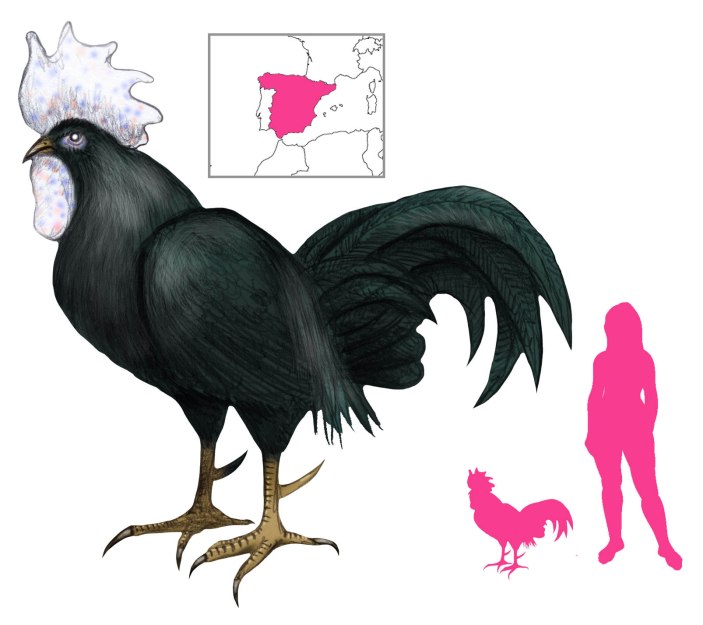
Every hundred years, a kite in the Spanish mountains lays a red egg in a gorse bush. From that egg hatches a black and white bird, larger than a chicken, which lives exactly fifty years. When that bird dies, a green worm emerges from its rotting flesh. That worm gradually metamorphoses into a Gallo de la Muerte – a Rooster of Death.

A gallo de la muerte has black plumage and a white comb with blue and reddish spots. Anyone who hears its whining, screaming quiquiriquí is doomed to die the next day.

The only remedy for this death sentence is a particular herb that grows among the mountain apple trees from the start of spring till the month of May. This herb is blue and has black roots. The remedy involves boiling this herb in rosemary water and praying over the concoction before it is imbibed.

References

Candón, M. and Bonnet, E. (1993) A buen entendedor…Anaya & Mario Muchnik, Madrid.

Llano, M. (1998) Obras Completas, t. I. Alianza Editorial, Madrid.

Cactus Cat

Variations: Cactifelinus inebrius (Cox), Felis spinobiblulosus (Tryon)

Cactus Cat

Cactus Cats once lived in the wide-open Southwestern deserts. They were once found in saguaro country between Prescott and Tucson and in the Sonoran Desert as far south as the cholla hills of Yucatan. Nowadays the species is practically extinct following the exploitation and destruction of its desert home.

A cactus cat has thorny hair, with especially long, rigid spines on its ears and tail. The tail is branched like a cactus with scattered thorny hair. There are sharp bony blades on the forearms above the forefeet.

Cactus cats use their forearm-blades to cut deep slanting slashes at the base of giant cacti. One of those cats will travel in a wide circular path, 80 chains long, slashing every cactus it sees. By the time it returns to the first cactus, the sap oozing from the cuts has fermented into mescal. The cactus cat laps this alcoholic brew up hungrily. By the end of the second circuit the cat is thoroughly drunk and waltzes off in a drunken stupor. It yowls and rasps its bone blades together, a sound which carries through the desert night.

It is this fondness for liquor that was the downfall of the species. By following a cactus cat around, one could collect the mescal and deprive the cat of its sustenance. This was not an activity without risk, however. Thieves caught in the act were flogged to death with the cat’s spiny tail, leaving red welts deceptively similar to the effects of heat rash.

References

Cox, W. T. (1910) Fearsome Creatures of the Lumberwoods with a Few Desert and Mountain Beasts. Judd and Detweiler, Washington D. C.

Tryon, H. H. (1939) Fearsome Critters. The Idlewild Press, Cornwall, NY.

Bayfart

Bayfart

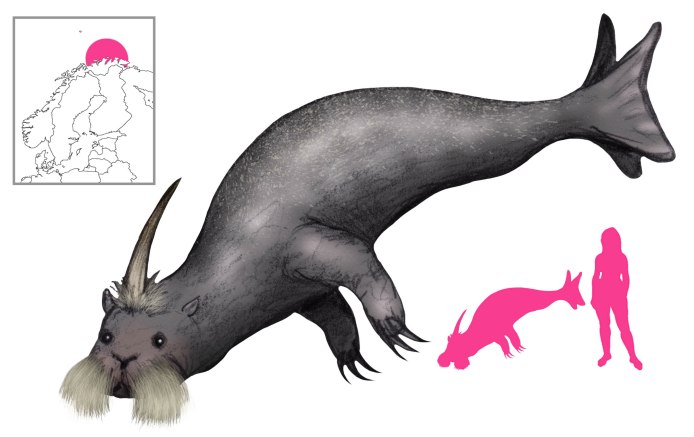
The Bayfart is an animal whose existence is reported by the inhabitants of Finnmark. It is something like a seal, roughly the same size and shape. Its fur is greyish. It has small ears and a single horn on its head surrounded by hair, and hog-like bristles around its nose. Its forelegs have claws as long as a lion’s, while its has two flippers for hind legs.

Thevet received a bayfart skin from a Scotsman, who obtained it in Denmark in 1570. It had been caught in the Northern Sea.

References

Thevet, A. (1575) La Cosmographie Universelle. Guillaume Chaudiere, Paris.

Nue

Variations: Nue-dori (Nue-bird)

Nue

Described as a “bird-beast”, the Nue lacks any avian physical features. It exists largely outside the Japanese yokai canon, best known from the Tale of the Heike (1371).

The kanji for the word nue are “night” and “bird”. It is likely that the legend of the nue started with a Chinese bird. When it appeared in the 8th-Century Kojiki and the Manyōshū it was a bird that sang mournfully in the forest at night. Purification rituals would be performed in the palace after its sad song. This is probably the White’s thrush or toratsugumi (Zoothera dauma).

In the Tale of the Heike the nue becomes a frightening hybrid creature with the head of a monkey, the body of a tanuki or badger, the limbs of a tiger, and a snake’s or viper’s tail. It makes a cry like that of the nue thrush and lives deep in the mountains. It would appear in the sky over the emperor’s palace every night, hidden in a foreboding black cloud.

The nue was shot out of the sky by Minamoto no Yorimasa with a single arrow. For this feat he was awarded the sword known as Shishiō, the “King of Lions”, which is still on display at the Tokyo National Museum. The event also established Yorimasa’s reputation as a slayer of monsters, and he killed a second nue during the reign of a later emperor.

A 15th-Century Noh drama by Zeami Motokiyo tells the tale of the nue’s slaying from the perspective of the nue. Its forlorn lament over its death hearkens back to its origin as a bird with a sad song.

References

Foster, M. D. (2015) The Book of Yokai. University of California Press, Berkeley.

Sekien, T.; Alt, M. and Yoda, H. eds. (2017) Japandemonium Illustrated: The Yokai Encyclopedias of Toriyama Sekien. Dover Publications, New York.