Songòmby

Variations: Songomby, Songaomby, Tsiombiomby, Tsongomby, Bibiaombe; Brech, Brek (probably); Habeby, Fotsiandre (probably); Mangarsahoc (probably); Tòkantòngotra, Tòkandìa. Tokatomboka (probably)

Songomby

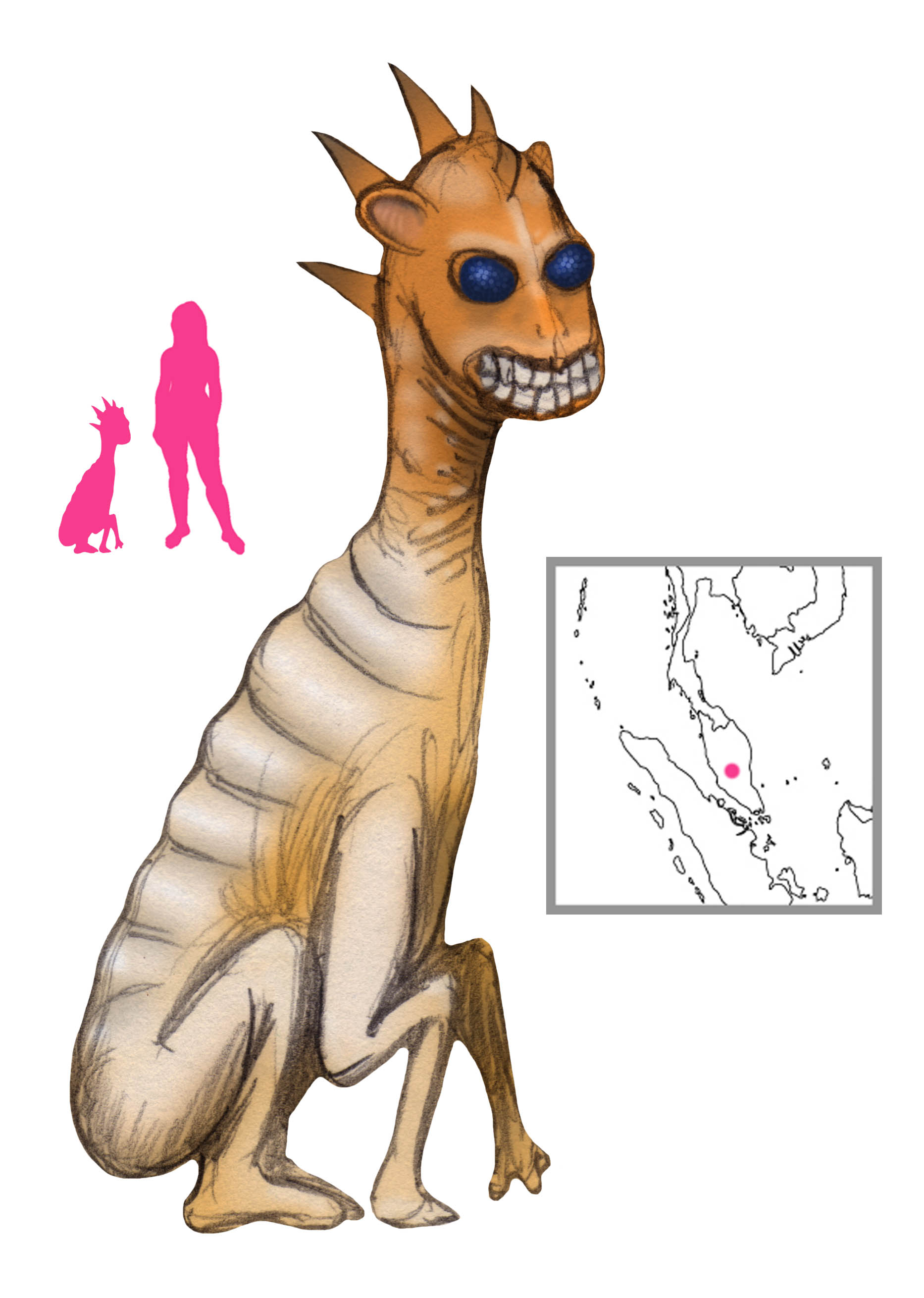
The Songòmby is an unusual carnivorous animal from the folklore of Madagascar. The name may be derived from sònga, “having the upper lip turned upwards”, and òmby, “ox” according to Sibree. The word songòmby is taken to mean “lion-hearted” or “courageous”. Another name, bibiaombe , means “ox-animal”. Molet offers two derivations for songòmby:  from the Swahili songo ngomby, “snake ox”, or a corruption of the alternative name tsiombiomby (“looks like an ox”). Domenichini-Ramiaramanana gives a popular etymology as derived from the question many ask when seeing it: Sangoa omby re izany? (“Isn’t that just an ox?”), and a more serious one from songo and omby where songo refers to virgin land allowed to go wild; in this case, the reference is to a feral ox.

Consistent across the descriptions is that the songòmby is the size of an ox or a horse, exceedingly fast, burdened with floppy ears, and a man-eater. It looks something like a horse, a mule, or an ox. It has flaring nostrils and terrible incisors. Its prominent ears dangle over its eyes and can distract it at crucial moments.

Gabriel Ferrand says it has the body of an ox and a hornless horse’s head. It lives in forests and eats plants, insects, and humans. Its speed is beyond compare – a distant songòmby can reach its prey immediately. If its human prey tries to escape by climbing a tree, it will wait at the base of the tree and try to bring the human down by ruse. If that fails it directs a jet of urine at its prey. The victim loses their grip, falls, and is devoured by the songòmby.

R. P. Callet says the songòmby looks like a donkey with spots. It eats grass but if it sees people it chases them. It comes out at night to graze. When climbing mountains they are fast as horses, but when they go down they move slowly because their ears flop over their eyes.

Domenichini-Ramiaramanana describes the songòmby as white in color, very fast, like both a horse and an ox, and with a single horn. It sprinkles itchy hair (lay) from its nostrils. If its prey tries to escape by climbing a tree, the itchiness brought on by the lay will make the victim try to scratch itself, falling out of the tree. Thus, if climbing a tree to avoid a songomby, one must be sure to tie oneself to the branches with lianas. The creature is patient though and will wait till morning at the foot of the tree.

In northern Madagascar the songòmby is like the donkey or the mouflon. It has tufts of hair at its feet. It may have backswept horns or no horns at all. Its hooves are so hard they strike sparks from the ground. Most unusually of all, “it is only seen in profile and looking behind it”. This final clue suggests to Molet that the songòmby evolved from the decorative ch’i-lin on Chinese plates, which is often depicted in profile and looking backwards. The people of Madagascar would have seen those on Chinese plates brought by Arab traders – a trade which was stopped by the Portuguese, leaving the origin of the songòmby to distant history.

To catch a songòmby, a child is tied up in front of the songòmby’s den while a net is put over the entrance. The child’s crying attracts the songòmby, which is snared in the net. Worse than that, children were punished by putting them outside and telling them the songòmby would eat them. But this was not without its risks. A child was once put outside, and the parents called out “Here’s your share, Mr. Songòmby!” As luck would have it, a songòmby was passing by. “Oh, he really is here!” cried the child, but the parents ignored him, replying “Let him eat you!” thinking the child was mistaken. After a while they opened the door to find their child was gone. They followed the trail of blood all the way to the entrance of the songòmby’s cave.

Fortunately the songòmby is not invincible. A man going out by night once met a songòmby, but as he was strong and brave, fought it all night without being hurt. The hero Imbahitrila once defeated a songòmby by arming himself with two magical eggs from the angavola bird. They answered his wish to overcome the songòmby by causing it to trip and fall. Once on the ground the songòmby was easily slain by Imbatrihila’s spear.

The Tòkantòngotra or Tòkandìa (“single-hoof”) is very similar to the songòmby. It is white in color, large (but smaller than the songòmby). Its feet are single hooves, like those of a horse (but not one foot in front and one in the back, as some authors have interpreted). Like the songòmby, it is very fast, travels by night, and is a man-eater.

Flacourt describes an animal called the Mangarsahoc. It is a large beast with a horse’s round hooves and long dangling ears. When it comes down from the mountains, the ears cover its eyes and impair its vision. It brays like a donkey – and, indeed, Flacourt decides that it must be some kind of wild donkey. A mountain 20 leagues from Fort Dauphin is named Mangarsahoc after the animal. Flacourt also mentions an animal called the Brech or Brek, about the size of a goat kid and with a single horn on its forehead. It is very wild in nature. Flacourt determines that “it must be a unicorn”. Both of those seem close enough to the songòmby to be worth mentioning.

The Habeby or Fotsiandre (“white sheep”) looks like a white sheep with long, dangling ears, staring eyes, and short wool. Reclusive and shy, it is not carnivorous, but the description once again recalls the songòmby.

When the horse was first brought to Madagascar, it was believed to be a songòmby (it was eventually saddled with the name soavaly, derived from the French cheval).

References

Domenichini-Ramiaramanana, B. (1983) Du ohabolana au hainteny: langue, littérature et politique à Madagascar. Karthala, Paris.

de Flacourt, E. (1661) Histoire de la Grande Isle Madagascar. Francois Clouzier, Paris.

Molet, L. (1974) Origine Chinoise Possible de Quelques Animaux Fantastiques de Madagascar. Journal de la Soc. des Africanistes, XLIV(2), pp. 123-138.

Sibree, J. (1896) Madagascar Before the Conquest. Macmillan, New York.
Bès Kěmwar

Variations: Hantu Ulat (Malay), Maggot Spirit, Riverside Maggot Spirit, Tip-of-Leaf Maggot Spirit, Caterpillar Spirit; Bès Kěmwar Jě’la, Hantu Ulat Duri, Thorny Maggot Spirit; Bès Kěmwar Sòk, Hantu Ulat Bulu, Hairy Caterpillar Spirit; Bès Kěmwar Těrbang, Hantu Ulat Terbang, Flying-Maggot Spirit

Bes Kemwar

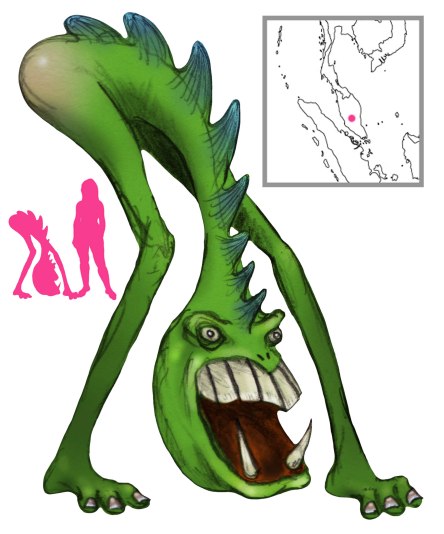
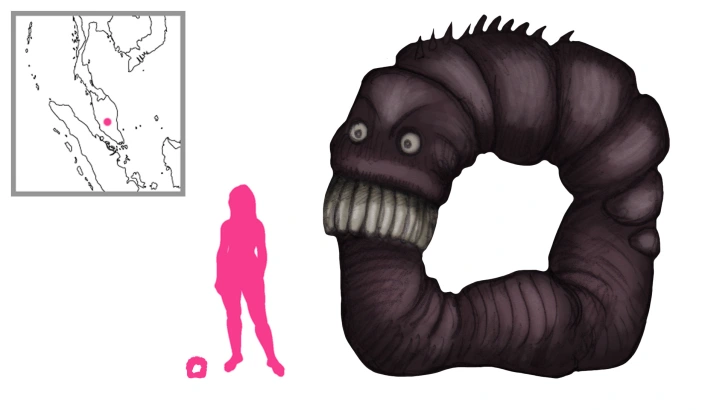
The Bès Kěmwar, “maggot spirit”, is one of the many bès or disease spirits known to the Jah Hut of Malaysia. A polyvalent spirit, it is depicted as a maggot or caterpillar, with variants distinguished by hair, thorns, wings, and other details. It eats rice, vegetables, and other crops. It is responsible for aches in bones, joints, and muscles. If its caterpillar hair falls into water and that water is drunk, it causes coughing and bleeding in the throat. Maggot spirits are also known to live in rotten tree trunks and feed in them. Anyone who approaches the fallen tree will be bitten in the leg by the spirit, causing redness, swelling, and itching. All the toenails fall off but the swelling will be gone by two or three months.

The riverside maggot spirit lives by the river and appears only during the jungle-fruit season in February. It flies onto the heads of old people and causes all their hair to fall off.

The tip-of-leaf maggot spirit feeds on the leaves of coconut and rice. To prevent this attack on crops, a pawang must bless the plants with a pounded mixture of daun setawa and kunyit mulai, which is burned to ashes and scattered over the plantation.

Bès Kěmwar Jě’la, the thorny-maggot spirit, lives on leaves. It causes restlessness and rheumatism.

Bès Kěmwar Sòk, the hairy caterpillar spirit, lives on the tips of tree branches. Its hair drops into drinking water and causes irritation and swelling in the throat. This affliction can be cured by a poyang while in its early stages, but untreated victims will eventually die as they cannot eat or drink.

Bès Kěmwar Těrbang, the flying-maggot spirit, lives in bushes and eats the leaves of the daun mengkirai tree. Its urine and stool falls on anyone who passes under the tree, causing the victim to become bald and swollen. In the evening it flies onto the roofs of houses and opens them up. Children seeing its eyes reflecting like mirrors will be terrified into crying. Burning daun-kesim keeps this nocturnal nuisance away.

References

Werner, R. (1975) Jah-hět of Malaysia, Art and Culture. Penerbit Universiti Malaya, Kuala Lumpur.

Markupo

Variations: Macupo, Marcupo

Markupo

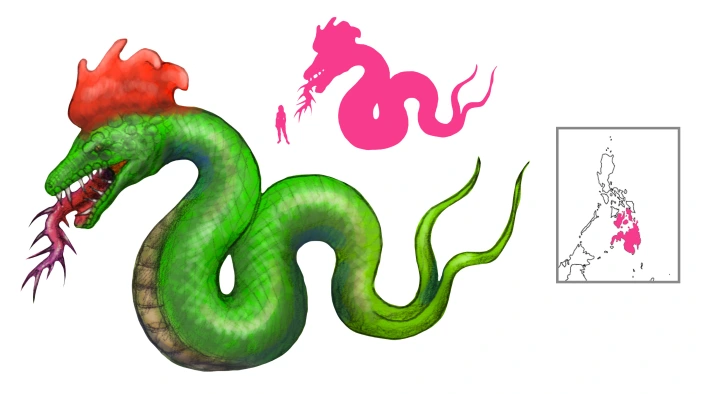
The Markupo is a serpent known to the Hiligaynon of the Philippines. It lives in the highest mountains of the historical province of Bulgas, between Marapara and Canlaon.

In appearance the markupo is a huge snake with a distinctive red crest. Its long tongue has thornlike hairs. It has sharp tusks and a forked tail.

The markupo sings sonorously on clear days. Its exhaled poison is instantly lethal to the touch. If sprinkled on plants, this poison withers the plant, kills any birds that land on it, and kills any beast touched by its shadow.

References

Ramos, M. D. (1971) Creatures of Philippine Lower Mythology. University of the Philippines Press, Quezon.

Ramos, M. D. (1973) Filipino Cultural Patterns and Values. Island Publishers, Quezon City.

Tompondrano

Variations: Tòmpondràno, Tompon-drano, Tompoudrano

Tompondrano final

Tompondrano, “lord of the water” or “master of the water”, applies to multiple concepts within the folklore of Madagascar. For our purposes, it refers to at least two types of water snake – one which was commonly encountered in day-to-day life, and an undefined marine monster. Whales, sharks, and crocodiles are also known as tompondrano; the Sakalava proverb “the amby never leaves the master of the water” apparently refers to the pilotfish. The alternative spelling of tompoudrano is phonetically identical to tompondrano in French.

The tompondrano is a water-snake blessed by the Vazimba, a mythical ancient race that lived in the center of Madagascar. For this reason it is respected as a sacred animal. It should not be killed, and dead tompondranos are wrapped in red silk in the same way as human corpses. Tompondranos are good swimmers, often seen crossing ponds and rivers in the forest, but they are not notably large (the largest snake in Madagascar, the akoma or Madagascar ground boa, is some 2.7 meters long).

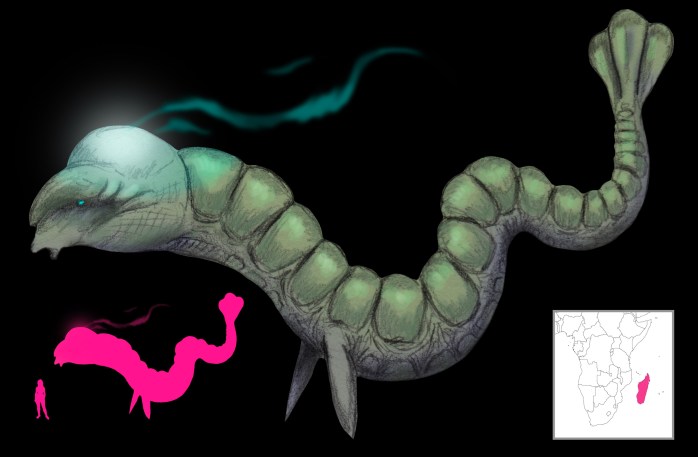
A very different tompondrano was seen by G. Petit in 1926, on the night a cyclone was announced. He describes seeing bright and fleeting lights produced intermittently every few seconds, something like a much weaker signal beacon of a ship. They were emitted by a large aquatic body rolling on its axis and leaving an indefinitely long phosphorescent trail behind it. Petit was later told by Vezo informants that he had seen a tompondrano a creature 20 to 25 meters long, large and flattened, with hard plates on its body and a tail like that of a shrimp. It is the tompondrano’s head that is luminous. Its mouth is ventrally located, and the creature turns itself upside down to attack targets on the surface. There is a retractable fleshy hood that protects the eyes. It is either legless or has appendages like those of whales. To ward off its unwelcome attentions, an axe and a silver ring are suspended at the bows of boats.

References

Birkeli, E. (1924) Folklore Sakalava. Bulletin de l’Academie Malgache, IV, pp. 185-417.

Jourdran, E. (1903) Les Ophidiens de Madagascar. A. Michalon, Paris.

Romanovsky, V.; Francis-Boeuf, C.; and Bourcart, J. (1953) La Mer. Larousse, Paris.

Sibree, J. (1896) Madagascar Before the Conquest. Macmillan, New York.
Origorúso

Variations: Oriogorúho, Orio-goruhu; Suguma; Poópoó

Origoruso

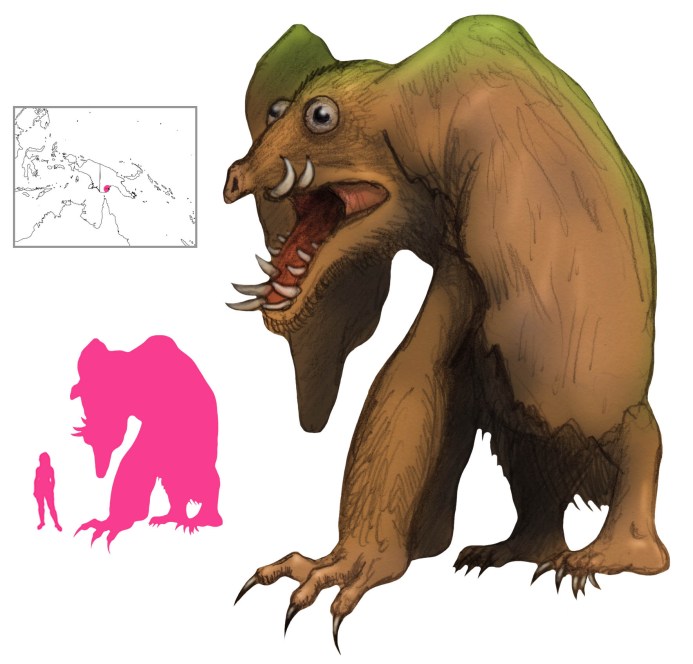
The Origorúso (Kiwai) or Oriogorúho (Mawata) is a man-beast, an ogre from the folklore of the Kiwai islanders of Papua New Guinea. Its name is derived from the fact that it eats (orúso) its food raw (orío).

An origorúso has very short legs, and supports itself on its hands while walking. It has huge eyes and enormous ears; its cavernous mouth has protruding tusks like those of a pig. The tusks are superfluous, as an origorúso swallows its prey whole and raw.Its fingers are armed with long claws. Male origorúso have two penises. An origorúso can make a sound like a loud grunt or roar, but it can also speak normally with people.

At night an origorúso lies on one of its oversized ears, and uses the other as a blanket. By day the ears are usually rolled up.

Origorúsos live underground or inside large trees. They raid villages to carry off and eat people. Sometimes an origorúso will enter a village and devour everyone in one house before leaving. An origorúso used to carry off a child in a village every day, until a cripple guarding a little boy tied a string around the child’s leg. When the cripple went to sleep, the origorúso pulled on the child, and by doing so pulled the string and alerted the man. Everyone in the village wisely fled, with the exception of a man, a woman and their child. They managed to appease the origorúso by throwing pigs at it until it fed and went to sleep. Then they left behind a coconut shell full of lice collected from their child; the lice answered the origorúso’s calls and detained it while they made good their escape.

Sometimes humans can become origorúsos under the right condition. A Kiwai woman in childbirth, upon being insulted by her husband, transformed into an origorúso who pursued the husband relentlessly. A man who lived a while with a friendly origorúso slept in the creature’s ears and ate raw meat; it was all fine until the man’s ears started to grow as big as the origorúso’s. “You got bed, I got bed; you got mat, I got mat”, the origorúso said cheerfully. But the man, terrified, ran back home and hid among his people. It was all in vain. The origorúso, angered, lay siege to the village, and with him came other origorúsos, the horrific útumos that are the ghosts of decapitated men, and other vile spirits. They did not leave until the escapee was given to them, torn apart, and consumed.

Fragments of origorúso bone make potent fighting medicine and are given to dogs.

The origorúso is only one of a number of creatures with enormous ears used to sleep in. The Bina people refer to their oriogorúho as female and nocturnal. The Suguma seems to be synonymous with the origorúso. The Poópoó also has huge ears, and has skin covered with po (knobs); it either has huge tusks or normal-sized teeth, and it otherwise looks like a normal man.

References

Beaver, W. N. (1920) Unexplored New Guinea. Seeley, Service & Co. Limited, London.

Kirtley, B. F. (1963) The Ear-Sleepers: Some Permutatios of a Traveler’s Tale. The Journal of American Folklore, 76(300), pp. 119-130.

Landtman, G. (1917) The Folk-tales of the Kiwai Papuans. Acta Societatis Scientiarium Fennicae, t. XLVII, Helsingfors.

Landtman, G. (1927) The Kiwai Papuans of British New Guinea. MacMillan and Co. Limited, London.

Famocantratra

Variations: Famocantraton (Dapper)

Famocantratra

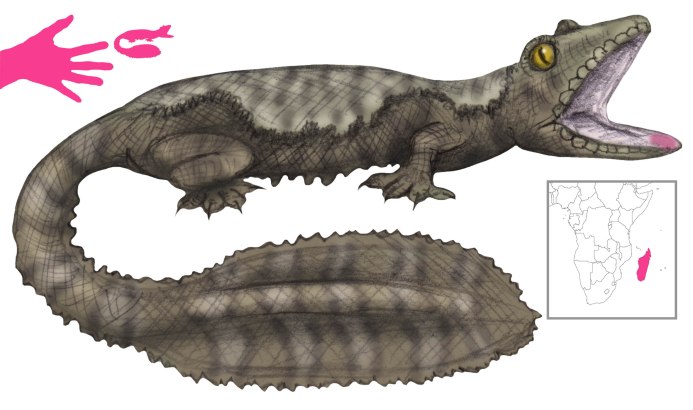
The Famocantratra (as Flacourt describes it) or Famocantraton (in Dapper and subsequent works) is a small lizardlike animal found in Madagascar. Its name means “leaper at the chest”.

The famocantratra’s back, chin, and top of its neck, legs, and tail are made of small paws or claws which allow it to adhere to trees like glue. It is almost impossible to see as it sticks to trunks. Its mouth is always open to capture insects and other small invertebrates.

It will leap onto the chest of anyone who passes by, and it holds on so fast that the skin has to be sliced off with a razor. For this reason it is feared and avoided by the natives of Madagascar.

References

Dapper, O. (1686) Description de l’Afrique. Wolfgang, Waesberge, Boom, & van Someren, Amsterdam.

de Flacourt, E. (1661) Histoire de la Grande Isle Madagascar. Francois Clouzier, Paris.

Bès

Variations: Hantu (Malay)

The Bès are the evil spirits of the Jah Hut, an Orang Asli people from peninsular Malaysia. They are true spirits, existing independently and not emerging from humans alive or dead. The vast majority of bès, or hantu as they are known in Malay, are malevolent beings associated with disease. Far less numerous than the bès are the jin (underground spirits), nabi (guardian spirits), and kemoch (spirits of the dead).

All the bès were created along with ‘iblis, the evil one, by Proman, God’s assistant, who botched the creation of the first man. Their great stronghold is a Pauh Janggi Bringin Sungsang, a “Giant Mango Tree Entwined by a Strangler Fig”, that stands beyond the ocean. From there they sally forth to cause all kinds of trouble. God allows it because the bès keep the world in balance, taking life that others may in turn live.

Sickness is caused by the influence of the bès. This usually happens by night – while we sleep, our soul leaves our body and wanders in the jungle. A bès who finds that soul will prevent it from returning, and the owner of the soul will fall ill.

Healing is the duty of the puyang or medicine man. It is their job to locate the missing soul and return it with the help of the good spirits, otherwise their charge will die. The běni’sòy ceremony is used in those cases. It involves drawing the evil spirits out of the body and transferring them into a palm leaf bundle brushed over the skin. Once the bès is trapped, the bundle can be safely disposed of.

Spiritual wood carvings of the bès in question are made to help draw the evil spirit out. These carvings establish an iconography for the bès and allow us to see them as the Jah Hut do.

References

Teoh, B. S. (1986) Bes Hyang Dney: A Jah Hut Myth of Peninsular Malaysia. Journal of the Malaysian Branch of the Royal Asiatic Society, 59(2), pp. 139-144.

Werner, R. (1975) Jah-hět of Malaysia, Art and Culture. Penerbit Universiti Malaya, Kuala Lumpur.

Bès Bulong

Variations: Hantu Bulong (Malay), Bulong, Spirit Bulong

Bes Bulong

Bès Bulong, the spirit Bulong or simply Bulong, is a bès or spirit from the folklore of the Jah Hut people of Malaysia. It walks around by night. If it sees anyone walking about between midnight and 6:00 AM, it will pull out that person’s soul and leave them unconscious.

References

Werner, R. (1975) Jah-hět of Malaysia, Art and Culture. Penerbit Universiti Malaya, Kuala Lumpur.

Bès Dangon

Variations: Hantu Punggong (Malay), Buttock Spirit

Bes Dangon

The Bès Dangon, “buttock spirit”, is a bès or spirit from the folklore of the Jah Hut people of Malaysia. It lives on the top of coconut trees, and the heat of its urine and stool eventually kills the trees. Anyone who tries to climb an inhabited tree is kicked back down.

References

Werner, R. (1975) Jah-hět of Malaysia, Art and Culture. Penerbit Universiti Malaya, Kuala Lumpur.

Bès Jě’la Kòy

Variations: Hantu Kepala Berduri (Malay), Spiky-head Spirit

The Bès Jě’la Kòy, “spiky-head spirit”, is one of many bès or spirits from the folklore of the Jah Hut people of Malaysia. It lives on top of termite hills and knows how long every person will live. If it judges that a person’s lifespan is too short, it will take them into the termite hill to be friends with it forever.

A spiky-head spirit takes one person a year into its termite hill.

References

Werner, R. (1975) Jah-hět of Malaysia, Art and Culture. Penerbit Universiti Malaya, Kuala Lumpur.