Xicalcoatl

Variations: Jicara Snake, Chocolate Cup Snake, Malinche

xicalcoatl

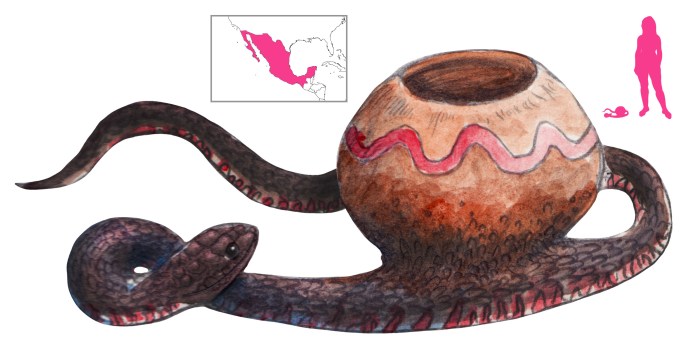
Both large and small varieties of the Xicalcoatl, the Aztec “Chocolate Cup Snake”, exist, and may be found in the waterways of Mexico. They are black in color with variegated bellies. When they reach maturity, xicalcoatls develop an excrescence on their backs. This natural growth looks like a jicara (a gourd chocolate cup) down to the last detail, with colorful designs and patterns on its smooth surface.

Xicalcoatls lure humans to their doom by submerging themselves in water and allowing the painted jicara to show above the surface. A passer-by, seeing the chocolate cup seemingly floating on the water, will try to seize it, but their attentions only cause the cup to drift further and further away. When the victim reaches a sufficient depth, the xicalcoatl causes the water to churn and drown the unfortunate chocolate-seeker.

A watered-down version of this tale persists in Mexico in the form of the evil fairy Malinche, who leaves painted chocolate cups in the water to tempt children.

References

Nuttall, Z. (1895) A Note on Ancient Mexican Folk-lore. The Journal of American Folklore, v. 8, no. 29, pp. 117-129.

Sahagun, B. (1830) Historia General de las Cosas de Nueva España, v. III. Alejandro Valdés, Calle de Santo Domingo, Esquina de Tacuba, Mexico.

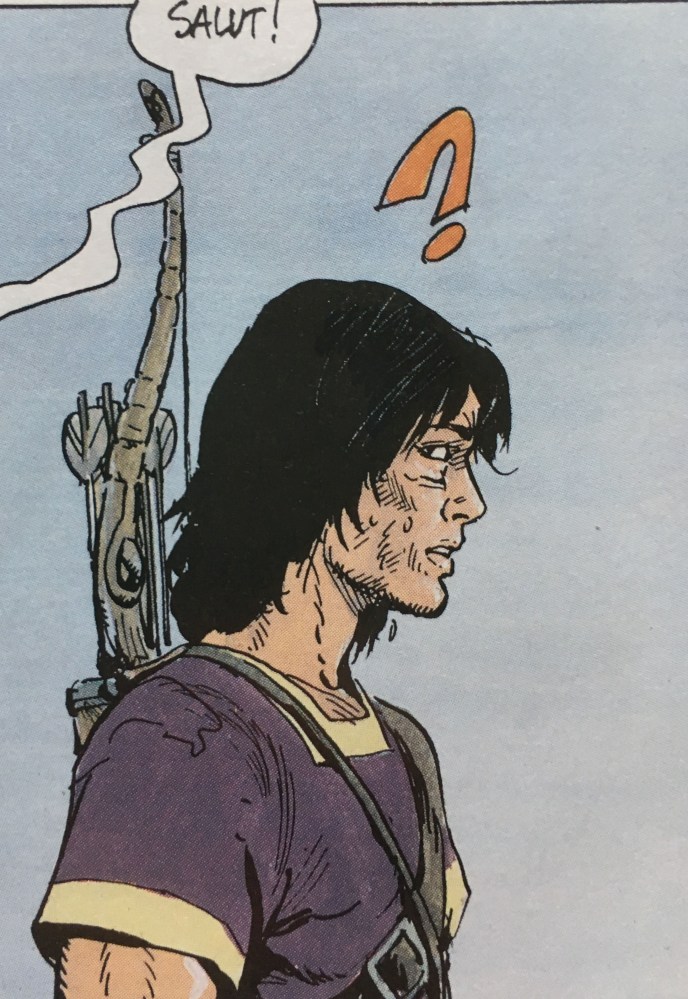
Today’s obscure modern monster comes from the pages of Thorgal, a fantasy/science-fiction BD series by Jean van Hamme and Grzegorz Rosinski. In it our titular hero Thorgal Aegirsson, a space-faring alien raised as a Viking (long story), and his long-suffering wife Aaricia face insurmountable odds and enemies like the brutal Viking chieftain Gandalf-the-Mad, the sleazy Volsung of Nichor, the sinister Shardar of Brek Zarith, Nidhogg the Serpent, and, of course, Kriss of Valnor. You get the idea.

In Géants (Giants), one of his many adventures, Thorgal finds himself on a journey to Jotunheim in order to recover the memories he lost in the Invisible Fortress (long story). His guide, a Valkyrie, drops him off at the border and warns him of the Guardian. So, for our purposes this story begins here, with Thorgal exploring the barren wastes surrounding the land of the Giants.

photo-1-18-17-12-05-19-pm

That’s when he is hailed by an unfamiliar voice…

photo-1-18-17-12-05-28-pm

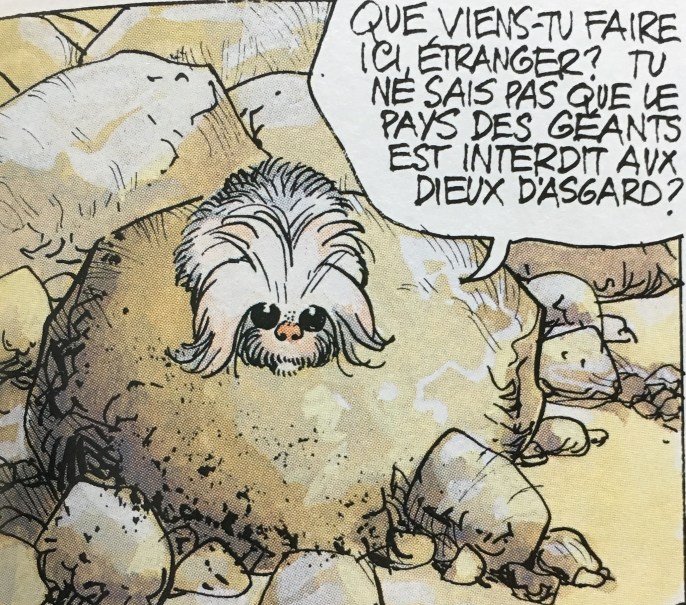
… and he turns around to find a sort of fluffy shih-tzu type critter, clearly demanding that Our Hero show some ID and justify his existence.

photo-1-18-17-12-05-35-pm

Naturally Thorgal is enamored of the cute doggo, and obligingly gives it head skritches on demand. He asks if the creature is the guardian, whereupon it responds that we are the guardian.

photo-1-18-17-12-05-40-pm

That’s right, the little furballs are everywhere.

photo-1-18-17-12-05-47-pm

“They’re so cute!” exclaims Our Hero. “I’ll admit I wasn’t expecting such a charming welcome…”

photo-1-18-17-12-05-57-pm

D:

photo-1-18-17-12-06-25-pm

D8

photo-1-18-17-12-06-39-pm

Of course Thorgal manages to escape by the skin of his teeth and goes on to his exploits among the giants, which include befriending a not-so-little girl and escaping the clutches of a two-headed falcon (long story). For the return journey he benefits from the same cop-out ride home started by Tolkien, namely eagles a Valkyrie swan. The poor Guardian is left thoroughly nonplussed.

photo-1-18-17-12-07-13-pm

I feel your pain, little head.


Kăk-whăn’-û-ghăt Kǐg-û-lu’-nǐk

Variations: Akhlut (erroneously)

kakwanugat-kegurlunik

Around the coastlines of the Bering Strait, pack ice constantly breaks off and floats away. If there are wolf tracks on the ice, and a chunk of that breaks loose, then it looks as if the prints lead into the water’s edge, or as if a wolf came out of the sea. Yupik folklore holds that this is evidence of the Kăk-whăn’-û-ghăt Kǐg-û-lu’-nǐk.

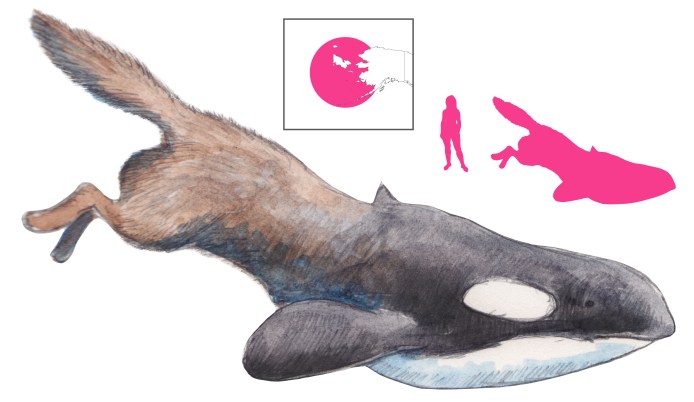
A kăk-whăn’-û-ghăt kǐg-û-lu’-nǐk is a killer whale (akh’-lut) that can shapeshift at will into a wolf (kǐg-û-lu’-nǐk) to hunt on land. The name of kăk-whăn’-û-ghăt kǐg-û-lu’-nǐk is applied to those creatures when in wolf form. They are aggressive and will kill humans if given the chance.

The kăk-whăn’-û-ghăt kǐg-û-lu’-nǐk is typically depicted as halfway through its transformation – whale at one end and wolf at the other. The beluga whale and caribou are a similarly symbiotic pair, becoming a whale in the sea and a reindeer on land.

References

Nelson, E. W. (1900) The Eskimo about Bering Strait. Extract from the Eighteenth Annual Report of the Bureau of American Ethnology, Government Printing Office, Washington.

Apep

Variations: Āpep, Āapep, Aaapef, Apophis, Rerek; further names from the Papyrus of Nesi-Amsu listed by Budge are Nesht, Tutu, Hau-hra, Hemhemti, Qettu, Qerneru, Iubani, Amam, Hem-taiu, Saatet-ta, Khermuti, Kenememti, Sheta, Serem-taui, Sekhem-hra, Unti, Karau-anememti, Khesef-hra, Seba-ent-seba, Khak-ab, Khan-ru… uaa, Nai, Am, Turrupa, Iubau, Uai, Kharubu the Four Times Wicked, Sau, Beteshu

apep

Apep, Āapep, or Apophis in Greek, is the chief chthonic monster in the Egyptian cosmogony, born during the dark times of the First Intermediate Period and depicted as an enormous serpent with winding coils or alternatively as a giant crocodile, or with a human head and hands as in the Stele of Taqayna. He is described as being a hundred and twenty cubits (55 meters) long, or otherwise thirty cubits (14 meters) long, with the first eight cubits made of flint and with coils like sandbanks, lying on a sandbank 450 cubits (205 meters) long.

Apep is darkness, cloud, wind, rain, mist, and storm. The antithesis of light and life, his primary goal is the destruction of the sun god Ra and his solar barque, causing the elimination of light and day and the victory of chaos and darkness. Assisted by a retinue of lesser demons and serpents – the mesu betshet or “children of rebellion”, the snakes Seba, Af, and Nak, and the crocodile Seshsesh – he hides under the earth and below the horizon, and attempts to swallow Ra’s barque every night. Ra, aided by his cortège of gods, thwarts Apep’s attempts time and time again, allowing the sun to rise once more. Occasionally Apep gains the upper hand, causing storms, earthquakes, and solar eclipses, but those end as Ra is cut free from Apep’s stomach. The serpent’s inevitable fate is to be chopped up into pieces and cast back into the abyss, but he always returns the following night, as full of malice and venom as ever, in an endless cycle of destruction.

In a mythology revolving around the sun, Apep, sworn enemy of Ra, darkness personified, is as evil a creature as could exist in the Egyptian pantheon. Some degree of respect was granted him; the Hyksos pharaoh Apepi (r. 1590 – 1550 BCE) took him as his namesake, in a perverse move likely intended to instill fear in the native Egyptians. As a deity, he was never worshipped, but always avoided, spited and mutilated in effigy during natural disasters.

The apotropaic “Book of Overthrowing Apep” (4th century BCE) provides helpful instructions for the faithful, including exhortations for “Spitting on Apep”, “Trampling on Apep with the Left Foot”, “Taking the Knife to Smite Apep”, “Taking the Lance to Smite Apep”, “Putting Apep on the Fire”, “Fettering Apep”, and other such activities. The Book of the Dead features the soul of the deceased piercing Apep, praying for aid in destroying Apep at the apex of his power. Apep’s gruesome punishment is described at length – he is to be speared, stabbed with knives, each bone of his body separated by red-hot knives, scorched, roasted, and consumed by fire. Each name of Apep had to be cursed separately, and the Papyrus of Nesi-Amsu lists the serpent’s many names.

In time the role of Apep as the enemy of the Sun overlapped with that of the desert god Set, once the primary defender of the solar barque from Apep’s depredations, such that Apepi is described in ca. 1274 BCE as a monolatrous worshipper of Set.

References

Aldington, R. and Ames, D. trans.; Guirand, F. (1972) New Larousse Encyclopedia of Mythology. Paul Hamlyn, London.

Ames, D. trans. (1965) Egyptian Mythology. From Mythologie Generale Larousse. Paul Hamlyn, London.

Budge, E. A. W. (1913) The Papyrus of Ani: a reproduction in facsimile, vol. I. G. P. Putnam, New York.

Budge, E. A. W. (1913) The Papyrus of Ani: a reproduction in facsimile, vol. II. G. P. Putnam, New York.

Budge, E. A. W. (2015) The Gods of the Egyptians, vol. I. Dover Publications Inc., New York.

Budge, E. A. W. (2015) The Gods of the Egyptians, vol. II. Dover Publications Inc., New York.

ElSebaie, S. M. (2000) The destiny of the world: a study on the end of the universe in the light of ancient Egyptian texts. M.A. diss., University of Toronto.

Faulkner, R. O. (1937) The Bremner-Rhind Papyrus: III: D. The Book of Overthrowing Apep. The Journal of Egyptian Archaeology 23, no. 2, pp. 166-185.

Simpson, W. K., Faulkner, R. O., and Wente, E. F. (2003) The Literature of Ancient Egypt. Yale University Press, New Haven.

Turner, P. (2012) Seth – a misrepresented god in the ancient Egyptian pantheon? PhD diss., University of Manchester.

Wilkinson, R. H. (2003) The Complete Gods and Goddesses of Ancient Egypt. Thames and Hudson, London.
Bogey

Variations: Bogie, Boogy, Bogy, Bogeyman, Bogyman, Nursery Bogie, and many more

bogey

In its broadest definition, a bogey, bogeyman, or nursery bogie is any monster whose purpose is to scare children into good behavior. In turn, bogeys can punish different kinds of behavior, or even attack without provocation; they can be the cause of unexplained events or be in league with parents; they can be linked to specific areas, or show up on feast days and holidays. Any creature can be a bogey, with the only restriction being their use as a warning (i.e. “don’t go outside at midday or snakes will bite you”). Bogeys are probably the most ancient and widespread of creatures, and will continue to thrive as long as creative parents and gullible children exist. The proliferation of characters such as Slenderman is further proof of these child-snatchers’ enduring appeal.

The Bag Man is the classical bogey. Variations on a man (or woman, or monster) carrying a sack or basket can be found wherever bogeys exist. They are large, hirsute, and fanged. Often they have horns and cloven hooves, the remnants of their origin as demons and devils. Sometimes they are described in ethnically-charged terms, and named after feared and otherized minorities. Bag Men seek out unruly children and stuff them into their bag, carrying them away for punishment – usually devouring them. The Bag Man is most commonly known as the Bogeyman in English-speaking areas. In France he is the Croquemitaine, but also Bras de Fer, Lustucru, Moine Bourru… The French Babou is no doubt one and the same as the Italian Babau. Spanish-speaking countries contend with El Coco, while Arabic-speakers fear Abou Kees (“Man with a Bag”, literally “Bag Father”). In southern Africa the basket bearer becomes the Isitwalangcengce, a hyena-like creature whose head is the basket in which children are carried off. The Southern Californian Haakapainiži is an enormous grasshopper with a basket on his back.

Christmas Bogeys are an offshoot of Bag Men, often sharing many characteristics with them but restricting themselves to Christmas festivities. The likes of Père Fouettard in France, Krampus in Germany, Zwarte Pieter in Holland, and many others besides intimidate children into good behavior. The other major archetype of festive bogey is the Witch, and she usually works alone. The Italian Befana rewards and punishes children accordingly at the festival of Epiphany. The hag Chauchevieille attacks the unfaithful who skip midnight mass on Christmas Eve. Frau Gaude drives a pack of hellhounds through town on Christmas Eve. The Guillaneu of the Vendée rides a headless and tailless horse on the New Year. Trotte-Vieille of the Haute-Saone impales naughty children on her long horns, but can be placated with a cauldron of hot broth on the doorstep. In Lucerne, Straeggel shaves the heads of girls who have not finished their tasks on the last Wednesday before Christmas. The legacy of Christmas bogeys lives on today throughout the Western world, as children are taught to believe in a hairy man dressed in red and carrying a large bag; this man enters houses unbidden and judges children on their behavior, and accepts small offerings of cookies.

Another class of bogeys can be described as “interdictory” or “guardian” bogeys, frequenting certain dangerous areas and dissuading children from going there. One of these is the Green-toothed Hag, found mostly in Britain. There is Grindylow in Yorkshire; Jenny Greenteeth in Lancashire; Nellie Longarms in Cheshire, Derbyshire, and Shropshire; Peg Powler between Yorkshire and Durham, but also other such characters as Marrabbecca, who lives in Sicilian wells. They have long arms, sharp green teeth, and straggly hair, and drag children into stagnant pools to be devoured. The Hook Man is another such archetype, including the sinister Jan Haak of Holland whose large hook pulls children underwater. Water-horses such as Mourioche in Brittany also do their job in keeping riverbanks and beaches deserted. In the Ardennes, the waterways are guarded by the crustacean Traîcousse and the bulky lizardlike Mahwot’; the Karnabo’s eerie whistling sounds from abandoned slate quarries. The Biloko of the Congo gruesomely devour anyone who ventures into the deep jungle; the Colombian Abúhuwa and West African Dodo fill a similar role.

Yet other bogeys are harder to categorize. The Bells of Wallonia, whose ringing causes children to freeze in the middle of whatever grimace they are making. The Camacrusa of Gascony is a disembodied leg that eats children. Scandinavian Church Grims haunt places of worship. The Wallonian Colôrobètch nips children and inflicts them with frostbite. In Russia, the Domovoi and his associates can be used by parents for more sinister purposes. Gatta Marella is a nightmarish alpine cat. Lamiae and Striges are nocturnal predators of children in Greece. Used floorboards (lattes usées) in Mons and Tournai, France, become Latusés, bogeys that keep children out of the attic. The reptilian Whowie and the froglike Yara-ma-yha-who are invoked in Australia.

All of which goes to prove that, when it comes to the art of frightening children, humanity has no equal.

References

Callaway, C. (1868) Nursery Tales, Traditions, and Histories of the Zulus. Trübner and Co., London.

Canobbio, S. (1996) “Se non fai il bravo viene…” A proposito degli spauracchi per bambini. In Les Etres Imaginaires dans les Recits des Alpes. Imprimerie ITLA, Aoste.

Dubois, P.; Sabatier, C.; and Sabatier, R. (1992) La Grande Encyclopédie des Lutins. Hoëbeke, Paris.

Dubois, P.; Sabatier, C.; and Sabatier, R. (1996) La Grande Encyclopédie des Fées. Hoëbeke, Paris.

Dubois, P.; Sabatier, C.; and Sabatier, R. (2005) The Complete Encyclopedia of Elves, Goblins, and Other Little Creatures. Abbeville Press.

van Hageland, A. (1973) La Mer Magique. Marabout, Paris.

Heiniger, P. Les Formes du Noir. In Loddo, D. and Pelen, J. (eds.) (2001) Êtres fantastiques des régions de France. L’Harmattan, Paris.Lambot, J. (1987) L’Ardenne. Pierre Mardaga, Brussels.

Knappert, J. (1971) Myths and Legends of the Congo. Heinemann Educational Books, London.Rose, C. (2000) Giants, Monsters, and Dragons. W. W. Norton and Co., New York.

Laird, C. (1976) The Chemehuevis. Malki Museum Press, Morongo Indian Reservation, Banning.

Lawson, J. C. (1964) Modern Greek Folklore: A Study in Survivals. University Books.

Sébillot, P. (1882) Traditions et superstitions de la Haute-Bretagne. Maisonneuve et Cie, Paris.

Tijskens, J. (1965) Les Noms du Croquemitaine en Wallonie. Enquêtes du Musée de la Vie Wallonne, nos. 117-120, tome X, pp. 257-391.

Tremearne, A. J. N. (1913) Hausa Superstitions and Customs. J. Bale and Sons and Danielsson, Ltd., London.