Chimalcoatl

chimalcoatl

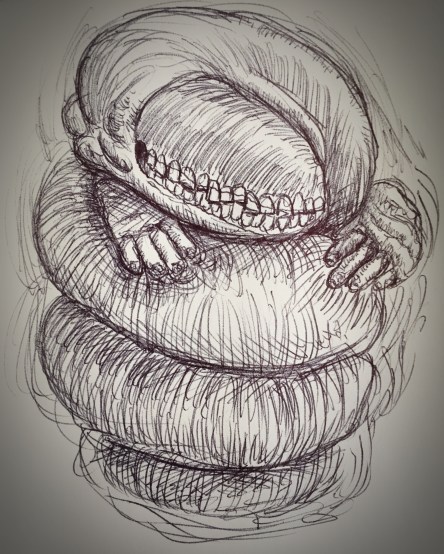
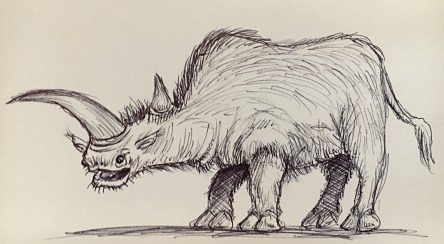
The Chimalcoatl, “shield snake”, is a long, thick Mexican snake. It earns its name from the fleshy, colorful shield on its back. Its appearance is an omen of death or prosperity and fortune in war, depending on the occasion.

References

Nuttall, Z. (1895) A Note on Ancient Mexican Folk-lore. The Journal of American Folklore, v. 8, no. 29, pp. 117-129.

Tetragnathon

Variations: Tetragnathus, Tetragnathius, Solipuga Solipaga, Salpuga, Solifuga

tetragnathon

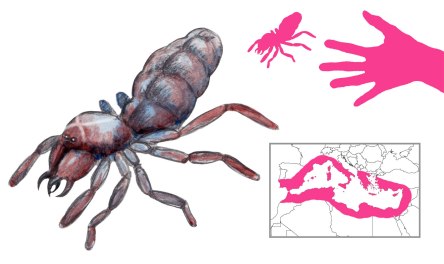
The Tetragnathon, “four-jawed”, is described by Classical authors as a sort of phalangion, or harmful spider. It is so fearsome that the people neighboring the Akridophagi (locust-eaters) were driven away by swarms of tetragnathons emerging after heavy rain.

Philoumenos describes two forms of tetragnathon. One is flattened, whitish, rough-legged, with two growths on its head at right angles that give the impression of four jaws. The other has a line that divides its mouth across the middle, producing four jaws. Pliny specifies that the most dangerous tetragnathon is the one with two white lines crossing in the middle of the head; the other is ashen-colored shading to white towards its abdomen. Either way the tetragnathon is deadly, biting when sat upon, but its venom can be cured by fresh spring water.

The tetragnathon is probably a solifuge, a spider-like arachnid with enormous chelicerae. It is nonvenomous, but its huge pincer-like mouthparts – easily interpreted as two sets of jaws – can deliver a painful bite.

References

Beavis, I. C. (1988) Insects and other Invertebrates in Classical Antiquity. Alden Press, Osney Mead, Oxford.

Kitchell, K. F. (2014) Animals in the Ancient World from A to Z. Routledge, Milton Park, Abingdon, Oxon.

Hugag

Variations: Rythmopes inarticulatus (Cox), Reclinor rigidus (Tryon)
hugag

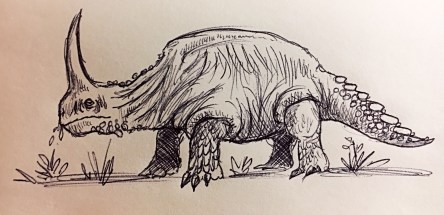
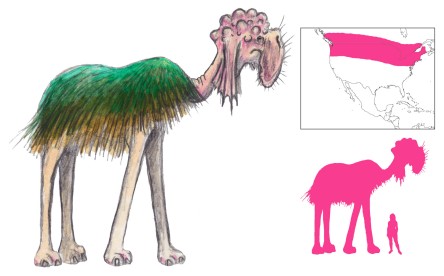
The Animal That Cannot Lie Down is a near-universal tale arrived at independently by multiple cultures and commonly attached to accounts of the moose. The Hugag is another permutation of this theme repackaged for the whimsical world of backwoods tall tales. Whether it came spontaneously into existence, was derived from native tales of the Stiff-Legged Bear, or is a bit of Classical jokery from Cox, none can say for certain.

Hugags are found in lumberwoods territory, including Minnesota, Wisconsin, and Canada, and are the largest beasts of the lumberwoods. Cox describes them as looking like enormous moose, with the chief difference being jointless legs and overdeveloped upper lips. The head and neck are hairless, covered by a leathery skin. The ears are corrugated and floppy. The feet have four toes, and the coat and long tail are shaggy. Tryon adds more detail, giving it a warty snout, a bald, lumpy head, and pine needles for hair. It stands 13 feet tall and weighs up to 6,000 pounds. Pitch oozes from its pores.

A hugag is completely incapable of lying down. It is constantly on the move, browsing from trees by wrapping its upper lip around branches, and occasionally stripping bark. Pine knots are its favorite food. It sleeps by leaning against a tree. Bent trees, posts, and cabins are signs of a hugag’s passing. Hugag hunters can easily bag their quarry by sawing almost completely through a tree, so that when a hugag leans against it the tree collapses, leaving the animal helpless on the ground. Most of the time it is difficult to find hugags, mainly because they disguise themselves as piles of pine slash. Fortunately hugags are quite harmless, barring cases when they lean on houses.

Mike Flynn is the current record-holder hugag hunter, having killed a massive 1,800-pounder on the Turtle River, Minnesota. It was a juvenile.

References

Beck, H. P. (1949) The animal that cannot lie down. Journal of the Washington Academy of Sciences, 39(9), pp. 294-301.

Cox, W. T. (1910) Fearsome Creatures of the Lumberwoods with a Few Desert and Mountain Beasts. Judd and Detweiler, Washington D. C.

Dorson, R. M. (1982) Man and Beast in American Comic Legend. Indiana University Press, Bloomington.

Tryon, H. H. (1939) Fearsome Critters. The Idlewild Press, Cornwall, NY.

Abaia

Abaia

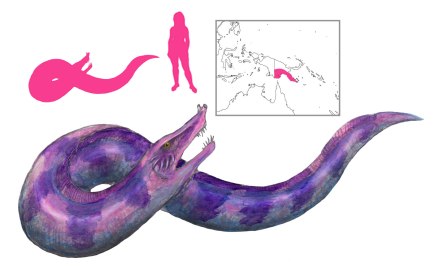
There is a lake in British New Guinea. It is deep and full of fish, and Abaia, the magic eel, dwells at the bottom. Abaia does not like to be disturbed. Like many snakes and eels in Melanesian beliefs, it is closely associated with weather, storms, and floods.

Once a man found Abaia’s lake and caught many fish. Then he invited the other inhabitants of his village to share in the endless bounty. They too filled their nets, and one woman caught Abaia himself, but the eel managed to escape.

In retaliation for this affront, Abaia caused it to rain that night. The lake water rose and everyone drowned – everyone, save for one old woman who sought refuge in a tree. She was the only one who had not eaten any of the fish.

References

Dixon, R. B. (1916) The Mythology of All Races v. IX: Oceanic. Marshall Jones Company, Boston.

C is for… Chang Nam

The minuscule Chang Nam – “water elephant” – of Thailand is a feared and deadly creature. Despite being the size of mouse, this poisonous pint-sized pachyderm can kill merely by stabbing a person’s shadow or reflection.

Reallllly stretching the definition of “modern” here, but I wanted to bring this up in some form anyway. Back in the grim darkness of July 1900, Pearson’s Magazine ran an article by Herbert C. Fyfe and illustrated by Warwick Goble. It was somewhat ominously titled.

theend

The article in question covered a whole bunch of a different catastrophic ends that could befall the world (and specifically humanity), with a lot of reference to H. G. Wells, of course. Below is Goble’s rendition of the “loathsome animals” inhabiting the frozen world of the far future. They’re not so loathsome to me though, considering they look like The Muppet from the Black Lagoon. Cute actually!

loathsome

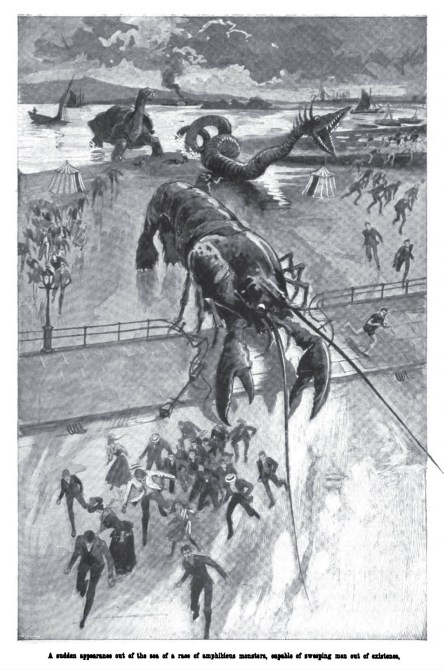
But the most memorable image from the story is what I’ve come to call the Lobsterpocalypse, or “the extinction of man by the enormous increase and spread of a lower order”, or otherwise a really odd misunderstanding of evolutionary timescales. And the most terrifying creature that could do this? A crab.

Fossil remains of crabs, 6ft. in length, have been discovered, and such enormous creatures might – owing to some cause or other – multiply exceedingly.

If we imagine a shark that could raid out upon the land, or a tiger that could take refuge in the sea, we should have a fair suggestion of what a terrible monster a large predatory crab might prove. And, so far as zoological science goes, we must, at least, admit that such a creation is an evolutionary possibility.

Then there are the cuttlefish, the octopus, and other denizens of the deep, any of which might conceivably grow in numbers, and extinguish man.

Goble, however, draws neither crab nor cephalopod, instead placing a huge monster lobster (mobster?) front and center about to make sashimi out of well-dressed turn-of-the-century beachgoers. Accompanying it are a sea serpent and – horror of horrors – a Galapagos tortoise.

lobsterpocalypse

I for one welcome our new crustacean overlords.

B is for… Bøjg

bojg

Peer Gynt runs into the Great Bøjg of Etnedal during his adventures. It is huge, shapeless, slimy, slippery, and misty; it impedes Peer’s movements no matter where he turns. Running into this troll feels like blundering into a den of sleepy growly bears. Which is an adorable simile.