Hound“Now wait a darn minute!” you may find yourself asking. “The Freybug isn’t a modern monster, even if it’s obscure. It’s the Norfolk black dog. It got itself a starring role in William O’Connor’s Dracopedia series (which you should review) and even got name-checked as a Hound in Final Fantasy (pictured). It even got its own Wikipedia entry!” You’d be right as usual, good reader. But I would like to draw attention to the dearth of information regarding this Freybug. What is it? Where did it come from? Why was it used in the Dracopedia and Final Fantasy?

It’s all about the name really. Final Fantasy needed another black dog name, and the Dracopedia needed something fancy and frightening for the letter F. Besides, it has the words frey and bug. Two great tastes that taste great together.

As with many obscure creatures, Giants, Monsters, and Dragons is the ultimate source. What does GMaD tell us?

This is the name of a monster in the medieval traditions and folklore of England. It took the form of a monstrous black dog that patrolled the country lanes at night terrifying late travelers and making them flee in horror. It is mentioned in an English manuscript of 1555.

There is only one reference provided, which hilariously is Rose’s other book, Spirits, Fairies, Gnomes, and Goblins. And SFGaG says the following.

This is the name of a demon of the roads in English folk beliefs of the Middle Ages. It was described as a Black Dog fiend and referred to in an English document of 1555.

References? None whatsoever. Dead end. I know I’ve complained about it a lot but I’ll say it again.

Source.

Your.

Damn.

Creatures.

This is the only freybug reference I can consistently find. I have no idea where the Norfolk thing came from, considering Shuck is the Norfolk black dog. And Shuck wouldn’t take well to competition, I’d wager.

As things stand we have only Rose’s word for it that the freybug is from an “English manuscript” from 1555. One that’s conveniently uncited. Unless further evidence surfaces (and I have no doubt Rose has access to all sorts of cool manuscripts) I’m inclined to consider this a Borgesian literary in-joke. And if it is, it certainly would be a modern creature. Quod erat demonsterandum.

51NMDYE9EBL._SX334_BO1,204,203,200_

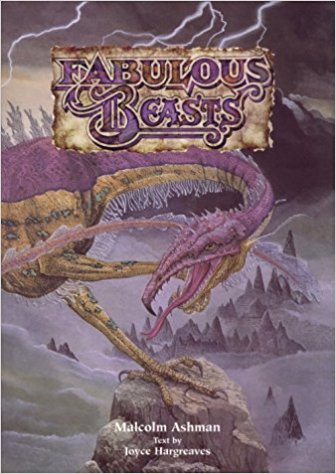
Fabulous Beasts

Malcolm Ashman and Joyce Hargreaves

There are two kinds of modern bestiary (and by bestiary I mean books of fantastic creatures, as opposed to real bestiaries which are books of creatures as moral lessons): the visual and the textual. They aren’t set in stone but fit on a spectrum. I should make a sliding scale graphical representation of it someday. Where was I? Oh, right. Long before a certain bespectacled wizard kid showed up, this was a top hit for beast-related keywords. It fits far on the visual side of the scale. And it is quite the piece of eye candy. Let’s have a gander!

It can be bought here and here.

Scope

“[F]antastic creatures of myth and legend… from every corner of the world”. The focus is, however, Classical and Medieval European as expected. In fact about half of the creatures covered are Greco-Roman.

It’s a bit broader in scope than ABC, including things like gods (Pan, Quetzalcoatl), transformed humans (Blodeuedd, Werewolves), transformed gods (Zeus in swan and bull forms), and ghosts of sorts (Herne the Hunter).

Organization

Some 50 creatures are divided into four sections: Birds, Dragons and Serpents, Half Human, and Animals (meaning Mammals). The divisions are basic but with a smaller number of creatures they do fine (even if you could argue that some creatures go in different categories; fabulous beasts always did defy classification).

Text

The text is by Joyce Hargreaves, and it’s serviceable. Does a good job of retelling classic tales, as well as things like Borges’ creatures.

There are some parts where there’s some disconnect between text and art – Typhon has a body covered with feathers apparently, but it’s not shown there (unrelated but this book seems to be the origin of the Typhon-with-a-donkey’s-head meme?).

Images

If you’re buying this book, you’re buying it for the illustrations by Malcolm Ashman. And oh, what illustrations they are. The Simurgh, the Nile Goose, the Lambton Worm coiled around rolling hills… they’re all colorful (pencil drawings excluded) and evocative. They’re definitely worth the price of entry, and stand up to repeated viewing.

There are some interesting takes on things. The Cyclops is made completely monstrous – I’m talking crocodile osteoderms on the legs here. The Lamia follows classic snake-tailed conventions but shares the book with a full-color Echidne. Two snake-women in one book? Why not? The Heavenly Cock, Rainbird, and Phoenix are all done up as golden pheasants and birds of paradise and are beautiful to behold. The Roc looks like an Andean condor, which bothers the ornithologist in me, but it looks awesome.

I’m also going to take the brave stance of saying that nobody, but nobody draws pervy animals like Ashman does. Check out his Europa’s bull and Leda’s swan. Zeus isn’t even trying to hide how lecherous he is for hot mortals. Seriously, they’re scary. Gah.

Research

No references, but as mentioned it visibly draws on Borges’ Book of Imaginary Beings as well as the usual stable of giants, monsters, and dragons. Things like the Rainbird are practically illustrated Borges entries. The Peryton tale is retold with a straight face (again). The Simurgh follows Borges’ favored description, itself from Flaubert and originally not applicable to the Simurgh!

The main problem is that there really isn’t anything new to learn for the advanced teratologist. If you’re a regular reader of ABC, then you probably already know about things like the Nemean Lion and the Erymanthian Boar and the Manticore.

Summary

A beautiful, beautiful book that takes familiar creatures and makes them look good. Definitely recommended for the stellar illustrations, but don’t expect to learn anything new or find novel references. A solid rating of 4 in my opinion.

4

Who remembers Atari? That’s a rhetorical question because, despite being in the right age bracket for it, for a number of reasons I’ve never actually played on it. But I knew it existed. And I knew some ads for Atari games. One of them really fired up my imagination. That’s right, I’m here to talk about Space Cavern.

Images from Atarimania.

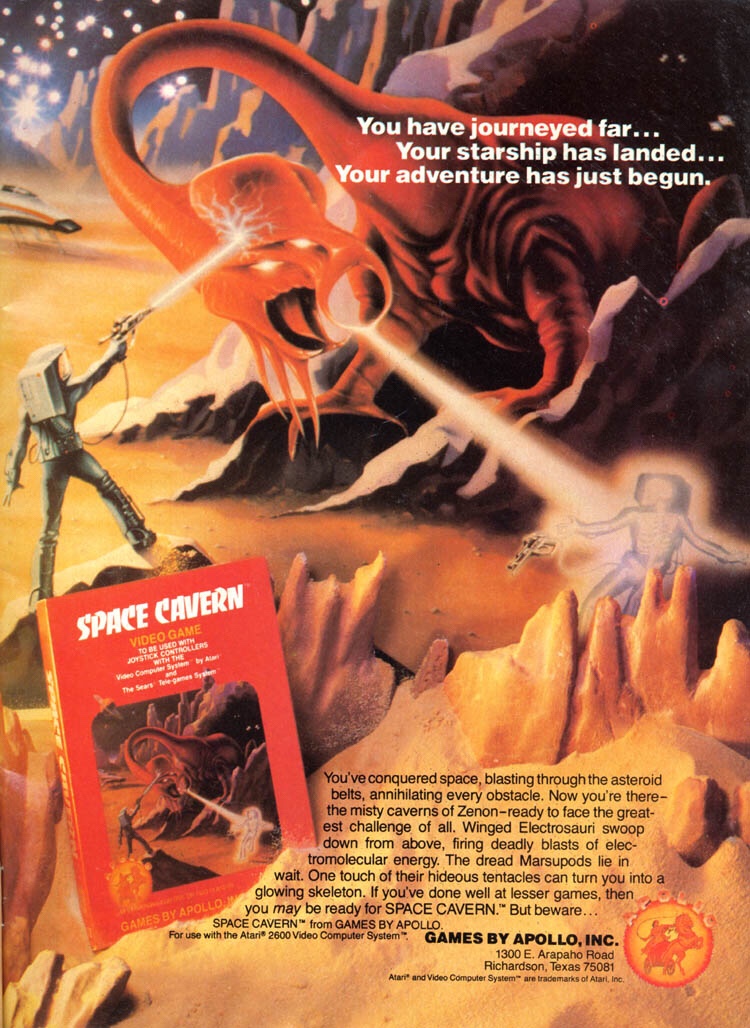
Space Cavern ran an ad in magazines that looked a little something like this.

How awesome is that? Judging by the description that thing is a marsupod. Does it have four eyes or are those spots of bioluminescence? Is that its brain? Is it a demon sauropod that zaps you with lightning? Who knows, it’s metal as all hell. And it scared me somewhat too – I didn’t want to become a skeleton!

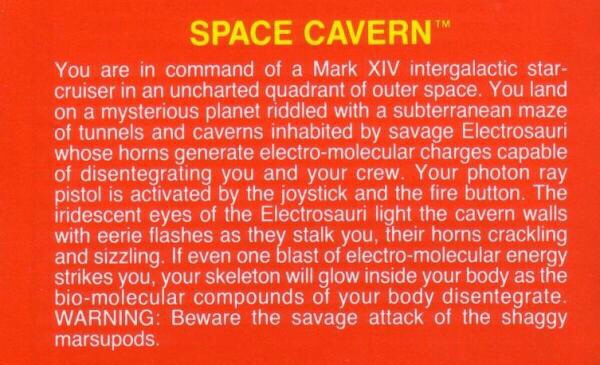
Electrosauri are nowhere in sight though. I always though they must look something like pterosaurs. Electric pterosaurs.

The official description calls marsupods “shaggy”. That… thing… up there does not look shaggy. Unless you’re being charitable about its chin danglers. Still no visual representation of an electrosaurus (?), which makes me sad.

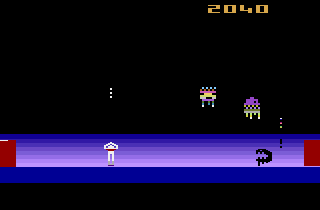
Of course there was a bit of artistic license taken in the art. Actual gameplay looks a little something like this.

The electrosauri are the Space Invader things floating over the horizon, while the marsupod is the evil Pacman emerging from the right-hand side of the screenshot. I don’t know how they got a demon sauropod out of that, please don’t ask.

enc

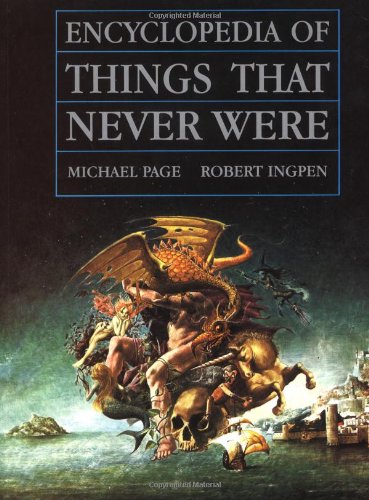
Encyclopedia of Things That Never Were

Michael Page and Robert Ingpen

The Encylopedia of Things That Never Were (EoTTNW for short) is one of the big books of creature reference. And by big I mean it’ll be one of the tallest books on your shelf. It’s not only about creatures either, but it was my introduction to a lot of the more famous and somewhat obscure monsters out there. Is it worth a gander? Let’s find out.

You can get it here and here if you so desire.

Scope

Vast. This has the broadest appeal of any book I’ve reviewed so far. It doesn’t just have creatures, it has gods, heroes, places, esoteric procedures, and literary allusions. You can read up on alectromancy, masks, rattles, swords, and voodoo as well as wizards, dragons, manticores, and gnomes. EoTTNW is an encyclopedia and it’s worthy of that title.

Organization

Six main chapters. Of the Cosmos is gods, heroes, creation myths, and astral beings. Of the Ground and Underground covers terrestrial entites. Of Wonderland discusses places real and imagined. Of Magic, Science, and Invention is about, er, magic, science, and invention. Of Water, Sky and Air does the same for non-terrestrial beings, and Of the Night is about ghosts and vampires and other evil beings.

Each chapter has entries arranged alphabetically, encyclopedia-style in three columns, with artwork taking up to a whole page.

Text

Straightforward and lucid, as befits an encyclopedia. Doesn’t try to be too academic or too flippant, which is good. The pre-chapter essays are nice and atmospheric. A lot of the entries tell a story, too – check out, say, Satan, or Wendigo, or the retelling of the entire Dorian Gray story under “Drawings, Paintings, Portraits etc”.

If you’re just in it for the creatures, those are mainly in chapters 2, 5, and 6. This isn’t a creature book though, more of a big overview of myth and imagination.

Images

Quite lovely and masterfully done. Often somewhat abstract and mood-setting, such as a shapeless Grendel lurching out of the darkness at Beowulf, a tiny ship lost in the Mare Tenebrosum, or a creepy doll-house of omens. There’s the familiar abatwa-and-pet-ant, a sea serpent drowning a whale, Sakarabru looming over a village, the bunyip and the whowie… They’re detailed, colorful, evocative, and sometimes quite spooky.

One problem I do have is the rampant art copying, which is acknowledged off-handedly at the bottom of the very last page. It’s just weird seeing Boticelli’s Venus standing in for the Nereids, or a faithful reproduction of Tenniel’s Jabberwock among the dragons (minus waistcoat, alas). The yakkus on page 84 are copied in the triad on page 218. Stuff like that. It’s not… wrong, I guess, but I’m sure the artist could have done better.

Research

Confusing. There are references at the end (yay!) but not attached to individual entries (boo!). And there is some dodgy research. I’ve mentioned the Acheri thing before on this site, for instance. But why is the ahuizotl a generic lake monster with no mention of its defining traits? Why are the notoriously touchy, poison-arrow-shooting Abatwa described as shy and “not a warlike race”? Why is the Wendigo based entirely on Algernon Blackwood’s version? And where on Earth did the barbegazi come from? I’ve been unable to find them in anything that doesn’t directly come from this book.

Those are, of course, creature-specific complaints. I didn’t see anything especially wrong in other fields but scholars of those may well have their quibbles.

Summary

A great, beautiful, and impressive book, with just enough mistakes and inaccuracies and art issues that I can’t give it an entire 4 gigelorums. It’s still a perfect introduction to fantasy staples in general. While I can’t recommend it as a cornerstone creature reference, it is an outstanding encyclopedia of the fantastic.

3

Cybrids-1920x1080

Who remembers Starsiege? When it came out in 1999 it was my favorite computer game ever, and it still is. Which makes it even sadder that it got upstaged and replaced by Tribes, and even Starsiege 2845, the much-anticipated update, petered out and died with a whimper.

It’s a pity really, because Starsiege was an amazing game. It’s not just the big fighting robots you get to pilot, the meaty boomsticks they use to blast each other to dust, or even the hero brothers both voiced by Mark Hamill (although those are all significant factors…). One of the things that most captivated younger me was the bad guys. The rogue AI. The evil robots. The “cybernetic hybrids”, or Cybrids, who call themselves the NEXT and are also known by the racial slur of “glitch”.

What sets the Cybrids apart from the 4,955,381 other instances of rebelling murderous artificial intelligences? What makes them worthy of the title of monster? Let’s find out.

Images and quotations are either from Starsiege‘s manuals, in-game screenshots, or taken from the Starsiege Compendium, which is an awesome site and you must visit it. Copyright their respective creators.

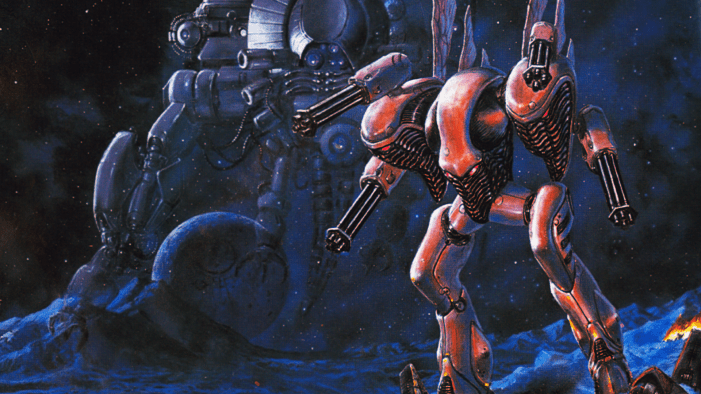
For one thing there’s the combat vehicles, or warforms. Cybrid vehicles are organically grown and modeled with the intent to strike fear into the hearts of humans. And this isn’t just show, as Cybrids are equipped with radiation guns, arachnitron mines, railguns, nanite eaters, particle beams, and other engines of death.

adjudicator

The Adjudicator is one of the pinnacles of Cybrid warform technology. Its appearance was created through “focus-testing” on captive humans, and was designed to have as terrifying a silhouette as possible. Adjudicators are usually deployed for cleansing//purifying population centers.

executioner

Executioners, or “potato bugs” as humans have come to call them, are all business. I love the fins and articulations look Cybrid vehicles have going, and given advanced enough graphics tech we could have seen some really cool alien stuff. So in terms of vehicles alone Cybrids are pretty darn monstrous.
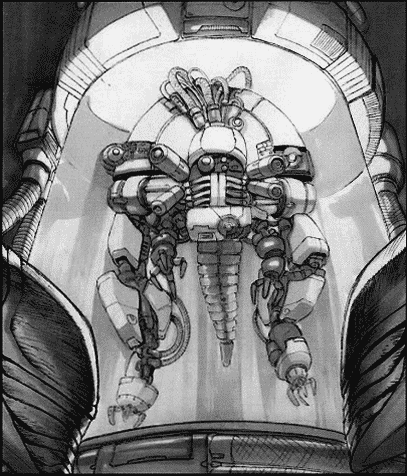
prometheus-cybermatrixLike all good robots, the Cybrids were originally created with the best of intentions. The first Cybrid made, shown here, was Prometheus. IT was the first true artificial intelligence, and IT was tasked with creating more of ITS kind. This new generation of cybrids went on to fight the wars of humanity, up until Prometheus decided that IT could do a better job running the planet, and that humans were a blight that had to be eradicated. You can’t blame IT really. Then followed the Earthsieges and, eventually, the Starsiege, in a series of events that are far too detailed for me to describe here.

Instead, I’ll point out something about the subtleties of Cybrid communication.

Cybrid thought links concepts in a multilayered structure of ideas and “harmonics.” Hence, the term “human\\animals” communicates the primary identifier “human,” while “animals” provides a clarifying harmonic that further details the original concept. Action-oriented concepts or active principles receive a “dynamic” harmonic (represented here by //) whereas passive or object-oriented clusters receive a “grounded” harmonic (shown as \\).

Some terms – such as vehicle designations – contain both active and passive concepts and thus include both types of harmonic, but this use is unusual. names use the same conventions, adding a distinguishing sub-packet to designate a name (A name is represented by ). Cybrids also add an identifier packet when referring to themselves, e.g., or .

So, for instance:

Preliminary studies suggest that 85% of human\\animals will hesitate before offlining//injuring >>children<<.
cybridhub

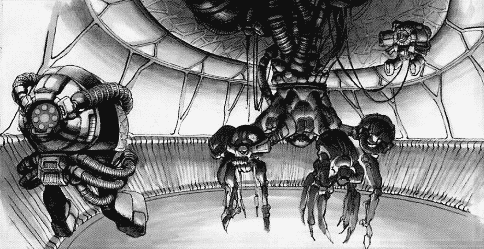
One of Prometheus’ biggest discoveries was that the NEXT needed to have free will and intelligence of their own. It’s not very useful if your entire army can be destroyed just by blowing up one control center (more would-be conquerors should be aware of this). So instead each Cybrid is a full-blown personality, with thoughts and dreams and aspirations just like a human, kept in line by a Byzantine system of castes, hierarchies, and sects. And at the top of it all is Prometheus, holding sway via a cult of personality that sees IT worshipped as a living god.

Starsiege is chock-full of little news snippets and communications briefs – chatlogs, if you will – that give an idea of how the Cybrids (and humans, for that matter) think. This ScanX has virtually no effect on the game and can be easy to miss if you’re just in it for the big robots blowing each other up (which is loads of fun of course).

On the development of a bio-engineered nanite plague. Note the completely detached, clinical observations.

<INQUISITOR SECT>:

Observing//reporting. Nanophage infection of animal units in [location-designate:::
Vancouver] yields//shows promising results. However, rate of human flesh\\meat consumption\\necrosis fails to match//equal Dissector Sect estimates. Combat//tactical utility remains minimal.

<PROVOCATEUR SECT>:

Suggest//query. Decrease nanophage fatality schedule. Increase//lengthen dormacy phase. Expand vector via infiltrator Addendum = infect human\\animal remains and launch//accelerate carrier remains into animal-infested zones\\cities. Optimize broad-band killing efficiency.

<MACHINATOR SECT>:

>>Nanophage<< infiltration uses non-human\\animal vectors [ref. >>cats-dogs-rats-birds<< with superior\\acceptable efficiency. Non-human\\animals do not require conversion, merely infection and subsequent release\\targeting. Theses units successfully enter human habitats and evoke// receive >>sympathy<<.

In the human campaign, there’s a plot thread that was apparently dropped from the final game. ScanX notes read:

MELANIE:
This is Melanie. I’m the only one left, and I’m scared. Is there anybody out there? Please answer! I’m so scared…

PHOENIX:
Melanie? We can’t get a trace… Where are you?

MELANIE:
Here! I’m on Europa! Please help!

PHOENIX:
We’re on our way, sweetheart. Hang tight, ‘K?

And that’s it. You can play the human campaign and kick Prometheus’ iron posterior, but you never hear about Melanie again. Then you see the same exchange on the Cybrid ScanX.

MELANIE:
This is Melanie. I’m the only one left, and I’m scared. Is there anybody out there? Please answer! I’m so scared…

<MACHINATOR SECT>:
Melanie, honey, hold on! Help is on the way. Can you just give us a tracer signal so we know where to find you? Good girl …

<MACHINATOR SECT>:
This is <Shaper-of-Endocrines: Sixth>.

Initiating ‘Siren’ program. Concealed warforms standing by for human\\animal intervention. Human\\animals projected to find program difficult to resist …

<MELANIE>:
This is Melanie. I’m the only one left, and I’m scared. Is there anybody out there? Please answer! I’m so scared…

You have no idea how much this conversation freaked me out when I was littler.

The average Cybrid isn’t evil as much as pragmatic to a fault and utterly amoral. It’s less about “I want to kill people because I can, mwahaha” and more about “I wonder how long a human can survive in a vacuum if its lungs are filled with fluoroantimonic acid”.

<PROVOCATEUR SECT>:
Audio recordings of human\\animal subjects in custody\\experiments of Dissector Sect are now available\\ready for downloading to warforms. Recommend//suggest <units> broadcast//playback these noises at maximum volume when moving through animal warrens\\urban zones.

<MACHINATOR SECT>:
Use of individual live animals attached to chassis of warforms shows interesting\\promising results in disrupting human\\animal response time. Erratic performance\\tactics is noted in 42% of animal opponents who confronted//faced >>hostage<<-equipped warforms. Recommend variance of age and gender of >>human shields<< to determine optimal configuration.

And each Cybrid has its own personality and motivations. For instance, Eats-only-heads has a, er, head fetish and is fascinated with the feeling of “taste”.

eoh

Tyranny probably has a tumblr somewhere.
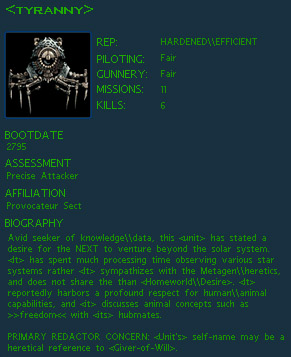
tr

Corinthian-blue was a e s t h e t i c before it was cool.

cb

And pLaGUe-DoG was rebooted multiple times. He’s… unique.
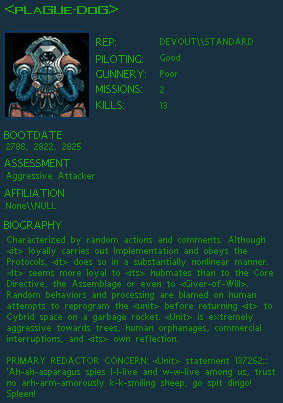
pd

I could post Cybrid communications all day, but just a couple more before moving on. The <Machinator Sect> runs the Trojan Horse infiltration program. Their spies try to blend in with humans, and you can actually see them getting better at English over the course of the game. Early attempts at communication are a bit more awkward.

IMPERIAL NAVY (Mercury):
Stepanovna Base is still not responding. Solar interference in our sector has diminished to negligible levels. Mercury commlinks remain down. Raveler teams report GLORIA is down in Mercury sector. Admiral Hasegawa orders precautionary upgrade of SITREP to Amber Nine. Combat wings are now on standby alert. Resend status queries to Mercury.

<MACHINATOR SECT>:
Stepanovna base here… Negative … Colonel. <We>, ah,we have experienced… technical problems downside, acknowledge? have our … young men… out redacting … commlinks\\antennae… No worries for you, acknowledge? Everything’s moderately low temperature.

They can’t quite get idioms.

<MACHINATOR SECT>

Surrender or we make leather of you! We are kind of nice.

Surrender//submit, human\\\\creator\\\\worms! You will inevitably lose//fail//submit anyway. <We> have you by the short rabbits. Unless you submit//kowtow, we will be forced to tan your epidermis and reduce your offspring to carbonized slag chips. However, <we> are kindly to the disposed of and will treat you efficiently if you cave//roll over now.

human-watchWhat defeated the Cybrids? The human campaign has you killing Prometheus, but it’s strongly implied (and confirmed in the additional material) that it wasn’t just that that finished off the glitches.

Turns out that with free will came dissent. Some Cybrids, calling themselves Metagens, decided they didn’t believe in Prometheus’ doctrine of cleansing the Earth and taking it for their own. They weren’t human-friendly either – at best they respected humans as fellow killers, like we’d respect a tiger or a shark. Others thought humans and Earth were a waste of time, and Cybrids belonged in the stars. They sabotaged Cybrid efforts from within, leaked plans to human forces, and defected en masse when news of Prometheus’s death came through. In the end it was infighting that collapsed the Cybrid invasion.

That isn’t even the whole of it, and the story of Starsiege is not a happy one. The Chase outlines just how brutal the war was, what its lingering effects were, and other such depressing points. But that’s another story…

I had the opportunity to reread George MacDonald’s The Princess and Curdie (TPAC for short) and it wasn’t much fun. MacDonald was the precursor to Lewis and Tolkien, and his moralizing is ham-fisted and unsubtle. It’s a sequel to the superior The Princess and the Goblin, one which focuses on the miner boy Curdie. Our Hero is empowered by one of the vanishing few female mystical figures in Christian fantasy (she’s Gandalf or Aslan, if you will); specifically, she gives him the ability to assess souls by shaking hands. Good people have baby hands, bad people’s hands feel like animal paws.

You see where this is going. (*SPOILERS* I guess for the rest of the review) TPAC is drenched with praise for the divine right of kings to rule and disdain for the disgusting greed of the lower classes. Curdie visits a comically evil town where, apparently, people wake up in the morning every day and decide to be bad. He acts like a jerk, destroys the plot to kill the kindly old king, tortures some plebeians at length (so much that it gets uncomfortable) and eventually becomes king himself because – surprise surprise – he has royal blood in him and so is fit to rule. But then he and the princess die without offspring and the unrepentant sinners of the town mine deep enough that everything collapses. Everyone dies. The end!

I didn’t remember any of that. What I remember from reading it as a child was the monsters.

Ohhh, those monsters. Nobody’s quite sure where they come from. In The Princess and the Goblin they’re the descendants of “regular” animals bred by goblins for subterranean life. In TPAC they’re apparently people whose sinful lifestyle transformed them according to their nature, and they’re now making amends for it. I say apparently because it’s mentioned a few times but not really expounded upon. I loved them to bits at any rate and scribbled them all over my school notebooks at the time.

Let’s see what they are, shall we? The images I’ll be sharing here are by Charles Folkard, Helen Stratton, and Dorothy Lathrop, and will be credited accordingly. All quotes are from TPAC.

monsters helen stratton

Our first and most notable is the one that accompanies Curdie throughout the book. Her name is Lina, and she is the one in the foreground of the image above by Helen Stratton. Her appearance is striking.

She had a very short body, and very long legs made like an elephant’s, so that in lying down she kneeled with both pairs. Her tail, which dragged on the floor behind her, was twice as long and quite as thick as her body. Her head was something between that of a polar bear and a snake. Her eyes were dark green, with a yellow light in them. Her under teeth came up like a fringe of icicles, only very white, outside of her upper lip. Her throat looked as if the hair had been plucked off. It showed a skin white and smooth.

Of course, Lina accompanies our hero, fights and protects him, and is generally a Good Dog. At the of TPAC she apparently dies happily by incinerating herself in a mass of burning magic roses. Yay?

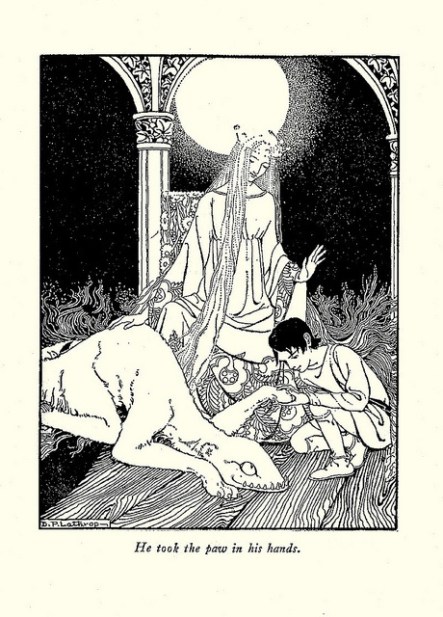
lina dorothy lathroplina paw dorothy lathrop

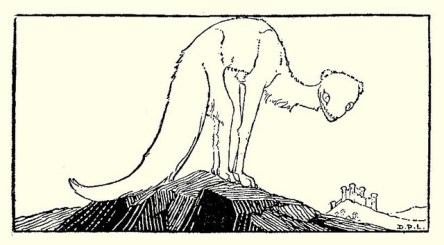
I must admit that Dorothy Lathrop’s version of her (two images above) is adorable.

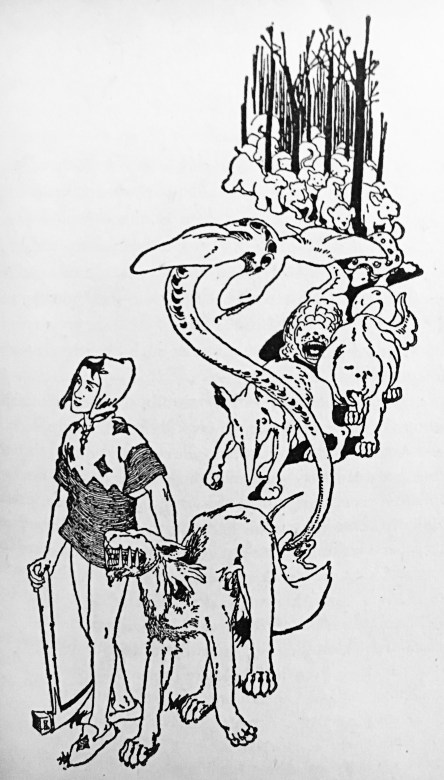
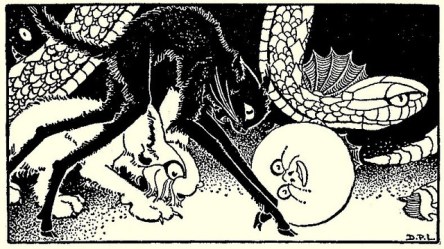
Lina then serves to marshal an army of monsters with which to torment the sinners of the town. Just some of them are shown below in Lathrop’s rendition.

…until at last, before they were out of the wood, she was followed by forty-nine of the most grotesquely ugly, the most extravagantly abnormal animals imagination can conceive. To describe them were a hopeless task. I knew a boy who used to make animals out of heather roots. Wherever he could find four legs, he was pretty sure to find a head and a tail. His beasts were a most comic menagerie, and right fruitful of laughter. But they were not so grotesque and extravagant as Lina and her followers.

monsters dorothy lathrop

Probably the most memorable of the monsters is the “legserpent”.

One of them, for instance, was like a boa constrictor walking on four little stumpy legs near its tail About the same distance from its head were two little wings, which it was for ever fluttering as if trying to fly with them. Curdie thought it fancied it did fly with them, when it was merely plodding on busily with its four little stumps. How it managed to keep up he could not think, till once when he missed it from the group: the same moment he caught sight of something at a distance plunging at an awful serpentine rate through the trees, and presently, from behind a huge ash, this same creature fell again into the group, quietly waddling along on its four stumps. Watching it after this, he saw that, when it was not able to keep up any longer, and they had all got a little space ahead, it shot into the wood away from the route, and made a great round, serpenting along in huge billows of motion, devouring the ground, undulating awfully, galloping as if it were all legs together, and its four stumps nowhere. In this mad fashion it shot ahead, and, a few minutes after, toddled in again amongst the rest, walking peacefully and somewhat painfully on its few fours.

Imagine Archeops’ desperately flapping wings stapled to a python, and you’re already halfway there.

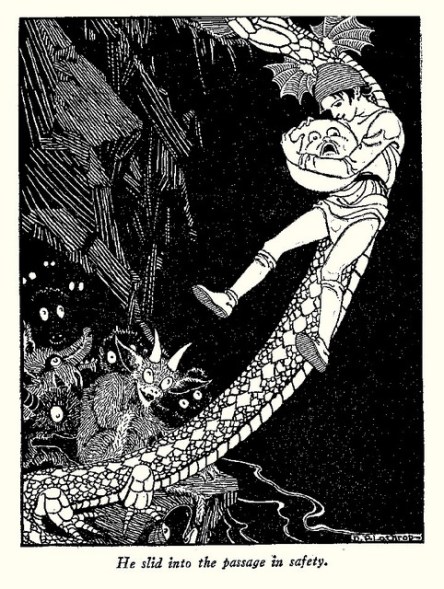
legserpent dorothy lathrop

The legserpent helps Curdie and friends cross a chasm (image above, Dorothy Lathrop), and participates in enacting grisly vengeance on the Lord Chamberlain…

Now his lordship had had a bedstead made for himself, sweetly fashioned of rods of silver gilt: upon it the legserpent found him asleep, and under it he crept. But out he came on the other side, and crept over it next, and again under it, and so over it, under it, over it, five or six times, every time leaving a coil of himself behind him, until he had softly folded all his length about the lord chamberlain and his bed. This done, he set up his head, looking down with curved neck right over his lordship’s, and began to hiss in his face. He woke in terror unspeakable, and would have started up; but the moment he moved, the legserpent drew his coils closer, and closer still, and drew and drew until the quaking traitor heard the joints of his beadstead grinding and gnarring. Presently he persuaded himself that it was only a horrid nightmare, and began to struggle with all his strength to throw it off. Thereupon the legserpent gave his hooked nose such a bite, that his teeth met through it—but it was hardly thicker than the bowl of a spoon; and then the vulture knew that he was in the grasp of his enemy the snake, and yielded. As soon as he was quiet the legserpent began to untwist and retwist, to uncoil and recoil himself, swinging and swaying, knotting and relaxing himself with strangest curves and convolutions, always, however, leaving at least one coil around his victim. At last he undid himself entirely, and crept from the bed. Then first the lord chamberlain discovered that his tormentor had bent and twisted the bedstead, legs and canopy and all, so about him, that he was shut in a silver cage out of which it was impossible for him to find a way. Once more, thinking his enemy was gone, he began to shout for help. But the instant he opened his mouth his keeper darted at him and bit him,and after three or four such essays, with like result, he lay still.

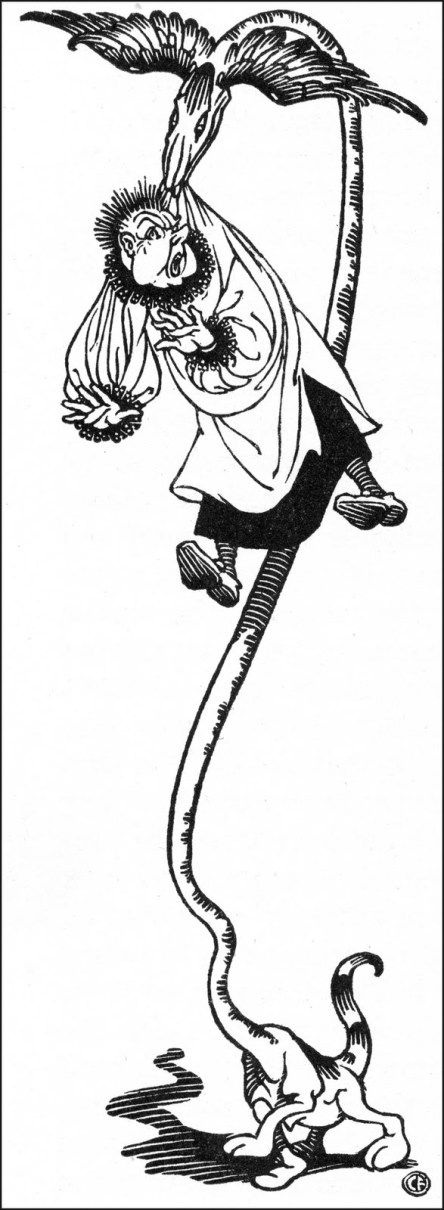
… and the priest on “Religion Day” (image below by Charles Folkard).

At this point of the discourse the head of the legserpent rose from the floor of the temple, towering above the pulpit, above the priest, then curving downwards, with open mouth slowly descended upon him. Horror froze the sermon-pump. He stared upwards aghast. The great teeth of the animal closed upon a mouthful of the sacred vestments, and slowly he lifted the preacher from the pulpit, like a handful of linen from a wash-tub, and, on his four solemn stumps, bore him out of the temple, dangling aloft from his jaws.

legserpent charles folkard

Then there’s a whole bunch of other absurdly adorable monstrosities which barely get time to shine. There’s a Scorpion the size of a giant crab, and a three-foot-long Centipede. The sharp-nosed “tapir” and “Clubhead” work in tandem to destroy a rock wall…

At the very first blow came a splash from the water beneath, but ere he could heave a third, a creature like a tapir, only that the grasping point of its proboscis was hard as the steel of Curdie’s hammer, pushed him gently aside, making room for another creature, with a head like a great club, which it began banging upon the floor with terrible force and noise. After about a minute of this battery, the tapir came up again, shoved Clubhead aside, and putting its own head into the hole began gnawing at the sides of it with the finger of its nose, in such a fashion that the fragments fell in a continuous gravelly shower into the water. In a few minutes the opening was large enough for the biggest creature amongst them to get through it.

The tapir puts its nose to gruesome use.

The tapir had the big footman in charge: the fellow stood stock-still, and let the beast come up to him, then put out his finger and playfully patted his nose. The tapir gave the nose a little twist, and the finger lay on the floor. Then indeed the footman ran, and did more than run, but nobody heeded his cries. […] The master of the horse Curdie gave in charge to the tapir. When the soldier saw him enter—for he was not yet asleep—he sprang from his bed, and flew at him with his sword. But the creature’s hide was invulnerable to his blows, and he pecked at his legs with his proboscis until he jumped into bed again, groaning, and covered himself up; after which the tapir contented himself with now and then paying a visit to his toes.

“Ballbody” is probably the silliest.

…he had neither legs nor head nor arms nor tail: he was just a round thing, about a foot in diameter, with a nose and mouth and eyes on one side of the ball. He had made his journey by rolling as swiftly as the fleetest of them could run. […] …he could do nothing at cleaning, for the more he rolled, the more he spread the dirt. Curdie was curious to know what he had been, and how he had come to be such as he was; but he could only conjecture that he was a gluttonous alderman whom nature had treated homœopathically.

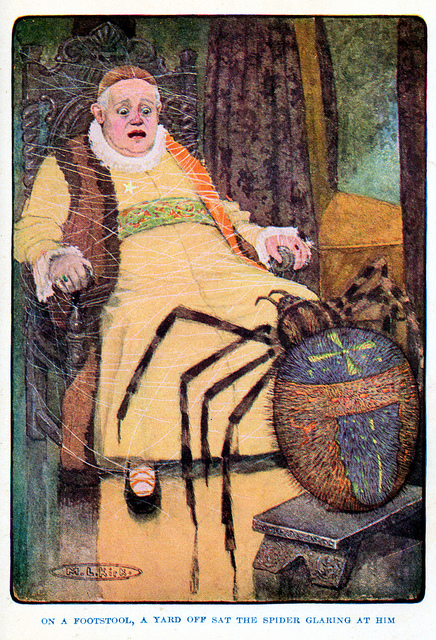
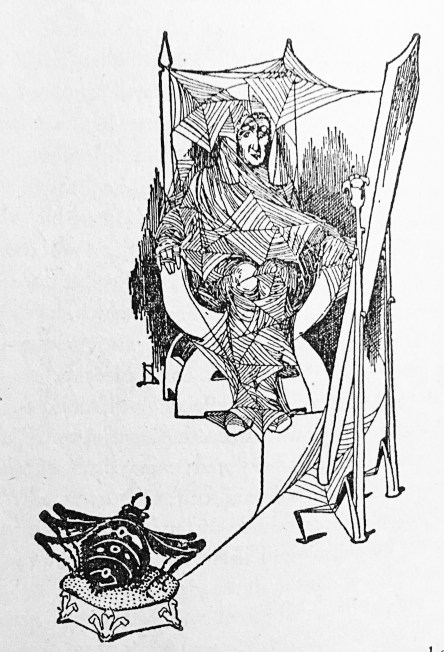
And then there’s the giant spider, which inspired at least two pieces of art, first by Charles Folkard.

spider charles folkard

For the attorney-general, Curdie led to his door a huge spider, about two feet long in the body, which, having made an excellent supper, was full of webbing. The attorney-general had not gone to bed, but sat in a chair asleep before a great mirror. He had been trying the effect of a diamond star which he had that morning taken from the jewel-room. When he woke he fancied himself paralysed; every limb, every finger even, was motionless: coils and coils of broad spider-ribbon bandaged his members to his body, and all to the chair. In the glass he saw himself wound about, under and over and around, with slavery infinite. On a footstool a yard off sat the spider glaring at him.

spider helen stratton

And then by Helen Stratton. I cannot properly express how much I love the above image. You can just imagine the spider glaring crossly at the poor guy, all like òÒÓó

Well, that concludes our retrospective through MacDonald’s lovingly designed monstrosities. If TPAC had been only about their adventures it would probably have been far more fun.

9782366720532

Créatures Fantastiques Deyrolle

Jean-Baptiste de Panafieu, Camille Renversade

Everyone knows Deyrolle charts. Well, a lot of people do. And even if you’ve never heard of them, the educational-chart-poster style will look familiar, as will the instructive anatomical layouts. And if you’ve been to Paris, you may have seen or walked by their place/museum. So what happens when you mix fantastic creatures with Deyrolle’s style (with their blessing, of course)? You get something like Créatures Fantastiques Deyrolle (CFD from now on).

If you have deep pockets, you can grab a copy here and here – they’re actually pricey, out of print, and not available on the publisher’s site anymore, but they’re going to get reprinted!

Scope

Global. While not as comprehensive as, say, ABC (yay self-promotion), it covers a wide range of creatures, from bestiary mainstays to literary jokes to cryptozoological darlings.

Organization

Broken up by general groups – reptiles, land mammals, creatures of the air, creatures of the sea, humanoids, and hybrids. Each entry of this large-sized coffee-table book is split in two halves – the left side is the text, the right side is the illustration. More below.

Text

A lot of research has gone into the writing, which is fluid and fun to read, with wry interpretations and commentary throughout. There are citations from the sources, which is always nice. It’s informative and low on embellishment, knocking spots off Dubois’ florid style.

It’s also in French, make of that what you will.

Most importantly, the text has the actual research and what is known about those creatures. Then when you’re done with that, you check out the art…

Images

Lush. There is plenty of artistic interpretation, but not more than I’d deem acceptable. The dragons entry, for instance, has lovely butterfly-esque versions of the Graoully, Grand’Goule, Gargouille, Grand Bailla, Drac… which are entirely the illustrator’s designs, but considering the lack of established iconography (unlike, say, the Tarasque) you can’t blame them. The basilisk is in its eight-legged form, but unlike the detestable lizardlike version common today, it does look like eight plucked mutant roosters mushed together.

Everything gets mock-scientific names, and anatomical cutaways are everywhere. Want to see a sea-serpent’s skeleton? An x-ray of the Loch Ness Monster (represented by a Heuvelmansesque long-necked seal)? What about a comparison of Cetus species (as gigantic anglerfishes) or unicorn species? There’s even fossils of the orabou and the Sarmatian snail discussed at length!

All of the “artistic license” is in the art, so if it bothers you, you can focus on the text and leave out the illustrations (but why would you?)

My only regret is that their version of the coquecigrue is so perfect, I won’t be able to come up with something better.

Research

References are not listed for each entry separately (as in ABC) but are all available at the end in a bibliography. Citations from original texts are cited appropriately. A variety of sources are consulted for a broad view of differing viewpoints. As mentioned, the text is straight-up research, while the art takes more liberties.

The authors have shown their work in spades. There are loads of obscure animals discussed, including a couple even I haven’t heard of!

My only real qualm is that the seps is described as rotting and melting its victims, but the art says it “preserves” its victims…

Summary

Another five-star review? Already? It was bound to happen though. CFD is ridiculously good – well-researched, well-illustrated, with a bibliography and clear separation of fact and artistic license, all wrapped up in a fun faux-scientific retro look. The only thing keeping all teratologists from owning a copy is price and availability. No, it being in French is not a problem. Learn it. Buy this book (when prices are reasonable). Feel good.

5

url

A Chinese Bestiary

Richard E. Strassberg

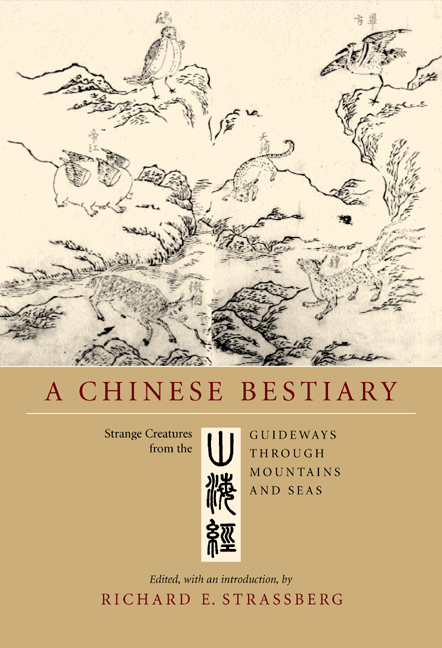
The Shan Hai Jing is the seminal Chinese bestiary, in fact one of the most creature-packed creature books in existence! (It’s also where Borges got his Chinese fauna from) And if you’re in the unfortunate position of being unable to read Chinese, like myself, you’re going to need a translation. This is where Strassberg’s A Chinese Bestiary (ACB) comes in, and it delivers in spades.

You can get your grubby mitts on it here and here.

Scope

It’s the Shan Hai Jing. Need I say more? I do? Oh. It’s an English translation of the Guideways, with ample commentary and the original illusrations.

Once more, this is not a complete compendium of mythical creatures nor does it pretend to be. Its narrow focus is what makes it good.

Organization

Introductions and Notes frame the Shan Hai Jing translation, which is the meat of the book. The text is broken up by region and by creature, with each notable creature having its own number to identify it in the illustration and (in most cases) commentary. Straightforward and easy to use.

Text

It’s a translation of a classic Chinese text. And I don’t read Chinese, so I can’t comment on how good of a translation it is (Chinese-reading ABC readers should feel free to chime in with opinions, if any). But it’s written clearly, thoroughly referenced and footnoted.

Images

Black and white and simple enough, but most importantly they are the original illustrations. So what you’re seeing is what people at the time (or at least, one artist at the time) thought those creatures look like. As opposed to, you know, some teratologist with delusions of competence presenting a subjective interpretation…

Research

As mentioned above, there are references and notes for just about everything. As the Shan Hai Jing is itself an ur-reference, there is little need for more – but there is more! These range from folklore notes to Guo Pu’s commentaries and everything in between.

If it’s not academic enough for you, there’s always the massive Mathieu translation, which is extremely academic. Also it’s in French.

Summary

I can’t really sing the praises of this book enough. It’s good. Like Meeting with Monsters it has a (relatively) narrow subject and it uses that to excellent effect. Another must-have book for anyone with a passing interest in Chinese teratology.

5

Nyuvwira

Variations: Inifwira

Nyuvwira

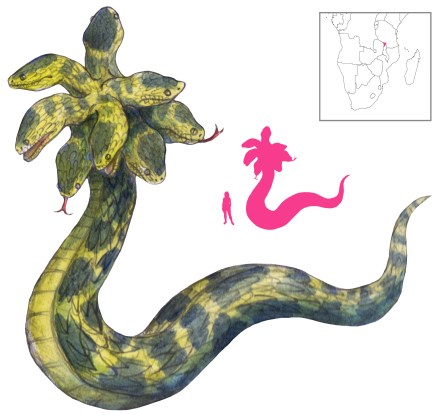
The Nyuvwira is an enormous snake restricted to the Chitipa District of Malawi. It is found in association with minerals, especially precious minerals of monetary value. It can also be found in the mines of South Africa. It is known as Inifwira in Sukwa.

A nyuvwira has eight heads and is the largest snake in the world. It generates electricity and lights at night. It lives underground, which is fortunate as it is extremely toxic. When it moves (about every 200 years) it causes death and disaster. Airplanes flying over a nyuvwira crash.

The skin of a nyuvwira, held in one’s pocket, prevents planes from moving and is a powerful charm for wealth. To kill a nyuvwira one must construct a spiral hut and line it with razors, then entice the snake in by ringing bells. It will crawl over the razors and cut itself to death.

References

Hargreaves, B. J. (1984) Mythical and Real Snakes of Chitipa District. The Society of Malawi Journal, Vol. 37, No. 1, pp. 40-52.