Saratan

Variations: Zaratan (erroneously), Sarathan
Saratan

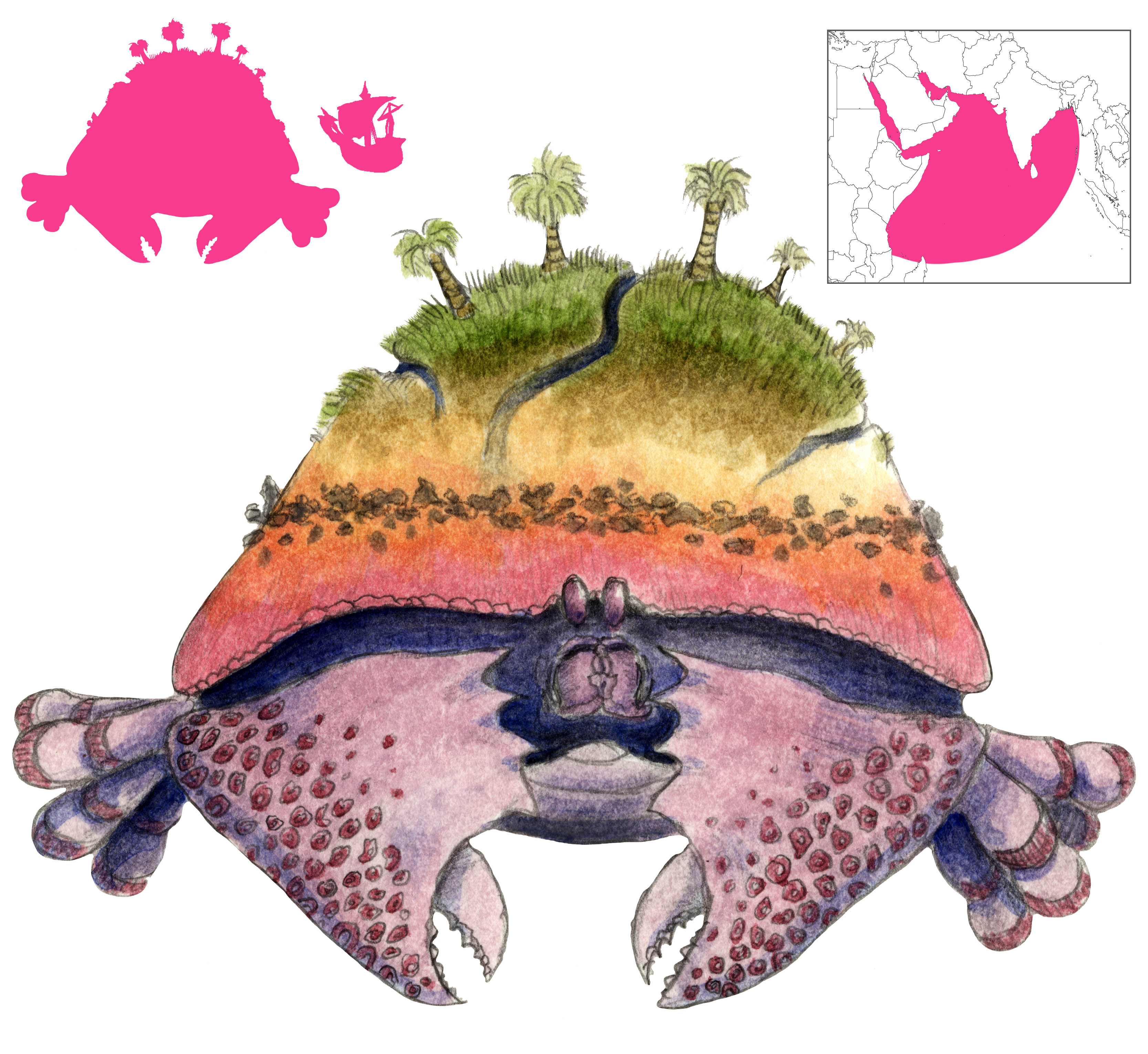
Saratan is Arabic for crab. It also means cancer, in the same way as cancer is Latin for crab. Hence, every use of the word saratan here can be replaced with “crab”.

Al-Jahiz knows what crabs are. He talks about how crabs have eight legs and two “teeth” which give the appearance of ten legs. They have eyes on their back. They live in water or burrows on the shore, where they lay their eggs, and feed out of greed instead of necessity.

But the “crab” he describes at one point is enormous in size and lives in the open ocean. Vegetation grows on its back as it rests on the surface. Cracks and crevices in its shell look like gullies and rivers. It is this monster that sleeps in the middle of the ocean until sailors land on it, mistaking it for an island. Then it awakens and dives underwater, drowning anyone incapable of swimming back to ship.

Al-Jahiz does concede that he cannot find anyone who claims to have seen this monster.

“What is the most wondrous thing you have ever seen?” Al-Jahiz and a group of friends ponder this question. “The elephant”, comes one response. “The soul”. “Sleep and awakening”. “Forgetfulness and memory”. “Fire”. “The belly of the cosmos”. Another of the scholars present expresses his amazement with the elephant. Finally, Ma’bad bin ‘Omar states “The saratan and the ostrich are greater miracles than the elephant”.

Elsewhere Al-Jahiz goes on to add “The greatest of God’s creations are the snake and the saratan and the fish”, and “The greatest animals created are the fish and the saratan”.

It is strange that the saratan is popularly known as “zaratan”, and described as a whale or turtle. The blame for this lies with Borges, who describes the saratan’s activities but neglects to mention that it is a gigantic crab. He quotes a Spanish translation of Al-Jahiz by Palacios which converts saratan to “zaratan”. Oddly enough, the English translation of Palacios’ text uses the more reasonable transliteration of “sarathan”. In either case, Palacios does describe this monster as a “certain crustacean of the sea” (“cierto crustaceo maritimo”), a fact that Borges omits.

References

Borges, J. L.; trans. Hurley, A. (2005) The Book of Imaginary Beings. Viking.

Al-Jahiz, A. (1966) Kitab al-Hayawan. Mustafa al-Babi al-Halabi wa Awladihi, Egypt.

Palacios, M. A. (1919) La escatologia musulmana en la Divina Comedia. Estanislao Maestre, Madrid.

Palacios, M. A.; Sunderland, H. trans. (1926) Islam and the Divine Comedy. John Murray, London.

Seps

Variations: Sep, Sepedon

Seps

The Seps – “putrefaction” – is a deadly snake found in the deserts of Africa. It is especially feared for its corrosive venom, which melts flesh and bone alike to leave its victim a smear on the ground. Lucan awarded it the title of Libya’s greatest plague.

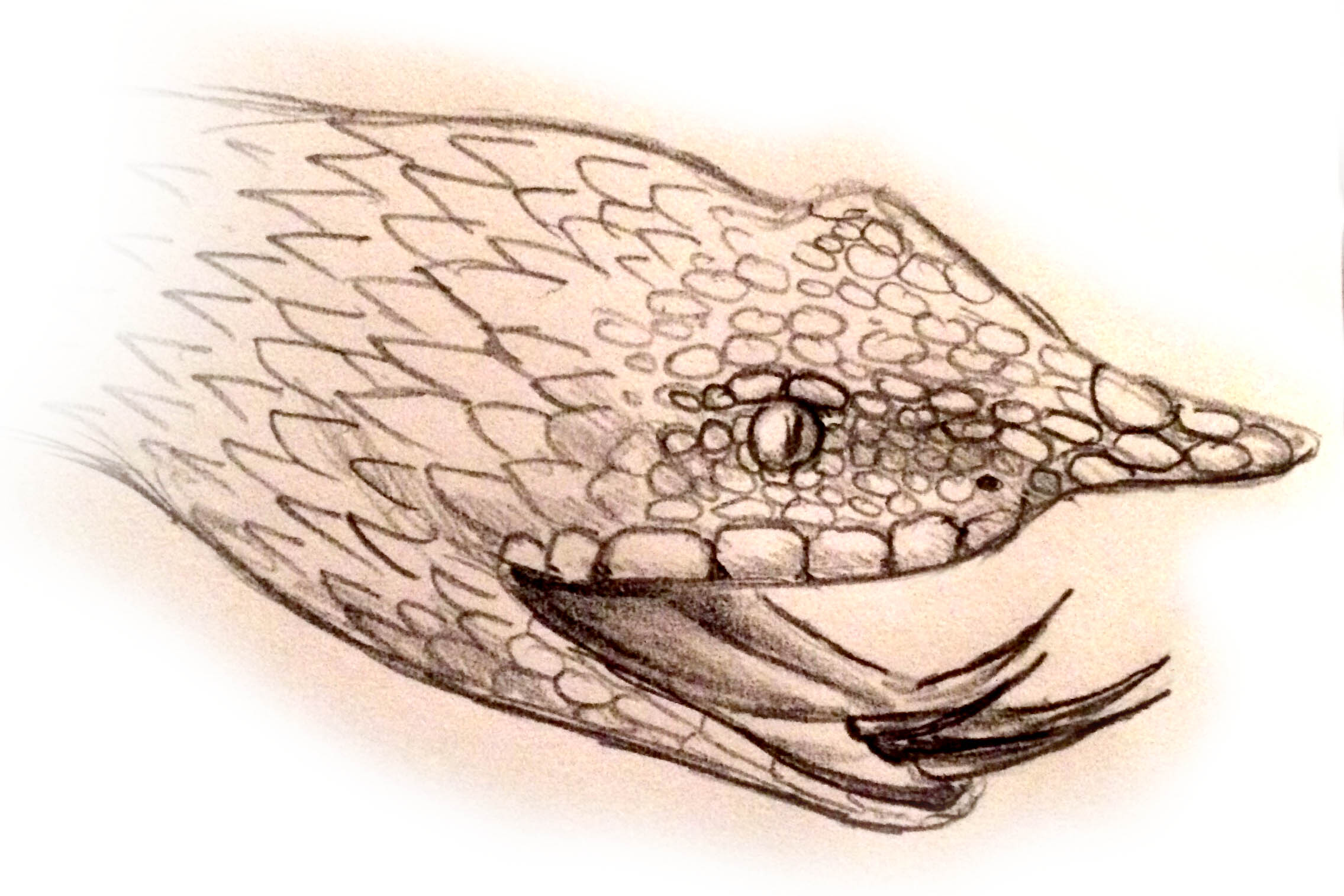
A seps is about two cubits (about a meter) long, and varicolored along its length; some say it can also change color like a chameleon. It uniquely has four hollow fangs in its lower jaw. Topsell attests to its speed, describing its motion as going “by spires and half-hoops”, possibly a reference to sidewinding. Aldrovandi gives the seps a horn on the nose and large triangular scales. Seps can be found in valleys, deserts, and under rocks. They can survive winters thanks to their natural warmth.

Seps bwSeps venom is highly virulent, causing massive necrosis and putrefaction of tissues. Skin, muscle, blood, bone – everything rots and dissolves away, and if the bite is not treated, the victim literally melts into oblivion, leaving nothing behind. Eldred points out that the original Greek seps killed in the same way as the dipsas – by inducing extreme thirst. Lucan alters that to better suit the snake’s name.

For antivenin, Topsell recommends the same measures as with other venomous snakes, as well as sponges soaked in warm vinegar; a concoction of ashes, butter, and honey; or otherwise millet, honey, bay, oxymel, and purslane.

Lucan describes the fate of a Roman soldier after being bitten by a seps. The unfortunate Sabellus’ skin, flesh, and sinews shriveled away from the bite, exposing bare bones before they, too, succumbed to the venom. The putrefying venom worked its way upward from the bite, and the soldier melted like a candle.

While no snake has venom as powerful as that of the seps, the symptoms of seps bite seem to be an exaggeration of actual necrosis caused by snake bite.

References

Aelian, trans. Scholfield, A. F. (1959) On the Characteristics of Animals, vol. II. Harvard University Press, Cambridge, Massachusetts.

Aldrovandi, U. (1640) Serpentum, et Draconum Historiae. Antonij Bernie, Bologna.

Batinski, E. (1992) Cato and the Battle with the Serpents. Syllecta Classica, Vol. 3, pp. 71-80.

Eldred, K. O. (2000) Poetry in Motion: the Snakes of Lucan. Helios 27.1, p. 63.

Isidore of Seville, trans. Barney, S. A.; Lewis, W. J.; Beach, J. A.; and Berghof, O. (2006) The Etymologies of Isidore of Seville. Cambridge University Press, Cambridge.

Lucan, trans. Rowe, N. (1720) Pharsalia. T. Johnson, London.

Topsell, E. (1658) The History of Serpents. E. Cotes, London.

Sinad

Variations: Sinād, Sénad, Senad

Sinad 2

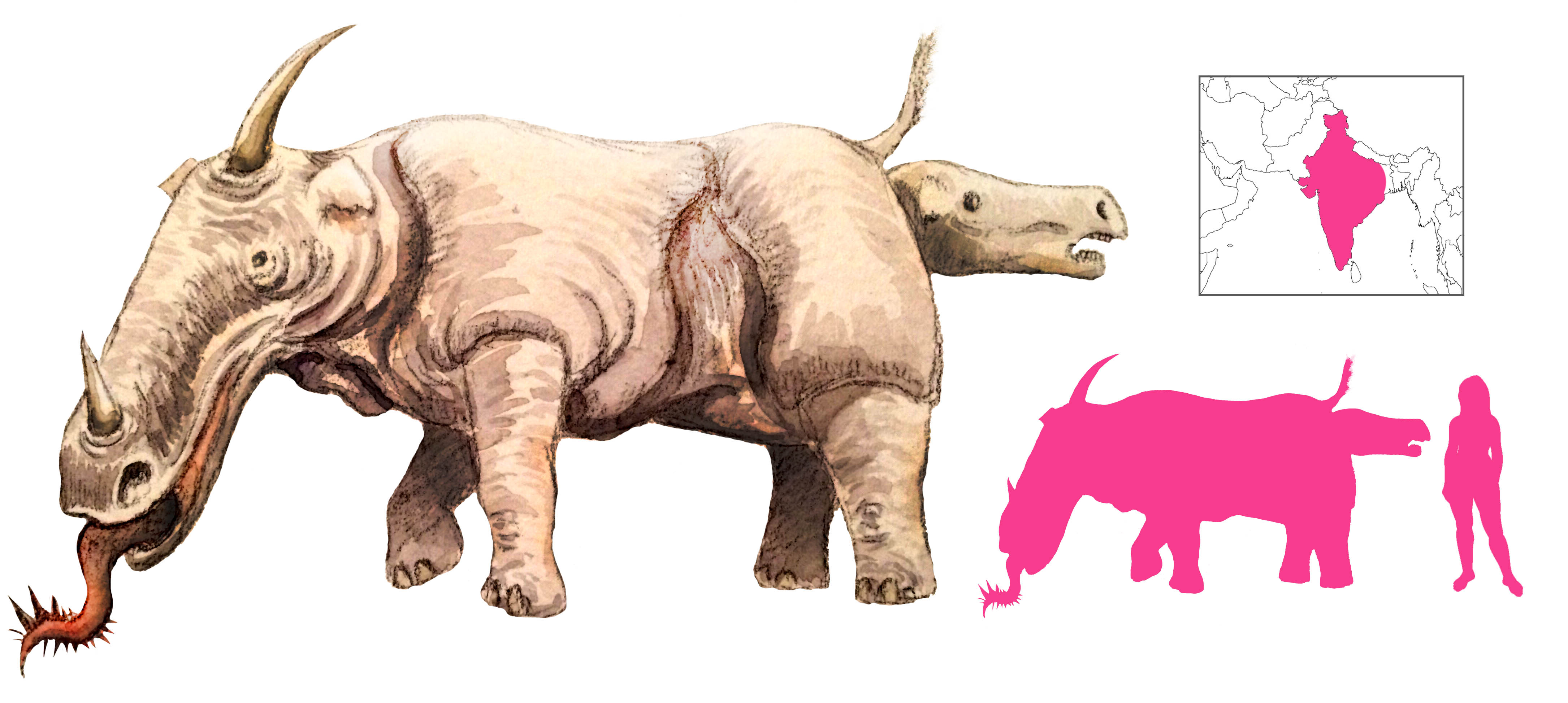
The Sinad is an Indian creature of uncertain appearance and dubious maternal instinct, described by Al-Jahiz, Al-Qazwini, and a number of other Muslim authors. Its primary characteristics – also attributed to the karkadann – were its sharp, thorny tongue and its unusual method of giving birth.

Al-Qazwini describes the sinad as similar to but smaller than an elephant, and larger than an ox. When the female is ready to give birth, the young sinad would stick its head out of its mother’s womb, feeding on grass and waiting until it was mature enough to run away. This was because the mother sinad, following her parental instincts, would attempt to lick her calf clean – in the process flaying the flesh off its bones. Once it was large enough, the calf would squirm out and gallop to safety.

This lethal tongue was also associated with the karkadann, and representations of them became blurred. Some images of the sinad are elephantine, while others came to follow the established iconography of the karkadann, giving it one or two horns. Al-Gharnati stated that the kings of China tortured people by having a karkadann lick them. Marco Polo, in his disillusioned report on the unicorn, said that its deadliest weapon was its tongue.

Flaubert, in his Temptation of Saint Anthony, makes an allusion to the Sénad as a three-headed bear that tears its cubs apart with its tongue. Here he conflates the sinad as described by Bochart with Pliny’s description of the bear licking its amorphous newborn cubs into shape. The three heads are a Flaubertian flourish.

References

Ettinghausen, R. (1950) The Unicorn. Studies in Muslim Iconography, Freer Gallery of Art Occasional Papers Vol. 1, No. 3, Washington.

Flaubert, G. (1885) La Tentation de Saint Antoine. Quantin, Paris.

Pliny; Holland, P. trans. (1847) Pliny’s Natural History. George Barclay, Castle Street, Leicester Square.

Polo, M. (1965) The Travels. Penguin Classics, London.

Al-Qazwini, Z. (1849) Zakariya ben Muhammed ben Mahmud el-Cazwini’s Kosmographie. Erster Theil: Die Wunder der Schöpfung. Ed. F. Wüstenfeld. Dieterichsche Buchhandlung, Göttingen.

Seznec, J. (1943) Saint Antoine et les Monstres: Essai sur les Sources et la Signification du Fantastique de Flaubert. PMLA, Vol. 58, No. 1, pp. 195-222.

Stymphalian Bird

Variations: Stymphalide, Bird of Ares

Stymphalian bird 2

Pausanias theorized that the Stymphalian birds originated in Arabia, citing the presence of fierce desert birds known as the Stymphalides. He then admits that the population found at Stymphalos, in Arcadia, may have been the result of a few wayward birds making their way into Greece. Following this line of reasoning, Pausanias deduces that they earned the name of Stymphalides due to their fame in Greece, and the name then supplanted whatever name they originally had in Arabia!

The appearance of the Stymphalian birds is no less muddled. Their most feared weapon is the sharpened, pointed tips of their wing feathers, which they fling like darts to stab their prey. Sometimes their feathers and beaks are made of bronze or iron, the better for piercing armor. Pausanias described them as about crane-sized, but resembling the ibis in shape, but with a stronger bill; elsewhere he says they are like hawks or eagles. In Greek art they have been represented as ibises, swans, and other such waterfowl; at least one obol from Stymphalos shows a bird with a short crest and a stout, powerful bill. Finally, no doubt influenced by tales of harpies and sirens, the temple of Stymphalian Diana also has stone statues of virgins with birds’ feet.Stymphalian bird bw

It remains true that the Stymphalian birds were first and foremost associated with Lake Stymphalia. They terrorized the region, ravaging crops, killing people, and poisoning the ground with their dung. Fox suggests that the legend originated as a glamorization of a plague or pestilence rising from the marshes, which would explain their noxious qualities. While their feathered darts could pierce armor, they were powerless against a certain type of tree bark, which held them fast like quicklime. There was only so much bark to go around, though, and the birds seemed numberless.

It was this scourge that Heracles was sent to destroy. As his sixth labor, it was one of a list of impossible tasks, and indeed the vast numbers of birds seemed beyond the hero’s strength. Heracles got around this by exploiting a simple fact – despite their numbers and ferocity, Stymphalian birds were as easily spooked as sparrows. Fashioning a pair of bronze castanets, he made such a din that the flock took off in a panic; from there he shot a great number down with his arrows, while the remainder of the birds flew off and were never seen in Arcadia again.

That was not the end of the Stymphalian birds, as from Greece they made their way to the Black Sea and populated the Island of Ares, where they became sacred guardians to the god of war. It was this flock that Jason and his Argonauts encountered on their way to Colchis. While the birds of Ares managed to wound the Argonaut Oileus with a feather projectile, they were scared off once more by the noise of rattling bronze armor, but not before pelting the Argonauts with a hailstorm of feathers.

References

Aldington, R. and Ames, D. trans.; Guirand, F. (1972) New Larousse Encyclopedia of Mythology. Paul Hamlyn, London.

Ames, D. trans.; Guirand, F. (1963) Greek Mythology. From Mythologie Generale Larousse. Paul Hamlyn, London.

Apollonius, Coleridge, E.P. trans. (1889) The Argonautica. George Bell and Sons, London.

Fox, W. M. (1964) The Mythology of All Races v. I: Greek and Roman. Cooper Square Publishers, New York.

Pausanias, Levi, P. trans. (1979) Guide to Greece, volume 2: Southern Greece. Penguin Books, London.

Scarbo

Scarbo

Scarbo is a vampiric dwarf with specialized tastes. He enjoys nothing more than entering the rooms of poets, artists, and writers, and spending the night tormenting them. With his razor-sharp fangs, he bites into his host’s neck, then helpfully cauterizes the bloody wound with a metal finger heated red-hot.

He clambers around the victim’s room, scrabbling at the rafters, scratching at the bedposts. He whispers threats into their ears – and his creativity knows no bounds, as he describes in loving detail the burial shroud he has planned for his victim, the funeral that he will hold, and the sobbing children that will gather in his wake.

He spends the entire night in the room, growing larger as the moon rises, then, as dawn approaches, he flickers, turns blue and translucent, and winks out like a snuffed candle.

Scarbo’s primary contributions to the arts are the Gothic prose poem Gaspard de la Nuit, reportedly written by the Devil himself, and the piano piece of the same name by Ravel, which matches his fiendish activities with its fiendish difficulty.

References

Bertrand, L. (1904) Gaspard de la Nuit. Ambroise Vollard, Paris.

Sapo Fuerzo

Variations: Strong Toad

Strong toad

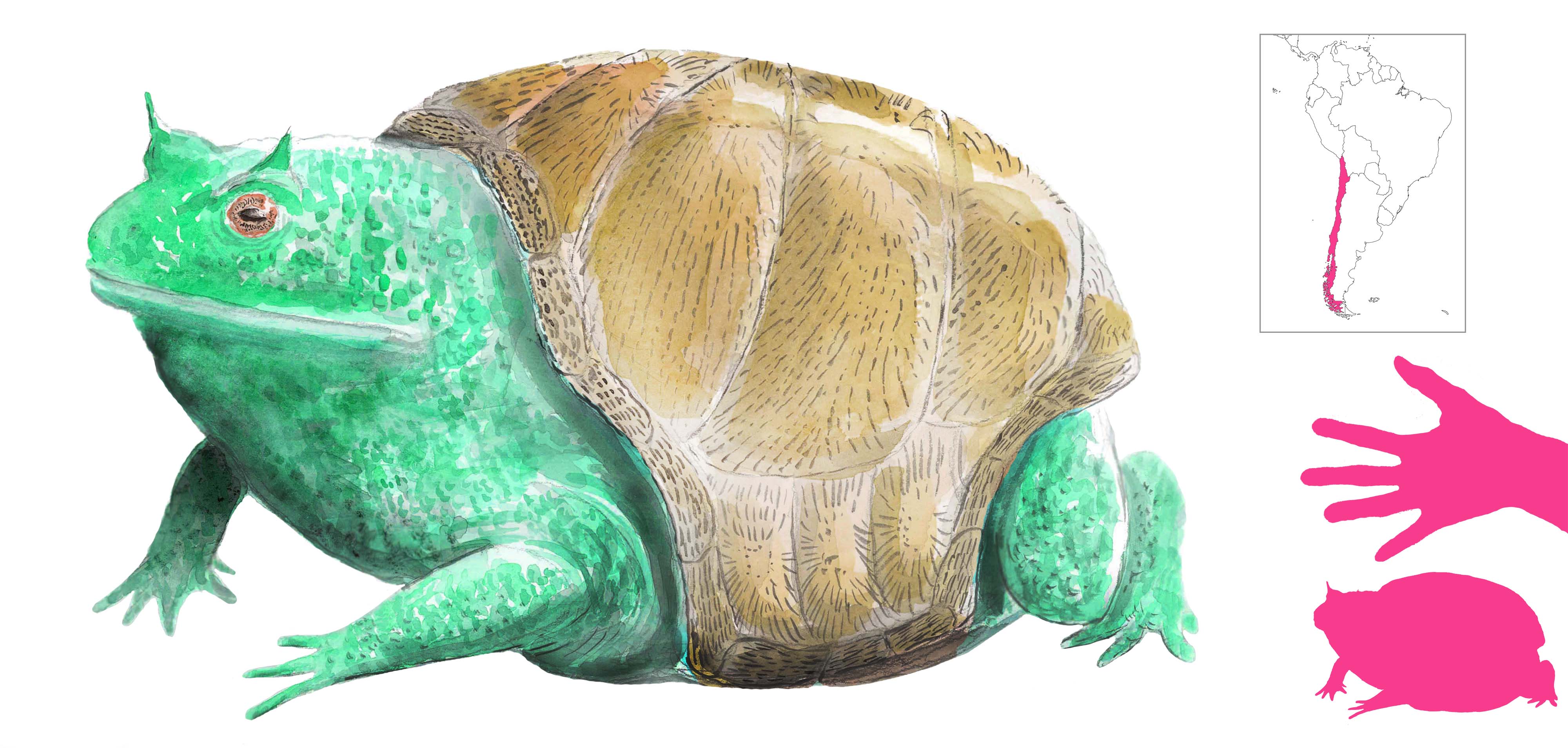
The sapo fuerzo, or “strong toad”, is a remarkable amphibian from the Andes of Chile. It can be easily distinguished from regular toads by its hard, turtle-like shell. It is phosphorescent, and glows in the dark like a firefly.

It earns its name from its supernatural powers and its incredible resilience. A sapo fuerzo is capable of attracting or repelling anything within its reach by the sheer power of its gaze. It can also regenerate and recover from virtually any injury, and the only way to kill one is burn it and reduce it completely to ashes.

References

Aguirre, S. M. (2003) Mitos de Chile. Random House, Editorial Sudamericana Chilena.

Cifuentes, J. V. (1947) Mitos y supersticiones (3rd Ed.). Editorial Nascimento, Santiago, Chile.