Lavellan

Variations: Water Shrew, Water Mole, Blind Mouse, Common Lizard

Lavellan

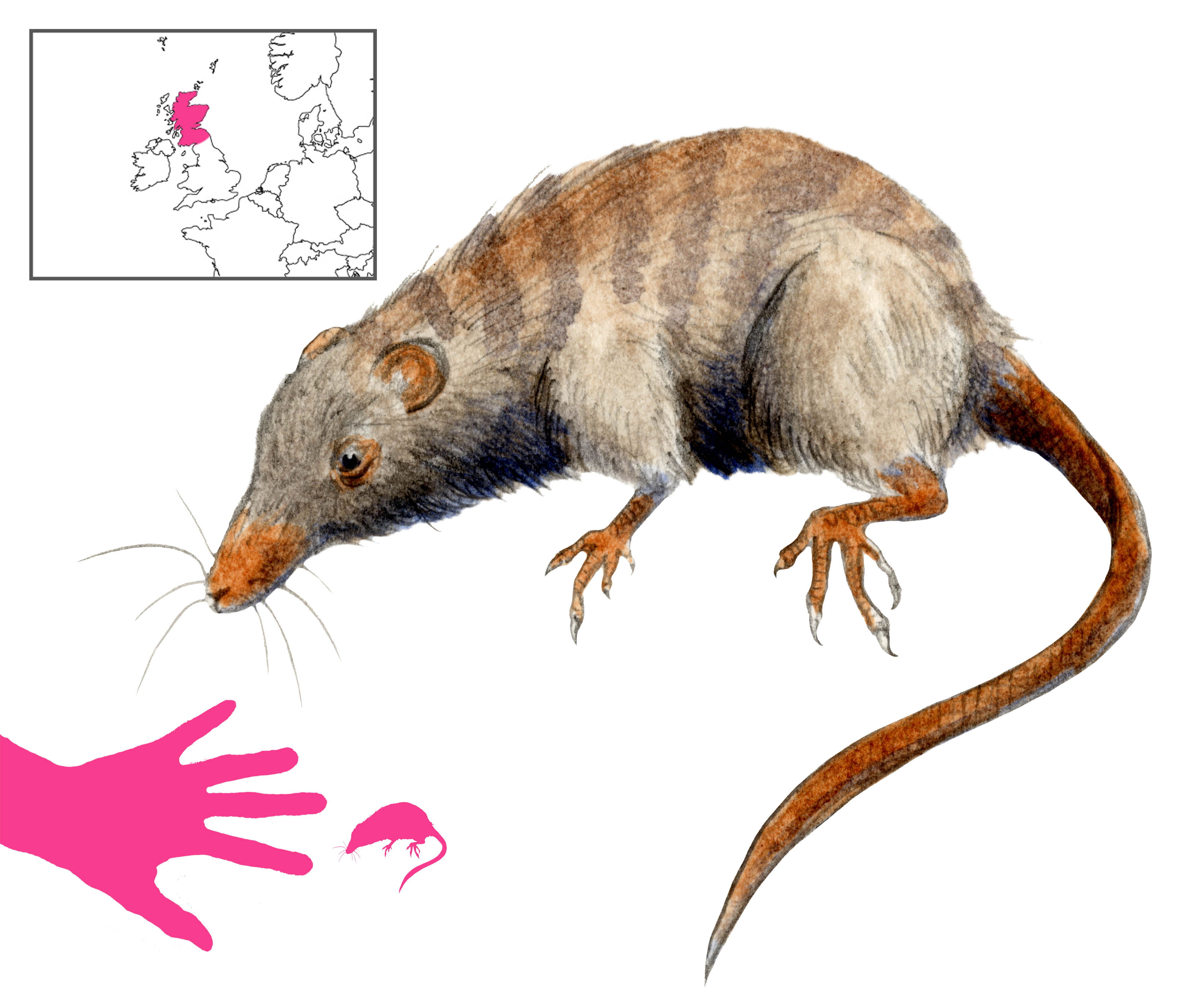
The Lavellan is a toxic mammal found in northern Scotland, primarily Caithness.

A lavellan’s appearance is unclear and unassuming; at the very least, it is believed to be small and furry. Sibbald believed it had the head and color of a marten, while other accounts describe it as resembling a shrew or a lizard. It has bright eyes and moves very quickly.

Lavellans are highly poisonous, and are capable of harming cattle from forty yards away. Their very breath is noxious. They are also lethal to humans, as told in one satirical song: “Let him not go away from the houses, to moss or wood, lest the Lavellan come and smite him”.

Farmers kill lavellans on sight and preserve their skin. Water in which a lavellan skin has been dipped is a certain remedy for lavellan poisoning. Boiling a lavellan head will also provide an antidote.

It has generally been assumed that the lavellan is a demonization of the water shrew, also known locally as water mole or blind mouse. The shrew’s saliva is mildly toxic but nowhere near as virulent as the lavellan’s. Harvie-Brown and Buckley, on the other hand, propose that the common lizard – brownish in color, bright-eyed, swift, and unfamiliar – was the originator of the lavellan. It may well be a combination of both.

References

Campbell, J. G. (1900) Superstitions of the Highlands and Islands of Scotland. James MacLehose and Sons, Glasgow.

Fleming, J. (1814) Contributions to the British Fauna. Memoirs of the Wernerian Natural History Society, Vol. II, Part I, pp. 238-251.

Harvie-Brown, J. A. and Buckley, T. E. (1887) A Vertebrate Fauna of Sutherland, Caithness, and West Cromarty. T. and A. Constable, Edinburgh University Press.

Pennant, T. (1818) British Zoology, vol. I. J. Christie, Dublin.

Guariba-boia

Variations: Howler monkey snake

Guariba boia

Guariba-boia, the “howler monkey snake”, can be found in a wide stretch of the Amazon river, from Fonte Boa in the west to Urucurituba in the east, and in the lakes of the Rio Negro. It excavates tunnels in murky river bottoms, and hides in mud or thickets of water-plants. Usually its voice is the only sign of its existence.

As the name implies, a guariba-boia typically has the head of a howler monkey (guariba) on the body of a snake (boia). Sometimes it has the body of a howler monkey and the paws of an otter, and rarely it has the head of a sloth (although such a feature would seem hardly intimidating). Guariba-boias grow to about six meters long.

Guariba-boias announce their presence with loud, resonant howls that sound like an entire troop of howler monkeys. They roar from below water, and their calls are particularly loud on rainy nights.

While not as big as boiunas, guariba-boias are armed with needle-sharp fangs and lethal venom. Death by guariba-boia bite is swift and painful, after which the creature swallows its victim whole. A guariba-boia does not regularly seek out human prey, but will overturn canoes and kill the occupants if hungry enough.

References

Smith, N. J. H. (1996) The Enchanted Amazon Rain Forest. University Press of Florida, Gainesville.

Tsuchinoko

Variations: Bachi-hebi, Gigi-hebi, Koro, Koro-hebi, Nozuchi, Tsuchi-korobi

Tsuchinoko final

The Tsuchinoko (“child of the earth” or “mallet child”) is a snake native to Japan. Its primary characteristics are its unusual stocky appearance and its secretiveness. Sightings of tsuchinoko go at least as far back as 1807, in the Edo Period.

A tsuchinoko is easily recognized by its fat, dorsoventrally flattened appearance, reminiscent of a beer bottle, mallet, or pestle (tsuchi). It is this feature that has earned it its name, as well as the alternate name of nozuchi (“field mallet”). It is known as bachi-hebi and gigi-hebi in Akita Prefecture, koro and koro-hebi in Fukui Prefecture, and tsuchi-korobi in Tottori Prefecture.

tsuchinoko bwWhile rare and hard to find, the tsuchinoko is believed to be venomous. It can get around by rolling, as observed by witnesses; when spotted, it laughs and vanishes in a flash of light, causing the onlookers to fall ill. When angered, a tsuchinoko will hiss, spit, and even jump at its pursuer before biting with its fangs.

Recent years have greatly added to the tsuchinoko’s reputation, as reports of sightings have led to its promotion into a full-blown cryptid. The 2000 discovery of an alleged tsuchinoko skeleton in Yoshii, Okayama Prefecture, firmly cemented the snake’s existence in popular culture.

The true identity of tsuchinoko sightings are possibly the venomous yamakagashi (Rhabdophis tigrinus) or the dangerously venomous mamushi (Gloydius blomhoffi). The latter has caused human fatalities, and therefore any potential tsuchinokos should be treated with respect and given a wide berth.

References

Foster, M. D. (2009) Pandemonium and Parade: Japanese Monsters and the Culture of Yokai. University of California Press, Berkeley.

Foster, M. D. (2015) The Book of Yokai. University of California Press, Berkeley.

O’Shea, M. (2005) Venomous Snakes of the World. New Holland Publishers, London.

Chimera

Variations: Chimaera, Chimaira
Chimera

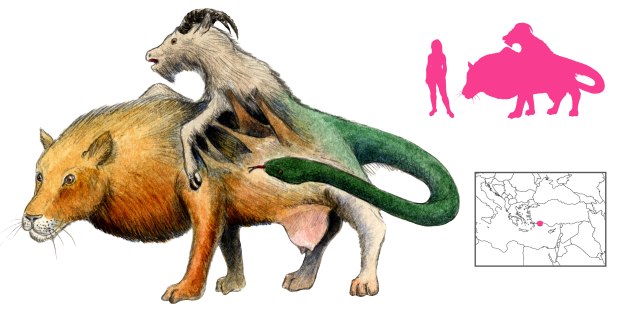
The Chimera or Chimaera (“goat”) was the daughter of Typhon and Echidna. She was the terror of Lycia in southern Turkey, killing people and livestock and torching crops.

Homer describes her as being a lion in front, a serpent behind, and a goat in the middle, with the power of breathing fire. Hesiod specifies that she had three heads. The lion’s head was in its customary place, the snake’s head was on the end of the tail, and the goat’s head emerged tumorously from the middle. Hyginus gives all three heads the ability to breathe fire, while Apollodorus states that only the goat head could do so, functioning as some kind of shoulder-mounted flamethrower.

While Homer’s description might suggest a lion’s head, a goat’s body, and a snake’s tail, the Chimera has been consistently represented in Greek art with multiple heads. Usually she is mostly lion with a snake tail; the goat has proven tricky to depict convincingly, ranging from a head to the entire front half of a goat. Some Etruscan renditions add wings. The iconography behind the Chimera may go back farther, and may be of Asian origin. The term has also been used to describe various unrelated hybrid animals, with or without multiple heads.

She was finally slain by Bellerophon, who had been sent to Lycia to die. The wife of King Proitos had fallen madly in love with him; after he rejected her advances, she told her husband that Bellerophon had tried to seduce her. Enraged, the king dispatched Bellerophon to Iobates of Lycia, bearing a message requesting him to kill the messenger. Iobates sent him to battle the Chimera – surely an impossible task.

But Bellerophon had the favor of the gods, and the aid of the winged horse Pegasus. Mounted on Pegasus’ back, he easily flew out of range of the Chimera’s fiery breath, and shot her to death with arrows. Some accounts add that he rammed a lump of lead into her throat, where it melted and suffocated her.

Chimera bwChimera was a study in contradictions. Her three components did not make any sense together. Her name meant “goat”, but the goat was the least coherent part of her, reduced to a mere head in an anatomically dubious position. Evidently something so contradictory as the Chimera needed a rational explanation, even to the ancient Greeks. Plutarch believed she was inspired by a pirate captain, whose ship was decorated with the three component animals. Servius Honoratus said she was a loose interpretation of the Lycian landscape. Mount Chimera was a volcano, with snakes at its base, goats wandering around its heights, and a pride of lions at the top. Bellerophon, arriving on his ship Pegasus, set fire to the mountain and eradicated the dangerous animals.

The Etruscans dedicated the Chimera to the supreme god Tinia. The Etruscan Arezzo bronze of the Chimera remains the most enduring image produced of her. As a hybrid she was both celestial and chthonic, representing the year and the seasons. The lion, hot and strong, was summer; the snake, cold and ground-dwelling, was winter; and the transitory goat was spring and summer.

In The Temptation of Saint Anthony, the Chimera is a great, green-eyed, dragon-winged creature with a luxuriant mane; she is as capricious as desire and imagination. She reveals breathtaking new perspectives to humans, pours insanity, ambitions, hopes, and dreams into their minds, drives people to dangerous quests, and kills anyone content in wisdom. She is woefully incompatible with the rational, stoic Sphinx, and their attempts at copulation fail.

“Chimera” has entered our vocabulary in a number of ways, always in reference to incongruity. A chimera or something chimeric is fanciful, improbable, and imaginary. A chimera can also mean an organism with distinct cells from different zygotes. Finally, Chimaera is a genus of deep-sea fish, named after its bizarre appearance.

References

Bazopoulou-Kyrkanidou, E. (2001) Chimeric Creatures in Greek Mythology and Reflections in Science. American Journal of Medical Genetics 100:66-80.

Borges, J. L.; trans. Hurley, A. (2005) The Book of Imaginary Beings. Viking.

Flaubert, G. (1885) La Tentation de Saint Antoine. Quantin, Paris.

Hesiod; trans. Elton, C. A. (1832) The Theogony. In Hesiod. A. J. Valpy, London.

Homer, trans. Buckley, T. A. (1851) The Iliad of Homer. Henry G. Bohn, London.

Locatelli, D. and Rossi, F. (2010) Les Étrusques: Pouvoir – religion – vie quotidienne. Série Civilisations, Hazan.

Roes, A. (1934) The Representation of the Chimaera. The Journal of Hellenic Studies, Vol. 54, Part 1, pp. 21-25.

Schmitt, M. L. (1966) Bellerophon and the Chimaera in Archaic Greek Art. American Journal of Archaeology, Vol. 70, No. 4, pp. 341-347.

Smith, R. S. and Trzaskoma, S. M. (2007) Apollodorus’ Library and Hyginus’ Fabulae. Hackett Publishing Company, Indianapolis.

Till, B. (1980) Some Observations on Stone Winged Chimeras at Ancient Chinese Tomb Sites. Artibus Asiae, Vol. 42, No. 4, pp. 261-281.
Mbielu-mbielu-mbielu

Mbielu3

The Mbielu-mbielu-mbielu, or “animal with planks growing out of its back”, is a little-known creature restricted to the Likouala-aux-Herbes in the Congo.

It has only ever been seen in the water with only its back protruding, exposing large “planks” with algal growth between them. What it looks like underwater remains unknown. The mbielu-mbielu-mbielu does not show any aggressive behavior and is presumably herbivorous.

Mbielu3 sketch

The suggestion that it is a late-surviving stegosaur is dubious at best, considering that stegosaurs went extinct long before the end of the Cretaceous (with the possible exception of the disputable Dravidosaurus).

References

Mackal, R. (1987) A living dinosaur? E. J. Brill, New York.

Weishampel, D. B.; Dodson, P.; and Osmolska, H. (2004) The Dinosauria, 2nd Edition. University of California Press, Berkeley.

Seps

Variations: Sep, Sepedon

Seps

The Seps – “putrefaction” – is a deadly snake found in the deserts of Africa. It is especially feared for its corrosive venom, which melts flesh and bone alike to leave its victim a smear on the ground. Lucan awarded it the title of Libya’s greatest plague.

A seps is about two cubits (about a meter) long, and varicolored along its length; some say it can also change color like a chameleon. It uniquely has four hollow fangs in its lower jaw. Topsell attests to its speed, describing its motion as going “by spires and half-hoops”, possibly a reference to sidewinding. Aldrovandi gives the seps a horn on the nose and large triangular scales. Seps can be found in valleys, deserts, and under rocks. They can survive winters thanks to their natural warmth.

Seps bwSeps venom is highly virulent, causing massive necrosis and putrefaction of tissues. Skin, muscle, blood, bone – everything rots and dissolves away, and if the bite is not treated, the victim literally melts into oblivion, leaving nothing behind. Eldred points out that the original Greek seps killed in the same way as the dipsas – by inducing extreme thirst. Lucan alters that to better suit the snake’s name.

For antivenin, Topsell recommends the same measures as with other venomous snakes, as well as sponges soaked in warm vinegar; a concoction of ashes, butter, and honey; or otherwise millet, honey, bay, oxymel, and purslane.

Lucan describes the fate of a Roman soldier after being bitten by a seps. The unfortunate Sabellus’ skin, flesh, and sinews shriveled away from the bite, exposing bare bones before they, too, succumbed to the venom. The putrefying venom worked its way upward from the bite, and the soldier melted like a candle.

While no snake has venom as powerful as that of the seps, the symptoms of seps bite seem to be an exaggeration of actual necrosis caused by snake bite.

References

Aelian, trans. Scholfield, A. F. (1959) On the Characteristics of Animals, vol. II. Harvard University Press, Cambridge, Massachusetts.

Aldrovandi, U. (1640) Serpentum, et Draconum Historiae. Antonij Bernie, Bologna.

Batinski, E. (1992) Cato and the Battle with the Serpents. Syllecta Classica, Vol. 3, pp. 71-80.

Eldred, K. O. (2000) Poetry in Motion: the Snakes of Lucan. Helios 27.1, p. 63.

Isidore of Seville, trans. Barney, S. A.; Lewis, W. J.; Beach, J. A.; and Berghof, O. (2006) The Etymologies of Isidore of Seville. Cambridge University Press, Cambridge.

Lucan, trans. Rowe, N. (1720) Pharsalia. T. Johnson, London.

Topsell, E. (1658) The History of Serpents. E. Cotes, London.

Dipsas

Variations: Dipsa, Dipsades (pl.), Ammobates (“sand crawler”), Arida (“arid”), Kausone (“burner”), Melanurus (“black-tail”), Prester (“inflater”, erroneously), Situla (“bucket”), Torrida (“torrid”)

Dipsas

The Dipsas – “thirsty” or “thirst-causer”, among its many names – was one of the deadly snakes encountered by Cato’s army in the African desert. It was feared for its venom, which induced unquenchable, desperate thirst in its victims. Aelian and Aldrovandi believed it to be the same as the prester, a conclusion which Topsell disputed.

Aelian points out that the dipsas is white with two black stripes on its tail; Topsell mentions its black tail and black-and-yellow spots on its anterior; Aldrovandi pictures it with longitudinal black and white stripes and prominent scales on its head. Dipsades may be found near sources of water, including springs and marshes, and they will also lie in wait in ostrich nests.

The small size of the dipsas makes it easy to overlook, and its bite is painless; its victims often are oblivious to the cause of their unnatural thirst. The venom seeps into the bones, sets fire to the organs, absorbs vital fluids, and parches the tongue and throat. Sometimes victims are driven to drink so much that their stomachs explode; if there is no water around, they eventually succumb to internal burning.

Lucan describes the effect of a dipsas bite on the Roman standard-bearer Aulus, bitten after he accidentally stepped on a dipsas. No amount of water could quench his thirst, and, after trying in vain to drink up a river, he tore his wrists open in a last-ditch effort to drink his own blood. His suicide was practically a mercy.

Aelian mentions a tale told where a donkey, charged by Zeus with bestowing immortality on mankind, stopped by a spring to drink. That spring was guarded by a dipsas, which refused to allow the donkey to drink until it had given it the secret of immortality – and since then, the snake sheds its skin and rejuvenates itself, while humans, much like the unfortunate Gilgamesh, lost their chance at eternal youth. This story was also told by Sophocles and a number of other authors. Dipsades also guard a spring in the Pharsalia, and Cato (correctly) points out that snake venom is harmless in water. In both of these cases, we have the dipsas causing thirst not by its bite, but by denying access to water.

The descriptions of dipsas venom may be close to the actual effects of some snake venoms, notably the burning sensation and the parched throat. Nowadays Dipsas refers to a genus of New World snakes that only pose a threat to snails and slugs.

References

Aelian, trans. Scholfield, A. F. (1959) On the Characteristics of Animals, vol. II. Harvard University Press, Cambridge, Massachusetts.

Aldrovandi, U. (1640) Serpentum, et Draconum Historiae. Antonij Bernie, Bologna.

Batinski, E. (1992) Cato and the Battle with the Serpents. Syllecta Classica, Vol. 3, pp. 71-80.

Eldred, K. O. (2000) Poetry in Motion: the Snakes of Lucan. Helios 27.1, p. 63.

Isidore of Seville, trans. Barney, S. A.; Lewis, W. J.; Beach, J. A.; and Berghof, O. (2006) The Etymologies of Isidore of Seville. Cambridge University Press, Cambridge.

Lucan, trans. Rowe, N. (1720) Pharsalia. T. Johnson, London.

Topsell, E. (1658) The History of Serpents. E. Cotes, London.