Duphon

Duphon

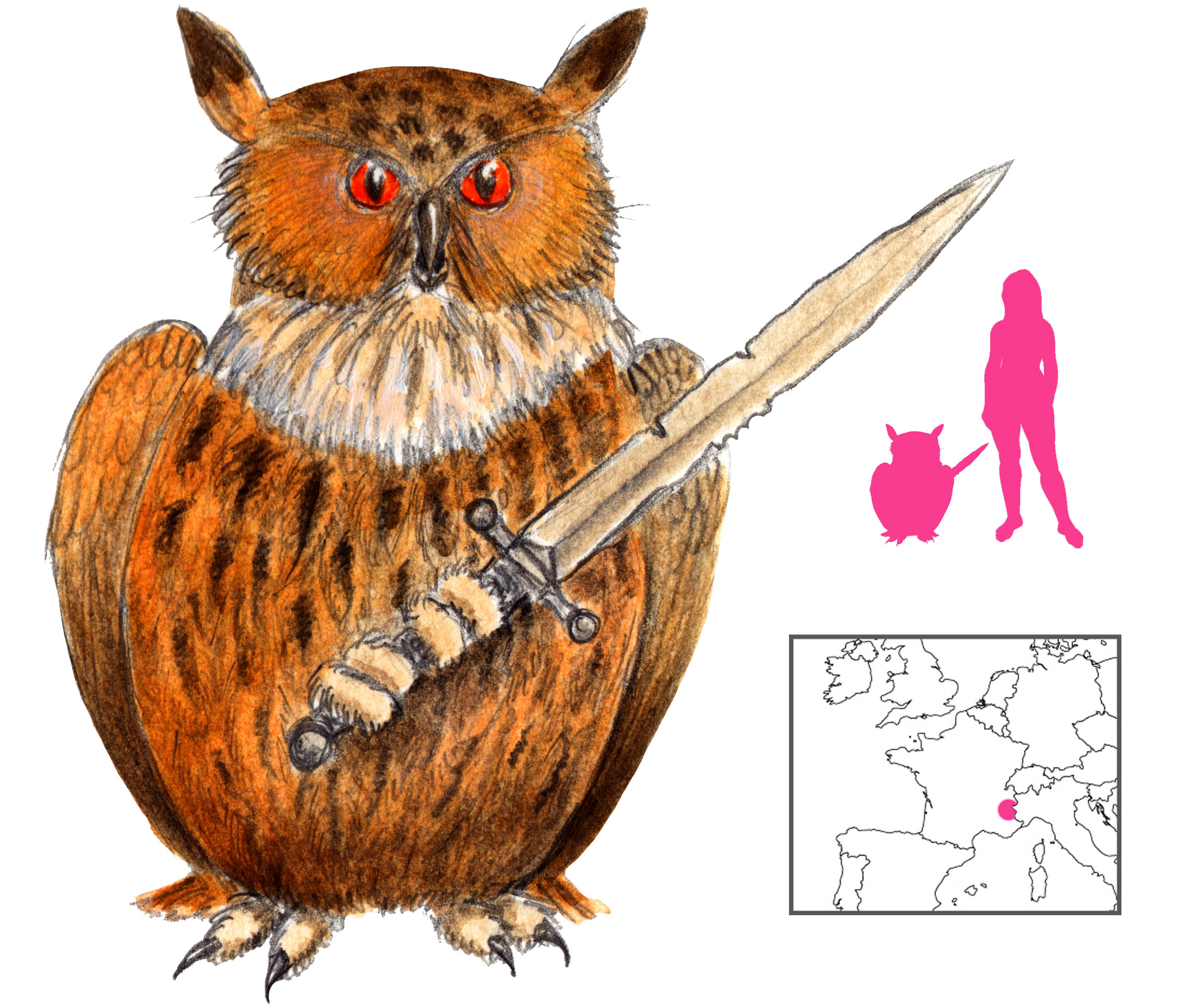
Eagle-owls are impressive animals. As the largest owls, they are top predators in their environments, even feeding on other birds of prey. Their size and eerie calls have ensured them a place in the folklore of many cultures.

It should then be unsurprising that the eagle-owl has been reinterpreted as a supernatural creature. The Duphon can be found in the Hautes-Alpes region of France, where it braids horse manes, pinches young women, and causes mischief and mayhem. The town of Serres preserves a duphon lair in the form of a stone door and ruined ramparts, known as the Trou du Duphon (“The Duphon’s Hole”).

References

van Gennep, A. (1948) Le folklore des Hautes-Alpes, Tome II. J. P. Maisonneuve et Cie, Paris.

del Hoyo, J.; Elliott, A.; Sargatal, J.; Christie, D.A.; & de Juana, E. (eds.) (2013) Handbook of the Birds of the World Alive. Lynx Edicions, Barcelona.

Ladoucette, J. C. F. (1848) Histoire, topographie, antiquités, usages, dialectes des Hautes-Alpes. Gide et Cie, Paris.

Pilou

Variations: Er-pilour-lann

Pilou

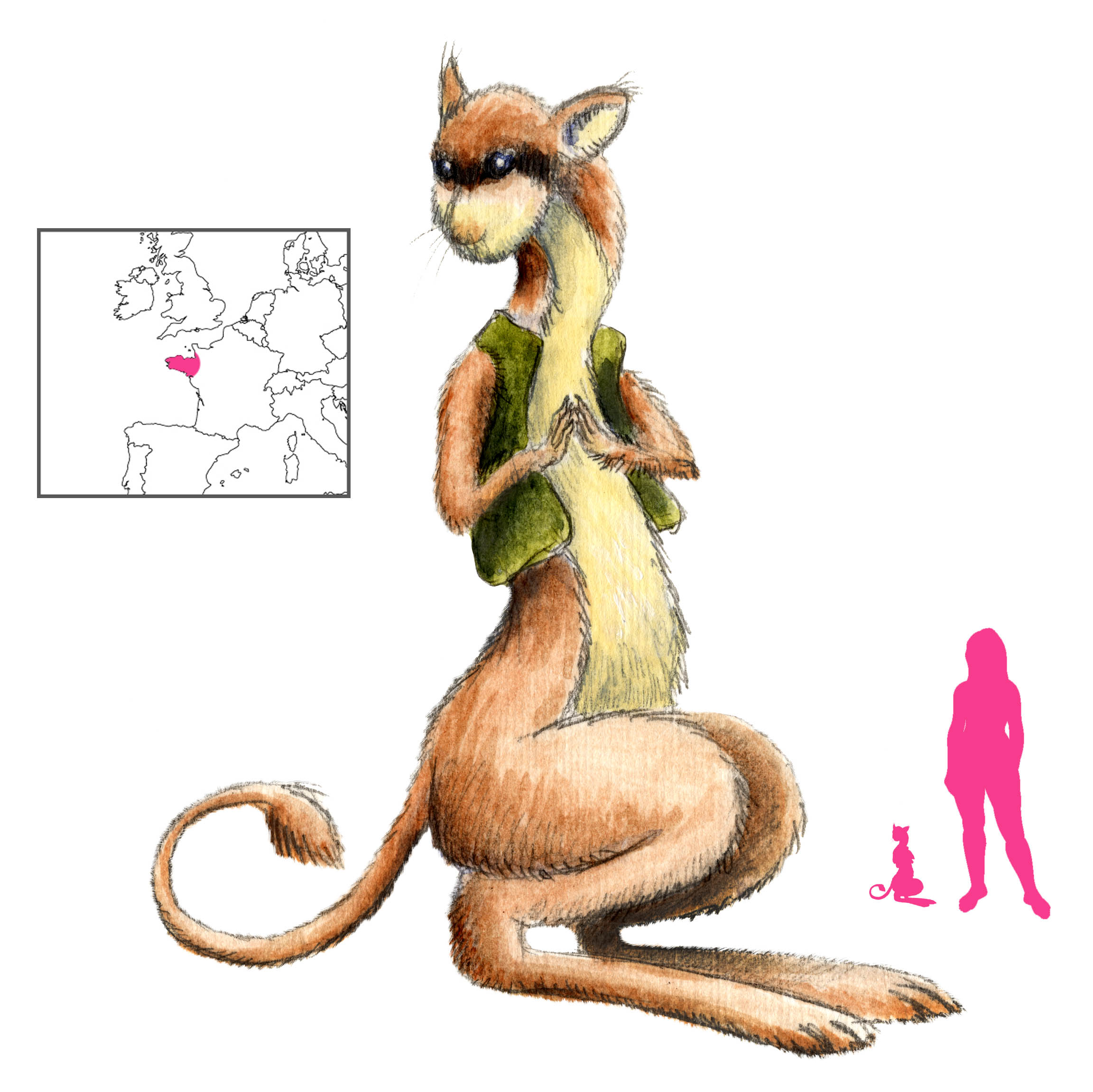
Pilous are always heard and never seen. While their name suggests soft fur – pilou in its modern expression refers to a type of cotton – it actually refers to the men who pound apples into cider, using wooden pilons. Pilous walk with a regular, stomping tread, making a rhythmic sound like that of apples being mashed, and that is all anyone knows of them. Nevertheless, Dubois fancifully describes these lutins as resembling large garden dormice, and that is as good a description as any.

Pilous are native to the northwestern tip of France, specifically Brittany and Ile-et-Vilaine. They come out at night in the attic, in the rafters, in the walls, and start marching. They are not evil but mischievous, and delight in the noise they make. In Brittany, where they become Er-pilour-lann, they wield mallets with which they pound the walls of old houses.

Most encounters with them are about their disregard for human comfort. A farmhand once went into the barn to fetch some hay when the thumping begin, the din seemingly coming from everywhere. He called his uncle, who implored the pilous “Would you, please, stop your noise so I could get some hay for my mare?” They stopped, but the moment the uncle stepped into the barn they started up again, louder than ever.

Another time a group of men were in a barn when a pair of pilous started: one, two, one, two. “I’d like it better if there were three of you!” yelled one of the men, and sure enough a third pilou joined in. Other men started requesting more and more, and the number of pilous increased accordingly. The same stunt was later attempted by three bored young girls, but they requested too many, and soon the pilous were rattling their bed and knocking at their walls. The girls wisely went quiet, and the creatures eventually left.

Attempts to put pilous to use have failed. One miser left oakum fibers behind in the attic in hopes that the pilous would stomp them flat, but he returned in the morning to find the material shredded and scattered all over the attic.

References

d’Amézeuil, C. (1863) Récits Bretons. E. Dentu, Paris.

Dubois, P.; Sabatier, C.; and Sabatier, R. (2005) The Complete Encyclopedia of Elves, Goblins, and Other Little Creatures. Abbeville Press.

Orain, A. (1899) Le Monde des Ténèbres en Ile-et-Vilaine. Revue de Bretagne, de Vendée et d’Anjou, XXI, Paris.

Orain, A. (1901) Contes de L’Ile-et-Vilaine. J. Maisonneuve, Paris.

Le Rouzic, Z. (1924) Carnac: Légendes – Traditions – Coutumes et Contes du Pays. LaFolye Frères et Cie, Vannes.

Jetin

Variations: J’tin, Crion

Jetin

Jetins (from jeter, “to throw”) are tiny lutins native to the seaside caves of Brittany. Their appearance is uncertain; Dubois suggests they are hirsute and rough-looking, with silver shoes. Despite their size – ranging from thumb-sized to 1.5 feet tall – they are incredibly strong, capable of lifting and tossing huge boulders with ease.

Always looking for a chance to show off their strength, jetins amuse themselves by throwing rocks around, sometimes over great distances. Standing stones, menhirs, all manner of megaliths; such stones are discarded playthings of the jetins.

Rock-throwing was not the only pastime the jetins enjoyed. They were also fond of tying knots in horse tails and releasing livestock, and, like any good fairy, they often exchanged human babies for one of their own. The ugly, wrinkled changelings they leave behind are never weaned and never grow. Jetins can be convinced to return stolen children by carrying the changeling to a jetin hole and threatening to kill it. The human baby will quickly be returned and swapped with the impostor.

The jetins shared their territory with the even tinier Fions and the secretive Fées des Houles (“Fairies of the Sea Caves”). Due to their size and their reclusive natures, none of these have been observed in great detail, although the Fées have been benevolent towards humans. The Crions, perhaps the same as jetins, were tiny dwarfs who carried the stones of Carnac on their shoulders.

Elsewhere, the discobolous function of the jetins is fulfilled by Gargantua and other giants, whose size is more proportionate to their strength, and the fairies known as Fileuses (“Weavers”).

References

Dubois, P.; Sabatier, C.; and Sabatier, R. (1992) La Grande Encyclopédie des Lutins. Hoëbeke, Paris.

Morvan, F. (1998) Vie et mœurs des lutins bretons. Actes Sud.

Sébillot, P. (1905) Le Folk-lore de France, Tome Deuxième: La Mer et les Eaux Douces. Librairie Orientale et Américaine, Paris.

Sébillot, P. (1907) Le Folk-lore de France, Tome Quatrième: Le Peuple et L’Histoire. Librairie Orientale et Américaine, Paris.

Lavandière de Nuit

Variations: Lavandière, Laveuse de Nuit (French); Kannerez Noz, Cannerez Noz, Gannerez Noz (Breton); Bean nighe, Bhean Nighe, Caoineachag, Nigheag Bheag a Bhroin (Gaelic); Washerwoman, Night Washerwoman, Washer of the Ford, Little Washer of Sorrow (English)
Lavandiere

The lavandières de nuit (“washerwomen of the night”) are present in some form or other from Scotland to Provence. Their exact nature is uncertain; sometimes they are ghosts, other times members of the fairy kingdom. Their best-documented haunt is Brittany.

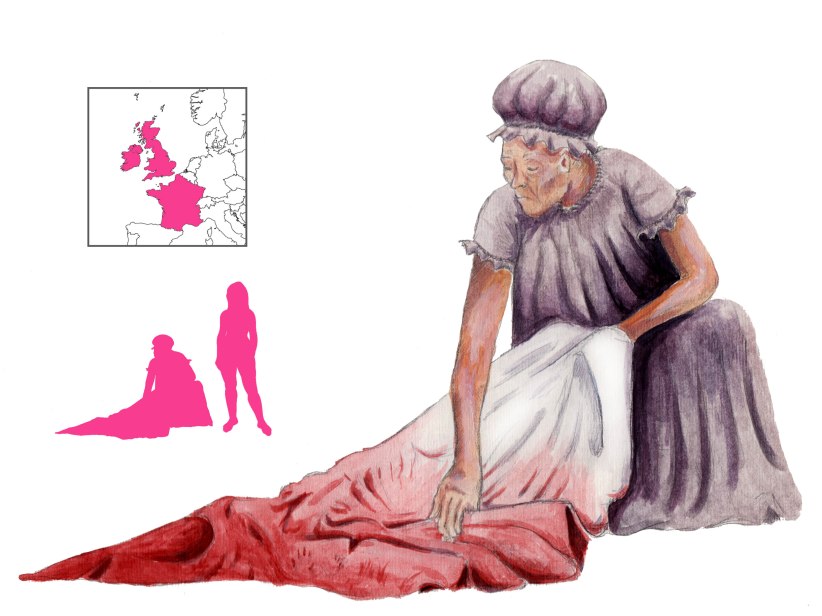
Lavandières are female, and can be seen washing laundry in the odd hours of the night. They usually take the form of tall, gaunt, and withered crones, but the Gollières a Noz of Romandie are as beautiful as they are cruel. Some of them sing as they wash, earning them the name of kannerez noz (night singers). Their song is sadder than a De Profundis. Those of Morbihan have had their song recorded as follows:

Tors la guenille, tors // Le suaire des épouses des morts.

(Wring the rags, wring // the shroud of the wives of the dead).

Often a lavandière is condemned to wash a shroud in atonement for a sin committed in life. Some merely did laundry on Sunday. Others were greedy misers who denied decent clothing to the poor. The grimmest were those guilty of infanticide. The outline of a baby’s corpse could be seen in their blood-soaked sheets; try as they might, the blood never washed out, and the bones never whitened.

The bean nighe of the British Isles are women who died in childbirth before their time, and who are doomed to wash the clothes of those fated to drown until the day when they were meant to die. Their appearance foretells death. Some are aligned with the Morrigan, and wash the corpses of the dead. Cú Chulainn saw one, the daughter of Bodhbh, washing bloodstained clothes and weeping; he died in battle not long after.

In France, especially in Brittany, they call passers-by to help them wring out the laundry. This isn’t a choice – those who accept out of ill will get their arms broken, and those who refuse are drowned. To escape their clutches, one must wring in the same direction they do, turning clockwise when they turn clockwise and vice versa. But this has to be kept up all night, and the lavandières never tire. One false move and the unfortunate victim is crushed, wrung out, their corpse mangled beyond recognition. Even the strongest man is no match for a lavandière, who wrings humans out as easily as a pair of tights.

Another way of escaping their clutches is to tell them Diwasket ho poan ha me diwasko ma hini (“wring out your sins, and I will wring out mine”). Running away at top speed always helps, and lavandières cannot cross recently-ploughed fields. Finally, making the sign of the cross or reciting Biblical verses is always helpful.

The lavandière of Chantepie was a stingy woman who buried her husband in a dirty shroud. She continues to wash it every night.

The lavandières of Fond-de-Fond hold up the bodies of the recently-deceased.

In Landéda, the lavandières are powerless against the goodhearted, but tie the sinful into knots.

The lavandière of Noes Gourdais, near Dinan, appeared early in the morning and had a skull for a head.

The Mille-Lorraines of Lower Normandy form fairy circles around ponds.

Several lavandières gather in the pond of Roc-Reu, and drown anyone who tries to touch them.

Around Dinan, the teurdous (“twister”) is a rare male counterpart. He does not wash, but instead offers to help washerwomen wring out their laundry. If they accept, he breaks their arms.

The true nature of the lavandières is more prosaic. Unfamiliar sounds have been invoked – the croaking of frogs or toads, for instance, might have suggested the sound of washboards. The lavandières themselves may have had nothing supernatural about them. A number of flesh-and-blood women may have had reason to do laundry at night: those who worked during the day, those who did not wish to be seen doing menial work, those who wanted to clean the clothes of their illicit lovers… Anyone coming upon them could be forgiven for seeing them as ghosts.

Others managed to exploit the superstitious fear of lavandières. A garde-champêtre in Vaucluse once stumbled upon a pair of lavandières in spectral white clothes. “Wring the laundry!” they cackled, grabbing him by the collar. And wring he did, all night long. He also noted the fine quality of the cloth they were washing, but did not dare stop until morning, when they left. Only later did the warden find out that a nearby castle had been robbed of various items of clothing. He had spent the whole night helping the thieves wash their ill-gotten gains.

References

Dubois, P.; Sabatier, C.; and Sabatier, R. (1996) La Grande Encyclopédie des Fées. Hoëbeke, Paris.

Giraudon, D. La lavandière de nuit Ar gannerez-noz. In Loddo, D. and Pelen, J. (eds.) (2001) Êtres fantastiques des régions de France. L’Harmattan, Paris.

Kilfeather, A. (2003) Legend and wetland landscape in Ireland. Journal of Wetland Archaeology, 3, pp. 37-50.

Le Quellec, J. (1988) Le légendaire du Sud-Vendée: organisation spatio-mythique. Etuderies 3-4.

MacPhail, M. (1898) Folklore from the Hebrides III. Folklore, Vol. 9, No. 1, pp. 84-93.

Sand, G. (1877) Légendes Rustiques. Ancienne Maison Michel Lévy Frères, Paris.

Sébillot, P. (1881) Littérature orale de la Haute-Bretagne. Maisonneuve et Cie, Paris.

Sébillot, P. (1904) Le Folk-Lore de France, Tome Premier: Le Ciel et la Terre. Librairie Orientale et Américaine, Paris.

Sébillot, P. (1905) Le Folk-Lore de France, Tome Deuxième: La Mer et les Eaux Douces. Librairie Orientale et Américaine, Paris.

Sébillot, P. (1968) Le folklore de la Bretagne. Éditions G. P. Maisonneuve et Larose, Paris.
Arragouset

Variations: Arragousset, Sarregouset, Sarragouset

Arragouset 2

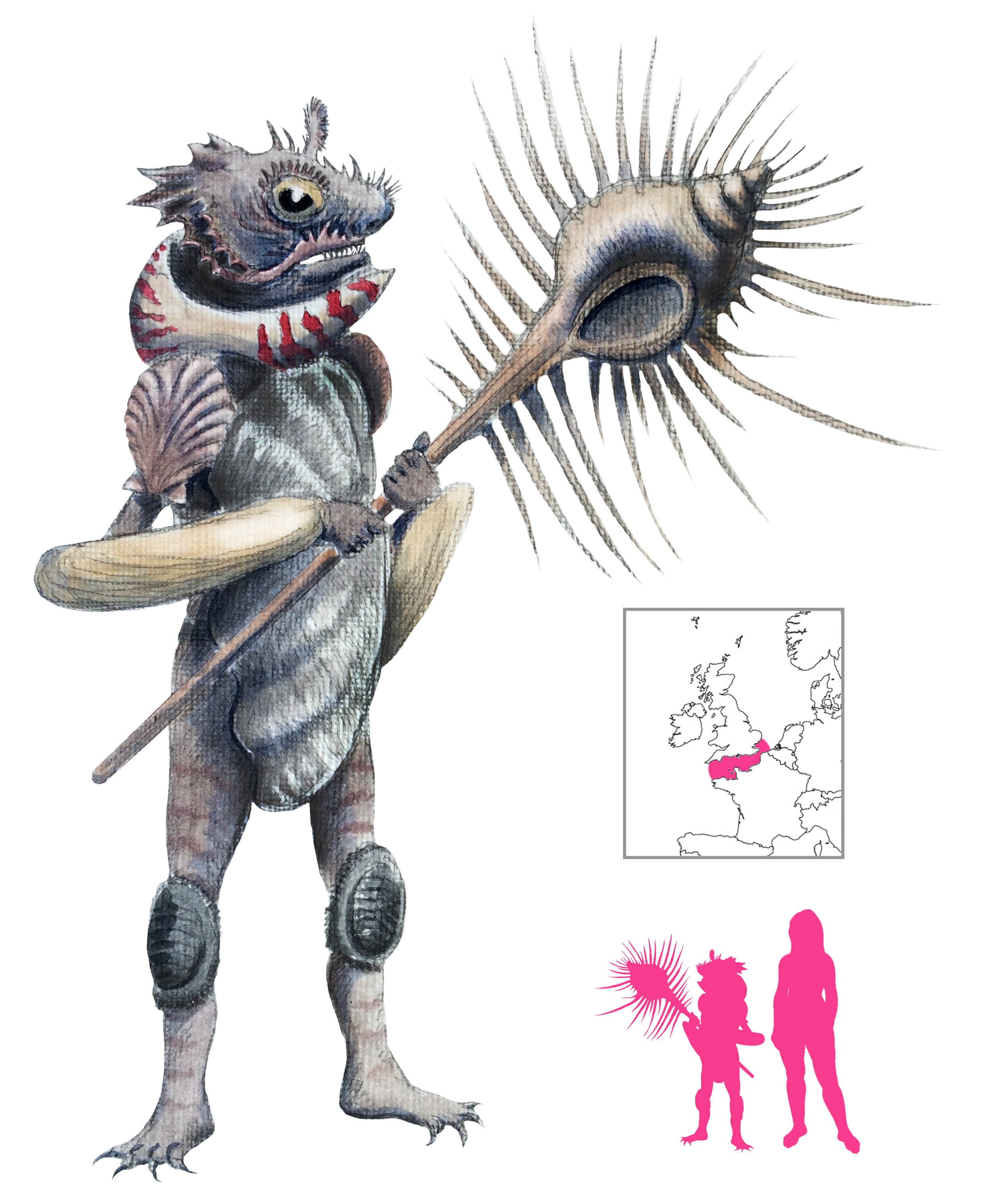
Jean Letocq, a shepherd on the west coast of Guernsey, woke up one morning to see hundreds of little people streaming out of the Creux des Fées (Fairies’ Hollow). They were armed to the teeth, carrying weapons made of sharpened shells. They told the man to bear their message: they wished to take human wives, and would be strongly displeased if women were not turned over to them. This ultimatum was refused, and so the fairies slaughtered every last man they encountered, dying the sea red with blood. The only survivors, a man and a boy of St. Andrew’s parish, hid in an abandoned oven for years.

They were the Arragousets, or Sarregousets as Hugo called them. We know that they were bellicose fairies of the sea, dwelling underwater and in seaside caves, ruling their own marine kingdom. One of their number once took a human woman for his wife, and her beauty and wit so enamored the other fairies that they had to follow suit.

With the men safely massacred, the Arragousets put down the sword and went native. They married the maidens and the newly-widowed, and lived peacefully on land. They made caring husbands and doting fathers, to the extent that the widows warmed to them, and the maidens were delighted with their fairy lovers.

Then, after years of peace, they disappeared as quickly as they had appeared. The circumstances remain mysterious. Sébillot suggests that they were recalled by their king, while MacCulloch states that their time on land was limited. Whatever the reason, all the Arragousets left the island and were never seen again.

Or rather, they went invisible, as their presence remained on Guernsey. They sired a new generation of boys and girls – intelligent, able sailors of small stature – and they returned regularly to watch over them. They did a hundred little favors in the hopes of finishing the work they had started. Arragousets are always ready to help their descendants, but they are pitiless in dealing with offenders.

Hugo said they can still be seen on stormy days, dancing in the clouds and longing to return to the land.

References

Dubois, P.; Sabatier, C.; and Sabatier, R. (1992) La Grande Encyclopédie des Lutins. Hoëbeke, Paris.

Hugo, V. (1866) Les Travailleurs de la Mer. Librairie Internationale, Paris.

MacCulloch, E. (1903) Guernsey Folk Lore. Elliot Stock, London.

Sébillot, P. (1905) Le Folk-lore de France, Tome Deuxième: La Mer et les Eaux Douces. Librairie Orientale et Américaine, Paris.

Scarbo

Scarbo

Scarbo is a vampiric dwarf with specialized tastes. He enjoys nothing more than entering the rooms of poets, artists, and writers, and spending the night tormenting them. With his razor-sharp fangs, he bites into his host’s neck, then helpfully cauterizes the bloody wound with a metal finger heated red-hot.

He clambers around the victim’s room, scrabbling at the rafters, scratching at the bedposts. He whispers threats into their ears – and his creativity knows no bounds, as he describes in loving detail the burial shroud he has planned for his victim, the funeral that he will hold, and the sobbing children that will gather in his wake.

He spends the entire night in the room, growing larger as the moon rises, then, as dawn approaches, he flickers, turns blue and translucent, and winks out like a snuffed candle.

Scarbo’s primary contributions to the arts are the Gothic prose poem Gaspard de la Nuit, reportedly written by the Devil himself, and the piano piece of the same name by Ravel, which matches his fiendish activities with its fiendish difficulty.

References

Bertrand, L. (1904) Gaspard de la Nuit. Ambroise Vollard, Paris.