Múshveli

Variations: Mushveli, Mousewhale; Hafmús, Hafmus (“Sea-mouse”)

Mushveli

The chimaera, ratfish, or rabbitfish (Chimaera monstrosa) is a small and completely harmless deep-sea fish. Evidently its legendary counterpart the Múshveli, or “mousewhale”, is enormous and highly dangerous. As one of the illhveli (“evil whales”) of Iceland, it is inedible and delights in causing death and destruction.

Múshvelis are mostly mouth, ear, and tail. The gaping, deeply split mouth is large enough to swallow a rowboat in a single gulp, and the large, prominent ears stick out like sails while the animal swims. A long whiplike tail without a fin allows the múshveli to swim at terrifying speeds, so fast that the sea churns ahead of it. Instead of fins, there are two stumpy hoofed legs. These animals are over ten meters long, and light gray or brownish-black in color.

Múshvelis sink ships by ramming them or rearing up, placing their feet on the gunwales, and pushing down until the ship capsizes. If a múshveli is sighted, the best course of action is usually to make for shore as fast as possible, and once there make for higher ground. Unlike most other evil whales, múshvelis can clamber onto the beach with their stubby legs, but they are out of their element and give up quickly. One múshveli ran a boat aground and followed the sailors as far as it could. It easily shrugged off three bullets, and eventually returned to the sea with the next high tide.

Large boats are usually impregnable to múshvelis. In one account, two Icelandic fishermen on a small boat were alerted to the presence of a múshveli by the roar of the foaming sea. It was making right for their boat, and terror made them freeze up. Fortunately, the crew of a French fishing schooner saw their plight, and steered their boat into the múshveli’s path. The sea-mouse rammed the ship so hard that it listed to one side, but remained afloat. The múshveli continued to take its rage out on the French schooner while the fishermen were taken aboard to safety, and eventually the monstrous whale gave up and disappeared.

References

Davidsson, O. (1900) The Folk-lore of Icelandic Fishes. The Scottish Review, October, pp. 312-332.

Hlidberg, J. B. and Aegisson, S.; McQueen, F. J. M. and Kjartansson, R., trans. (2011) Meeting with Monsters. JPV utgafa, Reykjavik.
Vatnagedda

Variations: Eiturgedda, Vatna-gedda, Loch Pike, Poisonous Pike

Vatnagedda

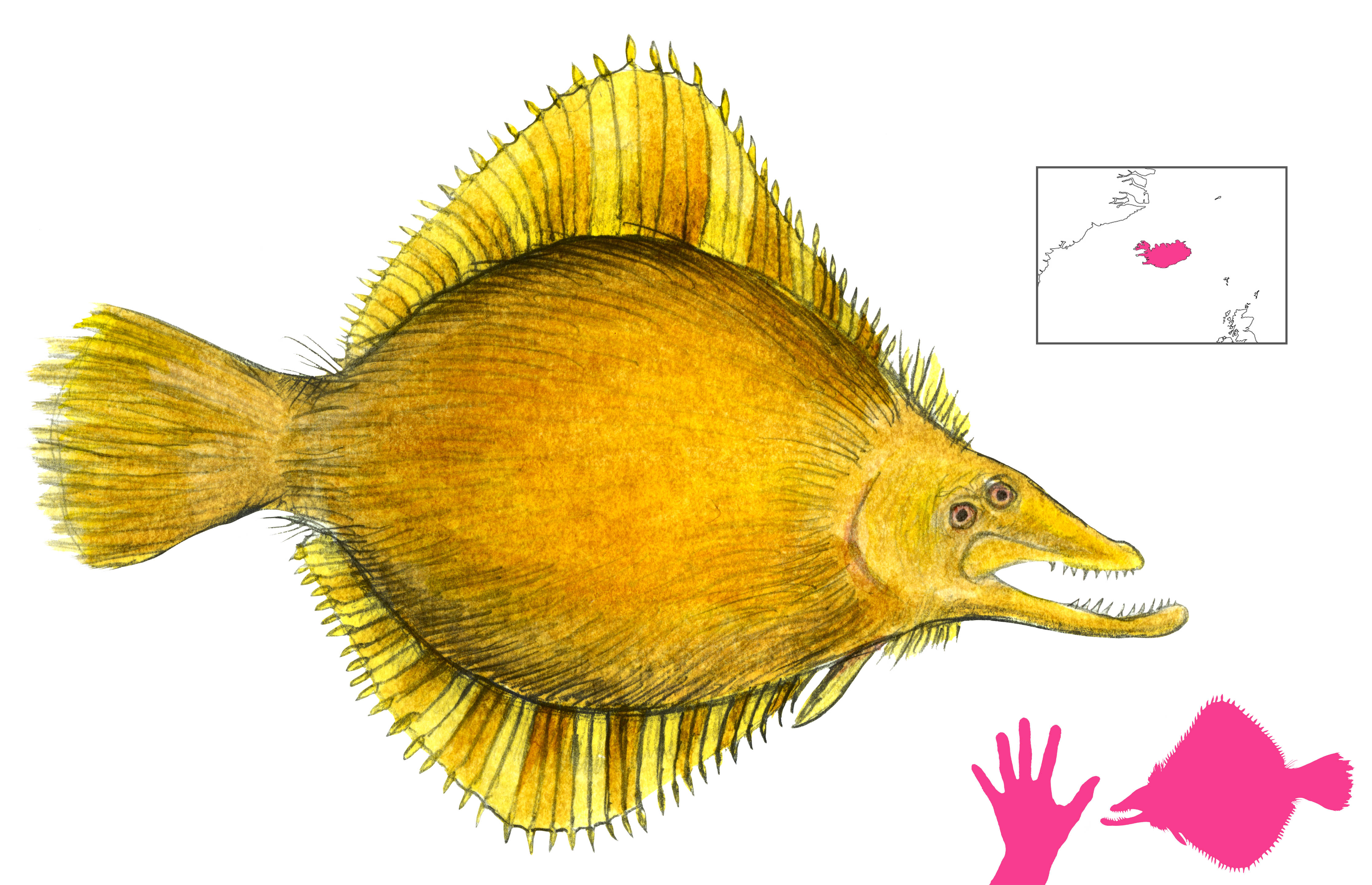
A number of Icelandic fishes are extremely toxic, but the Vatnagedda or “loch-pike” is probably the deadliest of all. Despite its name, it looks less like a pike and more like a small furry flounder, golden in color (although blue variants have been reported). They are also known as Eiturgedda, or “poisonous pike”.

The poison of the vatnagedda is found in its flesh and skin. Merely touching it is enough to cause death. The corrosive toxins can dissolve organic and inorganic matter alike, and eat through layers of clothing. Even ghosts are not immune to vatnagedda poison. The presence of a dead vatnagedda is enough to scare off any evil spirit, and vatnagedda fat will cure pain caused by ghosts and sorcery.

Vatnageddas live at the bottom of murky lakes. They hate light, which is said to kill them, and so are only seen at the surface before storms and in fog. To catch one, the hook must be baited with gold. Anglers must wear gloves made of human skin, or multiple layers of skate-skin; even then, handling the fish will result in rashes and inflammation.

The main problem after landing a vatnagedda is holding on to it, as its poison will eventually destroy any material around it. One specimen that had been wrapped in two horse-skins melted its way underground and vanished into the earth. Wrapping it in the caul of a child, followed by the caul of a calf, is the only known way to transport a vatnagedda.

Jon Arnason tells of a sorcerer who aided a farmer and his son. Some evil spirit was visiting their home, and its repeated hauntings were driving the young daughter to madness. The sorcerer, wearing human-skin gloves and armed with a hook baited with gold, captured a vatnagedda from Gedduvatn (Pike Lake). The dead fish was placed in a bottle, wrapped in multiple layers of sheepskins and leather, and loaded onto a pack-horse for the journey home. By the time the sorcerer returned, the horse had developed a hairless, sunken patch on its back where the vatnagedda had been, and it was debilitated for the rest of its life. The vatnagedda was buried under the threshold of the house, and the ghost never returned. The girl made a full recovery.

References

Davidsson, O. (1900) The Folk-lore of Icelandic Fishes. The Scottish Review, October, pp. 312-332.

Hlidberg, J. B. and Aegisson, S.; McQueen, F. J. M. and Kjartansson, R., trans. (2011) Meeting with Monsters. JPV utgafa, Reykjavik.
Ziphius

Variations: Ziph, Ziphio, Ziphij, Xiphia, Xiphias, Zyffwal

Ziphius

The Ziphius is a huge and horrifying sea monster, reportedly found in northern seas and near the Scandinavian coast. It resembles a whale in shape and size, but with a viciously sharp beak and terrifying bulging eyes. The beak and bristly hair around the head and neck combine to give it an owlish appearance. The ziphius also has a pointed dorsal fin, paw-like flippers, and horizontal stripes down its length. It is a carnivore, feeding on seals and sailors alike.

The Ortus Sanitatis gives it four fully-formed legs and tail, making it look more like a beaked lion or even a hedgehog. Olaus Magnus describes its hideous, beaked head, comparing it to an owl (or a toad in the French translation). It has a deep maw, horrid large eyes, and a knife-like dorsal fin used to tear holes in ships. Gessner compared it to the physeterus. Munster showed it swallowing a sea calf, and emphasizes the fact that it is horrible.

Today Ziphius refers to the harmless and rarely seen Cuvier’s beaked whale. Killer whales probably were a more significant contribution to the image of the ziphius, as were swordfishes – ziphius is derived from xiphias, or sword.

De Montfort interpreted the ziphius differently. As it had a hooked beak and blazing eyes, he believed that it must have been a distortion of the giant squid or kraken.

References

van Duzer, C. (2013) Sea Monsters on Medieval and Renaissance Maps. The British Library, London.

Gessner, C. (1560) Nomenclator aquatilium animantium. Christoph Froschoverus.

Magnus, O. (1555) Historia de gentibus septentrionalibus. Giovanni M. Viotto, Rome.

Magnus, O. (1561) Histoire des pays septentrionaus. Christophle Plantin, Antwerp.

de Montfort, P. D. (1801) Histoire Naturelle, Générale et Particuliere des Mollusques, Tome Second. F. Dufart, Paris.

Munster, S. (1552) La Cosmographie Universelle. Henry Pierre.

Unknown. (1538) Ortus Sanitatis. Joannes de Cereto de Tridino.

Caspilly

Variations: Caspilli, Neemora (Persian)

Caspilly

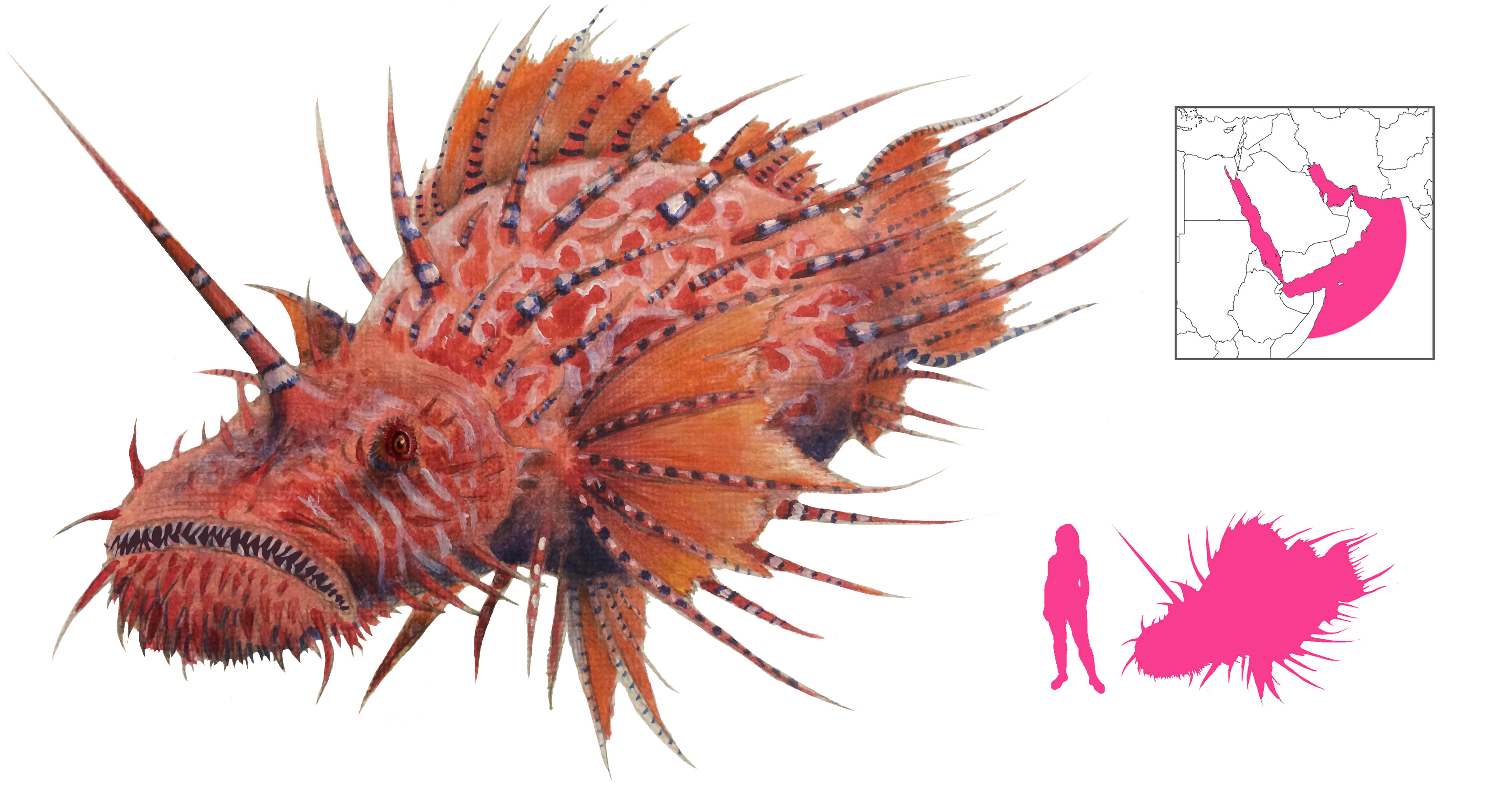
The Caspilly is a “marvelously large, and strong” fish from the Indian Ocean, described by Ambroise Paré on the basis of two separate accounts by André Thevet.

Thevet placed it in the Arabian Gulf, saying that it is known to the Arabs as caspilly, and to the Persians as neemora. The caspilly is almost as wide as it is long, but no more than two feet long. It has no scales, and its skin is spiky and barbed like that of a shark. On its forehead is a lancet-like spine, a foot and a half in length, that it keeps tucked along its nape. When it is hungry, it goes for the first fish it sees, stabbing it in the belly with its horn until its prey bleeds to death. Its teeth are venomous and bites are deadly. Applying a dead caspilly to a bite, on the other hand, will cure it. The horn is of great medicinal value, and caspilly are shot with arrows from a safe distance to retrieve such a prize.

Thevet also reports a nameless fish from the Peruvian sea, with a swordlike horn three feet long. This fish is a specialized whale killer. Upon seeing a whale, the fish will hide underneath before stabbing it in the navel with its horn, leaving the whale to writhe in its death throes and capsize nearby ships. Once the whale is dead, it can be eaten at leisure.

Paré economically combines both accounts, giving the caspilly a four-foot-long horn and making it the terror of the Arabian sea. He adds that the Arabs of the region hunt caspillys with giant hooks baited with camel meat. Any caspilly who greedily takes the bait will tire itself out on the line, eventually slowing down enough to be shot with arrows, brought onto ship, and bludgeoned to death. Caspilly flesh is edible, and caspilly alicorn is just as potent against venom as that of the unicorn.

In all likelihood the Caspilly was born from accounts of swordfish and killer whales, contaminated by lionfish and porcupinefish. The venomous bite may have been derived from the famed toxicity of pufferfish. Aldrovandi cautiously included it with his Herinaceus marinus, the porcupinefish, as Herinaceus arabus, the Arab hedgehog.

References

Aldrovandi, U. (1642) Monstrorum historia cum Paralipomenis historiae omnium animalium. Bononiae.

Paré, A. (1582) Discours d’Ambroise Paré – De la Licorne. Gabriel Buon, Paris.

Paré, A. (1614) Les Oeuvres d’Ambroise Paré. Nicolas Buon, Paris.

Thevet, A. (1575) La Cosmographie Universelle. Guillaume Chaudiere, Paris.