Dodo

Variations: Kadindi, Kaddodi, Kadda, Swallower-of-Men

Dodo

The Dodo is a monstrous humanoid creature from the folklore of the Hausa people. He can be found lurking in the deep forests and swamps of sub-Saharan West Africa, with a range including Sudan, Ghana, Nigeria, and the Côte d’Ivoire. The dodo has nothing in common with the extinct flightless bird of the same name, and probably was derived from tales of giant snakes.

Not much is known about a dodo’s appearance. He – for the dodo is always male – is the King of Beasts, and can just as easily be the lion, the python, the elephant, or the rhinoceros. A dodo is humanoid in appearance and large in size, as he has to stoop to get through doors. He has long, shaggy black hair. He has a keen sense of smell, and can detect meat from far away. He has some degree of magic powers, but cannot cross running water (paradoxically, dodos also live in ponds and streams). Most importantly, the dodo has a vast mouth glowing red from the inside, a seemingly infinite stomach capacity, and a taste for human flesh. As one of the African “swallowing monsters”, a dodo can easily engulf an entire village.

A dodo is often a self-invited guest, eating more and more until there is nothing left. This is not always a bad thing. Once a miser and his son were preparing to butcher a freshly-slaughtered ox in the forest, far from prying eyes. They decided to cook it in a nearby fire – a fire which turned out to be a dodo’s glowing, cavernous mouth.

“Well well”, said the dodo. “Who has invited me?” The miser, hoping to placate him, said “I did!” and gave him a leg of beef, which the dodo put away in his bag. “Does a man invite a friend to a feast for such a small morsel?” said the dodo. In response, the miser gave him another leg. “Does a man invite a friend to a feast for such a small morsel?” The next two legs followed, then half the bull, then the remainder of the bull. “Does a man invite a friend to a feast for such a small morsel?” “But there is nothing left!” protested the man. “You are also meat”, came the response. Terrified, the miser shoved his son forward, and the dodo tossed him into his bag. Finally, he grabbed the miser himself. “What about you?” he said, throwing him into his bag as well. The dodo went to collect firewood, but in the meantime the father and son managed to cut their way out of the bag and made their escape. The dodo returned, shrugged, and got a meal of roast beef. The miser vowed he would never be greedy again, and devoted the rest of his life to sharing his food and wealth with others.

While dodos readily eat meat, they are also fond of taking human women as their wives, sometimes fathering repulsive half-dodo children with them. Dodos like to strike bargains with prospective spouses, promising to help them for the price of marriage; sometimes those “bargains” are more straightforward, consisting of “Would you like me to eat you or marry you?” Such unions are never happy, and the wife will always try to escape her captor.

One dodo story tells of a young woman, pregnant with her first child, drawing water from a stream. Another woman, jealous of her companion and looking to get her scolded, threw dirt in her pot before leaving. But as the pregnant woman tried to carry her water pot, a dodo came out of the water and helped her with her load. Before she could protest, he stated “If you give birth to a boy, he will be my friend. If your child is a girl, she will be my wife”. And with that, he disappeared back into the water.

The mother soon gave birth, and her jealous rival was prompt to report the news to the dodo. “She gave birth to a girl”, she announced, and the dodo was immensely pleased. He was content to wait over the years, until the girl had become a woman as beautiful as her mother. On the day of the girl’s wedding, the jealous woman once more reported the news to the dodo, and he decided to show up uninvited.

“Kadindi has arrived”, he boomed, as everyone stared at him. “I have come to collect the payment I am due”. The daughter was obviously unhappy about marrying the monster, so instead her father gave the dodo a horse, part of the bride’s dowry. “Here is the payment for your debt”, he said, and the dodo swallowed the horse. But that was not enough. Next he ate all of the cattle, all of the wedding feast, all of the guests, and finally the father and mother. There was only the daughter left, and in desperation she prayed to the heavens. “Dodo has come to demand payment”, she implored. In response to her prayer, a knife fell out of the sky, and it was promptly swallowed as well – killing the dodo, cutting open his belly, and causing all the livestock, food, guests, and parents to come out unharmed. The wedding went on as planned.

References

Tremearne, A. J. N. (1913) Hausa Superstitions and Customs. J. Bale and Sons and Danielsson, Ltd., London.
Yara-ma-yha-who

Yara ma ya who

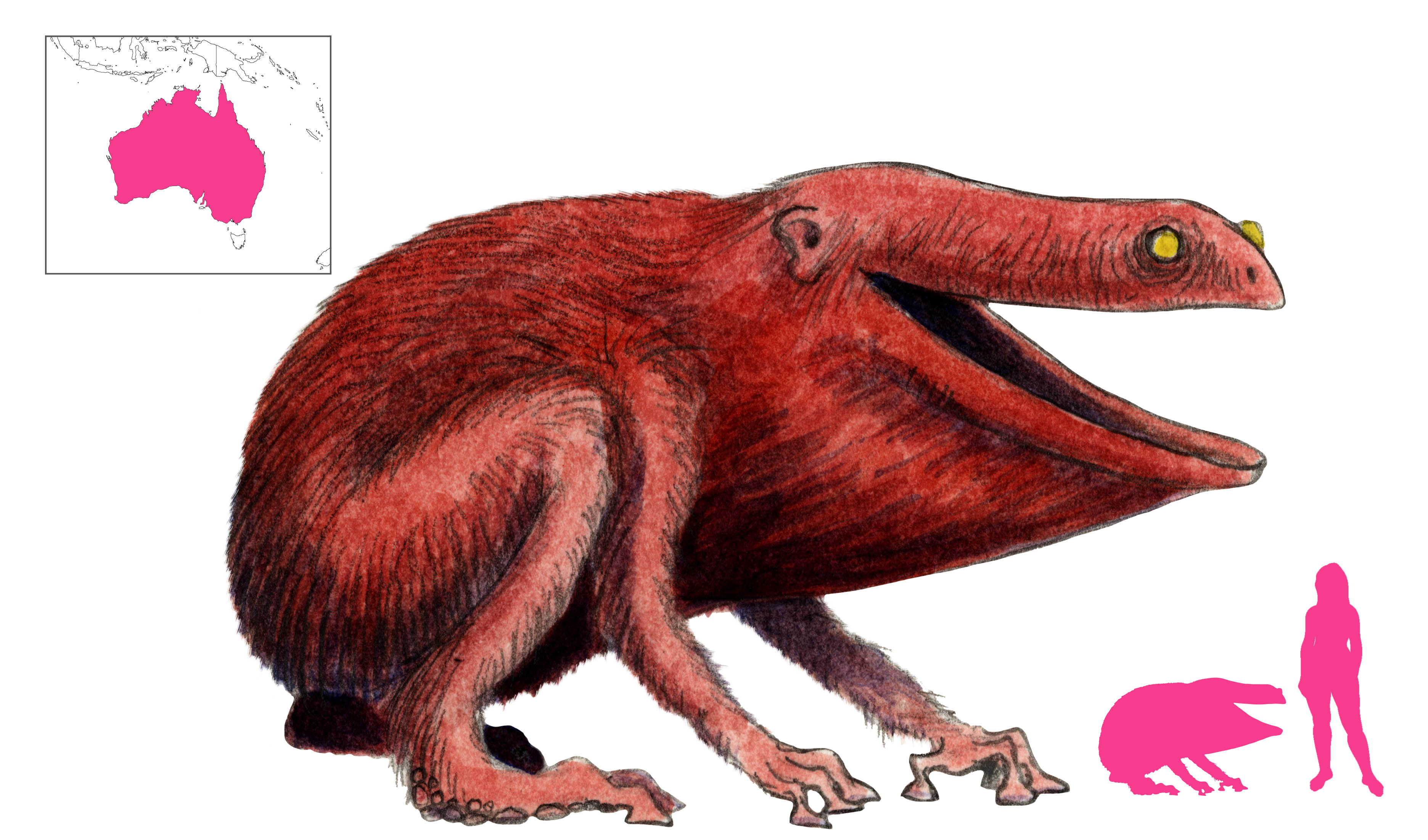
The Yara-ma-yha-who of Australia are restricted to the forests of the Pacific coast, and their absence elsewhere should be considered a blessing. They are primarily nursery bogies, dissuading children from frequenting dangerous areas.

A yara-ma-yha-who is a grotesque sight, and would be amusing were it not for its ghastly habits. Not more than four feet tall, red, and covered with fur, a yara-ma-yha-who has a disproportionately large head. It can open its toothless mouth like a snake, and its throat and belly are similarly distensible. An adult man can be easily swallowed by a yara-ma-yha-who without discomfort. Its fingers and toes are equipped with suction cups. Yara-ma-yha-who are good climbers, but can only waddle like cockatoos on land.

Thick-leaved fig trees are the yara-ma-yha-who’s favorite haunt. They can wait for days in the branches until some hapless traveler, perhaps seeking shelter from sun or rain, lies under the tree. Lone children are their favorite prey.

When a yara-ma-yha-who attacks, it attaches its hands and feet on its victim’s body, using the suction cups to drain the blood out of them. It does not empty them entirely, but only enough to make them faint. It then leaves its victim for a while, eventually returning to swallow them whole, head first. A little dance lets the food slide down, the meal is washed down with water, and the yara-ma-yha-who takes a nap.

After waking up, the yara-ma-yha-who vomits its prey out. The human is almost always alive and playing dead; there is no reason to fight back as the creature can overpower the strongest man. The yara-ma-yha-who takes five paces, then returns and pokes his victim’s sides with a stick. Then it walks away ten paces before returning to tickle the human under the arm or neck. A fifty-yard stroll is followed up by more tickling, then the yara-ma-yha-who goes behind a bush and sleeps.

This ritual is always repeated. The yara-ma-yha-who know that if they fail to carry out these actions, the spirit of the fig tree will mumble in their ears, causing them to transform into glowing tree mushrooms.

For this reason it is safest to play dead until this point, when you get to your feet and run. “Where have you gone, my victim?” calls the yara-ma-yha-who if it hears you escaping, but its awkward gait makes it easy to outrun. After failing to recapture prey, a spiteful yara-ma-yha-who will drink up all the water in nearby wells and water-holes, leading people to seek liquid from tree sap – and thus end up exposed to yara-ma-yha-who attack.

It is important not to let a yara-ma-yha-who swallow you multiple times. The second time you are swallowed and regurgitated, you become shorter and completely hairless. By the third time you are shorter still, and thick hair grows over your body. Eventully, after enough cycles of swallowing and vomiting, you become a yara-ma-yha-who yourself.

Heuvelmans believed the yara-ma-yha-who was inspired by tarsiers. Furry, big-eyed, and with suction-cup fingers, it is more a mammalian frog than anything else.

References

Heuvelmans, B. (1958) On the Track of Unknown Animals. Rupert Hart-Davis, London.

Smith, W. R. (2003) Myths and Legends of the Australian Aborigines. Dover Publications, Mineola.

Isitwalangcengce

Isitwalangcengce

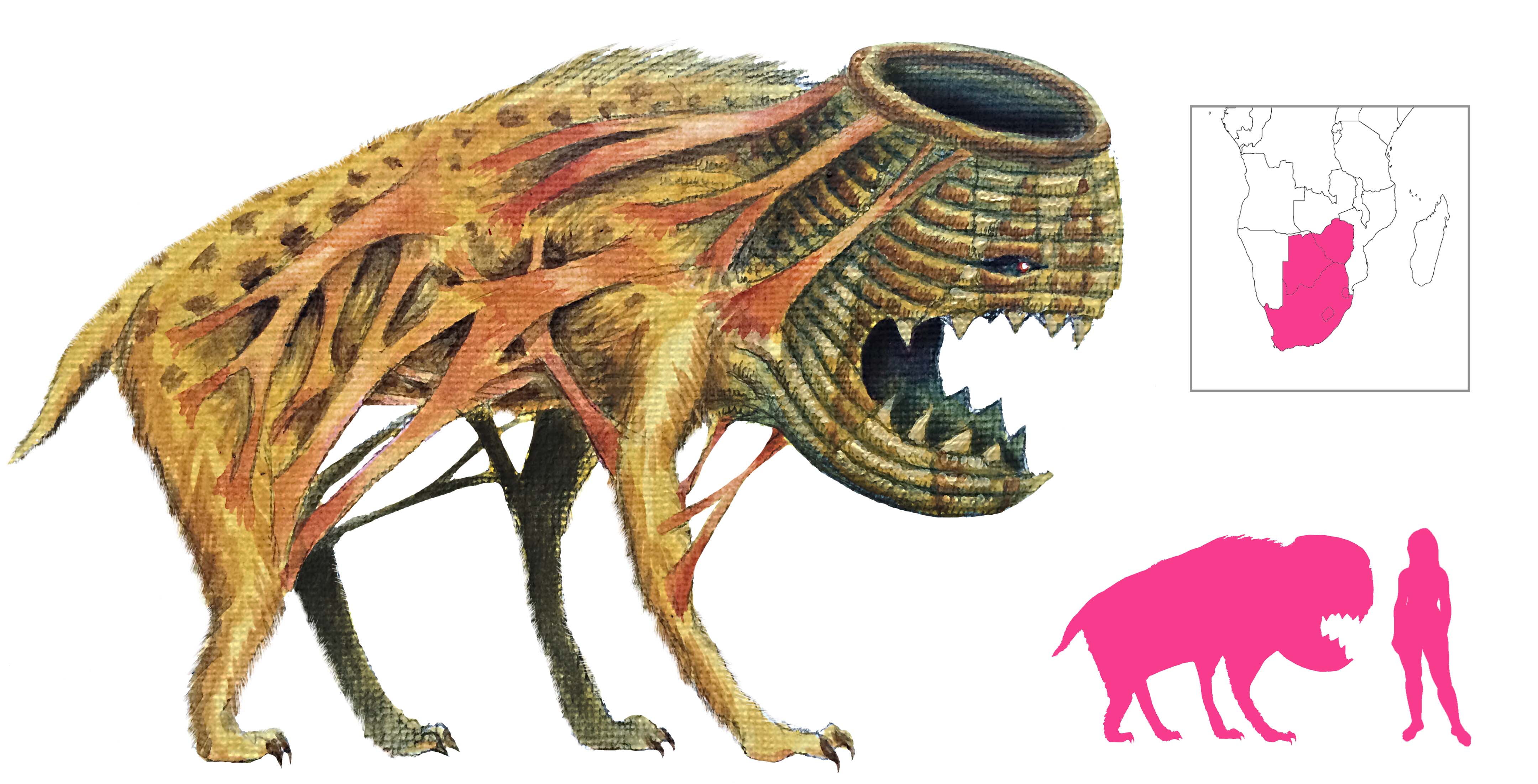
The Isitwalangcengce, or “Basket-bearer”, is hardly seen these days. Which is all the better, as this monster known to the Zulu people is a dedicated man-eater. Somewhat like a hyena in appearance, an Isitwalangcengce’s most notable feature is its basket-shaped head, complete with an opening in the top for carrying its prey.

Isitwalangcengces are powerful, and can easily overcome the bravest of men. They wait around villages during feast days, when children carrying freshly butchered meat go from house to house. They hide beside the doorway, and quickly stuff their victims into their head, carrying them off to eat. Isitwalangcengces do not actually eat all of their prey, but eat only the brain. An Isitwalangcengce will have a favorite rock to smash human heads on and lap up the contents.

If the Isitwalangcengce is strong, it is also dimwitted. This fact was exploited by one Zulu man who was being carried off in the basket. When the Isitwalangcengce passed through bushy terrain, the man reached out of the basket and pulled branches off, stuffing them into the cavity with him. Once he had filled the Isitwalangcengce’s head with sufficient branches, he grabbed onto a tree and hauled himself out. The Isitwalangcengce, meanwhile, noticed no difference in weight. By the time it reached the rocks and poured out a clump of branches and twigs, the man was long gone.

When the man returned to his village, he made sure to narrate his escapade in detail. News of that spread. Soon everyone knew to fill an Isitwalangcengce’s head with branches, and predation dropped drastically.

Now the Isitwalangcengce are mere nursery bogeys, good only for intimidating children. “If you aren’t good, the Isitwalangcengce will carry you off!” And the children smile to themselves, knowing that there’s always an easy way out.

References

Callaway, C. (1868) Nursery Tales, Traditions, and Histories of the Zulus. Trübner and Co., London.