Alicanto

Alicanto

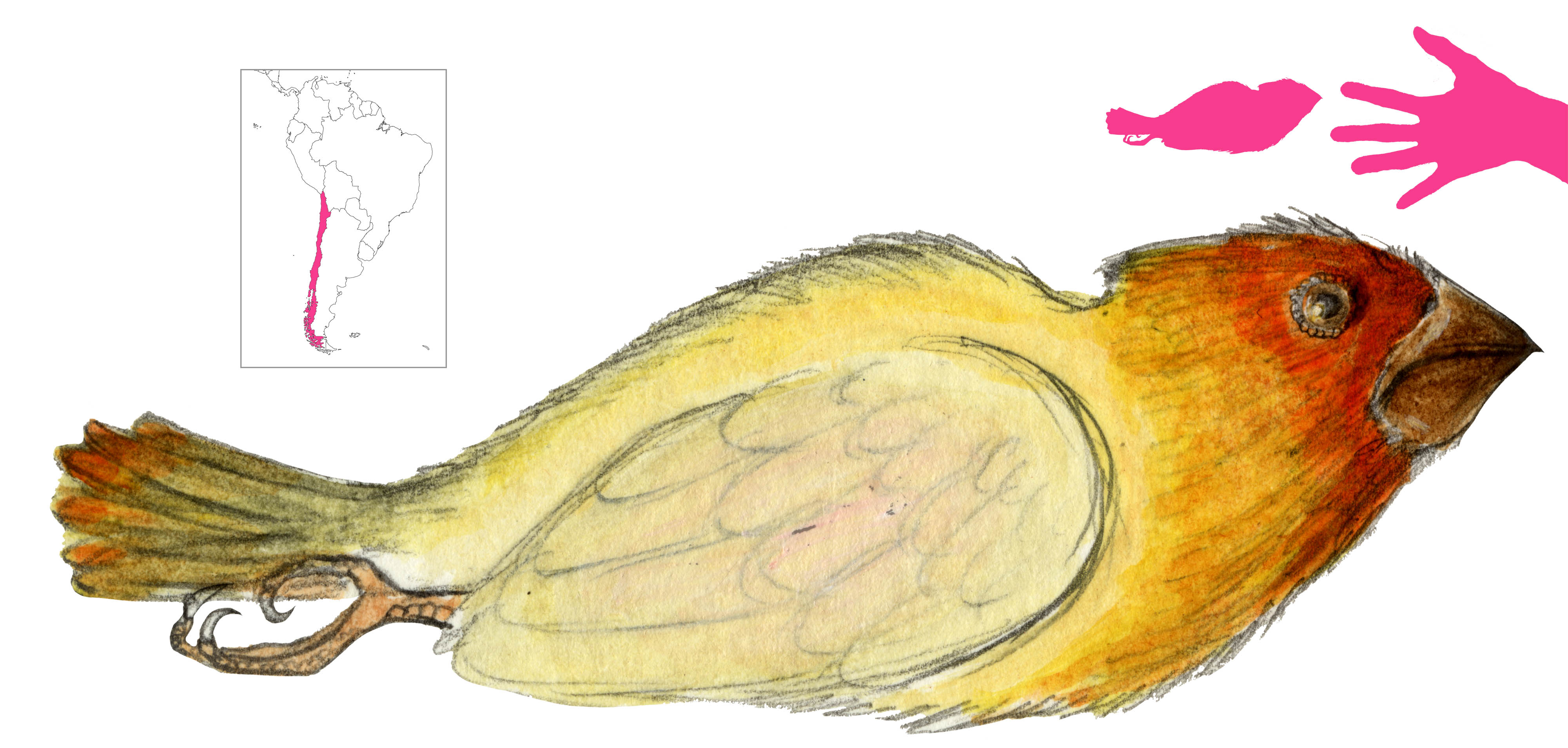
The Alicanto is a glowing nocturnal bird comparable to the Carbuncle, perhaps sharing the same folkloric origin. It is  known to inhabit Chile, and has been reported from Atacama, San Bernardo, Santiago, Talagante, and Tarapacá.

Alicantos feed exclusively on metal ores, and take on the color of the metal they ingest – a gold-eating alicanto emits a golden light, while the silver-eating variety glows a cold metallic gray. The rare copper-eating alicanto is greenish, with large wings, a hooked beak, long legs, and sharp claws. Due to its phosphorescence, an alicanto does not cast a shadow. The eyes are bright and gleam silver.

These birds are flightless, but their wings are perfectly functional. They will often gorge themselves on metal, filling their crop so much that they cannot fly. At best they run fast with their wings held open; a full alicanto can barely drag itself along the ground.

Alicantos live around mines and hidden treasure, and nest in small caves. The female always lays two eggs, the shells of which are made of the metal she eats.

As an alicanto indicates the presence of precious metal, finding one can be highly lucrative. For that reason they are sought out by prospectors, engineers, miners, and unscrupulous looters hoping that the birds will lead them to rich veins. However, an alicanto is highly protective of its food sources, and if it knows it’s being followed, it will stop glowing and disappear into the darkness – or worse, lead its pursuers to a cliff.

References

Aguirre, S. M. (2003) Mitos de Chile. Random House, Editorial Sudamericana Chilena.

Cifuentes, J. V. (1947) Mitos y supersticiones (3rd Ed.). Editorial Nascimento, Santiago, Chile.

Tsenahale

Variations: Tse’nahale, Tse’na’hale, Tsanahale
Tsenahale

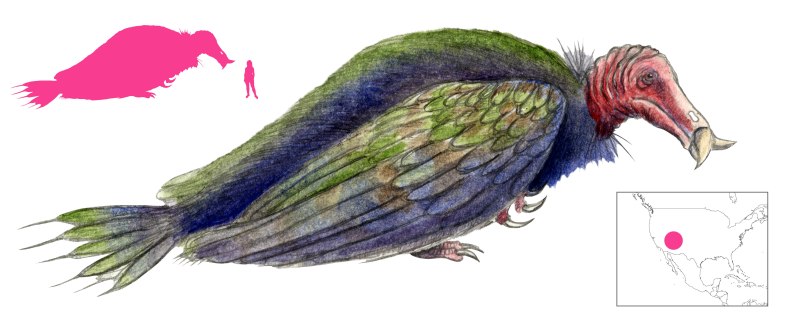
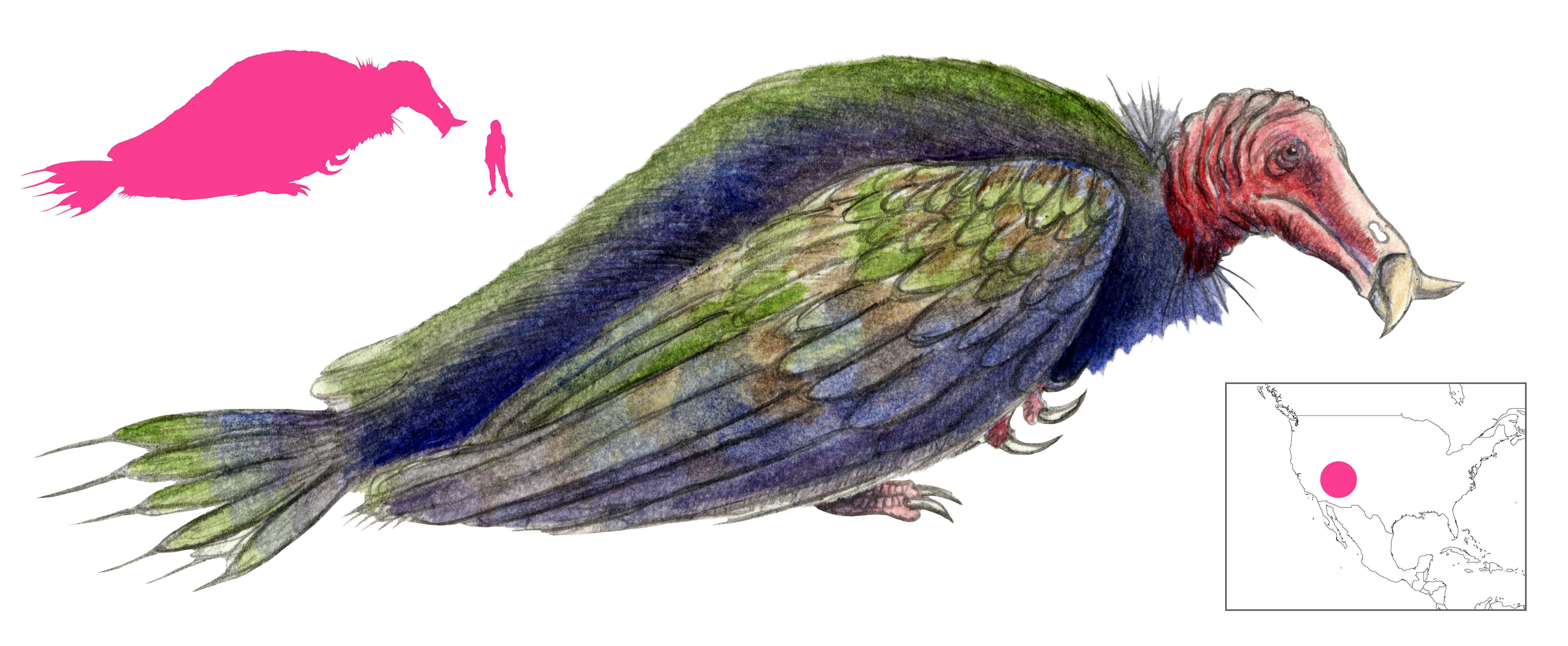
The Tsenahale were two of the Anaye, or “Alien Gods”, who plagued the land of the Navajo. They were born after men and women were separated, and the women resorted to unnatural practices as an outlet. In the case of the Tsenahale, the “father” was a pile of feathers; their mother must have been particularly desperate.

When the first Tsenahale was born, it was a misshapen creature with feathers on its back and shoulders. Its mother abandoned it in horror, but it survived and grew into a monstrous, bird-like creature likened to a huge eagle or a harpy. By the time Nayenezgani, the “Slayer of Alien Gods”, set out to rid the land of the Tsenahale, the Tsenahale were two in number, male and female. The male preyed solely on men, while the female hunted women. Raven was their spy.

Nayenezgani found the nest of the Tsenahale on Tse’bit’ai, the “Winged Rock”, or Shiprock as it is also known. As he approached, the male Tsenahale dive-bombed him, his huge wings whipping up a whirlwind as he swooped at him from four different directions. He seized him in his talons on the fourth attempt. The bird flew off with him and dropped him into the nest from a great height, but Nayenezgani was protected by his life-feather, and was unharmed. He cut open a bag of Teelget’s blood and let it spill, convincing the Tsenahale that he was safely dead.

As the two Tsenahale chicks approached him, Nayenezgani tried to silence them. “It’s not dead! It said ‘Sh!’ to us!” they screeched. “That’s air leaving the body. Just eat it”, snapped the father, before winging off.

Of course, Nayenezgani miraculously came back to life as soon as the Tsenahale was gone, and confronted the chicks. They were blue as a heron, with big eyes and sharp eagle beaks. “When will your father return?” asked Nayenezgani. “When we have a thunderstorm, he will be on that rock”, answered the chicks. “And your mother?” “When we have a rain shower, she will be on that crag”.

Soon a great storm formed, with thunder and lightning, and the male Tsenahale flew out of the clouds and perched on the rock as expected. Nayenezgani slew him with a single lightning arrow. Then the mother arrived in pouring rain, carrying with her a dead Pueblo woman in beautiful turquoise finery. Nayenezgani shot her in turn.

“What about us?” cried the chicks. “Are you going to kill us?” But Nayenezgani spared them. “You are not grown, and would grow into killers; but I will make something useful of you”. He picked the older chick up and told it “You will provide feathers for rites, and bones for whistles”. He swung it around four times and threw it into the air, turning it into a majestic eagle. Then he picked up the younger chick, telling it “Your voice will tell the future; sometimes you will lie, sometimes you will tell the truth”. He swung it as well, and it turned into an owl, which he threw into a crevice in the cliff.

As for the feathers of the Tsenahale, Nayenezgani took the largest from each wing as trophies. The others were plucked, and were metamorphosed into sparrows, warblers, chickadees, wrens, and all the little birds of the world.

References

Alexander, H. B. (1916) The Mythology of All Races v. X: North American. Marshall Jones Company, Boston.

Locke, R. F. (1990) Sweet Salt: Navajo folktales and mythology. Roundtable Publishing Company, Santa Monica.

Matthews, W. (1897) Navaho legends. Houghton Mifflin and Company, New York.

O’Bryan, A. (1956) The Diné: Origin Myths of the Navaho Indians. Bulletin 163 of the Smithsonian Institution, Washington, D. C.
Duphon

Duphon

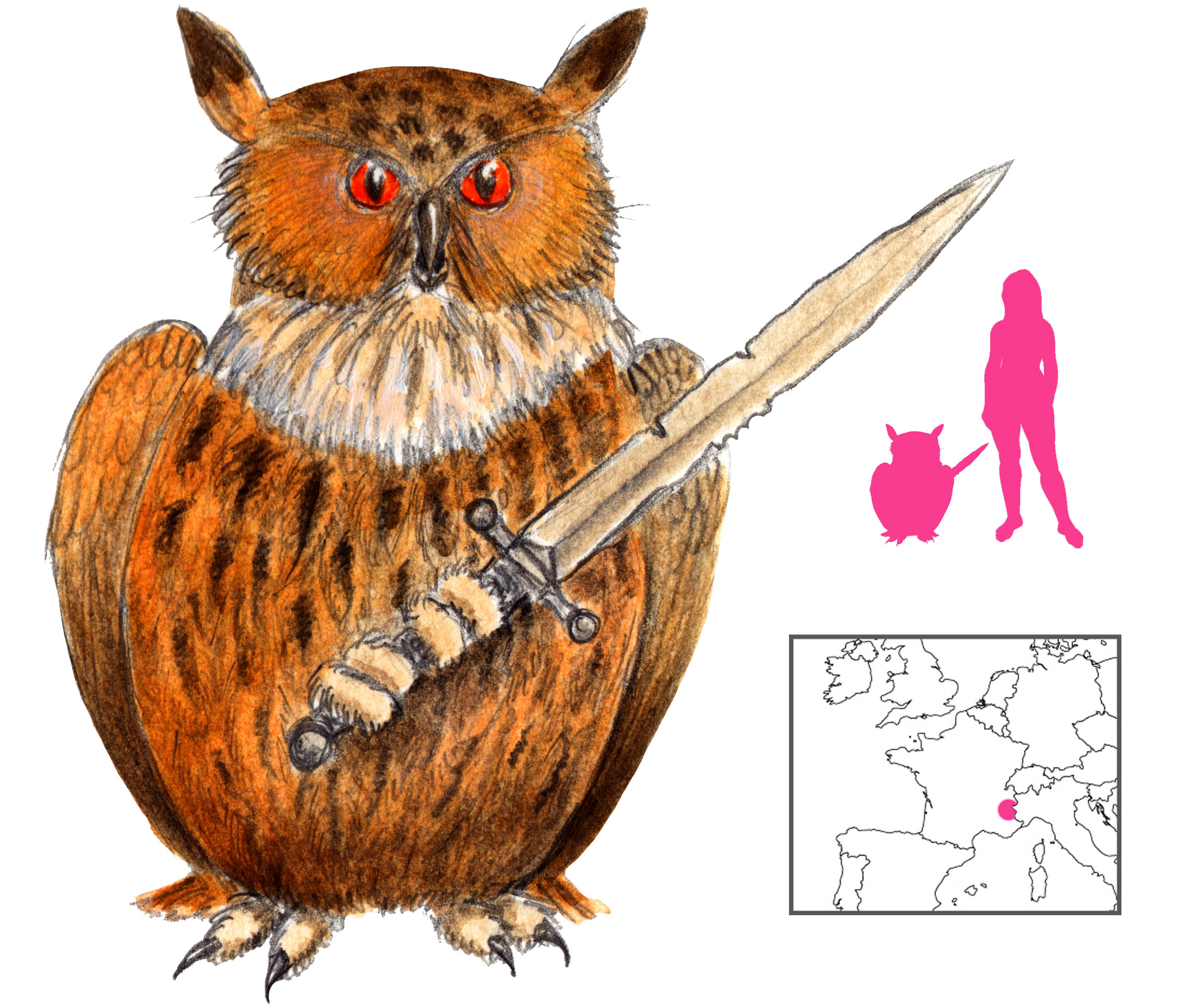
Eagle-owls are impressive animals. As the largest owls, they are top predators in their environments, even feeding on other birds of prey. Their size and eerie calls have ensured them a place in the folklore of many cultures.

It should then be unsurprising that the eagle-owl has been reinterpreted as a supernatural creature. The Duphon can be found in the Hautes-Alpes region of France, where it braids horse manes, pinches young women, and causes mischief and mayhem. The town of Serres preserves a duphon lair in the form of a stone door and ruined ramparts, known as the Trou du Duphon (“The Duphon’s Hole”).

References

van Gennep, A. (1948) Le folklore des Hautes-Alpes, Tome II. J. P. Maisonneuve et Cie, Paris.

del Hoyo, J.; Elliott, A.; Sargatal, J.; Christie, D.A.; & de Juana, E. (eds.) (2013) Handbook of the Birds of the World Alive. Lynx Edicions, Barcelona.

Ladoucette, J. C. F. (1848) Histoire, topographie, antiquités, usages, dialectes des Hautes-Alpes. Gide et Cie, Paris.

Dijiang

Variations: Ti-chiang

Dijiang

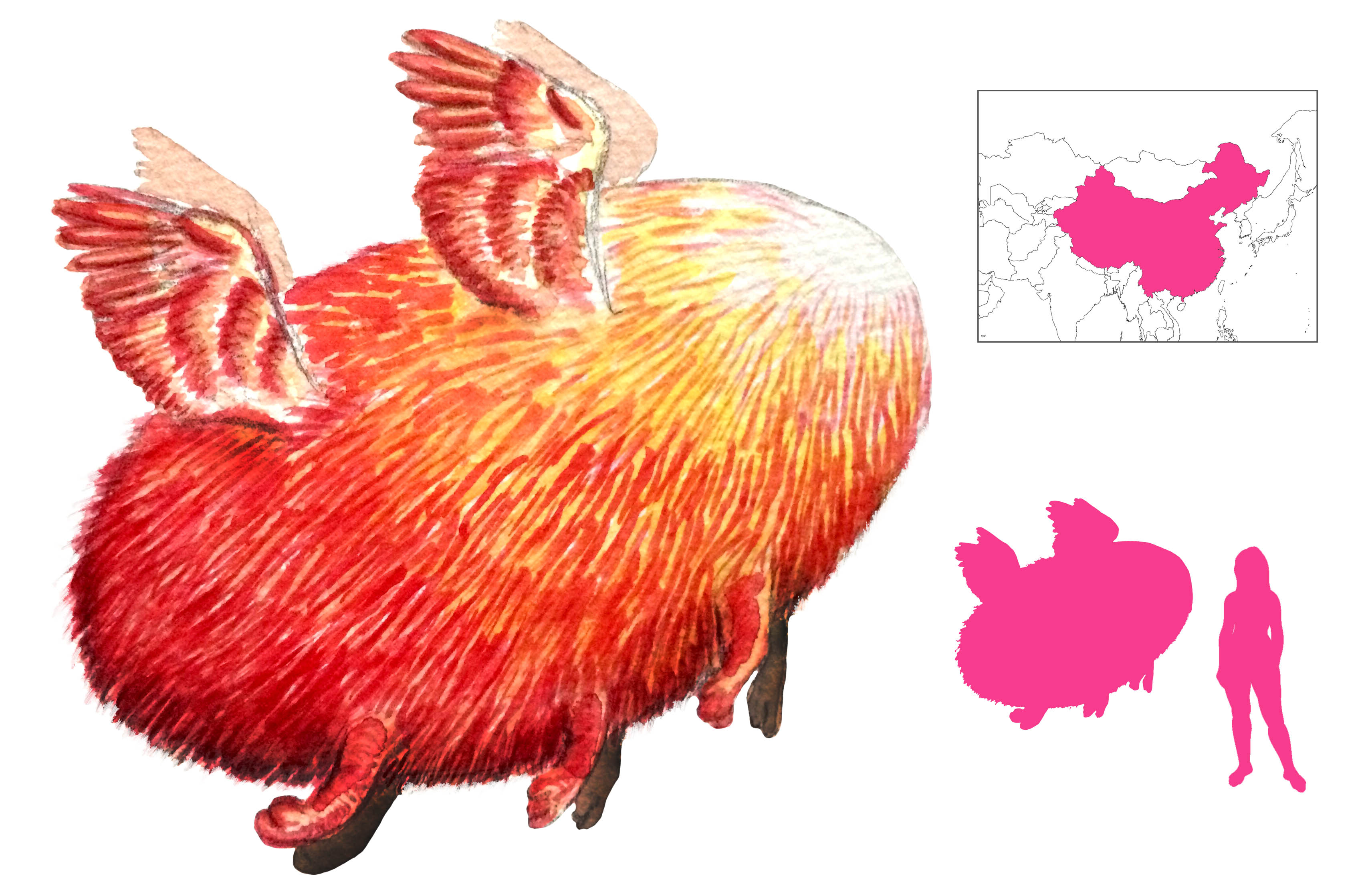
The divine bird known as Dijiang, the “Thearch Long River”, was like a yellow sack with an aura of cinnabar; Borges, calling it the Ti-chiang, described it as bright red. It had six legs and four wings, but no eyes or facial features of any kind, living in a perpetual state of confusion. It was also fond of singing and dancing.

This “state of confusion” led to the association of Dijiang with Hundun, a being of cosmic chaos. The undifferentiated Hundun had no eyes, ears, mouth, or orifices of any sort, and died when his guests tried to drill openings in his body.

Dijiang’s description can be found in the Guideways Through Mountains and Seas, where it is located in the Celestial Mountain along with large quantities of metal and jade. Borges attributes it to the T’ai Kuang Chi.

The four wings and six legs, as well as the lack of apparent head, suggest a magnified insect of some sort.

References

Borges, J. L.; trans. Hurley, A. (2005) The Book of Imaginary Beings. Viking.

Mathieu, R. (1983) Étude sur la mythologie et l’ethnologie de la Chine ancienne. Collège de France, Paris.

Strassberg, R. E. (2002) A Chinese Bestiary: Strange Creatures from the Guideways Through Mountains and Seas. University of California Press.

Stymphalian Bird

Variations: Stymphalide, Bird of Ares

Stymphalian bird 2

Pausanias theorized that the Stymphalian birds originated in Arabia, citing the presence of fierce desert birds known as the Stymphalides. He then admits that the population found at Stymphalos, in Arcadia, may have been the result of a few wayward birds making their way into Greece. Following this line of reasoning, Pausanias deduces that they earned the name of Stymphalides due to their fame in Greece, and the name then supplanted whatever name they originally had in Arabia!

The appearance of the Stymphalian birds is no less muddled. Their most feared weapon is the sharpened, pointed tips of their wing feathers, which they fling like darts to stab their prey. Sometimes their feathers and beaks are made of bronze or iron, the better for piercing armor. Pausanias described them as about crane-sized, but resembling the ibis in shape, but with a stronger bill; elsewhere he says they are like hawks or eagles. In Greek art they have been represented as ibises, swans, and other such waterfowl; at least one obol from Stymphalos shows a bird with a short crest and a stout, powerful bill. Finally, no doubt influenced by tales of harpies and sirens, the temple of Stymphalian Diana also has stone statues of virgins with birds’ feet.Stymphalian bird bw

It remains true that the Stymphalian birds were first and foremost associated with Lake Stymphalia. They terrorized the region, ravaging crops, killing people, and poisoning the ground with their dung. Fox suggests that the legend originated as a glamorization of a plague or pestilence rising from the marshes, which would explain their noxious qualities. While their feathered darts could pierce armor, they were powerless against a certain type of tree bark, which held them fast like quicklime. There was only so much bark to go around, though, and the birds seemed numberless.

It was this scourge that Heracles was sent to destroy. As his sixth labor, it was one of a list of impossible tasks, and indeed the vast numbers of birds seemed beyond the hero’s strength. Heracles got around this by exploiting a simple fact – despite their numbers and ferocity, Stymphalian birds were as easily spooked as sparrows. Fashioning a pair of bronze castanets, he made such a din that the flock took off in a panic; from there he shot a great number down with his arrows, while the remainder of the birds flew off and were never seen in Arcadia again.

That was not the end of the Stymphalian birds, as from Greece they made their way to the Black Sea and populated the Island of Ares, where they became sacred guardians to the god of war. It was this flock that Jason and his Argonauts encountered on their way to Colchis. While the birds of Ares managed to wound the Argonaut Oileus with a feather projectile, they were scared off once more by the noise of rattling bronze armor, but not before pelting the Argonauts with a hailstorm of feathers.

References

Aldington, R. and Ames, D. trans.; Guirand, F. (1972) New Larousse Encyclopedia of Mythology. Paul Hamlyn, London.

Ames, D. trans.; Guirand, F. (1963) Greek Mythology. From Mythologie Generale Larousse. Paul Hamlyn, London.

Apollonius, Coleridge, E.P. trans. (1889) The Argonautica. George Bell and Sons, London.

Fox, W. M. (1964) The Mythology of All Races v. I: Greek and Roman. Cooper Square Publishers, New York.

Pausanias, Levi, P. trans. (1979) Guide to Greece, volume 2: Southern Greece. Penguin Books, London.