A-mi’-kuk

Variations: Ă-mi’-kuk, Ä-mi’-kuk

A-mi-kuk

Kayakers in the cold seas of the Arctic Circle are the A-mi’-kuk’s favorite prey. The last thing they see are the a-mi’-kuk’s prehensile tentacles exploding from under the surface and wrapping around them, dragging both kayaker and boat under.

The a-mi’-kuk is large, leathery-skinned, and slimy. Its four long tentacular arms are used for seizing prey and swimming rapidly through the water. There is no escaping it – it will follow prey taking refuge on ice by swimming below it and bursting out onto the surface. Making for land is equally futile, as the a-mi’-kuk can swim through the earth with as much ease as it does through water.

A-mi’-kuks around St. Michael, Alaska, are known to migrate underground to inland lakes. The presence of one is a good sign for the lake. When an a-mi’-kuk leaves its lake, the channel it digs drains it dry, but when it returns the sea returns with it.

Nelson proposed the octopus as the origin of the a-mi’-kuk. He also gives ä-mi’-kuk as the name of the sea otter; what bearing this has on the legendary creature is unknown.

References

Nelson, E. W. (1887) Report upon Natural History Collections Made in Alaska Between the Years 1877 and 1881. Arctic Series of Publications Issued in Connection with the Signal Service, Government Printing Office, Washington.

Nelson, E. W. (1900) The Eskimo about Bering Strait. Extract from the Eighteenth Annual Report of the Bureau of American Ethnology, Government Printing Office, Washington.

Shādawār

Variations: Shadhahvar, Shadhahwar, Shādhahvār, Shad-hawar, Shād-hawār, Shad-havar, Shadhawar, Shadahvar, Shadahwar, Shadawar, Sadahvar, Sadahwar, Sadhavvar, Sadhazar, Sadhazag, Sadhuzag, Aras, ‘rs, ‘rsh
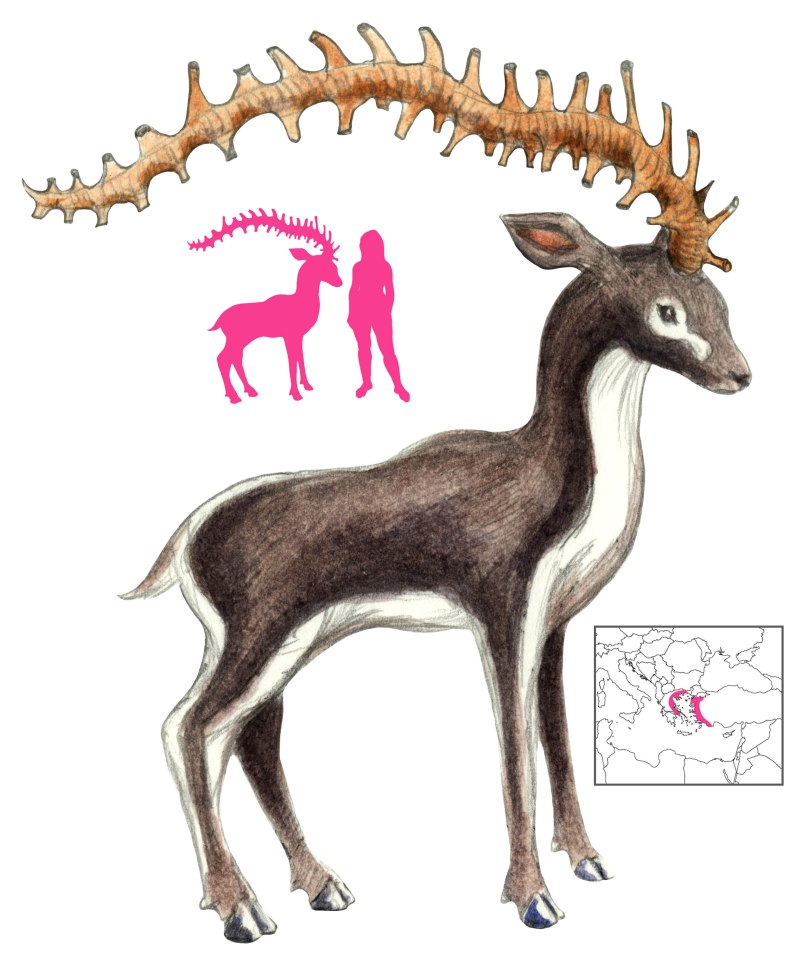
Shad-hawar

The earliest references to the musical-horned unicorn are given by Jabir Ibn Hayyan, around 900 A.D., where it is referred to as the Aras. It was given its most popular incarnation as the Shādawār by Al-Qazwini, which was subsequently copied with modifications by Al-Damiri and Al-Mustawfi. It was found in the farthest reaches of Bilad al-Rum, the Byzantine Empire, a vague location which to Al-Qazwini must have sounded remote.

Exactly how the shādawār’s name should be written and pronounced is unclear. Its writing has varied from author to author and manuscript to manuscript, sometimes starting with a Sā instead of a Shā, with the middle consonant being either a d or a dh (pronounced “the”), and ending in wār (Arabic) or vār (Persian). The spelling chosen here is ultimately arbitrary and based on Ettinghausen and Jayakar’s recommendations, and the most prevalent transliterations. The name is of unknown origin, but Hayyan’s aras is probably derived from “oryx”.

Unlike the more rhinocerine karkadann, the shādawār is an antelope-like ungulate with a single horn, but in this case it is long and hollow. There are forty-two hollow branches in the horn, and wind whistling through these flute-like holes results in beautiful, stirring melodies, so lovely that other animals will gather around to listen. Shādawār horns were offered to kings, who would hang them up as musical intruments. Depending on the angle they were held at, they would produce an enthralling tune or a sad dirge that moved all listeners to tears.

The shādawār has been incorrectly described as a flesh-eater, using its music to attract potential prey. In fact, Al-Qazwini makes no mention of any carnivorous tendencies. Al-Mustawfi, however, combines Al-Qazwini’s account of the shādawār with that of the carnivorous Sirānis immediately preceding it. It is the sirānis that lures prey to it with its music, and not the herbivorous shādawār.

Al-Damiri and Bochart give it seventy-two branches on its horn. Flaubert goes further and describes his “sadhuzag” as a black deer with the head of a bull, and a thicket of white horns on its head. It speaks to Anthony, describing its unique powers. “My seventy-four antlers are hollow as flutes. When I turn towards the South wind, sounds come out that attract enraptured beasts. Snakes coil around my legs, wasps cling to my nostrils, and parrots, doves, and ibises roost in my branches. – Listen! … But when I turn to the North wind, my antlers, thicker than a battalion of lances, exhale a howl; forests shudder, rivers retreat, fruit bulbs burst, and grasses stand on end like the hair of a coward. – Listen!”

References

Bochart, S. (1675) Hierozoicon. Johannis Davidis Zunneri, Frankfurt.

el-Cheikh, N. M. Byzantium through the Islamic Prism from the Twelfth to the Thirteenth Century. In Laiou, A. E. and Mottahedeh, R. P. (2001) The Crusades from the Perspective of Byzantium and the Muslim World. Dumbarton Oaks Research Library and Collection, Washington, D. C.

Contadini, A. Musical Beasts: The Swan-Phoenix in the Ibn Bakhtishu’ Bestiaries. In O, Kane, B. (2005) The Iconography of Islamic Art. Edinburgh University Press.

Contadini, A. (2012) A World of Beasts: A Thirteenth-Century Illustrated Arabic Book on Animals (the Kitab Na’t al-Hayawan) in the Ibn Bakhtishu’ Tradition. Brill, Leiden.

al-Damiri, K. (1891) Hayat al-hayawan al-kubra. Al-Matba’ah al-Khayriyah, Cairo.

Ettinghausen, R. (1950) The Unicorn. Studies in Muslim Iconography, Freer Gallery of Art Occasional Papers Vol. 1, No. 3, Washington.

Flaubert, G. (1885) La Tentation de Saint Antoine. Quantin, Paris.

Jayakar, A. S. G. (1908) ad-Damiri’s Hayat al-Hayawan (A Zoological Lexicon). Luzac and Co., London.

Kraus, P. (1986) Jabir Ibn Hayyan : Contribution à l’historie des idées scientifiques dans l’Islam. Société d’Édition Les Belles Lettres, Paris.

al-Qazwini, Z. (1849) Zakariya ben Muhammed ben Mahmud el-Cazwini’s Kosmographie. Erster Theil: Die Wunder der Schöpfung. Ed. F. Wüstenfeld. Dieterichsche Buchhandlung, Göttingen.

Catoblepas

Variations: Katoblepas, Catablepon, Katoblepon, Catobleponta, Gorgon (erroneously)

Catoblepas

The Catoblepas, “that which looks downwards”, is probably the most hideous and repulsive of living things, so horrid that its mere glance is lethal. Pliny locates it in Ethiopia, around the source of the Nile, Aelian puts it in Libya, and Topsell gives a range of Hesperia and Lybia.

According to Pliny, the body of a catoblepas is of small size, and its limbs are heavy, but its massive head is too heavy to be held up and always looks downwards. This is a good thing, as anyone who saw the eyes of a catoblepas died.

Aelian gives more detail, describing it as the size of a bull, but with a grim expression, shaggy eyebrows, and small bloodshot eyes. It looks downwards, and has a horselike mane that starts on its head and covers its face. The catoblepas feeds on poisonous plants; when threatened, it shudders and raises its mane in warning before opening its mouth and belching a foul, toxic gas. This gas poisons the air around it, and anything that breathes it loses its voice, collapses in convulsions, and dies. Other animals give it a wide berth because of this. There is no mention of a deadly gaze.

Topsell combines the catoblepas with the Gorgon, stating that the myth of Perseus originated from a war with African Amazons led by Medusa. The snake-hair of the gorgons was inspired by the catoblepas’ messy mane. His fanciful description borrows liberally from gorgons and adds thick eyelids, scales like a dragon, tusks like a boar, no hair on the head, wings, human hands, and a size between that of a bull and a calf. He also denies that a catoblepas can kill with its breath, which is unheard of in the animal world; it is far more likely to kill with its eyes like the well-known cockatrice. He gives as proof an anecdote of Marius’ soldiers encountering a catoblepas and thinking it a sheep, only to die immediately when it looked up at them. It was eventually killed in an ambush by spear-men, and its skin was sent to the temple of Hercules in Rome.

It is in Flaubert’s Temptation that we get the most nightmarish vision of the catoblepas. Here it is a sprawling, long-maned black buffalo with the head of a pig dragging on the ground. Its neck is long and thin like an emptied intestine. It is also granted the power of speech, addressing Anthony. “Fat, melancholy, wild, I perpetually feel the warmth of mud under my belly, hiding infinite rot under my armpit. My skull is so heavy that I cannot lift it. I roll it around me, slowly; – and, jaws opened, I tear with my tongue poisonous herbs watered with my breath. Once, I ate my paws by accident. No-one, Anthony, has ever seen my eyes, or those who have seen them are dead. If I lifted my eyelids – my pink and swollen eyelids, straight away, you would die”.

Cuvier suggested that this maned, hoofed, and downward-looking abomination of nature was inspired by the harmless gnu or wildebeest.

References

Aelian, trans. Scholfield, A. F. (1959) On the Characteristics of Animals, vol. II. Harvard University Press, Cambridge, Massachusetts.

Borges, J. L.; trans. Hurley, A. (2005) The Book of Imaginary Beings. Viking.

Flaubert, G. (1885) La Tentation de Saint Antoine. Quantin, Paris.

Pliny; Holland, P. trans. (1847) Pliny’s Natural History. George Barclay, Castle Street, Leicester Square.

Topsell, E. (1658) The History of Four-footed Beasts. E. Cotes, London.