Sinad

Variations: Sinād, Sénad, Senad
Sinad 2

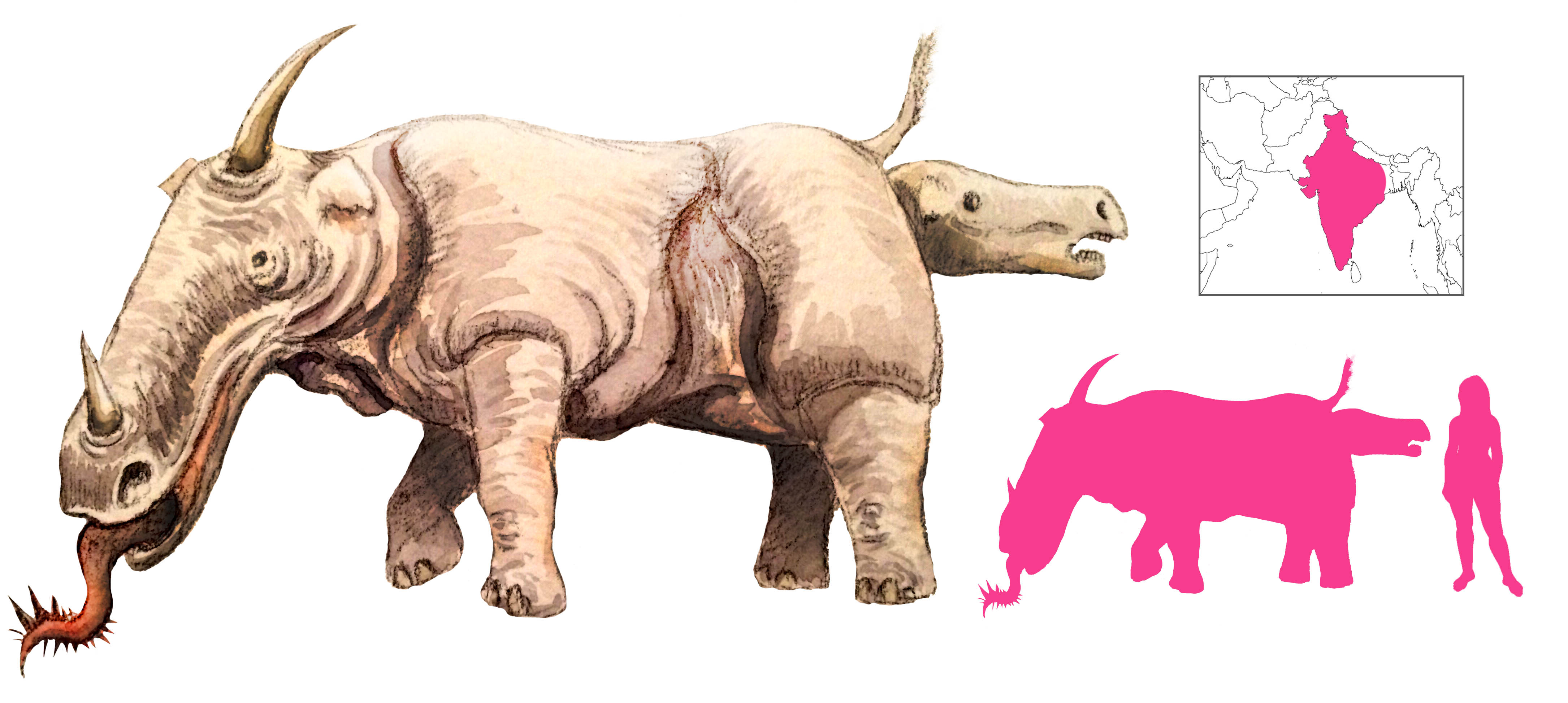
The Sinad is an Indian creature of uncertain appearance and dubious maternal instinct, described by Al-Jahiz, Al-Qazwini, and a number of other Muslim authors. Its primary characteristics – also attributed to the karkadann – were its sharp, thorny tongue and its unusual method of giving birth.

Al-Qazwini describes the sinad as similar to but smaller than an elephant, and larger than an ox. When the female is ready to give birth, the young sinad would stick its head out of its mother’s womb, feeding on grass and waiting until it was mature enough to run away. This was because the mother sinad, following her parental instincts, would attempt to lick her calf clean – in the process flaying the flesh off its bones. Once it was large enough, the calf would squirm out and gallop to safety.

This lethal tongue was also associated with the karkadann, and representations of them became blurred. Some images of the sinad are elephantine, while others came to follow the established iconography of the karkadann, giving it one or two horns. Al-Gharnati stated that the kings of China tortured people by having a karkadann lick them. Marco Polo, in his disillusioned report on the unicorn, said that its deadliest weapon was its tongue.

Flaubert, in his Temptation of Saint Anthony, makes an allusion to the Sénad as a three-headed bear that tears its cubs apart with its tongue. Here he conflates the sinad as described by Bochart with Pliny’s description of the bear licking its amorphous newborn cubs into shape. The three heads are a Flaubertian flourish.

References

Ettinghausen, R. (1950) The Unicorn. Studies in Muslim Iconography, Freer Gallery of Art Occasional Papers Vol. 1, No. 3, Washington.

Flaubert, G. (1885) La Tentation de Saint Antoine. Quantin, Paris.

Pliny; Holland, P. trans. (1847) Pliny’s Natural History. George Barclay, Castle Street, Leicester Square.

Polo, M. (1965) The Travels. Penguin Classics, London.

Al-Qazwini, Z. (1849) Zakariya ben Muhammed ben Mahmud el-Cazwini’s Kosmographie. Erster Theil: Die Wunder der Schöpfung. Ed. F. Wüstenfeld. Dieterichsche Buchhandlung, Göttingen.

Seznec, J. (1943) Saint Antoine et les Monstres: Essai sur les Sources et la Signification du Fantastique de Flaubert. PMLA, Vol. 58, No. 1, pp. 195-222.
Umutwa

Variations: Abatwa (pl., often used as singular), Chitowe, Katsumbakazi, Maithoachiana, Mkonyingo, Mumbonelekwapi, Wabilikimo

Umutwa

First contact between different people is never easy. Sometimes one group ends up exaggerated, romanticized, altered until they are virtually unrecognizable. It was this process that turned Saracens into malevolent mountain goblins, and which caused the San bushmen to shrink to near-microscopic size in Zulu folklore, resulting in the Abatwa. The term is still used in Zulu to refer to bushmen, and some identify as Abatwa, but the Abatwa of folklore are supernatural and unmistakeable.

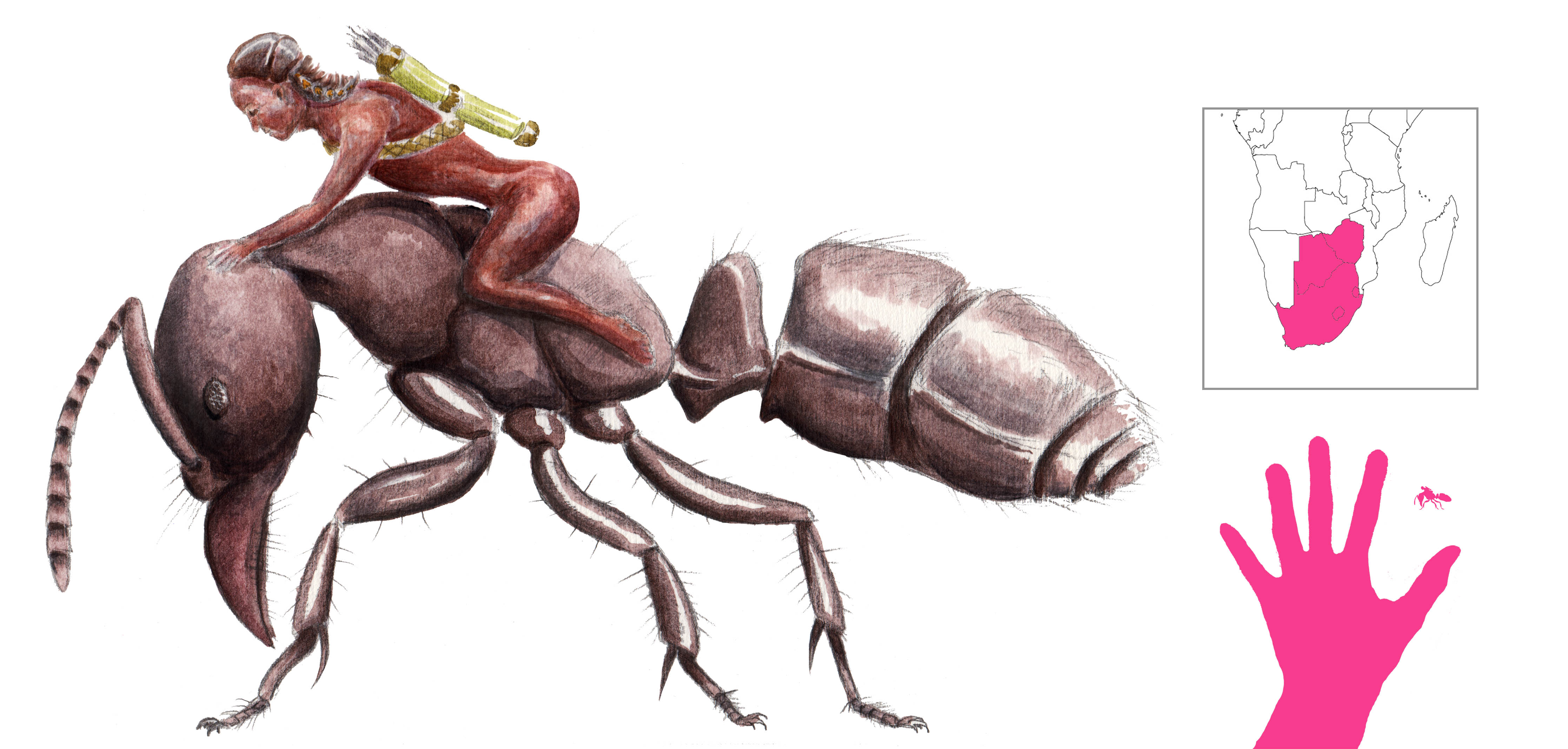
The Abatwa, Umutwa in the singular, are the smallest of all fairies. They live in the rugged uplands, where they use blades of grass as shelters and sleep in anthills. Abatwa have no fixed village apart from their bivouacs in the anthills. The only times they are sedentary are when they kill game; even then they stay around the carcass only as long as it takes to fully consume it. Sometimes the Abatwa ride horses in search of game. In such cases, dozens of the tiny warriors sit atop one horse, in a line from head to tail. If their hunt is unsuccessful, they do the next best thing and eat the horse.

Despite their size, they are deadly hunters, armed with poisoned arrows that can kill even elephants. Being stalked and killed by Abatwa is a nightmare, as you face foes too small to see; they are like driver ants, or puff adders, virtually invisible, yet disproportionately deadly. However, they are also self-conscious about being tiny, to the point of being very touchy about it. This insecurity is outweighed by an enormous ego. Abatwa are vulnerable to flattery.

When one meets an Umutwa and hails him with the traditional Sa-ku-bona (“I have seen you”), the Umutwa is immediately suspicious. “Where did you see me?” If you answer “I haven’t seen you before”, “Just now”, or words to that effect, the Umutwa, furious about this slight on his size, will immediately draw his bow and shoot you dead.

Clearly a more diplomatic approach is in order. Creativity is vital here, as is exaggeration and, above all, sincere delivery. “I last saw you on my way here. See that mountain on the horizon? I was on top of it when I saw you, I couldn’t mistake you for anyone else”. Then the Umutwa smiles with pride, secure in the knowledge that despite being tiny, he is still a towering and respected figure.

The motif of tiny warriors with height insecurity is widespread in sub-Saharan Africa. All of these creatures, associated with different cultures, can be dealt with in the same way as the Abatwa, and respond negatively (and lethally) to going unnoticed.

If you flatter the Katsumbakazi of the Giryama, something lucky will happen to you.

The Maithoachiana of the Akikyu in Dagoreti are a cannibal race that are rich and skilled in metalworking.

The Wabilikimo of the Swahili live four days’ journey from Chaga, and are only twice the length from the middle finger to the elbow.

The Itowe (singular Chitowe) of the Machinga Yao rob gardens, rot pumpkins, turn fruits bitter, and leave footprints everywhere. Putting some of your crops at cross-roads will help placate them. They are like men but run on all fours. The related Mumbonelekwapi have long beards.

The Wakonyingo (singular Mkonyingo) of the Wachaga have enormous, misshapen heads and hide on Mount Kilimanjaro; none are bigger than a little boy. They have ladders that reach into the sky. They never lie down but lean against a wall, as getting up is hard with their top-heavy build. Wakonyingo take pity on people in trouble and will help them if they are lost. They leave bits of meat when sacrificing to their ancestors; the meat rolls down the mountain and turns into white-necked ravens. They are somewhat less touchy than the others mentioned, but can still exact terrible vengeance.

References

Ananikian, M. H. and Werner, A. (1964) The Mythology of All Races v. VII: Armenian and African. Cooper Square Publishers, New York.

Callaway, C. (1868) Nursery Tales, Traditions, and Histories of the Zulus. Trübner and Co., London.

Arragouset

Variations: Arragousset, Sarregouset, Sarragouset

Arragouset 2

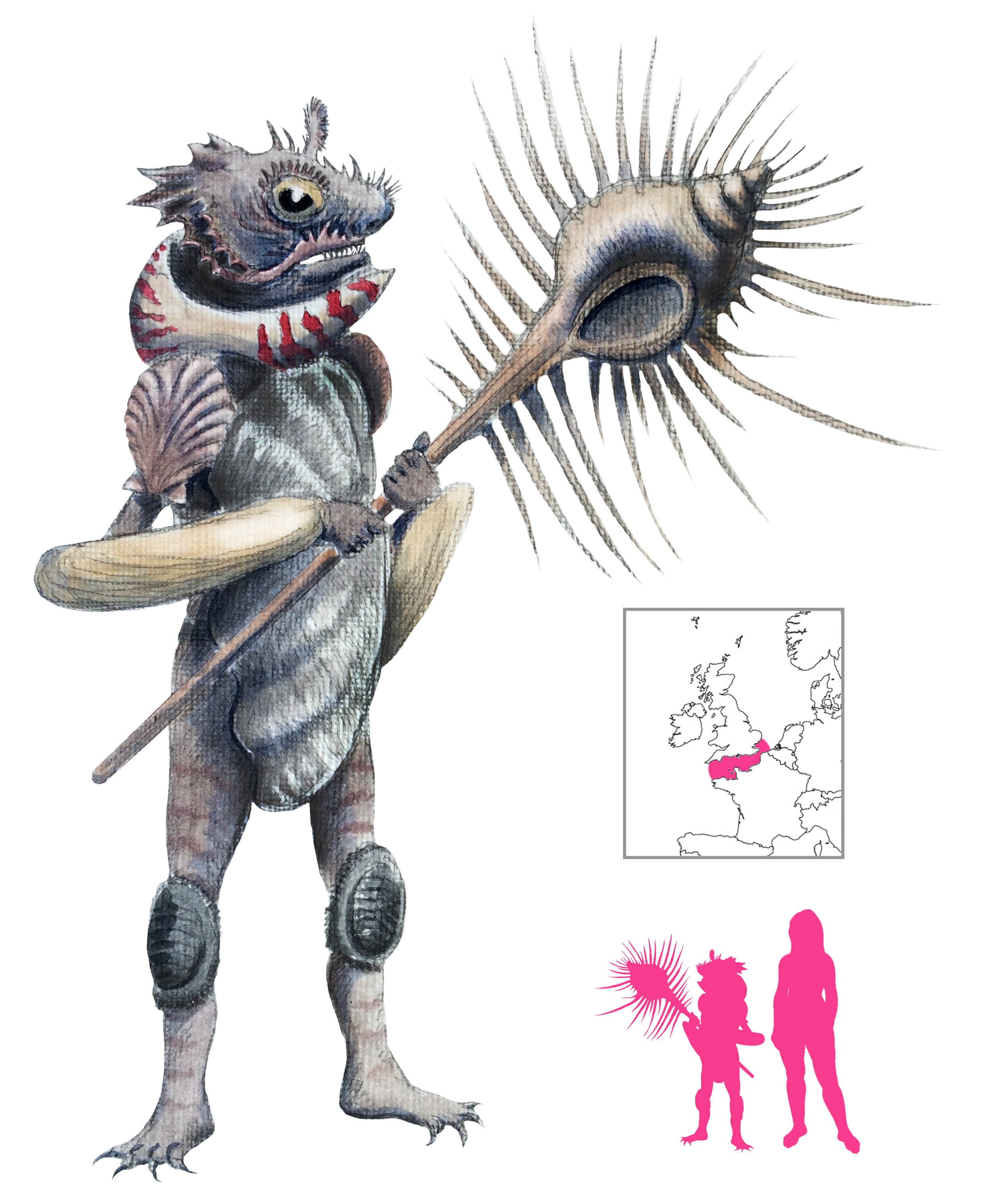
Jean Letocq, a shepherd on the west coast of Guernsey, woke up one morning to see hundreds of little people streaming out of the Creux des Fées (Fairies’ Hollow). They were armed to the teeth, carrying weapons made of sharpened shells. They told the man to bear their message: they wished to take human wives, and would be strongly displeased if women were not turned over to them. This ultimatum was refused, and so the fairies slaughtered every last man they encountered, dying the sea red with blood. The only survivors, a man and a boy of St. Andrew’s parish, hid in an abandoned oven for years.

They were the Arragousets, or Sarregousets as Hugo called them. We know that they were bellicose fairies of the sea, dwelling underwater and in seaside caves, ruling their own marine kingdom. One of their number once took a human woman for his wife, and her beauty and wit so enamored the other fairies that they had to follow suit.

With the men safely massacred, the Arragousets put down the sword and went native. They married the maidens and the newly-widowed, and lived peacefully on land. They made caring husbands and doting fathers, to the extent that the widows warmed to them, and the maidens were delighted with their fairy lovers.

Then, after years of peace, they disappeared as quickly as they had appeared. The circumstances remain mysterious. Sébillot suggests that they were recalled by their king, while MacCulloch states that their time on land was limited. Whatever the reason, all the Arragousets left the island and were never seen again.

Or rather, they went invisible, as their presence remained on Guernsey. They sired a new generation of boys and girls – intelligent, able sailors of small stature – and they returned regularly to watch over them. They did a hundred little favors in the hopes of finishing the work they had started. Arragousets are always ready to help their descendants, but they are pitiless in dealing with offenders.

Hugo said they can still be seen on stormy days, dancing in the clouds and longing to return to the land.

References

Dubois, P.; Sabatier, C.; and Sabatier, R. (1992) La Grande Encyclopédie des Lutins. Hoëbeke, Paris.

Hugo, V. (1866) Les Travailleurs de la Mer. Librairie Internationale, Paris.

MacCulloch, E. (1903) Guernsey Folk Lore. Elliot Stock, London.

Sébillot, P. (1905) Le Folk-lore de France, Tome Deuxième: La Mer et les Eaux Douces. Librairie Orientale et Américaine, Paris.