Tlilcoatl

Variations: Acoatl

acoatl

The Tlilcoatl (“black snake”) or Acoatl (“water snake”) is a long, powerful snake found in the swamps and waterlogged caves of Mexico. This glossy black snake is thick enough that a man’s arms can just barely wrap around it. The scales are a glossy black in color. The head is large, with blazing eyes and beardlike appendages at the back similar to those of the barbel. The tail is bifurcated.

The powerful mouth of a tlilcoatl can generate a suction strong enough to draw in prey from a distance. Tlilcoatls feed mostly on fish, but they are not above drowning and eating people. They can spit venom as passers-by, incapacitating them enough to suck them in, pull them underwater, and devour them.

Sometimes a more elaborate stratagem is required. A tlilcoatl will dig out a small pool and stock it with fish to serve as bait. It pauses after depositing a new catch of fish, looking around, then going back to get more. It is tempting to profit from the snake’s absence to steal fish. But the tlilcoatl, standing erect, easily detects thieves, and chases them so fast that it seems to fly over the grass. Once in the snake’s coils there is no escape; the tlilcoatl pushes both ends of its tail into the unfortunate victim’s nostrils (or any other opening) before squeezing the life out of them.

There is, however, a means of stealing a tlilcoatl’s fish cache and escaping alive. All that is required is a hollow tree. When chased by the serpent, would-be fish thieves should hide within the tree. The tlilcoatl will coil around the unyielding trunk and squeeze so hard that it dies.

References

Nuttall, Z. (1895) A Note on Ancient Mexican Folk-lore. The Journal of American Folklore, v. 8, no. 29, pp. 117-129.

Sahagun, B. (1830) Historia General de las Cosas de Nueva España, v. III. Alejandro Valdés, Calle de Santo Domingo, Esquina de Tacuba, Mexico.

Xicalcoatl

Variations: Jicara Snake, Chocolate Cup Snake, Malinche

xicalcoatl

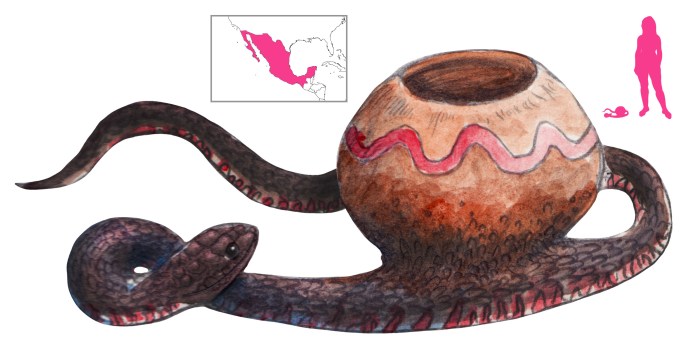
Both large and small varieties of the Xicalcoatl, the Aztec “Chocolate Cup Snake”, exist, and may be found in the waterways of Mexico. They are black in color with variegated bellies. When they reach maturity, xicalcoatls develop an excrescence on their backs. This natural growth looks like a jicara (a gourd chocolate cup) down to the last detail, with colorful designs and patterns on its smooth surface.

Xicalcoatls lure humans to their doom by submerging themselves in water and allowing the painted jicara to show above the surface. A passer-by, seeing the chocolate cup seemingly floating on the water, will try to seize it, but their attentions only cause the cup to drift further and further away. When the victim reaches a sufficient depth, the xicalcoatl causes the water to churn and drown the unfortunate chocolate-seeker.

A watered-down version of this tale persists in Mexico in the form of the evil fairy Malinche, who leaves painted chocolate cups in the water to tempt children.

References

Nuttall, Z. (1895) A Note on Ancient Mexican Folk-lore. The Journal of American Folklore, v. 8, no. 29, pp. 117-129.

Sahagun, B. (1830) Historia General de las Cosas de Nueva España, v. III. Alejandro Valdés, Calle de Santo Domingo, Esquina de Tacuba, Mexico.

Apep

Variations: Āpep, Āapep, Aaapef, Apophis, Rerek; further names from the Papyrus of Nesi-Amsu listed by Budge are Nesht, Tutu, Hau-hra, Hemhemti, Qettu, Qerneru, Iubani, Amam, Hem-taiu, Saatet-ta, Khermuti, Kenememti, Sheta, Serem-taui, Sekhem-hra, Unti, Karau-anememti, Khesef-hra, Seba-ent-seba, Khak-ab, Khan-ru… uaa, Nai, Am, Turrupa, Iubau, Uai, Kharubu the Four Times Wicked, Sau, Beteshu

apep

Apep, Āapep, or Apophis in Greek, is the chief chthonic monster in the Egyptian cosmogony, born during the dark times of the First Intermediate Period and depicted as an enormous serpent with winding coils or alternatively as a giant crocodile, or with a human head and hands as in the Stele of Taqayna. He is described as being a hundred and twenty cubits (55 meters) long, or otherwise thirty cubits (14 meters) long, with the first eight cubits made of flint and with coils like sandbanks, lying on a sandbank 450 cubits (205 meters) long.

Apep is darkness, cloud, wind, rain, mist, and storm. The antithesis of light and life, his primary goal is the destruction of the sun god Ra and his solar barque, causing the elimination of light and day and the victory of chaos and darkness. Assisted by a retinue of lesser demons and serpents – the mesu betshet or “children of rebellion”, the snakes Seba, Af, and Nak, and the crocodile Seshsesh – he hides under the earth and below the horizon, and attempts to swallow Ra’s barque every night. Ra, aided by his cortège of gods, thwarts Apep’s attempts time and time again, allowing the sun to rise once more. Occasionally Apep gains the upper hand, causing storms, earthquakes, and solar eclipses, but those end as Ra is cut free from Apep’s stomach. The serpent’s inevitable fate is to be chopped up into pieces and cast back into the abyss, but he always returns the following night, as full of malice and venom as ever, in an endless cycle of destruction.

In a mythology revolving around the sun, Apep, sworn enemy of Ra, darkness personified, is as evil a creature as could exist in the Egyptian pantheon. Some degree of respect was granted him; the Hyksos pharaoh Apepi (r. 1590 – 1550 BCE) took him as his namesake, in a perverse move likely intended to instill fear in the native Egyptians. As a deity, he was never worshipped, but always avoided, spited and mutilated in effigy during natural disasters.

The apotropaic “Book of Overthrowing Apep” (4th century BCE) provides helpful instructions for the faithful, including exhortations for “Spitting on Apep”, “Trampling on Apep with the Left Foot”, “Taking the Knife to Smite Apep”, “Taking the Lance to Smite Apep”, “Putting Apep on the Fire”, “Fettering Apep”, and other such activities. The Book of the Dead features the soul of the deceased piercing Apep, praying for aid in destroying Apep at the apex of his power. Apep’s gruesome punishment is described at length – he is to be speared, stabbed with knives, each bone of his body separated by red-hot knives, scorched, roasted, and consumed by fire. Each name of Apep had to be cursed separately, and the Papyrus of Nesi-Amsu lists the serpent’s many names.

In time the role of Apep as the enemy of the Sun overlapped with that of the desert god Set, once the primary defender of the solar barque from Apep’s depredations, such that Apepi is described in ca. 1274 BCE as a monolatrous worshipper of Set.

References

Aldington, R. and Ames, D. trans.; Guirand, F. (1972) New Larousse Encyclopedia of Mythology. Paul Hamlyn, London.

Ames, D. trans. (1965) Egyptian Mythology. From Mythologie Generale Larousse. Paul Hamlyn, London.

Budge, E. A. W. (1913) The Papyrus of Ani: a reproduction in facsimile, vol. I. G. P. Putnam, New York.

Budge, E. A. W. (1913) The Papyrus of Ani: a reproduction in facsimile, vol. II. G. P. Putnam, New York.

Budge, E. A. W. (2015) The Gods of the Egyptians, vol. I. Dover Publications Inc., New York.

Budge, E. A. W. (2015) The Gods of the Egyptians, vol. II. Dover Publications Inc., New York.

ElSebaie, S. M. (2000) The destiny of the world: a study on the end of the universe in the light of ancient Egyptian texts. M.A. diss., University of Toronto.

Faulkner, R. O. (1937) The Bremner-Rhind Papyrus: III: D. The Book of Overthrowing Apep. The Journal of Egyptian Archaeology 23, no. 2, pp. 166-185.

Simpson, W. K., Faulkner, R. O., and Wente, E. F. (2003) The Literature of Ancient Egypt. Yale University Press, New Haven.

Turner, P. (2012) Seth – a misrepresented god in the ancient Egyptian pantheon? PhD diss., University of Manchester.

Wilkinson, R. H. (2003) The Complete Gods and Goddesses of Ancient Egypt. Thames and Hudson, London.

Scytale

Variations: Scytalis (Latin), Scytall, Scicalis, Sciscetalis, Seyseculus, Picalis, Situla; Caecilia (erroneously)

scytale

The Scytale (Greek) or Scitalis (Latin), probably derived from scintilla (“spark” or “glimmer”), is one of the many venomous snakes born from the blood of Medusa in the Libyan desert. It was mentioned in the catalogue of snakes that plagued Lucan and his men, but does not get more than a cursory description.

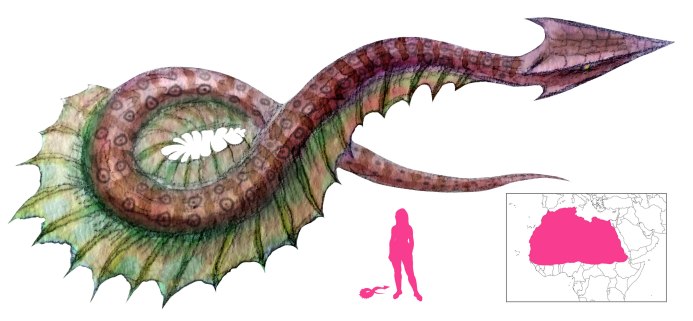
A scytale shares a lot of characteristics with amphisbaenas: earth-colored, heavy-bodied, blunt-headed and blunt-tailed. But while the amphisbaena has two heads, the scytale only looks like it has two heads. Its tail is rounded, flatter, and thicker than the rest of its body, but the scytale only slithers in one direction. More notably, a scytale has scales, markings, or spots on its back that shimmer and gleam in the colors of the rainbow. Its body generates a lot of heat.

Slow and sluggish, the scytale has no means of running down prey. Instead, it uses the gleaming, iridescent markings on its back to mesmerize onlookers, causing them to draw near and within striking range.

The intense inner heat of the scytale allows it to emerge in the winter to shed its skin, even with frost still on the ground. It shares this cold tolerance with the amphisbaena.

Scytale venom is indistinguishable from amphisbaena and viper venom, and remedies for it are the same.

References

Aldrovandi, U. (1640) Serpentum, et Draconum Historiae. Antonij Bernie, Bologna.

Cuba, J. (1539) Le iardin de santé. Philippe le Noir, Paris.

Isidore of Seville, trans. Barney, S. A.; Lewis, W. J.; Beach, J. A.; and Berghof, O. (2006) The Etymologies of Isidore of Seville. Cambridge University Press, Cambridge.

Lucan, trans. Rowe, N. (1720) Pharsalia. T. Johnson, London.

Topsell, E. (1658) The History of Serpents. E. Cotes, London.

Amphisbaena

Variations: Amphisbaina, Alchismus, Amphisilene, Amphistere, Amphiptere, Ankesime, Auksimem, Double-head, Double-marcheur (French); Doble Andadora; Blind Snake

amphisbaena

The Amphisbaena, “goes both ways”, is one of the many snakes encountered by Lucan and his army in the deserts of Libya. It has also been reported from Lemnus, but it is unknown to the Germans. Unlike its biological namesake, the benign, legless burrowing lizards known as amphisbaenas, the Libyan amphisbaena is venomous and deadly, producing double the amount of venom a regular snake would. Sand boas are another candidate for the amphisbaena’s identity, but they too are harmless.

Two heads are an amphisbaena’s distinguishing feature, with one head in the normal place and one at the end of the tail. How these heads affect locomotion is unclear. An amphisbaena may move like a regular snake, one head trailing behind, but changing directions instantly and going forward or backwards with equal ease. Alternatively, both heads could lead, leaving the body following behind in a loop. An amphisbaena’s sight is poor, but its eyes glow. Physically it resembles an earthworm, with an indistinguishable head and tail. It is blackish earth-colored, with a rough, spotted skin. It is very muscular and tough-scaled, and is an excellent digger.

In addition to the amphisbaena described above, Pammenes tells of two-headed snakes with two feet near the tail in Egypt. Borges reports a creature from the Antilles called the doble andadora (“goes both ways”), also known as the two-headed snake and the mother of ants. It feeds on ants and can reattach itself if chopped in half. The association with ants is the same as that of the legless lizards that share the amphisbaena’s name, and probably refers to the same animal. As with every other snake, the amphisbaena of medieval bestiaries was burdened with legs and wings, and the use of the term became even more confused. Any creature in medieval art with an extra head on the end of its tail can be safely labeled an amphisbaena, although at this point the Greek two-headed snake is long forgotten. The heraldic amphisbaena eventually was corrupted into amphistere, amphiptere, and amphisian basilisk, from where it was assumed to have a pair of wings as well as an extra head!

Amphisbaenas are very cold-resistant, and are the first snakes to come out after winter, ahead of the first cuckoo song. Their temperament is correspondingly hotter than that of other snakes. They feed on earthworms, beetles, and especially ants, digging into their nests, its tough skin protecting it from their bites and stings. Solinus believed amphisbaenas gave birth through the tail-end mouth. They take good care of their eggs, guarding them until they hatch and showing love to their offspring.

Amphisbaena venom is unremarkable and causes the same symptoms as viper bites – inflammation and slow, painful death. Besides drinking coriander, the antidotes for amphisbaena bite are the same as those used for vipers. Amphisbaenas themselves are hard to kill, except with a vine-branch. One amphisbaena woke Dionysus from his rest, and in retaliation he crushed it with a vine-branch.

Several remedies have been derived from amphisbaenas. A walking-stick covered with amphisbaena skin keeps away venomous animals, and an olive branch wrapped in amphisbaena skin cures cold shiverings. An amphisbaena attached to a tree will ensure that the logger will not get cold and the tree will fall easily. If a pregnant woman steps over a dead amphisbaena, she will abort instantly, as the vapor arising from the dead snake is so toxic as to suffocate the fetus. However, if a pregnant woman carries a live amphisbaena in a box with her, the effect is nullified.

The two heads of the amphisbaena understandably led to a healthy amount of criticism. Thomas Browne denied that amphisbaenas could exist, stating that an animal with two anteriors was impossible. Al-Jahiz recounts an interview with a man who swore that he saw an amphisbaena, and, unconvinced, chalked it up to fear-induced exaggeration. “From which end does it move?” he asked the man. “Where does it eat from, and where does it bite from?” The man replied “It doesn’t move forward, but it gets around by rolling, like boys roll on sand. As for eating, it eats lunch with one head and dinner with the other. And as for biting, it bites with both heads at the same time!”

References

Aelian, trans. Scholfield, A. F. (1959) On the Characteristics of Animals, vol. II. Harvard University Press, Cambridge, Massachusetts.

Aelian, trans. Scholfield, A. F. (1959) On the Characteristics of Animals, vol. III. Harvard University Press, Cambridge, Massachusetts.

Aldrovandi, U. (1640) Serpentum, et Draconum Historiae. Antonij Bernie, Bologna.

Borges, J. L.; trans. Hurley, A. (2005) The Book of Imaginary Beings. Viking.

Cuba, J. (1539) Le iardin de santé. Philippe le Noir, Paris.

Druce, G. C. (1910) The Amphisbaena and its Connexions in Ecclesiastical Art and Architecture. Archaeological Journal, v. 67, pp. 285-317.

Isidore of Seville, trans. Barney, S. A.; Lewis, W. J.; Beach, J. A.; and Berghof, O. (2006) The Etymologies of Isidore of Seville. Cambridge University Press, Cambridge.

Al-Jahiz, A. (1966) Kitab al-Hayawan. Mustafa al-Babi al-Halabi wa Awladihi, Egypt.

Kitchell, K. F. (2014) Animals in the Ancient World from A to Z. Routledge, Milton Park, Abingdon, Oxon.

Lucan, trans. Rowe, N. (1720) Pharsalia. T. Johnson, London.

Macloc, J. (1820) A Natural History of all the Most Remarkable Quadrupeds, Birds, Fishes, Serpents, Reptiles, and Insects in the Known World. Dean and Munday, London.

Palliot, P. (1660) La Vraye et Parfaite Science des Armoiries. Pierre Palliot, Dijon.

Parker, J. (1894) A Glossary of Terms Used in Heraldry. James Parker and Co., Oxford.

Pliny; Bostock, J. and Riley, H. T. trans. (1857) The Natural History of Pliny, v. III. Henry G. Bohn, London.

Topsell, E. (1658) The History of Serpents. E. Cotes, London.


Cenchris

Variations: Cenchros, Cenchrines, Cenchridion, Cenchrites, Cenchria; Millet; Milliaris (from millet); Punter-schlang, Berg-schlang (German); Lyon (due to its color and ferocity); Famusus, Aracis, Falivisus (Topsell gives those last three as barbarous versions)

Cenchris

The Cenchris or Millet is one of the many venomous snakes spawned from the blood of Medusa that live in the Sahara desert. It was listed in the catalog of serpents assailing Cato and his men, but did not receive a separate account describing the effects of its deadly venom. Situated in Libya according to Lucan, Topsell stated it to hail from Lemnus and Samothracia.

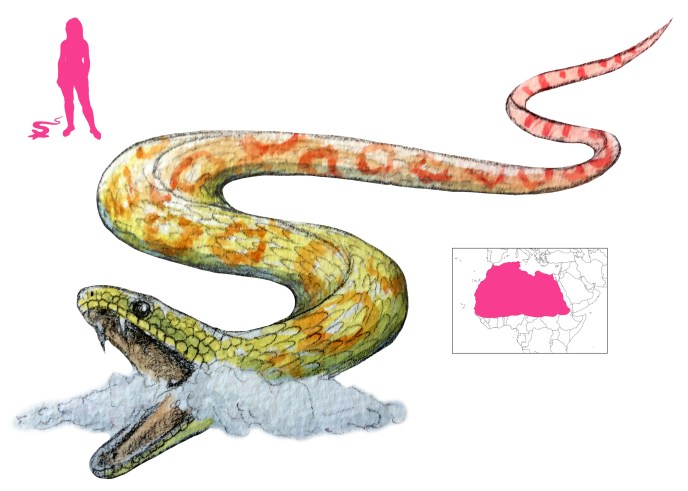
The most obvious characteristic of a cenchris is that it always move in a straight line, and does not coil or flex its body. For this reason it can travel fast in a straight line, but cannot make sharp turns. In color it is a dusky yellow, looking like the color of millet seed, but Aldrovandi suggests it to be at least partly green. Regardless of the color, the cenchris is attractively spotted and speckled, bringing to mind millet or marbled columns. The pointed tail is turned upwards, like a lion’s. A cenchris grows to two cubits (about one meter) long.

The cenchris is most active and aggressive when millet is at the peak of its growth, and head to the mountains in the summer. Unlike other venomous snakes, it will use its entire body when attacking, wrapping around its victim and beating it; meanwhile, it fastens its fangs in its prey and sucks its blood out.

Cenchris venom rots and putrefies flesh, causing lethargy, stomachache, and death within two days if left untreated. Lettuce, flax-seed, savory, rue, betony, and daffodil in three cups of wine, followed by two drams of centaury, gentian, hartwort, nosewort, or sesame, makes a good antidote.

While not easy to narrow to a single species, the rectilinear locomotion suggests the cenchris to be inspired by large, heavy-bodied vipers such as the puff adder.

References

Aldrovandi, U. (1640) Serpentum, et Draconum Historiae. Antonij Bernie, Bologna.

Isidore of Seville, trans. Barney, S. A.; Lewis, W. J.; Beach, J. A.; and Berghof, O. (2006) The Etymologies of Isidore of Seville. Cambridge University Press, Cambridge.

Lucan, trans. Rowe, N. (1720) Pharsalia. T. Johnson, London.

Topsell, E. (1658) The History of Serpents. E. Cotes, London.
Tosetáx

Variations: Tsamtáx, Tsamtás (pl.)

Tosetax

According to the Nivaklé of Paraguay, dry seasons are exacerbated by the Tsamtás serpents, which lie in the middle of the sky and radiate heat. A tsamtáx will intercept and eat the Fanxás or thunderbirds flying from the south and bringing rain with them. Only the shamans can prevent this state of things by tearing down the tsamtás nest, making them fall to their death and allowing the rainy season to return.

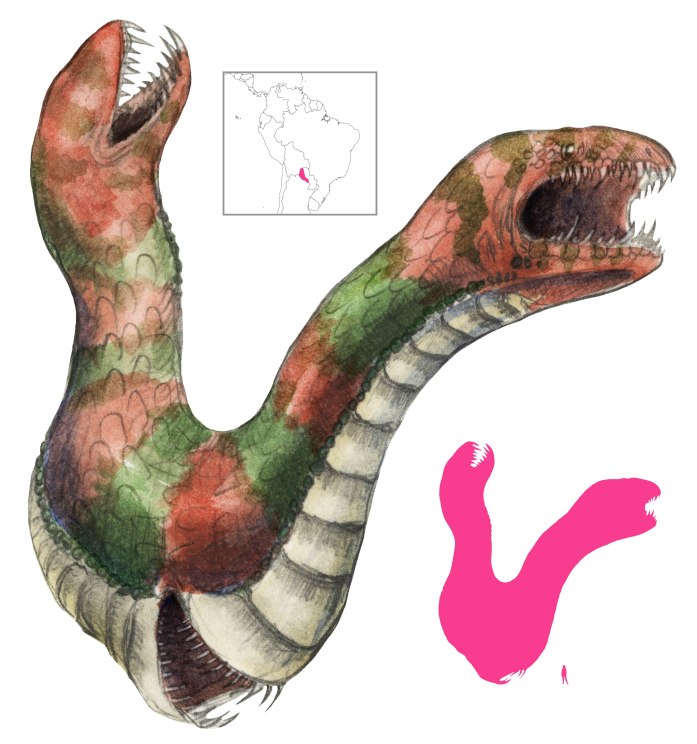
Tosetáx is even more terrifying. He arrived after the tsamtás had been dealt with, and installed himself in the center of the sky. Tosetáx is an enormous green and red snake, with three mouths – one at the head, one at the tail, and one in the middle of his body. As with the tsamtás, Tosetáx was waiting to ambush the returning thunderbirds.

Tosetáx was defeated by five powerful shamans who turned themselves into snakes. One of the shamans coiled himself around Tosetáx and, by turning and coiling, took him to the north out of the thunderbirds’ flight path. There the shamans cut off the serpent’s three mouths and cut him in half, killing him.

References

Chase-Sardi, M.; Costa, M. M.; Mashnshnek, C. O.; Siffredi, A.; Tomasini, J. A.; Wilbert, J. and Simoneau, K. eds. (1987) Folk Literature of the Nivaklé Indians. UCLA Latin American Center Publications, University of California, Los Angeles.

Jaculus

Variations: Iaculus, Jaculare; Sagitta (Latin); Acontia, Acontias, Saetta (Greek); Cafezati, Cafezasi, Altararat, Acoran, Altinanti (Arabic); Orchilanne (Turkish); Saettone (Calabria and Sicily); Ein Schosse Oder Angelsch Lang (German); Decurtati (Hungary)

Jaculus

The Jaculus, “javelin” or “dart”, is one of the many snakes that attacked Lucan’s forces during their march through the Libyan desert. While catalogued as a Libyan desert snake, Topsell expanded its range to include Rhodes, Lemnos, Calabria, Sicily, Germany

It can be considered a flying snake, although the “flight” is long-distance leaping over ten to thirty feet. They get into trees and bushes, bunch themselves up in bow and hoop shapes, and fling themselves at high speed onto their prey. Traveling as fast as a thrown javelin, they can puncture clothing and flesh alike. Jaculi are cunning and cruel, and will lie in ambush for human prey, but their presence is given away by the noise they make while coiling in dry plants.

The appearance of the jaculus varies, but it usually has small black ocelli, no bigger than lentils, on its body. The jaculi of Rhodes are ash-colored with a white belly and two black lines running from its head to the tip of its tail; the cafezati or “jumpers” of the Middle East are red, and have been posited as the Biblical fiery serpents. The Hungarian jaculi or decurtati are thick and short-tailed, only two hands long.

A jaculus killed Paulus, one of Lucan’s men, by darting from a distance before it could be seen. It was not venom that felled its victim, but rather the gaping hole left behind after it passed through Paulus’ head at the temples. Topsell believed it was a jaculus that attacked the apostle Paul and bit his hand. Another such snake coiled around the arm of a Zurich peasant; even though it didn’t bite, the arm ended up putrefying and requiring yearly bleeding to drain the black blood inside.

Topsell attests that the same antidotes used for viper venom can be used for jaculus bites. He adds that jaculus gall with Scythian stone yields eye-salve.

References

Aelian, trans. Scholfield, A. F. (1959) On the Characteristics of Animals, vol. II. Harvard University Press, Cambridge, Massachusetts.

Aldrovandi, U. (1640) Serpentum, et Draconum Historiae. Antonij Bernie, Bologna.

Isidore of Seville, trans. Barney, S. A.; Lewis, W. J.; Beach, J. A.; and Berghof, O. (2006) The Etymologies of Isidore of Seville. Cambridge University Press, Cambridge.

Lucan, trans. Rowe, N. (1720) Pharsalia. T. Johnson, London.

Topsell, E. (1658) The History of Serpents. E. Cotes, London.

Pareas

Variations: Parea, Parias, Paruas, Pharias, Parous, Baron, Pagerina, Anguis Aesculapij, Aesculapian Snake

Pareas

The Pareas is briefly mentioned in the Pharsalia’s catalogue of Libyan serpents. It always travels on its tail, leaving a furrow behind it in the ground. Its bite is harmless and gentle, and so it was consecrated to Asclepius, god of healers. Topsell classifies it among the innocent serpents.

Aelian describes it as being red with sharp eyes and a wide mouth. Topsell, on the other hand, gave its length as four spans, and its color as yellow with two long streaks down its side. Aldrovandi describes the pareas as being yellowish below and black above, with possible variations of green and white along its length. He dismisses the claim that it has a crest.

The tendency of the pareas to travel while holding itself clear of the ground has led to its association with the Eden serpent, which did not creep along the ground prior to being cursed. This claim has been contested by Alexander Neckham and Petrus Comestor, as the pareas very clearly does not conform to that curse. Petrus concluded that the curse must only have affected the individual serpent of Eden, leaving other snakes – including the pareas – uncursed.

References

Aelian, trans. Scholfield, A. F. (1959) On the Characteristics of Animals, vol. II. Harvard University Press, Cambridge, Massachusetts.

Aldrovandi, U. (1640) Serpentum, et Draconum Historiae. Antonij Bernie, Bologna.

Isidore of Seville, trans. Barney, S. A.; Lewis, W. J.; Beach, J. A.; and Berghof, O. (2006) The Etymologies of Isidore of Seville. Cambridge University Press, Cambridge.

Kelly, H. A. (1971) The Metamorphoses of the Eden Serpent during the Middle Ages and Renaissance. Viator, 2, pp. 301-328.

Lucan, trans. Rowe, N. (1720) Pharsalia. T. Johnson, London.

Topsell, E. (1658) The History of Serpents. E. Cotes, London.
Prester

Variations: Presteros, Torridus (Torrid), Dipsas (Thirsty)

Prester

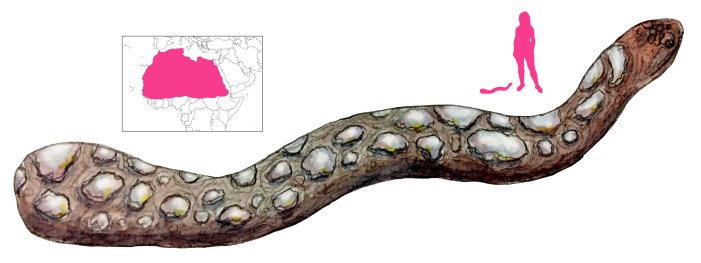
The Prester, “bellows-swelling”, “swollen veins”, or “inflater”,  is a deadly species of asp found in the deserts of Libya. Its name is derived from the gruesome effects of its venom, which were experienced firsthand by Lucan’s men. Aldrovandi believed it to be the same as the Dipsas, while Topsell saw it as distinct, since the prester kills by heat while the dipsas uses thirst.

Presters are so torrid that they keep their steaming mouth open to cool off, and foam constantly bubbles out from inside them. Topsell identifies presters with the fiery snakes that plagued the Israelites in the wilderness, but does not describe them beyond their extreme internal heat. They are fast-moving snakes, hurrying from place to place with their panting mouths wide open.

Aelian described the prester’s venom as causing profound lethargy, progressive weakness, loss of memory, inability to urinate, hair loss, choking, and eventually convulsions that lead to death. Flaubert specifies that mere contact with it causes debilitation.

Lucan describes more grotesque symptoms. The unfortunate Nasidius, upon suffering a scorching prester’s bite, feels the flames of the venom coursing through his veins. His entire body starts to swell, inflating and bloating and cutting through his armor, engulfing his limbs. The tumorous swelling ends only once Nasidius is a formless, headless heap. The remains are so disgusting that even the scavengers shun them.

Topsell recommends wild purslane, castoreum or beaver-stones, opoponax and rue in wine, and sprats as a remedy for prester bite.

References

Aelian, trans. Scholfield, A. F. (1959) On the Characteristics of Animals, vol. III. Harvard University Press, Cambridge, Massachusetts.

Aldrovandi, U. (1640) Serpentum, et Draconum Historiae. Antonij Bernie, Bologna.

Batinski, E. (1992) Cato and the Battle with the Serpents. Syllecta Classica, Vol. 3, pp. 71-80.

Eldred, K. O. (2000) Poetry in Motion: the Snakes of Lucan. Helios 27.1, p. 63.

Flaubert, G. (1885) La Tentation de Saint Antoine. Quantin, Paris.

Isidore of Seville, trans. Barney, S. A.; Lewis, W. J.; Beach, J. A.; and Berghof, O. (2006) The Etymologies of Isidore of Seville. Cambridge University Press, Cambridge.

Lucan, trans. Rowe, N. (1720) Pharsalia. T. Johnson, London.

Topsell, E. (1658) The History of Serpents. E. Cotes, London.